RT Assessment Plan: Client Mr. Zee and Leisure Satisfaction

Verified

Added on  2023/03/21

|4
|748
|34
Report
AI Summary
This report outlines an assessment plan for a 70-year-old male client named Mr. Zee, focusing on his leisure satisfaction. The assessment process involves determining learning outcomes, selecting appropriate evidence, and preparing a report based on findings. The Leisure Satisfaction Measurement (LSM), developed by Idyll Arbor, Inc., is chosen as the primary assessment tool. The LSM consists of 24 questions assessing six categories of leisure needs: social, psychological, educational, relaxation, physiological, and aesthetic. The report details the LSM's application, its strengths, and limitations, including the similarity of questions. The assessment aims to understand Mr. Zee's cognitive behavior and how leisure activities contribute to his overall well-being. The report emphasizes the importance of leisure satisfaction in enhancing happiness and life quality.

Document Page
1
Management
tabler-icon-diamond-filled.svg

Paraphrase This Document

Need a fresh take? Get an instant paraphrase of this document with our AI Paraphraser
Document Page
2
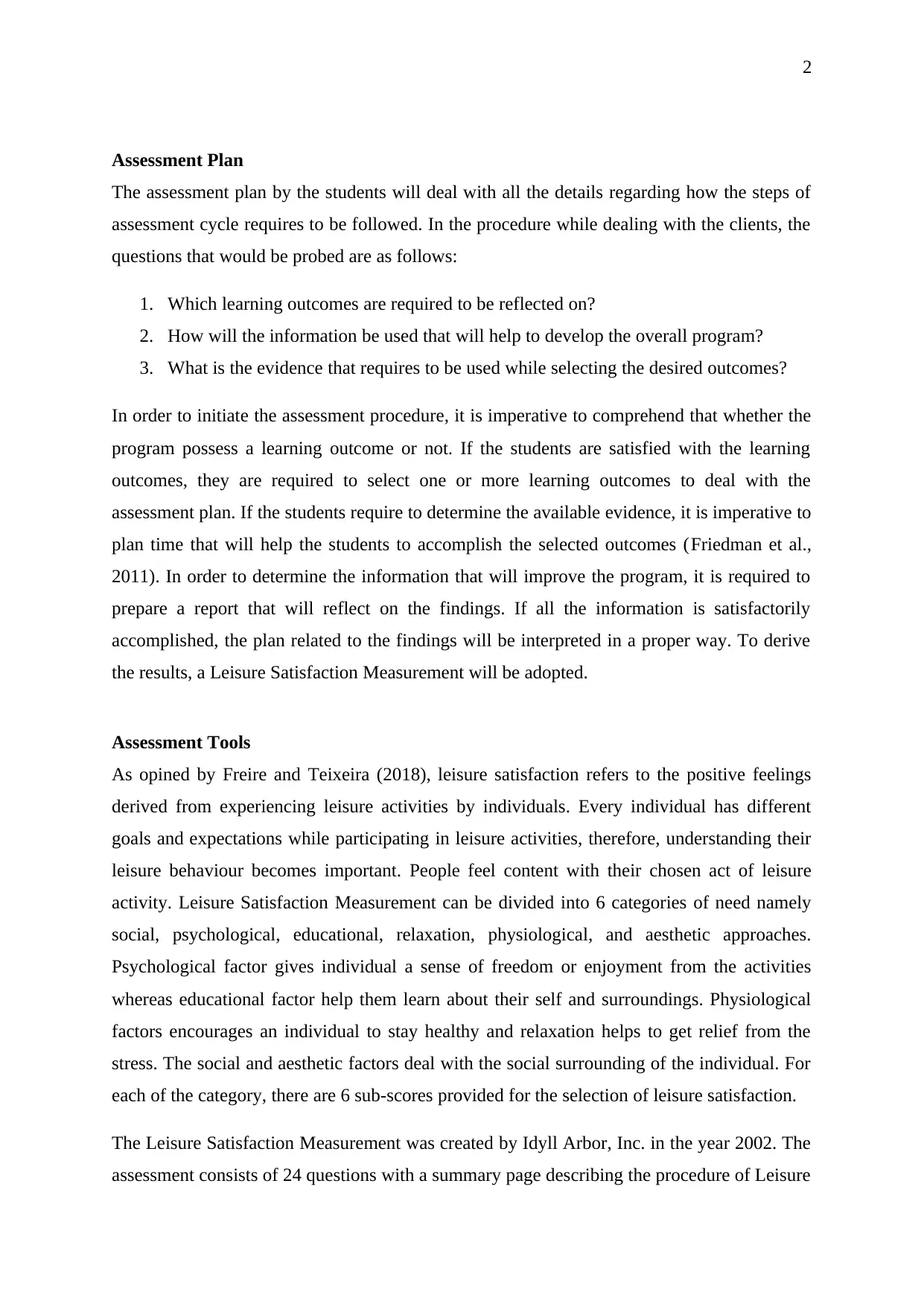
Assessment Plan
The assessment plan by the students will deal with all the details regarding how the steps of
assessment cycle requires to be followed. In the procedure while dealing with the clients, the
questions that would be probed are as follows:
1. Which learning outcomes are required to be reflected on?
2. How will the information be used that will help to develop the overall program?
3. What is the evidence that requires to be used while selecting the desired outcomes?
In order to initiate the assessment procedure, it is imperative to comprehend that whether the
program possess a learning outcome or not. If the students are satisfied with the learning
outcomes, they are required to select one or more learning outcomes to deal with the
assessment plan. If the students require to determine the available evidence, it is imperative to
plan time that will help the students to accomplish the selected outcomes (Friedman et al.,
2011). In order to determine the information that will improve the program, it is required to
prepare a report that will reflect on the findings. If all the information is satisfactorily
accomplished, the plan related to the findings will be interpreted in a proper way. To derive
the results, a Leisure Satisfaction Measurement will be adopted.
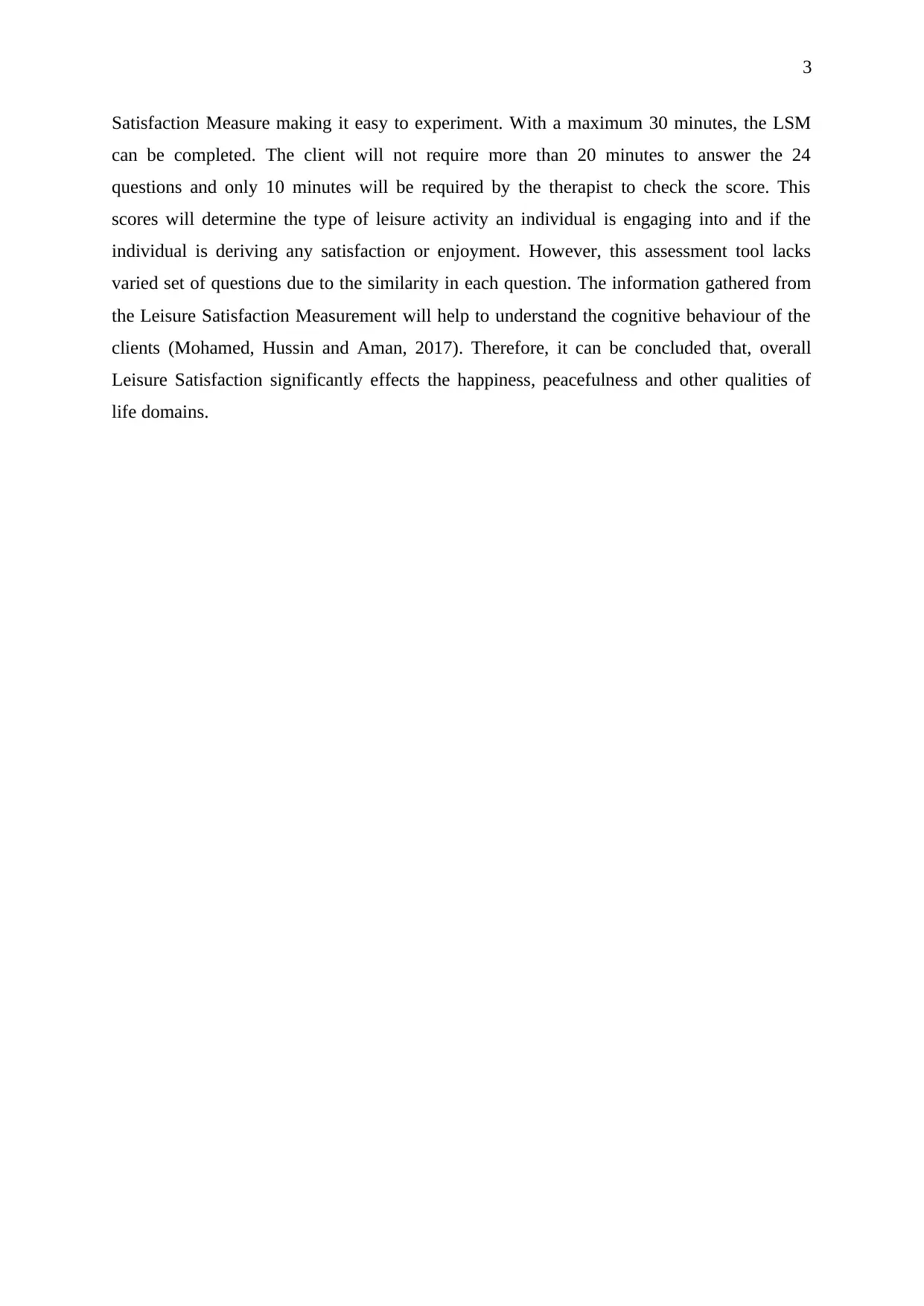
Assessment Tools
As opined by Freire and Teixeira (2018), leisure satisfaction refers to the positive feelings
derived from experiencing leisure activities by individuals. Every individual has different
goals and expectations while participating in leisure activities, therefore, understanding their
leisure behaviour becomes important. People feel content with their chosen act of leisure
activity. Leisure Satisfaction Measurement can be divided into 6 categories of need namely
social, psychological, educational, relaxation, physiological, and aesthetic approaches.
Psychological factor gives individual a sense of freedom or enjoyment from the activities
whereas educational factor help them learn about their self and surroundings. Physiological
factors encourages an individual to stay healthy and relaxation helps to get relief from the
stress. The social and aesthetic factors deal with the social surrounding of the individual. For
each of the category, there are 6 sub-scores provided for the selection of leisure satisfaction.
The Leisure Satisfaction Measurement was created by Idyll Arbor, Inc. in the year 2002. The
assessment consists of 24 questions with a summary page describing the procedure of Leisure
Document Page
3
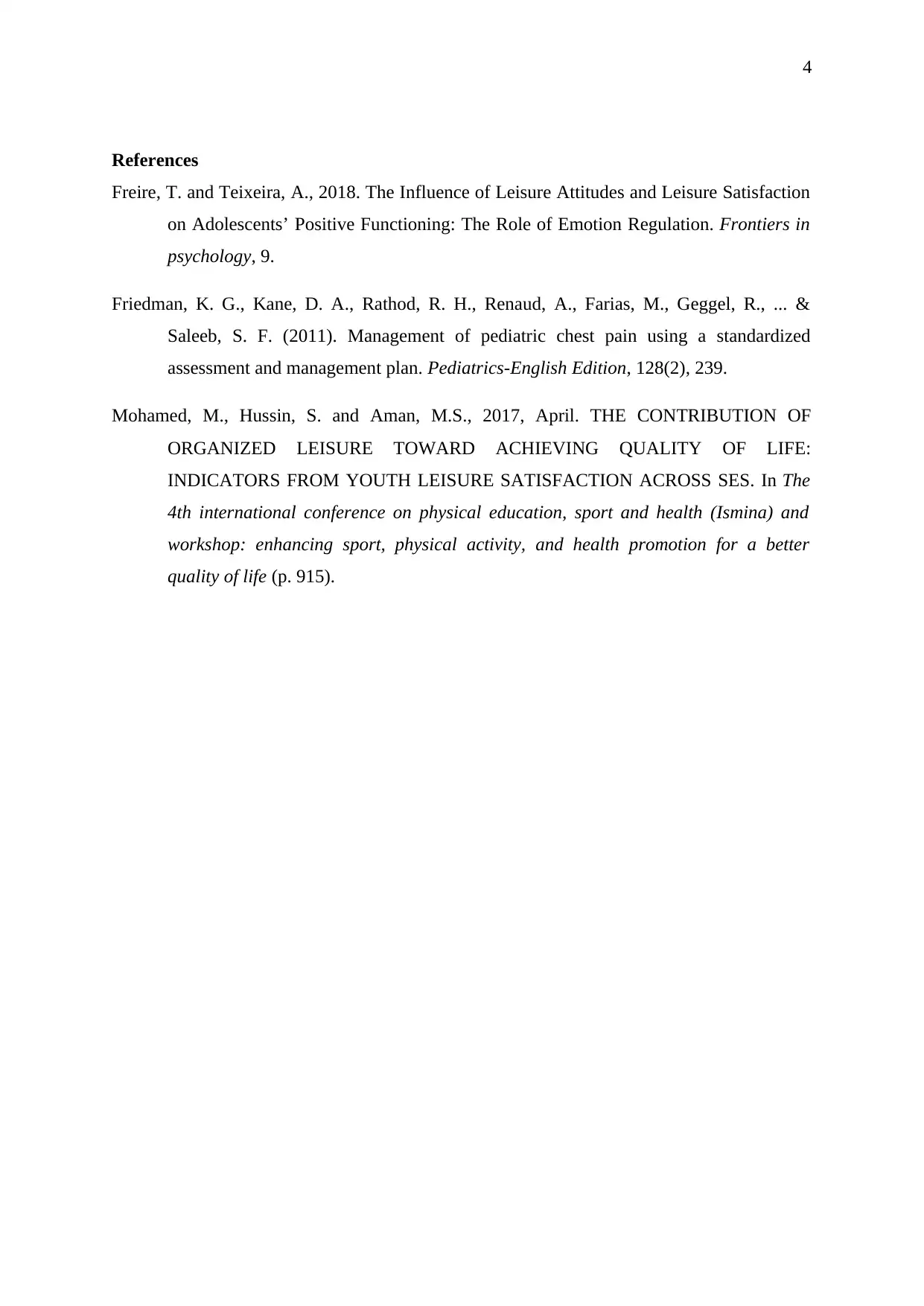
Satisfaction Measure making it easy to experiment. With a maximum 30 minutes, the LSM
can be completed. The client will not require more than 20 minutes to answer the 24
questions and only 10 minutes will be required by the therapist to check the score. This
scores will determine the type of leisure activity an individual is engaging into and if the
individual is deriving any satisfaction or enjoyment. However, this assessment tool lacks
varied set of questions due to the similarity in each question. The information gathered from
the Leisure Satisfaction Measurement will help to understand the cognitive behaviour of the
clients (Mohamed, Hussin and Aman, 2017). Therefore, it can be concluded that, overall
Leisure Satisfaction significantly effects the happiness, peacefulness and other qualities of
life domains.
Document Page
4
References
Freire, T. and Teixeira, A., 2018. The Influence of Leisure Attitudes and Leisure Satisfaction
on Adolescents’ Positive Functioning: The Role of Emotion Regulation. Frontiers in
psychology, 9.
Friedman, K. G., Kane, D. A., Rathod, R. H., Renaud, A., Farias, M., Geggel, R., ... &
Saleeb, S. F. (2011). Management of pediatric chest pain using a standardized
assessment and management plan. Pediatrics-English Edition, 128(2), 239.
Mohamed, M., Hussin, S. and Aman, M.S., 2017, April. THE CONTRIBUTION OF
ORGANIZED LEISURE TOWARD ACHIEVING QUALITY OF LIFE:
INDICATORS FROM YOUTH LEISURE SATISFACTION ACROSS SES. In The
4th international conference on physical education, sport and health (Ismina) and
workshop: enhancing sport, physical activity, and health promotion for a better
quality of life (p. 915).
chevron_up_icon
1 out of 4
circle_padding
hide_on_mobile
zoom_out_icon
[object Object]