Report on Managing and Running a Small Business (Coursework)
VerifiedAdded on 2020/06/06
|20
|5942
|53
Report
AI Summary
This report delves into the critical aspects of managing and running a small business. It begins by exploring the considerations for resource planning and allocation, crucial for both social enterprises and traditional small businesses. The report then examines Customer Relationship Management (CRM) processes, highlighting strategies for acquiring and retaining customers. It further investigates transnational business development, using the Uppsala internationalization model to analyze the benefits and drawbacks of international expansion. A significant portion of the report is dedicated to financial management, including cash flow forecasting, break-even analysis, and the interpretation of key financial statements. Finally, the report addresses the implications of key legislation and regulations affecting small businesses, providing a comprehensive overview of essential management practices.
MANAGING AND
RUNNING A SMALL
BUSINESS
RUNNING A SMALL
BUSINESS

Paraphrase This Document
Need a fresh take? Get an instant paraphrase of this document with our AI Paraphraser
Table of Contents
INTRODUCTION...........................................................................................................................1
TASK 1............................................................................................................................................1
P1 Considerations a social enterprise or small business needs to address when planning and
allocating resources................................................................................................................1
TASK 2............................................................................................................................................2
P2 Different process of Customer Relationship Management...............................................2
P3 How business can develop transnationally and determine benefits and drawbacks.........3
TASK 3............................................................................................................................................6
P4 Cash flow forecast statement showing fixed and variable costs set against income.........6
P5 Break even analysis...........................................................................................................8
P6 Key financial statements for successful management of business..................................10
TASK 4..........................................................................................................................................11
P7 Implication of key legislation and regulations................................................................11
CONCLUSION..............................................................................................................................12
REFERENCES..............................................................................................................................13
INTRODUCTION...........................................................................................................................1
TASK 1............................................................................................................................................1
P1 Considerations a social enterprise or small business needs to address when planning and
allocating resources................................................................................................................1
TASK 2............................................................................................................................................2
P2 Different process of Customer Relationship Management...............................................2
P3 How business can develop transnationally and determine benefits and drawbacks.........3
TASK 3............................................................................................................................................6
P4 Cash flow forecast statement showing fixed and variable costs set against income.........6
P5 Break even analysis...........................................................................................................8
P6 Key financial statements for successful management of business..................................10
TASK 4..........................................................................................................................................11
P7 Implication of key legislation and regulations................................................................11
CONCLUSION..............................................................................................................................12
REFERENCES..............................................................................................................................13
INTRODUCTION
Management of small business is important to raise profitability and enhance market
share. The report will cover understanding of key aspects for running small business. Activities
involved in small business and developing customer relationship while planning and allocating
resources will be discussed in this report. Forecasting and budgeting, retention and recruitment
of staff, interpreting financial statements, building a team and leadership, dealing with
government rules and legislations will be covered in this report. The understanding to develop
small business and achieve success for the benefits and profitability towards organisation will be
discussed.
TASK 1
P1 Considerations a social enterprise or small business needs to address when planning and
allocating resources
A small business needs to evaluate various things such as resources, planning, strategies,
organisation structure, recruitment, performance management and articulation of business
objectives and goals. This will help to allocate resources and provide information which is
helpful for the managers to take decisions effectively.
Business plan: A business plan should be considered by SMALL WHITE ELEPHANT (SWE)
in order to set vision, goals and objectives that help employees to achieve their individual goals
effectively. The business plan is necessary before allocating resources as it helps to identify what
amount of resources is needed to reach objectives and goals (Bobillo, Rodríguez-Sanz and
Tejerina-Gaite, 2014). This will also support to manage resources with employees in order to
increase profitability and production. Moreover, project management techniques will help
business while securing bank loan and overdraft.
Organisation structure: Structure of the firm should be applicable to the business stage and
purpose effectively. An appropriate organisation culture will help to manage and control various
resources within firm in order to enhance production and profitability. Being an employer it is
necessary to assess use of resources within organisation culture that it helps to manage changes
as well as their effectiveness.
Planing resources: SMALL WHITE ELEPHANT is able to make strategies and plans towards
managing and planning resources. The business should determine various resources including
capacity utilisation, skills and knowledge to develop and improve job specifications and
1
Management of small business is important to raise profitability and enhance market
share. The report will cover understanding of key aspects for running small business. Activities
involved in small business and developing customer relationship while planning and allocating
resources will be discussed in this report. Forecasting and budgeting, retention and recruitment
of staff, interpreting financial statements, building a team and leadership, dealing with
government rules and legislations will be covered in this report. The understanding to develop
small business and achieve success for the benefits and profitability towards organisation will be
discussed.
TASK 1
P1 Considerations a social enterprise or small business needs to address when planning and
allocating resources
A small business needs to evaluate various things such as resources, planning, strategies,
organisation structure, recruitment, performance management and articulation of business
objectives and goals. This will help to allocate resources and provide information which is
helpful for the managers to take decisions effectively.
Business plan: A business plan should be considered by SMALL WHITE ELEPHANT (SWE)
in order to set vision, goals and objectives that help employees to achieve their individual goals
effectively. The business plan is necessary before allocating resources as it helps to identify what
amount of resources is needed to reach objectives and goals (Bobillo, Rodríguez-Sanz and
Tejerina-Gaite, 2014). This will also support to manage resources with employees in order to
increase profitability and production. Moreover, project management techniques will help
business while securing bank loan and overdraft.
Organisation structure: Structure of the firm should be applicable to the business stage and
purpose effectively. An appropriate organisation culture will help to manage and control various
resources within firm in order to enhance production and profitability. Being an employer it is
necessary to assess use of resources within organisation culture that it helps to manage changes
as well as their effectiveness.
Planing resources: SMALL WHITE ELEPHANT is able to make strategies and plans towards
managing and planning resources. The business should determine various resources including
capacity utilisation, skills and knowledge to develop and improve job specifications and
1
⊘ This is a preview!⊘
Do you want full access?
Subscribe today to unlock all pages.

Trusted by 1+ million students worldwide
premises and equipment. This will help towards proper management of resources in order to
increase sales and production. The business should identify resources such as who is currently
available to take on the project and whether the equipment (laptops, machinery etc.) required is
already available or need to be purchased.
Human Resource Management: Human resources are the essential elements of business in
order to drive business performance which helps to increase profitability and production. The
firm should recruit employees with effective knowledge and skills that helps to manage
resources within the firm effectively. Human resources department is responsible for managing
and controlling work of employees at workplace and maximise their performances in order to
achieve strategic objectives and goals (Cimic and Ren, 2014). This will also help SWE to
achieve its objectives and goals which leads towards profitability and production.
Resource allocation plan: Entire information as discussed above should be considered in
resource allocation plan, a list of both human and non-human resources. Employees should
understand their roles and responsibilities and try to complete their tasks on time in order to
achieve individual goals and objectives. Under each tool, its specifications, its purpose and the
date it needs to be utilized as well as the date it should be returned need to be mentioned.
Thus, it can be said that considering planning and allocating of resources, SWE is able to
manage its productivity and profitability which will help to compete others in the market. This
will also help towards competitive advantage.
Business units can explore business operations and functions at global level through the
means of following strategies such as: Exporting: By sending goods or services to another country for the purpose of sale
business can be expanded globally. Franchising: By taking franchisee of leading brands, operating at international level,
business entity can explore operations and thereby attain success.
Foreign direct investment: It is one of the most effectual ways of expansion in which
ownership pertaining to business controlled by an entity resides in another country. In
other words, through investing money in foreign countries business entity can expand
internationally.
2
increase sales and production. The business should identify resources such as who is currently
available to take on the project and whether the equipment (laptops, machinery etc.) required is
already available or need to be purchased.
Human Resource Management: Human resources are the essential elements of business in
order to drive business performance which helps to increase profitability and production. The
firm should recruit employees with effective knowledge and skills that helps to manage
resources within the firm effectively. Human resources department is responsible for managing
and controlling work of employees at workplace and maximise their performances in order to
achieve strategic objectives and goals (Cimic and Ren, 2014). This will also help SWE to
achieve its objectives and goals which leads towards profitability and production.
Resource allocation plan: Entire information as discussed above should be considered in
resource allocation plan, a list of both human and non-human resources. Employees should
understand their roles and responsibilities and try to complete their tasks on time in order to
achieve individual goals and objectives. Under each tool, its specifications, its purpose and the
date it needs to be utilized as well as the date it should be returned need to be mentioned.
Thus, it can be said that considering planning and allocating of resources, SWE is able to
manage its productivity and profitability which will help to compete others in the market. This
will also help towards competitive advantage.
Business units can explore business operations and functions at global level through the
means of following strategies such as: Exporting: By sending goods or services to another country for the purpose of sale
business can be expanded globally. Franchising: By taking franchisee of leading brands, operating at international level,
business entity can explore operations and thereby attain success.
Foreign direct investment: It is one of the most effectual ways of expansion in which
ownership pertaining to business controlled by an entity resides in another country. In
other words, through investing money in foreign countries business entity can expand
internationally.
2
Paraphrase This Document
Need a fresh take? Get an instant paraphrase of this document with our AI Paraphraser
TASK 2
P2 Different process of Customer Relationship Management
Customer relationship management: Customer Relationship Management (CRM) can be
described as an approach that helps to interact with potential and current customers in the
market. Management of customer relationship is crucial for SWE in order to increase sales and
profitability. The key word is 'relationship' here which implies that certain strategies and plans
should be formulated by business in order to manage their customers (Eriksson, Nummela and
Saarenketo, 2014). It can be said that a happy customer tells at least three of his or her best
friends or family members about his or her experience with brand which can be positive or
negative. A CRM process helps business to win more deals, shorten sales cycles and build a
consistent, repeatable sales process which lead towards production and profitability. The process
of CRM is discussed as follows:
Assessment of customer value: It is necessary for the business to determine various needs,
expectations and wants of customers in the market that helps to assess value of consumers
effectively. However, it can be said that customer value proposition can be determined by
developing and improving customer value assessment. It will help to understand what customers
actually expect from the brand in terms of taste and preferences.
Acquiring and retaining customers: Acquiring and retaining customers is crucial for SWE in
order to increase profitability and production effectively. The firm should make effective
changes in the process that helps to expand its market which lead towards profitability. It can be
said that SWE is a restaurant that it is able to add something new in menu which helps to attract
new customers in the market.
Customer care program: The business should develop and improve effective communication
programs for customer in order to make changes according to their needs and requirements.
Feedback system, face to face interaction and telephone communication are some effective
elements from which the firm is able to acquire what their customers actually wants from brand
effectively (Evans and Price, 2017). This will lead towards production and profitability and will
accomplish objectives and goals.
Survey: Survey is an effective way to assess customer requirements and demands in the market.
The firm is able to interact with consumers with digital platforms such as social media, online
testimonials, email services, mobile chat and online interaction. This will help business to
3
P2 Different process of Customer Relationship Management
Customer relationship management: Customer Relationship Management (CRM) can be
described as an approach that helps to interact with potential and current customers in the
market. Management of customer relationship is crucial for SWE in order to increase sales and
profitability. The key word is 'relationship' here which implies that certain strategies and plans
should be formulated by business in order to manage their customers (Eriksson, Nummela and
Saarenketo, 2014). It can be said that a happy customer tells at least three of his or her best
friends or family members about his or her experience with brand which can be positive or
negative. A CRM process helps business to win more deals, shorten sales cycles and build a
consistent, repeatable sales process which lead towards production and profitability. The process
of CRM is discussed as follows:
Assessment of customer value: It is necessary for the business to determine various needs,
expectations and wants of customers in the market that helps to assess value of consumers
effectively. However, it can be said that customer value proposition can be determined by
developing and improving customer value assessment. It will help to understand what customers
actually expect from the brand in terms of taste and preferences.
Acquiring and retaining customers: Acquiring and retaining customers is crucial for SWE in
order to increase profitability and production effectively. The firm should make effective
changes in the process that helps to expand its market which lead towards profitability. It can be
said that SWE is a restaurant that it is able to add something new in menu which helps to attract
new customers in the market.
Customer care program: The business should develop and improve effective communication
programs for customer in order to make changes according to their needs and requirements.
Feedback system, face to face interaction and telephone communication are some effective
elements from which the firm is able to acquire what their customers actually wants from brand
effectively (Evans and Price, 2017). This will lead towards production and profitability and will
accomplish objectives and goals.
Survey: Survey is an effective way to assess customer requirements and demands in the market.
The firm is able to interact with consumers with digital platforms such as social media, online
testimonials, email services, mobile chat and online interaction. This will help business to
3
acquire preferences and tastes of customers after using the products and services offered by firm
in the market. Data collection process from internal and external database will also help to
analyse right way for firm in order to provide quality services.
Cross train employees: The business should ensure that employees working at workplace are
cross trained in multiple areas especially when there are less than 50 employees (Goffee and
Scase, 2015). This will help to manage work in multiple ways from which the firm is able to
acquire good and effective CRM. From support requests, to sales initiatives and marketing
campaigns, cross-training means the customer experience will remain positive no matter who’s
handling it effectively and efficiently.
P3 How business can develop transnationally and determine benefits and drawbacks
Transactional business refers to the operational activities in different nations with
integration and coordination of operations and strategies. It can be said that transactional
operations and strategies will help SWE to combine global reach, coordination of unique
advantages and operational activities that helps business to drive its sales and profitability in
order to increase market share effectively.
The Uppsala internationalisation model will help SWE to develop its transactional
operational activities. The model is basically based on developing transactional activities of firm
in international markets effectively. The firm should determine cultural differences, internal
foundations and market activities in order to handle international activities and transactional
operations. The model will help organisation to develop its market at international level by four
different steps effectively. It can be said that business should have knowledge of foreign markets
in order to expand their activities and operations (Hatak and Roessl, 2015). The Uppsala model
is one of the theories describing the internationalization process of firms. The model states that
firms first choose to enter nearby markets with low market commitment. The four steps are
provided below which should be considered by SWE in order to increase and improve their
transactional operations in foreign markets with low level of commitment.
Step 1: No regular export activities (sporadic export).
Step 2: Export via independent representative (export mode).
Step 3: Establishment of a foreign sales subsidiary.
Step 4: Foreign production/manufacturing.
4
in the market. Data collection process from internal and external database will also help to
analyse right way for firm in order to provide quality services.
Cross train employees: The business should ensure that employees working at workplace are
cross trained in multiple areas especially when there are less than 50 employees (Goffee and
Scase, 2015). This will help to manage work in multiple ways from which the firm is able to
acquire good and effective CRM. From support requests, to sales initiatives and marketing
campaigns, cross-training means the customer experience will remain positive no matter who’s
handling it effectively and efficiently.
P3 How business can develop transnationally and determine benefits and drawbacks
Transactional business refers to the operational activities in different nations with
integration and coordination of operations and strategies. It can be said that transactional
operations and strategies will help SWE to combine global reach, coordination of unique
advantages and operational activities that helps business to drive its sales and profitability in
order to increase market share effectively.
The Uppsala internationalisation model will help SWE to develop its transactional
operational activities. The model is basically based on developing transactional activities of firm
in international markets effectively. The firm should determine cultural differences, internal
foundations and market activities in order to handle international activities and transactional
operations. The model will help organisation to develop its market at international level by four
different steps effectively. It can be said that business should have knowledge of foreign markets
in order to expand their activities and operations (Hatak and Roessl, 2015). The Uppsala model
is one of the theories describing the internationalization process of firms. The model states that
firms first choose to enter nearby markets with low market commitment. The four steps are
provided below which should be considered by SWE in order to increase and improve their
transactional operations in foreign markets with low level of commitment.
Step 1: No regular export activities (sporadic export).
Step 2: Export via independent representative (export mode).
Step 3: Establishment of a foreign sales subsidiary.
Step 4: Foreign production/manufacturing.
4
⊘ This is a preview!⊘
Do you want full access?
Subscribe today to unlock all pages.
Trusted by 1+ million students worldwide
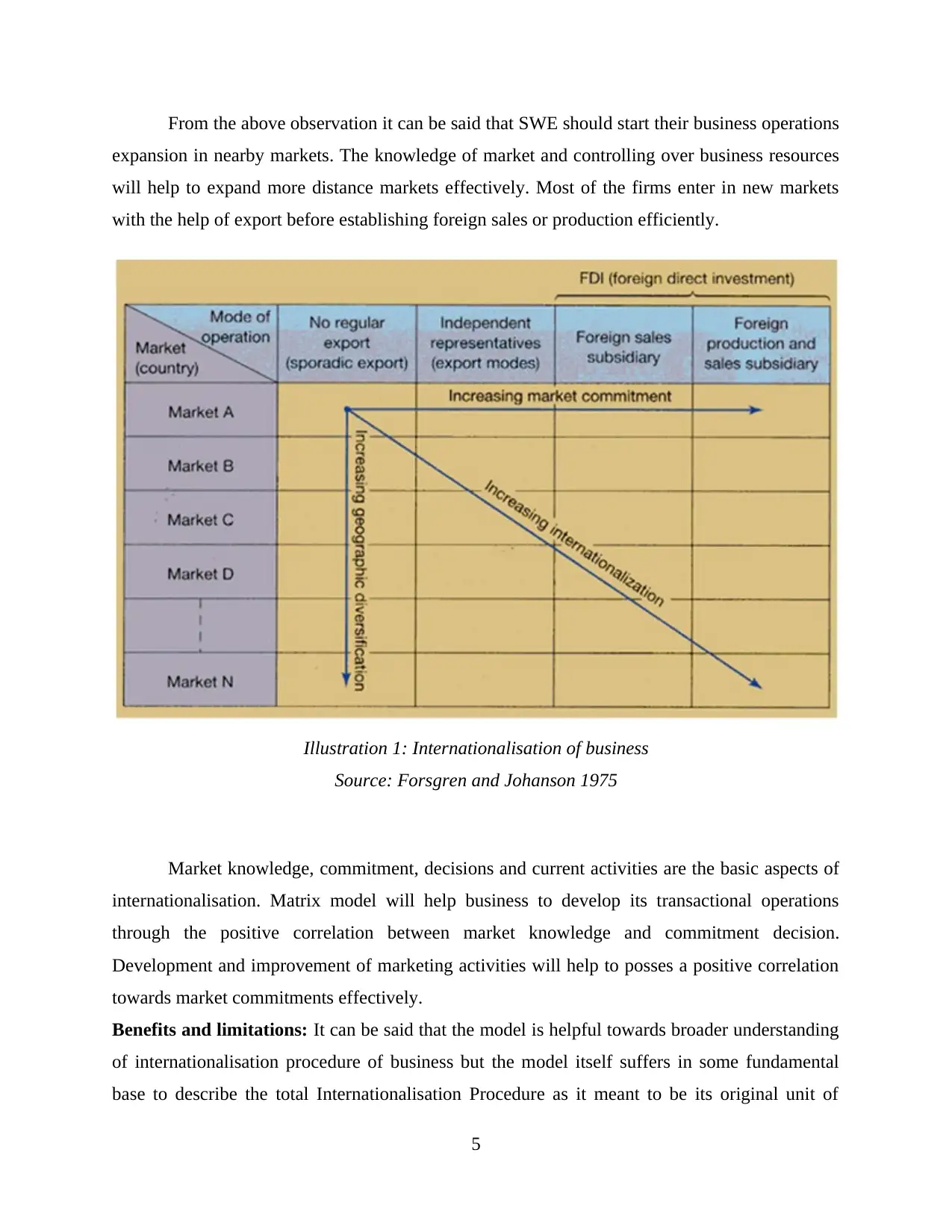
From the above observation it can be said that SWE should start their business operations
expansion in nearby markets. The knowledge of market and controlling over business resources
will help to expand more distance markets effectively. Most of the firms enter in new markets
with the help of export before establishing foreign sales or production efficiently.
Market knowledge, commitment, decisions and current activities are the basic aspects of
internationalisation. Matrix model will help business to develop its transactional operations
through the positive correlation between market knowledge and commitment decision.
Development and improvement of marketing activities will help to posses a positive correlation
towards market commitments effectively.
Benefits and limitations: It can be said that the model is helpful towards broader understanding
of internationalisation procedure of business but the model itself suffers in some fundamental
base to describe the total Internationalisation Procedure as it meant to be its original unit of
5
Illustration 1: Internationalisation of business
Source: Forsgren and Johanson 1975
expansion in nearby markets. The knowledge of market and controlling over business resources
will help to expand more distance markets effectively. Most of the firms enter in new markets
with the help of export before establishing foreign sales or production efficiently.
Market knowledge, commitment, decisions and current activities are the basic aspects of
internationalisation. Matrix model will help business to develop its transactional operations
through the positive correlation between market knowledge and commitment decision.
Development and improvement of marketing activities will help to posses a positive correlation
towards market commitments effectively.
Benefits and limitations: It can be said that the model is helpful towards broader understanding
of internationalisation procedure of business but the model itself suffers in some fundamental
base to describe the total Internationalisation Procedure as it meant to be its original unit of
5
Illustration 1: Internationalisation of business
Source: Forsgren and Johanson 1975
Paraphrase This Document
Need a fresh take? Get an instant paraphrase of this document with our AI Paraphraser
analysis, even before considering the changes in business environments during the last 20 years
and its impact on the development (Hussain Bhuiyan and Bakar, 2014). For an example, the
model does nor provide clear considerations towards management incentives and it has a effect
on managers decision making also. However, the technological developments in production,
transportation and telecommunication is grateful to watch. It helps organisation such as SWE to
develop and improve its transactional operations in order to expand its business operational
activities which lead towards production and profitability effectively.
TASK 3
P4 Cash flow forecast statement showing fixed and variable costs set against income
In order to prepare a cash flow statement, same figures are required used in profitability
and loss forecast effectively. The major difference is that all cash inflow and outflow's are
considered by organisation. For an example, loans, payments, personal money transfer and taxes
etc. the cash flow statement records costs in the month where the business wants to incur them
effectively (McDonald, Stewart and Dingle, 2014). Here are some steps provided below in order
to understand and create cash flow statement elements:
Beginning balance: While making cash flow statement for the first month the business should
project the actual amount of cash which is available in the bank balance.
Estimate Cash Coming In: All amount should be fill which is expected during the month. This
will include sales revenues which is available actually in hand, collection of old sales made on
credit bases, personal money transfer to business operations and loans required and coming in
firm.
Estimate Cash Going Out: All the project payments of particular month should be considered
by firm in the cash flow statement (Lyaruu, 2016). This will include all the variable costs such as
costs of goods sold and fixed costs such as tax payments, rents and any other loan payments.
Finally, the total will be calculated for the month effectively.
SuSWEact Outlays From Income: The last step is to suSWEact total monthly cash outs from
firm from total monthly income generated by business. That figure will be the beginning cash
balance at the start of next month effectively. The amount will be copied to the next month
column and will go through the procedure again in order to calculate net profit amount from cash
flow statement.
6
and its impact on the development (Hussain Bhuiyan and Bakar, 2014). For an example, the
model does nor provide clear considerations towards management incentives and it has a effect
on managers decision making also. However, the technological developments in production,
transportation and telecommunication is grateful to watch. It helps organisation such as SWE to
develop and improve its transactional operations in order to expand its business operational
activities which lead towards production and profitability effectively.
TASK 3
P4 Cash flow forecast statement showing fixed and variable costs set against income
In order to prepare a cash flow statement, same figures are required used in profitability
and loss forecast effectively. The major difference is that all cash inflow and outflow's are
considered by organisation. For an example, loans, payments, personal money transfer and taxes
etc. the cash flow statement records costs in the month where the business wants to incur them
effectively (McDonald, Stewart and Dingle, 2014). Here are some steps provided below in order
to understand and create cash flow statement elements:
Beginning balance: While making cash flow statement for the first month the business should
project the actual amount of cash which is available in the bank balance.
Estimate Cash Coming In: All amount should be fill which is expected during the month. This
will include sales revenues which is available actually in hand, collection of old sales made on
credit bases, personal money transfer to business operations and loans required and coming in
firm.
Estimate Cash Going Out: All the project payments of particular month should be considered
by firm in the cash flow statement (Lyaruu, 2016). This will include all the variable costs such as
costs of goods sold and fixed costs such as tax payments, rents and any other loan payments.
Finally, the total will be calculated for the month effectively.
SuSWEact Outlays From Income: The last step is to suSWEact total monthly cash outs from
firm from total monthly income generated by business. That figure will be the beginning cash
balance at the start of next month effectively. The amount will be copied to the next month
column and will go through the procedure again in order to calculate net profit amount from cash
flow statement.
6
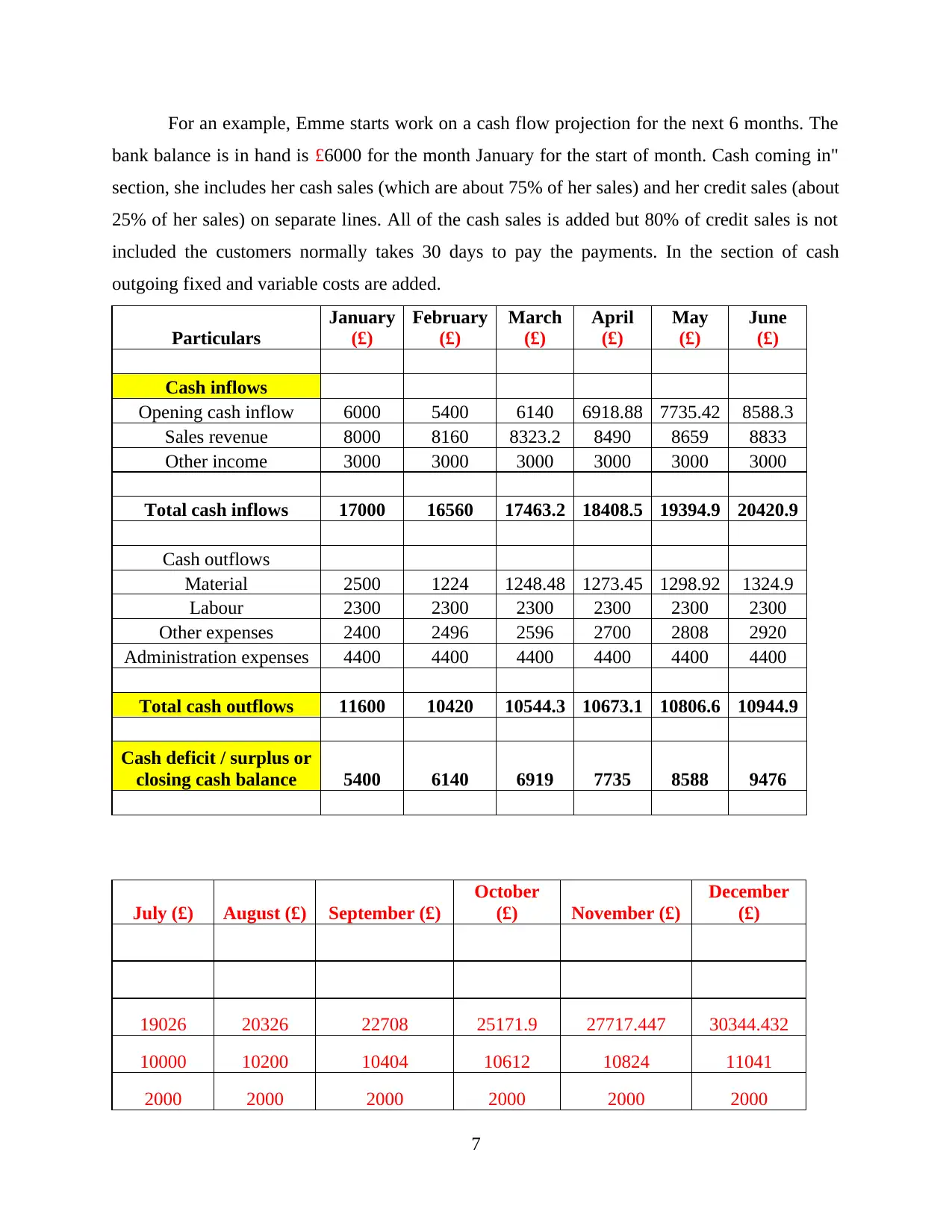
For an example, Emme starts work on a cash flow projection for the next 6 months. The
bank balance is in hand is £6000 for the month January for the start of month. Cash coming in"
section, she includes her cash sales (which are about 75% of her sales) and her credit sales (about
25% of her sales) on separate lines. All of the cash sales is added but 80% of credit sales is not
included the customers normally takes 30 days to pay the payments. In the section of cash
outgoing fixed and variable costs are added.
Particulars
January
(£)
February
(£)
March
(£)
April
(£)
May
(£)
June
(£)
Cash inflows
Opening cash inflow 6000 5400 6140 6918.88 7735.42 8588.3
Sales revenue 8000 8160 8323.2 8490 8659 8833
Other income 3000 3000 3000 3000 3000 3000
Total cash inflows 17000 16560 17463.2 18408.5 19394.9 20420.9
Cash outflows
Material 2500 1224 1248.48 1273.45 1298.92 1324.9
Labour 2300 2300 2300 2300 2300 2300
Other expenses 2400 2496 2596 2700 2808 2920
Administration expenses 4400 4400 4400 4400 4400 4400
Total cash outflows 11600 10420 10544.3 10673.1 10806.6 10944.9
Cash deficit / surplus or
closing cash balance 5400 6140 6919 7735 8588 9476
July (£) August (£) September (£)
October
(£) November (£)
December
(£)
19026 20326 22708 25171.9 27717.447 30344.432
10000 10200 10404 10612 10824 11041
2000 2000 2000 2000 2000 2000
7
bank balance is in hand is £6000 for the month January for the start of month. Cash coming in"
section, she includes her cash sales (which are about 75% of her sales) and her credit sales (about
25% of her sales) on separate lines. All of the cash sales is added but 80% of credit sales is not
included the customers normally takes 30 days to pay the payments. In the section of cash
outgoing fixed and variable costs are added.
Particulars
January
(£)
February
(£)
March
(£)
April
(£)
May
(£)
June
(£)
Cash inflows
Opening cash inflow 6000 5400 6140 6918.88 7735.42 8588.3
Sales revenue 8000 8160 8323.2 8490 8659 8833
Other income 3000 3000 3000 3000 3000 3000
Total cash inflows 17000 16560 17463.2 18408.5 19394.9 20420.9
Cash outflows
Material 2500 1224 1248.48 1273.45 1298.92 1324.9
Labour 2300 2300 2300 2300 2300 2300
Other expenses 2400 2496 2596 2700 2808 2920
Administration expenses 4400 4400 4400 4400 4400 4400
Total cash outflows 11600 10420 10544.3 10673.1 10806.6 10944.9
Cash deficit / surplus or
closing cash balance 5400 6140 6919 7735 8588 9476
July (£) August (£) September (£)
October
(£) November (£)
December
(£)
19026 20326 22708 25171.9 27717.447 30344.432
10000 10200 10404 10612 10824 11041
2000 2000 2000 2000 2000 2000
7
⊘ This is a preview!⊘
Do you want full access?
Subscribe today to unlock all pages.
Trusted by 1+ million students worldwide
31026 32526 35112 37784 40541.769 43385.24
2500 1530 1560.6 1591.81 1623.6482 1656.1212
2000 2000 2000 2000 2000 2000
2200 2288 2380 2475 2574 2677
4000 4000 4000 4000 4000 4000
10700 9818 9940.12 10066.5 10197.337 10332.758
20326 22708 25172 27717 30344 33052
Interpretation –
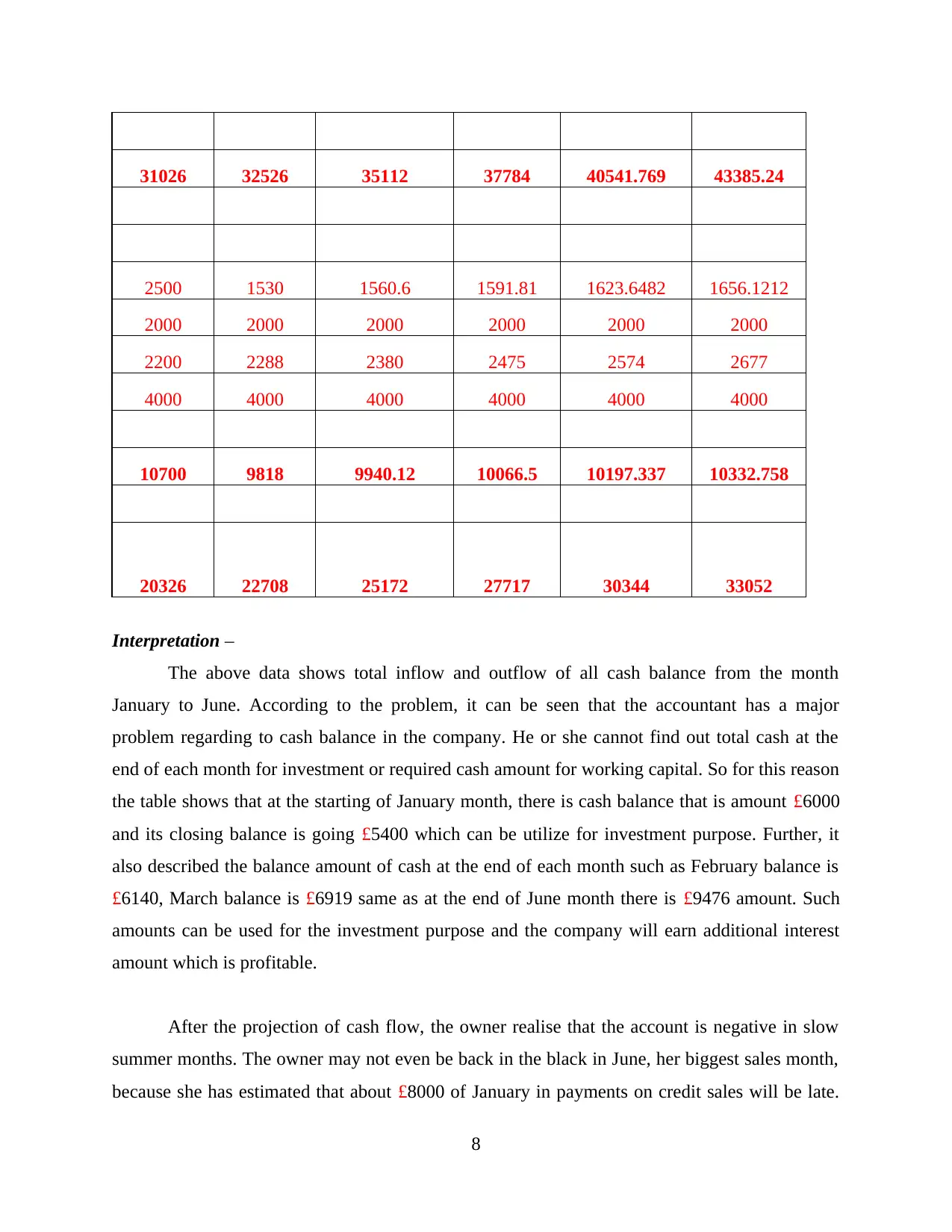
The above data shows total inflow and outflow of all cash balance from the month
January to June. According to the problem, it can be seen that the accountant has a major
problem regarding to cash balance in the company. He or she cannot find out total cash at the
end of each month for investment or required cash amount for working capital. So for this reason
the table shows that at the starting of January month, there is cash balance that is amount £6000
and its closing balance is going £5400 which can be utilize for investment purpose. Further, it
also described the balance amount of cash at the end of each month such as February balance is
£6140, March balance is £6919 same as at the end of June month there is £9476 amount. Such
amounts can be used for the investment purpose and the company will earn additional interest
amount which is profitable.
After the projection of cash flow, the owner realise that the account is negative in slow
summer months. The owner may not even be back in the black in June, her biggest sales month,
because she has estimated that about £8000 of January in payments on credit sales will be late.
8
2500 1530 1560.6 1591.81 1623.6482 1656.1212
2000 2000 2000 2000 2000 2000
2200 2288 2380 2475 2574 2677
4000 4000 4000 4000 4000 4000
10700 9818 9940.12 10066.5 10197.337 10332.758
20326 22708 25172 27717 30344 33052
Interpretation –
The above data shows total inflow and outflow of all cash balance from the month
January to June. According to the problem, it can be seen that the accountant has a major
problem regarding to cash balance in the company. He or she cannot find out total cash at the
end of each month for investment or required cash amount for working capital. So for this reason
the table shows that at the starting of January month, there is cash balance that is amount £6000
and its closing balance is going £5400 which can be utilize for investment purpose. Further, it
also described the balance amount of cash at the end of each month such as February balance is
£6140, March balance is £6919 same as at the end of June month there is £9476 amount. Such
amounts can be used for the investment purpose and the company will earn additional interest
amount which is profitable.
After the projection of cash flow, the owner realise that the account is negative in slow
summer months. The owner may not even be back in the black in June, her biggest sales month,
because she has estimated that about £8000 of January in payments on credit sales will be late.
8
Paraphrase This Document
Need a fresh take? Get an instant paraphrase of this document with our AI Paraphraser
There are some customers who are paying late that owner known that she is able to reduce costs
in same way and will require some extra cash for some months. She has already cut her own pay
in half and trimmed other expenses to the bone, she'll have to bring in money from extra sales,
provide extra services, or get a loan from family, friends, or a bank line of credit.
It can be said that money is needed to increase sales and collection of accounts receivable
effectively. Many other things are available that helps to raise profitability and production for the
firm which lead towards organisation success effectively.
P5 Break even analysis
Break-even analysis: Break-even analysis will help SWE to determine what amount of
selling they should do in terms of monthly and annually. It will help business to cover costs of
various business activities. This is known as break-even point and the break-even analysis table
helps to calculate a break-even point based on variable and fixed costs per unit sales and revenue
per unit sales. It also represents the amount of sales in wither quantity or sales which is requires
to cover total cost of both fixed and variable costs of firm effectively and efficiently. Break-even
analysis helps to evaluate point at which revenues received equal to the costs which is also
associated with receiving revenues effectively (McKeever, 2016). The manager’s and owner of
SWE should start the budget process conducting break-even analysis, an equation that helps to
show base cost of firm to provide products and services.
Break-even analysis will help business to determine areas which helps towards economic
strength and weaknesses in order to find ways from which the managers are able to increase
profitability and production effectively. Break-even analysis will help production managers to
take decisions regarding:
Safety margins that it will help business to decide extent from which it can easily afford
decreasing sales before it start incurring loss.
Determine volumes which are needed to attain profitability.
Provide suggestions regarding production capacity and decisions.
New product or drop production of any product.
This will also help to select production machinery in order to maximise profitability from
the available machineries.
Improve performance and profitability by increasing sales volume, selling price, reducing
variable expenses and fixed costs effectively.
9
in same way and will require some extra cash for some months. She has already cut her own pay
in half and trimmed other expenses to the bone, she'll have to bring in money from extra sales,
provide extra services, or get a loan from family, friends, or a bank line of credit.
It can be said that money is needed to increase sales and collection of accounts receivable
effectively. Many other things are available that helps to raise profitability and production for the
firm which lead towards organisation success effectively.
P5 Break even analysis
Break-even analysis: Break-even analysis will help SWE to determine what amount of
selling they should do in terms of monthly and annually. It will help business to cover costs of
various business activities. This is known as break-even point and the break-even analysis table
helps to calculate a break-even point based on variable and fixed costs per unit sales and revenue
per unit sales. It also represents the amount of sales in wither quantity or sales which is requires
to cover total cost of both fixed and variable costs of firm effectively and efficiently. Break-even
analysis helps to evaluate point at which revenues received equal to the costs which is also
associated with receiving revenues effectively (McKeever, 2016). The manager’s and owner of
SWE should start the budget process conducting break-even analysis, an equation that helps to
show base cost of firm to provide products and services.
Break-even analysis will help business to determine areas which helps towards economic
strength and weaknesses in order to find ways from which the managers are able to increase
profitability and production effectively. Break-even analysis will help production managers to
take decisions regarding:
Safety margins that it will help business to decide extent from which it can easily afford
decreasing sales before it start incurring loss.
Determine volumes which are needed to attain profitability.
Provide suggestions regarding production capacity and decisions.
New product or drop production of any product.
This will also help to select production machinery in order to maximise profitability from
the available machineries.
Improve performance and profitability by increasing sales volume, selling price, reducing
variable expenses and fixed costs effectively.
9
Limitations: Break-even analysis is helpful for only those organisations who have good
accounting system. It is based on assumptions between cost and revenue relationship. Selling
cost may not remain same for the business. It is not an effective tool for long range use and
restricted use in short run effectively.
Calculation of break-even point: Break-even point can be evaluated in terms of money and
physical units such as sales value in rupees.
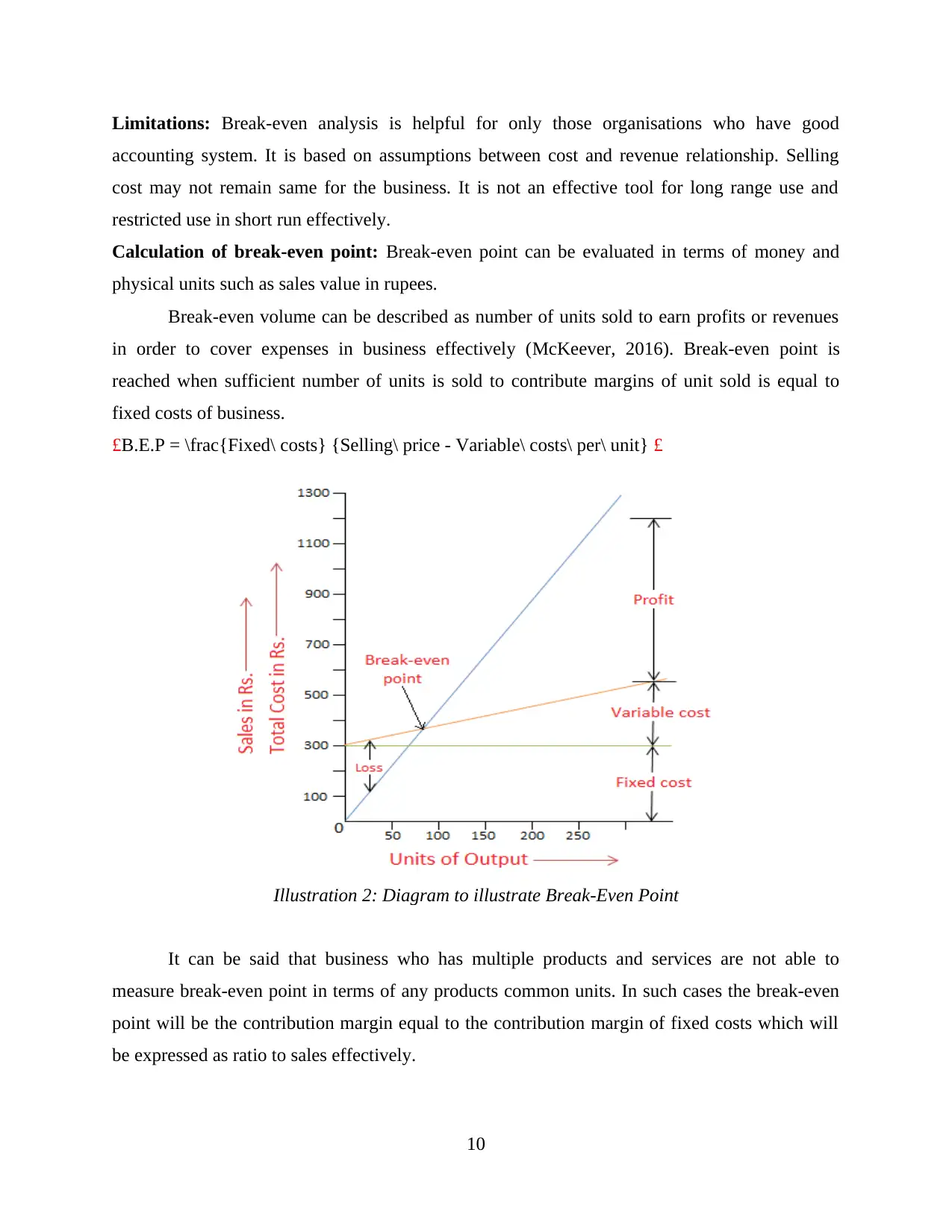
Break-even volume can be described as number of units sold to earn profits or revenues
in order to cover expenses in business effectively (McKeever, 2016). Break-even point is
reached when sufficient number of units is sold to contribute margins of unit sold is equal to
fixed costs of business.
£B.E.P = \frac{Fixed\ costs} {Selling\ price - Variable\ costs\ per\ unit} £
It can be said that business who has multiple products and services are not able to
measure break-even point in terms of any products common units. In such cases the break-even
point will be the contribution margin equal to the contribution margin of fixed costs which will
be expressed as ratio to sales effectively.
10
Illustration 2: Diagram to illustrate Break-Even Point
accounting system. It is based on assumptions between cost and revenue relationship. Selling
cost may not remain same for the business. It is not an effective tool for long range use and
restricted use in short run effectively.
Calculation of break-even point: Break-even point can be evaluated in terms of money and
physical units such as sales value in rupees.
Break-even volume can be described as number of units sold to earn profits or revenues
in order to cover expenses in business effectively (McKeever, 2016). Break-even point is
reached when sufficient number of units is sold to contribute margins of unit sold is equal to
fixed costs of business.
£B.E.P = \frac{Fixed\ costs} {Selling\ price - Variable\ costs\ per\ unit} £
It can be said that business who has multiple products and services are not able to
measure break-even point in terms of any products common units. In such cases the break-even
point will be the contribution margin equal to the contribution margin of fixed costs which will
be expressed as ratio to sales effectively.
10
Illustration 2: Diagram to illustrate Break-Even Point
⊘ This is a preview!⊘
Do you want full access?
Subscribe today to unlock all pages.
Trusted by 1+ million students worldwide

1 out of 20


Related Documents


Your All-in-One AI-Powered Toolkit for Academic Success.
+13062052269
info@desklib.com
Available 24*7 on WhatsApp / Email
![[object Object]](/_next/static/media/star-bottom.7253800d.svg)
Unlock your academic potential
Copyright © 2020–2026 A2Z Services. All Rights Reserved. Developed and managed by ZUCOL.