Challenges of Healthcare Access in Rural Areas: Report and Analysis

Verified

Added on  2023/01/23

|3
|400
|88
Report
AI Summary
This report addresses the challenges of accessing healthcare in rural areas, highlighting the significant impact of long distances and inadequate transportation infrastructure. The report emphasizes that these factors, alongside the scarcity of healthcare professionals, insufficient public health education, and social stigma, hinder rural communities from receiving essential medical services. It proposes that governments, healthcare organizations, and community members collaborate to improve public transport and implement technological solutions like telehealth to overcome these barriers. Additionally, it underscores the importance of addressing the shortage of healthcare professionals and providing public education on health issues to improve healthcare access and outcomes in rural areas.

Document Page
Running head: HEALTHCARE DELIVERY
Student name
Student No.
Unit
Title: Challenges in Accessing Health Services in Rural Areas
tabler-icon-diamond-filled.svg

Paraphrase This Document

Need a fresh take? Get an instant paraphrase of this document with our AI Paraphraser
Document Page
HEALTHCARE DELIVERY
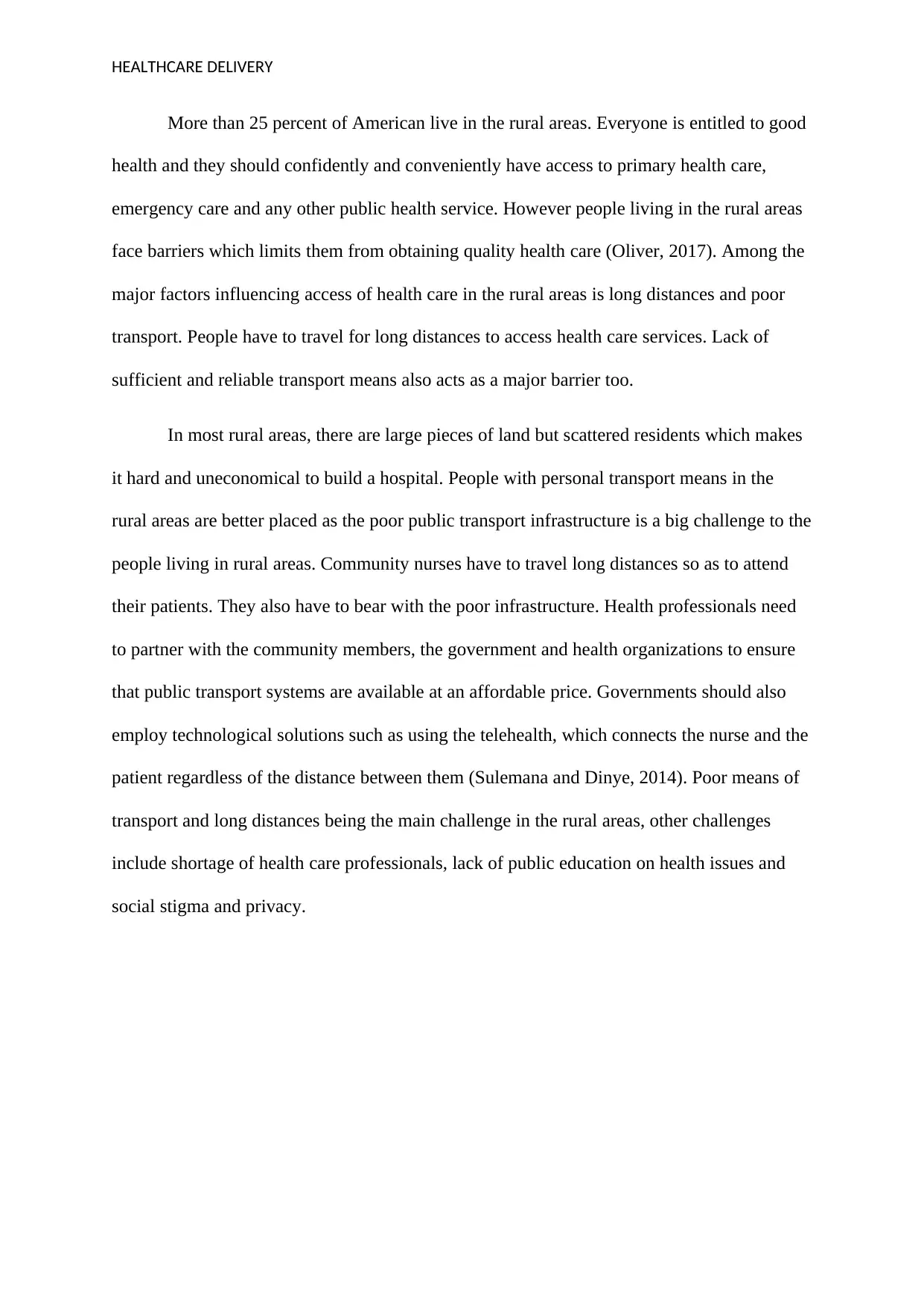
More than 25 percent of American live in the rural areas. Everyone is entitled to good
health and they should confidently and conveniently have access to primary health care,
emergency care and any other public health service. However people living in the rural areas
face barriers which limits them from obtaining quality health care (Oliver, 2017). Among the
major factors influencing access of health care in the rural areas is long distances and poor
transport. People have to travel for long distances to access health care services. Lack of
sufficient and reliable transport means also acts as a major barrier too.
In most rural areas, there are large pieces of land but scattered residents which makes
it hard and uneconomical to build a hospital. People with personal transport means in the
rural areas are better placed as the poor public transport infrastructure is a big challenge to the
people living in rural areas. Community nurses have to travel long distances so as to attend
their patients. They also have to bear with the poor infrastructure. Health professionals need
to partner with the community members, the government and health organizations to ensure
that public transport systems are available at an affordable price. Governments should also
employ technological solutions such as using the telehealth, which connects the nurse and the
patient regardless of the distance between them (Sulemana and Dinye, 2014). Poor means of
transport and long distances being the main challenge in the rural areas, other challenges
include shortage of health care professionals, lack of public education on health issues and
social stigma and privacy.
Document Page
HEALTHCARE DELIVERY
References
Oliver, D. (2017). Challenges for rural hospitals- the same but different. The BMJ, 2014;
357; j1731. Doi: https://doi.org/10.1136/bmj.j1731
Sulemana, A. and Dinye, R. D. (2014. Access to health care in rural communities in Ghana:
A study of some selected community in the PRU district. European Journal of
Research in Social Services, Vol. 2, No. 4, pp. 122-133. ISSN 2056-5429.
chevron_up_icon
1 out of 3
circle_padding
hide_on_mobile
zoom_out_icon
[object Object]