Ryle's Behaviorism: Examining the Relationship Between Mind and Body

Verified

Added on  2022/08/12

|4
|823
|39
Essay
AI Summary
This essay delves into Gilbert Ryle's behaviorist perspective on the mind-body problem, contrasting it with Cartesian dualism and exploring the concept of mental holism. It examines Ryle's arguments against the 'ghost in the machine' and his view that mental language can be interpreted in relation to behavior. The essay discusses the ontological assurance of Ryle's behaviorist view, which posits the body and mind as distinct entities, and considers criticisms of this view, particularly regarding the challenge of identifying a space for the mental in the physical world. The essay also references key scholars such as Armstrong, Kotzee, Navarro Reyes, and O'Sullivan, to provide a comprehensive analysis of Ryle's ideas and their relevance to contemporary discussions in the philosophy of mind. The conclusion highlights the significance of Ryle's behaviorist view in understanding the development of rational thought and the structure of individual's state of mind.
Document Page
Running head: PHILOSOPHY
PHILOSOPHY
Name of the Student:
Name of the University:
Author note:
tabler-icon-diamond-filled.svg

Paraphrase This Document

Need a fresh take? Get an instant paraphrase of this document with our AI Paraphraser
Document Page
1
PHILOSOPHY
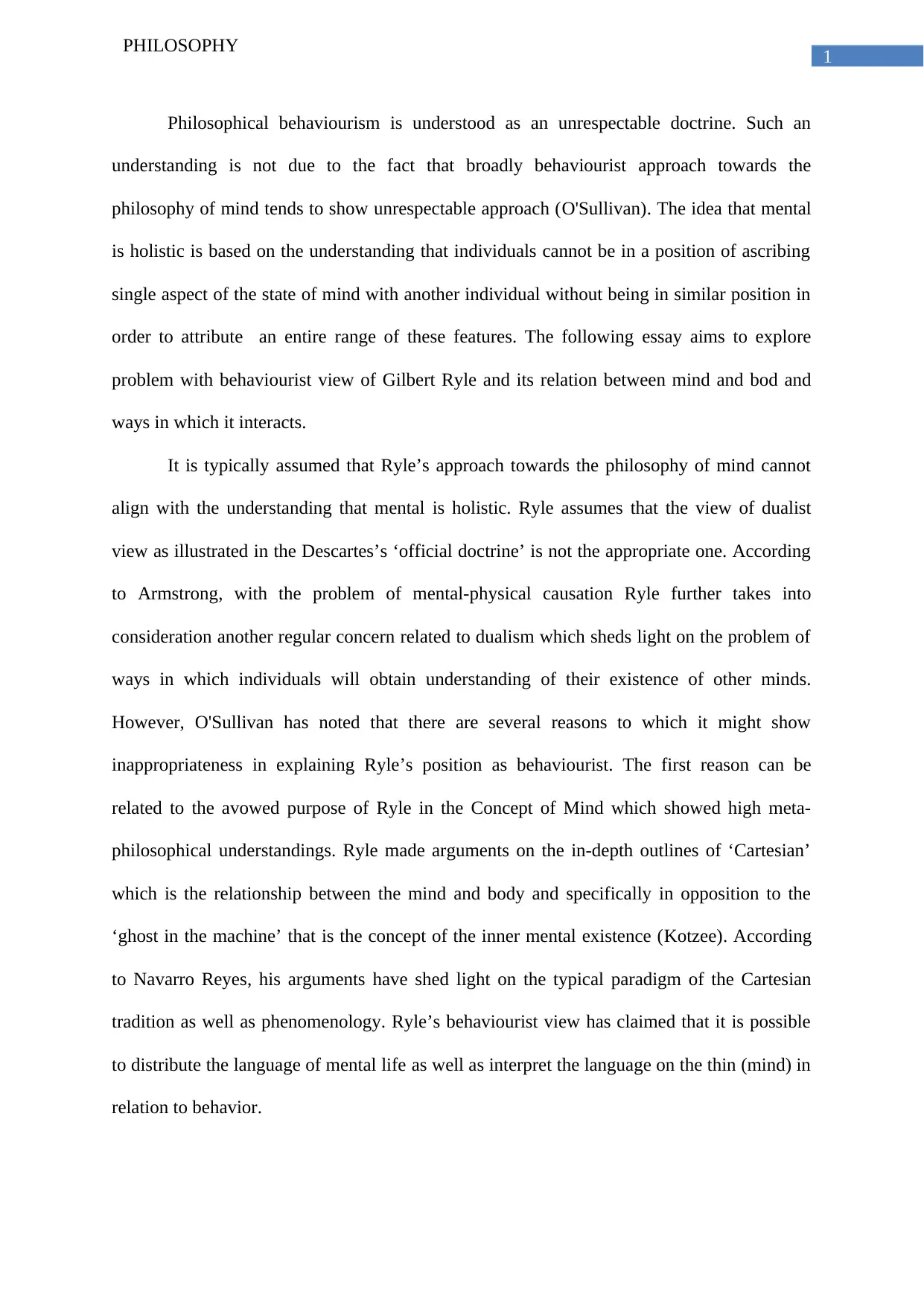
Philosophical behaviourism is understood as an unrespectable doctrine. Such an
understanding is not due to the fact that broadly behaviourist approach towards the
philosophy of mind tends to show unrespectable approach (O'Sullivan). The idea that mental
is holistic is based on the understanding that individuals cannot be in a position of ascribing
single aspect of the state of mind with another individual without being in similar position in
order to attribute an entire range of these features. The following essay aims to explore
problem with behaviourist view of Gilbert Ryle and its relation between mind and bod and
ways in which it interacts.
It is typically assumed that Ryle’s approach towards the philosophy of mind cannot
align with the understanding that mental is holistic. Ryle assumes that the view of dualist
view as illustrated in the Descartes’s ‘official doctrine’ is not the appropriate one. According
to Armstrong, with the problem of mental-physical causation Ryle further takes into
consideration another regular concern related to dualism which sheds light on the problem of
ways in which individuals will obtain understanding of their existence of other minds.
However, O'Sullivan has noted that there are several reasons to which it might show
inappropriateness in explaining Ryle’s position as behaviourist. The first reason can be
related to the avowed purpose of Ryle in the Concept of Mind which showed high meta-
philosophical understandings. Ryle made arguments on the in-depth outlines of ‘Cartesian’
which is the relationship between the mind and body and specifically in opposition to the
‘ghost in the machine’ that is the concept of the inner mental existence (Kotzee). According
to Navarro Reyes, his arguments have shed light on the typical paradigm of the Cartesian
tradition as well as phenomenology. Ryle’s behaviourist view has claimed that it is possible
to distribute the language of mental life as well as interpret the language on the thin (mind) in
relation to behavior.
Document Page
2
PHILOSOPHY
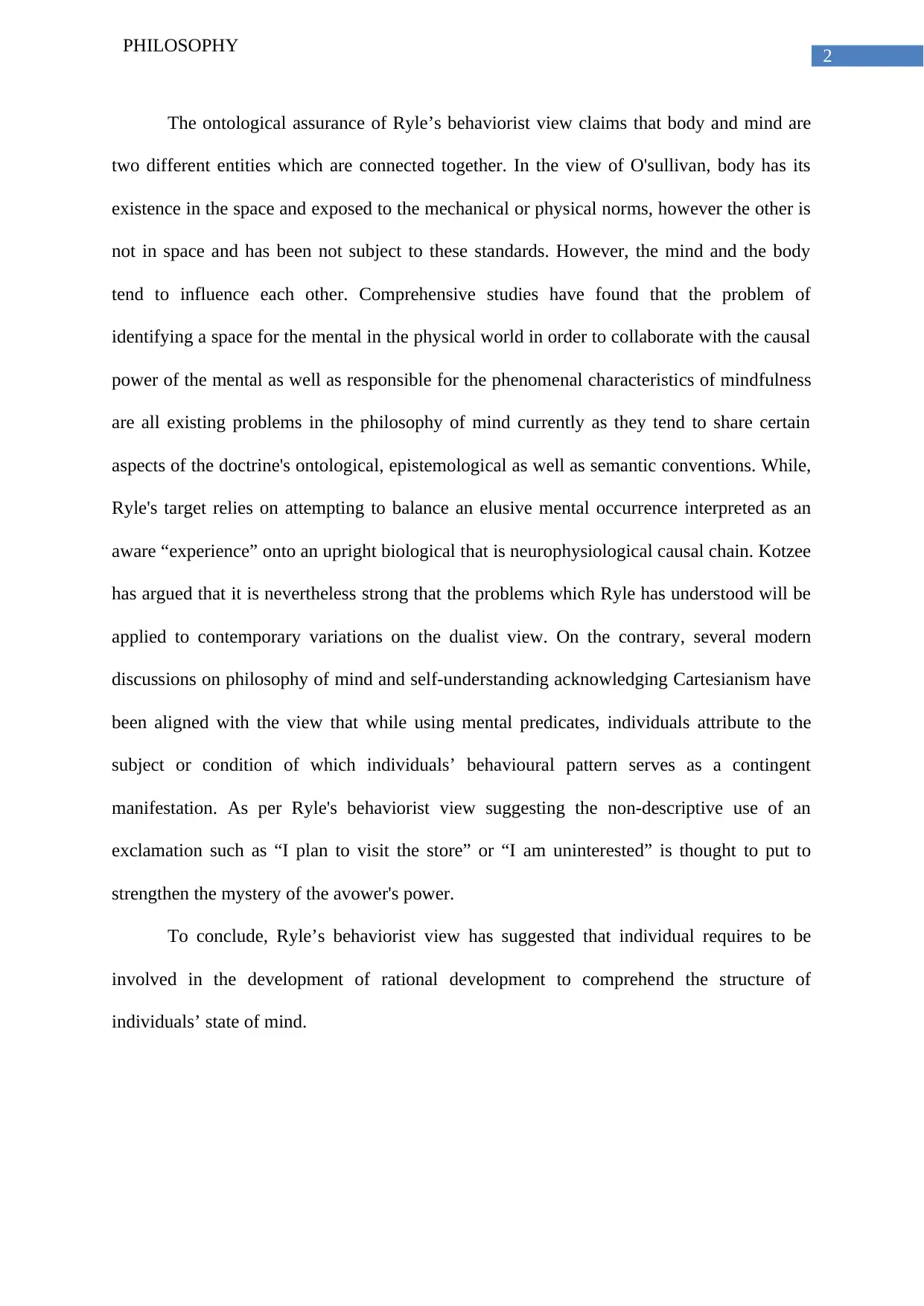
The ontological assurance of Ryle’s behaviorist view claims that body and mind are
two different entities which are connected together. In the view of O'sullivan, body has its
existence in the space and exposed to the mechanical or physical norms, however the other is
not in space and has been not subject to these standards. However, the mind and the body
tend to influence each other. Comprehensive studies have found that the problem of
identifying a space for the mental in the physical world in order to collaborate with the causal
power of the mental as well as responsible for the phenomenal characteristics of mindfulness
are all existing problems in the philosophy of mind currently as they tend to share certain
aspects of the doctrine's ontological, epistemological as well as semantic conventions. While,
Ryle's target relies on attempting to balance an elusive mental occurrence interpreted as an
aware “experience” onto an upright biological that is neurophysiological causal chain. Kotzee
has argued that it is nevertheless strong that the problems which Ryle has understood will be
applied to contemporary variations on the dualist view. On the contrary, several modern
discussions on philosophy of mind and self-understanding acknowledging Cartesianism have
been aligned with the view that while using mental predicates, individuals attribute to the
subject or condition of which individuals’ behavioural pattern serves as a contingent
manifestation. As per Ryle's behaviorist view suggesting the non-descriptive use of an
exclamation such as “I plan to visit the store” or “I am uninterested” is thought to put to
strengthen the mystery of the avower's power.
To conclude, Ryle’s behaviorist view has suggested that individual requires to be
involved in the development of rational development to comprehend the structure of
individuals’ state of mind.
Document Page
3
PHILOSOPHY
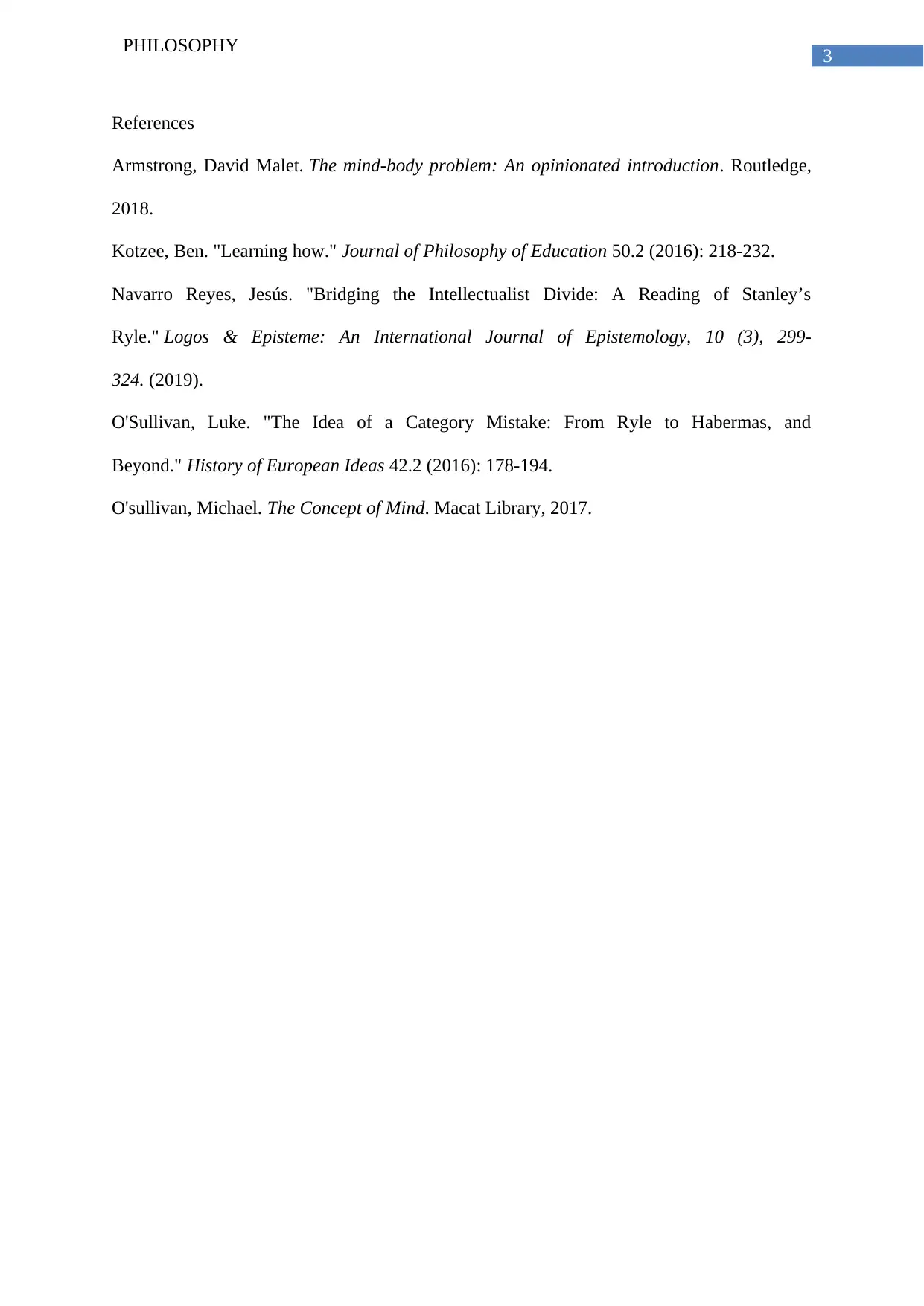
References
Armstrong, David Malet. The mind-body problem: An opinionated introduction. Routledge,
2018.
Kotzee, Ben. "Learning how." Journal of Philosophy of Education 50.2 (2016): 218-232.
Navarro Reyes, Jesús. "Bridging the Intellectualist Divide: A Reading of Stanley’s
Ryle." Logos & Episteme: An International Journal of Epistemology, 10 (3), 299-
324. (2019).
O'Sullivan, Luke. "The Idea of a Category Mistake: From Ryle to Habermas, and
Beyond." History of European Ideas 42.2 (2016): 178-194.
O'sullivan, Michael. The Concept of Mind. Macat Library, 2017.
chevron_up_icon
1 out of 4
circle_padding
hide_on_mobile
zoom_out_icon
[object Object]