Detailed Analysis of Sa Aking Kabata Poem: Rizal's Legacy and Debate

Verified

Added on  2020/10/15

|2
|593
|2115
Essay
AI Summary
This essay provides an in-depth analysis of the poem "Sa Aking Kabata," attributed to Jose Rizal. It delves into the poem's core themes of nationalism, linguistic pride, and the importance of cherishing one's cultural identity. The essay explores the poem's impact on Filipino culture and its role in inspiring generations. Furthermore, it examines the debate surrounding the poem's authenticity, discussing the arguments against Rizal's authorship and the historical context of the word "kalayaan." The analysis covers the poem's structure, symbolism, and the significance of its messages, while also providing a critical perspective on the controversies surrounding its origin. Overall, the essay highlights the enduring influence of "Sa Aking Kabata" as a symbol of Filipino identity and its continued relevance in contemporary society.
Document Page
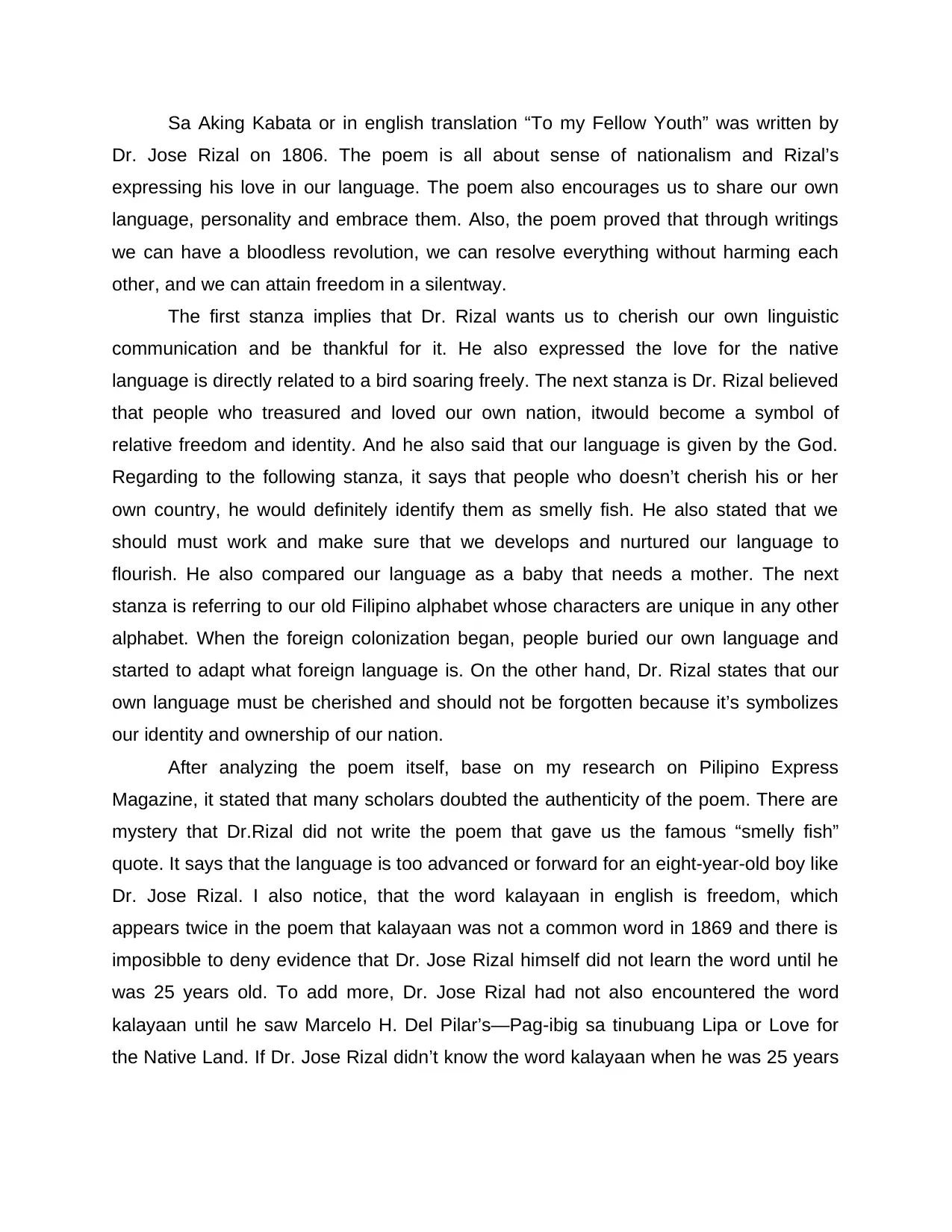
Sa Aking Kabata or in english translation “To my Fellow Youth” was written by
Dr. Jose Rizal on 1806. The poem is all about sense of nationalism and Rizal’s
expressing his love in our language. The poem also encourages us to share our own
language, personality and embrace them. Also, the poem proved that through writings
we can have a bloodless revolution, we can resolve everything without harming each
other, and we can attain freedom in a silentway.
The first stanza implies that Dr. Rizal wants us to cherish our own linguistic
communication and be thankful for it. He also expressed the love for the native
language is directly related to a bird soaring freely. The next stanza is Dr. Rizal believed
that people who treasured and loved our own nation, itwould become a symbol of
relative freedom and identity. And he also said that our language is given by the God.
Regarding to the following stanza, it says that people who doesn’t cherish his or her
own country, he would definitely identify them as smelly fish. He also stated that we
should must work and make sure that we develops and nurtured our language to
flourish. He also compared our language as a baby that needs a mother. The next
stanza is referring to our old Filipino alphabet whose characters are unique in any other
alphabet. When the foreign colonization began, people buried our own language and
started to adapt what foreign language is. On the other hand, Dr. Rizal states that our
own language must be cherished and should not be forgotten because it’s symbolizes
our identity and ownership of our nation.
After analyzing the poem itself, base on my research on Pilipino Express
Magazine, it stated that many scholars doubted the authenticity of the poem. There are
mystery that Dr.Rizal did not write the poem that gave us the famous “smelly fish”
quote. It says that the language is too advanced or forward for an eight-year-old boy like
Dr. Jose Rizal. I also notice, that the word kalayaan in english is freedom, which
appears twice in the poem that kalayaan was not a common word in 1869 and there is
imposibble to deny evidence that Dr. Jose Rizal himself did not learn the word until he
was 25 years old. To add more, Dr. Jose Rizal had not also encountered the word
kalayaan until he saw Marcelo H. Del Pilar’s—Pag-ibig sa tinubuang Lipa or Love for
the Native Land. If Dr. Jose Rizal didn’t know the word kalayaan when he was 25 years
tabler-icon-diamond-filled.svg

Paraphrase This Document

Need a fresh take? Get an instant paraphrase of this document with our AI Paraphraser
Document Page
old, he could not have written a poem in which word appears twice when he was an
eight-year-old boy.
All in all, even though there’s no assurance of who are the real author is. The
poem of Sa Aking Kabata has been an inspiration for generations. And this poem will
always an inspiration because it helps us, the young Filipino individuals to use our
abilities and achievements to stand out not just for success, but also for our nation’s
success. We should be proud of our nationality and identity, in that way we could show
our sense of pride as Filipino.
Reference:
https://www.pilipino-express.com/history-a-culture/in-other-words/3050-the-poem-that-
rizal-did-not-write.html
chevron_up_icon
1 out of 2
circle_padding
hide_on_mobile
zoom_out_icon
[object Object]