Sabermetrics: Statistical Analysis for Baseball Performance Evaluation

Verified

Added on  2022/10/18

|5
|1037
|14
Report
AI Summary
This report provides a comprehensive overview of sabermetrics, a statistical method used to analyze baseball player performance. It explores how sabermetrics applies statistical analysis to evaluate player records and make informed conclusions about individual contributions. The report discusses the evolution of sabermetrics, its impact on decision-making by coaches and managers, and its role in hiring talent. It highlights key concepts such as Wins Above Replacement (WAR) and Value Over Replacement Player (VORP), illustrating how these metrics are used to assess player value. The report also examines the application of quantitative analysis and related rates in baseball, demonstrating how managers utilize sabermetrics to analyze past performance and predict future contributions. It also includes a discussion on the challenges of comparing player statistics and how sabermetricians have overcome these hurdles. The report concludes by emphasizing the importance of sabermetrics in modern baseball management, including its influence on player evaluation, talent acquisition, and overall team strategy.
Document Page
Running Head: SABERMETRICS 1
Statistics
Institution Name
Student Name
Date of Submission
tabler-icon-diamond-filled.svg

Paraphrase This Document

Need a fresh take? Get an instant paraphrase of this document with our AI Paraphraser
Document Page
SABERMETRICS 2
Introduction
Sabermetrics applies statistical analysis to evaluate records of baseball and make
conclusions about the performance of the individual players. Professionals in sabermetric sector
have always disagreed with some fundamental assumptions about the way talent and individual
player contributions are evaluated and this has developed a lot of arguments. Nevertheless, most
of the ideas, opinions and methodologies of sabermetrics have been widely accepted in the field
of statistics. The functionality of sabermetrics is enhanced by the ability of every game to
produce a lot of recorded data (Whitman Syracuse University, 2015).
Sabermetricians sometimes argue that some of the data is overvalued. For example the
runs battle in (RBI) stat which depend on the performance of the other batters and whether they
access the base so that a player can move them in. This make RBI to be unsuitable way of
quantifying the level of skill of an individual player. Sabermetrics explores and studies available
raw data and evaluates such matters, while also questioning the impact of pitching coaches and
also questioning the most appropriate method of determining the value of the hitter to the entire
team (Jacob, 2019).
Quantitative analysis and related rates in baseball
Sabermetrics help in quantitative analysis in baseball by being able to explain most
aspects of the game such as determining the number of stealing trials that a team has. Related
rates in baseball can be applied to provide exact mathematical figures of various plays in a game
such as if a runner is removed from the game from third, related rates would also show if a throw
from outside the field would have been timely or was necessarily cut off before the plate.
Managers can use the related rates to study how swift player can get around the bases after a
battled ball. This is significant data that is used in creation of individual player and spying report
generation (John, Gabriel, & Michael, 2009).
Application in higher mathematics
Sabermetric statistics such as value over replacement player (VORP) shows the extent to
which a player assist his team compared to the unsuitable substitutional player that his
performance is below average. Wins above replacement (WAR) is another mode of sabermetrics
which analyses the contributions of a player to the team. Both value over replacement player and
Document Page
SABERMETRICS 3
wins above substitution compares a specific player to a substitution-level player so as to
investigate how many more wins the player contributed to the team. Wins above replacement
figures change with hitting positions and are significantly dependent on a player’s successful
performance and their total amount of playing time. Such kinds of information is used by
managers to decide if to sign or release players with certain specific characteristics (Basco &
Davies, 2010).
Managers use sabermetrics to analyze the past performance and predetermine how an
individual player will contribute to the team in future. These may be significant when
determining the winners of awards of the end of season and the value of getting into a certain
trading activity. The data can also be used to determine factors such as their market values.
Majority of baseball players prefer playing for some years in the minor league before being
promoted to the major league. The competitive variation together with impacts of ballpark make
undisputable comparison of statistics of a player to be a challenge. This challenge have been
overcame by sabermetricians who have adjusted the statistics of minor league players and this
have made easy determination of performance of players if they can be promoted to the major
league
The evolution of sabermetrics has brought transformation not only to decision making by
coaches and managers, but also the ways in which team management hire talent for office
positions. General Manager and assistant managerial jobs were historically reserved for the
former team players. However, sabermetrics have brought changes in employment processes buy
opening up and giving opportunities to those who are able to analyze to sabermetric data and
assist in implementing the insights in action and those in scouting operations (John, 2016).
Document Page
SABERMETRICS 4
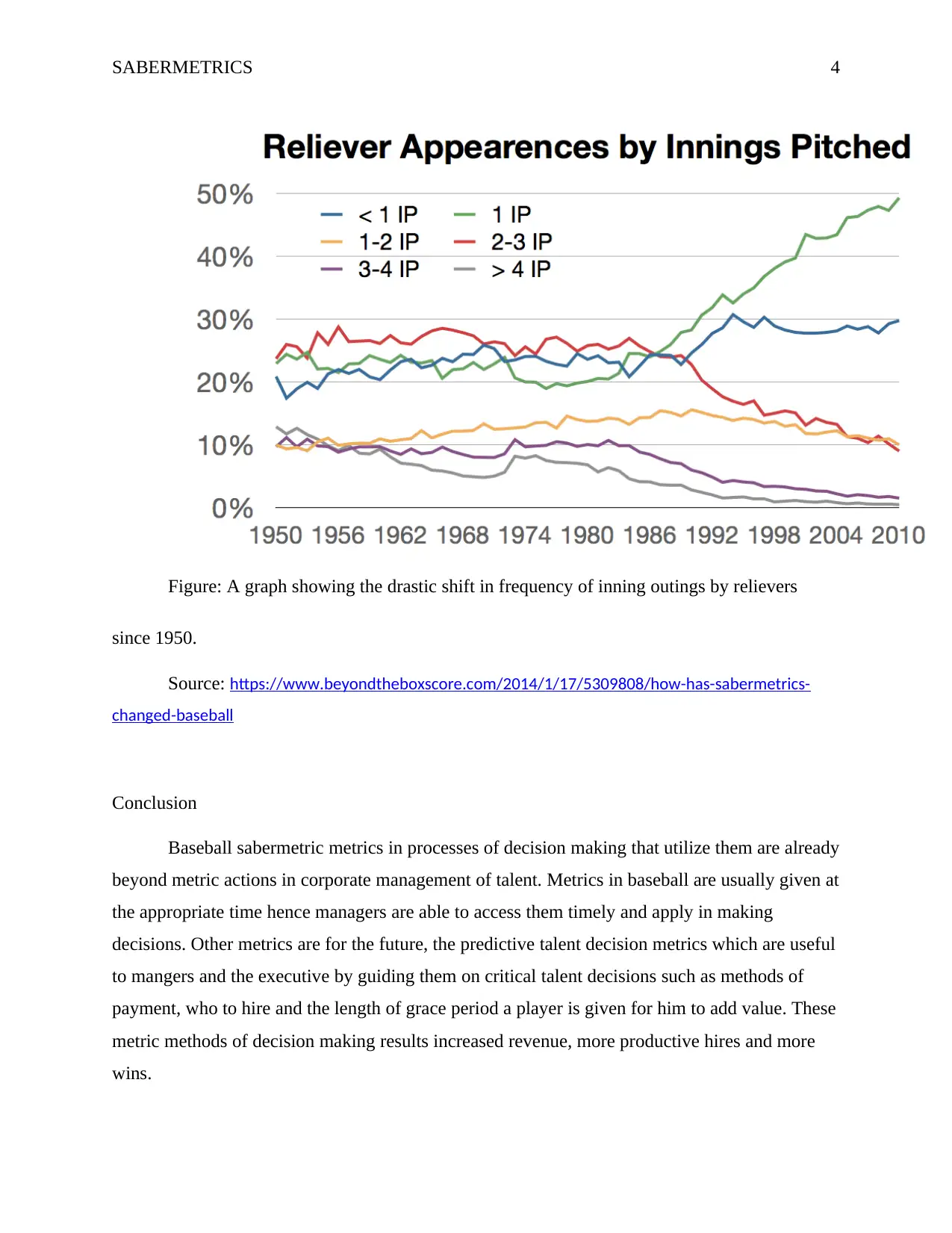
Figure: A graph showing the drastic shift in frequency of inning outings by relievers
since 1950.
Source: https://www.beyondtheboxscore.com/2014/1/17/5309808/how-has-sabermetrics-
changed-baseball
Conclusion
Baseball sabermetric metrics in processes of decision making that utilize them are already
beyond metric actions in corporate management of talent. Metrics in baseball are usually given at
the appropriate time hence managers are able to access them timely and apply in making
decisions. Other metrics are for the future, the predictive talent decision metrics which are useful
to mangers and the executive by guiding them on critical talent decisions such as methods of
payment, who to hire and the length of grace period a player is given for him to add value. These
metric methods of decision making results increased revenue, more productive hires and more
wins.
tabler-icon-diamond-filled.svg

Paraphrase This Document

Need a fresh take? Get an instant paraphrase of this document with our AI Paraphraser
Document Page
SABERMETRICS 5
References
Basco, D., & Davies, M. (. (2010). The Many Flavors of DIPS: A History and an Overview".
Baseball Research Journal, 32 (2).
Jacob, S. (2019). The Problem with Traditional Baseball Statistics. Retrieved from How
Sabermetrics Works: https://entertainment.howstuffworks.com/sabermetrics1.htm
John, S. (2016). Baseball Sabermetrics are Years Ahead of the Metric Practices in Corporate
Talent Managemnt. Retrieved from Best practice institute:
https://www.bestpracticeinstitute.org/blog/baseball-sabermetrics-are-years-ahead-of-the-
metric-practices-in-corporate-talent-management/
John, T., Gabriel, R., & Michael, R. (2009). Practicing Sabermetrics: Putting the Science of
Baseball Statistics to Work. United States of America: McFarland & Company, 189-198.
Whitman Syracuse University. (2015). Sabermetrics: Baseball Analytics and the Science of
Winning [Infographic]. Retrieved from online business:
https://onlinebusiness.syr.edu/blog/sabermetrics-baseball-analytics-the-science-of-
winning/
chevron_up_icon
1 out of 5
circle_padding
hide_on_mobile
zoom_out_icon
[object Object]