Safeguarding in Health and Social Care: Report on Abuse and Care Act
VerifiedAdded on 2020/06/05
|12
|3194
|26
Report
AI Summary
This report addresses safeguarding in health and social care, starting with the creation of an induction pack for new students at a Day Centre. It then delves into various types of abuse, including physical, domestic, and psychological, detailing their signs, indicators, and the impact of social and cultural factors. The report outlines procedures for protecting clients, patients, and colleagues from harm, emphasizing the responsibilities of each group. An essay component examines the implications of the New Care Act 2015 on individuals and professionals, highlighting the roles of patients, government, supportive communities, doctors, nurses, and staff. The report underscores the Act's impact on reducing abuse and improving healthcare practices. The report also discusses strategies to minimize abuse in health and social care and the significance of a healthy working environment.
Safeguarding in Health and
Social Care
Social Care

Paraphrase This Document
Need a fresh take? Get an instant paraphrase of this document with our AI Paraphraser
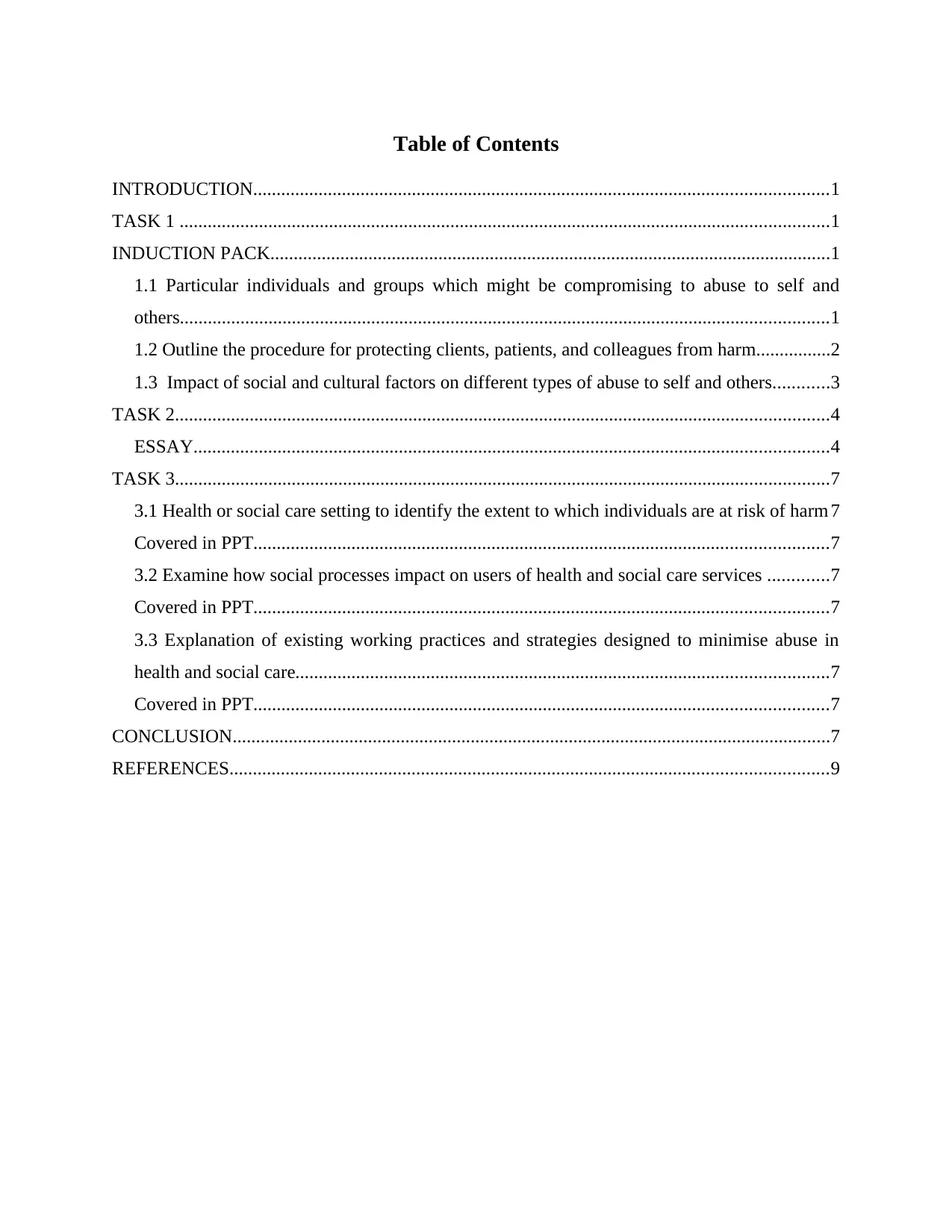
Table of Contents
INTRODUCTION...........................................................................................................................1
TASK 1 ...........................................................................................................................................1
INDUCTION PACK........................................................................................................................1
1.1 Particular individuals and groups which might be compromising to abuse to self and
others...........................................................................................................................................1
1.2 Outline the procedure for protecting clients, patients, and colleagues from harm................2
1.3 Impact of social and cultural factors on different types of abuse to self and others............3
TASK 2............................................................................................................................................4
ESSAY........................................................................................................................................4
TASK 3............................................................................................................................................7
3.1 Health or social care setting to identify the extent to which individuals are at risk of harm 7
Covered in PPT...........................................................................................................................7
3.2 Examine how social processes impact on users of health and social care services .............7
Covered in PPT...........................................................................................................................7
3.3 Explanation of existing working practices and strategies designed to minimise abuse in
health and social care..................................................................................................................7
Covered in PPT...........................................................................................................................7
CONCLUSION................................................................................................................................7
REFERENCES................................................................................................................................9
INTRODUCTION...........................................................................................................................1
TASK 1 ...........................................................................................................................................1
INDUCTION PACK........................................................................................................................1
1.1 Particular individuals and groups which might be compromising to abuse to self and
others...........................................................................................................................................1
1.2 Outline the procedure for protecting clients, patients, and colleagues from harm................2
1.3 Impact of social and cultural factors on different types of abuse to self and others............3
TASK 2............................................................................................................................................4
ESSAY........................................................................................................................................4
TASK 3............................................................................................................................................7
3.1 Health or social care setting to identify the extent to which individuals are at risk of harm 7
Covered in PPT...........................................................................................................................7
3.2 Examine how social processes impact on users of health and social care services .............7
Covered in PPT...........................................................................................................................7
3.3 Explanation of existing working practices and strategies designed to minimise abuse in
health and social care..................................................................................................................7
Covered in PPT...........................................................................................................................7
CONCLUSION................................................................................................................................7
REFERENCES................................................................................................................................9
INTRODUCTION
In the recent era, safeguarding in health and social care is an important content because it
assist to provides better health care services and facilities to patients. Therefore, it is needed to be
make assure and systematically follows rules and responsibilities within the organisation. Hence,
in this report, as a supervisor of Day centre here will be producing an appropriate induction pack
for inducting 6 students in the health care organisation. In the other words, here will be
significantly write down essay on safeguarding implications of new Care Act 2015 for persons
and professionals of this sector which should followed by them. In the last, an attractive
presentation will be make on working practices and strategies of health and social care. (Balen,
Rhodes and Ward, 2010)
TASK 1
INDUCTION PACK
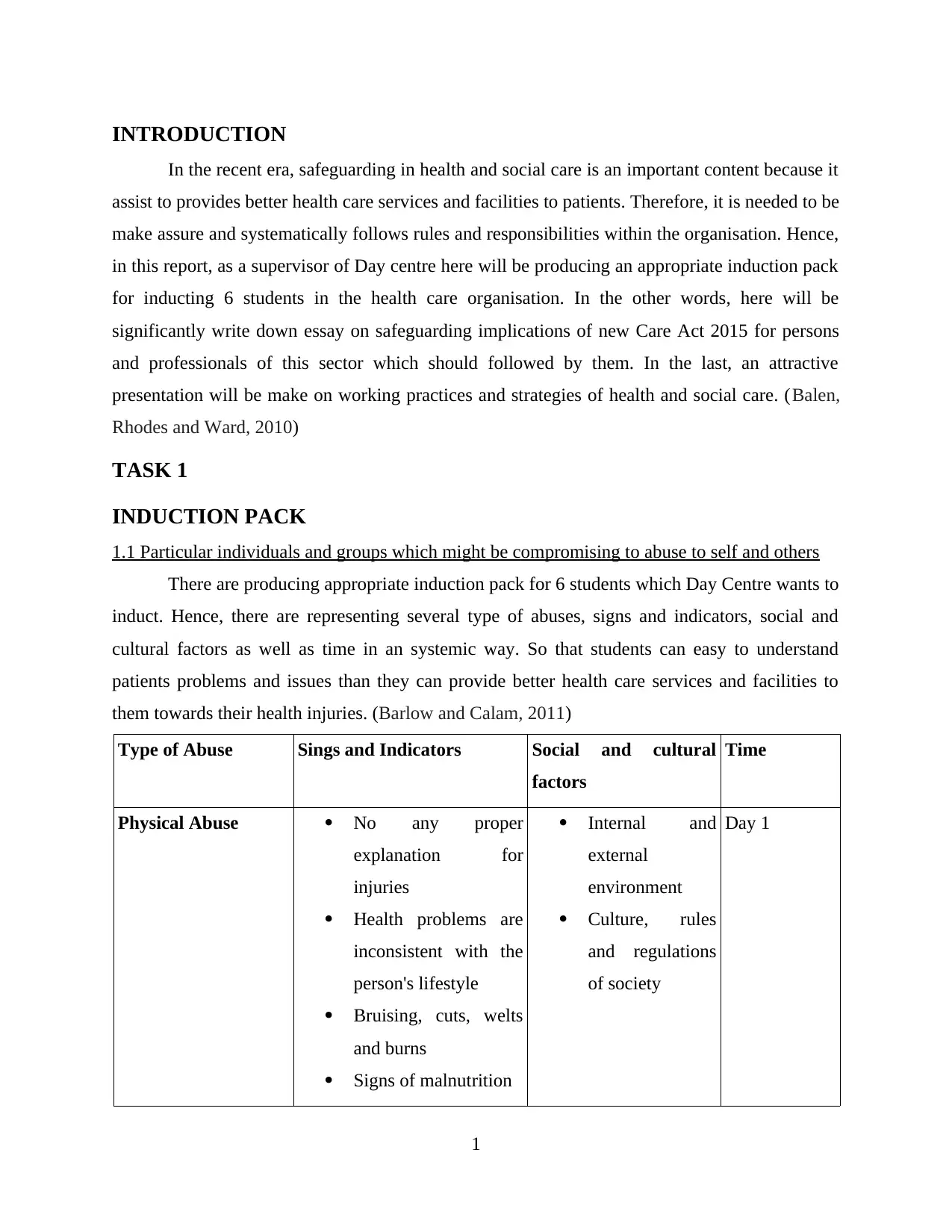
1.1 Particular individuals and groups which might be compromising to abuse to self and others
There are producing appropriate induction pack for 6 students which Day Centre wants to
induct. Hence, there are representing several type of abuses, signs and indicators, social and
cultural factors as well as time in an systemic way. So that students can easy to understand
patients problems and issues than they can provide better health care services and facilities to
them towards their health injuries. (Barlow and Calam, 2011)
Type of Abuse Sings and Indicators Social and cultural
factors
Time
Physical Abuse No any proper
explanation for
injuries
Health problems are
inconsistent with the
person's lifestyle
Bruising, cuts, welts
and burns
Signs of malnutrition
Internal and
external
environment
Culture, rules
and regulations
of society
Day 1
1
In the recent era, safeguarding in health and social care is an important content because it
assist to provides better health care services and facilities to patients. Therefore, it is needed to be
make assure and systematically follows rules and responsibilities within the organisation. Hence,
in this report, as a supervisor of Day centre here will be producing an appropriate induction pack
for inducting 6 students in the health care organisation. In the other words, here will be
significantly write down essay on safeguarding implications of new Care Act 2015 for persons
and professionals of this sector which should followed by them. In the last, an attractive
presentation will be make on working practices and strategies of health and social care. (Balen,
Rhodes and Ward, 2010)
TASK 1
INDUCTION PACK
1.1 Particular individuals and groups which might be compromising to abuse to self and others
There are producing appropriate induction pack for 6 students which Day Centre wants to
induct. Hence, there are representing several type of abuses, signs and indicators, social and
cultural factors as well as time in an systemic way. So that students can easy to understand
patients problems and issues than they can provide better health care services and facilities to
them towards their health injuries. (Barlow and Calam, 2011)
Type of Abuse Sings and Indicators Social and cultural
factors
Time
Physical Abuse No any proper
explanation for
injuries
Health problems are
inconsistent with the
person's lifestyle
Bruising, cuts, welts
and burns
Signs of malnutrition
Internal and
external
environment
Culture, rules
and regulations
of society
Day 1
1
⊘ This is a preview!⊘
Do you want full access?
Subscribe today to unlock all pages.

Trusted by 1+ million students worldwide
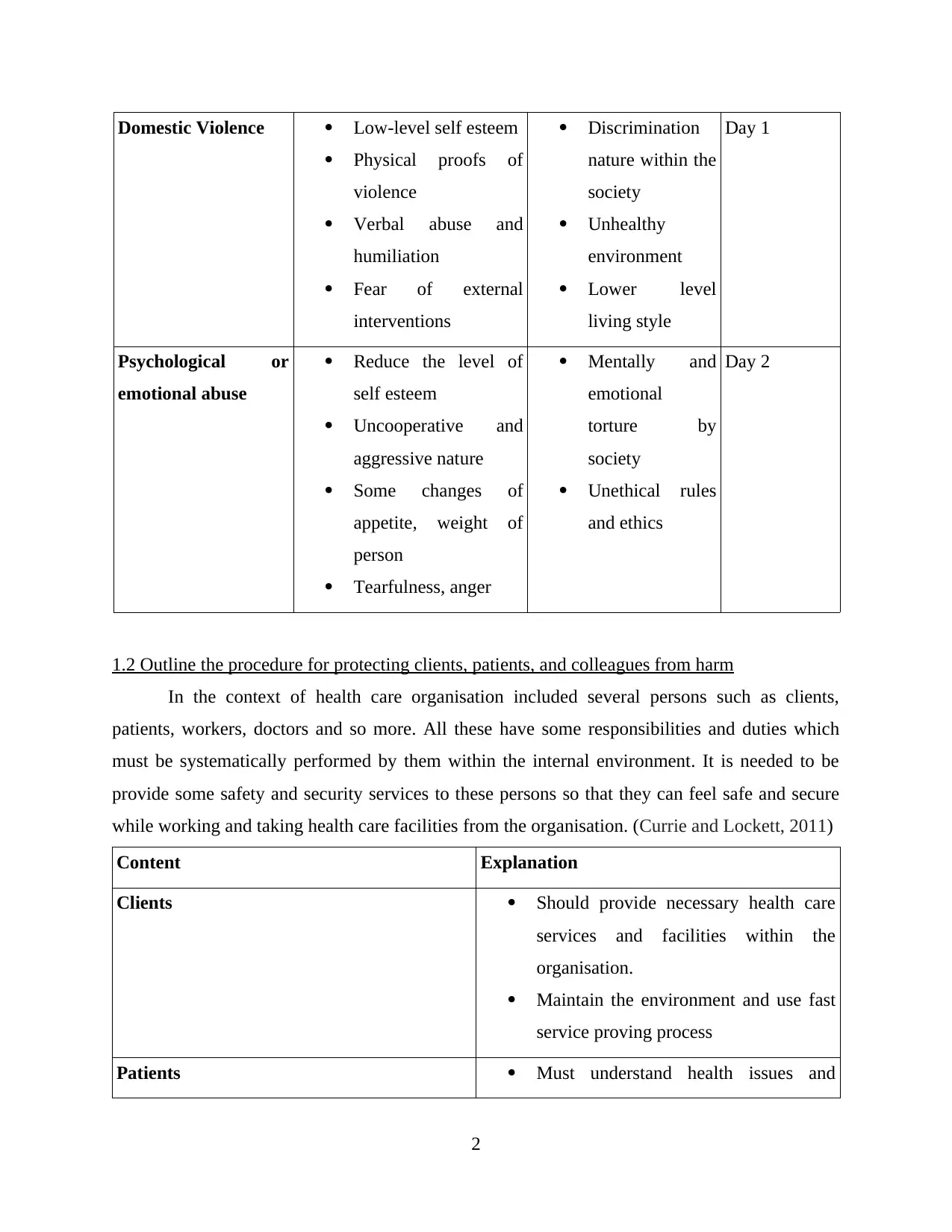
Domestic Violence Low-level self esteem
Physical proofs of
violence
Verbal abuse and
humiliation
Fear of external
interventions
Discrimination
nature within the
society
Unhealthy
environment
Lower level
living style
Day 1
Psychological or
emotional abuse
Reduce the level of
self esteem
Uncooperative and
aggressive nature
Some changes of
appetite, weight of
person
Tearfulness, anger
Mentally and
emotional
torture by
society
Unethical rules
and ethics
Day 2
1.2 Outline the procedure for protecting clients, patients, and colleagues from harm
In the context of health care organisation included several persons such as clients,
patients, workers, doctors and so more. All these have some responsibilities and duties which
must be systematically performed by them within the internal environment. It is needed to be
provide some safety and security services to these persons so that they can feel safe and secure
while working and taking health care facilities from the organisation. (Currie and Lockett, 2011)
Content Explanation
Clients Should provide necessary health care
services and facilities within the
organisation.
Maintain the environment and use fast
service proving process
Patients Must understand health issues and
2
Physical proofs of
violence
Verbal abuse and
humiliation
Fear of external
interventions
Discrimination
nature within the
society
Unhealthy
environment
Lower level
living style
Day 1
Psychological or
emotional abuse
Reduce the level of
self esteem
Uncooperative and
aggressive nature
Some changes of
appetite, weight of
person
Tearfulness, anger
Mentally and
emotional
torture by
society
Unethical rules
and ethics
Day 2
1.2 Outline the procedure for protecting clients, patients, and colleagues from harm
In the context of health care organisation included several persons such as clients,
patients, workers, doctors and so more. All these have some responsibilities and duties which
must be systematically performed by them within the internal environment. It is needed to be
provide some safety and security services to these persons so that they can feel safe and secure
while working and taking health care facilities from the organisation. (Currie and Lockett, 2011)
Content Explanation
Clients Should provide necessary health care
services and facilities within the
organisation.
Maintain the environment and use fast
service proving process
Patients Must understand health issues and
2
Paraphrase This Document
Need a fresh take? Get an instant paraphrase of this document with our AI Paraphraser
problems of patients
Try to provides better health care
services and facilities to patients as per
their injuries.
Clarify some rights and powers to
patients
Colleagues Identify the responsibilities and duties
of staff members and workers of health
care centre
Clarify the rules and polices of Day
centre
1.3 Impact of social and cultural factors on different types of abuse to self and others
As per above define different of abuses and social and cultural factors which affect on
self and others either positive or negative style. Thus, it is needful to systematically analysed and
evaluate the actual implications with the help of appropriate methods and techniques.(Dimond,
2016) Apart from this, there are shows effective induction pack on influences of social and
cultural on several kind of abuses such as follows:
Different type of Abuse Social and culture factors Impacts or affects
Physical Abuse Role of communities
Rules and regulations
of society
Surrounding society
Standard of living
Education and
occupation
People cannot
effectively live in the
unhealthy society
Lack of health relation
with peers and persons
Physically tortures by
society
Domestic Violence Decrease the level of
self image in the
Lack of coordination
3
Try to provides better health care
services and facilities to patients as per
their injuries.
Clarify some rights and powers to
patients
Colleagues Identify the responsibilities and duties
of staff members and workers of health
care centre
Clarify the rules and polices of Day
centre
1.3 Impact of social and cultural factors on different types of abuse to self and others
As per above define different of abuses and social and cultural factors which affect on
self and others either positive or negative style. Thus, it is needful to systematically analysed and
evaluate the actual implications with the help of appropriate methods and techniques.(Dimond,
2016) Apart from this, there are shows effective induction pack on influences of social and
cultural on several kind of abuses such as follows:
Different type of Abuse Social and culture factors Impacts or affects
Physical Abuse Role of communities
Rules and regulations
of society
Surrounding society
Standard of living
Education and
occupation
People cannot
effectively live in the
unhealthy society
Lack of health relation
with peers and persons
Physically tortures by
society
Domestic Violence Decrease the level of
self image in the
Lack of coordination
3
society group
Use abusive language
with persons
Angry behaviour of
individuals
Discrimination nature
and interaction
Increase the level of
fights and use of
scurrilous words in the
communication process
Affect living style
Psychological or emotional
abuse
Mentally abuse by
society
Unethical society terms
and conditions
Nature of person bring
aggressive and abusive
Decrease the
confidence and
motivation of
individuals
Isolation and
depression
TASK 2
ESSAY
The New Care Act, 2015 is an Act which were enacted by Parliament of UK that
received as Royal Assent on 14 May 2015. Hence, one of the major purpose behind regulated
this act in the health and social care sector is to maintain and implement some appropriate
changes in already existing 60 years old health care rules and regulations. It is needed to be
implement and regulate some appropriate rules and regulations for controlling and reducing the
level of abusive activities from the society.(Ellis, 2011) It aids to develop healthy surrounding so
that persons can easy to solve own health issues and problems. Government of the UK had
enacted several acts and polices which have to be followed by every healthcare centre such as
Mental Capacity Act, 2005 must provide better health care services and facilities to patients who
has less mental abilities also who affected by mentally disorder problem. On the other hand, in
the society has large number of adults who suffered by mental issues due to this they cannot able
4
Use abusive language
with persons
Angry behaviour of
individuals
Discrimination nature
and interaction
Increase the level of
fights and use of
scurrilous words in the
communication process
Affect living style
Psychological or emotional
abuse
Mentally abuse by
society
Unethical society terms
and conditions
Nature of person bring
aggressive and abusive
Decrease the
confidence and
motivation of
individuals
Isolation and
depression
TASK 2
ESSAY
The New Care Act, 2015 is an Act which were enacted by Parliament of UK that
received as Royal Assent on 14 May 2015. Hence, one of the major purpose behind regulated
this act in the health and social care sector is to maintain and implement some appropriate
changes in already existing 60 years old health care rules and regulations. It is needed to be
implement and regulate some appropriate rules and regulations for controlling and reducing the
level of abusive activities from the society.(Ellis, 2011) It aids to develop healthy surrounding so
that persons can easy to solve own health issues and problems. Government of the UK had
enacted several acts and polices which have to be followed by every healthcare centre such as
Mental Capacity Act, 2005 must provide better health care services and facilities to patients who
has less mental abilities also who affected by mentally disorder problem. On the other hand, in
the society has large number of adults who suffered by mental issues due to this they cannot able
4
⊘ This is a preview!⊘
Do you want full access?
Subscribe today to unlock all pages.
Trusted by 1+ million students worldwide
to memorise any information an things in their mind for long time period. Additionally, mental
causes through they cannot able to communicate with any person. Further, it is required to treat
all persons as well as must equally provide educations, health and safety, society welfare and so
more. Along with this, government of UK try to reduce the level of abuse and negative things
from the society so that respectively increased their standard of living also develop health
working surrounding. In the last, The new Care Act 2015 assist to increased working
performance of staff members so that they can understand patient's health issues and problems.
With the help of this, may be reduce the level of health problems and abuses from the society
and health care organisations.(Fyson and Kitson, 2012) While implicate this act in the action
then it directly affect on individuals and professionals of health and social care that may be
positive or negative. Therefore, there are defining some major implication of The New Care Act,
2015 in the context of Individuals and professionals such as follows:
INDIVIDUALS: In which included patients, government, supportive communities of health care
and so more. While enacted The New Care Act 2015 in the action from the Parliament of UK
then it effectively impacts on individuals either positive or negative style. Apart from this, there
are representing the actual implication of this act in the aspect of patients, government and
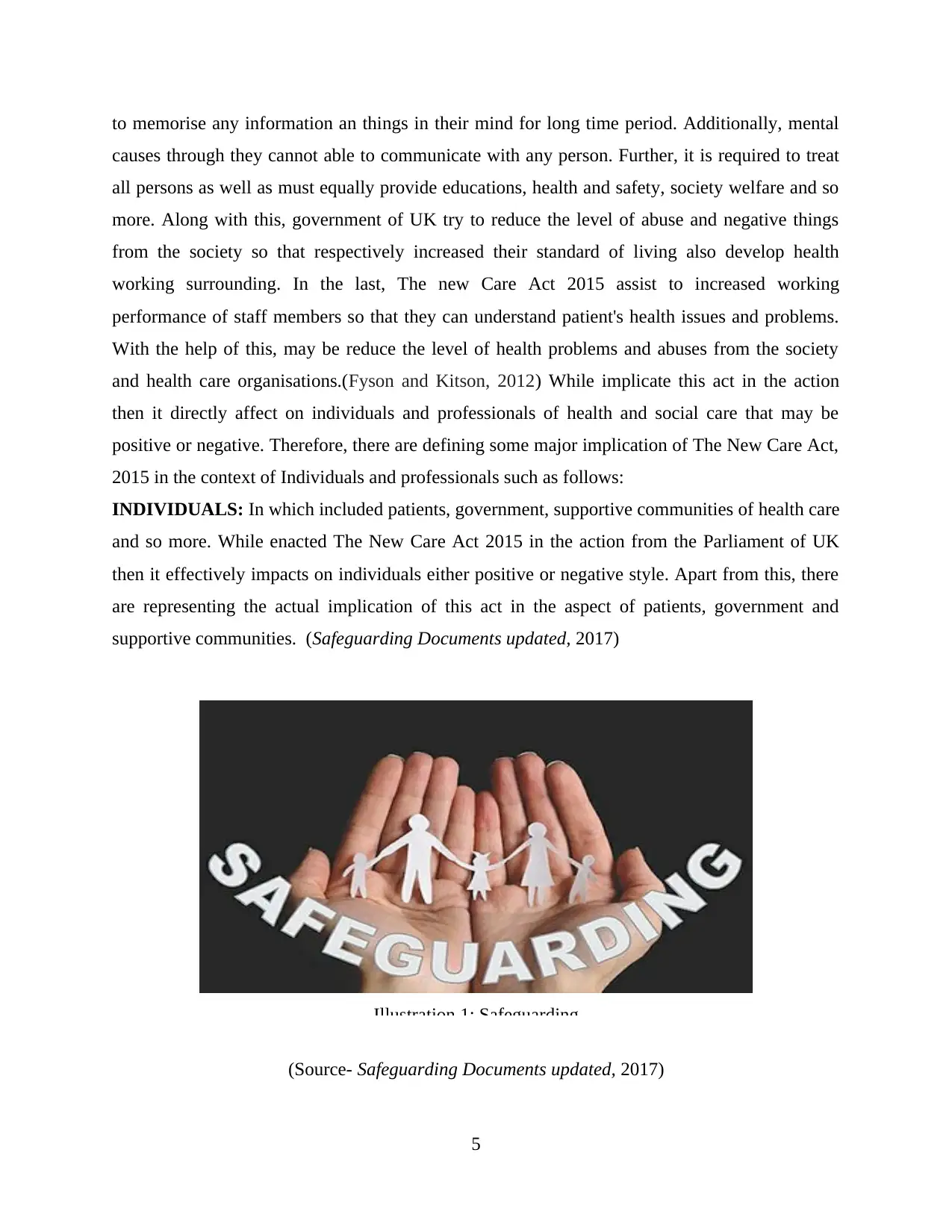
supportive communities. (Safeguarding Documents updated, 2017)
Illustration 1: Safeguarding
(Source- Safeguarding Documents updated, 2017)
5
causes through they cannot able to communicate with any person. Further, it is required to treat
all persons as well as must equally provide educations, health and safety, society welfare and so
more. Along with this, government of UK try to reduce the level of abuse and negative things
from the society so that respectively increased their standard of living also develop health
working surrounding. In the last, The new Care Act 2015 assist to increased working
performance of staff members so that they can understand patient's health issues and problems.
With the help of this, may be reduce the level of health problems and abuses from the society
and health care organisations.(Fyson and Kitson, 2012) While implicate this act in the action
then it directly affect on individuals and professionals of health and social care that may be
positive or negative. Therefore, there are defining some major implication of The New Care Act,
2015 in the context of Individuals and professionals such as follows:
INDIVIDUALS: In which included patients, government, supportive communities of health care
and so more. While enacted The New Care Act 2015 in the action from the Parliament of UK
then it effectively impacts on individuals either positive or negative style. Apart from this, there
are representing the actual implication of this act in the aspect of patients, government and
supportive communities. (Safeguarding Documents updated, 2017)
Illustration 1: Safeguarding
(Source- Safeguarding Documents updated, 2017)
5
Paraphrase This Document
Need a fresh take? Get an instant paraphrase of this document with our AI Paraphraser
Patients: At this time, most of the persons are affected by several health issues and problems
thus it is required to be provide better health care services and facilities to them so that they can
resolve their troubles. After implementing The New Care Act 2015 patients feel safe and secure
while taking treatments from health care organisation as well as they has some rights to take
appropriate decision against hospitals and staff members if they done any kind of negative and
discriminative activities with them. In order to this, it assists to provides appropriate rights and
powers to patients so that they can understand and increase their knowledge level about health
care industry. (Glasby and Dickinson, 2014)
Government: After regulated this act government more aware about developing healthy
environment and reducing the level of abusive activities from the country. Therefore, they focus
on to implement more appropriate rules and regulations in the nation which have to be followed
by every health care centres so that patients can feel safe.
Supportive communities: With the help of this Act, supportive communities better understand
and provide health services to patients who suffered by different health diseases and issues. Their
working style and system also enhanced also government will give some other benefits to
supportive communities so that they significantly solve health problems by suitable and better
treatments. (Glasby, 2017)
PROFESSIONALS: Doctors, workers or staff members, nurses etc. all they are professionals of
health care centre. All these professionals has some responsibilities and duties which should be
effectively performed within the health care centre. So that patients can make trust and take
proper treatments from professionals regarding their heath issues and problems. In order to this,
better environment of health care organisation helps to reduce the level of abusive activities and
health issues. Government of the UK had regulated several rules and acts for the health care
sector which have to be systematically followed by the professionals. Therefore, there are
defining some implications of The New Care Act 2015 on professional of health and social care
such as: (Karanikolos and et. al., 2013)
6
thus it is required to be provide better health care services and facilities to them so that they can
resolve their troubles. After implementing The New Care Act 2015 patients feel safe and secure
while taking treatments from health care organisation as well as they has some rights to take
appropriate decision against hospitals and staff members if they done any kind of negative and
discriminative activities with them. In order to this, it assists to provides appropriate rights and
powers to patients so that they can understand and increase their knowledge level about health
care industry. (Glasby and Dickinson, 2014)
Government: After regulated this act government more aware about developing healthy
environment and reducing the level of abusive activities from the country. Therefore, they focus
on to implement more appropriate rules and regulations in the nation which have to be followed
by every health care centres so that patients can feel safe.
Supportive communities: With the help of this Act, supportive communities better understand
and provide health services to patients who suffered by different health diseases and issues. Their
working style and system also enhanced also government will give some other benefits to
supportive communities so that they significantly solve health problems by suitable and better
treatments. (Glasby, 2017)
PROFESSIONALS: Doctors, workers or staff members, nurses etc. all they are professionals of
health care centre. All these professionals has some responsibilities and duties which should be
effectively performed within the health care centre. So that patients can make trust and take
proper treatments from professionals regarding their heath issues and problems. In order to this,
better environment of health care organisation helps to reduce the level of abusive activities and
health issues. Government of the UK had regulated several rules and acts for the health care
sector which have to be systematically followed by the professionals. Therefore, there are
defining some implications of The New Care Act 2015 on professional of health and social care
such as: (Karanikolos and et. al., 2013)
6
Doctors: These are plays very eminent role in the health care centres because it helps to provide
better health services and facilities to patients as per their injuries and health issues. Therefore,
according to the New Care Act, 2015 doctors has some major responsibilities which have to be
effectively performed by them because while doctors are not follows rules and regulations of
health care organisation then it may be negative affect on patients. Thus, it is needful for doctors
must be understand patients as well as their problems. (Lai and et. al., 2013)
Workers and Nurses: As per the New Care Act, 2015 nurses and staff members also should
follows rules and regulations of health care organisation additionally must be equally treat every
patients. Nurses are responsible to provide actual and reliable information to patients towards
their health injuries and problems so that patients can understand and take proper treatments
from them. At this time several fake and unethical activities had happen in the country due to
that patients not able to easy make faith on hospitals, doctors and nurses. Thus, after enacted this
act in the country professionals of health care centre are easy to understand their duties and try to
provide better services. In the last, The New Care Act, 2015 helps to decrease the level of
abusive and unethical activities from the society. With the help of this act professionals become
more conscious and focus on their duties and responsibilities as well as patients also can
significantly take proper treatments with faith towards their health issues and problems. (Lloyd,
2010)
TASK 3
3.1 Health or social care setting to identify the extent to which individuals are at risk of harm
Covered in PPT
3.2 Examine how social processes impact on users of health and social care services
Covered in PPT
7
better health services and facilities to patients as per their injuries and health issues. Therefore,
according to the New Care Act, 2015 doctors has some major responsibilities which have to be
effectively performed by them because while doctors are not follows rules and regulations of
health care organisation then it may be negative affect on patients. Thus, it is needful for doctors
must be understand patients as well as their problems. (Lai and et. al., 2013)
Workers and Nurses: As per the New Care Act, 2015 nurses and staff members also should
follows rules and regulations of health care organisation additionally must be equally treat every
patients. Nurses are responsible to provide actual and reliable information to patients towards
their health injuries and problems so that patients can understand and take proper treatments
from them. At this time several fake and unethical activities had happen in the country due to
that patients not able to easy make faith on hospitals, doctors and nurses. Thus, after enacted this
act in the country professionals of health care centre are easy to understand their duties and try to
provide better services. In the last, The New Care Act, 2015 helps to decrease the level of
abusive and unethical activities from the society. With the help of this act professionals become
more conscious and focus on their duties and responsibilities as well as patients also can
significantly take proper treatments with faith towards their health issues and problems. (Lloyd,
2010)
TASK 3
3.1 Health or social care setting to identify the extent to which individuals are at risk of harm
Covered in PPT
3.2 Examine how social processes impact on users of health and social care services
Covered in PPT
7
⊘ This is a preview!⊘
Do you want full access?
Subscribe today to unlock all pages.
Trusted by 1+ million students worldwide
3.3 Explanation of existing working practices and strategies designed to minimise abuse in health
and social care
Covered in PPT
CONCLUSION
From the above mentioned report it has been concluded that health and social care sector
is fastest growing industry at world wide level because every persons are become more health
conscious. Therefore, Day centre has been inducted 6 students with in the organisation thus here
has been produced induction pack for them. In which has been clarify the different type of
abuses and their indicators. Additionally different type of social and culture factors which might
be impact on patients. In the other hand, here has been wrote effective essay on actual
implication of The New Care Act 2015 on individuals and professionals of health and social care
because its directly affects on staff members and doctors of the health care centre either positive
or negative in nature. In the last, here has been demonstrated several risk for 6 students while
they were working for patients as well as different type of working practices and strategies.
8
and social care
Covered in PPT
CONCLUSION
From the above mentioned report it has been concluded that health and social care sector
is fastest growing industry at world wide level because every persons are become more health
conscious. Therefore, Day centre has been inducted 6 students with in the organisation thus here
has been produced induction pack for them. In which has been clarify the different type of
abuses and their indicators. Additionally different type of social and culture factors which might
be impact on patients. In the other hand, here has been wrote effective essay on actual
implication of The New Care Act 2015 on individuals and professionals of health and social care
because its directly affects on staff members and doctors of the health care centre either positive
or negative in nature. In the last, here has been demonstrated several risk for 6 students while
they were working for patients as well as different type of working practices and strategies.
8
Paraphrase This Document
Need a fresh take? Get an instant paraphrase of this document with our AI Paraphraser
REFERENCES
Books, Online and Journals
Balen, R., Rhodes, C. and Ward, L., 2010. The power of stories: Using narrative for
interdisciplinary learning in health and social care. Social Work Education. 29(4).
pp.416-426.
Barlow, J. and Calam, R., 2011. A public health approach to safeguarding in the 21st century.
Child Abuse Review. 20(4). pp.238-255.
Currie, G. and Lockett, A., 2011. Distributing leadership in health and social care: concertive,
conjoint or collective?. International Journal of Management Reviews. 13(3). pp.286-
300.
Dimond, B. C., 2016. Legal Aspects of Mental Capacity: A Practical Guide for Health and
Social Care Professionals. John Wiley & Sons.
Ellis, K., 2011. ‘Street‐level Bureaucracy’Revisited: The Changing Face of Frontline Discretion
in Adult Social Care in England. Social Policy & Administration. 45(3). pp.221-244.
Fyson, R. and Kitson, D., 2010. Human rights and social wrongs: Issues in safeguarding adults
with learning disabilities. Practice. 22(5). pp.309-320.
Glasby, J. and Dickinson, H., 2014. Partnership working in health and social care: what is
integrated care and how can we deliver it?. Policy Press.
Glasby, J., 2017. Understanding health and social care. Policy Press.
Karanikolos, M. and et. al., 2013. Financial crisis, austerity, and health in Europe. The Lancet.
381(9874). pp.1323-1331.
Lai, T. and et. al., 2013. Estonia: health system review. Health systems in transition. 15(6). pp.1-
196.
Lloyd, L., 2010. The individual in social care: the ethics of care and the ‘personalisation
agenda’in services for older people in England. Ethics and Social Welfare. 4(2).
pp.188-200.
Lymbery, M., 2010. A new vision for adult social care? Continuities and change in the care of
older people. Critical Social Policy. 30(1). pp.5-26.
McKeeargue, M., 2010. Budget crises, health, and social welfare programmes. Bmj. 341. p.77.
Moss, B., 2017. Communication skills in health and social care. Sage.
Parton, N., 2010. Child protection and safeguarding in England: Changing and competing
conceptions of risk and their implications for social work. British Journal of Social
Work. 41(5). pp.854-875.
Ray, M. and Phillips, J., 2012. Social work with older people. Palgrave Macmillan.
Rigby, M., Hill, P., Koch, S. and Keeling, D., 2011. Social care informatics as an essential part
of holistic health care: a call for action. International Journal of Medical Informatics.
80(8). pp.544-554.
Schwartz, L.A. and et. al., 2011. A social‐ecological model of readiness for transition to adult‐
oriented care for adolescents and young adults with chronic health conditions. Child:
care, health and development. 37(6). pp.883-895.
Sheldon, B., 2011. Cognitive-behavioural therapy: Research and practice in health and social
care. Routledge.
Stevens, M. and et. al., 2011. Assessing the role of increasing choice in English social care
services. Journal of Social Policy. 40(2). pp.257-274.
9
Books, Online and Journals
Balen, R., Rhodes, C. and Ward, L., 2010. The power of stories: Using narrative for
interdisciplinary learning in health and social care. Social Work Education. 29(4).
pp.416-426.
Barlow, J. and Calam, R., 2011. A public health approach to safeguarding in the 21st century.
Child Abuse Review. 20(4). pp.238-255.
Currie, G. and Lockett, A., 2011. Distributing leadership in health and social care: concertive,
conjoint or collective?. International Journal of Management Reviews. 13(3). pp.286-
300.
Dimond, B. C., 2016. Legal Aspects of Mental Capacity: A Practical Guide for Health and
Social Care Professionals. John Wiley & Sons.
Ellis, K., 2011. ‘Street‐level Bureaucracy’Revisited: The Changing Face of Frontline Discretion
in Adult Social Care in England. Social Policy & Administration. 45(3). pp.221-244.
Fyson, R. and Kitson, D., 2010. Human rights and social wrongs: Issues in safeguarding adults
with learning disabilities. Practice. 22(5). pp.309-320.
Glasby, J. and Dickinson, H., 2014. Partnership working in health and social care: what is
integrated care and how can we deliver it?. Policy Press.
Glasby, J., 2017. Understanding health and social care. Policy Press.
Karanikolos, M. and et. al., 2013. Financial crisis, austerity, and health in Europe. The Lancet.
381(9874). pp.1323-1331.
Lai, T. and et. al., 2013. Estonia: health system review. Health systems in transition. 15(6). pp.1-
196.
Lloyd, L., 2010. The individual in social care: the ethics of care and the ‘personalisation
agenda’in services for older people in England. Ethics and Social Welfare. 4(2).
pp.188-200.
Lymbery, M., 2010. A new vision for adult social care? Continuities and change in the care of
older people. Critical Social Policy. 30(1). pp.5-26.
McKeeargue, M., 2010. Budget crises, health, and social welfare programmes. Bmj. 341. p.77.
Moss, B., 2017. Communication skills in health and social care. Sage.
Parton, N., 2010. Child protection and safeguarding in England: Changing and competing
conceptions of risk and their implications for social work. British Journal of Social
Work. 41(5). pp.854-875.
Ray, M. and Phillips, J., 2012. Social work with older people. Palgrave Macmillan.
Rigby, M., Hill, P., Koch, S. and Keeling, D., 2011. Social care informatics as an essential part
of holistic health care: a call for action. International Journal of Medical Informatics.
80(8). pp.544-554.
Schwartz, L.A. and et. al., 2011. A social‐ecological model of readiness for transition to adult‐
oriented care for adolescents and young adults with chronic health conditions. Child:
care, health and development. 37(6). pp.883-895.
Sheldon, B., 2011. Cognitive-behavioural therapy: Research and practice in health and social
care. Routledge.
Stevens, M. and et. al., 2011. Assessing the role of increasing choice in English social care
services. Journal of Social Policy. 40(2). pp.257-274.
9
Tew, J. and et. al., 2012. Social factors and recovery from mental health difficulties: a review of
the evidence. The British Journal of Social Work. 42(3). pp.443-460.
Webber, M., McCree, C. and Angeli, P., 2013. Inter‐agency joint protocols for safeguarding
children in social care and adult mental‐health agencies: a cross‐sectional survey of
practitioner experiences. Child & Family Social Work. 18(2). pp.149-158.
Online
Safeguarding Documents updated. 2017. [Online]. Available
through:<http://www.basketballni.com/safeguarding/safeguarding-documents-updated/
>.
10
the evidence. The British Journal of Social Work. 42(3). pp.443-460.
Webber, M., McCree, C. and Angeli, P., 2013. Inter‐agency joint protocols for safeguarding
children in social care and adult mental‐health agencies: a cross‐sectional survey of
practitioner experiences. Child & Family Social Work. 18(2). pp.149-158.
Online
Safeguarding Documents updated. 2017. [Online]. Available
through:<http://www.basketballni.com/safeguarding/safeguarding-documents-updated/
>.
10
⊘ This is a preview!⊘
Do you want full access?
Subscribe today to unlock all pages.
Trusted by 1+ million students worldwide

1 out of 12


Related Documents


Your All-in-One AI-Powered Toolkit for Academic Success.
+13062052269
info@desklib.com
Available 24*7 on WhatsApp / Email
![[object Object]](/_next/static/media/star-bottom.7253800d.svg)
Unlock your academic potential
Copyright © 2020–2025 A2Z Services. All Rights Reserved. Developed and managed by ZUCOL.