Maritime Safety Company: Issues, Causes, Alternatives, Report
VerifiedAdded on 2021/06/14
|13
|2964
|47
Report
AI Summary
This report provides a comprehensive analysis of the Maritime Safety Company, addressing its challenges in a rapidly evolving market. The company faces issues related to transformation, including internal resistance and a lack of innovation. The report identifies causes such as the absence of an independent perspective and a reluctance to change from traditional methods. It explores alternative solutions like top-down and bottom-up approaches, redesigning cross-functional processes, and creating a transformation task force. The recommended solutions include developing a target operating model, rethinking the business model, and fostering a culture of change. The implementation involves acquiring new skills, establishing a clear organizational structure, and embracing digital transformation. The report emphasizes the need for leadership and a shift in employee behavior to ensure successful transformation and sustainable growth in the competitive maritime safety market. The report also discusses the importance of embracing technology and customer-centric strategies.
Maritime Safety Company Issues, Causes, Alternatives, Recommendations and Implementations
Student’s Name
Institution
Student’s Name
Institution

Paraphrase This Document
Need a fresh take? Get an instant paraphrase of this document with our AI Paraphraser
2
Executive Summary
The Maritime Safety Company operates in Maritime safety. It is a very well-established
organization which provides services globally to different organizations. The size of the
organization is small size with approximately between 40 -50 employees. The board comprises a
large enterprise type organization. The organization has established services that are well-known,
well drafted and were satisfied by their financial performance. They had created and established
a brand. They realized that they could remain static as a company and needed as a company and
needed to change the way they deliver services to their clients because of the realization that
their rate of change outside the industry was moving at a fast pace as compared to the change
within the organization. The report gives present the issues, causes, alternatives,
recommendation, and implementation aspects of the company.
Introduction
The global market in maritime safety was 17.3 billion US dollars in 2016. It is forecasted
to grow at the rate of 7.7% in the period of 2017 through to 2024. The market is driven by
compliances and standards, safety awareness, increasing trade activities and freight. The
segmentation of the market is based on technologies and systems, access control, surveillance
and tracking segment and the rest of the segments are segmented into long-range acoustic device.
The Maritime Safety Company deals only with maritime safety and delivering technology
services. The company operates in a global environment and therefore faces competition from
others players in the same global market. BAE Systems and Elbit Systems Ltd are some of the
players this same market among many competitors (DataBridge Market Research, 2018).
Issues
Executive Summary
The Maritime Safety Company operates in Maritime safety. It is a very well-established
organization which provides services globally to different organizations. The size of the
organization is small size with approximately between 40 -50 employees. The board comprises a
large enterprise type organization. The organization has established services that are well-known,
well drafted and were satisfied by their financial performance. They had created and established
a brand. They realized that they could remain static as a company and needed as a company and
needed to change the way they deliver services to their clients because of the realization that
their rate of change outside the industry was moving at a fast pace as compared to the change
within the organization. The report gives present the issues, causes, alternatives,
recommendation, and implementation aspects of the company.
Introduction
The global market in maritime safety was 17.3 billion US dollars in 2016. It is forecasted
to grow at the rate of 7.7% in the period of 2017 through to 2024. The market is driven by
compliances and standards, safety awareness, increasing trade activities and freight. The
segmentation of the market is based on technologies and systems, access control, surveillance
and tracking segment and the rest of the segments are segmented into long-range acoustic device.
The Maritime Safety Company deals only with maritime safety and delivering technology
services. The company operates in a global environment and therefore faces competition from
others players in the same global market. BAE Systems and Elbit Systems Ltd are some of the
players this same market among many competitors (DataBridge Market Research, 2018).
Issues
3
The issues are that they have three different points of inflection that has to stop the
transformation from taking place. This hindrance was causing a number of concerns to the board
and the company. There is a concern about financial, reputation and sustainability of services.
In addition, the same people that are providing traditional services are the same people
trying to hinder transformation. There is no actual completion day or reasons to successfully
deliver the transformation because the company was operating successfully through delivering
services to its clients.
The approaches that were adopted to addressing the issues bring in in-house the
additional capabilities in the same area without separating and bringing in new perspective and
approaches. This was continuous, were not evolving, not identified and no good cause analysis
or a path to follow the organization.
Moreover, there was lack of innovation and strategy that was put in place by the
company. There were increased reputation risk and the commercial risk that was increasing on
daily basis and therefore the need to identify different options to be implemented so as to move
forward.
Causes
The bigger problem is caused by the company as there is no independent perspective and
a clear path that guarantees success so as to effect the transformation. The independent oversight
section in-place is small and does not impact on the transformation and changes through the
various points of inflection. Additionally, the degree of organizational capacity is missing,
unidentified and has never been independently identified through previous paths. Moreover,
there is no burning platform that ignites the desire to change because of the notion that they are
operating successfully in the traditional way.
The issues are that they have three different points of inflection that has to stop the
transformation from taking place. This hindrance was causing a number of concerns to the board
and the company. There is a concern about financial, reputation and sustainability of services.
In addition, the same people that are providing traditional services are the same people
trying to hinder transformation. There is no actual completion day or reasons to successfully
deliver the transformation because the company was operating successfully through delivering
services to its clients.
The approaches that were adopted to addressing the issues bring in in-house the
additional capabilities in the same area without separating and bringing in new perspective and
approaches. This was continuous, were not evolving, not identified and no good cause analysis
or a path to follow the organization.
Moreover, there was lack of innovation and strategy that was put in place by the
company. There were increased reputation risk and the commercial risk that was increasing on
daily basis and therefore the need to identify different options to be implemented so as to move
forward.
Causes
The bigger problem is caused by the company as there is no independent perspective and
a clear path that guarantees success so as to effect the transformation. The independent oversight
section in-place is small and does not impact on the transformation and changes through the
various points of inflection. Additionally, the degree of organizational capacity is missing,
unidentified and has never been independently identified through previous paths. Moreover,
there is no burning platform that ignites the desire to change because of the notion that they are
operating successfully in the traditional way.
⊘ This is a preview!⊘
Do you want full access?
Subscribe today to unlock all pages.

Trusted by 1+ million students worldwide
4
Through the process, the company realized that the structure that was in place was not
going to allow successful delivery of the transformation. The transformation has cultural,
organizational and technology-based elements.
Alternatives
The organization irrespective of its successful nature as well as its reputation in the
market, there is short of initiatives for change. The ill-match initiatives seen in the organization
is due to the fact that efforts get focused on one or two of the three axes of change. The first
alternative that is better for change in the organization is setting of top-down direction. The
approach gives a focus for change and transformation in the entire organization as well as
developing amble conditions that are vital for improvements of performance (Carlos Pinho et
al.2014, 374-398). Additionally, a broad-based there is the need for a bottom-up approach so that
it enhances performance improvement. This permits the employees to take approaches that are
fresh in enhancing performance and solving issues that may arise. On top of this, there is the
need for redesign of the cross-functional process so as to facilitate linking of functions, activities,
and information in new methods in order to allow the breakthrough in quality, timeliness and
improve in cost (Hill et al. 2014).
The other alternative that energizes the team is setting and rewarding quick wins. It
provides a tangible new approach to doing things which get enshrined in the transformation
vision and culture for change. Since the transformation takes time and involves many people, a
number of these people will not wake-up for the task unless they get strategic goals that are
short-term as well as achievable for the long path to ultimate success (Dyer et al. 2013).
Moreover, the organization needs to create transformation task force charged with the
role of ensuring that there is no complacency that permits old habits. Despite the fact that the
Through the process, the company realized that the structure that was in place was not
going to allow successful delivery of the transformation. The transformation has cultural,
organizational and technology-based elements.
Alternatives
The organization irrespective of its successful nature as well as its reputation in the
market, there is short of initiatives for change. The ill-match initiatives seen in the organization
is due to the fact that efforts get focused on one or two of the three axes of change. The first
alternative that is better for change in the organization is setting of top-down direction. The
approach gives a focus for change and transformation in the entire organization as well as
developing amble conditions that are vital for improvements of performance (Carlos Pinho et
al.2014, 374-398). Additionally, a broad-based there is the need for a bottom-up approach so that
it enhances performance improvement. This permits the employees to take approaches that are
fresh in enhancing performance and solving issues that may arise. On top of this, there is the
need for redesign of the cross-functional process so as to facilitate linking of functions, activities,
and information in new methods in order to allow the breakthrough in quality, timeliness and
improve in cost (Hill et al. 2014).
The other alternative that energizes the team is setting and rewarding quick wins. It
provides a tangible new approach to doing things which get enshrined in the transformation
vision and culture for change. Since the transformation takes time and involves many people, a
number of these people will not wake-up for the task unless they get strategic goals that are
short-term as well as achievable for the long path to ultimate success (Dyer et al. 2013).
Moreover, the organization needs to create transformation task force charged with the
role of ensuring that there is no complacency that permits old habits. Despite the fact that the
Paraphrase This Document
Need a fresh take? Get an instant paraphrase of this document with our AI Paraphraser
5
efforts for change cannot be perceived in a short time, the task force has to embrace and advocate
for resiliency fueled by a good reward system. The team is held accountable and gets a reward
based on their achievements (Klang et al. 2014, 454-478).
On the other hand, must have a purpose for the change. When there is a purpose for
change, there is the creation of the power to transform the organization. It indicates the point at
which the organization is situated at the time for the change. This makes the employee
rejuvenated and energized, creates strong alignment in the company, boost customer loyalty,
greater value for investment and new markets. According to Visnjic et al. (2016, 36-52), leaders
currently endeavor in people, planet, and profit. The essentiality of profit generation is to get the
employees, make them satisfied and show a responsibility in the outside society through the
commitment to embracing sustainable practices in relation to the environment.
Decision Criteria
The criteria that get employed in arriving at the options to make recommendations are
based on the dynamic market that is rapidly evolving. In order to remain competitive in the
maritime safety market, Martine Safety Company has to upscale its strategies to be sustainable
such that they are well above the players in the market. The current state of using traditional
method and strategies will soon be overtaken by events and will find the organization in a bad
state as far as the stiff competition is a consideration. The competition based on technology
adoption and change in culture by other players in the market will make Maritime Safety
Company lack behind and risk losing the market share they enjoy. Customers, on the other hand,
are upbeat with current technological changes and are adapting and using this vital tool for better
services to their doorsteps. In view of this, there is need to change the company culture, embrace
technology, develop a clear path to success and set strategies with new perspective and approach.
efforts for change cannot be perceived in a short time, the task force has to embrace and advocate
for resiliency fueled by a good reward system. The team is held accountable and gets a reward
based on their achievements (Klang et al. 2014, 454-478).
On the other hand, must have a purpose for the change. When there is a purpose for
change, there is the creation of the power to transform the organization. It indicates the point at
which the organization is situated at the time for the change. This makes the employee
rejuvenated and energized, creates strong alignment in the company, boost customer loyalty,
greater value for investment and new markets. According to Visnjic et al. (2016, 36-52), leaders
currently endeavor in people, planet, and profit. The essentiality of profit generation is to get the
employees, make them satisfied and show a responsibility in the outside society through the
commitment to embracing sustainable practices in relation to the environment.
Decision Criteria
The criteria that get employed in arriving at the options to make recommendations are
based on the dynamic market that is rapidly evolving. In order to remain competitive in the
maritime safety market, Martine Safety Company has to upscale its strategies to be sustainable
such that they are well above the players in the market. The current state of using traditional
method and strategies will soon be overtaken by events and will find the organization in a bad
state as far as the stiff competition is a consideration. The competition based on technology
adoption and change in culture by other players in the market will make Maritime Safety
Company lack behind and risk losing the market share they enjoy. Customers, on the other hand,
are upbeat with current technological changes and are adapting and using this vital tool for better
services to their doorsteps. In view of this, there is need to change the company culture, embrace
technology, develop a clear path to success and set strategies with new perspective and approach.
6
Recommended Solutions
There is a need for Maritime Safety Company to develop a target operating model and
get the model aligned with the goals of transformation. In order to realize this, the process begins
with benchmarking with other players in the market and making the assessment so as to make a
comparison with the current state of the organization Smith and Wendy 2014).In the evaluation
of the organization, the profitability gained is as a result of the reputation build over time, the
operations set and steering made with time. However, with the current stiff market and
emergence of tough players coupled with application and implementation of technology,
Maritime Company will soon be defeated owing to its use of the traditional model (Cummings et
al. 2014).
It is therefore of paramount importance to eliminate, improve and replace core traditional
processes employed currently. These core processes need not be changed but instead reimagine
and rewire approaches and the viable option is to use the digital lens. The use of technology
coupled with changing customer behavior compels companies for radical changes with the aim
of improving product and services. In addition, when the internal processes in the organization
employ technology, there is increased transparency, create levels for making quick and effective
decisions (Welford and Richard 2013). In the application of the target Model, the lean approach
put forth great value. It begins with the value position examined from the customer’s perspective
as opposed to internal perspective. The processes get broken down into discrete steps matching
client’s needs, creating value and eliminating waste. This deals away with the friction that
emanates between departments as well as value streams. In addition, through the use of this
approach, the organization at the same time promotes learning organization which is vital for
transformation (Benn et al. 2014).
Recommended Solutions
There is a need for Maritime Safety Company to develop a target operating model and
get the model aligned with the goals of transformation. In order to realize this, the process begins
with benchmarking with other players in the market and making the assessment so as to make a
comparison with the current state of the organization Smith and Wendy 2014).In the evaluation
of the organization, the profitability gained is as a result of the reputation build over time, the
operations set and steering made with time. However, with the current stiff market and
emergence of tough players coupled with application and implementation of technology,
Maritime Company will soon be defeated owing to its use of the traditional model (Cummings et
al. 2014).
It is therefore of paramount importance to eliminate, improve and replace core traditional
processes employed currently. These core processes need not be changed but instead reimagine
and rewire approaches and the viable option is to use the digital lens. The use of technology
coupled with changing customer behavior compels companies for radical changes with the aim
of improving product and services. In addition, when the internal processes in the organization
employ technology, there is increased transparency, create levels for making quick and effective
decisions (Welford and Richard 2013). In the application of the target Model, the lean approach
put forth great value. It begins with the value position examined from the customer’s perspective
as opposed to internal perspective. The processes get broken down into discrete steps matching
client’s needs, creating value and eliminating waste. This deals away with the friction that
emanates between departments as well as value streams. In addition, through the use of this
approach, the organization at the same time promotes learning organization which is vital for
transformation (Benn et al. 2014).
⊘ This is a preview!⊘
Do you want full access?
Subscribe today to unlock all pages.
Trusted by 1+ million students worldwide
7
The other recommendation applicable is rethinking of the business model. Maritime
Safety Company has a task in this aspect ( (Bocken et al. 2014, 42-56). The traditional model
employed for a length of time get superseded by changing strategies in the market thus shift in
strategy, value reevaluation, as well as focus on new services and products. The traditional
model cannot be done away immediately but get juxtaposed with the new models like the
innovative-go-to-market method or digital strategy. The common transformation trap is used to
make flexible processes that get refined with time (Arend and Richard 2013, 390-402).
The organization through the use transformation task force requires leading from the
front as change agents. The team task to ensure change, as well as transformation, must show
leadership capabilities (Cruickshank et al. 2013, 271-290).The leader has to lead and be a role
model for the people to follow. When the right committed people are the task to lead, the people
providing traditional services will not try to hinder transformation (Goetsch, David and Stanley
2014). Maritime Safety Company instead of using the same people as agents of change requires
bringing in new people with the right skills that will be agents of change (Fitzsimmons et al.
2014, 80-94). Even though this might prove to be difficult owing to resistance and denial from
the employee, the task team has to induce a process for change so that it follows denial,
resistance, exploration, and commitment phases (Trevino et al. 2016).
In addition to the above recommendation for change and transformation, the Maritime
Safety Company requires relooking into the culture of the company (Katzenbach et al. 2015).
There is the need for the employees to transform what they do and the manner of doing the task
and this call for a change in behavior. Design and delayering of the organization bring in changes
in behavior that facilitate a good environment that encourages the exercise of desired behavior
(Nederveen Pieterse et al. 2013, 782-804).
The other recommendation applicable is rethinking of the business model. Maritime
Safety Company has a task in this aspect ( (Bocken et al. 2014, 42-56). The traditional model
employed for a length of time get superseded by changing strategies in the market thus shift in
strategy, value reevaluation, as well as focus on new services and products. The traditional
model cannot be done away immediately but get juxtaposed with the new models like the
innovative-go-to-market method or digital strategy. The common transformation trap is used to
make flexible processes that get refined with time (Arend and Richard 2013, 390-402).
The organization through the use transformation task force requires leading from the
front as change agents. The team task to ensure change, as well as transformation, must show
leadership capabilities (Cruickshank et al. 2013, 271-290).The leader has to lead and be a role
model for the people to follow. When the right committed people are the task to lead, the people
providing traditional services will not try to hinder transformation (Goetsch, David and Stanley
2014). Maritime Safety Company instead of using the same people as agents of change requires
bringing in new people with the right skills that will be agents of change (Fitzsimmons et al.
2014, 80-94). Even though this might prove to be difficult owing to resistance and denial from
the employee, the task team has to induce a process for change so that it follows denial,
resistance, exploration, and commitment phases (Trevino et al. 2016).
In addition to the above recommendation for change and transformation, the Maritime
Safety Company requires relooking into the culture of the company (Katzenbach et al. 2015).
There is the need for the employees to transform what they do and the manner of doing the task
and this call for a change in behavior. Design and delayering of the organization bring in changes
in behavior that facilitate a good environment that encourages the exercise of desired behavior
(Nederveen Pieterse et al. 2013, 782-804).
Paraphrase This Document
Need a fresh take? Get an instant paraphrase of this document with our AI Paraphraser
8
The Implementations and Implications
The initial stage of implementation is to have the right people in the organization with
skills and competencies. These require the organization to train, recruit and hire to get people
with new competencies. As this is a task, the implication is that resources get involved. The
organization has to set up resources that are sufficient to make implementation happen and the
support of management and the board is needed.
Additionally, there is need to create a target operating model. This is possible by setting
up the structure delineating distinct lines of authority, with clear and open communications lines.
It is important to eliminate, improve and replace core traditional processes by reimagining and
rewiring the approaches used. The viable option is digital lens.
The Maritime Safety Company has to change the culture of the organization. There is a
requirement for workforce to change what they do and the way of doing work. This requires an
adjustment in conduct. Plan and delayering of the association acquire changes in conduct that
encourage great condition that supports the exercise of wanted behavior.
The Implementations and Implications
The initial stage of implementation is to have the right people in the organization with
skills and competencies. These require the organization to train, recruit and hire to get people
with new competencies. As this is a task, the implication is that resources get involved. The
organization has to set up resources that are sufficient to make implementation happen and the
support of management and the board is needed.
Additionally, there is need to create a target operating model. This is possible by setting
up the structure delineating distinct lines of authority, with clear and open communications lines.
It is important to eliminate, improve and replace core traditional processes by reimagining and
rewiring the approaches used. The viable option is digital lens.
The Maritime Safety Company has to change the culture of the organization. There is a
requirement for workforce to change what they do and the way of doing work. This requires an
adjustment in conduct. Plan and delayering of the association acquire changes in conduct that
encourage great condition that supports the exercise of wanted behavior.
9
References
Arend, Richard J. "The business model: Present and future—beyond a skeumorph." Strategic
Organization 11, no. 4 (2013): 390-402.
Benn, Suzanne, Melissa Edwards, and Tim Williams. Organizational change for corporate
sustainability. Routledge, 2014.
Bocken, Nancy MP, Samuel W. Short, P. Rana, and Steve Evans. "A literature and practice
review to develop sustainable business model archetypes." Journal of cleaner production
65 (2014): 42-56.
Carlos Pinho, José, Ana Paula Rodrigues, and Sally Dibb. "The role of corporate culture, market
orientation and organisational commitment in organisational performance: the case of
non-profit organisations." Journal of Management Development 33, no. 4 (2014): 374-
398.
Cruickshank, Andrew, Dave Collins, and Sue Minten. "Culture change in a professional sports
team: Shaping environmental contexts and regulating power." International journal of
sports science & coaching 8, no. 2 (2013): 271-290.
Cummings, Thomas G., and Christopher G. Worley. Organization development and change.
Cengage learning, 2014.
DataBridge Market Research. 2018. Global Maritime Safety Market by Manufacturers, Regions,
Type and Application, Forecast to 2024. Accessed 4 May 2018.
https://factsweek.com/128206/global-maritime-safety-market-by-manufacturers-regions-
type-and-application-forecast-to-2024-2/
Dyer, William G., and Jeffrey H. Dyer. Team building: Proven strategies for improving team
performance. John Wiley & Sons, 2013.
References
Arend, Richard J. "The business model: Present and future—beyond a skeumorph." Strategic
Organization 11, no. 4 (2013): 390-402.
Benn, Suzanne, Melissa Edwards, and Tim Williams. Organizational change for corporate
sustainability. Routledge, 2014.
Bocken, Nancy MP, Samuel W. Short, P. Rana, and Steve Evans. "A literature and practice
review to develop sustainable business model archetypes." Journal of cleaner production
65 (2014): 42-56.
Carlos Pinho, José, Ana Paula Rodrigues, and Sally Dibb. "The role of corporate culture, market
orientation and organisational commitment in organisational performance: the case of
non-profit organisations." Journal of Management Development 33, no. 4 (2014): 374-
398.
Cruickshank, Andrew, Dave Collins, and Sue Minten. "Culture change in a professional sports
team: Shaping environmental contexts and regulating power." International journal of
sports science & coaching 8, no. 2 (2013): 271-290.
Cummings, Thomas G., and Christopher G. Worley. Organization development and change.
Cengage learning, 2014.
DataBridge Market Research. 2018. Global Maritime Safety Market by Manufacturers, Regions,
Type and Application, Forecast to 2024. Accessed 4 May 2018.
https://factsweek.com/128206/global-maritime-safety-market-by-manufacturers-regions-
type-and-application-forecast-to-2024-2/
Dyer, William G., and Jeffrey H. Dyer. Team building: Proven strategies for improving team
performance. John Wiley & Sons, 2013.
⊘ This is a preview!⊘
Do you want full access?
Subscribe today to unlock all pages.
Trusted by 1+ million students worldwide
10
Fitzsimmons, Stacey R., and Christina L. Stamper. "How societal culture influences friction in
the employee–organization relationship." Human Resource Management Review 24, no.
1 (2014): 80-94.
Goetsch, David L., and Stanley B. Davis. Quality management for organizational excellence.
Upper Saddle River, NJ: pearson, 2014.
Hill, Charles WL, Gareth R. Jones, and Melissa A. Schilling. Strategic management: theory: an
integrated approach. Cengage Learning, 2014.
Katzenbach, Jon R., and Douglas K. Smith. The wisdom of teams: Creating the high
performance organization. Harvard Business Review Press, 2015.
Klang, David, Maria Wallnöfer, and Fredrik Hacklin. "The business model paradox: A
systematic review and exploration of antecedents." International Journal of Management
Reviews 16, no. 4 (2014): 454-478.
Locke, Edwin A., and Gary P. Latham, eds. New developments in goal setting and task
performance. Routledge, 2013.
Nederveen Pieterse, Anne, Daan Van Knippenberg, and Dirk Van Dierendonck. "Cultural
diversity and team performance: The role of team member goal orientation." Academy of
Management Journal 56, no. 3 (2013): 782-804.
Smith, Wendy K. "Dynamic decision making: A model of senior leaders managing strategic
paradoxes." Academy of Management Journal 57, no. 6 (2014): 1592-1623.
Trevino, Linda K., and Katherine A. Nelson. Managing business ethics: Straight talk about how
to do it right. John Wiley & Sons, 2016.
Visnjic, Ivanka, Frank Wiengarten, and Andy Neely. "Only the brave: Product innovation,
Fitzsimmons, Stacey R., and Christina L. Stamper. "How societal culture influences friction in
the employee–organization relationship." Human Resource Management Review 24, no.
1 (2014): 80-94.
Goetsch, David L., and Stanley B. Davis. Quality management for organizational excellence.
Upper Saddle River, NJ: pearson, 2014.
Hill, Charles WL, Gareth R. Jones, and Melissa A. Schilling. Strategic management: theory: an
integrated approach. Cengage Learning, 2014.
Katzenbach, Jon R., and Douglas K. Smith. The wisdom of teams: Creating the high
performance organization. Harvard Business Review Press, 2015.
Klang, David, Maria Wallnöfer, and Fredrik Hacklin. "The business model paradox: A
systematic review and exploration of antecedents." International Journal of Management
Reviews 16, no. 4 (2014): 454-478.
Locke, Edwin A., and Gary P. Latham, eds. New developments in goal setting and task
performance. Routledge, 2013.
Nederveen Pieterse, Anne, Daan Van Knippenberg, and Dirk Van Dierendonck. "Cultural
diversity and team performance: The role of team member goal orientation." Academy of
Management Journal 56, no. 3 (2013): 782-804.
Smith, Wendy K. "Dynamic decision making: A model of senior leaders managing strategic
paradoxes." Academy of Management Journal 57, no. 6 (2014): 1592-1623.
Trevino, Linda K., and Katherine A. Nelson. Managing business ethics: Straight talk about how
to do it right. John Wiley & Sons, 2016.
Visnjic, Ivanka, Frank Wiengarten, and Andy Neely. "Only the brave: Product innovation,
Paraphrase This Document
Need a fresh take? Get an instant paraphrase of this document with our AI Paraphraser
11
service business model innovation, and their impact on performance." Journal of Product
Innovation Management 33, no. 1 (2016): 36-52.
Welford, Richard. Hijacking environmentalism: Corporate responses to sustainable
development. Routledge, 2013.
service business model innovation, and their impact on performance." Journal of Product
Innovation Management 33, no. 1 (2016): 36-52.
Welford, Richard. Hijacking environmentalism: Corporate responses to sustainable
development. Routledge, 2013.
12
Appendixes
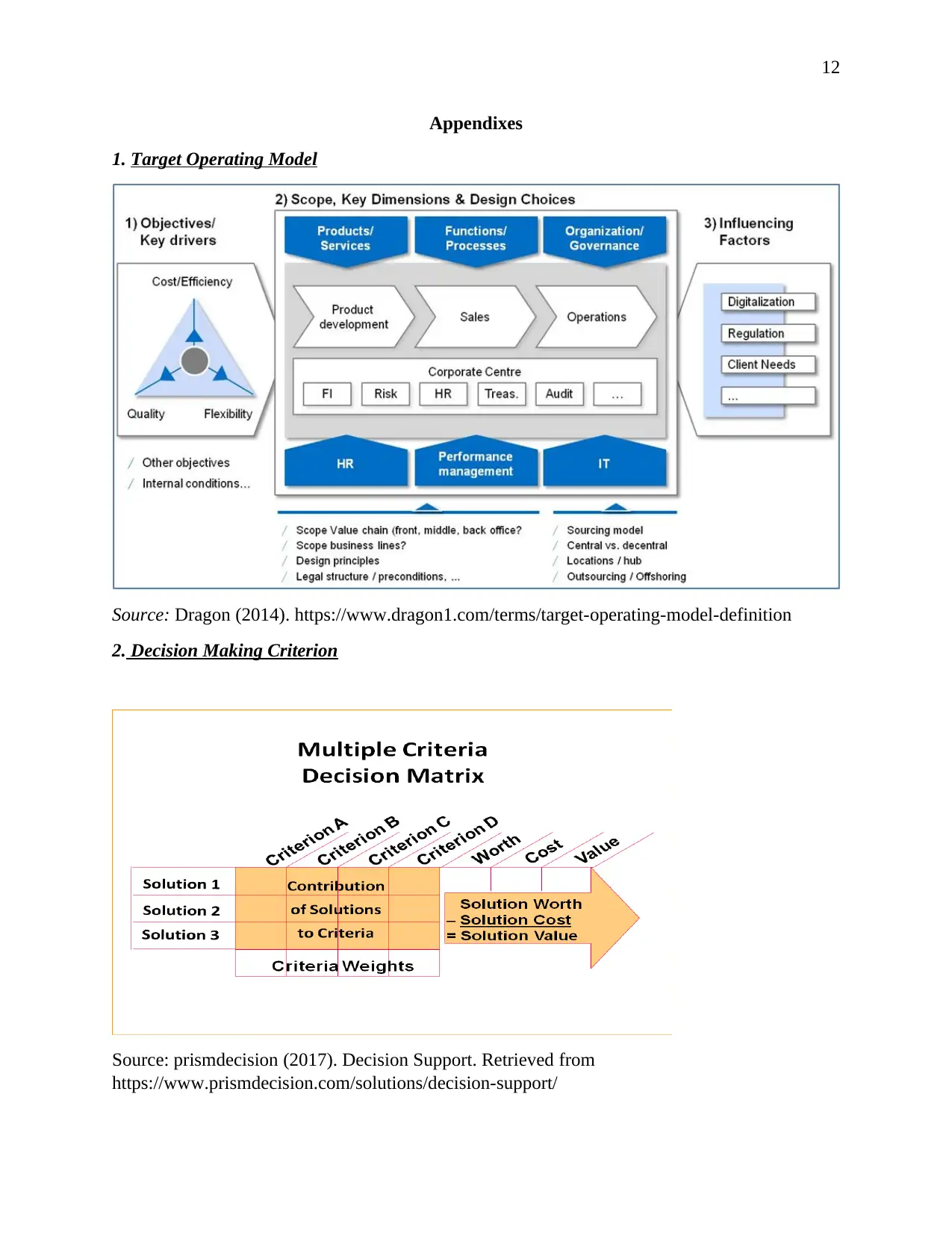
1. Target Operating Model
Source: Dragon (2014). https://www.dragon1.com/terms/target-operating-model-definition
2. Decision Making Criterion
Source: prismdecision (2017). Decision Support. Retrieved from
https://www.prismdecision.com/solutions/decision-support/
Appendixes
1. Target Operating Model
Source: Dragon (2014). https://www.dragon1.com/terms/target-operating-model-definition
2. Decision Making Criterion
Source: prismdecision (2017). Decision Support. Retrieved from
https://www.prismdecision.com/solutions/decision-support/
⊘ This is a preview!⊘
Do you want full access?
Subscribe today to unlock all pages.
Trusted by 1+ million students worldwide

1 out of 13


Related Documents


Your All-in-One AI-Powered Toolkit for Academic Success.
+13062052269
info@desklib.com
Available 24*7 on WhatsApp / Email
![[object Object]](/_next/static/media/star-bottom.7253800d.svg)
Unlock your academic potential
Copyright © 2020–2026 A2Z Services. All Rights Reserved. Developed and managed by ZUCOL.