Organisational Behaviour: Leadership and Motivation at Sainsbury
VerifiedAdded on 2023/01/17
|15
|5369
|58
Report
AI Summary
This report provides an in-depth analysis of organisational behaviour within the context of Sainsbury, a UK supermarket chain. It begins by defining organisational behaviour and its impact on employee attitudes and business objectives. Task 1 explores the influence of organisational culture, power dynamics, and politics on individual and team behaviour, with a critical analysis of these factors. Task 2 evaluates content and process theories of motivation, specifically focusing on Maslow's Hierarchy of Needs and Expectancy Theory, and their application within Sainsbury. Task 3 examines effective and ineffective teams, analyzing team development theories to foster cooperation. Finally, Task 4 applies organisational behaviour philosophies, justifying and evaluating their impact on Sainsbury. The report concludes with a critical analysis of the relationships between culture, politics, power, and motivation, highlighting their importance for team and organisational success.
Organisational
Behaviour
Behaviour

Paraphrase This Document
Need a fresh take? Get an instant paraphrase of this document with our AI Paraphraser
INTRODUCTION.............................................................................................................................4
TASK 1.................................................................................................................................................4
P1 Organisation culture, power and politics and their influence on individual and team behaviour. .4
M1 Critically analyse how the culture, politics and power of an organisation can influence
individual and team behaviour and performance...............................................................................6
TASK 2.................................................................................................................................................7
P2 Evaluation of content and process theories of motivation in context of Sainsbury.......................7
M2 Critical evaluation of how to influence the behaviour of others through effective
implementation of motivational theories...........................................................................................9
D1 Evaluate of the relationship between culture, politics, power and motivation that enables teams
and organisations to succeed..............................................................................................................9
TASK 3...............................................................................................................................................10
P3 Understanding of effective and ineffective team and their comparison......................................10
M3 Analyse of team development theories for development of cooperation in various teams of
Sainsbury.........................................................................................................................................12
TASK 4...............................................................................................................................................12
P4 Application of philosophies of organisational behaviour in Sainsbury.......................................12
M4 Justification and evaluation of range of concepts and philosophies influence Sainsbury in
positive or negative manner.............................................................................................................13
D2 Critically analyse and evaluate the relevance of team development theories in the context of
organisational behaviour concepts and philosophies that influence behaviour in the workplace.....14
CONCLUSION...................................................................................................................................14
REFERENCES....................................................................................................................................15
TASK 1.................................................................................................................................................4
P1 Organisation culture, power and politics and their influence on individual and team behaviour. .4
M1 Critically analyse how the culture, politics and power of an organisation can influence
individual and team behaviour and performance...............................................................................6
TASK 2.................................................................................................................................................7
P2 Evaluation of content and process theories of motivation in context of Sainsbury.......................7
M2 Critical evaluation of how to influence the behaviour of others through effective
implementation of motivational theories...........................................................................................9
D1 Evaluate of the relationship between culture, politics, power and motivation that enables teams
and organisations to succeed..............................................................................................................9
TASK 3...............................................................................................................................................10
P3 Understanding of effective and ineffective team and their comparison......................................10
M3 Analyse of team development theories for development of cooperation in various teams of
Sainsbury.........................................................................................................................................12
TASK 4...............................................................................................................................................12
P4 Application of philosophies of organisational behaviour in Sainsbury.......................................12
M4 Justification and evaluation of range of concepts and philosophies influence Sainsbury in
positive or negative manner.............................................................................................................13
D2 Critically analyse and evaluate the relevance of team development theories in the context of
organisational behaviour concepts and philosophies that influence behaviour in the workplace.....14
CONCLUSION...................................................................................................................................14
REFERENCES....................................................................................................................................15
INTRODUCTION
Organizational behaviour is defined as the study of human behaviour and performance
towards an achievement of organizational goal or objective in an appropriate manner. Also, it
is regarded as a process which empowers managers or leaders to direct the business and its
operations along with building relationships amongst various functional unit of an
organisation in order to attain sustainable growth. Apart from this, working culture of an
organisation plays significant role as it impact positively or negatively over employee’s
attitude or response towards business objective (Burrell and Morgan, 2019). Also, motivation
is another factor which is considered as an essential aspect which enables managers to
acquire increased level of personnel engagement into business activities that benefits the
entity and enhance their productivity. Hence, in context of this project Sainsbury is selected
which is a UK supermarket chain. Sainsbury is the third largest supermarket chain holding
around 15.3% market share of supermarket segment in UK. The company was founded in
1869 by John James Sainsbury and headquartered in Holborn, London. It is public limited
company and listed on London Stock Exchange and Financial Times Stock Exchange.
TASK 1
P1 Organisation culture, power and politics and their influence on individual and team
behaviour
Organisational culture is guide provided to the members and individuals in company for
managing and influencing their behaviour. It includes experiences, philosophies, values and
expectations of organisation from staff and other related parties. Organisational culture
includes vision and mission statement, norms, systems, symbols and language of company
which members follow and influencing their behaviour. Few cultures present in organisation
are highlighted below:
Person culture- In some organisations personnel’s believes and thinks that they are
more important than the entity they are working in. individuals are more concerned
about themselves rather than the organisation and others working with them (Chang
and et. al., 2016)Company who has this culture takes a back seat and eventually
suffers as employees become self-centred and they keep themselves and their
objective first rather than the organisation.
Organizational behaviour is defined as the study of human behaviour and performance
towards an achievement of organizational goal or objective in an appropriate manner. Also, it
is regarded as a process which empowers managers or leaders to direct the business and its
operations along with building relationships amongst various functional unit of an
organisation in order to attain sustainable growth. Apart from this, working culture of an
organisation plays significant role as it impact positively or negatively over employee’s
attitude or response towards business objective (Burrell and Morgan, 2019). Also, motivation
is another factor which is considered as an essential aspect which enables managers to
acquire increased level of personnel engagement into business activities that benefits the
entity and enhance their productivity. Hence, in context of this project Sainsbury is selected
which is a UK supermarket chain. Sainsbury is the third largest supermarket chain holding
around 15.3% market share of supermarket segment in UK. The company was founded in
1869 by John James Sainsbury and headquartered in Holborn, London. It is public limited
company and listed on London Stock Exchange and Financial Times Stock Exchange.
TASK 1
P1 Organisation culture, power and politics and their influence on individual and team
behaviour
Organisational culture is guide provided to the members and individuals in company for
managing and influencing their behaviour. It includes experiences, philosophies, values and
expectations of organisation from staff and other related parties. Organisational culture
includes vision and mission statement, norms, systems, symbols and language of company
which members follow and influencing their behaviour. Few cultures present in organisation
are highlighted below:
Person culture- In some organisations personnel’s believes and thinks that they are
more important than the entity they are working in. individuals are more concerned
about themselves rather than the organisation and others working with them (Chang
and et. al., 2016)Company who has this culture takes a back seat and eventually
suffers as employees become self-centred and they keep themselves and their
objective first rather than the organisation.
⊘ This is a preview!⊘
Do you want full access?
Subscribe today to unlock all pages.

Trusted by 1+ million students worldwide
Power culture- There are some organisations in which all the authority and power
remains in few hands that is considered as power culture. This culture has one or two
leaders who hold all the authority to make decisions and control plans or strategies of
company. All rapid decisions are taken by top level management or few people who
has all the power and therefore vertical structure is suggested for company who has
this culture. It will affect Sainsbury teams and its members in negative manners,
employees will start feeling less important and this will demotivate them and detach
them from company.
Role culture- In this culture roles and responsibilities are assigned to employees in
accordance with their expertise and specialisation. Different functional units are
created by grouping bundle of individuals for attaining specific objectives or goals.
Divisional structure of organisation is recommended and best suited for entities
adopting role culture. For Sainsbury role culture is suggested as it is best suited for the
company because of its various divisions and huge employee base.
Organisational power is an ability or capability of company structure, by which
management utilize all resources effectively for development and betterment of organisation.
Power is basically ability individual have over other to get things done in their way and
required manner, they control them and make them perform task according to them (Chumg
and et. al., 2016). Some types of power which managers have in organisation structure to
manage and influence the behaviour of employees or their teams are as follows:
Reward power- It a power which leaders have, it enables them to appreciate their staff
and by rewarding them according to their skills or their performances. This power is
useful for motivating people and influencing them to work harder by pushing
themselves to achieve better positions in organisation. This power is applicable in
Sainsbury, managers can use this power to motivate their team members attaining
efficient results and benefiting both the organisation and achieving their personal
goals.
Coercive power- Coercive power makes personnel belief that they are lacking and do
not have enough competitive skills and they are not complying with the needs of
organisation. It’s a forcing style of getting thing done with all negative effects on
personnel and teams (Coccia, 2015). Practicing this power is not at all suggestive for
Sainsbury as it will demotivate employees and increase dissatisfaction in them.
remains in few hands that is considered as power culture. This culture has one or two
leaders who hold all the authority to make decisions and control plans or strategies of
company. All rapid decisions are taken by top level management or few people who
has all the power and therefore vertical structure is suggested for company who has
this culture. It will affect Sainsbury teams and its members in negative manners,
employees will start feeling less important and this will demotivate them and detach
them from company.
Role culture- In this culture roles and responsibilities are assigned to employees in
accordance with their expertise and specialisation. Different functional units are
created by grouping bundle of individuals for attaining specific objectives or goals.
Divisional structure of organisation is recommended and best suited for entities
adopting role culture. For Sainsbury role culture is suggested as it is best suited for the
company because of its various divisions and huge employee base.
Organisational power is an ability or capability of company structure, by which
management utilize all resources effectively for development and betterment of organisation.
Power is basically ability individual have over other to get things done in their way and
required manner, they control them and make them perform task according to them (Chumg
and et. al., 2016). Some types of power which managers have in organisation structure to
manage and influence the behaviour of employees or their teams are as follows:
Reward power- It a power which leaders have, it enables them to appreciate their staff
and by rewarding them according to their skills or their performances. This power is
useful for motivating people and influencing them to work harder by pushing
themselves to achieve better positions in organisation. This power is applicable in
Sainsbury, managers can use this power to motivate their team members attaining
efficient results and benefiting both the organisation and achieving their personal
goals.
Coercive power- Coercive power makes personnel belief that they are lacking and do
not have enough competitive skills and they are not complying with the needs of
organisation. It’s a forcing style of getting thing done with all negative effects on
personnel and teams (Coccia, 2015). Practicing this power is not at all suggestive for
Sainsbury as it will demotivate employees and increase dissatisfaction in them.
Paraphrase This Document
Need a fresh take? Get an instant paraphrase of this document with our AI Paraphraser
Employees will get frustrated with the style leaders are working and start developing
negative attitude.
Organisational politics has two aspects negative and positive, politics takes place in
every organisation. If leader are using their power effectively and politics which is deploying
is effectively and in favour of organisation and its employees it will provide favourable
results. But if misuse of power or authority is done by any member then it can result in
negative politics. Types of organisational politics:
The weeds- It’s a dynamic and free dimension which grows automatically or naturally
in the environment of company amongst employees. It can be favourable for the
organisation and helps in building goods healthy relations. But if ignored and left
unmonitored then it can be very dangerous for entity.
The rocks- This type of politics takes place amongst people who ties knots with high
level groups, who holds strong powers with them. These relations are made on the
basis of individual interactions and formal authority levels like roles and expertise
people hold.
The high ground- It’s a functional politics which uses structure of control systems,
incentives schemes and sanctions that keep company in order and compliance.
Sainsbury managers can be a part of high ground politics; they can plan some special
rewards for their employees according to their tasks and performances. Providing
them job satisfaction and motivation (De Vasconcelos, Gouveia and Kimble, 2016).
Mixture of culture, power and politics in organisation is very influencing on individual
working in Sainsbury as part of a team or on personal level. These elements have direct
impacts on the behaviour and attitude of employees, if they are not happy and unsatisfied it
will affect company and its operations. Therefore, all these three factors indirectly have its
influence on Sainsbury’s operation and its employees.
M1 Critically analyse how the culture, politics and power of an organisation can influence
individual and team behaviour and performance
In every organisation the function of power, culture and politics plays a crucial role as it
directly impact over team and individual performance as well it’s decision making
capabilities. In context of Sainsbury, as it run its functional unit in retail sector by delivering
different segment of product or services. Therefore, in order to improve their overall
productivity, they make an initiative to adopt role culture into its working process which
negative attitude.
Organisational politics has two aspects negative and positive, politics takes place in
every organisation. If leader are using their power effectively and politics which is deploying
is effectively and in favour of organisation and its employees it will provide favourable
results. But if misuse of power or authority is done by any member then it can result in
negative politics. Types of organisational politics:
The weeds- It’s a dynamic and free dimension which grows automatically or naturally
in the environment of company amongst employees. It can be favourable for the
organisation and helps in building goods healthy relations. But if ignored and left
unmonitored then it can be very dangerous for entity.
The rocks- This type of politics takes place amongst people who ties knots with high
level groups, who holds strong powers with them. These relations are made on the
basis of individual interactions and formal authority levels like roles and expertise
people hold.
The high ground- It’s a functional politics which uses structure of control systems,
incentives schemes and sanctions that keep company in order and compliance.
Sainsbury managers can be a part of high ground politics; they can plan some special
rewards for their employees according to their tasks and performances. Providing
them job satisfaction and motivation (De Vasconcelos, Gouveia and Kimble, 2016).
Mixture of culture, power and politics in organisation is very influencing on individual
working in Sainsbury as part of a team or on personal level. These elements have direct
impacts on the behaviour and attitude of employees, if they are not happy and unsatisfied it
will affect company and its operations. Therefore, all these three factors indirectly have its
influence on Sainsbury’s operation and its employees.
M1 Critically analyse how the culture, politics and power of an organisation can influence
individual and team behaviour and performance
In every organisation the function of power, culture and politics plays a crucial role as it
directly impact over team and individual performance as well it’s decision making
capabilities. In context of Sainsbury, as it run its functional unit in retail sector by delivering
different segment of product or services. Therefore, in order to improve their overall
productivity, they make an initiative to adopt role culture into its working process which
leads them to assign roles and responsibilities among personnel on the basis of their interest
or capability. Sainsbury make an effort to adopt reward power as it motive them to recognise
the employee effort and also help them to reward employees in a fairly manner (Fein and et.
al., 2015). Additionally, Sainsbury ensures regarding maintaining a transparent or effective
communication among workforce that benefit them by gaining advantage among competitor
in an innovative style.
TASK 2
P2 Evaluation of content and process theories of motivation in context of Sainsbury
Motivation is a process of encouraging employees of company to work with their full
potential for attaining goals in an effective and more efficient manner, bringing higher profits
to organisation. Two broad categorised in which motivating techniques are divided are
content and Process theories. Content theories of motivation are the earliest tools introduced
by researchers and further modifications are being done with passing of time. This theory is
has four different theories in it given by authors and they are Maslow’s Hierarchy of needs,
ERG theory, Herzberg’s two factor theory and McClelland’s needs for achievement theory.
On the other hand, Process theories main focus is on how the individuals behave in order to
fulfil their needs. Process theories are Expectancy theory, Equity theory, Reinforcement
theory and Goal setting theory.
For Sainsbury Maslow’s Hierarchy of needs theory is selected amongst other content
theories:
Maslow’s Hierarchy of needs theory is the most widely known and used for understanding
and discovering the basic needs of people (Gkorezis and Petridou, 2017). It has five levels in
structure which represents five types of requirements of a person and through which this
theory is explained properly:
Physiological needs- Under these level very basic needs of individual are considered
like food, water and shelter. These requirements are foremost for every individual as
these are the basic survival needs.
Safety needs- Once basic needs are fulfilled then comes the safety needs, every
employee wish to have a safe and healthy working environment. They require job
security and freedom from any threats or danger while working.
or capability. Sainsbury make an effort to adopt reward power as it motive them to recognise
the employee effort and also help them to reward employees in a fairly manner (Fein and et.
al., 2015). Additionally, Sainsbury ensures regarding maintaining a transparent or effective
communication among workforce that benefit them by gaining advantage among competitor
in an innovative style.
TASK 2
P2 Evaluation of content and process theories of motivation in context of Sainsbury
Motivation is a process of encouraging employees of company to work with their full
potential for attaining goals in an effective and more efficient manner, bringing higher profits
to organisation. Two broad categorised in which motivating techniques are divided are
content and Process theories. Content theories of motivation are the earliest tools introduced
by researchers and further modifications are being done with passing of time. This theory is
has four different theories in it given by authors and they are Maslow’s Hierarchy of needs,
ERG theory, Herzberg’s two factor theory and McClelland’s needs for achievement theory.
On the other hand, Process theories main focus is on how the individuals behave in order to
fulfil their needs. Process theories are Expectancy theory, Equity theory, Reinforcement
theory and Goal setting theory.
For Sainsbury Maslow’s Hierarchy of needs theory is selected amongst other content
theories:
Maslow’s Hierarchy of needs theory is the most widely known and used for understanding
and discovering the basic needs of people (Gkorezis and Petridou, 2017). It has five levels in
structure which represents five types of requirements of a person and through which this
theory is explained properly:
Physiological needs- Under these level very basic needs of individual are considered
like food, water and shelter. These requirements are foremost for every individual as
these are the basic survival needs.
Safety needs- Once basic needs are fulfilled then comes the safety needs, every
employee wish to have a safe and healthy working environment. They require job
security and freedom from any threats or danger while working.
⊘ This is a preview!⊘
Do you want full access?
Subscribe today to unlock all pages.
Trusted by 1+ million students worldwide
Social needs- These needs are associated with the feelings of employees, everyone
wants to be accepted socially and especially at their workplace. Sense of
belongingness is what all employees want to feel.
Self-esteem needs- Here, the needs of recognition and gaining importance from other
are highlighted. Every personnel need to develop and grow and for that they want to
be recognized by their superiors and wish to work on important projects.
Self-actualization needs- These needs are those where personnel feel and want to take
more challenges for developing better skills and bringing creativity in their work
(Weng and et. al., 2015). For accomplishing this they wish to perform more
meaningful and innovative job roles.
Out of Process theories Expectancy theory is considered for Sainsbury:
Expectancy theory concept was given by Victor H. Vroom and it has three components
Expectancy, Instrumentality and Valance.
Expectancy- A belief is followed in this factor that efforts of the employees will
provide desired level of performance. Efforts are dependent on the experience,
confidence and required standards of performance. Each personnel have different
level of expectations and confidence in them about their capabilities(Hall and et. al.,
2016). Therefore, management of Sainsbury has to understand these levels and
provide required training and supervision to staff. In order to fulfilling their needs for
attaining their expected level of performance.
Instrumentality- Concept of this element is that employee belief that they get
outcomes if they reach to their expected level of performance. By reaching to their
performance standards they think if they get rewarded for their performance. So here
role of Sainsbury’s leaders here is they should keep their promises for motivating
employees and providing them what they expected.
Valance- The value employees placed on the rewards for the outcomes they achieved
on behalf of organisation. These values, rewards or goals are the sources by which
people get motivated and work in particular way for providing effective resulted to
company. Valance can also be defined as emotional expectations personnel holds in
relation to the outcomes they are generating on behalf of organisation. Sainsbury’s
managers have this job to analysis the behaviour of their employees and find out what
wants to be accepted socially and especially at their workplace. Sense of
belongingness is what all employees want to feel.
Self-esteem needs- Here, the needs of recognition and gaining importance from other
are highlighted. Every personnel need to develop and grow and for that they want to
be recognized by their superiors and wish to work on important projects.
Self-actualization needs- These needs are those where personnel feel and want to take
more challenges for developing better skills and bringing creativity in their work
(Weng and et. al., 2015). For accomplishing this they wish to perform more
meaningful and innovative job roles.
Out of Process theories Expectancy theory is considered for Sainsbury:
Expectancy theory concept was given by Victor H. Vroom and it has three components
Expectancy, Instrumentality and Valance.
Expectancy- A belief is followed in this factor that efforts of the employees will
provide desired level of performance. Efforts are dependent on the experience,
confidence and required standards of performance. Each personnel have different
level of expectations and confidence in them about their capabilities(Hall and et. al.,
2016). Therefore, management of Sainsbury has to understand these levels and
provide required training and supervision to staff. In order to fulfilling their needs for
attaining their expected level of performance.
Instrumentality- Concept of this element is that employee belief that they get
outcomes if they reach to their expected level of performance. By reaching to their
performance standards they think if they get rewarded for their performance. So here
role of Sainsbury’s leaders here is they should keep their promises for motivating
employees and providing them what they expected.
Valance- The value employees placed on the rewards for the outcomes they achieved
on behalf of organisation. These values, rewards or goals are the sources by which
people get motivated and work in particular way for providing effective resulted to
company. Valance can also be defined as emotional expectations personnel holds in
relation to the outcomes they are generating on behalf of organisation. Sainsbury’s
managers have this job to analysis the behaviour of their employees and find out what
Paraphrase This Document
Need a fresh take? Get an instant paraphrase of this document with our AI Paraphraser
they expect in relation to their reward. Then accordingly, appreciate their performance
and reward them.
Sainsbury is a supermarket chain which has various departments performing several tasks
with help of numerous employees. There are great chances of development of conflicts
amongst employees and their interests can differ from company. To encourage staff and to
increase their enthusiasm Sainsbury can use above suggested motivational theories. These
way managers can stop building any conflicts and reduce its chances.
M2 Critical evaluation of how to influence the behaviour of others through effective
implementation of motivational theories
For attaining sustainable growth, the concept of motivation is considered as an essential
component as it enables company to render increased level of satisfaction to each personnel.
In context of Sainsbury, they make an effort to utilise motivational and behavioural theory
within its business function that help superior to provide improved level of employee
satisfaction(Kitchin, 2017). Moreover, content theory is viewed as more suitable for
Sainsbury as it linked with personnel’s needs or demand that empower manger to take
corrective course of action in regard of fulfilling the same in an efficient manner.
D1 Evaluate of the relationship between culture, politics, power and motivation that enables
teams and organisations to succeed
From the above discussion, it has been determined that the culture, power and politics
contains positive and negative influence on organisational brand value. Therefore, Sainsbury
manager takes an initiative in examining the need and ability of an individual as well as team.
This is because, it assist superior to obtain full engagement of manpower towards company
objective that aid Sainsbury to overcome the issue of conflict, employee turnover, dispute
effectually. By adopting proper culture and politics management and employees can work
effectively that helps to accomplish the business goals (Wagstaff and Larner,
2015).Furthermore, Sainsbury make use motivational theory which help them to generate
healthy working culture and also to render improved level of motivation among workforce in
regard of organisation.
and reward them.
Sainsbury is a supermarket chain which has various departments performing several tasks
with help of numerous employees. There are great chances of development of conflicts
amongst employees and their interests can differ from company. To encourage staff and to
increase their enthusiasm Sainsbury can use above suggested motivational theories. These
way managers can stop building any conflicts and reduce its chances.
M2 Critical evaluation of how to influence the behaviour of others through effective
implementation of motivational theories
For attaining sustainable growth, the concept of motivation is considered as an essential
component as it enables company to render increased level of satisfaction to each personnel.
In context of Sainsbury, they make an effort to utilise motivational and behavioural theory
within its business function that help superior to provide improved level of employee
satisfaction(Kitchin, 2017). Moreover, content theory is viewed as more suitable for
Sainsbury as it linked with personnel’s needs or demand that empower manger to take
corrective course of action in regard of fulfilling the same in an efficient manner.
D1 Evaluate of the relationship between culture, politics, power and motivation that enables
teams and organisations to succeed
From the above discussion, it has been determined that the culture, power and politics
contains positive and negative influence on organisational brand value. Therefore, Sainsbury
manager takes an initiative in examining the need and ability of an individual as well as team.
This is because, it assist superior to obtain full engagement of manpower towards company
objective that aid Sainsbury to overcome the issue of conflict, employee turnover, dispute
effectually. By adopting proper culture and politics management and employees can work
effectively that helps to accomplish the business goals (Wagstaff and Larner,
2015).Furthermore, Sainsbury make use motivational theory which help them to generate
healthy working culture and also to render improved level of motivation among workforce in
regard of organisation.
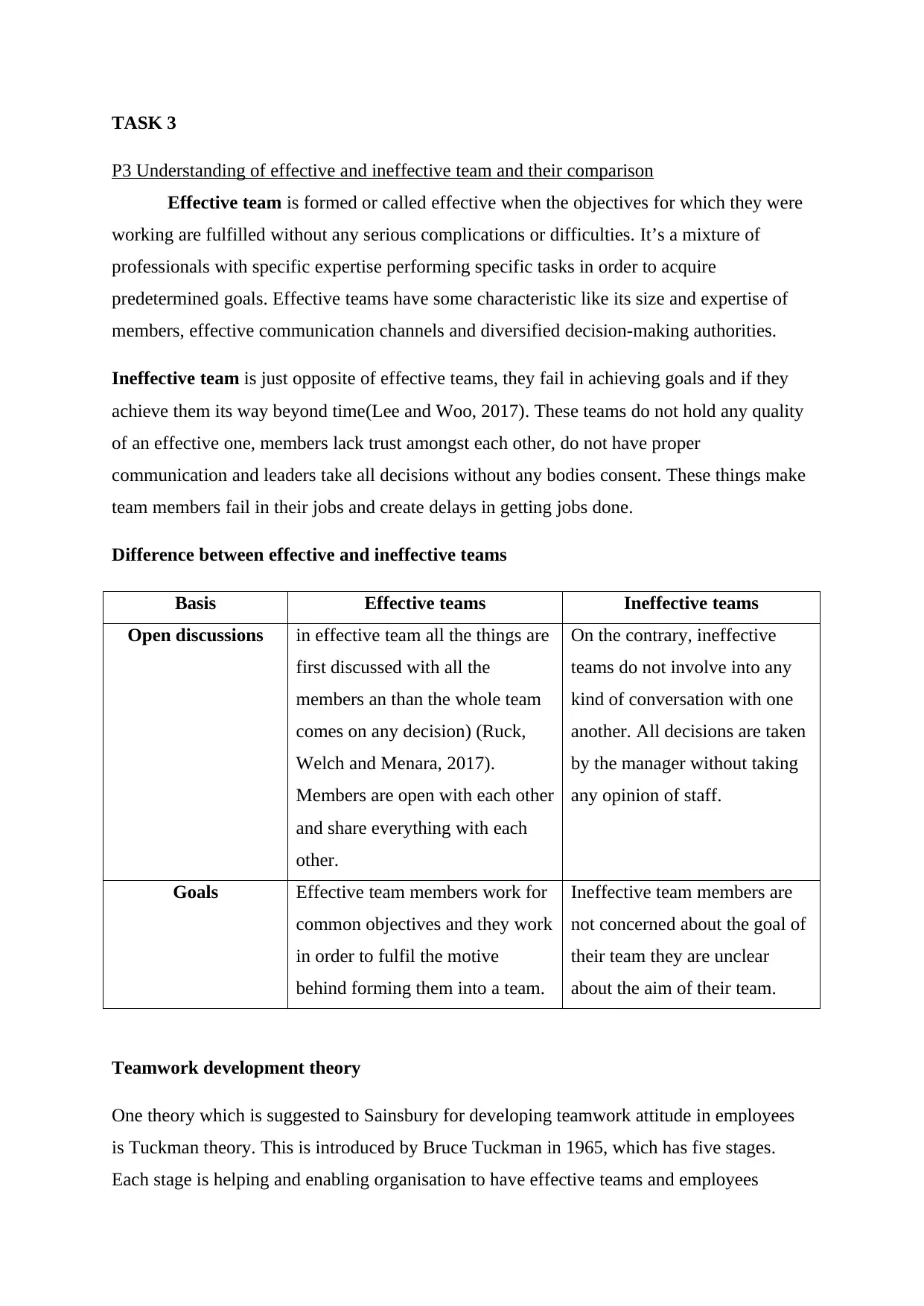
TASK 3
P3 Understanding of effective and ineffective team and their comparison
Effective team is formed or called effective when the objectives for which they were
working are fulfilled without any serious complications or difficulties. It’s a mixture of
professionals with specific expertise performing specific tasks in order to acquire
predetermined goals. Effective teams have some characteristic like its size and expertise of
members, effective communication channels and diversified decision-making authorities.
Ineffective team is just opposite of effective teams, they fail in achieving goals and if they
achieve them its way beyond time(Lee and Woo, 2017). These teams do not hold any quality
of an effective one, members lack trust amongst each other, do not have proper
communication and leaders take all decisions without any bodies consent. These things make
team members fail in their jobs and create delays in getting jobs done.
Difference between effective and ineffective teams
Basis Effective teams Ineffective teams
Open discussions in effective team all the things are
first discussed with all the
members an than the whole team
comes on any decision) (Ruck,
Welch and Menara, 2017).
Members are open with each other
and share everything with each
other.
On the contrary, ineffective
teams do not involve into any
kind of conversation with one
another. All decisions are taken
by the manager without taking
any opinion of staff.
Goals Effective team members work for
common objectives and they work
in order to fulfil the motive
behind forming them into a team.
Ineffective team members are
not concerned about the goal of
their team they are unclear
about the aim of their team.
Teamwork development theory
One theory which is suggested to Sainsbury for developing teamwork attitude in employees
is Tuckman theory. This is introduced by Bruce Tuckman in 1965, which has five stages.
Each stage is helping and enabling organisation to have effective teams and employees
P3 Understanding of effective and ineffective team and their comparison
Effective team is formed or called effective when the objectives for which they were
working are fulfilled without any serious complications or difficulties. It’s a mixture of
professionals with specific expertise performing specific tasks in order to acquire
predetermined goals. Effective teams have some characteristic like its size and expertise of
members, effective communication channels and diversified decision-making authorities.
Ineffective team is just opposite of effective teams, they fail in achieving goals and if they
achieve them its way beyond time(Lee and Woo, 2017). These teams do not hold any quality
of an effective one, members lack trust amongst each other, do not have proper
communication and leaders take all decisions without any bodies consent. These things make
team members fail in their jobs and create delays in getting jobs done.
Difference between effective and ineffective teams
Basis Effective teams Ineffective teams
Open discussions in effective team all the things are
first discussed with all the
members an than the whole team
comes on any decision) (Ruck,
Welch and Menara, 2017).
Members are open with each other
and share everything with each
other.
On the contrary, ineffective
teams do not involve into any
kind of conversation with one
another. All decisions are taken
by the manager without taking
any opinion of staff.
Goals Effective team members work for
common objectives and they work
in order to fulfil the motive
behind forming them into a team.
Ineffective team members are
not concerned about the goal of
their team they are unclear
about the aim of their team.
Teamwork development theory
One theory which is suggested to Sainsbury for developing teamwork attitude in employees
is Tuckman theory. This is introduced by Bruce Tuckman in 1965, which has five stages.
Each stage is helping and enabling organisation to have effective teams and employees
⊘ This is a preview!⊘
Do you want full access?
Subscribe today to unlock all pages.
Trusted by 1+ million students worldwide
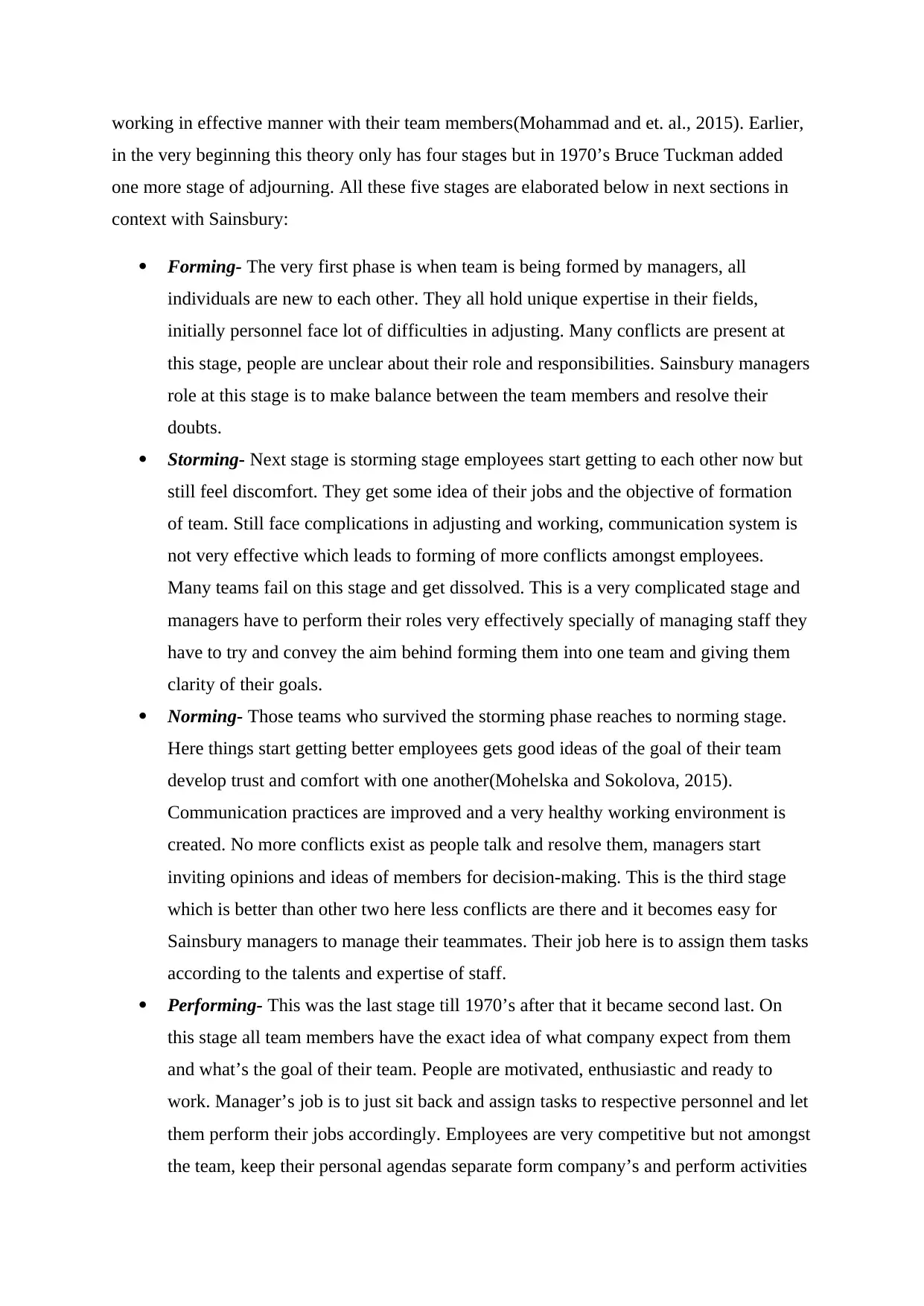
working in effective manner with their team members(Mohammad and et. al., 2015). Earlier,
in the very beginning this theory only has four stages but in 1970’s Bruce Tuckman added
one more stage of adjourning. All these five stages are elaborated below in next sections in
context with Sainsbury:
Forming- The very first phase is when team is being formed by managers, all
individuals are new to each other. They all hold unique expertise in their fields,
initially personnel face lot of difficulties in adjusting. Many conflicts are present at
this stage, people are unclear about their role and responsibilities. Sainsbury managers
role at this stage is to make balance between the team members and resolve their
doubts.
Storming- Next stage is storming stage employees start getting to each other now but
still feel discomfort. They get some idea of their jobs and the objective of formation
of team. Still face complications in adjusting and working, communication system is
not very effective which leads to forming of more conflicts amongst employees.
Many teams fail on this stage and get dissolved. This is a very complicated stage and
managers have to perform their roles very effectively specially of managing staff they
have to try and convey the aim behind forming them into one team and giving them
clarity of their goals.
Norming- Those teams who survived the storming phase reaches to norming stage.
Here things start getting better employees gets good ideas of the goal of their team
develop trust and comfort with one another(Mohelska and Sokolova, 2015).
Communication practices are improved and a very healthy working environment is
created. No more conflicts exist as people talk and resolve them, managers start
inviting opinions and ideas of members for decision-making. This is the third stage
which is better than other two here less conflicts are there and it becomes easy for
Sainsbury managers to manage their teammates. Their job here is to assign them tasks
according to the talents and expertise of staff.
Performing- This was the last stage till 1970’s after that it became second last. On
this stage all team members have the exact idea of what company expect from them
and what’s the goal of their team. People are motivated, enthusiastic and ready to
work. Manager’s job is to just sit back and assign tasks to respective personnel and let
them perform their jobs accordingly. Employees are very competitive but not amongst
the team, keep their personal agendas separate form company’s and perform activities
in the very beginning this theory only has four stages but in 1970’s Bruce Tuckman added
one more stage of adjourning. All these five stages are elaborated below in next sections in
context with Sainsbury:
Forming- The very first phase is when team is being formed by managers, all
individuals are new to each other. They all hold unique expertise in their fields,
initially personnel face lot of difficulties in adjusting. Many conflicts are present at
this stage, people are unclear about their role and responsibilities. Sainsbury managers
role at this stage is to make balance between the team members and resolve their
doubts.
Storming- Next stage is storming stage employees start getting to each other now but
still feel discomfort. They get some idea of their jobs and the objective of formation
of team. Still face complications in adjusting and working, communication system is
not very effective which leads to forming of more conflicts amongst employees.
Many teams fail on this stage and get dissolved. This is a very complicated stage and
managers have to perform their roles very effectively specially of managing staff they
have to try and convey the aim behind forming them into one team and giving them
clarity of their goals.
Norming- Those teams who survived the storming phase reaches to norming stage.
Here things start getting better employees gets good ideas of the goal of their team
develop trust and comfort with one another(Mohelska and Sokolova, 2015).
Communication practices are improved and a very healthy working environment is
created. No more conflicts exist as people talk and resolve them, managers start
inviting opinions and ideas of members for decision-making. This is the third stage
which is better than other two here less conflicts are there and it becomes easy for
Sainsbury managers to manage their teammates. Their job here is to assign them tasks
according to the talents and expertise of staff.
Performing- This was the last stage till 1970’s after that it became second last. On
this stage all team members have the exact idea of what company expect from them
and what’s the goal of their team. People are motivated, enthusiastic and ready to
work. Manager’s job is to just sit back and assign tasks to respective personnel and let
them perform their jobs accordingly. Employees are very competitive but not amongst
the team, keep their personal agendas separate form company’s and perform activities
Paraphrase This Document
Need a fresh take? Get an instant paraphrase of this document with our AI Paraphraser
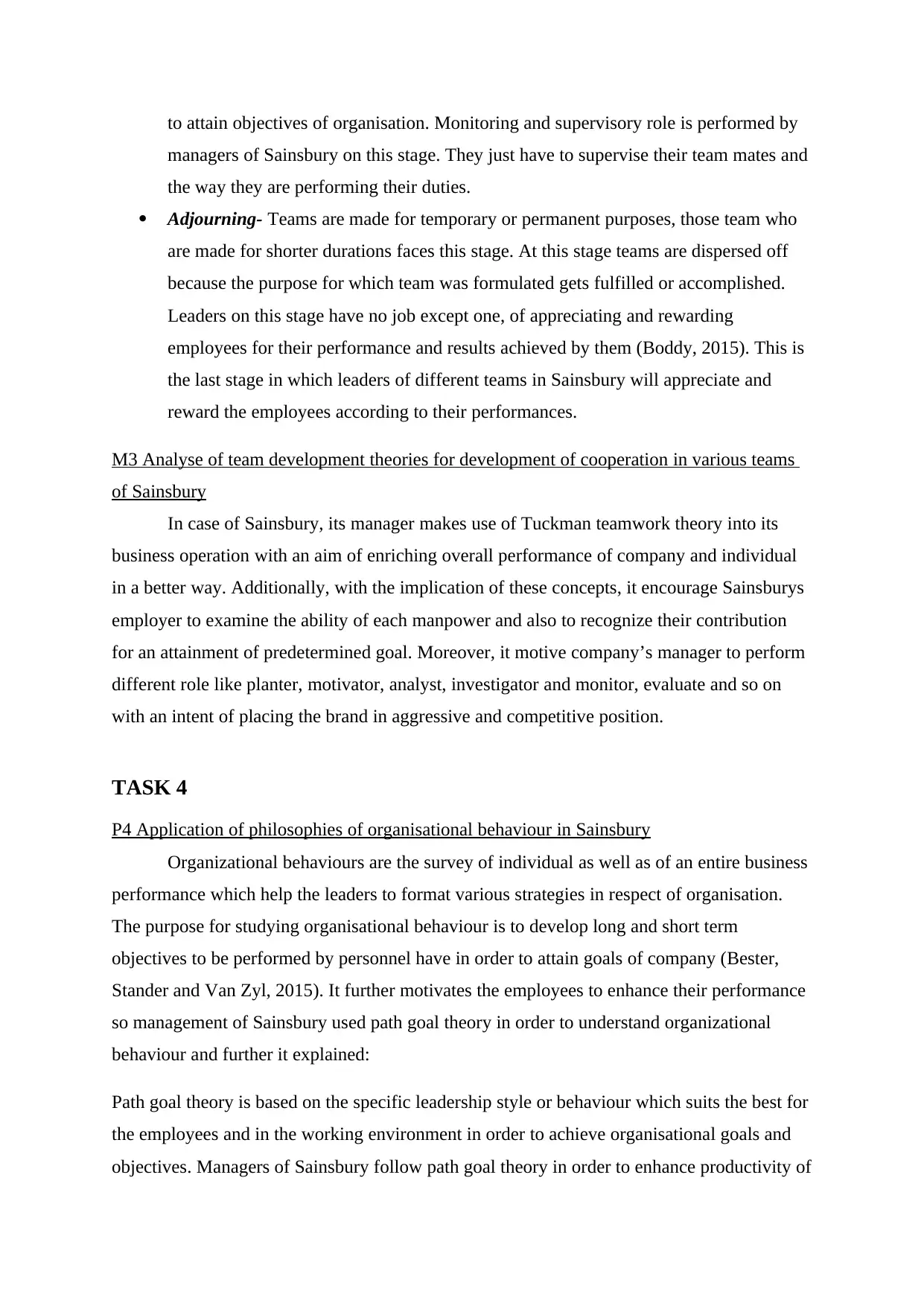
to attain objectives of organisation. Monitoring and supervisory role is performed by
managers of Sainsbury on this stage. They just have to supervise their team mates and
the way they are performing their duties.
Adjourning- Teams are made for temporary or permanent purposes, those team who
are made for shorter durations faces this stage. At this stage teams are dispersed off
because the purpose for which team was formulated gets fulfilled or accomplished.
Leaders on this stage have no job except one, of appreciating and rewarding
employees for their performance and results achieved by them (Boddy, 2015). This is
the last stage in which leaders of different teams in Sainsbury will appreciate and
reward the employees according to their performances.
M3 Analyse of team development theories for development of cooperation in various teams
of Sainsbury
In case of Sainsbury, its manager makes use of Tuckman teamwork theory into its
business operation with an aim of enriching overall performance of company and individual
in a better way. Additionally, with the implication of these concepts, it encourage Sainsburys
employer to examine the ability of each manpower and also to recognize their contribution
for an attainment of predetermined goal. Moreover, it motive company’s manager to perform
different role like planter, motivator, analyst, investigator and monitor, evaluate and so on
with an intent of placing the brand in aggressive and competitive position.
TASK 4
P4 Application of philosophies of organisational behaviour in Sainsbury
Organizational behaviours are the survey of individual as well as of an entire business
performance which help the leaders to format various strategies in respect of organisation.
The purpose for studying organisational behaviour is to develop long and short term
objectives to be performed by personnel have in order to attain goals of company (Bester,
Stander and Van Zyl, 2015). It further motivates the employees to enhance their performance
so management of Sainsbury used path goal theory in order to understand organizational
behaviour and further it explained:
Path goal theory is based on the specific leadership style or behaviour which suits the best for
the employees and in the working environment in order to achieve organisational goals and
objectives. Managers of Sainsbury follow path goal theory in order to enhance productivity of
managers of Sainsbury on this stage. They just have to supervise their team mates and
the way they are performing their duties.
Adjourning- Teams are made for temporary or permanent purposes, those team who
are made for shorter durations faces this stage. At this stage teams are dispersed off
because the purpose for which team was formulated gets fulfilled or accomplished.
Leaders on this stage have no job except one, of appreciating and rewarding
employees for their performance and results achieved by them (Boddy, 2015). This is
the last stage in which leaders of different teams in Sainsbury will appreciate and
reward the employees according to their performances.
M3 Analyse of team development theories for development of cooperation in various teams
of Sainsbury
In case of Sainsbury, its manager makes use of Tuckman teamwork theory into its
business operation with an aim of enriching overall performance of company and individual
in a better way. Additionally, with the implication of these concepts, it encourage Sainsburys
employer to examine the ability of each manpower and also to recognize their contribution
for an attainment of predetermined goal. Moreover, it motive company’s manager to perform
different role like planter, motivator, analyst, investigator and monitor, evaluate and so on
with an intent of placing the brand in aggressive and competitive position.
TASK 4
P4 Application of philosophies of organisational behaviour in Sainsbury
Organizational behaviours are the survey of individual as well as of an entire business
performance which help the leaders to format various strategies in respect of organisation.
The purpose for studying organisational behaviour is to develop long and short term
objectives to be performed by personnel have in order to attain goals of company (Bester,
Stander and Van Zyl, 2015). It further motivates the employees to enhance their performance
so management of Sainsbury used path goal theory in order to understand organizational
behaviour and further it explained:
Path goal theory is based on the specific leadership style or behaviour which suits the best for
the employees and in the working environment in order to achieve organisational goals and
objectives. Managers of Sainsbury follow path goal theory in order to enhance productivity of
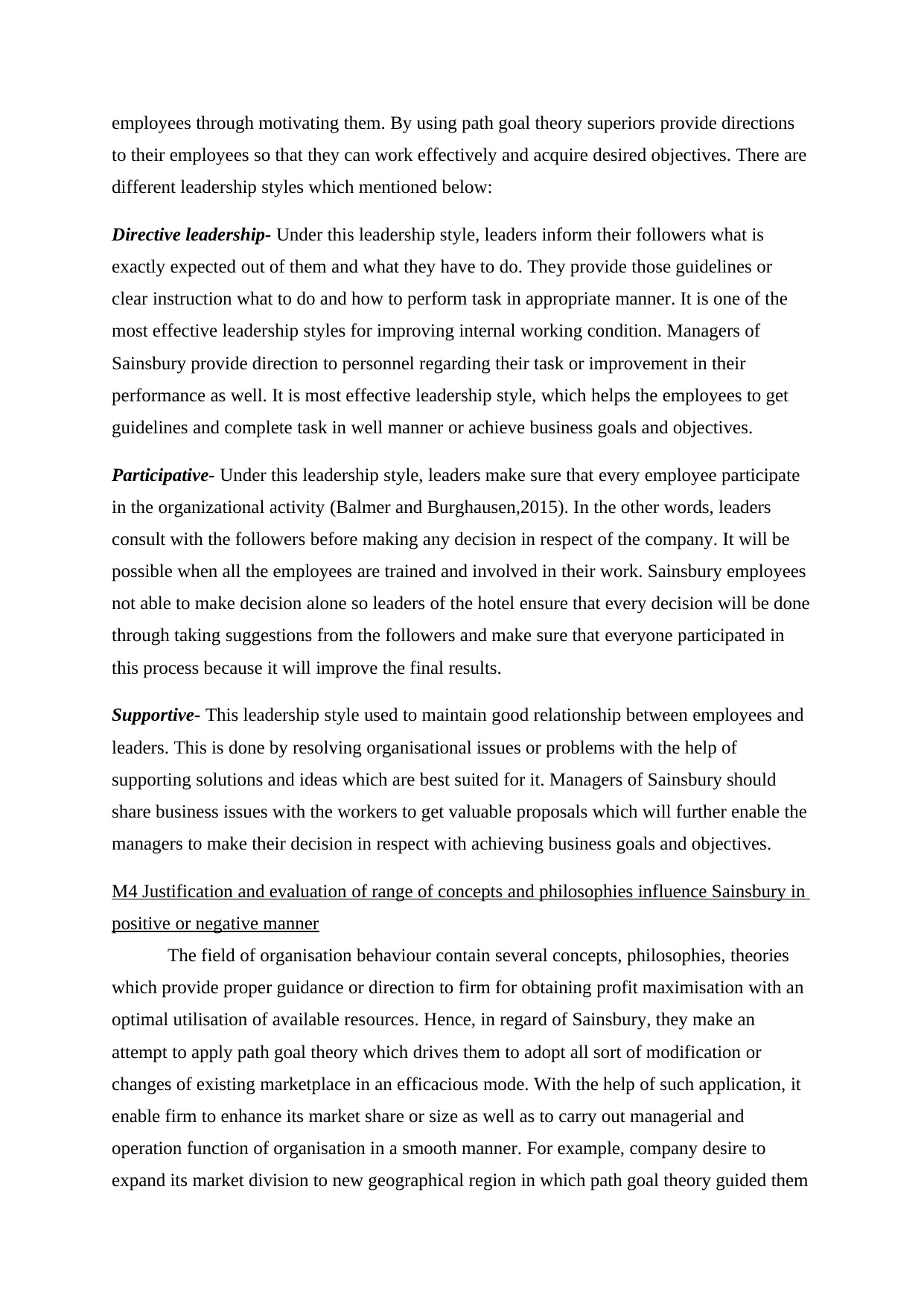
employees through motivating them. By using path goal theory superiors provide directions
to their employees so that they can work effectively and acquire desired objectives. There are
different leadership styles which mentioned below:
Directive leadership- Under this leadership style, leaders inform their followers what is
exactly expected out of them and what they have to do. They provide those guidelines or
clear instruction what to do and how to perform task in appropriate manner. It is one of the
most effective leadership styles for improving internal working condition. Managers of
Sainsbury provide direction to personnel regarding their task or improvement in their
performance as well. It is most effective leadership style, which helps the employees to get
guidelines and complete task in well manner or achieve business goals and objectives.
Participative- Under this leadership style, leaders make sure that every employee participate
in the organizational activity (Balmer and Burghausen,2015). In the other words, leaders
consult with the followers before making any decision in respect of the company. It will be
possible when all the employees are trained and involved in their work. Sainsbury employees
not able to make decision alone so leaders of the hotel ensure that every decision will be done
through taking suggestions from the followers and make sure that everyone participated in
this process because it will improve the final results.
Supportive- This leadership style used to maintain good relationship between employees and
leaders. This is done by resolving organisational issues or problems with the help of
supporting solutions and ideas which are best suited for it. Managers of Sainsbury should
share business issues with the workers to get valuable proposals which will further enable the
managers to make their decision in respect with achieving business goals and objectives.
M4 Justification and evaluation of range of concepts and philosophies influence Sainsbury in
positive or negative manner
The field of organisation behaviour contain several concepts, philosophies, theories
which provide proper guidance or direction to firm for obtaining profit maximisation with an
optimal utilisation of available resources. Hence, in regard of Sainsbury, they make an
attempt to apply path goal theory which drives them to adopt all sort of modification or
changes of existing marketplace in an efficacious mode. With the help of such application, it
enable firm to enhance its market share or size as well as to carry out managerial and
operation function of organisation in a smooth manner. For example, company desire to
expand its market division to new geographical region in which path goal theory guided them
to their employees so that they can work effectively and acquire desired objectives. There are
different leadership styles which mentioned below:
Directive leadership- Under this leadership style, leaders inform their followers what is
exactly expected out of them and what they have to do. They provide those guidelines or
clear instruction what to do and how to perform task in appropriate manner. It is one of the
most effective leadership styles for improving internal working condition. Managers of
Sainsbury provide direction to personnel regarding their task or improvement in their
performance as well. It is most effective leadership style, which helps the employees to get
guidelines and complete task in well manner or achieve business goals and objectives.
Participative- Under this leadership style, leaders make sure that every employee participate
in the organizational activity (Balmer and Burghausen,2015). In the other words, leaders
consult with the followers before making any decision in respect of the company. It will be
possible when all the employees are trained and involved in their work. Sainsbury employees
not able to make decision alone so leaders of the hotel ensure that every decision will be done
through taking suggestions from the followers and make sure that everyone participated in
this process because it will improve the final results.
Supportive- This leadership style used to maintain good relationship between employees and
leaders. This is done by resolving organisational issues or problems with the help of
supporting solutions and ideas which are best suited for it. Managers of Sainsbury should
share business issues with the workers to get valuable proposals which will further enable the
managers to make their decision in respect with achieving business goals and objectives.
M4 Justification and evaluation of range of concepts and philosophies influence Sainsbury in
positive or negative manner
The field of organisation behaviour contain several concepts, philosophies, theories
which provide proper guidance or direction to firm for obtaining profit maximisation with an
optimal utilisation of available resources. Hence, in regard of Sainsbury, they make an
attempt to apply path goal theory which drives them to adopt all sort of modification or
changes of existing marketplace in an efficacious mode. With the help of such application, it
enable firm to enhance its market share or size as well as to carry out managerial and
operation function of organisation in a smooth manner. For example, company desire to
expand its market division to new geographical region in which path goal theory guided them
⊘ This is a preview!⊘
Do you want full access?
Subscribe today to unlock all pages.
Trusted by 1+ million students worldwide

1 out of 15


Related Documents


Your All-in-One AI-Powered Toolkit for Academic Success.
+13062052269
info@desklib.com
Available 24*7 on WhatsApp / Email
![[object Object]](/_next/static/media/star-bottom.7253800d.svg)
Unlock your academic potential
Copyright © 2020–2026 A2Z Services. All Rights Reserved. Developed and managed by ZUCOL.