Strategic Analysis and Business Plan Review: Sainsbury's Report
VerifiedAdded on 2023/01/17
|11
|3118
|68
Report
AI Summary
This report provides a comprehensive analysis of J Sainsbury Plc's strategic management. It begins with an introduction to strategic management and its importance for companies in a fluctuating business environment, specifically focusing on Sainsbury's position as the third-largest supermarket chain in the UK. The main body of the report delves into a critical assessment of Sainsbury's strategic process, including goal setting, information gathering and analysis, strategy formulation, implementation, and evaluation. Furthermore, it evaluates the impact of external and internal governmental variations on the organization's strategy, utilizing SWOT and PESTLE analyses to assess strengths, weaknesses, opportunities, and threats, as well as political, economic, social, technological, legal, and environmental factors. The report concludes with a review of Sainsbury's business plan, outlining its aims, objectives, and strategies. The report highlights key aspects of Sainsbury's operations and strategic approach within the competitive UK retail market, providing a detailed overview of the company's strategic position and future direction.
Strategic Management

Paraphrase This Document
Need a fresh take? Get an instant paraphrase of this document with our AI Paraphraser
Table of Contents
INTRODUCTION...........................................................................................................................3
MAIN BODY...................................................................................................................................3
Critical assessment of process which is used by company for determining their strategy-.........3
Critical evaluation of impact of external and internal governmental variations on
organizational strategy-................................................................................................................4
Review of organization's Business Plan-.....................................................................................7
CONCLUSION................................................................................................................................8
REFERENCES................................................................................................................................9
INTRODUCTION...........................................................................................................................3
MAIN BODY...................................................................................................................................3
Critical assessment of process which is used by company for determining their strategy-.........3
Critical evaluation of impact of external and internal governmental variations on
organizational strategy-................................................................................................................4
Review of organization's Business Plan-.....................................................................................7
CONCLUSION................................................................................................................................8
REFERENCES................................................................................................................................9
INTRODUCTION
Strategic management is ongoing planning, analysing, monitoring and assessment of all
which is necessary for the company to meet the goals and objectives of company. Fluctuations in
business environment need company to constantly assess their strategies for success.
J Sainsbury Plc is trading as the Sainsbury which is third largest chain of the
supermarkets in UK. The company has the share of 15.3% in supermarket share. It was
established by 1869 by the John James Sainsbury. The above report includes the critical
assessment of process which can be used by company for determining their strategy. Critical
evaluation of impact of internal and external environmental variation on organizational strategy.
The report ends with the business plan.
MAIN BODY
Critical assessment of process which is used by company for determining their strategy-
The strategic management is the process which is more than just set of rules which is to
be followed. It is the philosophical approach for a business. The top management of business
must think strategically first and then apply that thought into the process. It is the process
implemented when each individual in business understands the strategy.
There are five stages in the process of strategic management which are goal setting,
analysis strategy formation, strategy implementation and strategy monitoring.
Clarify your vision-
The main purpose of setting goal is for clarifying vision of the business. This stage
contains identification of key facts that are defining the short and long term objectives. Second
facts is identifying process of how it can be accomplished the objectives of business (Alyoubi,
2015). The last fact is customizing the process of the staff and giving each person a task so that
individual can succeed. Further, keeping in mind within this process is that the goals are to be
detailed, realistic and matching values of your vision.
Gather and Analyse Information-
It is the key stage because information collected in this stage is shaped in next two further
stages. The more information and data are being gathered for accomplishing the vision of
business. The focus for analysing information is on understanding needs of business as
sustainable entity. Strategic direction and identification of initiatives which will help the business
in growing.
Strategic management is ongoing planning, analysing, monitoring and assessment of all
which is necessary for the company to meet the goals and objectives of company. Fluctuations in
business environment need company to constantly assess their strategies for success.
J Sainsbury Plc is trading as the Sainsbury which is third largest chain of the
supermarkets in UK. The company has the share of 15.3% in supermarket share. It was
established by 1869 by the John James Sainsbury. The above report includes the critical
assessment of process which can be used by company for determining their strategy. Critical
evaluation of impact of internal and external environmental variation on organizational strategy.
The report ends with the business plan.
MAIN BODY
Critical assessment of process which is used by company for determining their strategy-
The strategic management is the process which is more than just set of rules which is to
be followed. It is the philosophical approach for a business. The top management of business
must think strategically first and then apply that thought into the process. It is the process
implemented when each individual in business understands the strategy.
There are five stages in the process of strategic management which are goal setting,
analysis strategy formation, strategy implementation and strategy monitoring.
Clarify your vision-
The main purpose of setting goal is for clarifying vision of the business. This stage
contains identification of key facts that are defining the short and long term objectives. Second
facts is identifying process of how it can be accomplished the objectives of business (Alyoubi,
2015). The last fact is customizing the process of the staff and giving each person a task so that
individual can succeed. Further, keeping in mind within this process is that the goals are to be
detailed, realistic and matching values of your vision.
Gather and Analyse Information-
It is the key stage because information collected in this stage is shaped in next two further
stages. The more information and data are being gathered for accomplishing the vision of
business. The focus for analysing information is on understanding needs of business as
sustainable entity. Strategic direction and identification of initiatives which will help the business
in growing.
⊘ This is a preview!⊘
Do you want full access?
Subscribe today to unlock all pages.

Trusted by 1+ million students worldwide
Formulate A Strategy-
For developing a strategy is to review information which have been collected by
complete analysis. Determination of resources which currently held by business for reaching the
defined objectives and goals (Ocasio, Laamanen and Vaara, 2018). The areas also identified
where business seeks the external resources. Business and economic situations are fluid, it is the
critical stage for developing alternative approaches which target each step of plan.
Implement Your Strategy-
Successful strategy implementation is the critical to success of the Sainsbury. It is action
stage of strategic management process. If in business overall strategy do not work among
business with current structure, a new structure can be developed at the beginning stage. Each of
the individual among company should have clear for their duties and responsibilities and further
how it can be fitted with the overall goals and objective of company.
Evaluate and Control-
Strategic evaluation and control actions can consists performance measurements,
consistent review of external and internal issues and developing connective action when it is
necessary. Successful evaluation of strategy begins with the defining criteria by which it can be
measured. These set parameters are helpful in goal setting in stage one (Stead and Stead, 2016).
The determination of the progress by measuring actual result versus plan. Further the
determination of strategy is being done and if the strategy is not helpful in attaining the objective
and gaol of business than corrective action plan is to be taken. And then also if its is not
successful than the strategic management process is to be repeated.
Critical evaluation of impact of external and internal governmental variations on
organizational strategy-
SWOT Analysis-
SWOT Analysis is strategic planning technique which is used by company for identifying
strength, weaknesses, opportunities and threats which are related to the business planning or
competition. It can be described below-
Strength
The main strength of Sainsbury which has enabled them to establish their position in
market their innovative promotional strategies. More than half of the advertising strategies which
is adopted by Sainsbury to attract customers are extremely innovative and helps them to pitch
For developing a strategy is to review information which have been collected by
complete analysis. Determination of resources which currently held by business for reaching the
defined objectives and goals (Ocasio, Laamanen and Vaara, 2018). The areas also identified
where business seeks the external resources. Business and economic situations are fluid, it is the
critical stage for developing alternative approaches which target each step of plan.
Implement Your Strategy-
Successful strategy implementation is the critical to success of the Sainsbury. It is action
stage of strategic management process. If in business overall strategy do not work among
business with current structure, a new structure can be developed at the beginning stage. Each of
the individual among company should have clear for their duties and responsibilities and further
how it can be fitted with the overall goals and objective of company.
Evaluate and Control-
Strategic evaluation and control actions can consists performance measurements,
consistent review of external and internal issues and developing connective action when it is
necessary. Successful evaluation of strategy begins with the defining criteria by which it can be
measured. These set parameters are helpful in goal setting in stage one (Stead and Stead, 2016).
The determination of the progress by measuring actual result versus plan. Further the
determination of strategy is being done and if the strategy is not helpful in attaining the objective
and gaol of business than corrective action plan is to be taken. And then also if its is not
successful than the strategic management process is to be repeated.
Critical evaluation of impact of external and internal governmental variations on
organizational strategy-
SWOT Analysis-
SWOT Analysis is strategic planning technique which is used by company for identifying
strength, weaknesses, opportunities and threats which are related to the business planning or
competition. It can be described below-
Strength
The main strength of Sainsbury which has enabled them to establish their position in
market their innovative promotional strategies. More than half of the advertising strategies which
is adopted by Sainsbury to attract customers are extremely innovative and helps them to pitch
Paraphrase This Document
Need a fresh take? Get an instant paraphrase of this document with our AI Paraphraser
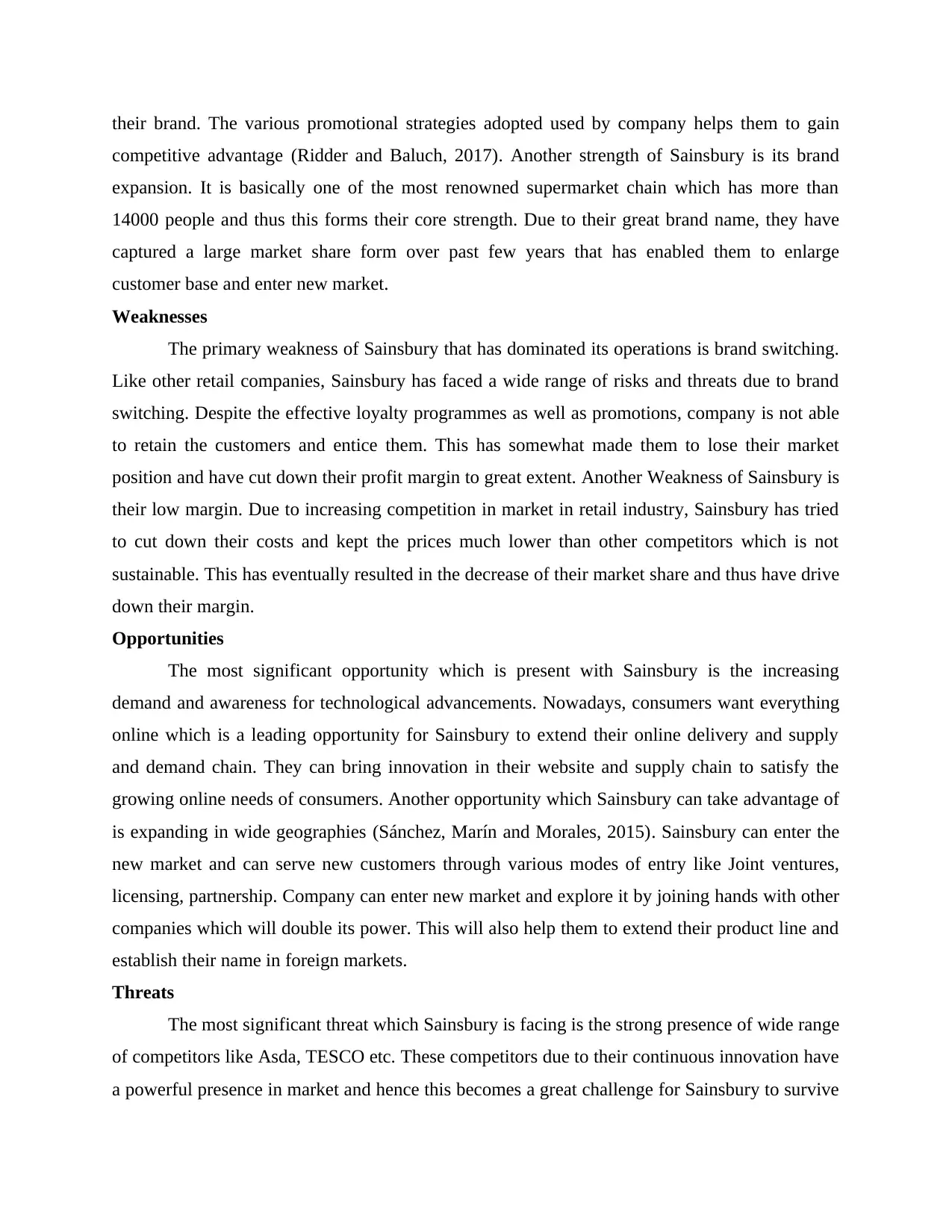
their brand. The various promotional strategies adopted used by company helps them to gain
competitive advantage (Ridder and Baluch, 2017). Another strength of Sainsbury is its brand
expansion. It is basically one of the most renowned supermarket chain which has more than
14000 people and thus this forms their core strength. Due to their great brand name, they have
captured a large market share form over past few years that has enabled them to enlarge
customer base and enter new market.
Weaknesses
The primary weakness of Sainsbury that has dominated its operations is brand switching.
Like other retail companies, Sainsbury has faced a wide range of risks and threats due to brand
switching. Despite the effective loyalty programmes as well as promotions, company is not able
to retain the customers and entice them. This has somewhat made them to lose their market
position and have cut down their profit margin to great extent. Another Weakness of Sainsbury is
their low margin. Due to increasing competition in market in retail industry, Sainsbury has tried
to cut down their costs and kept the prices much lower than other competitors which is not
sustainable. This has eventually resulted in the decrease of their market share and thus have drive
down their margin.
Opportunities
The most significant opportunity which is present with Sainsbury is the increasing
demand and awareness for technological advancements. Nowadays, consumers want everything
online which is a leading opportunity for Sainsbury to extend their online delivery and supply
and demand chain. They can bring innovation in their website and supply chain to satisfy the
growing online needs of consumers. Another opportunity which Sainsbury can take advantage of
is expanding in wide geographies (Sánchez, Marín and Morales, 2015). Sainsbury can enter the
new market and can serve new customers through various modes of entry like Joint ventures,
licensing, partnership. Company can enter new market and explore it by joining hands with other
companies which will double its power. This will also help them to extend their product line and
establish their name in foreign markets.
Threats
The most significant threat which Sainsbury is facing is the strong presence of wide range
of competitors like Asda, TESCO etc. These competitors due to their continuous innovation have
a powerful presence in market and hence this becomes a great challenge for Sainsbury to survive
competitive advantage (Ridder and Baluch, 2017). Another strength of Sainsbury is its brand
expansion. It is basically one of the most renowned supermarket chain which has more than
14000 people and thus this forms their core strength. Due to their great brand name, they have
captured a large market share form over past few years that has enabled them to enlarge
customer base and enter new market.
Weaknesses
The primary weakness of Sainsbury that has dominated its operations is brand switching.
Like other retail companies, Sainsbury has faced a wide range of risks and threats due to brand
switching. Despite the effective loyalty programmes as well as promotions, company is not able
to retain the customers and entice them. This has somewhat made them to lose their market
position and have cut down their profit margin to great extent. Another Weakness of Sainsbury is
their low margin. Due to increasing competition in market in retail industry, Sainsbury has tried
to cut down their costs and kept the prices much lower than other competitors which is not
sustainable. This has eventually resulted in the decrease of their market share and thus have drive
down their margin.
Opportunities
The most significant opportunity which is present with Sainsbury is the increasing
demand and awareness for technological advancements. Nowadays, consumers want everything
online which is a leading opportunity for Sainsbury to extend their online delivery and supply
and demand chain. They can bring innovation in their website and supply chain to satisfy the
growing online needs of consumers. Another opportunity which Sainsbury can take advantage of
is expanding in wide geographies (Sánchez, Marín and Morales, 2015). Sainsbury can enter the
new market and can serve new customers through various modes of entry like Joint ventures,
licensing, partnership. Company can enter new market and explore it by joining hands with other
companies which will double its power. This will also help them to extend their product line and
establish their name in foreign markets.
Threats
The most significant threat which Sainsbury is facing is the strong presence of wide range
of competitors like Asda, TESCO etc. These competitors due to their continuous innovation have
a powerful presence in market and hence this becomes a great challenge for Sainsbury to survive
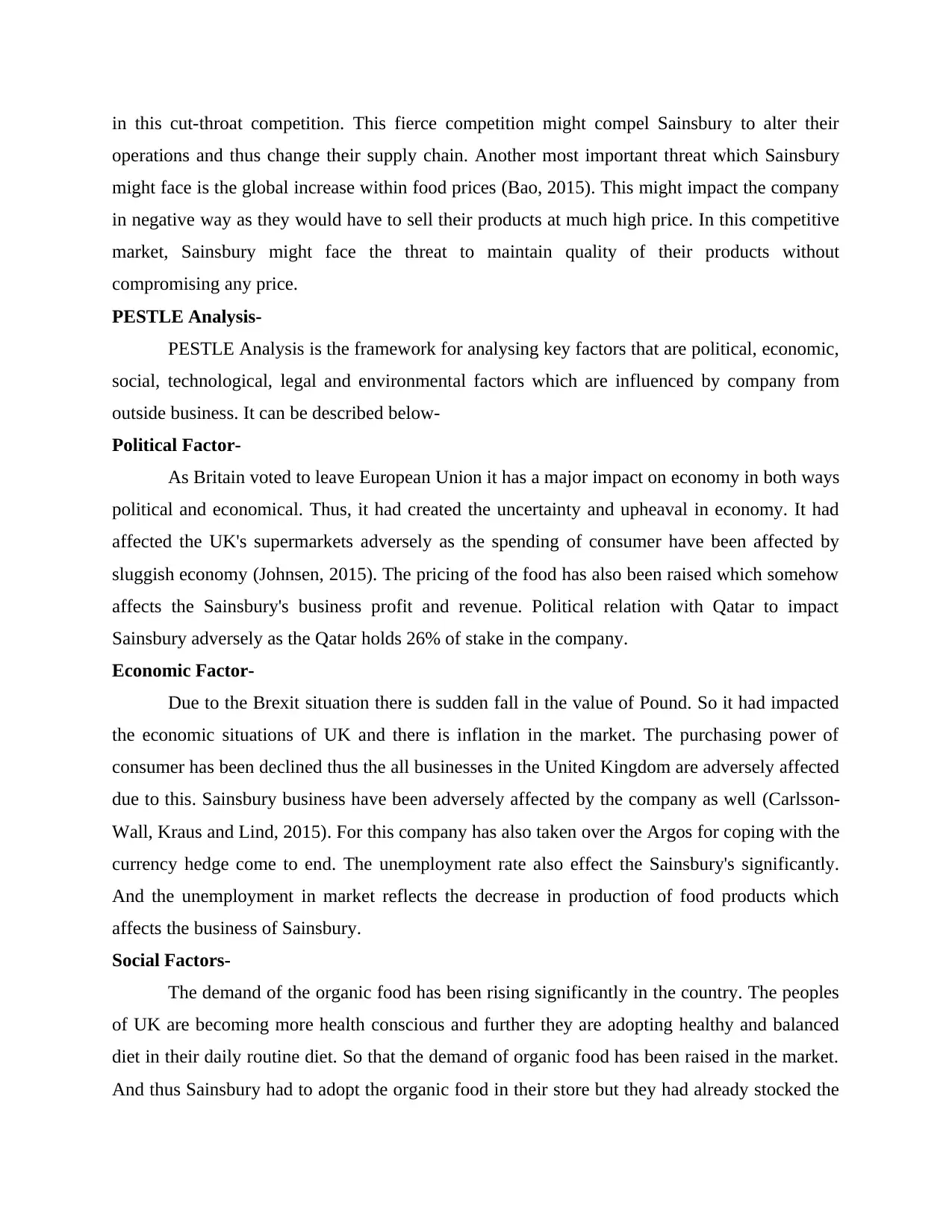
in this cut-throat competition. This fierce competition might compel Sainsbury to alter their
operations and thus change their supply chain. Another most important threat which Sainsbury
might face is the global increase within food prices (Bao, 2015). This might impact the company
in negative way as they would have to sell their products at much high price. In this competitive
market, Sainsbury might face the threat to maintain quality of their products without
compromising any price.
PESTLE Analysis-
PESTLE Analysis is the framework for analysing key factors that are political, economic,
social, technological, legal and environmental factors which are influenced by company from
outside business. It can be described below-
Political Factor-
As Britain voted to leave European Union it has a major impact on economy in both ways
political and economical. Thus, it had created the uncertainty and upheaval in economy. It had
affected the UK's supermarkets adversely as the spending of consumer have been affected by
sluggish economy (Johnsen, 2015). The pricing of the food has also been raised which somehow
affects the Sainsbury's business profit and revenue. Political relation with Qatar to impact
Sainsbury adversely as the Qatar holds 26% of stake in the company.
Economic Factor-
Due to the Brexit situation there is sudden fall in the value of Pound. So it had impacted
the economic situations of UK and there is inflation in the market. The purchasing power of
consumer has been declined thus the all businesses in the United Kingdom are adversely affected
due to this. Sainsbury business have been adversely affected by the company as well (Carlsson-
Wall, Kraus and Lind, 2015). For this company has also taken over the Argos for coping with the
currency hedge come to end. The unemployment rate also effect the Sainsbury's significantly.
And the unemployment in market reflects the decrease in production of food products which
affects the business of Sainsbury.
Social Factors-
The demand of the organic food has been rising significantly in the country. The peoples
of UK are becoming more health conscious and further they are adopting healthy and balanced
diet in their daily routine diet. So that the demand of organic food has been raised in the market.
And thus Sainsbury had to adopt the organic food in their store but they had already stocked the
operations and thus change their supply chain. Another most important threat which Sainsbury
might face is the global increase within food prices (Bao, 2015). This might impact the company
in negative way as they would have to sell their products at much high price. In this competitive
market, Sainsbury might face the threat to maintain quality of their products without
compromising any price.
PESTLE Analysis-
PESTLE Analysis is the framework for analysing key factors that are political, economic,
social, technological, legal and environmental factors which are influenced by company from
outside business. It can be described below-
Political Factor-
As Britain voted to leave European Union it has a major impact on economy in both ways
political and economical. Thus, it had created the uncertainty and upheaval in economy. It had
affected the UK's supermarkets adversely as the spending of consumer have been affected by
sluggish economy (Johnsen, 2015). The pricing of the food has also been raised which somehow
affects the Sainsbury's business profit and revenue. Political relation with Qatar to impact
Sainsbury adversely as the Qatar holds 26% of stake in the company.
Economic Factor-
Due to the Brexit situation there is sudden fall in the value of Pound. So it had impacted
the economic situations of UK and there is inflation in the market. The purchasing power of
consumer has been declined thus the all businesses in the United Kingdom are adversely affected
due to this. Sainsbury business have been adversely affected by the company as well (Carlsson-
Wall, Kraus and Lind, 2015). For this company has also taken over the Argos for coping with the
currency hedge come to end. The unemployment rate also effect the Sainsbury's significantly.
And the unemployment in market reflects the decrease in production of food products which
affects the business of Sainsbury.
Social Factors-
The demand of the organic food has been rising significantly in the country. The peoples
of UK are becoming more health conscious and further they are adopting healthy and balanced
diet in their daily routine diet. So that the demand of organic food has been raised in the market.
And thus Sainsbury had to adopt the organic food in their store but they had already stocked the
⊘ This is a preview!⊘
Do you want full access?
Subscribe today to unlock all pages.
Trusted by 1+ million students worldwide
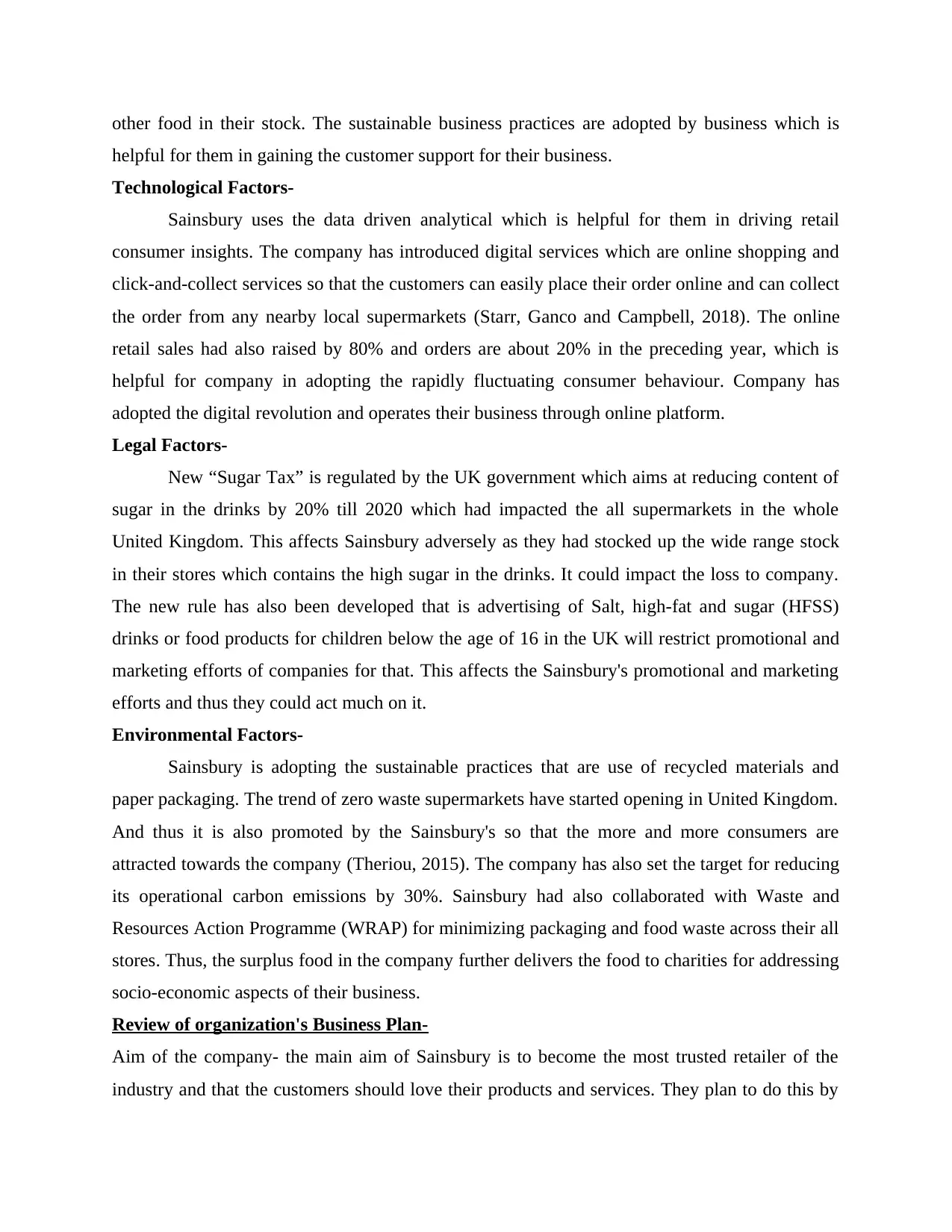
other food in their stock. The sustainable business practices are adopted by business which is
helpful for them in gaining the customer support for their business.
Technological Factors-
Sainsbury uses the data driven analytical which is helpful for them in driving retail
consumer insights. The company has introduced digital services which are online shopping and
click-and-collect services so that the customers can easily place their order online and can collect
the order from any nearby local supermarkets (Starr, Ganco and Campbell, 2018). The online
retail sales had also raised by 80% and orders are about 20% in the preceding year, which is
helpful for company in adopting the rapidly fluctuating consumer behaviour. Company has
adopted the digital revolution and operates their business through online platform.
Legal Factors-
New “Sugar Tax” is regulated by the UK government which aims at reducing content of
sugar in the drinks by 20% till 2020 which had impacted the all supermarkets in the whole
United Kingdom. This affects Sainsbury adversely as they had stocked up the wide range stock
in their stores which contains the high sugar in the drinks. It could impact the loss to company.
The new rule has also been developed that is advertising of Salt, high-fat and sugar (HFSS)
drinks or food products for children below the age of 16 in the UK will restrict promotional and
marketing efforts of companies for that. This affects the Sainsbury's promotional and marketing
efforts and thus they could act much on it.
Environmental Factors-
Sainsbury is adopting the sustainable practices that are use of recycled materials and
paper packaging. The trend of zero waste supermarkets have started opening in United Kingdom.
And thus it is also promoted by the Sainsbury's so that the more and more consumers are
attracted towards the company (Theriou, 2015). The company has also set the target for reducing
its operational carbon emissions by 30%. Sainsbury had also collaborated with Waste and
Resources Action Programme (WRAP) for minimizing packaging and food waste across their all
stores. Thus, the surplus food in the company further delivers the food to charities for addressing
socio-economic aspects of their business.
Review of organization's Business Plan-
Aim of the company- the main aim of Sainsbury is to become the most trusted retailer of the
industry and that the customers should love their products and services. They plan to do this by
helpful for them in gaining the customer support for their business.
Technological Factors-
Sainsbury uses the data driven analytical which is helpful for them in driving retail
consumer insights. The company has introduced digital services which are online shopping and
click-and-collect services so that the customers can easily place their order online and can collect
the order from any nearby local supermarkets (Starr, Ganco and Campbell, 2018). The online
retail sales had also raised by 80% and orders are about 20% in the preceding year, which is
helpful for company in adopting the rapidly fluctuating consumer behaviour. Company has
adopted the digital revolution and operates their business through online platform.
Legal Factors-
New “Sugar Tax” is regulated by the UK government which aims at reducing content of
sugar in the drinks by 20% till 2020 which had impacted the all supermarkets in the whole
United Kingdom. This affects Sainsbury adversely as they had stocked up the wide range stock
in their stores which contains the high sugar in the drinks. It could impact the loss to company.
The new rule has also been developed that is advertising of Salt, high-fat and sugar (HFSS)
drinks or food products for children below the age of 16 in the UK will restrict promotional and
marketing efforts of companies for that. This affects the Sainsbury's promotional and marketing
efforts and thus they could act much on it.
Environmental Factors-
Sainsbury is adopting the sustainable practices that are use of recycled materials and
paper packaging. The trend of zero waste supermarkets have started opening in United Kingdom.
And thus it is also promoted by the Sainsbury's so that the more and more consumers are
attracted towards the company (Theriou, 2015). The company has also set the target for reducing
its operational carbon emissions by 30%. Sainsbury had also collaborated with Waste and
Resources Action Programme (WRAP) for minimizing packaging and food waste across their all
stores. Thus, the surplus food in the company further delivers the food to charities for addressing
socio-economic aspects of their business.
Review of organization's Business Plan-
Aim of the company- the main aim of Sainsbury is to become the most trusted retailer of the
industry and that the customers should love their products and services. They plan to do this by
Paraphrase This Document
Need a fresh take? Get an instant paraphrase of this document with our AI Paraphraser
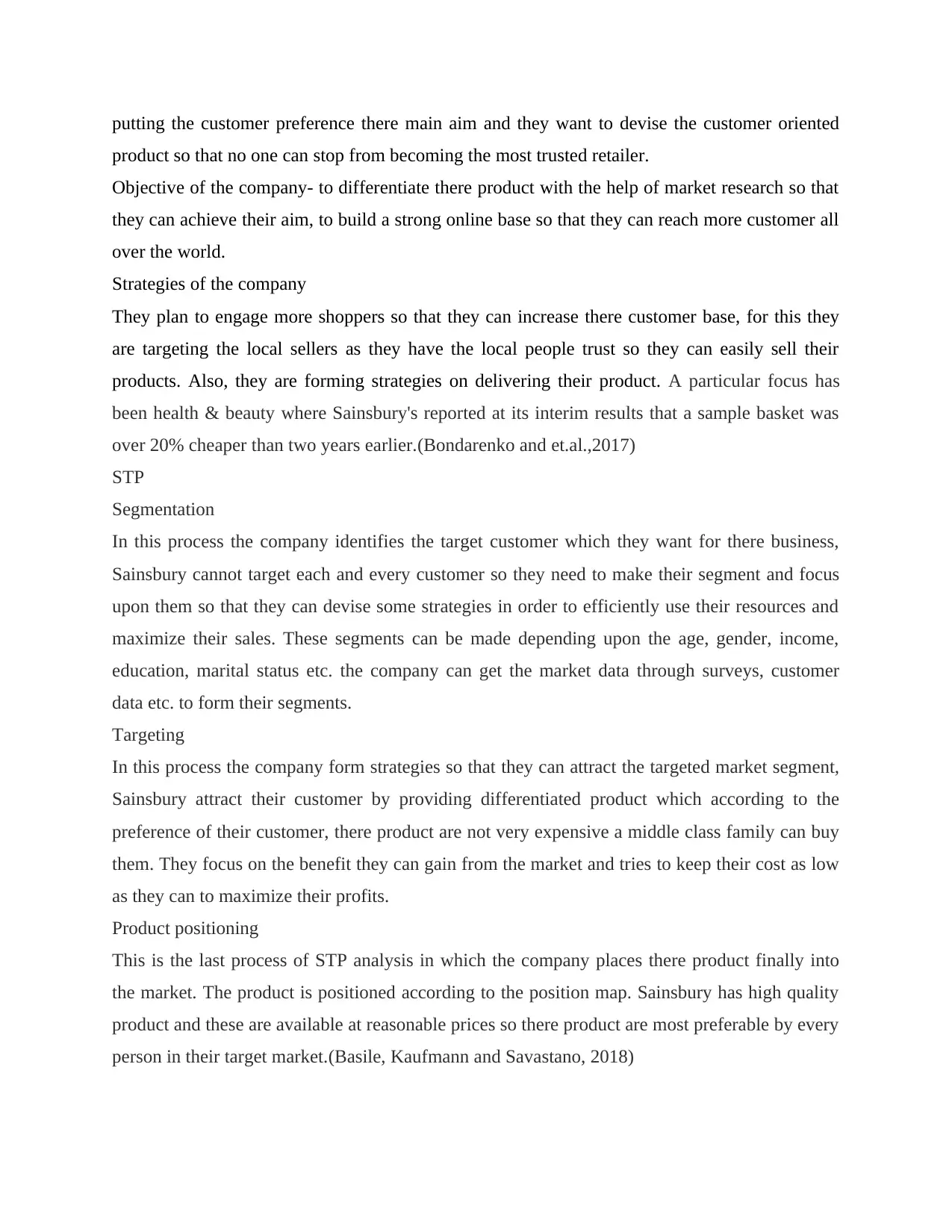
putting the customer preference there main aim and they want to devise the customer oriented
product so that no one can stop from becoming the most trusted retailer.
Objective of the company- to differentiate there product with the help of market research so that
they can achieve their aim, to build a strong online base so that they can reach more customer all
over the world.
Strategies of the company
They plan to engage more shoppers so that they can increase there customer base, for this they
are targeting the local sellers as they have the local people trust so they can easily sell their
products. Also, they are forming strategies on delivering their product. A particular focus has
been health & beauty where Sainsbury's reported at its interim results that a sample basket was
over 20% cheaper than two years earlier.(Bondarenko and et.al.,2017)
STP
Segmentation
In this process the company identifies the target customer which they want for there business,
Sainsbury cannot target each and every customer so they need to make their segment and focus
upon them so that they can devise some strategies in order to efficiently use their resources and
maximize their sales. These segments can be made depending upon the age, gender, income,
education, marital status etc. the company can get the market data through surveys, customer
data etc. to form their segments.
Targeting
In this process the company form strategies so that they can attract the targeted market segment,
Sainsbury attract their customer by providing differentiated product which according to the
preference of their customer, there product are not very expensive a middle class family can buy
them. They focus on the benefit they can gain from the market and tries to keep their cost as low
as they can to maximize their profits.
Product positioning
This is the last process of STP analysis in which the company places there product finally into
the market. The product is positioned according to the position map. Sainsbury has high quality
product and these are available at reasonable prices so there product are most preferable by every
person in their target market.(Basile, Kaufmann and Savastano, 2018)
product so that no one can stop from becoming the most trusted retailer.
Objective of the company- to differentiate there product with the help of market research so that
they can achieve their aim, to build a strong online base so that they can reach more customer all
over the world.
Strategies of the company
They plan to engage more shoppers so that they can increase there customer base, for this they
are targeting the local sellers as they have the local people trust so they can easily sell their
products. Also, they are forming strategies on delivering their product. A particular focus has
been health & beauty where Sainsbury's reported at its interim results that a sample basket was
over 20% cheaper than two years earlier.(Bondarenko and et.al.,2017)
STP
Segmentation
In this process the company identifies the target customer which they want for there business,
Sainsbury cannot target each and every customer so they need to make their segment and focus
upon them so that they can devise some strategies in order to efficiently use their resources and
maximize their sales. These segments can be made depending upon the age, gender, income,
education, marital status etc. the company can get the market data through surveys, customer
data etc. to form their segments.
Targeting
In this process the company form strategies so that they can attract the targeted market segment,
Sainsbury attract their customer by providing differentiated product which according to the
preference of their customer, there product are not very expensive a middle class family can buy
them. They focus on the benefit they can gain from the market and tries to keep their cost as low
as they can to maximize their profits.
Product positioning
This is the last process of STP analysis in which the company places there product finally into
the market. The product is positioned according to the position map. Sainsbury has high quality
product and these are available at reasonable prices so there product are most preferable by every
person in their target market.(Basile, Kaufmann and Savastano, 2018)
Monitoring
Sainsbury needs to measure their performance in an effective manner with the help of indicators
and parameters. It will help the company to know in which area changes need to be made and
where they are lacking as every area has their own mechanism and it requires different resources.
Analysis is required of every specific area so that they can perform the task easily and without
disruptions. They need to focus on the aspect of changing the factor of cost, quality, speed and
work on improving it. Company needs to remove the duplicate measures in their steps in order to
design and change the entire process of business.
CONCLUSION
From the above study it has been concluded that the Strategic management is helpful for
company in developing the various strategies can be developed and further implemented. The
company can further grow and compete effectively with the rivals by analysing several internal
and external factors across the company and the area where business activities are being
conducted. They can raise their profits and revenues effectively by implementing different
policies and strategies to gain the objective of company. The company can effectively compete
with its rivals so that they can establish their brand loyalty among the consumer become the
largest retail supermarket chain in the country and globally.
(Bondarenko and et.al.,2017)
Sainsbury needs to measure their performance in an effective manner with the help of indicators
and parameters. It will help the company to know in which area changes need to be made and
where they are lacking as every area has their own mechanism and it requires different resources.
Analysis is required of every specific area so that they can perform the task easily and without
disruptions. They need to focus on the aspect of changing the factor of cost, quality, speed and
work on improving it. Company needs to remove the duplicate measures in their steps in order to
design and change the entire process of business.
CONCLUSION
From the above study it has been concluded that the Strategic management is helpful for
company in developing the various strategies can be developed and further implemented. The
company can further grow and compete effectively with the rivals by analysing several internal
and external factors across the company and the area where business activities are being
conducted. They can raise their profits and revenues effectively by implementing different
policies and strategies to gain the objective of company. The company can effectively compete
with its rivals so that they can establish their brand loyalty among the consumer become the
largest retail supermarket chain in the country and globally.
(Bondarenko and et.al.,2017)
⊘ This is a preview!⊘
Do you want full access?
Subscribe today to unlock all pages.
Trusted by 1+ million students worldwide

Paraphrase This Document
Need a fresh take? Get an instant paraphrase of this document with our AI Paraphraser
REFERENCES
Books and Journals
Alyoubi, B.A., 2015. Decision support system and knowledge-based strategic management.
Procedia Computer Science.65. pp.278-284.
Bao, G., 2015. What theories are needed for strategic management?. Nankai Business Review
International.6(4). pp.433-454.
Basile, G., Kaufmann, H.R. and Savastano, M., 2018. Revisiting complexity theory to achieve
strategic intelligence. International Journal of Foresight and Innovation Policy.13(1-2).
pp.57-70.
Bondarenko, T.G and et.al.,2017. Optimization of the company strategic management system in
the context of economic instability. European Research Studies.20(2). p.3.
Carlsson-Wall, M., Kraus, K. and Lind, J., 2015. Strategic management accounting in close
inter-organisational relationships. Accounting and Business Research.45(1). pp.27-54.
Johnsen, Å., 2015. Strategic management thinking and practice in the public sector: A strategic
planning for all seasons?. Financial Accountability & Management.31(3). pp.243-268.
Ocasio, W., Laamanen, T. and Vaara, E., 2018. Communication and attention dynamics: An
attention‐based view of strategic change. Strategic Management Journal.39(1). pp.155-
167.
Ridder, H.G. and Baluch, A.M., 2017. Strategic human resource management. In The Nonprofit
Human Resource Management Handbook (pp. 69-86). Routledge.
Sánchez, A.A., Marín, G.S. and Morales, A.M., 2015. The mediating effect of strategic human
resource practices on knowledge management and firm performance. Revista Europea de
Dirección y Economía de la Empresa. 24(3). pp.138-148.
Starr, E., Ganco, M. and Campbell, B.A., 2018. Strategic human capital management in the
context of cross‐industry and within‐industry mobility frictions. Strategic Management
Journal.39(8).pp.2226-2254.
Stead, J.G. and Stead, W.E., 2016. Spiritual capabilities: keys to successful sustainable strategic
management. In Spirituality and Sustainability (pp. 89-103). Springer, Cham.
Theriou, N.G., 2015. Strategic Management Process and the Importance of Structured Formality,
Financial and Non-Financial Information. European Research Studies.18(2). p.3.
Books and Journals
Alyoubi, B.A., 2015. Decision support system and knowledge-based strategic management.
Procedia Computer Science.65. pp.278-284.
Bao, G., 2015. What theories are needed for strategic management?. Nankai Business Review
International.6(4). pp.433-454.
Basile, G., Kaufmann, H.R. and Savastano, M., 2018. Revisiting complexity theory to achieve
strategic intelligence. International Journal of Foresight and Innovation Policy.13(1-2).
pp.57-70.
Bondarenko, T.G and et.al.,2017. Optimization of the company strategic management system in
the context of economic instability. European Research Studies.20(2). p.3.
Carlsson-Wall, M., Kraus, K. and Lind, J., 2015. Strategic management accounting in close
inter-organisational relationships. Accounting and Business Research.45(1). pp.27-54.
Johnsen, Å., 2015. Strategic management thinking and practice in the public sector: A strategic
planning for all seasons?. Financial Accountability & Management.31(3). pp.243-268.
Ocasio, W., Laamanen, T. and Vaara, E., 2018. Communication and attention dynamics: An
attention‐based view of strategic change. Strategic Management Journal.39(1). pp.155-
167.
Ridder, H.G. and Baluch, A.M., 2017. Strategic human resource management. In The Nonprofit
Human Resource Management Handbook (pp. 69-86). Routledge.
Sánchez, A.A., Marín, G.S. and Morales, A.M., 2015. The mediating effect of strategic human
resource practices on knowledge management and firm performance. Revista Europea de
Dirección y Economía de la Empresa. 24(3). pp.138-148.
Starr, E., Ganco, M. and Campbell, B.A., 2018. Strategic human capital management in the
context of cross‐industry and within‐industry mobility frictions. Strategic Management
Journal.39(8).pp.2226-2254.
Stead, J.G. and Stead, W.E., 2016. Spiritual capabilities: keys to successful sustainable strategic
management. In Spirituality and Sustainability (pp. 89-103). Springer, Cham.
Theriou, N.G., 2015. Strategic Management Process and the Importance of Structured Formality,
Financial and Non-Financial Information. European Research Studies.18(2). p.3.

1 out of 11


Related Documents


Your All-in-One AI-Powered Toolkit for Academic Success.
+13062052269
info@desklib.com
Available 24*7 on WhatsApp / Email
![[object Object]](/_next/static/media/star-bottom.7253800d.svg)
Unlock your academic potential
Copyright © 2020–2026 A2Z Services. All Rights Reserved. Developed and managed by ZUCOL.