Operations & Project Management: Sainsbury's Strategies & Analysis
VerifiedAdded on 2023/06/18
|23
|6054
|406
Report
AI Summary
This report provides a detailed analysis of Sainsbury's operations and project management strategies. It begins with an overview of the company, highlighting its market position and diverse product range. The report distinguishes between operation and operations management, followed by a review and critique of the implementation of operations management principles within Sainsbury's, including Taylor's theory of scientific management, flexible specialization, lean production, mass customization, and agile manufacturing. It examines how operational management contributes to achieving organizational goals and explores continuous improvement as a philosophy, including lean principles and a continuous improvement plan with recommendations. Furthermore, the report includes an overview of a case study, explaining each stage of the product life cycle in the context of an in-house catering project within the firm and critically evaluating the application of the product lifecycle in project management using relevant theories and models. The report concludes by summarizing the key findings and insights.
16 – OPERATIONS AND
PROJECT
MANAGEMENT
PROJECT
MANAGEMENT

Paraphrase This Document
Need a fresh take? Get an instant paraphrase of this document with our AI Paraphraser
TABLE OF CONTENTS
TABLE OF CONTENTS..............................................................................................................2
INTRODUCTION...........................................................................................................................3
MAIN BODY...................................................................................................................................4
PART 1............................................................................................................................................4
Overview of the company...........................................................................................................4
Operation vs operations management.........................................................................................4
Review and critique of the implementation of operations management principles within
Sainsbury.....................................................................................................................................5
The way operational management lead in meeting organization goals......................................7
Continuous improvement as a philosophy and lean principles...................................................8
Continuous improvement plan along with recommendation....................................................10
PART- B........................................................................................................................................11
An overview of the given case study........................................................................................11
Explanation of each and every stage of the product life cycle in context of in house project
related to catering within the firm.............................................................................................12
Critical evaluation of Product life cycle in application in project by utilising theories and
models.......................................................................................................................................22
CONCLUSION..............................................................................................................................22
REFERENCES..............................................................................................................................23
TABLE OF CONTENTS..............................................................................................................2
INTRODUCTION...........................................................................................................................3
MAIN BODY...................................................................................................................................4
PART 1............................................................................................................................................4
Overview of the company...........................................................................................................4
Operation vs operations management.........................................................................................4
Review and critique of the implementation of operations management principles within
Sainsbury.....................................................................................................................................5
The way operational management lead in meeting organization goals......................................7
Continuous improvement as a philosophy and lean principles...................................................8
Continuous improvement plan along with recommendation....................................................10
PART- B........................................................................................................................................11
An overview of the given case study........................................................................................11
Explanation of each and every stage of the product life cycle in context of in house project
related to catering within the firm.............................................................................................12
Critical evaluation of Product life cycle in application in project by utilising theories and
models.......................................................................................................................................22
CONCLUSION..............................................................................................................................22
REFERENCES..............................................................................................................................23
INTRODUCTION
Operation is work to managing the inner working of company so that it can easily and
smoothly perform its task in competitive environment. Operational management includes
activities from utilizing the resources from equipment, material, staff and technology thereby
qualitative services can be rendered to customer's. Project management is use of specific
knowledge, techniques and tool in order to deliver maximum value to customer's living in the
society. The report has contained key information pertaining to difference between operation and
operational management. Furthermore, it has included information related to implementation of
operations management principles and continuous improvement plan so that company can meet
its required objectives.
MAIN BODY
PART 1
Overview of the company
Sainsbury is second largest chain of supermarket in United Kingdom have founded by
John James in 1869 with an motivate to earn high profit margin. Argos, habitat, nectar, TU are
different brands in which company deals to attract and retained maximum number of customer's
in the firm. It has wide range of products starting from home care, personal to financial services
that has lead in meeting expectancy of customer's beyond their wants. Currently the firm have
market share of 16.0% in retail sector of UK that help in influencing range of people to be part of
the organization (Gunasekaran and Subramanian, 2018). Company have 1428 shops and 111900
employees that are working for overall growth and development of firm in external environment.
Effective management and presence of company across worldwide has helped Sainsbury in
meeting the expectancy of customer's beyond their wants.
Operation vs operations management
Operation are range of functions or routine work that are performed by different
individual within the organization so that the services can be rendered to the customer's rapidly.
Salisbury manager has lay importance to promote smooth operation of business that has
contributed in retaining customer's loyalty, fast operation and achievement of company
objectives.
Operation is work to managing the inner working of company so that it can easily and
smoothly perform its task in competitive environment. Operational management includes
activities from utilizing the resources from equipment, material, staff and technology thereby
qualitative services can be rendered to customer's. Project management is use of specific
knowledge, techniques and tool in order to deliver maximum value to customer's living in the
society. The report has contained key information pertaining to difference between operation and
operational management. Furthermore, it has included information related to implementation of
operations management principles and continuous improvement plan so that company can meet
its required objectives.
MAIN BODY
PART 1
Overview of the company
Sainsbury is second largest chain of supermarket in United Kingdom have founded by
John James in 1869 with an motivate to earn high profit margin. Argos, habitat, nectar, TU are
different brands in which company deals to attract and retained maximum number of customer's
in the firm. It has wide range of products starting from home care, personal to financial services
that has lead in meeting expectancy of customer's beyond their wants. Currently the firm have
market share of 16.0% in retail sector of UK that help in influencing range of people to be part of
the organization (Gunasekaran and Subramanian, 2018). Company have 1428 shops and 111900
employees that are working for overall growth and development of firm in external environment.
Effective management and presence of company across worldwide has helped Sainsbury in
meeting the expectancy of customer's beyond their wants.
Operation vs operations management
Operation are range of functions or routine work that are performed by different
individual within the organization so that the services can be rendered to the customer's rapidly.
Salisbury manager has lay importance to promote smooth operation of business that has
contributed in retaining customer's loyalty, fast operation and achievement of company
objectives.
⊘ This is a preview!⊘
Do you want full access?
Subscribe today to unlock all pages.

Trusted by 1+ million students worldwide
On the other hand, operations management is concerned with designing and controlling
overall process of production of good and services so that maximum value can be delivered to
customer's for fulfillment of their respective desire. There are range of activities that are involved
in the operation management such as planning, organizing, coordinating and controlling
resources of firm thereby it can gain competitive advantages (SZENDE, DALTON and YOO,
2021). Therefore, in in other words, the operational management is administration of business
practice in order to create maximum value that can be delivered to customer's for satisfaction of
their respective wants.
Review and critique of the implementation of operations management principles within
Sainsbury
Operational management is related to managing all the operational of company
effectively and efficiently as possible so that end goals of organization can be achieved in better
manner. There are range of operational management principle that has been implemented within
the Sainsbury so that it can gain competitive advantages. Such as Taylor's theory of scientific
management, flexible specialization, lean production, agile manufacturing are different
operational management principle that has been used by the company to promote smooth
operation of business in external environment. Such as:
1. Taylor's theory of scientific management: It is the theory that find out the most
effectively method that can be used to complete a particular job in organization so that it
can deliver services to customer's at minimum price possible. The major purpose of
Taylor theory is improving the productivity, economic efficiency thereby wants of the
customer's can be fulfilled beyond their wants (Nguenang, 2018). Sainsbury manager has
applied principals such as science, not rule of Thumb, harmony, not discord, cooperation,
not individualism and development of each and every person to its efficiency and
prosperity.
Science, not rule of thumb is principle has been abide by company as it always think
before doing any of the particular task. In addition to this, it has promoted harmony and
cooperation among individuals that are working in the firm so that they can work in team for
achievement of company goals. Furthermore, it has provided appropriate training and guidance
overall process of production of good and services so that maximum value can be delivered to
customer's for fulfillment of their respective desire. There are range of activities that are involved
in the operation management such as planning, organizing, coordinating and controlling
resources of firm thereby it can gain competitive advantages (SZENDE, DALTON and YOO,
2021). Therefore, in in other words, the operational management is administration of business
practice in order to create maximum value that can be delivered to customer's for satisfaction of
their respective wants.
Review and critique of the implementation of operations management principles within
Sainsbury
Operational management is related to managing all the operational of company
effectively and efficiently as possible so that end goals of organization can be achieved in better
manner. There are range of operational management principle that has been implemented within
the Sainsbury so that it can gain competitive advantages. Such as Taylor's theory of scientific
management, flexible specialization, lean production, agile manufacturing are different
operational management principle that has been used by the company to promote smooth
operation of business in external environment. Such as:
1. Taylor's theory of scientific management: It is the theory that find out the most
effectively method that can be used to complete a particular job in organization so that it
can deliver services to customer's at minimum price possible. The major purpose of
Taylor theory is improving the productivity, economic efficiency thereby wants of the
customer's can be fulfilled beyond their wants (Nguenang, 2018). Sainsbury manager has
applied principals such as science, not rule of Thumb, harmony, not discord, cooperation,
not individualism and development of each and every person to its efficiency and
prosperity.
Science, not rule of thumb is principle has been abide by company as it always think
before doing any of the particular task. In addition to this, it has promoted harmony and
cooperation among individuals that are working in the firm so that they can work in team for
achievement of company goals. Furthermore, it has provided appropriate training and guidance
Paraphrase This Document
Need a fresh take? Get an instant paraphrase of this document with our AI Paraphraser
to employees related to the way task need to be completed that has lead in enhancing overall
performance and productivity of organization (Afreen, 2021).
2. Flexible specialization: It is an business strategy that is mainly adapted by the
organization to stay competitive from other firm operating in retail sector of United
Kingdom. Likewise, in this firm hire and retained employees that have multiple skills so
that they are capable of completing their respective task. Sainsbury has ensured that it
have sufficient human and financial resource to accomplished all the desired activities of
the firm with a motive to delivered range of services to customer in limited time possible.
Furthermore, the company have ability to quickly adapt itself with the changing
environment that helps it in bringing innovative ideas in the businesses and stay
competitive. Sainsbury has flexible organization structure that contribute company in
rapidly accepting the changes to stay ahead in competition and meet the requirements of
customer's (Moynihan, 2018). Open and friendly culture has also contributed employees
in sharing their innovative ideas to others so that company can accept the same ad grow
its business.
3. Lean production: It is lean production methodology emphasis on making optimum
utilization of resources to eliminate wastage and delivered maximum value to customer's
for satisfaction of their wants. Sainsbury has accepted the lean production principle while
performing its task through making use of new and innovative technology that is capable
of delivering maximum value to customer's at minimum cost or wastage. Leader has also
effectively guide and direct employees pertaining to the way task needs to be completed
that has lead in making employees happy and satisfied (Jaggars and Jones, 2018). Lean
manufacturing principle lead in delivering high quality products to customer's at lower
costs thus contribute in building and retaining strong brand image of firm in external
environment. Information technology has been used to have sufficient data pertaining to
the overall performance of employees, key errors or mistake so that timely corrective
action for better outcome or fruitful results. There are various benefits of the lean
manufacturing production which includes the enhancement in efficiency of the complete
project, reduces the wastage of resources and enhances the productivity level. It somehow
enables the firm to increase the product quality and make the resources more meaningful
and innovative along with good quality control that has been previously gets wasted.
performance and productivity of organization (Afreen, 2021).
2. Flexible specialization: It is an business strategy that is mainly adapted by the
organization to stay competitive from other firm operating in retail sector of United
Kingdom. Likewise, in this firm hire and retained employees that have multiple skills so
that they are capable of completing their respective task. Sainsbury has ensured that it
have sufficient human and financial resource to accomplished all the desired activities of
the firm with a motive to delivered range of services to customer in limited time possible.
Furthermore, the company have ability to quickly adapt itself with the changing
environment that helps it in bringing innovative ideas in the businesses and stay
competitive. Sainsbury has flexible organization structure that contribute company in
rapidly accepting the changes to stay ahead in competition and meet the requirements of
customer's (Moynihan, 2018). Open and friendly culture has also contributed employees
in sharing their innovative ideas to others so that company can accept the same ad grow
its business.
3. Lean production: It is lean production methodology emphasis on making optimum
utilization of resources to eliminate wastage and delivered maximum value to customer's
for satisfaction of their wants. Sainsbury has accepted the lean production principle while
performing its task through making use of new and innovative technology that is capable
of delivering maximum value to customer's at minimum cost or wastage. Leader has also
effectively guide and direct employees pertaining to the way task needs to be completed
that has lead in making employees happy and satisfied (Jaggars and Jones, 2018). Lean
manufacturing principle lead in delivering high quality products to customer's at lower
costs thus contribute in building and retaining strong brand image of firm in external
environment. Information technology has been used to have sufficient data pertaining to
the overall performance of employees, key errors or mistake so that timely corrective
action for better outcome or fruitful results. There are various benefits of the lean
manufacturing production which includes the enhancement in efficiency of the complete
project, reduces the wastage of resources and enhances the productivity level. It somehow
enables the firm to increase the product quality and make the resources more meaningful
and innovative along with good quality control that has been previously gets wasted.
Likewise, just in time is one of the approach that has been used by the company to promote its
growth and expansion. It has ensured that all products and services are to be delivered to
customer's in minimum time frame possible (Haksever and Render, 2017).
4. Mass customisation: It is process of delivering good and services to customer's as per
their requirements and preferences to make them happy and satisfied. Sainsbury in order
to sustain its market positioning has always focused on delivering innovative and creative
products to be delivered to the customer's. Along with it, lay emphasis on reducing the
overall cost of production through manufacturing product in bulk quantity or bringing
economic of scale in the firm (Größler, 2020). Personalized and customized services
provided to the customer's that has yield in providing maximum benefits to customer's.
Likewise, the Sainsbury has work collaborative with customer's to offer range of products
from alternative options (Tonchia, Tonchia and Mahagaonkar, 2018). It has helped in
reviewing and adjusting the products features as well as quality as per their requirements.
In addition to this company is also planning to make use of cosmetic customization in
which it has manufactured standard products but packaged them in well designed manner
so that it can be suitable for the customer's. Thus, abiding to the mass customization
principle has helped Sainsbury in retaining its market share in retail sector of United
Kingdom for many years.
5. Agile manufacturing: It is the principle of operational management that has been used
by Sainsbury to stay ahead in competition. As it has extremely focus on rapidly or
quickly adapting the needs and wants of the customer's. Sainsbury manager keeps eye on
what all taking place in external environment and try to find out different method or
strategies that could be used to make the best use of opportunities and overcome the
threat. Company by focusing on creating and maintaining healthy and friendly working
culture has motivated employees to work hard and determined for achievement of end
goals (Helmold and Terry, 2021).
The way operational management lead in meeting organization goals
Operational management of Sainsbury has contributed in meeting the company goals as
each and every aspect of business is planned, organized, integrated, controlled and close to
ensure quality and make necessary improvement for better outcome. It has lead in immense
growth and expansion. It has ensured that all products and services are to be delivered to
customer's in minimum time frame possible (Haksever and Render, 2017).
4. Mass customisation: It is process of delivering good and services to customer's as per
their requirements and preferences to make them happy and satisfied. Sainsbury in order
to sustain its market positioning has always focused on delivering innovative and creative
products to be delivered to the customer's. Along with it, lay emphasis on reducing the
overall cost of production through manufacturing product in bulk quantity or bringing
economic of scale in the firm (Größler, 2020). Personalized and customized services
provided to the customer's that has yield in providing maximum benefits to customer's.
Likewise, the Sainsbury has work collaborative with customer's to offer range of products
from alternative options (Tonchia, Tonchia and Mahagaonkar, 2018). It has helped in
reviewing and adjusting the products features as well as quality as per their requirements.
In addition to this company is also planning to make use of cosmetic customization in
which it has manufactured standard products but packaged them in well designed manner
so that it can be suitable for the customer's. Thus, abiding to the mass customization
principle has helped Sainsbury in retaining its market share in retail sector of United
Kingdom for many years.
5. Agile manufacturing: It is the principle of operational management that has been used
by Sainsbury to stay ahead in competition. As it has extremely focus on rapidly or
quickly adapting the needs and wants of the customer's. Sainsbury manager keeps eye on
what all taking place in external environment and try to find out different method or
strategies that could be used to make the best use of opportunities and overcome the
threat. Company by focusing on creating and maintaining healthy and friendly working
culture has motivated employees to work hard and determined for achievement of end
goals (Helmold and Terry, 2021).
The way operational management lead in meeting organization goals
Operational management of Sainsbury has contributed in meeting the company goals as
each and every aspect of business is planned, organized, integrated, controlled and close to
ensure quality and make necessary improvement for better outcome. It has lead in immense
⊘ This is a preview!⊘
Do you want full access?
Subscribe today to unlock all pages.
Trusted by 1+ million students worldwide
influence on improving the organization overall performance and financial bottom line through
emphasizing on making optimum use of available resources so that maximum value can be
delivered to customer's. In addition to this, it can be stated that operation management of
company keep in mind two goals such as keeping the cost of products low and making
customer's happy and satisfied. Thereby, they are always motivated to be part of the organisation
for fulfilling their requirements (Mishra and Browning, 2020). Manager has continuously
supervised and monitor overall performance of employees in order to take corrective action to
improve the same for growth and expansion of firm in international market. At last it can be
summarised or understand that effective operational management has helped Sainsbury in
bringing economic of scale in the firm and meeting expectancy of range of people living in the
society to enjoy high profit margin (Kimmons and Loweree, 2017).
Continuous improvement as a philosophy and lean principles
In the corporate world, it has been identified that each and every organization had started
with a motive to approach profit maximization by adopting and focusing towards specific
philosophies which ultimately helps them in order to improve their working. This enables the
firm to run successfully within the market space. As per the author, it has been described with
the help of continuous improvement which has been considered as one of the major philosophy
that enables the firm to obtain competitive advantages, enhancement in profit margins, revenue
generation and building broad consumer base (Diwas, 2020). It is basically tough task to manage
all the things in most appropriate ways.
Kaizen is an approach that has been utilized for continuous improvements based on
specific ideas to make small but steady changes.
emphasizing on making optimum use of available resources so that maximum value can be
delivered to customer's. In addition to this, it can be stated that operation management of
company keep in mind two goals such as keeping the cost of products low and making
customer's happy and satisfied. Thereby, they are always motivated to be part of the organisation
for fulfilling their requirements (Mishra and Browning, 2020). Manager has continuously
supervised and monitor overall performance of employees in order to take corrective action to
improve the same for growth and expansion of firm in international market. At last it can be
summarised or understand that effective operational management has helped Sainsbury in
bringing economic of scale in the firm and meeting expectancy of range of people living in the
society to enjoy high profit margin (Kimmons and Loweree, 2017).
Continuous improvement as a philosophy and lean principles
In the corporate world, it has been identified that each and every organization had started
with a motive to approach profit maximization by adopting and focusing towards specific
philosophies which ultimately helps them in order to improve their working. This enables the
firm to run successfully within the market space. As per the author, it has been described with
the help of continuous improvement which has been considered as one of the major philosophy
that enables the firm to obtain competitive advantages, enhancement in profit margins, revenue
generation and building broad consumer base (Diwas, 2020). It is basically tough task to manage
all the things in most appropriate ways.
Kaizen is an approach that has been utilized for continuous improvements based on
specific ideas to make small but steady changes.
Paraphrase This Document
Need a fresh take? Get an instant paraphrase of this document with our AI Paraphraser
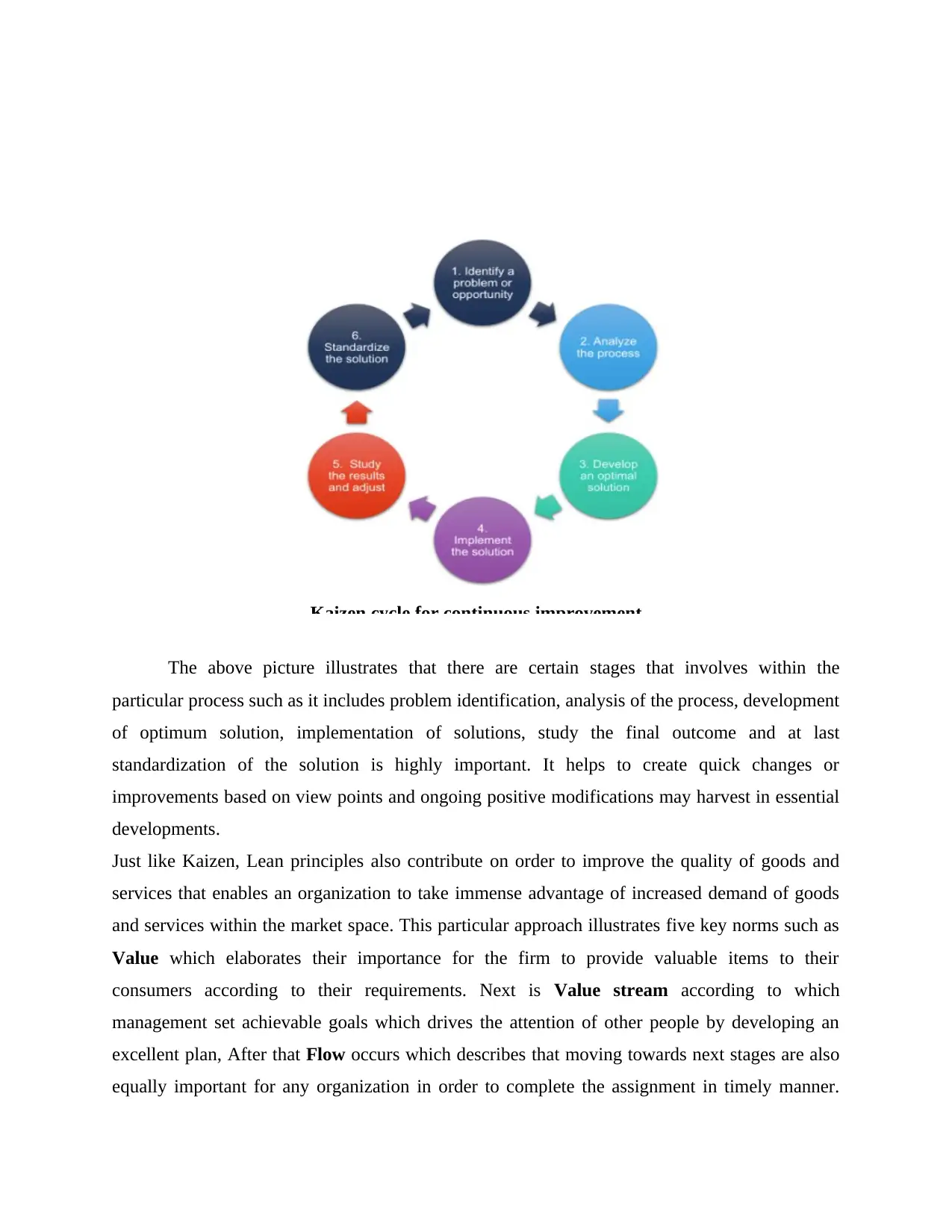
The above picture illustrates that there are certain stages that involves within the
particular process such as it includes problem identification, analysis of the process, development
of optimum solution, implementation of solutions, study the final outcome and at last
standardization of the solution is highly important. It helps to create quick changes or
improvements based on view points and ongoing positive modifications may harvest in essential
developments.
Just like Kaizen, Lean principles also contribute on order to improve the quality of goods and
services that enables an organization to take immense advantage of increased demand of goods
and services within the market space. This particular approach illustrates five key norms such as
Value which elaborates their importance for the firm to provide valuable items to their
consumers according to their requirements. Next is Value stream according to which
management set achievable goals which drives the attention of other people by developing an
excellent plan, After that Flow occurs which describes that moving towards next stages are also
equally important for any organization in order to complete the assignment in timely manner.
Kaizen cycle for continuous improvement
particular process such as it includes problem identification, analysis of the process, development
of optimum solution, implementation of solutions, study the final outcome and at last
standardization of the solution is highly important. It helps to create quick changes or
improvements based on view points and ongoing positive modifications may harvest in essential
developments.
Just like Kaizen, Lean principles also contribute on order to improve the quality of goods and
services that enables an organization to take immense advantage of increased demand of goods
and services within the market space. This particular approach illustrates five key norms such as
Value which elaborates their importance for the firm to provide valuable items to their
consumers according to their requirements. Next is Value stream according to which
management set achievable goals which drives the attention of other people by developing an
excellent plan, After that Flow occurs which describes that moving towards next stages are also
equally important for any organization in order to complete the assignment in timely manner.
Kaizen cycle for continuous improvement
After that Pull consists that this is the ultimate time to produce goods in the external market
which helps the brand to gain attention of potential buyers (Dierynck and Labro, 2018). The last
one is perfection principle which is most important of lean approach as it drives the attention of
management towards engagement of employees in decision-making procedure.
Continuous improvement plan along with recommendation
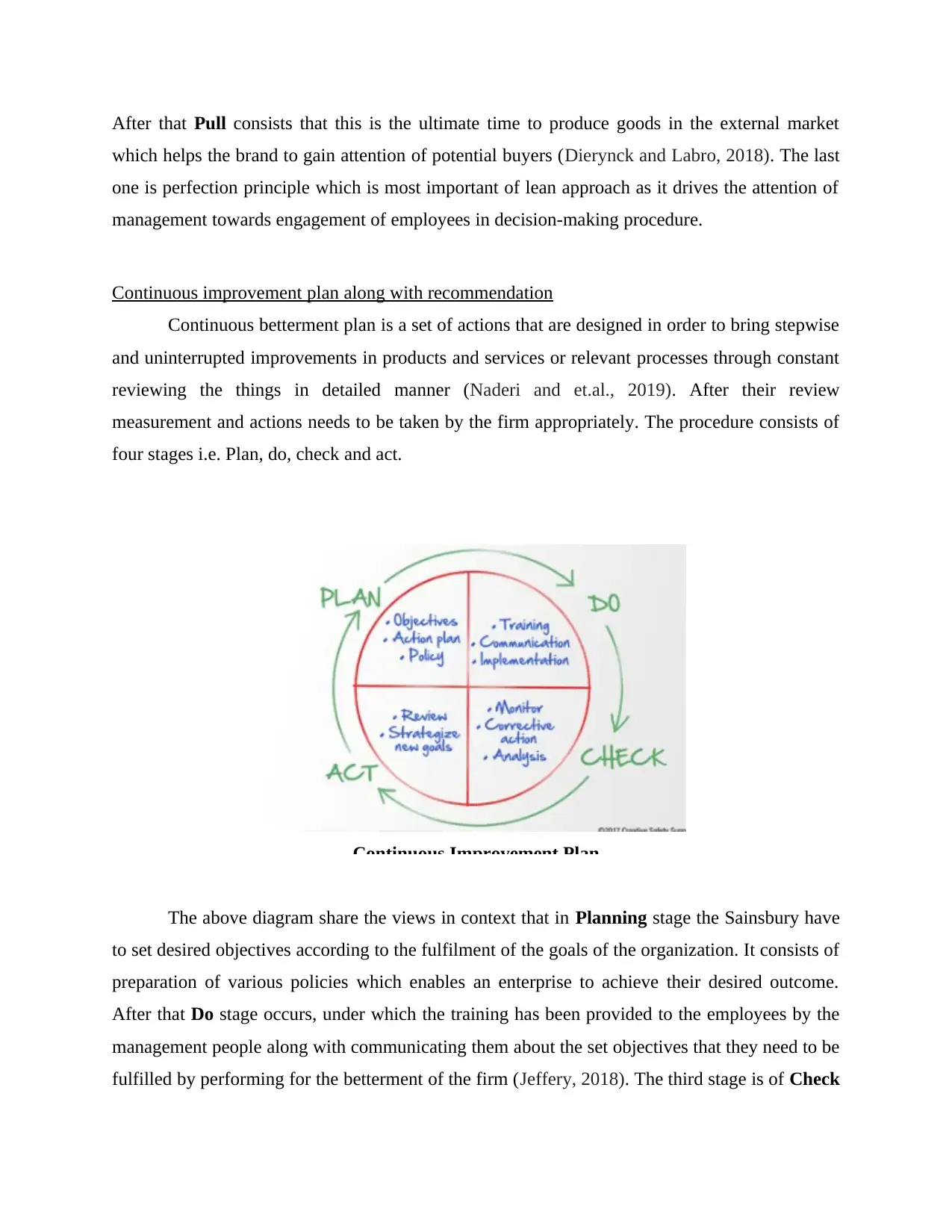
Continuous betterment plan is a set of actions that are designed in order to bring stepwise
and uninterrupted improvements in products and services or relevant processes through constant
reviewing the things in detailed manner (Naderi and et.al., 2019). After their review
measurement and actions needs to be taken by the firm appropriately. The procedure consists of
four stages i.e. Plan, do, check and act.
The above diagram share the views in context that in Planning stage the Sainsbury have
to set desired objectives according to the fulfilment of the goals of the organization. It consists of
preparation of various policies which enables an enterprise to achieve their desired outcome.
After that Do stage occurs, under which the training has been provided to the employees by the
management people along with communicating them about the set objectives that they need to be
fulfilled by performing for the betterment of the firm (Jeffery, 2018). The third stage is of Check
Continuous Improvement Plan
which helps the brand to gain attention of potential buyers (Dierynck and Labro, 2018). The last
one is perfection principle which is most important of lean approach as it drives the attention of
management towards engagement of employees in decision-making procedure.
Continuous improvement plan along with recommendation
Continuous betterment plan is a set of actions that are designed in order to bring stepwise
and uninterrupted improvements in products and services or relevant processes through constant
reviewing the things in detailed manner (Naderi and et.al., 2019). After their review
measurement and actions needs to be taken by the firm appropriately. The procedure consists of
four stages i.e. Plan, do, check and act.
The above diagram share the views in context that in Planning stage the Sainsbury have
to set desired objectives according to the fulfilment of the goals of the organization. It consists of
preparation of various policies which enables an enterprise to achieve their desired outcome.
After that Do stage occurs, under which the training has been provided to the employees by the
management people along with communicating them about the set objectives that they need to be
fulfilled by performing for the betterment of the firm (Jeffery, 2018). The third stage is of Check
Continuous Improvement Plan
⊘ This is a preview!⊘
Do you want full access?
Subscribe today to unlock all pages.
Trusted by 1+ million students worldwide
stage, in which the tasks have been monitored by the management people that the desired goals
meet the final outcomes or not. If there are certain gaps occurs then necessary measures will be
taken place by them within stipulated time frame. The last stage is of Action stage under which
the management review previous performances and set new strategies according to the modified
goals and objectives of the firm.
In context of Sainsbury, it has been recommended that taking necessary steps towards
changes in order to maintain current company culture as well as their resources. The firm can
change its production process by analysing current market trends and thus start manufacturing
modified products. The firm can also focus towards the quality of the goods and services and
conduct practice as per the requirements. For example with focusing towards the procurement
strategies, effective resource management, adopting cost-efficient strategies, etc. the Sainsbury
can manage product quality (Lee and et.al., 2019). Apart from this, recruitment of appropriate
staff members are highly recommended to the organization to manage their tasks and challenges
in most efficient manner. All these actions enables the firm to work in appropriate way without
making any major mistakes that results in declining sales and brand value within the market
place.
PART- B
An overview of the given case study
The given case study is related to the ample size manufacturing organization in Midland
in which the total number of employees i.e. 1250 are working for the betterment of the
establishment. According to current scenario, it has been identified that the company does not
have any kind of on-site catering facilities, so for the purpose of induction and personal
development, the firm plans to start an in- house project which supports the catering facilities.
Moreover, the organization identifies two major objectives which are related to reduce the staff
movement during the lunch break as with this the issue related to congestion in local areas arises.
At the same time, the another kind of major issue that requires high amount of focus is that the
firm have to take necessary steps towards the CSR activities which includes helping the staff
members in order to develop a sense of adopting healthy lifestyle along with reduction in staff
absenteeism (Boer and et.al., 2017). Therefore, the firm is planning to have healthy food and in
meet the final outcomes or not. If there are certain gaps occurs then necessary measures will be
taken place by them within stipulated time frame. The last stage is of Action stage under which
the management review previous performances and set new strategies according to the modified
goals and objectives of the firm.
In context of Sainsbury, it has been recommended that taking necessary steps towards
changes in order to maintain current company culture as well as their resources. The firm can
change its production process by analysing current market trends and thus start manufacturing
modified products. The firm can also focus towards the quality of the goods and services and
conduct practice as per the requirements. For example with focusing towards the procurement
strategies, effective resource management, adopting cost-efficient strategies, etc. the Sainsbury
can manage product quality (Lee and et.al., 2019). Apart from this, recruitment of appropriate
staff members are highly recommended to the organization to manage their tasks and challenges
in most efficient manner. All these actions enables the firm to work in appropriate way without
making any major mistakes that results in declining sales and brand value within the market
place.
PART- B
An overview of the given case study
The given case study is related to the ample size manufacturing organization in Midland
in which the total number of employees i.e. 1250 are working for the betterment of the
establishment. According to current scenario, it has been identified that the company does not
have any kind of on-site catering facilities, so for the purpose of induction and personal
development, the firm plans to start an in- house project which supports the catering facilities.
Moreover, the organization identifies two major objectives which are related to reduce the staff
movement during the lunch break as with this the issue related to congestion in local areas arises.
At the same time, the another kind of major issue that requires high amount of focus is that the
firm have to take necessary steps towards the CSR activities which includes helping the staff
members in order to develop a sense of adopting healthy lifestyle along with reduction in staff
absenteeism (Boer and et.al., 2017). Therefore, the firm is planning to have healthy food and in
Paraphrase This Document
Need a fresh take? Get an instant paraphrase of this document with our AI Paraphraser
house catering facilities for their employees so that they are able to avoid getting the food items
from anywhere else within the office premises.
Explanation of each and every stage of the product life cycle in context of in house project
related to catering within the firm
INITIATION OF PROJECT
This is the primary stage under which the organization decides to initiate its project so
that the standard objectives can be easily achievable. The organization requires an in premise
catering facility in order to motivate their employees in more effectual manner so that they can
able to work for growth and development of the establishment (KRAJEWSKI, Ritzman and
Malhotra, 2019). So, it involves the description of key information such as business
requirements, key associates and stakeholders, objectives and scope of the assignment that can
be illustrated as:
1. Brief description: This project is related to starting an in house catering facility so that the
employees are able to get necessary food items within office premises to satisfy their
requirements rather than going somewhere else for fulfilling their desires.
2. Goals and deliverables: The primary goal is to reduce the staff movement outside from the
office premises and certain chances of absenteeism within the organization. Apart from this, it
initiates steps towards corporate social responsibilities with the help of offering healthy and
hygienic food products to employees within the office premises.
3. Scope: the basic scope of the project is wide as this concept will highly beneficial for the firm
i.e. contribute in enhancement of productivity as well as profitability through satisfying the
requirements of consumers in most effective manner.
4. Stakeholders: The stakeholders are the people that are interested or impacted by the project
such as employees, customers and investors within the organization. Employees are the ones that
perform individual tasks and fulfil responsibilities so that qualitative services can be supply to
consumers (Charpin, 2018). So, in order to implement the project of in house catering, they will
from anywhere else within the office premises.
Explanation of each and every stage of the product life cycle in context of in house project
related to catering within the firm
INITIATION OF PROJECT
This is the primary stage under which the organization decides to initiate its project so
that the standard objectives can be easily achievable. The organization requires an in premise
catering facility in order to motivate their employees in more effectual manner so that they can
able to work for growth and development of the establishment (KRAJEWSKI, Ritzman and
Malhotra, 2019). So, it involves the description of key information such as business
requirements, key associates and stakeholders, objectives and scope of the assignment that can
be illustrated as:
1. Brief description: This project is related to starting an in house catering facility so that the
employees are able to get necessary food items within office premises to satisfy their
requirements rather than going somewhere else for fulfilling their desires.
2. Goals and deliverables: The primary goal is to reduce the staff movement outside from the
office premises and certain chances of absenteeism within the organization. Apart from this, it
initiates steps towards corporate social responsibilities with the help of offering healthy and
hygienic food products to employees within the office premises.
3. Scope: the basic scope of the project is wide as this concept will highly beneficial for the firm
i.e. contribute in enhancement of productivity as well as profitability through satisfying the
requirements of consumers in most effective manner.
4. Stakeholders: The stakeholders are the people that are interested or impacted by the project
such as employees, customers and investors within the organization. Employees are the ones that
perform individual tasks and fulfil responsibilities so that qualitative services can be supply to
consumers (Charpin, 2018). So, in order to implement the project of in house catering, they will
lead in making their employees more comfortable to have food within the food products and
avoiding going out for break in lunchtime.
5. Roles and responsibilities: Within the firm, the project manager is extremely responsible for
plan the actions, arrange appropriate resources, organizing and take controlling measures so that
the pre determined objectives can be achieved. On the other hand, the team members according
to their skills and knowledge, the responsibilities, authority in order to complete the task and
contribute their share towards delegated responsibilities, authorities to fulfil the task and
contribute their share in effectual implementation of assignment or project for better results.
6. Risks: Changes in external environment as well as financial modifications are two major risks
that are highly associated with the project which is related to the in house catering. As if the
project will unable to complete as per the desires of the employees, then it will illuminate as
financial loss to the firm (Hokoma and Amaigl, 2019). At the similar point of time, certain
changes within the external environment that may lead in delay among the completion of the
project.
PROJECT PLANNING
This is the second stage of PLC under which the manager devotes their complete time
and energy in order to plan key actions, budget, resources and proper time duration within which
the project will be completed so that the firm will able to enjoy high amount of profitability
(Sharma, 2018).
6. Scope planning: In the planning stage, the manager has declared that all over 8-9 months
he will require to accomplish the project. It has broader scope such as there will be
abundance of financial as well as human resources will be required to construct the in
house project within the establishment.
avoiding going out for break in lunchtime.
5. Roles and responsibilities: Within the firm, the project manager is extremely responsible for
plan the actions, arrange appropriate resources, organizing and take controlling measures so that
the pre determined objectives can be achieved. On the other hand, the team members according
to their skills and knowledge, the responsibilities, authority in order to complete the task and
contribute their share towards delegated responsibilities, authorities to fulfil the task and
contribute their share in effectual implementation of assignment or project for better results.
6. Risks: Changes in external environment as well as financial modifications are two major risks
that are highly associated with the project which is related to the in house catering. As if the
project will unable to complete as per the desires of the employees, then it will illuminate as
financial loss to the firm (Hokoma and Amaigl, 2019). At the similar point of time, certain
changes within the external environment that may lead in delay among the completion of the
project.
PROJECT PLANNING
This is the second stage of PLC under which the manager devotes their complete time
and energy in order to plan key actions, budget, resources and proper time duration within which
the project will be completed so that the firm will able to enjoy high amount of profitability
(Sharma, 2018).
6. Scope planning: In the planning stage, the manager has declared that all over 8-9 months
he will require to accomplish the project. It has broader scope such as there will be
abundance of financial as well as human resources will be required to construct the in
house project within the establishment.
⊘ This is a preview!⊘
Do you want full access?
Subscribe today to unlock all pages.
Trusted by 1+ million students worldwide

1 out of 23


Related Documents


Your All-in-One AI-Powered Toolkit for Academic Success.
+13062052269
info@desklib.com
Available 24*7 on WhatsApp / Email
![[object Object]](/_next/static/media/star-bottom.7253800d.svg)
Unlock your academic potential
Copyright © 2020–2026 A2Z Services. All Rights Reserved. Developed and managed by ZUCOL.