Talent Development: Leader & Manager Responsibilities at Sainsbury's
VerifiedAdded on 2023/06/13
|24
|4373
|163
Report
AI Summary
This report investigates the responsibilities of leaders and line managers in developing a talented workforce within Sainsbury's. It aims to identify these responsibilities, understand the relationship between leaders and line managers, and examine the issues they face when implementing talent strategies. The research employs a deductive approach, using surveys and literature reviews for data collection, with a quantitative method for analysis. Findings from a questionnaire distributed to 50 Sainsbury's employees reveal insights into the perceived roles of leaders and line managers, the importance of collaboration, and the benefits of their joint efforts in areas like employee supervision, motivation, and retention. The study concludes by offering recommendations and suggesting areas for further research, emphasizing the critical role of both leaders and line managers in fostering a skilled and motivated workforce at Sainsbury's.
Responsibilities of leaders and line
managers in development of
talented workforce in the business
place” A study on Sainsbury
managers in development of
talented workforce in the business
place” A study on Sainsbury

Paraphrase This Document
Need a fresh take? Get an instant paraphrase of this document with our AI Paraphraser
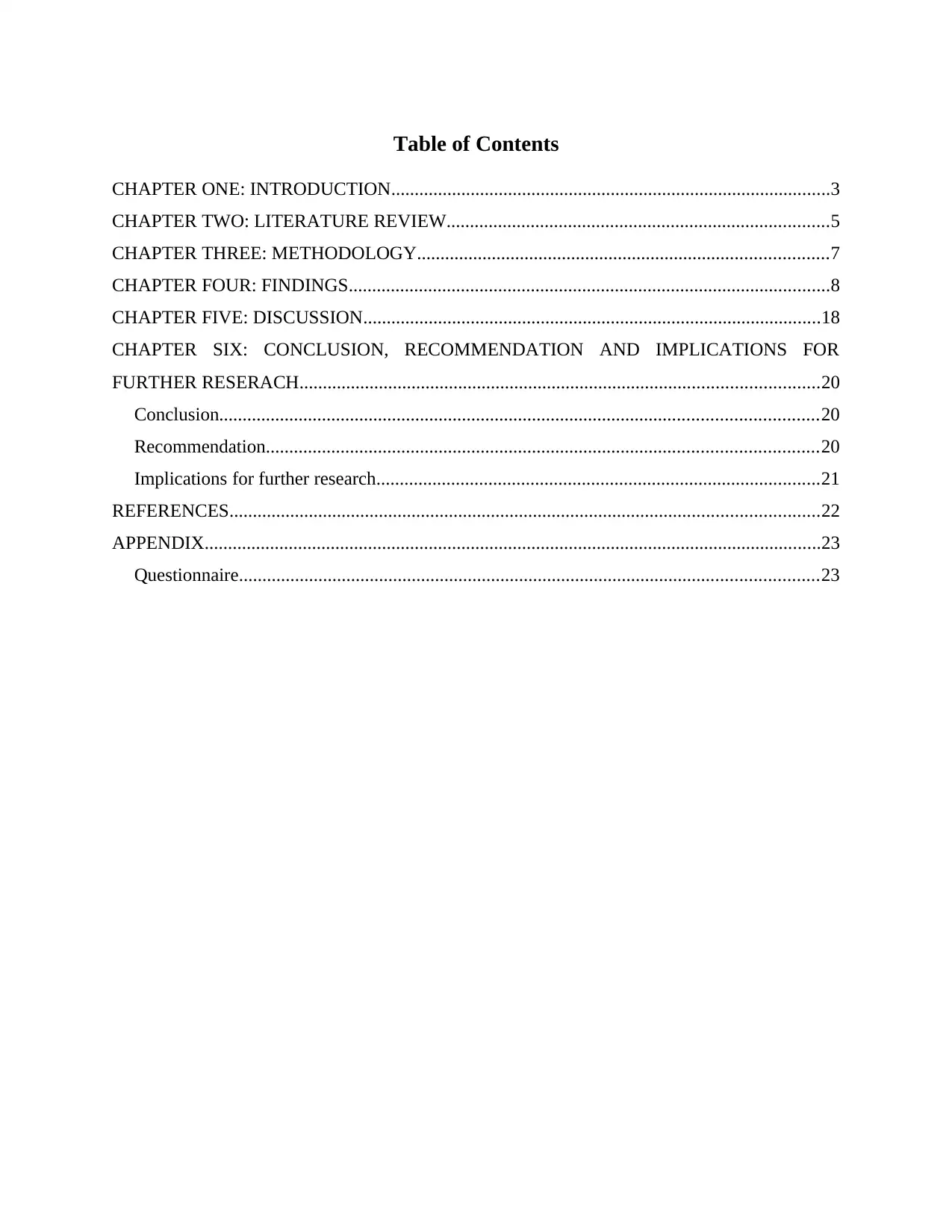
Table of Contents
CHAPTER ONE: INTRODUCTION..............................................................................................3
CHAPTER TWO: LITERATURE REVIEW..................................................................................5
CHAPTER THREE: METHODOLOGY........................................................................................7
CHAPTER FOUR: FINDINGS.......................................................................................................8
CHAPTER FIVE: DISCUSSION..................................................................................................18
CHAPTER SIX: CONCLUSION, RECOMMENDATION AND IMPLICATIONS FOR
FURTHER RESERACH...............................................................................................................20
Conclusion................................................................................................................................20
Recommendation......................................................................................................................20
Implications for further research...............................................................................................21
REFERENCES..............................................................................................................................22
APPENDIX....................................................................................................................................23
Questionnaire............................................................................................................................23
CHAPTER ONE: INTRODUCTION..............................................................................................3
CHAPTER TWO: LITERATURE REVIEW..................................................................................5
CHAPTER THREE: METHODOLOGY........................................................................................7
CHAPTER FOUR: FINDINGS.......................................................................................................8
CHAPTER FIVE: DISCUSSION..................................................................................................18
CHAPTER SIX: CONCLUSION, RECOMMENDATION AND IMPLICATIONS FOR
FURTHER RESERACH...............................................................................................................20
Conclusion................................................................................................................................20
Recommendation......................................................................................................................20
Implications for further research...............................................................................................21
REFERENCES..............................................................................................................................22
APPENDIX....................................................................................................................................23
Questionnaire............................................................................................................................23
CHAPTER ONE: INTRODUCTION
Background of the topic
Line manager and leader plays a different job role in an organisation and also they work
together in order to attain the vision and mission of business. The roles of line manager are to
develop, attract and retain top candidates who have potential to give productive output in
company (Wiblen and Marler, 2021). Line manager is the first layer of management and also
they focus on managing and evaluating the performance, contribution and development of
employees within organisation. Leaders are the one who provide guidance and vision to
individuals so that they can gain better career opportunities in future. There are several
responsibilities which are played by leaders such as they manage the performance, motivate team
and also solve the problems within business (Mey, Poisat and Stindt, 2021). The chosen
organisation for this research is Sainsbury, it is one of the largest chain of supermarkets in UK.
The brand was founded in 1869 by John James Sainsbury.
Research Aim
Aim: “To identify the responsibilities of leaders and line managers in development of talented
workforce in the business place” A study on Sainsbury.
Research Questions
What is the relationship between line managers and leaders within a business
environment?
What are the responsibilities of line managers and leaders in development of talented
workforce in the working environment of Sainsbury?
What are the issues faced by line managers and leaders at a time of implementing the
talent strategies within Sainsbury working culture?
Research Objectives
To understand the relationship between line managers and leaders within a business
environment.
To determine the responsibilities of line managers and leaders in development of talented
workforce in the working environment of Sainsbury.
To examine the issues faced by line managers and leaders at a time of implementing the
talent strategies within Sainsbury working culture.
Significance of Research
Background of the topic
Line manager and leader plays a different job role in an organisation and also they work
together in order to attain the vision and mission of business. The roles of line manager are to
develop, attract and retain top candidates who have potential to give productive output in
company (Wiblen and Marler, 2021). Line manager is the first layer of management and also
they focus on managing and evaluating the performance, contribution and development of
employees within organisation. Leaders are the one who provide guidance and vision to
individuals so that they can gain better career opportunities in future. There are several
responsibilities which are played by leaders such as they manage the performance, motivate team
and also solve the problems within business (Mey, Poisat and Stindt, 2021). The chosen
organisation for this research is Sainsbury, it is one of the largest chain of supermarkets in UK.
The brand was founded in 1869 by John James Sainsbury.
Research Aim
Aim: “To identify the responsibilities of leaders and line managers in development of talented
workforce in the business place” A study on Sainsbury.
Research Questions
What is the relationship between line managers and leaders within a business
environment?
What are the responsibilities of line managers and leaders in development of talented
workforce in the working environment of Sainsbury?
What are the issues faced by line managers and leaders at a time of implementing the
talent strategies within Sainsbury working culture?
Research Objectives
To understand the relationship between line managers and leaders within a business
environment.
To determine the responsibilities of line managers and leaders in development of talented
workforce in the working environment of Sainsbury.
To examine the issues faced by line managers and leaders at a time of implementing the
talent strategies within Sainsbury working culture.
Significance of Research
⊘ This is a preview!⊘
Do you want full access?
Subscribe today to unlock all pages.

Trusted by 1+ million students worldwide
The significance of this research is to determine the roles and responsibilities of line
manager and leaders within organisation (Clarke and Scurry, 2020). Nowadays people are
switching their job and focusing on better career opportunities due to which it is important to
develop the employees and also retain talented employees.
Rationale
Through conducting this research my individual and professional knowledge gets
improve as I have learned more about human resource management and also gain knowledge
how leaders and managers collectively work together in order to achieve the target.
manager and leaders within organisation (Clarke and Scurry, 2020). Nowadays people are
switching their job and focusing on better career opportunities due to which it is important to
develop the employees and also retain talented employees.
Rationale
Through conducting this research my individual and professional knowledge gets
improve as I have learned more about human resource management and also gain knowledge
how leaders and managers collectively work together in order to achieve the target.
Paraphrase This Document
Need a fresh take? Get an instant paraphrase of this document with our AI Paraphraser
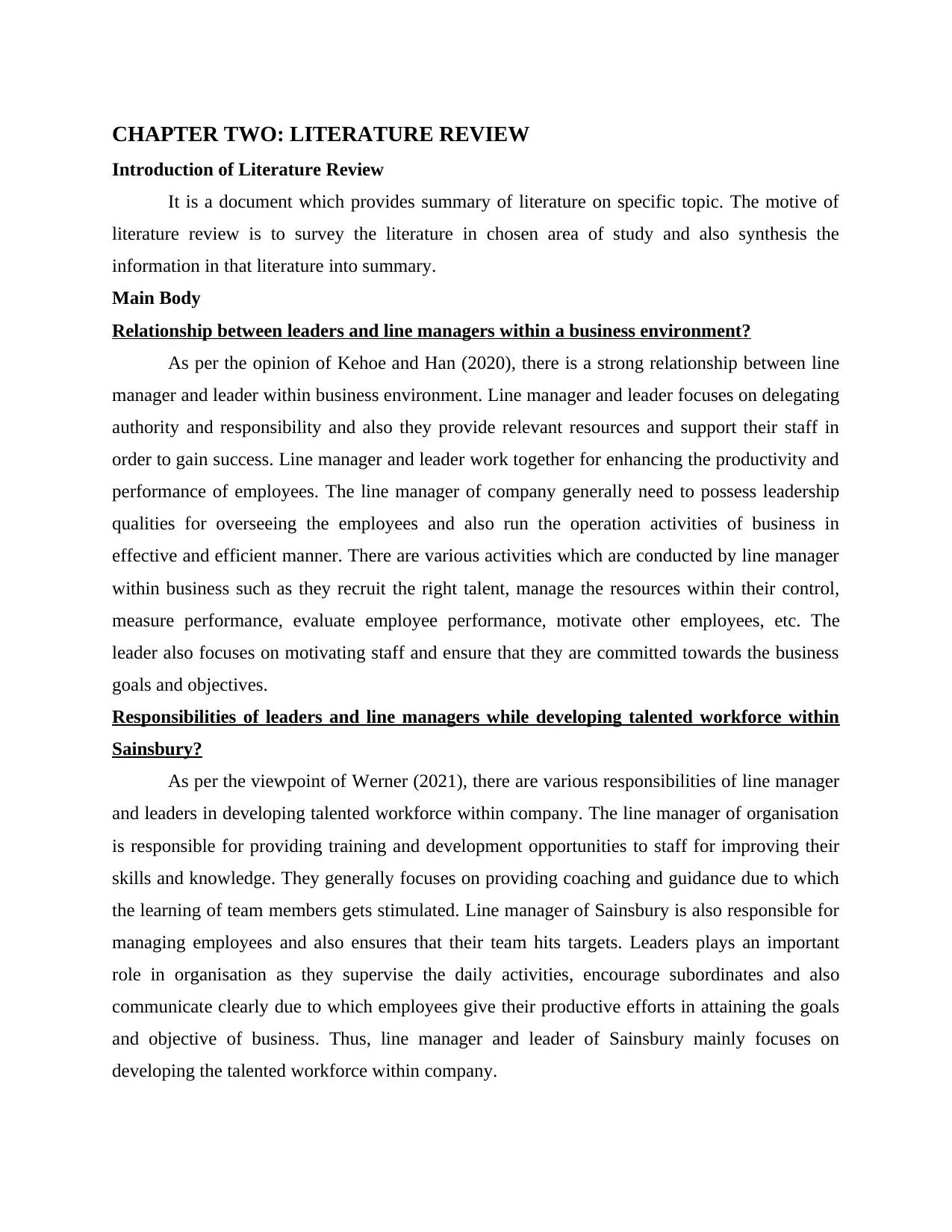
CHAPTER TWO: LITERATURE REVIEW
Introduction of Literature Review
It is a document which provides summary of literature on specific topic. The motive of
literature review is to survey the literature in chosen area of study and also synthesis the
information in that literature into summary.
Main Body
Relationship between leaders and line managers within a business environment?
As per the opinion of Kehoe and Han (2020), there is a strong relationship between line
manager and leader within business environment. Line manager and leader focuses on delegating
authority and responsibility and also they provide relevant resources and support their staff in
order to gain success. Line manager and leader work together for enhancing the productivity and
performance of employees. The line manager of company generally need to possess leadership
qualities for overseeing the employees and also run the operation activities of business in
effective and efficient manner. There are various activities which are conducted by line manager
within business such as they recruit the right talent, manage the resources within their control,
measure performance, evaluate employee performance, motivate other employees, etc. The
leader also focuses on motivating staff and ensure that they are committed towards the business
goals and objectives.
Responsibilities of leaders and line managers while developing talented workforce within
Sainsbury?
As per the viewpoint of Werner (2021), there are various responsibilities of line manager
and leaders in developing talented workforce within company. The line manager of organisation
is responsible for providing training and development opportunities to staff for improving their
skills and knowledge. They generally focuses on providing coaching and guidance due to which
the learning of team members gets stimulated. Line manager of Sainsbury is also responsible for
managing employees and also ensures that their team hits targets. Leaders plays an important
role in organisation as they supervise the daily activities, encourage subordinates and also
communicate clearly due to which employees give their productive efforts in attaining the goals
and objective of business. Thus, line manager and leader of Sainsbury mainly focuses on
developing the talented workforce within company.
Introduction of Literature Review
It is a document which provides summary of literature on specific topic. The motive of
literature review is to survey the literature in chosen area of study and also synthesis the
information in that literature into summary.
Main Body
Relationship between leaders and line managers within a business environment?
As per the opinion of Kehoe and Han (2020), there is a strong relationship between line
manager and leader within business environment. Line manager and leader focuses on delegating
authority and responsibility and also they provide relevant resources and support their staff in
order to gain success. Line manager and leader work together for enhancing the productivity and
performance of employees. The line manager of company generally need to possess leadership
qualities for overseeing the employees and also run the operation activities of business in
effective and efficient manner. There are various activities which are conducted by line manager
within business such as they recruit the right talent, manage the resources within their control,
measure performance, evaluate employee performance, motivate other employees, etc. The
leader also focuses on motivating staff and ensure that they are committed towards the business
goals and objectives.
Responsibilities of leaders and line managers while developing talented workforce within
Sainsbury?
As per the viewpoint of Werner (2021), there are various responsibilities of line manager
and leaders in developing talented workforce within company. The line manager of organisation
is responsible for providing training and development opportunities to staff for improving their
skills and knowledge. They generally focuses on providing coaching and guidance due to which
the learning of team members gets stimulated. Line manager of Sainsbury is also responsible for
managing employees and also ensures that their team hits targets. Leaders plays an important
role in organisation as they supervise the daily activities, encourage subordinates and also
communicate clearly due to which employees give their productive efforts in attaining the goals
and objective of business. Thus, line manager and leader of Sainsbury mainly focuses on
developing the talented workforce within company.
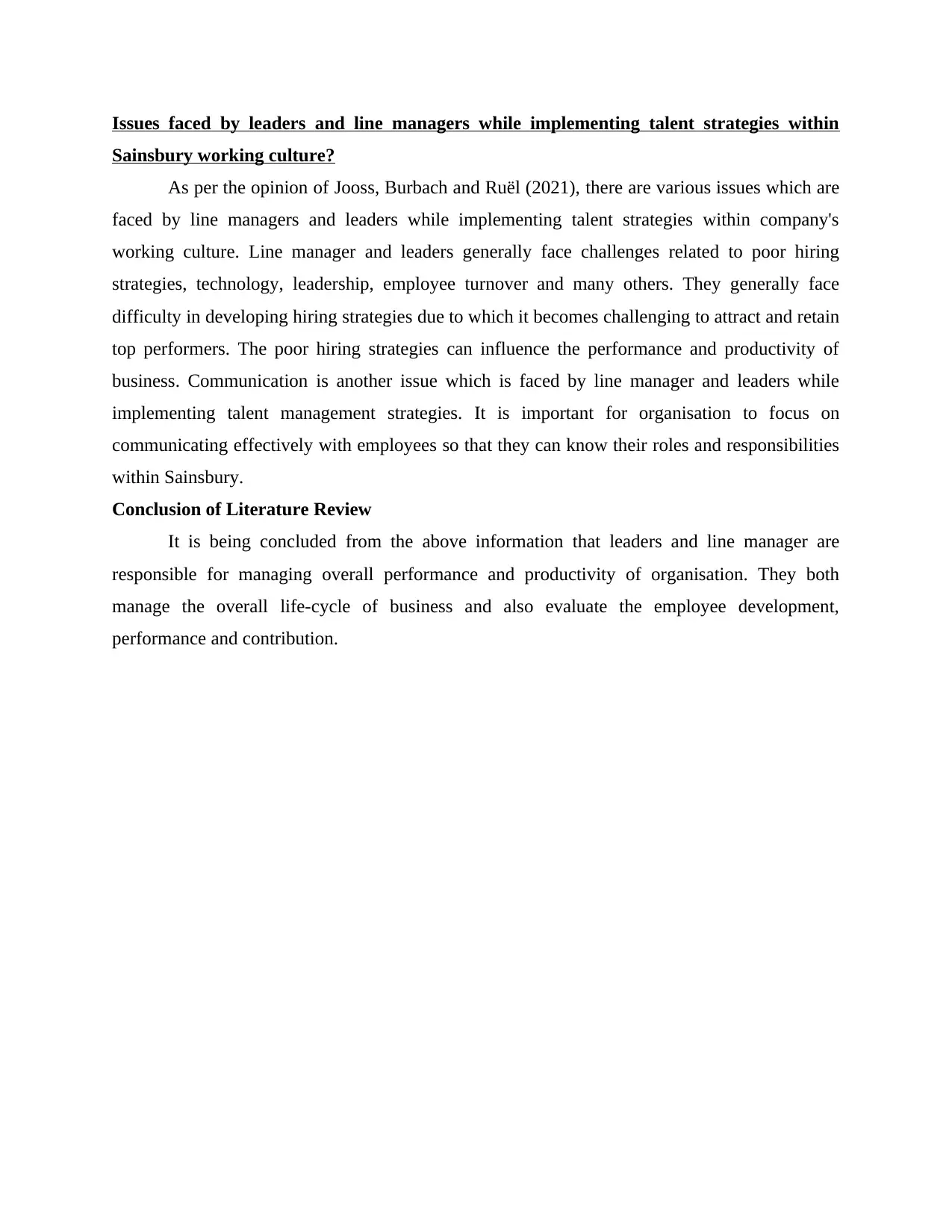
Issues faced by leaders and line managers while implementing talent strategies within
Sainsbury working culture?
As per the opinion of Jooss, Burbach and Ruël (2021), there are various issues which are
faced by line managers and leaders while implementing talent strategies within company's
working culture. Line manager and leaders generally face challenges related to poor hiring
strategies, technology, leadership, employee turnover and many others. They generally face
difficulty in developing hiring strategies due to which it becomes challenging to attract and retain
top performers. The poor hiring strategies can influence the performance and productivity of
business. Communication is another issue which is faced by line manager and leaders while
implementing talent management strategies. It is important for organisation to focus on
communicating effectively with employees so that they can know their roles and responsibilities
within Sainsbury.
Conclusion of Literature Review
It is being concluded from the above information that leaders and line manager are
responsible for managing overall performance and productivity of organisation. They both
manage the overall life-cycle of business and also evaluate the employee development,
performance and contribution.
Sainsbury working culture?
As per the opinion of Jooss, Burbach and Ruël (2021), there are various issues which are
faced by line managers and leaders while implementing talent strategies within company's
working culture. Line manager and leaders generally face challenges related to poor hiring
strategies, technology, leadership, employee turnover and many others. They generally face
difficulty in developing hiring strategies due to which it becomes challenging to attract and retain
top performers. The poor hiring strategies can influence the performance and productivity of
business. Communication is another issue which is faced by line manager and leaders while
implementing talent management strategies. It is important for organisation to focus on
communicating effectively with employees so that they can know their roles and responsibilities
within Sainsbury.
Conclusion of Literature Review
It is being concluded from the above information that leaders and line manager are
responsible for managing overall performance and productivity of organisation. They both
manage the overall life-cycle of business and also evaluate the employee development,
performance and contribution.
⊘ This is a preview!⊘
Do you want full access?
Subscribe today to unlock all pages.
Trusted by 1+ million students worldwide
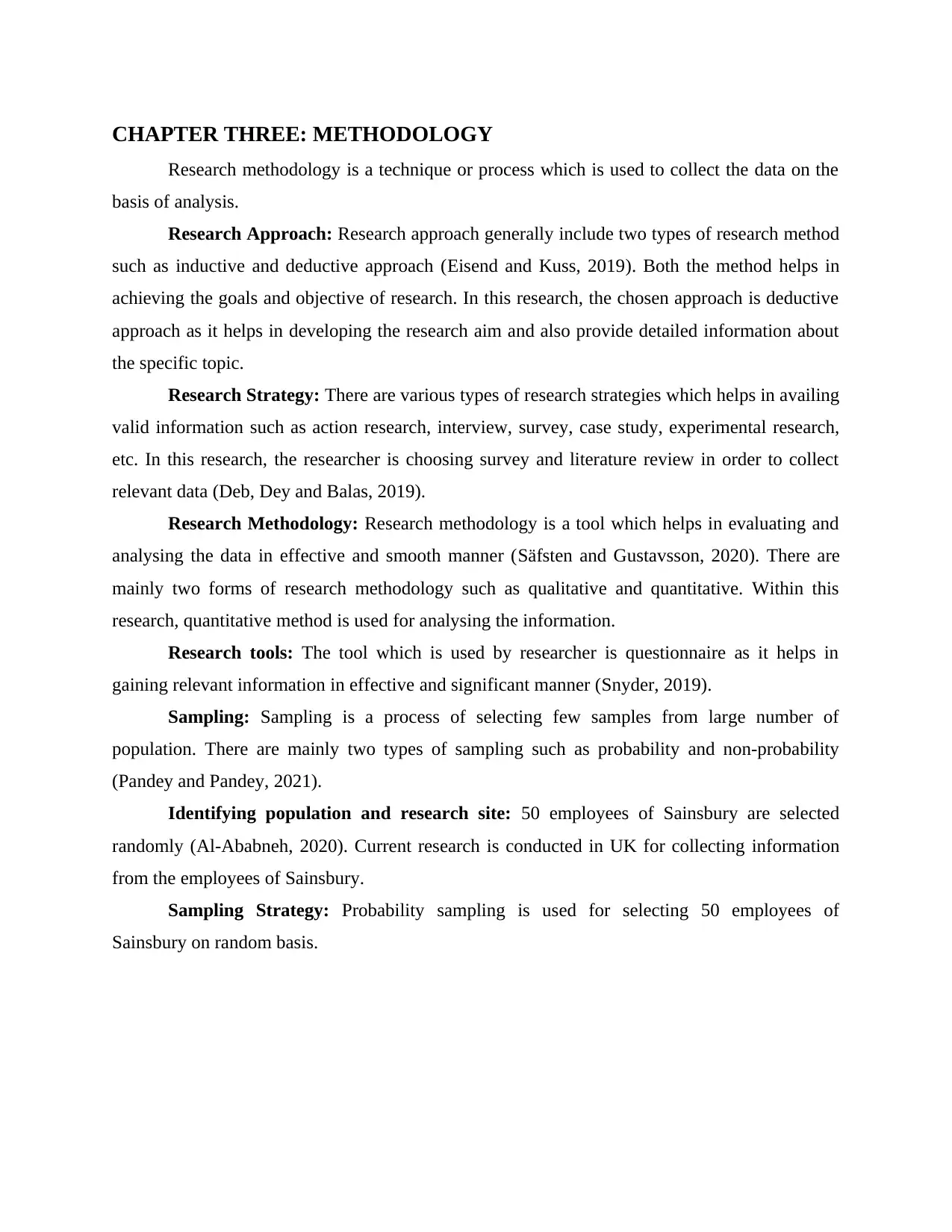
CHAPTER THREE: METHODOLOGY
Research methodology is a technique or process which is used to collect the data on the
basis of analysis.
Research Approach: Research approach generally include two types of research method
such as inductive and deductive approach (Eisend and Kuss, 2019). Both the method helps in
achieving the goals and objective of research. In this research, the chosen approach is deductive
approach as it helps in developing the research aim and also provide detailed information about
the specific topic.
Research Strategy: There are various types of research strategies which helps in availing
valid information such as action research, interview, survey, case study, experimental research,
etc. In this research, the researcher is choosing survey and literature review in order to collect
relevant data (Deb, Dey and Balas, 2019).
Research Methodology: Research methodology is a tool which helps in evaluating and
analysing the data in effective and smooth manner (Säfsten and Gustavsson, 2020). There are
mainly two forms of research methodology such as qualitative and quantitative. Within this
research, quantitative method is used for analysing the information.
Research tools: The tool which is used by researcher is questionnaire as it helps in
gaining relevant information in effective and significant manner (Snyder, 2019).
Sampling: Sampling is a process of selecting few samples from large number of
population. There are mainly two types of sampling such as probability and non-probability
(Pandey and Pandey, 2021).
Identifying population and research site: 50 employees of Sainsbury are selected
randomly (Al-Ababneh, 2020). Current research is conducted in UK for collecting information
from the employees of Sainsbury.
Sampling Strategy: Probability sampling is used for selecting 50 employees of
Sainsbury on random basis.
Research methodology is a technique or process which is used to collect the data on the
basis of analysis.
Research Approach: Research approach generally include two types of research method
such as inductive and deductive approach (Eisend and Kuss, 2019). Both the method helps in
achieving the goals and objective of research. In this research, the chosen approach is deductive
approach as it helps in developing the research aim and also provide detailed information about
the specific topic.
Research Strategy: There are various types of research strategies which helps in availing
valid information such as action research, interview, survey, case study, experimental research,
etc. In this research, the researcher is choosing survey and literature review in order to collect
relevant data (Deb, Dey and Balas, 2019).
Research Methodology: Research methodology is a tool which helps in evaluating and
analysing the data in effective and smooth manner (Säfsten and Gustavsson, 2020). There are
mainly two forms of research methodology such as qualitative and quantitative. Within this
research, quantitative method is used for analysing the information.
Research tools: The tool which is used by researcher is questionnaire as it helps in
gaining relevant information in effective and significant manner (Snyder, 2019).
Sampling: Sampling is a process of selecting few samples from large number of
population. There are mainly two types of sampling such as probability and non-probability
(Pandey and Pandey, 2021).
Identifying population and research site: 50 employees of Sainsbury are selected
randomly (Al-Ababneh, 2020). Current research is conducted in UK for collecting information
from the employees of Sainsbury.
Sampling Strategy: Probability sampling is used for selecting 50 employees of
Sainsbury on random basis.
Paraphrase This Document
Need a fresh take? Get an instant paraphrase of this document with our AI Paraphraser
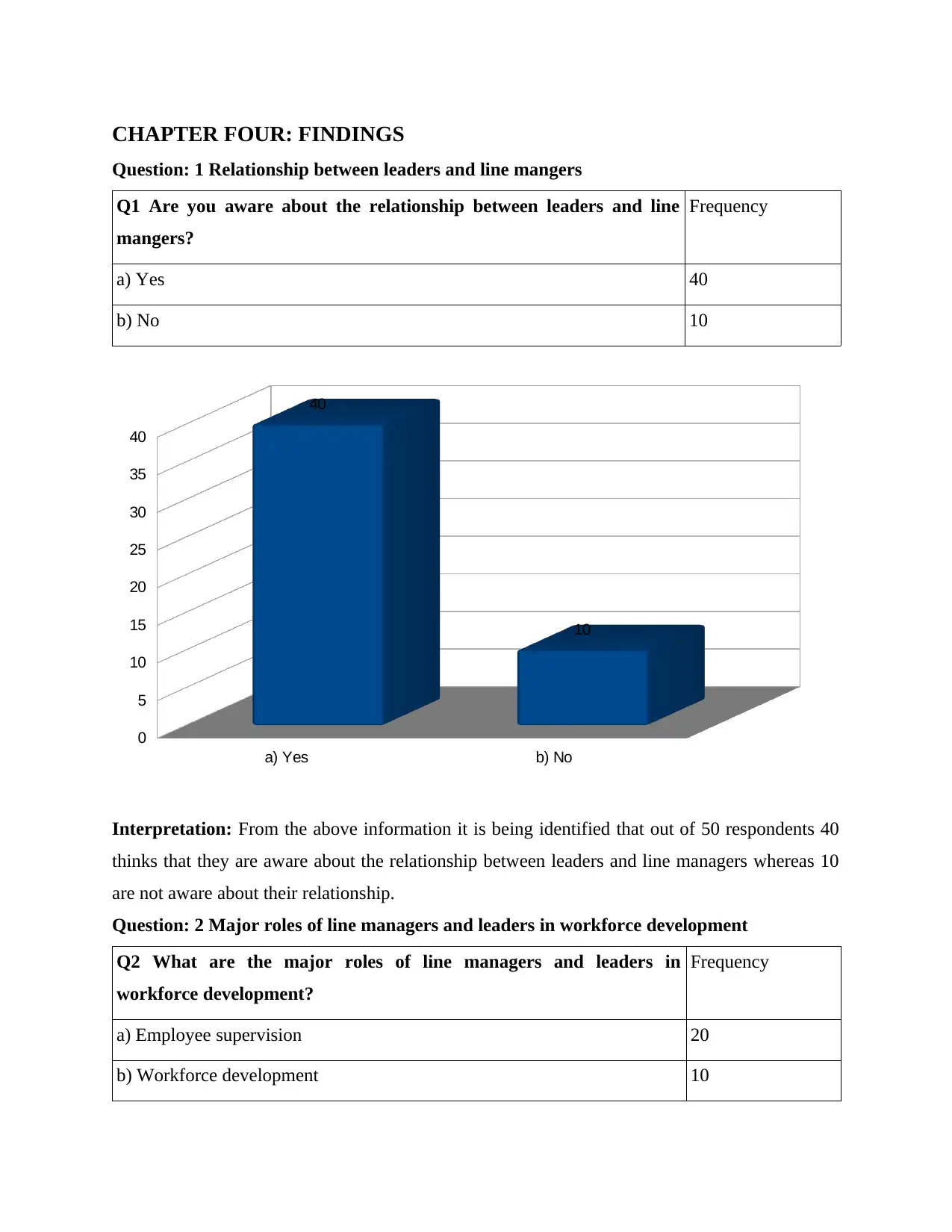
CHAPTER FOUR: FINDINGS
Question: 1 Relationship between leaders and line mangers
Q1 Are you aware about the relationship between leaders and line
mangers?
Frequency
a) Yes 40
b) No 10
a) Yes b) No
0
5
10
15
20
25
30
35
40
40
10
Interpretation: From the above information it is being identified that out of 50 respondents 40
thinks that they are aware about the relationship between leaders and line managers whereas 10
are not aware about their relationship.
Question: 2 Major roles of line managers and leaders in workforce development
Q2 What are the major roles of line managers and leaders in
workforce development?
Frequency
a) Employee supervision 20
b) Workforce development 10
Question: 1 Relationship between leaders and line mangers
Q1 Are you aware about the relationship between leaders and line
mangers?
Frequency
a) Yes 40
b) No 10
a) Yes b) No
0
5
10
15
20
25
30
35
40
40
10
Interpretation: From the above information it is being identified that out of 50 respondents 40
thinks that they are aware about the relationship between leaders and line managers whereas 10
are not aware about their relationship.
Question: 2 Major roles of line managers and leaders in workforce development
Q2 What are the major roles of line managers and leaders in
workforce development?
Frequency
a) Employee supervision 20
b) Workforce development 10
c) Increasing employee motivation 10
d) Coaching and mentoring 10
a) Employee supervision
b) Workforce development
c) Increasing employee motivation
d) Coaching and mentoring
0
2
4
6
8
10
12
14
16
18
20
20
10 10 10
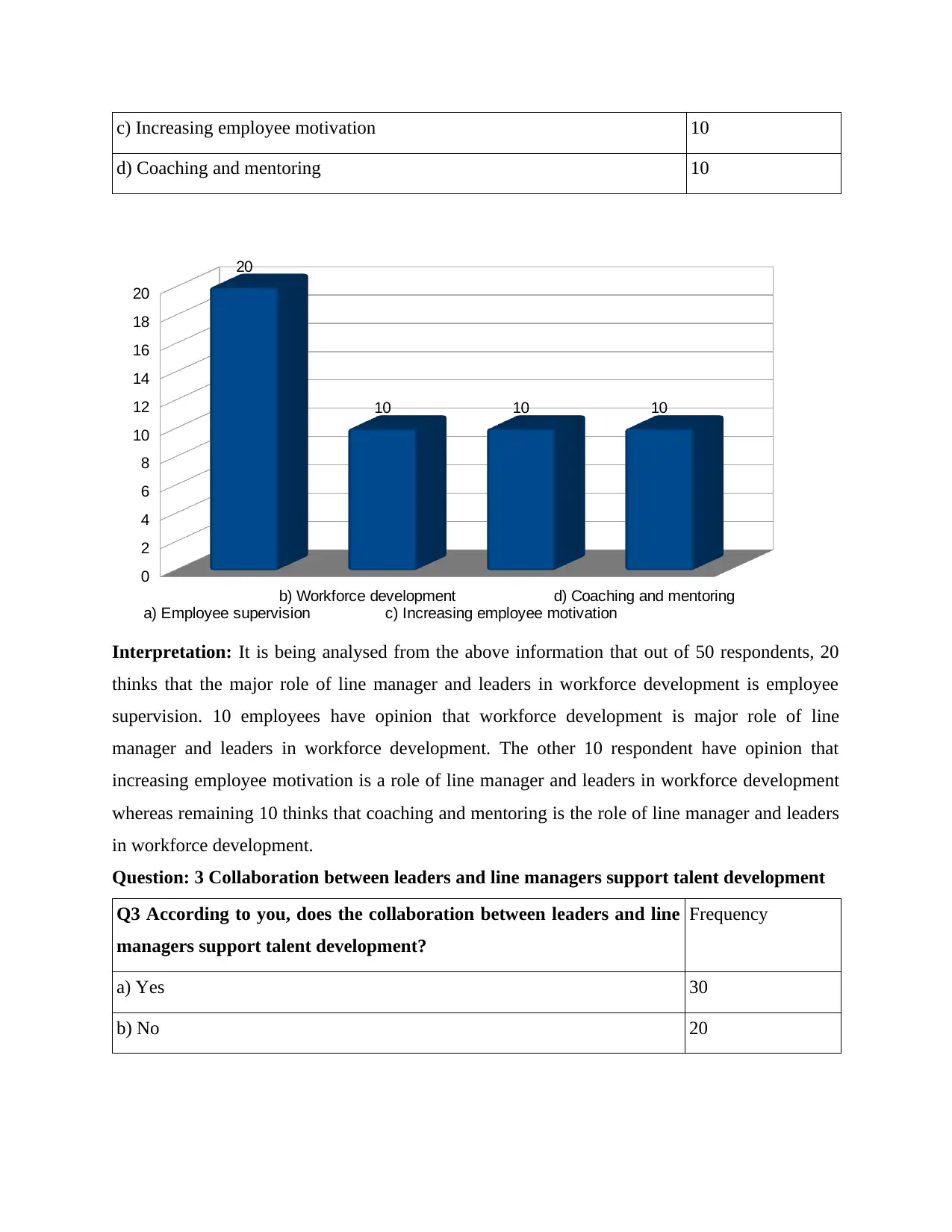
Interpretation: It is being analysed from the above information that out of 50 respondents, 20
thinks that the major role of line manager and leaders in workforce development is employee
supervision. 10 employees have opinion that workforce development is major role of line
manager and leaders in workforce development. The other 10 respondent have opinion that
increasing employee motivation is a role of line manager and leaders in workforce development
whereas remaining 10 thinks that coaching and mentoring is the role of line manager and leaders
in workforce development.
Question: 3 Collaboration between leaders and line managers support talent development
Q3 According to you, does the collaboration between leaders and line
managers support talent development?
Frequency
a) Yes 30
b) No 20
d) Coaching and mentoring 10
a) Employee supervision
b) Workforce development
c) Increasing employee motivation
d) Coaching and mentoring
0
2
4
6
8
10
12
14
16
18
20
20
10 10 10
Interpretation: It is being analysed from the above information that out of 50 respondents, 20
thinks that the major role of line manager and leaders in workforce development is employee
supervision. 10 employees have opinion that workforce development is major role of line
manager and leaders in workforce development. The other 10 respondent have opinion that
increasing employee motivation is a role of line manager and leaders in workforce development
whereas remaining 10 thinks that coaching and mentoring is the role of line manager and leaders
in workforce development.
Question: 3 Collaboration between leaders and line managers support talent development
Q3 According to you, does the collaboration between leaders and line
managers support talent development?
Frequency
a) Yes 30
b) No 20
⊘ This is a preview!⊘
Do you want full access?
Subscribe today to unlock all pages.
Trusted by 1+ million students worldwide
a) Yes b) No
0
5
10
15
20
25
30
30
20
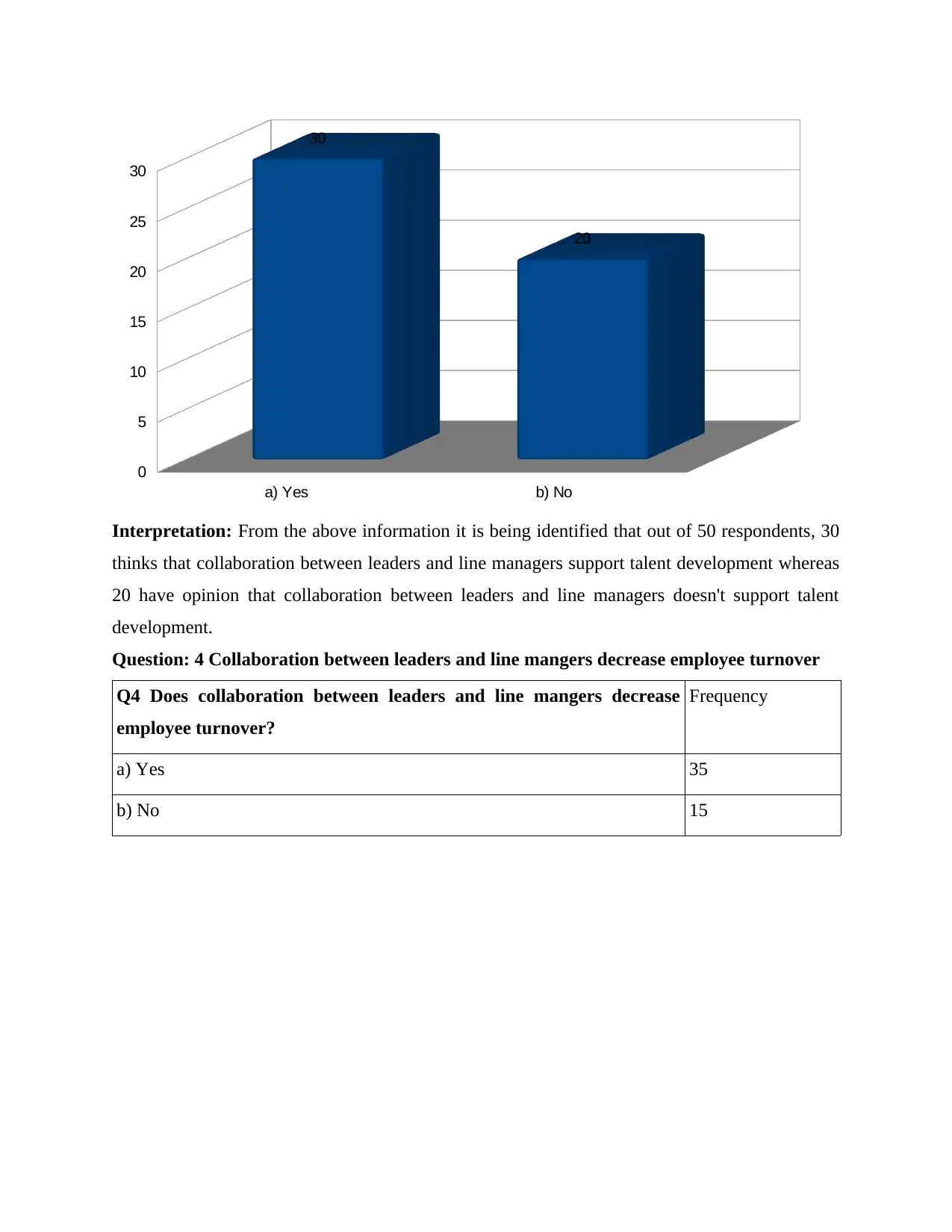
Interpretation: From the above information it is being identified that out of 50 respondents, 30
thinks that collaboration between leaders and line managers support talent development whereas
20 have opinion that collaboration between leaders and line managers doesn't support talent
development.
Question: 4 Collaboration between leaders and line mangers decrease employee turnover
Q4 Does collaboration between leaders and line mangers decrease
employee turnover?
Frequency
a) Yes 35
b) No 15
0
5
10
15
20
25
30
30
20
Interpretation: From the above information it is being identified that out of 50 respondents, 30
thinks that collaboration between leaders and line managers support talent development whereas
20 have opinion that collaboration between leaders and line managers doesn't support talent
development.
Question: 4 Collaboration between leaders and line mangers decrease employee turnover
Q4 Does collaboration between leaders and line mangers decrease
employee turnover?
Frequency
a) Yes 35
b) No 15
Paraphrase This Document
Need a fresh take? Get an instant paraphrase of this document with our AI Paraphraser
a) Yes b) No
0
5
10
15
20
25
30
35
35
15
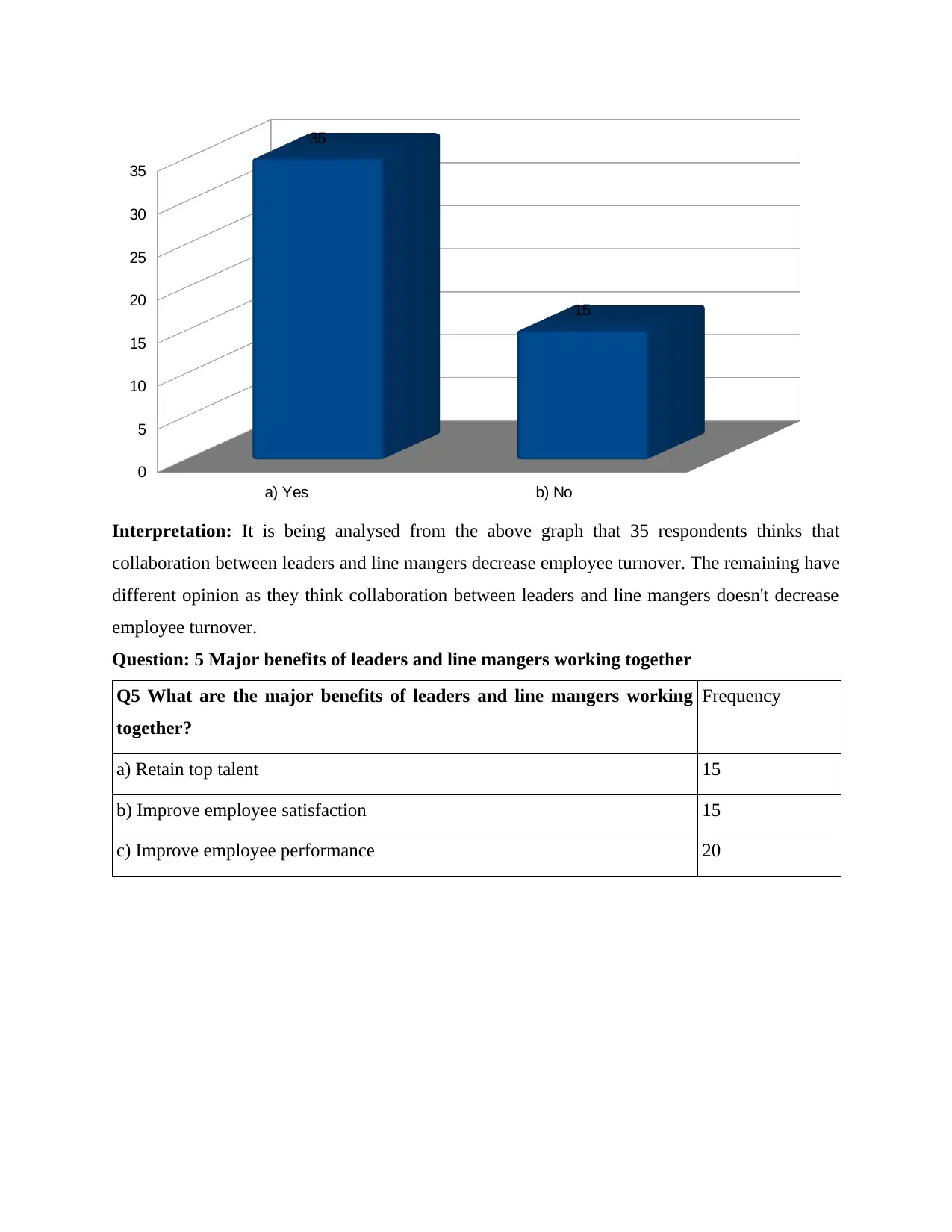
Interpretation: It is being analysed from the above graph that 35 respondents thinks that
collaboration between leaders and line mangers decrease employee turnover. The remaining have
different opinion as they think collaboration between leaders and line mangers doesn't decrease
employee turnover.
Question: 5 Major benefits of leaders and line mangers working together
Q5 What are the major benefits of leaders and line mangers working
together?
Frequency
a) Retain top talent 15
b) Improve employee satisfaction 15
c) Improve employee performance 20
0
5
10
15
20
25
30
35
35
15
Interpretation: It is being analysed from the above graph that 35 respondents thinks that
collaboration between leaders and line mangers decrease employee turnover. The remaining have
different opinion as they think collaboration between leaders and line mangers doesn't decrease
employee turnover.
Question: 5 Major benefits of leaders and line mangers working together
Q5 What are the major benefits of leaders and line mangers working
together?
Frequency
a) Retain top talent 15
b) Improve employee satisfaction 15
c) Improve employee performance 20
a) Retain top talent
b) Improve employee satisfaction
c) Improve employee performance
0
2
4
6
8
10
12
14
16
18
20
15 15
20
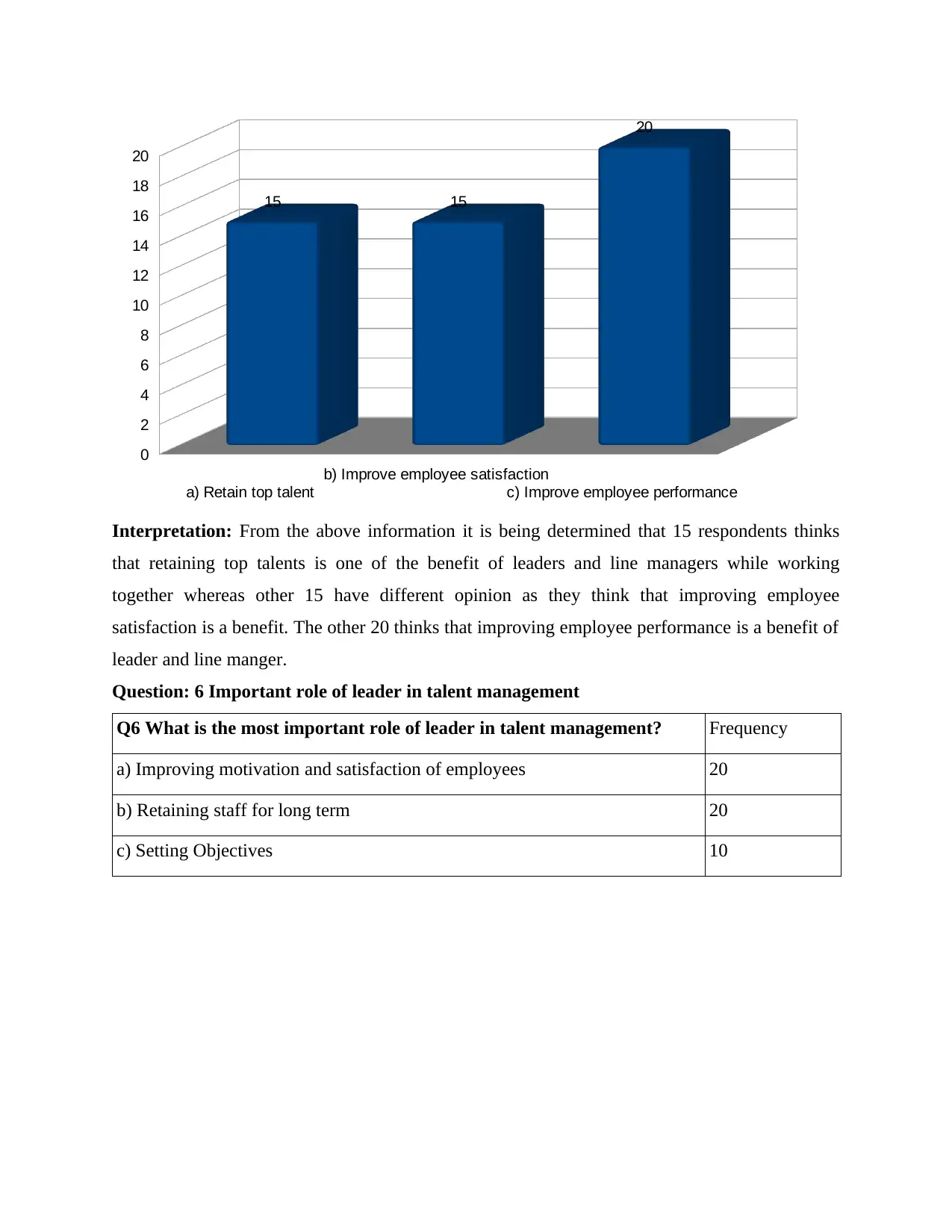
Interpretation: From the above information it is being determined that 15 respondents thinks
that retaining top talents is one of the benefit of leaders and line managers while working
together whereas other 15 have different opinion as they think that improving employee
satisfaction is a benefit. The other 20 thinks that improving employee performance is a benefit of
leader and line manger.
Question: 6 Important role of leader in talent management
Q6 What is the most important role of leader in talent management? Frequency
a) Improving motivation and satisfaction of employees 20
b) Retaining staff for long term 20
c) Setting Objectives 10
b) Improve employee satisfaction
c) Improve employee performance
0
2
4
6
8
10
12
14
16
18
20
15 15
20
Interpretation: From the above information it is being determined that 15 respondents thinks
that retaining top talents is one of the benefit of leaders and line managers while working
together whereas other 15 have different opinion as they think that improving employee
satisfaction is a benefit. The other 20 thinks that improving employee performance is a benefit of
leader and line manger.
Question: 6 Important role of leader in talent management
Q6 What is the most important role of leader in talent management? Frequency
a) Improving motivation and satisfaction of employees 20
b) Retaining staff for long term 20
c) Setting Objectives 10
⊘ This is a preview!⊘
Do you want full access?
Subscribe today to unlock all pages.
Trusted by 1+ million students worldwide

1 out of 24


Related Documents


Your All-in-One AI-Powered Toolkit for Academic Success.
+13062052269
info@desklib.com
Available 24*7 on WhatsApp / Email
![[object Object]](/_next/static/media/star-bottom.7253800d.svg)
Unlock your academic potential
Copyright © 2020–2026 A2Z Services. All Rights Reserved. Developed and managed by ZUCOL.