Financial Analysis Report: Sainsbury's and Tesco's Performance

Verified

Added on  2021/02/21

|27
|4274
|57
Report
AI Summary
This report presents a comprehensive financial analysis of two major retail firms, Sainsbury's and Tesco. It begins with an introduction to financial analysis, emphasizing the use of tools and techniques to interpret financial statements. The main body of the report delves into detailed ratio analysis, comparing the profitability, liquidity, and solvency of both companies over several years. Profitability ratios, including gross profit and net profit margins, are calculated and interpreted to assess each firm's earning capacity. Liquidity ratios, such as current and quick ratios, are examined to evaluate their ability to meet short-term obligations. Solvency ratios, like the debt-equity ratio, are analyzed to assess their long-term financial stability. Additionally, the report includes an analysis of working capital management and cash flow, providing a holistic view of their financial health. The report concludes with a summary of the key findings, comparing the financial performance of Sainsbury's and Tesco, and highlighting areas of strength and weakness for each company. This analysis aims to provide insights into the financial strategies and performance of these two prominent players in the retail sector.
Document Page
Financial Analysis
Management & Enterprises
tabler-icon-diamond-filled.svg

Paraphrase This Document

Need a fresh take? Get an instant paraphrase of this document with our AI Paraphraser
Document Page
Table of Contents
INTRODUCTION...........................................................................................................................1
MAIN BODY ................................................................................................................................1
1. Vertical and horizontal ratio analysis of financial statements for the both company:.............1
2. Working capital analysis:.......................................................................................................20
3. Cash flow analysis:................................................................................................................21
CONCLUSION..............................................................................................................................22
REFERENCES..............................................................................................................................24
Document Page
INTRODUCTION
The financial analysis can be defined as a combination of tools and techniques that are
used to analysis and interpret the financial statements and business reports. Management of the
business firm conducts the detailed analysis regarding the financial statements by evaluating the
certain technical analysis like cash flow management, Ratio analysis to know the business
position in the market. It is defined as process of assessing and analysing a firms’ financial report
in terms of ascertained the standard data that helps to recognise the business performance. Ratio
analysis helps to management in determinant the business position of an entity. So that they can
take the strategic decision as per market performance in the particular industry. Working capital
management is a fundamental concept to find out basic needs of the fund in the particular
business in short term period to operate the operational function of the business. Cash flow
analysis provides the information regarding the firm operational cycle period of cash inflow and
out flow.
To understand the financial aspect two retail sector firm Sainsbury's and TESCO are
selected that are involved in retail sales of product at supermarket or departmental stores. This
report justifies the definition and computation of financial ratios and interpretation of the
financial ratios. In this report, Cash flow and working capital analysis of these firm are also
discussed in detail.
MAIN BODY
1.Vertical and horizontal ratio analysis of financial statements for the both company:
Ratio analysis is particular method that states that financial position of the business at
certain level and it is a comparative analysis of two or more year of the business reports (Palepu
and Healy, 2013). It may include the profitability, liquidity, solvency and efficiency position of
the firm. This analysis includes the comparative study of the financial statement, profitability and
solvency ratio with another company. For this comparative study, Ratio analysis of the both firm
are as under:
Profitability Ratios:
1
Document Page
These are the ratio that are computed by the firm to assess the profitability of the business
in consequence to its basic business activities that are performed in the business circle. These are
financial metrics that are used to measure firm's ability to gain the earning or income from sales
revenue, operating cost, assets etc. These are the standard ratio that used to measure the
profitability condition of the corporation. Computation of profitability ratio of the both
companies are discussed as follows:
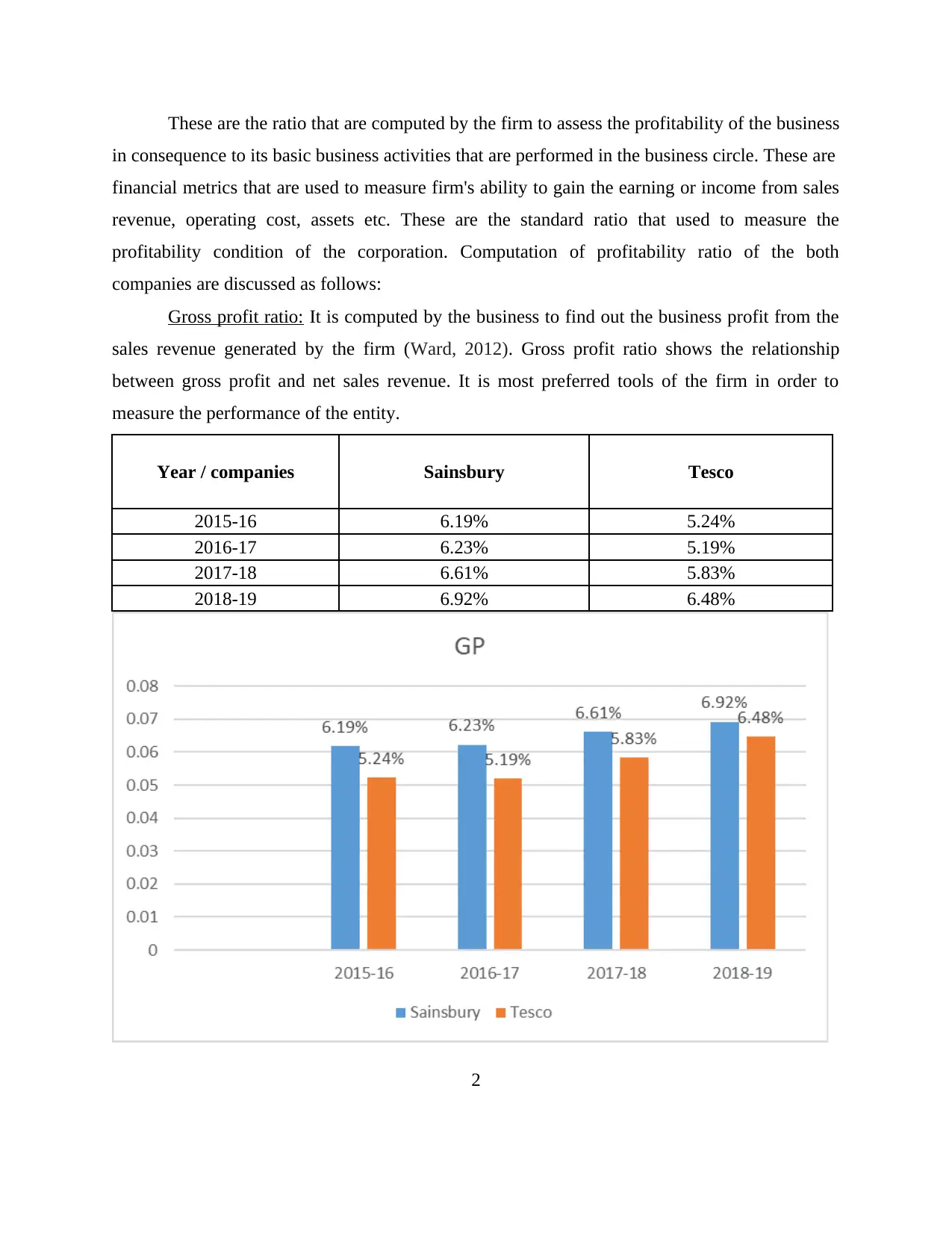
Gross profit ratio: It is computed by the business to find out the business profit from the
sales revenue generated by the firm (Ward, 2012). Gross profit ratio shows the relationship
between gross profit and net sales revenue. It is most preferred tools of the firm in order to
measure the performance of the entity.
Year / companies Sainsbury Tesco
2015-16 6.19% 5.24%
2016-17 6.23% 5.19%
2017-18 6.61% 5.83%
2018-19 6.92% 6.48%
2
tabler-icon-diamond-filled.svg

Paraphrase This Document

Need a fresh take? Get an instant paraphrase of this document with our AI Paraphraser
Document Page
Here,
Gross profit Ratio = Gross profit / Net sales revenue *100
Interpretation:
After the detailed analysis of this computation of gross profit margin of the Sainsbury's
firm, it states that gross profit margin is increasing year by year. But in the previous year it
increased most among the year. It directly means that company is in stable position to earning
the profit (Banerjee, 2012).
In order to discussion of the profit margin of TESCO firm, it is clearly shows that
company is in-stable in the market. But it is earning the profits in different manner like in the
year of 2015-16, firm bears loss but in the next year company earns a profit and ratio increases to
6.48 % in 2018-19.
As per the above computation of the gross profit, it is identified that gross profit of the
Sainsbury's is comparatively higher than that of TESCO's in all the year starting from the
2015-16
Profit of the Sainsbury's and TESCO are continuously increasing from the year of 2015-
16 so that's a good sign for the both company.
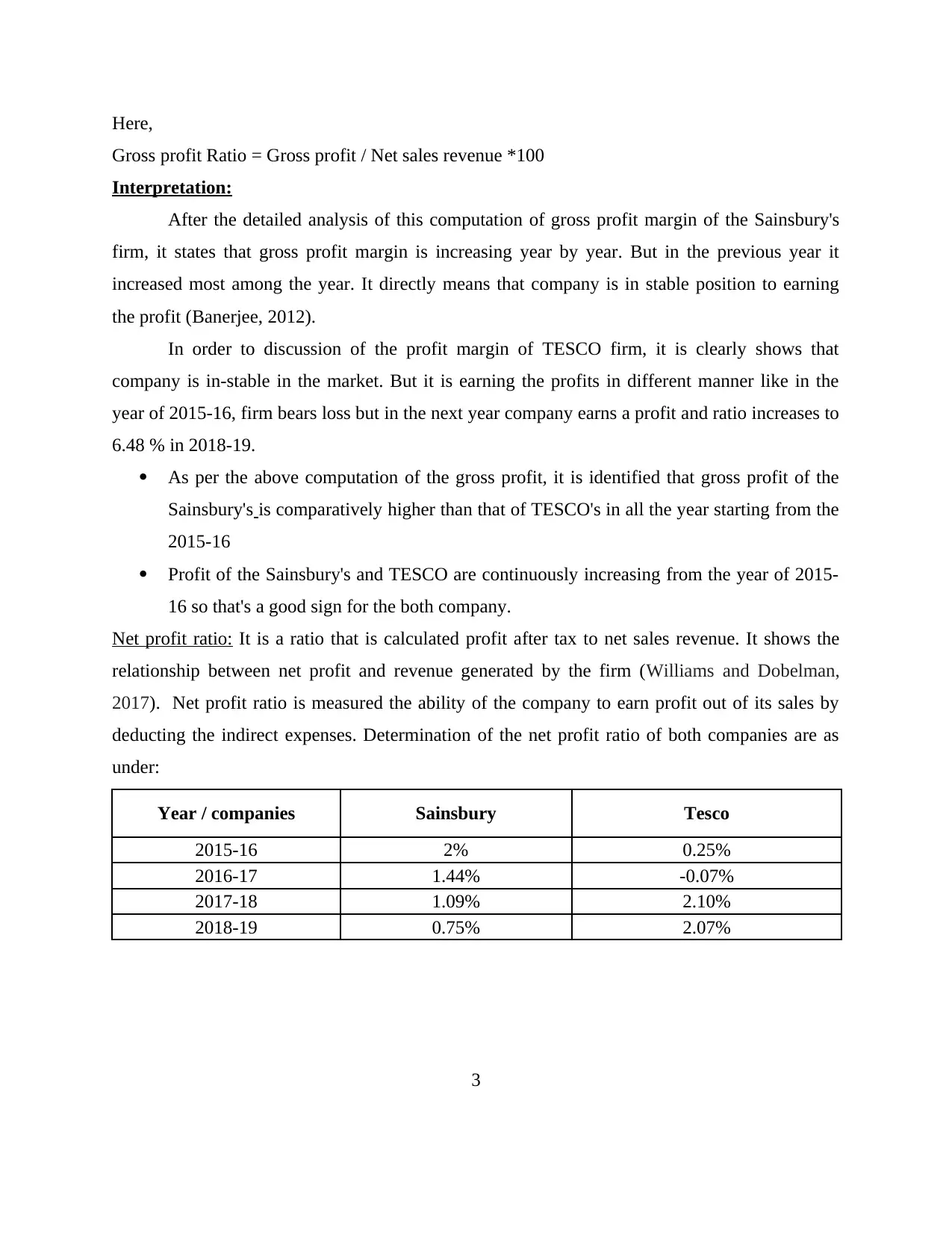
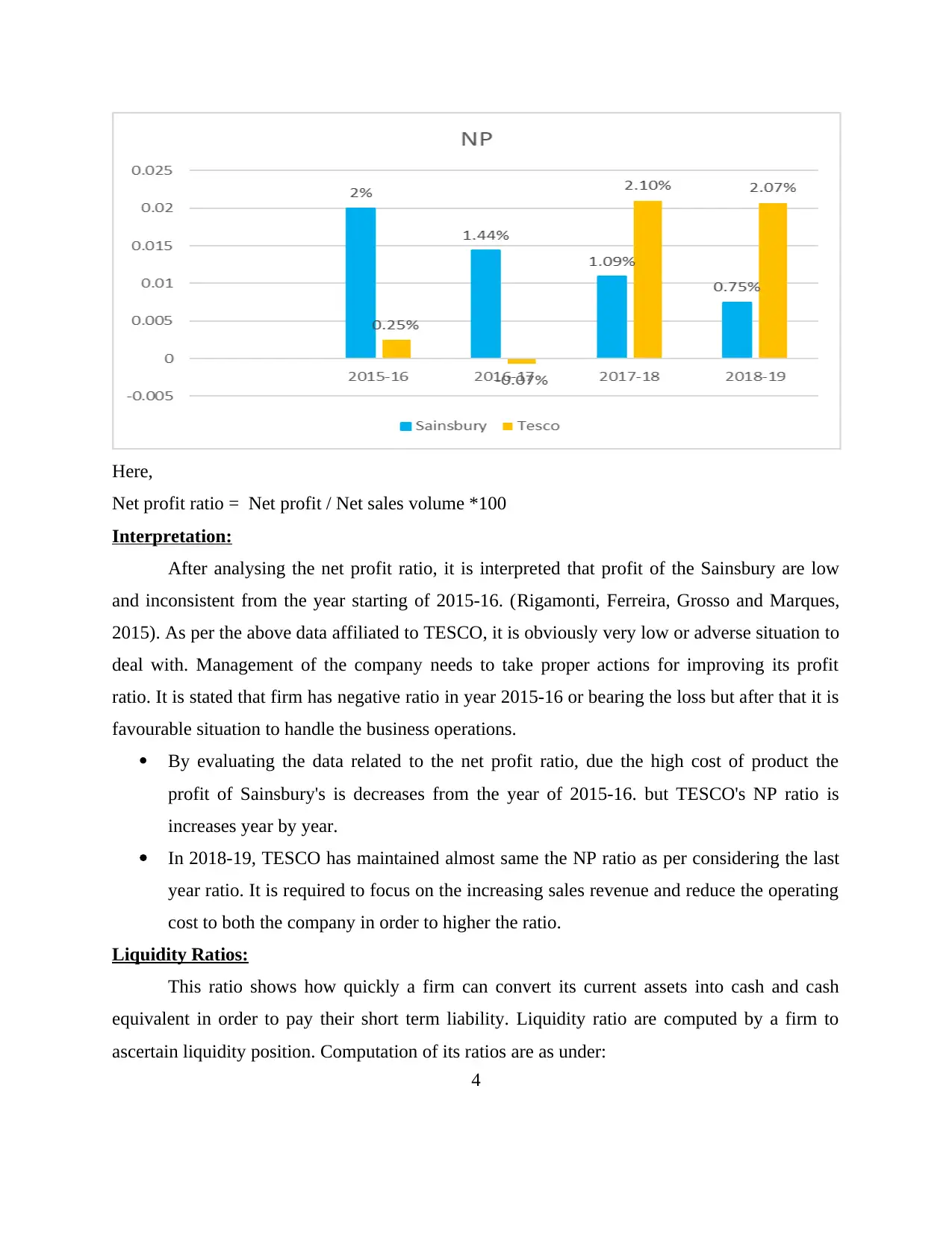
Net profit ratio: It is a ratio that is calculated profit after tax to net sales revenue. It shows the
relationship between net profit and revenue generated by the firm (Williams and Dobelman,
2017). Net profit ratio is measured the ability of the company to earn profit out of its sales by
deducting the indirect expenses. Determination of the net profit ratio of both companies are as
under:
Year / companies Sainsbury Tesco
2015-16 2% 0.25%
2016-17 1.44% -0.07%
2017-18 1.09% 2.10%
2018-19 0.75% 2.07%
3
Document Page
Here,
Net profit ratio = Net profit / Net sales volume *100
Interpretation:
After analysing the net profit ratio, it is interpreted that profit of the Sainsbury are low
and inconsistent from the year starting of 2015-16. (Rigamonti, Ferreira, Grosso and Marques,
2015). As per the above data affiliated to TESCO, it is obviously very low or adverse situation to
deal with. Management of the company needs to take proper actions for improving its profit
ratio. It is stated that firm has negative ratio in year 2015-16 or bearing the loss but after that it is
favourable situation to handle the business operations.
By evaluating the data related to the net profit ratio, due the high cost of product the
profit of Sainsbury's is decreases from the year of 2015-16. but TESCO's NP ratio is
increases year by year.
In 2018-19, TESCO has maintained almost same the NP ratio as per considering the last
year ratio. It is required to focus on the increasing sales revenue and reduce the operating
cost to both the company in order to higher the ratio.
Liquidity Ratios:
This ratio shows how quickly a firm can convert its current assets into cash and cash
equivalent in order to pay their short term liability. Liquidity ratio are computed by a firm to
ascertain liquidity position. Computation of its ratios are as under:
4
Document Page
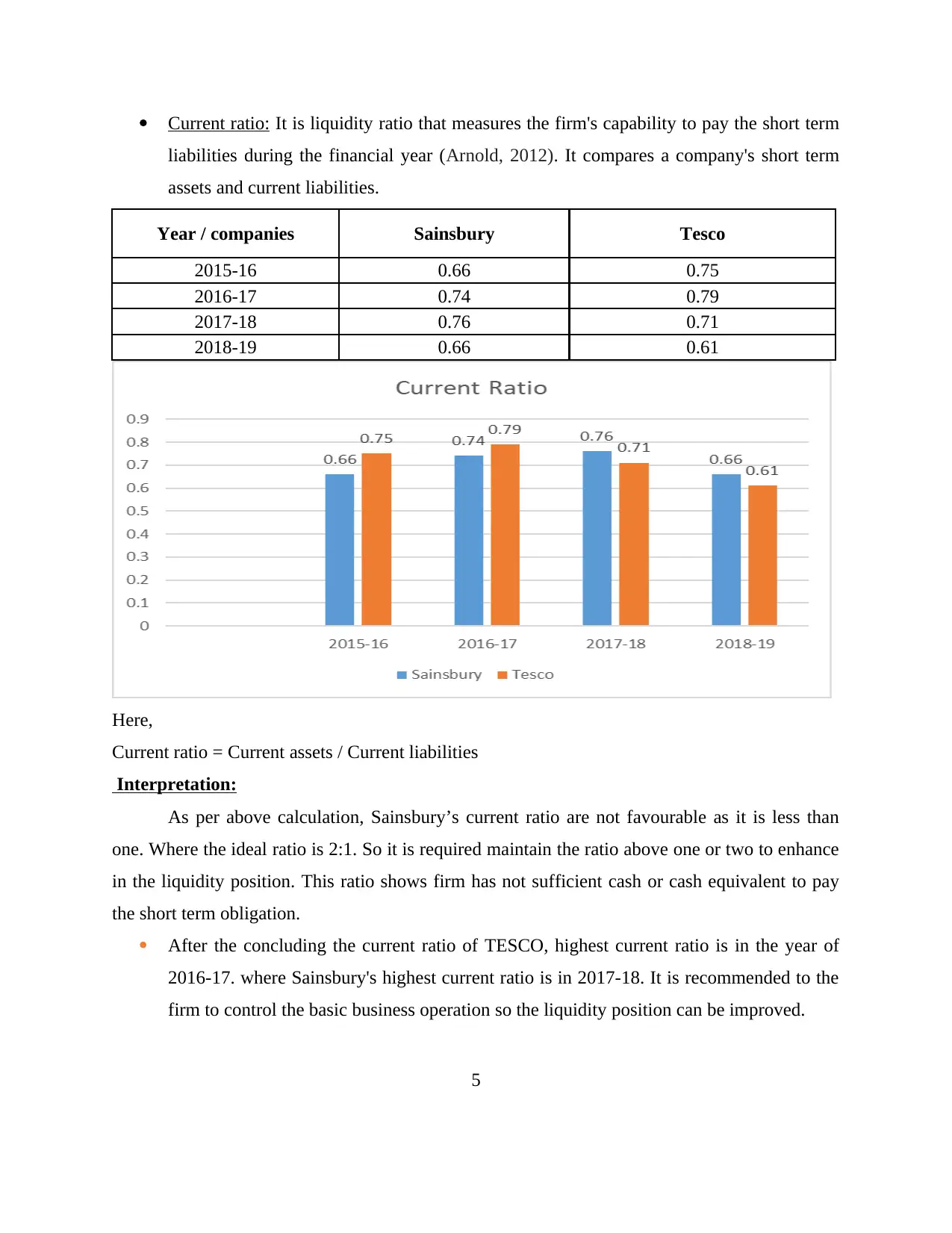
Current ratio: It is liquidity ratio that measures the firm's capability to pay the short term
liabilities during the financial year (Arnold, 2012). It compares a company's short term
assets and current liabilities.
Year / companies Sainsbury Tesco
2015-16 0.66 0.75
2016-17 0.74 0.79
2017-18 0.76 0.71
2018-19 0.66 0.61
Here,
Current ratio = Current assets / Current liabilities
Interpretation:
As per above calculation, Sainsbury’s current ratio are not favourable as it is less than
one. Where the ideal ratio is 2:1. So it is required maintain the ratio above one or two to enhance
in the liquidity position. This ratio shows firm has not sufficient cash or cash equivalent to pay
the short term obligation.
After the concluding the current ratio of TESCO, highest current ratio is in the year of
2016-17. where Sainsbury's highest current ratio is in 2017-18. It is recommended to the
firm to control the basic business operation so the liquidity position can be improved.
5
tabler-icon-diamond-filled.svg

Paraphrase This Document

Need a fresh take? Get an instant paraphrase of this document with our AI Paraphraser
Document Page
Both company may have almost same current ratio during the all year. Sainsbury's
current ratio is same in the year 2015-16 and 2018-19. So it is required to enhance the
business operation and effectiveness in appropriate manner to improve the business
efficiency.
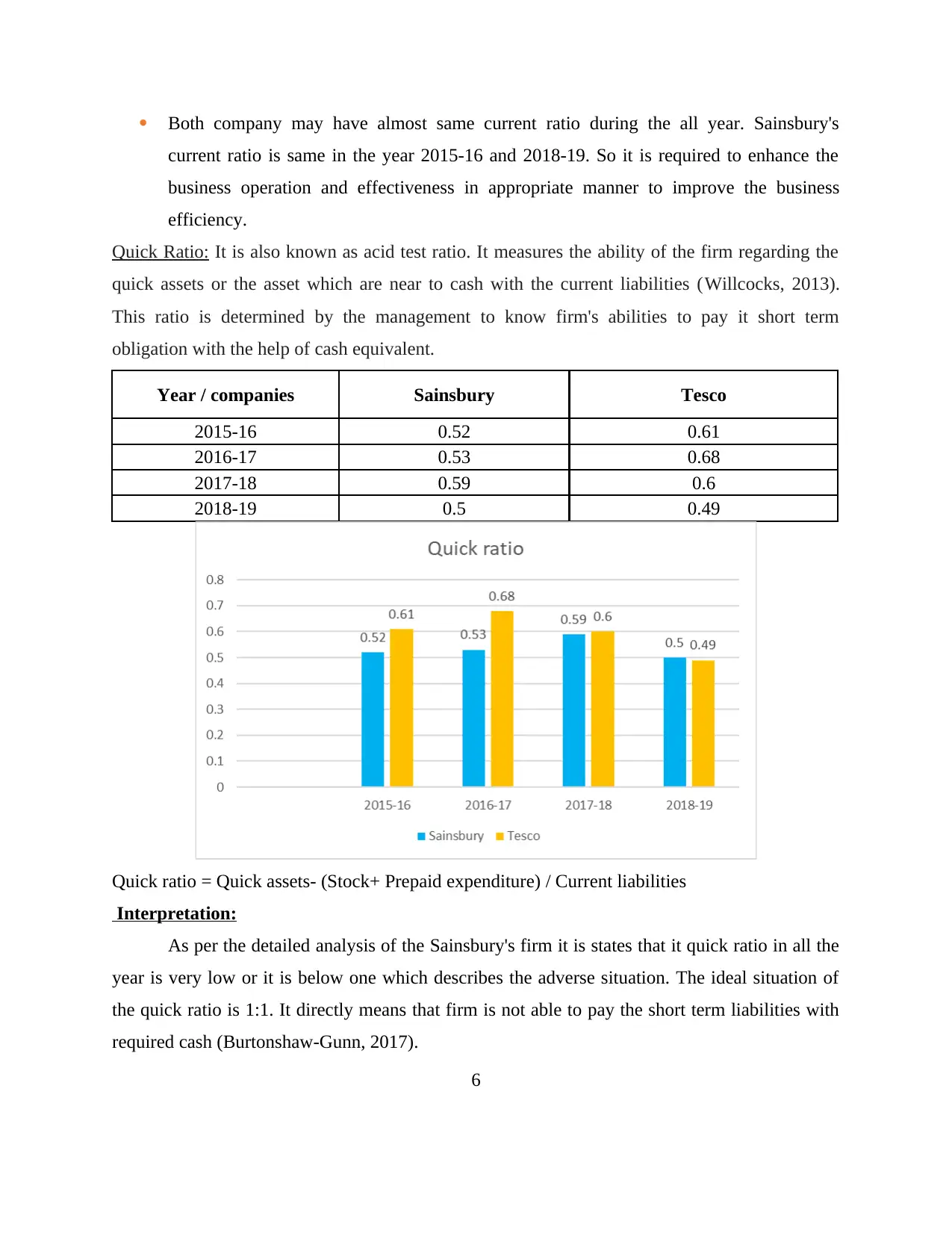
Quick Ratio: It is also known as acid test ratio. It measures the ability of the firm regarding the
quick assets or the asset which are near to cash with the current liabilities (Willcocks, 2013).
This ratio is determined by the management to know firm's abilities to pay it short term
obligation with the help of cash equivalent.
Year / companies Sainsbury Tesco
2015-16 0.52 0.61
2016-17 0.53 0.68
2017-18 0.59 0.6
2018-19 0.5 0.49
Quick ratio = Quick assets- (Stock+ Prepaid expenditure) / Current liabilities
Interpretation:
As per the detailed analysis of the Sainsbury's firm it is states that it quick ratio in all the
year is very low or it is below one which describes the adverse situation. The ideal situation of
the quick ratio is 1:1. It directly means that firm is not able to pay the short term liabilities with
required cash (Burtonshaw-Gunn, 2017).
6
Document Page
As per the deep evaluation of the ratio of TESCO, it is clearly shows the quick assets
ratio is below par situation. Thus, it needs to be alter the business model and plan in order to
controlling the business operations.
In the year of 2017-18, there is huge gap in quick ratio of both company. Sainsbury's is
maintained the ratio of 0.5 that is not at par situation. Where TESCO has the ratio of 0.49
only. So both the companies are required to implement new business tactics to
developing or enhancing the organisational efficiency.
Quick ratio of Sainsbury's is almost same in the year of 2015-16 and 2016-17. but after
that it increases.
Solvency ratios:
Solvency ratio is financial metrics that used to measure the firm's efficiency to meet the
long term obligation in the business organisation. This ratio shows weather the available
resources in the business are sufficient to pay the long term debts. Computations of various
solvency ratios are as below:
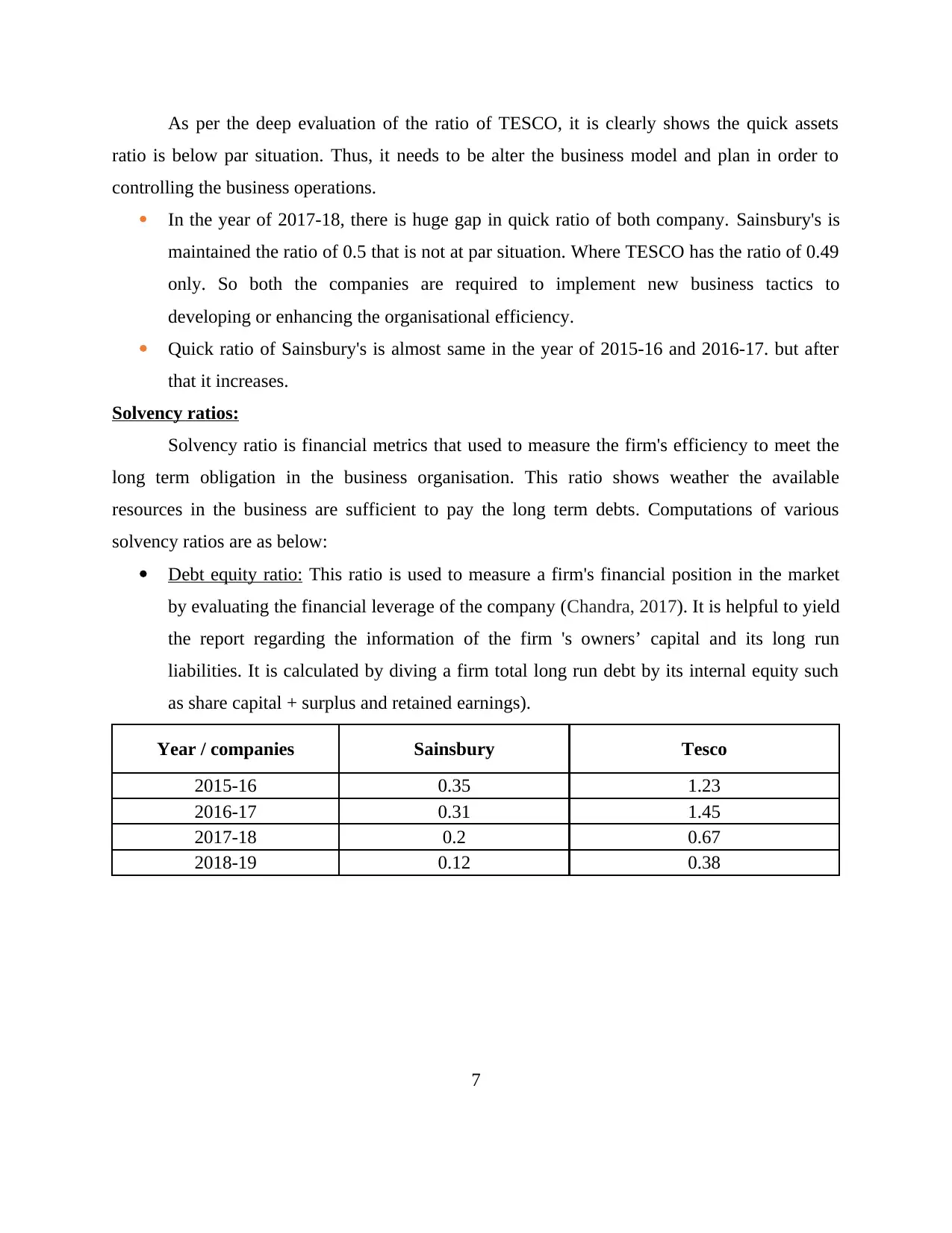
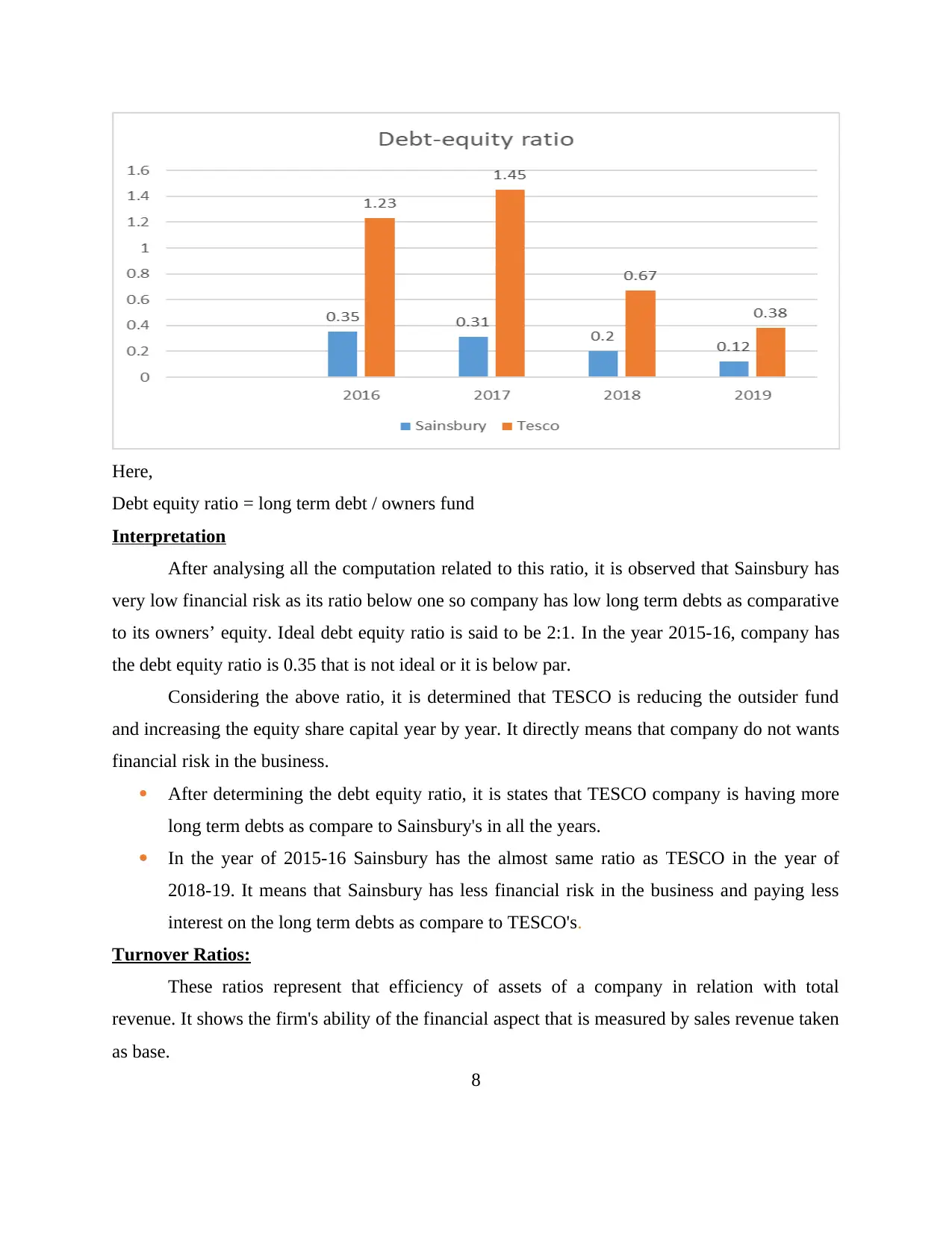
Debt equity ratio: This ratio is used to measure a firm's financial position in the market
by evaluating the financial leverage of the company (Chandra, 2017). It is helpful to yield
the report regarding the information of the firm 's owners’ capital and its long run
liabilities. It is calculated by diving a firm total long run debt by its internal equity such
as share capital + surplus and retained earnings).
Year / companies Sainsbury Tesco
2015-16 0.35 1.23
2016-17 0.31 1.45
2017-18 0.2 0.67
2018-19 0.12 0.38
7
Document Page
Here,
Debt equity ratio = long term debt / owners fund
Interpretation
After analysing all the computation related to this ratio, it is observed that Sainsbury has
very low financial risk as its ratio below one so company has low long term debts as comparative
to its owners’ equity. Ideal debt equity ratio is said to be 2:1. In the year 2015-16, company has
the debt equity ratio is 0.35 that is not ideal or it is below par.
Considering the above ratio, it is determined that TESCO is reducing the outsider fund
and increasing the equity share capital year by year. It directly means that company do not wants
financial risk in the business.
After determining the debt equity ratio, it is states that TESCO company is having more
long term debts as compare to Sainsbury's in all the years.
In the year of 2015-16 Sainsbury has the almost same ratio as TESCO in the year of
2018-19. It means that Sainsbury has less financial risk in the business and paying less
interest on the long term debts as compare to TESCO's.
Turnover Ratios:
These ratios represent that efficiency of assets of a company in relation with total
revenue. It shows the firm's ability of the financial aspect that is measured by sales revenue taken
as base.
8
tabler-icon-diamond-filled.svg

Paraphrase This Document

Need a fresh take? Get an instant paraphrase of this document with our AI Paraphraser
Document Page
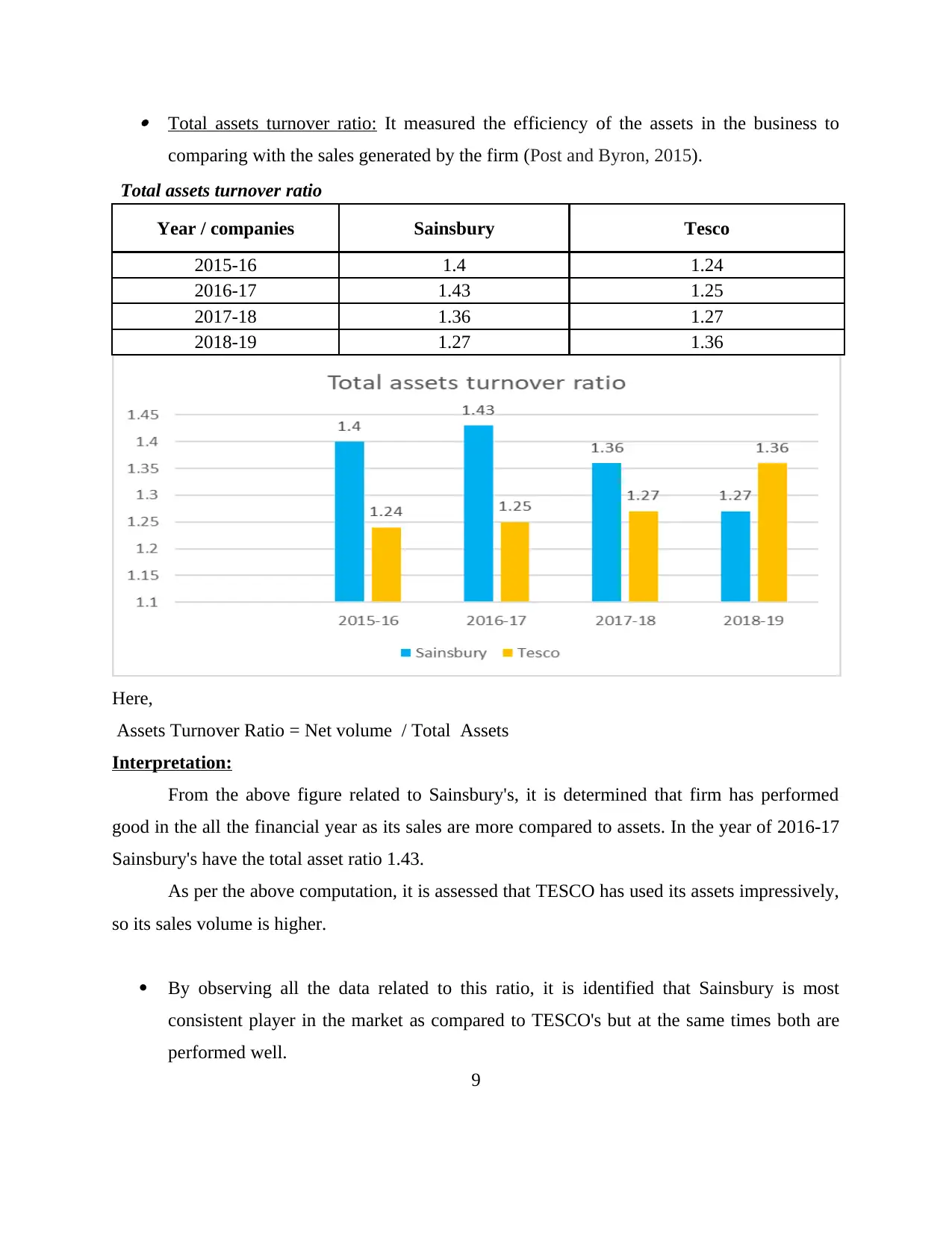
Total assets turnover ratio: It measured the efficiency of the assets in the business to
comparing with the sales generated by the firm (Post and Byron, 2015).
Total assets turnover ratio
Year / companies Sainsbury Tesco
2015-16 1.4 1.24
2016-17 1.43 1.25
2017-18 1.36 1.27
2018-19 1.27 1.36
Here,
Assets Turnover Ratio = Net volume / Total Assets
Interpretation:
From the above figure related to Sainsbury's, it is determined that firm has performed
good in the all the financial year as its sales are more compared to assets. In the year of 2016-17
Sainsbury's have the total asset ratio 1.43.
As per the above computation, it is assessed that TESCO has used its assets impressively,
so its sales volume is higher.
By observing all the data related to this ratio, it is identified that Sainsbury is most
consistent player in the market as compared to TESCO's but at the same times both are
performed well.
9
Document Page
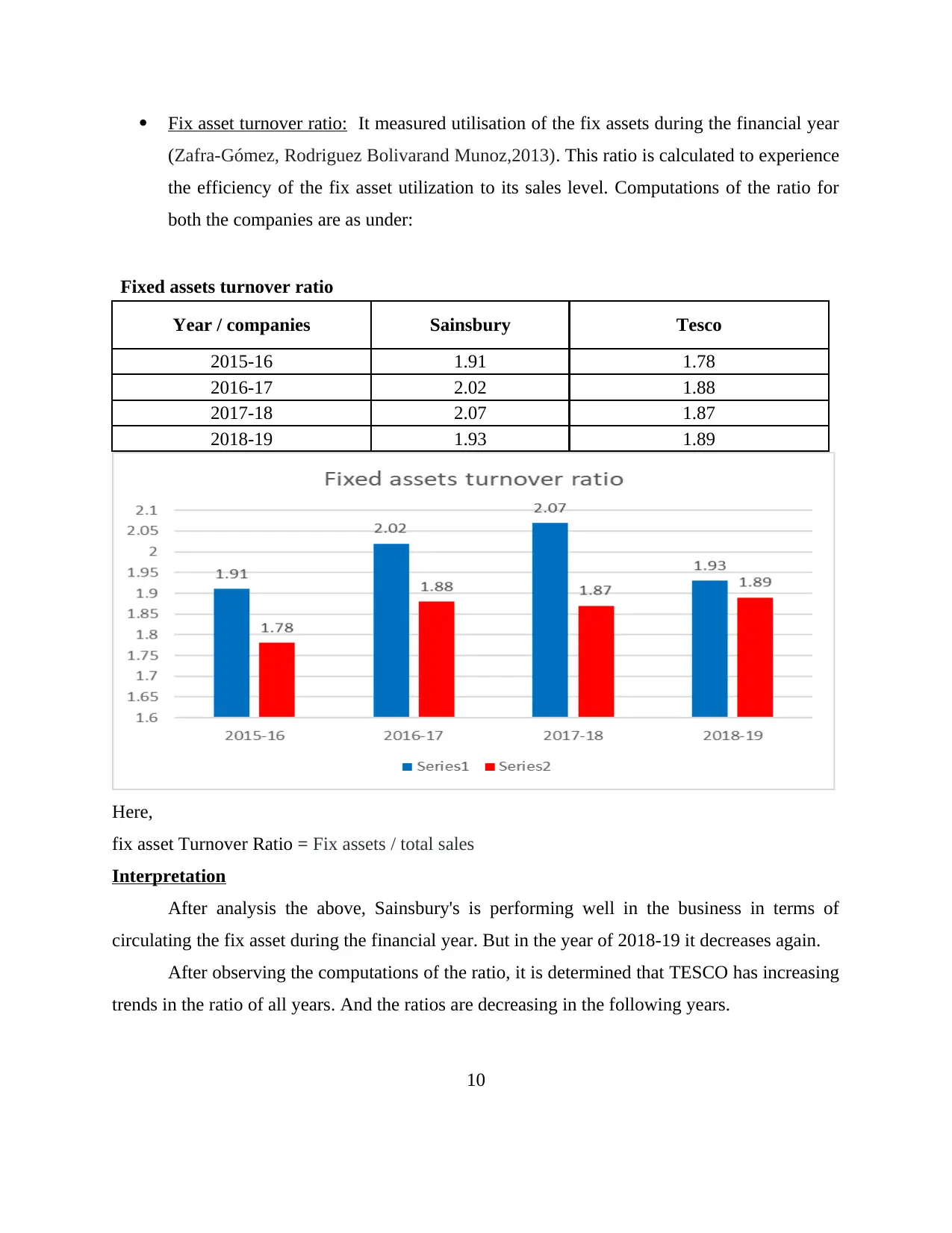
Fix asset turnover ratio: It measured utilisation of the fix assets during the financial year
(Zafra-Gómez, Rodriguez Bolivarand Munoz,2013). This ratio is calculated to experience
the efficiency of the fix asset utilization to its sales level. Computations of the ratio for
both the companies are as under:
Fixed assets turnover ratio
Year / companies Sainsbury Tesco
2015-16 1.91 1.78
2016-17 2.02 1.88
2017-18 2.07 1.87
2018-19 1.93 1.89
Here,
fix asset Turnover Ratio = Fix assets / total sales
Interpretation
After analysis the above, Sainsbury's is performing well in the business in terms of
circulating the fix asset during the financial year. But in the year of 2018-19 it decreases again.
After observing the computations of the ratio, it is determined that TESCO has increasing
trends in the ratio of all years. And the ratios are decreasing in the following years.
10
chevron_up_icon
1 out of 27
circle_padding
hide_on_mobile
zoom_out_icon
[object Object]