ITSM511 Commodity Trade: Sakhalin Oil & Gas Project Analysis
VerifiedAdded on 2023/05/28
|13
|2582
|252
Report
AI Summary
This report provides an in-depth analysis of the Sakhalin Oil and Gas projects, focusing on trade patterns, key exporters, and importers. It investigates the commercial development and operation of hydrocarbon fields under the Sakhalin-2 licenses, including project infrastructure development. The report highlights the involvement of major players like Gazprom, Mitsui, Royal Dutch Shell, and Mitsubishi. It further discusses the Sakhalin-1 project involving Japan, Russia, America, and India, operated by Exxon Neftgas Limited. The analysis covers the project's infrastructure, environmental concerns, and recommendations for sustainable development, emphasizing the benefits for shareholders, the Russian Federation, Sakhalin, and the local community. It concludes with the necessity of infrastructural improvements and modernization to support the project's future endeavors.
Running Head: COMMODITY TRADE
Commodity Trade
Name of the Student
Name of the University
Author Note
Commodity Trade
Name of the Student
Name of the University
Author Note

Paraphrase This Document
Need a fresh take? Get an instant paraphrase of this document with our AI Paraphraser
1COMMODITY TRADE
Table of Contents
Introduction......................................................................................................................................2
Discussion........................................................................................................................................3
Overview of the Company.......................................................................................................3
About the Sakhalin Project -1..................................................................................................3
About the Sakhalin Project -2..................................................................................................4
Exporters and Importers..........................................................................................................7
Recommendations............................................................................................................................8
Conclusion.......................................................................................................................................9
Reference.......................................................................................................................................11
Table of Contents
Introduction......................................................................................................................................2
Discussion........................................................................................................................................3
Overview of the Company.......................................................................................................3
About the Sakhalin Project -1..................................................................................................3
About the Sakhalin Project -2..................................................................................................4
Exporters and Importers..........................................................................................................7
Recommendations............................................................................................................................8
Conclusion.......................................................................................................................................9
Reference.......................................................................................................................................11
2COMMODITY TRADE
Introduction
There are so many opportunities in the global market of commodities. The commodity
market is a financial market which operates in the primary economic sector or with the raw
materials. The investors can easily access around more than 50 major community markets which
are divided into soft kind of commodities and hard commodities. The soft commodity products
goods include goods like coffee and cocoa (Henderson 2015). On the other hand, the hard
commodities include gold or oil. However, all kinds of commodities whether they are associated
with the energy or metals, food are an important part of everyday life. Few years ago, the
commodity trades were not so prevalent and people with average savings could not even dare to
invest in the commodity trading. Nowadays, many ways have emerged to facilitate the
participation of those who are not professionals but have the will to engage in the commodity
trading.
The present report will deal with the commodity trading projects and methods of
Sakhalin Energy Investment Company Ltd. growing in the Piltun- Astokhskoye oil field and also
in the Lunskoye gas field (Inkpen, Moffett and Ramaswamy 2017). Few of the major activities
of the company includes production, processing, transportation and marketing of natural gas and
oil. Gazprom, Mitsui, Royal Dutch Shell and Mitsubishi are among the major shareholders of the
company. The present report will deal with investigating the oil and gas projects of Sakhalin,
analyze its trade patterns and also the future prospects. It will further identify the major importers
and exporters. Lastly, it will investigate the commercial development and operations of the
hydrocarbon fields and sales in accordance with the licenses of Sakhalin -II. It will outline the
project infrastructure due to the benefit of the shareholders, the local community, Sakhalin and
Introduction
There are so many opportunities in the global market of commodities. The commodity
market is a financial market which operates in the primary economic sector or with the raw
materials. The investors can easily access around more than 50 major community markets which
are divided into soft kind of commodities and hard commodities. The soft commodity products
goods include goods like coffee and cocoa (Henderson 2015). On the other hand, the hard
commodities include gold or oil. However, all kinds of commodities whether they are associated
with the energy or metals, food are an important part of everyday life. Few years ago, the
commodity trades were not so prevalent and people with average savings could not even dare to
invest in the commodity trading. Nowadays, many ways have emerged to facilitate the
participation of those who are not professionals but have the will to engage in the commodity
trading.
The present report will deal with the commodity trading projects and methods of
Sakhalin Energy Investment Company Ltd. growing in the Piltun- Astokhskoye oil field and also
in the Lunskoye gas field (Inkpen, Moffett and Ramaswamy 2017). Few of the major activities
of the company includes production, processing, transportation and marketing of natural gas and
oil. Gazprom, Mitsui, Royal Dutch Shell and Mitsubishi are among the major shareholders of the
company. The present report will deal with investigating the oil and gas projects of Sakhalin,
analyze its trade patterns and also the future prospects. It will further identify the major importers
and exporters. Lastly, it will investigate the commercial development and operations of the
hydrocarbon fields and sales in accordance with the licenses of Sakhalin -II. It will outline the
project infrastructure due to the benefit of the shareholders, the local community, Sakhalin and
⊘ This is a preview!⊘
Do you want full access?
Subscribe today to unlock all pages.

Trusted by 1+ million students worldwide
3COMMODITY TRADE
also the Russian Federation. The report will conclude by giving an outline of the main topics
properly.
Discussion
Overview of the Company
The Sakhalin Energy Investment Company Ltd. or the Sakhalin Energy is an association
of several companies that is developing the Sakhalin -2 gas and oil project. The chief executive
of the company is Roman Dashkov. The principle business operation of the company is to
produce and export crude liquefied natural gas and oil. In the year 1994, the company started
operating for the first time and as per the annual reports of the company, it earns more than $
5.52 billion per annum. Gazprom is the parent company and there are approximately 2,230
employees working at present. The Sakhalin energy develops the Lunskoye and Piltun-
Astokhskoye gas fields which is commonly known as the Sakhalin – II project in the Sea of
Okhotsk situated off the shores of Sakhalin Island in the far east of Russia. The net asset of the
company by the year 2017, is $ 860 million. These include, three of the offshore gas and oil
platforms , the Piltun-Astokhskoye-A ( PA-A / Molikpaq), Piltun-Astokhskoye-B (PA-
B) and Lunskoye-A (LUN-A). There are also transsakhalin pipeline system, booster station,
onshore processing facility, oil export terminal and liquefied natural gas plant.
About the Sakhalin Project -1
The Sakhalin -1 project consists of Japan, Russia, America and India from where a good
number of participants are associated with this project and it is mainly operated by Exxon
Neftgas Limited which is a subsidiary of Exxon Mobil. The Exxon Neftgas Limited is a U.S
based subsidiary and holds almost 30 percent interest. The Russian oil company Rosneft acts
also the Russian Federation. The report will conclude by giving an outline of the main topics
properly.
Discussion
Overview of the Company
The Sakhalin Energy Investment Company Ltd. or the Sakhalin Energy is an association
of several companies that is developing the Sakhalin -2 gas and oil project. The chief executive
of the company is Roman Dashkov. The principle business operation of the company is to
produce and export crude liquefied natural gas and oil. In the year 1994, the company started
operating for the first time and as per the annual reports of the company, it earns more than $
5.52 billion per annum. Gazprom is the parent company and there are approximately 2,230
employees working at present. The Sakhalin energy develops the Lunskoye and Piltun-
Astokhskoye gas fields which is commonly known as the Sakhalin – II project in the Sea of
Okhotsk situated off the shores of Sakhalin Island in the far east of Russia. The net asset of the
company by the year 2017, is $ 860 million. These include, three of the offshore gas and oil
platforms , the Piltun-Astokhskoye-A ( PA-A / Molikpaq), Piltun-Astokhskoye-B (PA-
B) and Lunskoye-A (LUN-A). There are also transsakhalin pipeline system, booster station,
onshore processing facility, oil export terminal and liquefied natural gas plant.
About the Sakhalin Project -1
The Sakhalin -1 project consists of Japan, Russia, America and India from where a good
number of participants are associated with this project and it is mainly operated by Exxon
Neftgas Limited which is a subsidiary of Exxon Mobil. The Exxon Neftgas Limited is a U.S
based subsidiary and holds almost 30 percent interest. The Russian oil company Rosneft acts
Paraphrase This Document
Need a fresh take? Get an instant paraphrase of this document with our AI Paraphraser
4COMMODITY TRADE
through its affiliates and the Sakhalinmorneftgas –Shelf with 8.5 % and 11.5 % respectively. The
Japanese SODECO consortium on the other hand holds almost 30 % interest. The Indian oil
company named as ONGC Videsh Ltd (Kalyuzhnova et al. 2016). which is also a state owned
company has the 20 % of interest. The arctic climate and difficult geographic conditions of the
northern area of Sakhalin have necessitated the use of advanced and unique technologies. Hence,
the global projects like ExxonMobil has faced challenges while involving with the Skhalin -1
project. Among the new technologies the Yastreb land rig was designed especially and
exclusively for the Sakhalin -1 and it is one of the most powerful and effective land rigs in the
industry.
It functions to drill the wells offshore and the land –based locations. Apart from this the
ERD or the Extended Reach Drilling is a technology that is used to reduce the operating costs of
the offshore structures and at the same time cut down the impacts of environment in the sensitive
shore areas (Motomura 2014). The ExxonMobil proprietary technologies are used while drilling
such as the Integrated Hole Quality (IHQ) technologies and using the Fast Drill Process. With
the help of the IHQ, a broad range of interdependent structure variables that includes the rock
strength and stresses a well –dug hydraulics (Luebeck and Petrov 2018). The Fast Drill is a
unique technology that is both energy based and allows the engineers and the rig personnel to
extend the performance in each of the drilled foot.
About the Sakhalin Project -2
The Sakhalin -2 project is a gas and oil development project in the Islands of Sakhalin,
Russia. The main aim of the project is to develop the Piltun Astokhskoye oil field and the as field
of Lunskoye off the shores of Sakhalin Island in the Okkotsk Sea. The focus is also on the
development of the associated infrastructure on the shores. It has been found that the two fields
through its affiliates and the Sakhalinmorneftgas –Shelf with 8.5 % and 11.5 % respectively. The
Japanese SODECO consortium on the other hand holds almost 30 % interest. The Indian oil
company named as ONGC Videsh Ltd (Kalyuzhnova et al. 2016). which is also a state owned
company has the 20 % of interest. The arctic climate and difficult geographic conditions of the
northern area of Sakhalin have necessitated the use of advanced and unique technologies. Hence,
the global projects like ExxonMobil has faced challenges while involving with the Skhalin -1
project. Among the new technologies the Yastreb land rig was designed especially and
exclusively for the Sakhalin -1 and it is one of the most powerful and effective land rigs in the
industry.
It functions to drill the wells offshore and the land –based locations. Apart from this the
ERD or the Extended Reach Drilling is a technology that is used to reduce the operating costs of
the offshore structures and at the same time cut down the impacts of environment in the sensitive
shore areas (Motomura 2014). The ExxonMobil proprietary technologies are used while drilling
such as the Integrated Hole Quality (IHQ) technologies and using the Fast Drill Process. With
the help of the IHQ, a broad range of interdependent structure variables that includes the rock
strength and stresses a well –dug hydraulics (Luebeck and Petrov 2018). The Fast Drill is a
unique technology that is both energy based and allows the engineers and the rig personnel to
extend the performance in each of the drilled foot.
About the Sakhalin Project -2
The Sakhalin -2 project is a gas and oil development project in the Islands of Sakhalin,
Russia. The main aim of the project is to develop the Piltun Astokhskoye oil field and the as field
of Lunskoye off the shores of Sakhalin Island in the Okkotsk Sea. The focus is also on the
development of the associated infrastructure on the shores. It has been found that the two fields
5COMMODITY TRADE
contain crude oil of 1,200 million barrels and natural gas of almost 500 billion cubic meters.
There is an estimation of liquefied natural gas of 9.6 million tons exported per year and there are
180,000 barrels of oil will be produced. Till the year 2014, the total project cost was estimated to
be US$9 and $11 billion as calculated by Royal Dutch Shell. The Sakhalin 2projects are as
follows:
Piltun –Astokhskoye –A platform –
The Piltun –Astokhskoye –A is a basically an ice –resistant structure which is originally
established to explore the Canadian Beaufort Sea for oil exploration. In the year 1990, it has been
mothballed and at the same time it was installed in the Piltun- Astokhskoye field that is 16
kilometers off the shore. It has the capacity to produce 90,000 barrels of oil per day and 1.7 cubic
meters of associated gas.
Lunskoye –A platform –
In the year 2006, the Lunskoye field platform was for the first time installed in Lunskoye
around 15 kilometers off the shore. The capacity of production natural gas is 50 million cubic
meters equivalent to 50,000 barrels per day. It also has the capacity of producing 16,000 barrels
of oil per day.
Piltun- Astokhskoye –B platform-
The Piltun- Astokhskoye is a platform that was installed in the year 2007 in the Piltun
area oil field around 12 kilometers off the shore. The capacity of this platform is to produce
70,000 barrels of oil each day with 2.8 cubic meters of associated gas.
Onshore processing facility-
contain crude oil of 1,200 million barrels and natural gas of almost 500 billion cubic meters.
There is an estimation of liquefied natural gas of 9.6 million tons exported per year and there are
180,000 barrels of oil will be produced. Till the year 2014, the total project cost was estimated to
be US$9 and $11 billion as calculated by Royal Dutch Shell. The Sakhalin 2projects are as
follows:
Piltun –Astokhskoye –A platform –
The Piltun –Astokhskoye –A is a basically an ice –resistant structure which is originally
established to explore the Canadian Beaufort Sea for oil exploration. In the year 1990, it has been
mothballed and at the same time it was installed in the Piltun- Astokhskoye field that is 16
kilometers off the shore. It has the capacity to produce 90,000 barrels of oil per day and 1.7 cubic
meters of associated gas.
Lunskoye –A platform –
In the year 2006, the Lunskoye field platform was for the first time installed in Lunskoye
around 15 kilometers off the shore. The capacity of production natural gas is 50 million cubic
meters equivalent to 50,000 barrels per day. It also has the capacity of producing 16,000 barrels
of oil per day.
Piltun- Astokhskoye –B platform-
The Piltun- Astokhskoye is a platform that was installed in the year 2007 in the Piltun
area oil field around 12 kilometers off the shore. The capacity of this platform is to produce
70,000 barrels of oil each day with 2.8 cubic meters of associated gas.
Onshore processing facility-
⊘ This is a preview!⊘
Do you want full access?
Subscribe today to unlock all pages.
Trusted by 1+ million students worldwide
6COMMODITY TRADE
The onshore processing facility is located in the north-east island of Sakhalin that is
around 7 kilometers in the Nogliki district. It is basically designed to produce the and process the
natural gas and condensate oil from the Lunskoe and Piltun- Astokhskoye areas.
TransSakhalin pipelines –
It is a system that is designed for hydrocarbon transportation in the north of Sakhalin
Island from the Astokhkoye and Lunskoye fields. The TrasSakhalin pipelines are also used to
export the LNG oil in the terminals of Aniva Bay.
Oil Export Terminal-
The location of the oil export terminal is situated in the Aniva Bay which is to the east of
LNG plant. It consists of the export pipelines, the tanker loading unit which performs in the oil-
loading tanker.
LNG plant –
The Sakhalin -2 plan is the first such plant in Russia and situated in the Prigorodnoye in
Aniva Bay which is almost 13 kilometers east of Korsakov. The main aim of designing the plant
is to prevent the loss of containment in the sudden occurrence of earthquake and also maintain
the structural integrity of the essential elements. The LNG plants include and LNG jetty, two
100,000 cubic meters of LNG storage tanks and two LNG processing trains with the potential of
The onshore processing facility is located in the north-east island of Sakhalin that is
around 7 kilometers in the Nogliki district. It is basically designed to produce the and process the
natural gas and condensate oil from the Lunskoe and Piltun- Astokhskoye areas.
TransSakhalin pipelines –
It is a system that is designed for hydrocarbon transportation in the north of Sakhalin
Island from the Astokhkoye and Lunskoye fields. The TrasSakhalin pipelines are also used to
export the LNG oil in the terminals of Aniva Bay.
Oil Export Terminal-
The location of the oil export terminal is situated in the Aniva Bay which is to the east of
LNG plant. It consists of the export pipelines, the tanker loading unit which performs in the oil-
loading tanker.
LNG plant –
The Sakhalin -2 plan is the first such plant in Russia and situated in the Prigorodnoye in
Aniva Bay which is almost 13 kilometers east of Korsakov. The main aim of designing the plant
is to prevent the loss of containment in the sudden occurrence of earthquake and also maintain
the structural integrity of the essential elements. The LNG plants include and LNG jetty, two
100,000 cubic meters of LNG storage tanks and two LNG processing trains with the potential of
Paraphrase This Document
Need a fresh take? Get an instant paraphrase of this document with our AI Paraphraser
7COMMODITY TRADE
4.8 million tons per year.
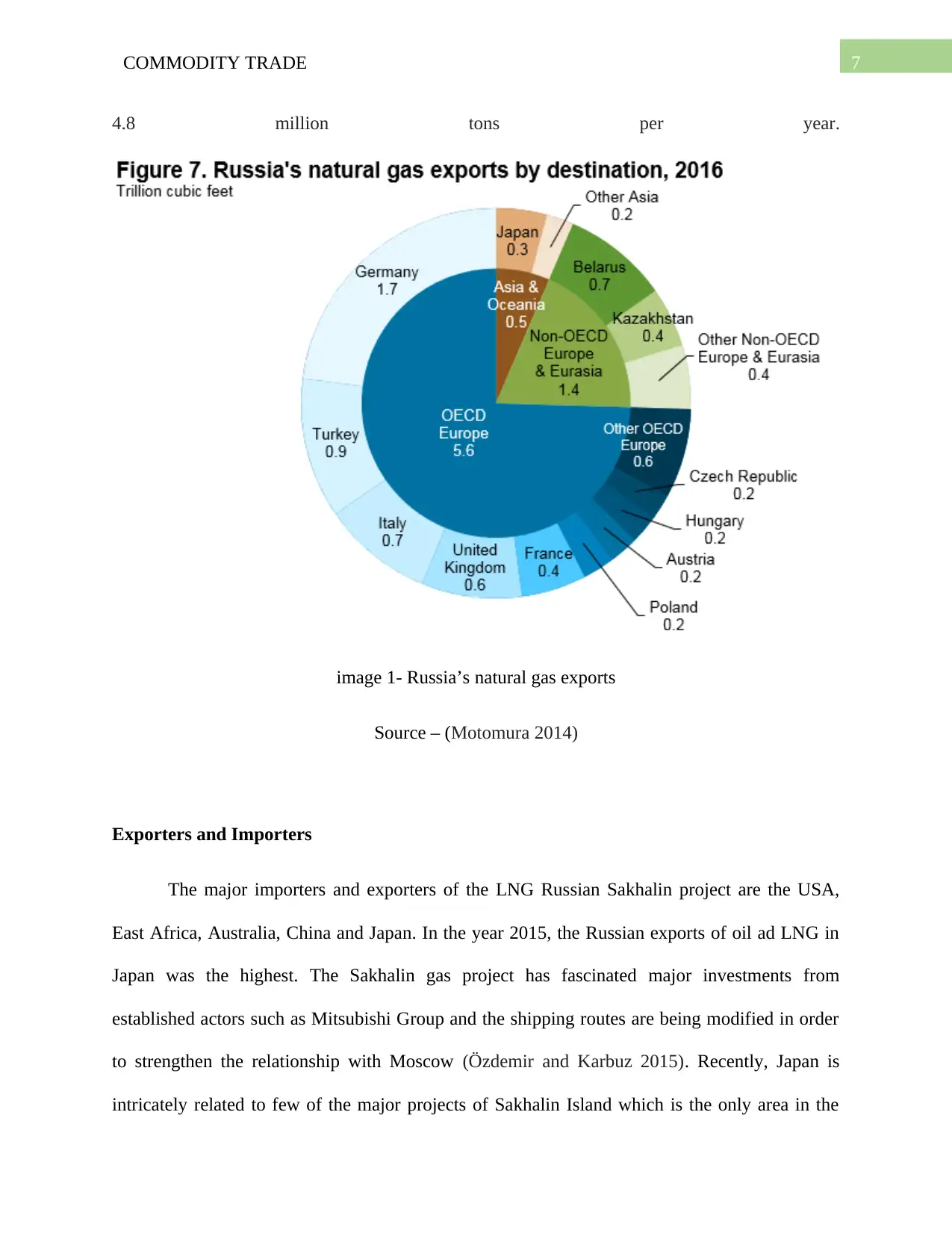
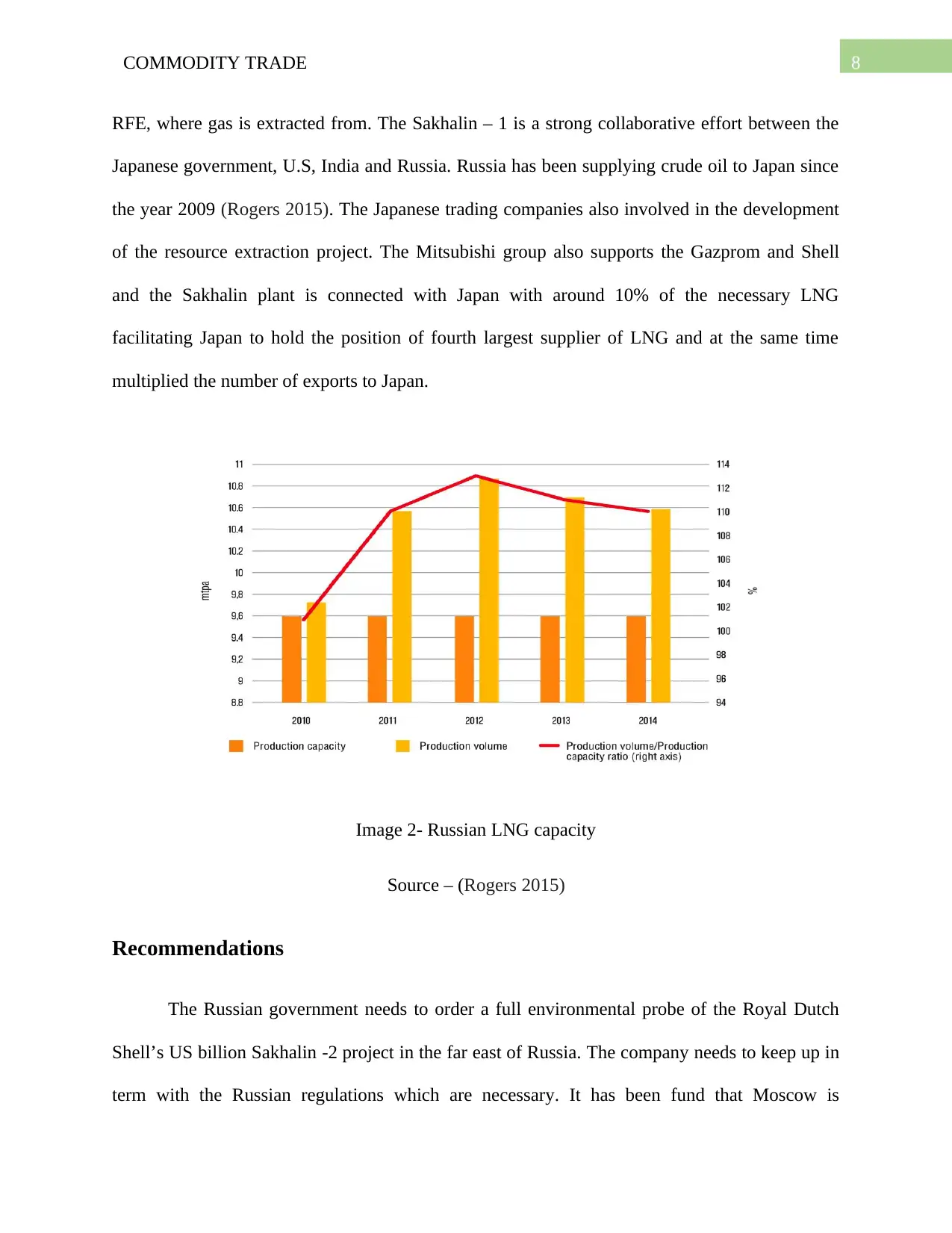
image 1- Russia’s natural gas exports
Source – (Motomura 2014)
Exporters and Importers
The major importers and exporters of the LNG Russian Sakhalin project are the USA,
East Africa, Australia, China and Japan. In the year 2015, the Russian exports of oil ad LNG in
Japan was the highest. The Sakhalin gas project has fascinated major investments from
established actors such as Mitsubishi Group and the shipping routes are being modified in order
to strengthen the relationship with Moscow (Özdemir and Karbuz 2015). Recently, Japan is
intricately related to few of the major projects of Sakhalin Island which is the only area in the
4.8 million tons per year.
image 1- Russia’s natural gas exports
Source – (Motomura 2014)
Exporters and Importers
The major importers and exporters of the LNG Russian Sakhalin project are the USA,
East Africa, Australia, China and Japan. In the year 2015, the Russian exports of oil ad LNG in
Japan was the highest. The Sakhalin gas project has fascinated major investments from
established actors such as Mitsubishi Group and the shipping routes are being modified in order
to strengthen the relationship with Moscow (Özdemir and Karbuz 2015). Recently, Japan is
intricately related to few of the major projects of Sakhalin Island which is the only area in the
8COMMODITY TRADE
RFE, where gas is extracted from. The Sakhalin – 1 is a strong collaborative effort between the
Japanese government, U.S, India and Russia. Russia has been supplying crude oil to Japan since
the year 2009 (Rogers 2015). The Japanese trading companies also involved in the development
of the resource extraction project. The Mitsubishi group also supports the Gazprom and Shell
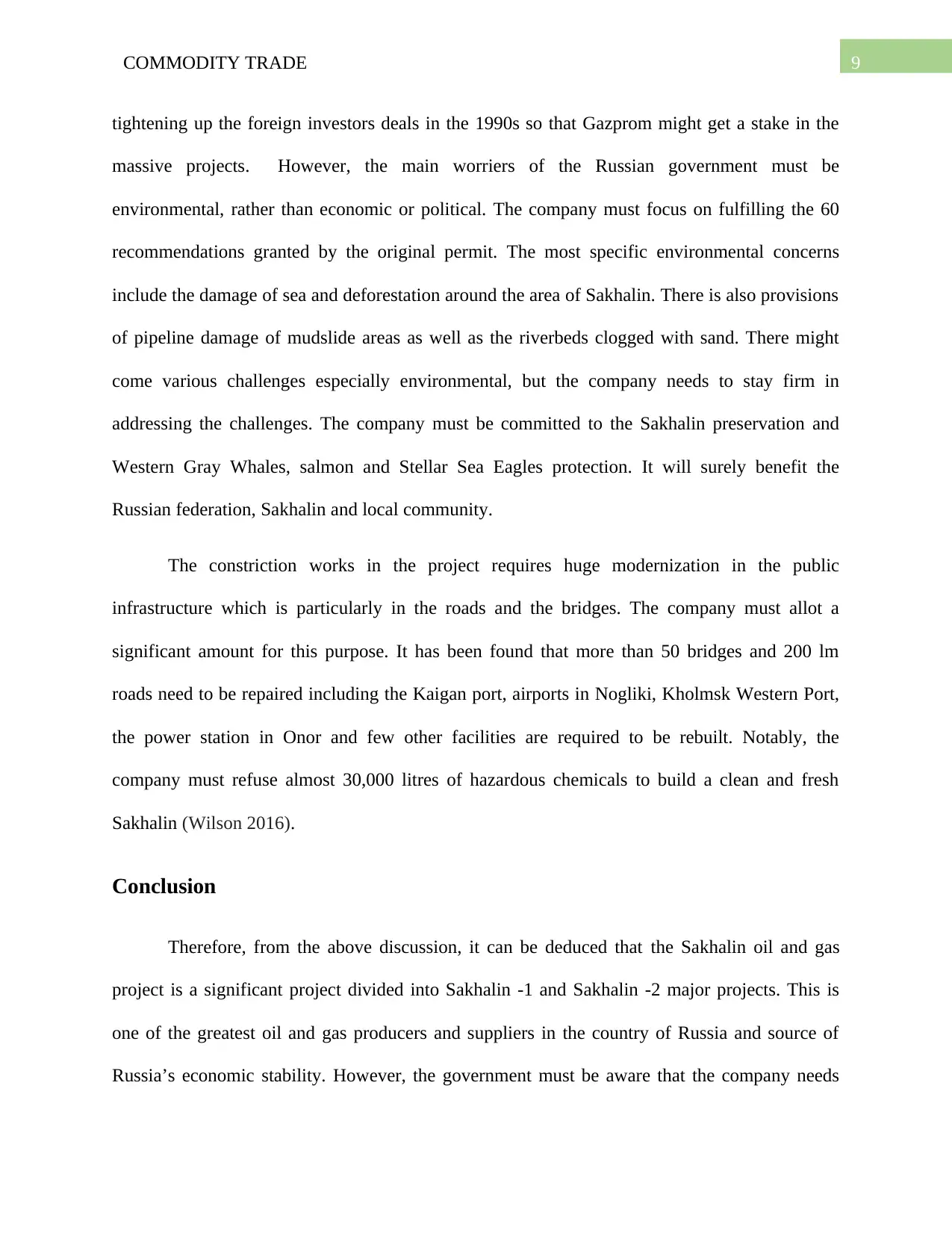
and the Sakhalin plant is connected with Japan with around 10% of the necessary LNG
facilitating Japan to hold the position of fourth largest supplier of LNG and at the same time
multiplied the number of exports to Japan.
Image 2- Russian LNG capacity
Source – (Rogers 2015)
Recommendations
The Russian government needs to order a full environmental probe of the Royal Dutch
Shell’s US billion Sakhalin -2 project in the far east of Russia. The company needs to keep up in
term with the Russian regulations which are necessary. It has been fund that Moscow is
RFE, where gas is extracted from. The Sakhalin – 1 is a strong collaborative effort between the
Japanese government, U.S, India and Russia. Russia has been supplying crude oil to Japan since
the year 2009 (Rogers 2015). The Japanese trading companies also involved in the development
of the resource extraction project. The Mitsubishi group also supports the Gazprom and Shell
and the Sakhalin plant is connected with Japan with around 10% of the necessary LNG
facilitating Japan to hold the position of fourth largest supplier of LNG and at the same time
multiplied the number of exports to Japan.
Image 2- Russian LNG capacity
Source – (Rogers 2015)
Recommendations
The Russian government needs to order a full environmental probe of the Royal Dutch
Shell’s US billion Sakhalin -2 project in the far east of Russia. The company needs to keep up in
term with the Russian regulations which are necessary. It has been fund that Moscow is
⊘ This is a preview!⊘
Do you want full access?
Subscribe today to unlock all pages.
Trusted by 1+ million students worldwide
9COMMODITY TRADE
tightening up the foreign investors deals in the 1990s so that Gazprom might get a stake in the
massive projects. However, the main worriers of the Russian government must be
environmental, rather than economic or political. The company must focus on fulfilling the 60
recommendations granted by the original permit. The most specific environmental concerns
include the damage of sea and deforestation around the area of Sakhalin. There is also provisions
of pipeline damage of mudslide areas as well as the riverbeds clogged with sand. There might
come various challenges especially environmental, but the company needs to stay firm in
addressing the challenges. The company must be committed to the Sakhalin preservation and
Western Gray Whales, salmon and Stellar Sea Eagles protection. It will surely benefit the
Russian federation, Sakhalin and local community.
The constriction works in the project requires huge modernization in the public
infrastructure which is particularly in the roads and the bridges. The company must allot a
significant amount for this purpose. It has been found that more than 50 bridges and 200 lm
roads need to be repaired including the Kaigan port, airports in Nogliki, Kholmsk Western Port,
the power station in Onor and few other facilities are required to be rebuilt. Notably, the
company must refuse almost 30,000 litres of hazardous chemicals to build a clean and fresh
Sakhalin (Wilson 2016).
Conclusion
Therefore, from the above discussion, it can be deduced that the Sakhalin oil and gas
project is a significant project divided into Sakhalin -1 and Sakhalin -2 major projects. This is
one of the greatest oil and gas producers and suppliers in the country of Russia and source of
Russia’s economic stability. However, the government must be aware that the company needs
tightening up the foreign investors deals in the 1990s so that Gazprom might get a stake in the
massive projects. However, the main worriers of the Russian government must be
environmental, rather than economic or political. The company must focus on fulfilling the 60
recommendations granted by the original permit. The most specific environmental concerns
include the damage of sea and deforestation around the area of Sakhalin. There is also provisions
of pipeline damage of mudslide areas as well as the riverbeds clogged with sand. There might
come various challenges especially environmental, but the company needs to stay firm in
addressing the challenges. The company must be committed to the Sakhalin preservation and
Western Gray Whales, salmon and Stellar Sea Eagles protection. It will surely benefit the
Russian federation, Sakhalin and local community.
The constriction works in the project requires huge modernization in the public
infrastructure which is particularly in the roads and the bridges. The company must allot a
significant amount for this purpose. It has been found that more than 50 bridges and 200 lm
roads need to be repaired including the Kaigan port, airports in Nogliki, Kholmsk Western Port,
the power station in Onor and few other facilities are required to be rebuilt. Notably, the
company must refuse almost 30,000 litres of hazardous chemicals to build a clean and fresh
Sakhalin (Wilson 2016).
Conclusion
Therefore, from the above discussion, it can be deduced that the Sakhalin oil and gas
project is a significant project divided into Sakhalin -1 and Sakhalin -2 major projects. This is
one of the greatest oil and gas producers and suppliers in the country of Russia and source of
Russia’s economic stability. However, the government must be aware that the company needs
Paraphrase This Document
Need a fresh take? Get an instant paraphrase of this document with our AI Paraphraser

10COMMODITY TRADE
some reconstruction in the infrastructure and modification in the projects to support the Russian
federation, local community and the Sakhalin area itself. The report has clearly investigated the
Sakhalin trade patterns, the prospects and identified the important exporters and importers. It has
also provided necessary recommendations to the company.
some reconstruction in the infrastructure and modification in the projects to support the Russian
federation, local community and the Sakhalin area itself. The report has clearly investigated the
Sakhalin trade patterns, the prospects and identified the important exporters and importers. It has
also provided necessary recommendations to the company.
11COMMODITY TRADE
Reference
Henderson, J., 2015, September. The impact of falling oil and gas prices on non-US LNG
producers. In Oxford Energy Forum (No. 101). Oxford Institute for Energy Studies.
Inkpen, A.C., Moffett, M.H. and Ramaswamy, K., 2017. The Global Oil & Gas Industry: Stories
From the Field. PennWell Corporation.
Kalyuzhnova, Y., Nygaard, C.A., Omarov, Y. and Saparbayev, A., 2016. Different Models of
Local Content Implementation in the Oil and Gas Industry. In Local Content Policies in
Resource-rich Countries (pp. 75-146). Palgrave Macmillan, London.
Luebeck, J. and Petrov, D., 2018. Use of Investment Project Implementation Mechanism under
Production Sharing Agreement for the Development of Oil and Gas. European Research Studies
Journal, 21(1), pp.650-662.
Motomura, M., 2014. Japan’s need for Russian oil and gas: A shift in energy flows to the Far
East. Energy Policy, 74, pp.68-79.
Özdemir, V. and Karbuz, S., 2015. A new era in Russian gas market: The diminishing role of
Gazprom. Energy Strategy Reviews, 8(2015), pp.39-44.
Rogers, H.V., 2015. The impact of lower gas and oil prices on global gas and LNG markets.
Stephenson, S.R. and Agnew, J.A., 2016. The work of networks: Embedding firms, transport,
and the state in the Russian Arctic oil and gas sector. Environment and Planning A, 48(3),
pp.558-576.
Reference
Henderson, J., 2015, September. The impact of falling oil and gas prices on non-US LNG
producers. In Oxford Energy Forum (No. 101). Oxford Institute for Energy Studies.
Inkpen, A.C., Moffett, M.H. and Ramaswamy, K., 2017. The Global Oil & Gas Industry: Stories
From the Field. PennWell Corporation.
Kalyuzhnova, Y., Nygaard, C.A., Omarov, Y. and Saparbayev, A., 2016. Different Models of
Local Content Implementation in the Oil and Gas Industry. In Local Content Policies in
Resource-rich Countries (pp. 75-146). Palgrave Macmillan, London.
Luebeck, J. and Petrov, D., 2018. Use of Investment Project Implementation Mechanism under
Production Sharing Agreement for the Development of Oil and Gas. European Research Studies
Journal, 21(1), pp.650-662.
Motomura, M., 2014. Japan’s need for Russian oil and gas: A shift in energy flows to the Far
East. Energy Policy, 74, pp.68-79.
Özdemir, V. and Karbuz, S., 2015. A new era in Russian gas market: The diminishing role of
Gazprom. Energy Strategy Reviews, 8(2015), pp.39-44.
Rogers, H.V., 2015. The impact of lower gas and oil prices on global gas and LNG markets.
Stephenson, S.R. and Agnew, J.A., 2016. The work of networks: Embedding firms, transport,
and the state in the Russian Arctic oil and gas sector. Environment and Planning A, 48(3),
pp.558-576.
⊘ This is a preview!⊘
Do you want full access?
Subscribe today to unlock all pages.
Trusted by 1+ million students worldwide

1 out of 13


Related Documents


Your All-in-One AI-Powered Toolkit for Academic Success.
+13062052269
info@desklib.com
Available 24*7 on WhatsApp / Email
![[object Object]](/_next/static/media/star-bottom.7253800d.svg)
Unlock your academic potential
Copyright © 2020–2026 A2Z Services. All Rights Reserved. Developed and managed by ZUCOL.