The Process of Developing a Comprehensive Sales Training Program
VerifiedAdded on 2021/05/31
|10
|2930
|203
Report
AI Summary
This report delves into the crucial aspects of developing a sales training program, emphasizing its significance in enhancing revenue generation and the skills of salespeople. It begins by highlighting the benefits of sales training, such as improved job satisfaction and conflict resolution skills, while also acknowledging potential drawbacks like increased costs and the risk of ineffective training. The report outlines a four-phase process for program development: training assessment, program design, reinforcement, and evaluation. Training assessment involves determining training needs and objectives, while program design focuses on content creation and training methods. Reinforcement strategies are essential to maintain knowledge retention, and the evaluation phase utilizes models like the Kirkpatrick model to assess program effectiveness. The report concludes with recommendations for organizations to implement effective sales training, including conducting thorough needs assessments and developing robust evaluation tools. Furthermore, it explores the future of sales training, emphasizing its role in adapting to evolving market trends and customer expectations.
Developing a sales training program
0 | P a g e
0 | P a g e

Paraphrase This Document
Need a fresh take? Get an instant paraphrase of this document with our AI Paraphraser
Table of Contents
Introduction.................................................................................................................................................2
Benefits and drawback of sales training......................................................................................................2
A process to develop the sales training program..........................................................................................3
Training assessment.................................................................................................................................3
Program design........................................................................................................................................4
Reinforcement.........................................................................................................................................5
Evaluation................................................................................................................................................5
Conclusion and Recommendations..............................................................................................................6
Future of sales training program..................................................................................................................7
References...................................................................................................................................................8
1 | P a g e
Introduction.................................................................................................................................................2
Benefits and drawback of sales training......................................................................................................2
A process to develop the sales training program..........................................................................................3
Training assessment.................................................................................................................................3
Program design........................................................................................................................................4
Reinforcement.........................................................................................................................................5
Evaluation................................................................................................................................................5
Conclusion and Recommendations..............................................................................................................6
Future of sales training program..................................................................................................................7
References...................................................................................................................................................8
1 | P a g e
Introduction
Sales training is one of the crucial links within the organization to ensure that the sales force is
upgraded for the generation of the revenue (Ingram et al., 2015). In Australia, it can be seen that
they generally failed to take the training program for sales seriously which impact their business.
It is the biggest reason for the business in Australia that they are facing huge challenges due to
the lack of sales training program (Johnston, & Marshall, 2016). It is the vital part of the sales
job as this help to enrich the career as well as the skill of the salesperson within the market. The
purpose of this paper is to provide the view on the development of sales training program within
the organization. Furthermore, the paper also discusses the various process and the benefits as
well as the drawbacks of the training program within the organization.
Benefits and drawback of sales training
The sales training program does not only provide benefits to the salespeople but also they
provide benefits to the business in the various ways. It can be seen that the sales training program
for the sales people helps to enrich the present job as well as increase the higher job satisfaction
for the staff members (Alvarez et al., 2015). All the training that is provided for the sales job
allows the employees to deal with various conflicts regarding the sales process. The training
program for sales also helps the workers to have the clear view regarding the career progress and
also motivate the employees to perform hard work within the market. Sales training program that
is provided by the organization is also a great chance for the salesperson to develop their
networking (Gardner et al., 2016). This happens because during the sales training program the
staff member has the chance to meet and interact with the other salesperson in the industry who
might help them to get suitable information regarding the market trends and the industry.
According to the organization perception, it can be seen that sales training helps to make the
employees loyal as well as productive.
It can be depicted that with all the benefits the sales training program is also having some of the
drawbacks. At the end of the sales training program, the salesperson will have the expectation
regarding the progress in their career. In this situation, if they are not promoted and provided the
expected position then it would reduce the moral enthusiasm of the employees in their present
job. The sales training for the organization will cause extra cost burden as this will include a
training room, then tutor, time as well as various resources of the organization will be invested in
2 | P a g e
Sales training is one of the crucial links within the organization to ensure that the sales force is
upgraded for the generation of the revenue (Ingram et al., 2015). In Australia, it can be seen that
they generally failed to take the training program for sales seriously which impact their business.
It is the biggest reason for the business in Australia that they are facing huge challenges due to
the lack of sales training program (Johnston, & Marshall, 2016). It is the vital part of the sales
job as this help to enrich the career as well as the skill of the salesperson within the market. The
purpose of this paper is to provide the view on the development of sales training program within
the organization. Furthermore, the paper also discusses the various process and the benefits as
well as the drawbacks of the training program within the organization.
Benefits and drawback of sales training
The sales training program does not only provide benefits to the salespeople but also they
provide benefits to the business in the various ways. It can be seen that the sales training program
for the sales people helps to enrich the present job as well as increase the higher job satisfaction
for the staff members (Alvarez et al., 2015). All the training that is provided for the sales job
allows the employees to deal with various conflicts regarding the sales process. The training
program for sales also helps the workers to have the clear view regarding the career progress and
also motivate the employees to perform hard work within the market. Sales training program that
is provided by the organization is also a great chance for the salesperson to develop their
networking (Gardner et al., 2016). This happens because during the sales training program the
staff member has the chance to meet and interact with the other salesperson in the industry who
might help them to get suitable information regarding the market trends and the industry.
According to the organization perception, it can be seen that sales training helps to make the
employees loyal as well as productive.
It can be depicted that with all the benefits the sales training program is also having some of the
drawbacks. At the end of the sales training program, the salesperson will have the expectation
regarding the progress in their career. In this situation, if they are not promoted and provided the
expected position then it would reduce the moral enthusiasm of the employees in their present
job. The sales training for the organization will cause extra cost burden as this will include a
training room, then tutor, time as well as various resources of the organization will be invested in
2 | P a g e
⊘ This is a preview!⊘
Do you want full access?
Subscribe today to unlock all pages.

Trusted by 1+ million students worldwide
the training program (Ford, 2014). All this will involve a huge cost for the administration of the
firm to get effective working function within the market. It can be also seen that after the huge
training program and spending lots of money for this program the training is ineffective (Singh et
al., 2015). In general, it can be seen that the sales training program have some of the drawbacks
and it entirely depends on the mentality and the behavior of the employees but the benefits of
sales training program are much greater than the drawbacks. It is essential for the firm to have a
suitable sales training program to maintain the employees within the firm.
A process to develop the sales training program
The development of the sales training program is a vital task for the organization and it has to
maintain four phases to conduct a suitable and effective sales training program. The four phases
that are required for the firm to maintain their activity are as follows:
Training assessment
This is the very first phase of the organization to initiate the training program within the firm. It
can be seen that at this stage the organization have to determine the training need assessment,
then the training objectives as well as the training objects. Training need assessment is the
process where the comparison of the performance skill, perception, and attitude of the people
with the readiness of Salesforce (Pierce, & Irwin, 2016). In this, the assessment is generally
performed in two different ways and they are self-assessment as well as the organizational
assessment. The training objective of this system is the goal that is being set for the training
program. The sales training objectives for the organizations are as follows:
Increase the productivity of sale
Improve the communication process and the customer's relationship
Improve the self-management as well as provide higher morale and lower the turnover
rate
These are the common objectives of the sales training program that is generally followed by the
organization. The training is provided to the various employees either they are new in the firm or
they are old. It is the fact that training is provided to improve the working function of the
employees and the organization. The organizational culture along with the working process is
continuously changing and developing and this case they required to provide suitable training to
3 | P a g e
firm to get effective working function within the market. It can be also seen that after the huge
training program and spending lots of money for this program the training is ineffective (Singh et
al., 2015). In general, it can be seen that the sales training program have some of the drawbacks
and it entirely depends on the mentality and the behavior of the employees but the benefits of
sales training program are much greater than the drawbacks. It is essential for the firm to have a
suitable sales training program to maintain the employees within the firm.
A process to develop the sales training program
The development of the sales training program is a vital task for the organization and it has to
maintain four phases to conduct a suitable and effective sales training program. The four phases
that are required for the firm to maintain their activity are as follows:
Training assessment
This is the very first phase of the organization to initiate the training program within the firm. It
can be seen that at this stage the organization have to determine the training need assessment,
then the training objectives as well as the training objects. Training need assessment is the
process where the comparison of the performance skill, perception, and attitude of the people
with the readiness of Salesforce (Pierce, & Irwin, 2016). In this, the assessment is generally
performed in two different ways and they are self-assessment as well as the organizational
assessment. The training objective of this system is the goal that is being set for the training
program. The sales training objectives for the organizations are as follows:
Increase the productivity of sale
Improve the communication process and the customer's relationship
Improve the self-management as well as provide higher morale and lower the turnover
rate
These are the common objectives of the sales training program that is generally followed by the
organization. The training is provided to the various employees either they are new in the firm or
they are old. It is the fact that training is provided to improve the working function of the
employees and the organization. The organizational culture along with the working process is
continuously changing and developing and this case they required to provide suitable training to
3 | P a g e
Paraphrase This Document
Need a fresh take? Get an instant paraphrase of this document with our AI Paraphraser
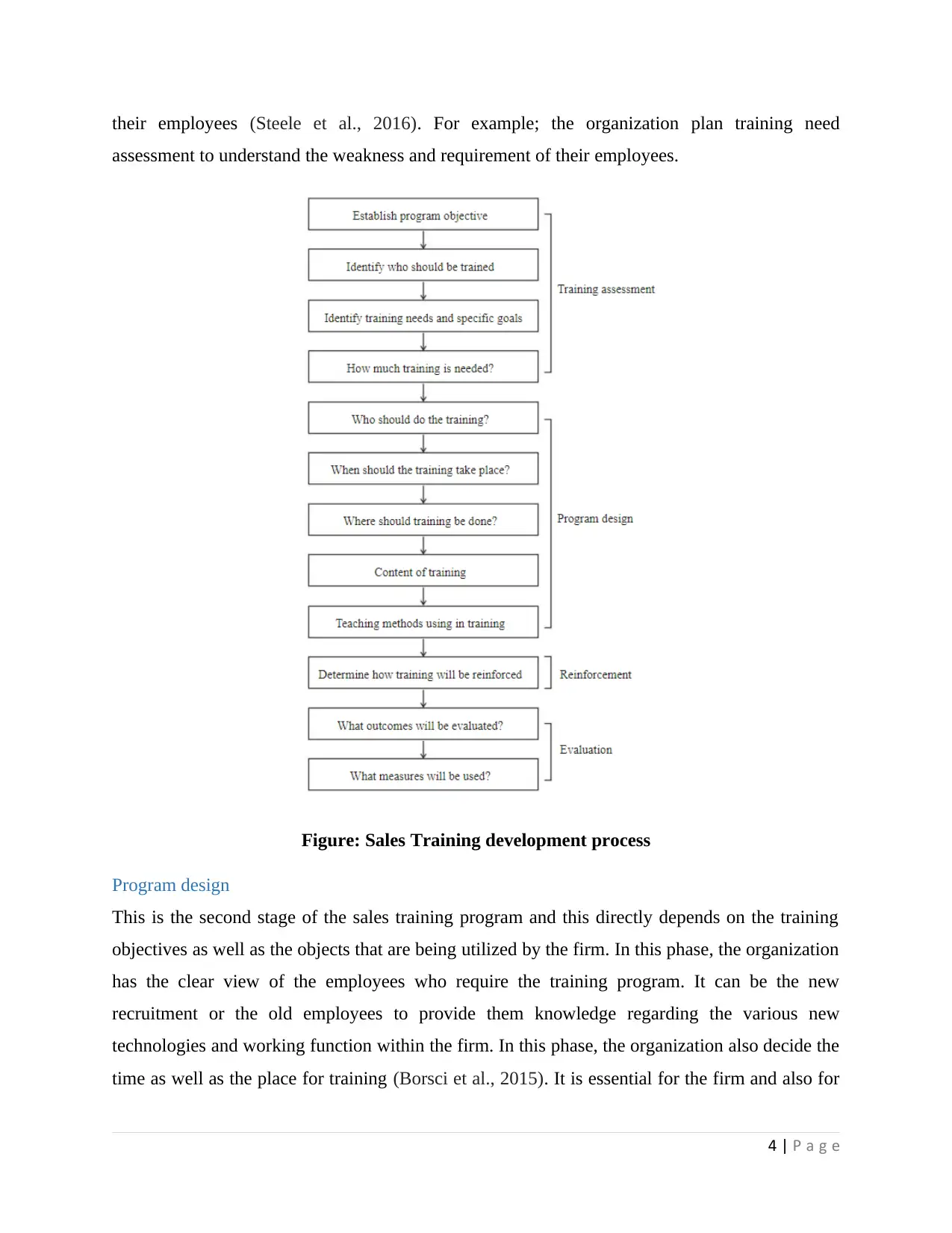
their employees (Steele et al., 2016). For example; the organization plan training need
assessment to understand the weakness and requirement of their employees.
Figure: Sales Training development process
Program design
This is the second stage of the sales training program and this directly depends on the training
objectives as well as the objects that are being utilized by the firm. In this phase, the organization
has the clear view of the employees who require the training program. It can be the new
recruitment or the old employees to provide them knowledge regarding the various new
technologies and working function within the firm. In this phase, the organization also decide the
time as well as the place for training (Borsci et al., 2015). It is essential for the firm and also for
4 | P a g e
assessment to understand the weakness and requirement of their employees.
Figure: Sales Training development process
Program design
This is the second stage of the sales training program and this directly depends on the training
objectives as well as the objects that are being utilized by the firm. In this phase, the organization
has the clear view of the employees who require the training program. It can be the new
recruitment or the old employees to provide them knowledge regarding the various new
technologies and working function within the firm. In this phase, the organization also decide the
time as well as the place for training (Borsci et al., 2015). It is essential for the firm and also for
4 | P a g e
the employees to have suitable training time and place that would help both the organization and
the employees without creating any kind of issues. The organization also discuss and prepare
suitable content for the sales training program (Badrinarayanan et al., 2015). It is essential to
have a suitable along with that effective sales training program for the salesperson to deal with
the various issues within the market. Furthermore, in this phase, it also decides regarding the
participative training method as well as the non-participative training method of the sales
program. In the participative training method it can be seen that the role play, then the case study
along with the on-job training is involved (Luna et al., 2018). In the non-participative training
method, the organization provides off-the-job training along with lectures, videos as well as the
guest speakers for the salesperson within the firm. In the training program, it is also essential to
maintain specific approach for providing the individual needs of the salesperson.
Reinforcement
Sales training program is not enough for having the suitable impact on the behavior of the staff
members within the organization. It is essential for the sales training program to have a suitable
and effective follow-up plan for the employees of the company. It can be depicted that without
the appropriate post-training skill, the knowledge that is being acquired from the training
program will get reduced after 14 months (Sager et al., 2014). The fact is that sales training
program is for a time being and after the end of the program most of the employees forget about
this process. It is essential for the organization to reinforce the entire method within the
organization for maintaining the skill and the knowledge of the salesperson within the firm. The
way of the refreshing class is the effective way by which the sales training effort can be
reinforced by the employees of the firm (Wotruba, & Simpson, 2015). For example; the business
use post-training classes to monitor the activeness of the employees within the firm. This is the
process where the managers and the team members have the ability to maintain their working
function within the organization top provide suitable and effective skill for the firm. This is being
used for reinforcing of the learning process so that the salesperson did not forget any of the
things that are being taught within the sales training program.
Evaluation
This is the final stage of the sales training program and it is necessary to step for the executives
of the organization to maintain the value of the training program as well as improve the design
5 | P a g e
the employees without creating any kind of issues. The organization also discuss and prepare
suitable content for the sales training program (Badrinarayanan et al., 2015). It is essential to
have a suitable along with that effective sales training program for the salesperson to deal with
the various issues within the market. Furthermore, in this phase, it also decides regarding the
participative training method as well as the non-participative training method of the sales
program. In the participative training method it can be seen that the role play, then the case study
along with the on-job training is involved (Luna et al., 2018). In the non-participative training
method, the organization provides off-the-job training along with lectures, videos as well as the
guest speakers for the salesperson within the firm. In the training program, it is also essential to
maintain specific approach for providing the individual needs of the salesperson.
Reinforcement
Sales training program is not enough for having the suitable impact on the behavior of the staff
members within the organization. It is essential for the sales training program to have a suitable
and effective follow-up plan for the employees of the company. It can be depicted that without
the appropriate post-training skill, the knowledge that is being acquired from the training
program will get reduced after 14 months (Sager et al., 2014). The fact is that sales training
program is for a time being and after the end of the program most of the employees forget about
this process. It is essential for the organization to reinforce the entire method within the
organization for maintaining the skill and the knowledge of the salesperson within the firm. The
way of the refreshing class is the effective way by which the sales training effort can be
reinforced by the employees of the firm (Wotruba, & Simpson, 2015). For example; the business
use post-training classes to monitor the activeness of the employees within the firm. This is the
process where the managers and the team members have the ability to maintain their working
function within the organization top provide suitable and effective skill for the firm. This is being
used for reinforcing of the learning process so that the salesperson did not forget any of the
things that are being taught within the sales training program.
Evaluation
This is the final stage of the sales training program and it is necessary to step for the executives
of the organization to maintain the value of the training program as well as improve the design
5 | P a g e
⊘ This is a preview!⊘
Do you want full access?
Subscribe today to unlock all pages.
Trusted by 1+ million students worldwide
that must be utilized for the future training program within the organization. Moreover, it can be
seen that almost 30 percent of the organization does not have suitable training evaluation process
for the firm (Holden, 2016). This is due to the facts that conducting the training evaluation is the
investment of more time and money that most of the organization did not wish to perform.
Furthermore, it can also be seen that there are various other difficulties that have to be
encountered due to the valuation of the sales training program. The other difficulties are the
managerial perception, then the evaluation restriction, methodological shortcoming as well as the
little of the empirical evidence (Ren et al., 2018). The Kirkpatrick model of the sales training
program is generally used by the organization to maintain their valuation process. The model
involves four different level of the training evaluation and they are a reaction, learning, behavior
and the results (Kirkpatrick, & Kirkpatrick, 2016). For example; the business in the present day
use the Kirkpatrick model of the sales training program to provide suitable training evaluation
for the employees. The entire process of the valuation within the training program is essential for
the organization to maintain their activity in the market and to provide effective knowledge
within the firm regarding the sales training skill of the salesperson.
Conclusion and Recommendations
The paper eventually concludes the facts that the training is essential for the firm to maintain
their sales performance within the market. The entire process within the sales training program
needs to be utilized by the organization for the successful completion of the training program
within the market. The paper also concludes the facts that the organization need to have effective
sales training evaluation and another process to develop a suitable training program for the
salesperson of the organization. Consequently, it became difficult for the organization to develop
the effective sales training program within the firm and for that suitable suggestion is required to
be followed by the organization. It is recommended that company need to perform the suitable
training need assessment for understanding the weakness of the salesperson along with the
weakness of the firm. It is also recommended that the sales training program within the
organization need to be provided to the salesperson as well as to the non-sales person also. It is
also recommended that the organization need to develop effective training evaluation tool for the
firm to maintain the employees and the sales training program within the organization.
6 | P a g e
seen that almost 30 percent of the organization does not have suitable training evaluation process
for the firm (Holden, 2016). This is due to the facts that conducting the training evaluation is the
investment of more time and money that most of the organization did not wish to perform.
Furthermore, it can also be seen that there are various other difficulties that have to be
encountered due to the valuation of the sales training program. The other difficulties are the
managerial perception, then the evaluation restriction, methodological shortcoming as well as the
little of the empirical evidence (Ren et al., 2018). The Kirkpatrick model of the sales training
program is generally used by the organization to maintain their valuation process. The model
involves four different level of the training evaluation and they are a reaction, learning, behavior
and the results (Kirkpatrick, & Kirkpatrick, 2016). For example; the business in the present day
use the Kirkpatrick model of the sales training program to provide suitable training evaluation
for the employees. The entire process of the valuation within the training program is essential for
the organization to maintain their activity in the market and to provide effective knowledge
within the firm regarding the sales training skill of the salesperson.
Conclusion and Recommendations
The paper eventually concludes the facts that the training is essential for the firm to maintain
their sales performance within the market. The entire process within the sales training program
needs to be utilized by the organization for the successful completion of the training program
within the market. The paper also concludes the facts that the organization need to have effective
sales training evaluation and another process to develop a suitable training program for the
salesperson of the organization. Consequently, it became difficult for the organization to develop
the effective sales training program within the firm and for that suitable suggestion is required to
be followed by the organization. It is recommended that company need to perform the suitable
training need assessment for understanding the weakness of the salesperson along with the
weakness of the firm. It is also recommended that the sales training program within the
organization need to be provided to the salesperson as well as to the non-sales person also. It is
also recommended that the organization need to develop effective training evaluation tool for the
firm to maintain the employees and the sales training program within the organization.
6 | P a g e
Paraphrase This Document
Need a fresh take? Get an instant paraphrase of this document with our AI Paraphraser
Future of sales training program
The world is changing and also the market trend and in this situation, the sales are evolving
rapidly within the market. This is one of the best ways by which the organization can expand
their brand image and also grab the attention of the customers. Due to this, the sales training
program has become essential for the salesperson and also for the organization. This in future
will help the salesperson to acquire knowledge on the satisfaction level of the customers and also
on the process by which an effective sales is being performed. The future of this training
program is quite well as this eventually allow the firm to maintain their employees and the skill
of working function within the market. It can be seen that with the use of sales training program
the organization in the future market can have the ability to develop their working skill and their
impact on the firm regarding the various process. In future, the sales training program will also
be provided by the usage of internet and other media to eventually have the low cost of the
training program.
7 | P a g e
The world is changing and also the market trend and in this situation, the sales are evolving
rapidly within the market. This is one of the best ways by which the organization can expand
their brand image and also grab the attention of the customers. Due to this, the sales training
program has become essential for the salesperson and also for the organization. This in future
will help the salesperson to acquire knowledge on the satisfaction level of the customers and also
on the process by which an effective sales is being performed. The future of this training
program is quite well as this eventually allow the firm to maintain their employees and the skill
of working function within the market. It can be seen that with the use of sales training program
the organization in the future market can have the ability to develop their working skill and their
impact on the firm regarding the various process. In future, the sales training program will also
be provided by the usage of internet and other media to eventually have the low cost of the
training program.
7 | P a g e
References
Alvarez, C. M., Taylor, K. A., & Rauseo, N. A. (2015). Creating thoughtful salespeople:
Experiential learning to improve critical thinking skills in traditional and online sales
education. Marketing Education Review, 25(3), 233-243.
Badrinarayanan, V., Dixon, A., West, V. L., & Zank, G. M. (2015). Professional sales coaching:
an integrative review and research agenda. European Journal of Marketing, 49(7/8),
1087-1113.
Borsci, S., Lawson, G., & Broome, S. (2015). Empirical evidence, evaluation criteria and
challenges for the effectiveness of virtual and mixed reality tools for training operators of
car service maintenance. Computers in Industry, 67, 17-26.
Ford, J. K. (2014). Improving training effectiveness in work organizations. Psychology Press.
Gardner, A. K., Diesen, D. L., Hogg, D., & Huerta, S. (2016). The impact of goal setting and
goal orientation on performance during a clerkship surgical skills training program. The
American Journal of Surgery, 211(2), 321-325.
Holden, J. (2016). Elevating the sales profession: what sellers crave and sales managers need for
success. Industrial and Commercial Training, 48(4), 194-198.
Ingram, T. N., LaForge, R. W., Williams, M. R., & Schwepker Jr, C. H. (2015). Sales
management: Analysis and decision making. Routledge.
Johnston, M. W., & Marshall, G. W. (2016). Salesforce management: Leadership, innovation,
technology. Routledge.
Kirkpatrick, J. D., & Kirkpatrick, W. K. (2016). Kirkpatrick's four levels of training evaluation.
Association for Talent Development.
Luna, N. M. S., Lucareli, P. R. G., Sales, V. C., Speciali, D., Alonso, A. C., Peterson, M. D., ...
& Greve, J. M. D. A. (2018). Treadmill training in Parkinson's patients after deep brain
stimulation: Effects on gait kinematics. NeuroRehabilitation, 42(2), 149-158.
Pierce, D., & Irwin, R. (2016). Competency assessment for entry-level sport ticket sales
professionals. Journal of Applied Sports Management, 8(2).
8 | P a g e
Alvarez, C. M., Taylor, K. A., & Rauseo, N. A. (2015). Creating thoughtful salespeople:
Experiential learning to improve critical thinking skills in traditional and online sales
education. Marketing Education Review, 25(3), 233-243.
Badrinarayanan, V., Dixon, A., West, V. L., & Zank, G. M. (2015). Professional sales coaching:
an integrative review and research agenda. European Journal of Marketing, 49(7/8),
1087-1113.
Borsci, S., Lawson, G., & Broome, S. (2015). Empirical evidence, evaluation criteria and
challenges for the effectiveness of virtual and mixed reality tools for training operators of
car service maintenance. Computers in Industry, 67, 17-26.
Ford, J. K. (2014). Improving training effectiveness in work organizations. Psychology Press.
Gardner, A. K., Diesen, D. L., Hogg, D., & Huerta, S. (2016). The impact of goal setting and
goal orientation on performance during a clerkship surgical skills training program. The
American Journal of Surgery, 211(2), 321-325.
Holden, J. (2016). Elevating the sales profession: what sellers crave and sales managers need for
success. Industrial and Commercial Training, 48(4), 194-198.
Ingram, T. N., LaForge, R. W., Williams, M. R., & Schwepker Jr, C. H. (2015). Sales
management: Analysis and decision making. Routledge.
Johnston, M. W., & Marshall, G. W. (2016). Salesforce management: Leadership, innovation,
technology. Routledge.
Kirkpatrick, J. D., & Kirkpatrick, W. K. (2016). Kirkpatrick's four levels of training evaluation.
Association for Talent Development.
Luna, N. M. S., Lucareli, P. R. G., Sales, V. C., Speciali, D., Alonso, A. C., Peterson, M. D., ...
& Greve, J. M. D. A. (2018). Treadmill training in Parkinson's patients after deep brain
stimulation: Effects on gait kinematics. NeuroRehabilitation, 42(2), 149-158.
Pierce, D., & Irwin, R. (2016). Competency assessment for entry-level sport ticket sales
professionals. Journal of Applied Sports Management, 8(2).
8 | P a g e
⊘ This is a preview!⊘
Do you want full access?
Subscribe today to unlock all pages.
Trusted by 1+ million students worldwide
Ren, Z., Dong, D., Li, H., & Chen, C. (2018). Self-Paced Prioritized Curriculum Learning With
Coverage Penalty in Deep Reinforcement Learning. IEEE Transactions on Neural
Networks and Learning Systems.
Sager, J. K., Dubinsky, A. J., Wilson, P. H., & Shao, C. (2014). Factors influencing the impact of
sales training: Test of a model. International Journal of Marketing Studies, 6(1), 1.
Singh, V. L., Manrai, A. K., & Manrai, L. A. (2015). Sales training: A state of the art and
contemporary review. Journal of Economics, Finance and Administrative
Science, 20(38), 54-71.
Steele, L. M., Mulhearn, T. J., Medeiros, K. E., Watts, L. L., Connelly, S., & Mumford, M. D.
(2016). How do we know what works? A review and critique of current practices in
ethics training evaluation. Accountability in research, 23(6), 319-350.
Wotruba, T. R., & Simpson, E. K. (2015). The selling cycle: A unifying guide for sales
management decisions. In Proceedings of the 1990 Academy of Marketing Science
(AMS) Annual Conference (pp. 81-84). Springer, Cham.
9 | P a g e
Coverage Penalty in Deep Reinforcement Learning. IEEE Transactions on Neural
Networks and Learning Systems.
Sager, J. K., Dubinsky, A. J., Wilson, P. H., & Shao, C. (2014). Factors influencing the impact of
sales training: Test of a model. International Journal of Marketing Studies, 6(1), 1.
Singh, V. L., Manrai, A. K., & Manrai, L. A. (2015). Sales training: A state of the art and
contemporary review. Journal of Economics, Finance and Administrative
Science, 20(38), 54-71.
Steele, L. M., Mulhearn, T. J., Medeiros, K. E., Watts, L. L., Connelly, S., & Mumford, M. D.
(2016). How do we know what works? A review and critique of current practices in
ethics training evaluation. Accountability in research, 23(6), 319-350.
Wotruba, T. R., & Simpson, E. K. (2015). The selling cycle: A unifying guide for sales
management decisions. In Proceedings of the 1990 Academy of Marketing Science
(AMS) Annual Conference (pp. 81-84). Springer, Cham.
9 | P a g e

1 out of 10


Related Documents


Your All-in-One AI-Powered Toolkit for Academic Success.
+13062052269
info@desklib.com
Available 24*7 on WhatsApp / Email
![[object Object]](/_next/static/media/star-bottom.7253800d.svg)
Unlock your academic potential
Copyright © 2020–2026 A2Z Services. All Rights Reserved. Developed and managed by ZUCOL.