Comprehensive Business Analysis Report: Samsara Tea House, London
VerifiedAdded on 2023/01/17
|5
|786
|43
Report
AI Summary
This report provides a comprehensive business analysis of Samsara Tea House, a London-based tea house. It begins with a SWOT analysis, identifying the company's strengths (experience, contracts, product variety), weaknesses (brand recognition, customer segmentation), opportunities (brand building, global expansion, green marketing), and threats (supplier dependence, competition). The report then presents a PESTLE analysis, examining political (duty, tax rates), economic (disposable incomes), social (demographics), technological (equipment), legal (food standards), and environmental (sustainable practices) factors. Finally, a stakeholder map is included, categorizing stakeholders based on their power and interest levels, including kitchen staff, shift supervisors, tea brewers, and the proprietor and general manager. The report concludes with a list of cited references.
Business and
Management
Management
Paraphrase This Document
Need a fresh take? Get an instant paraphrase of this document with our AI Paraphraser

Table of Contents
MAIN BODY...................................................................................................................................1
SWOT Analysis..........................................................................................................................1
PESTLE Analysis........................................................................................................................1
Stake holder's Map......................................................................................................................2
REFERENCES................................................................................................................................3
MAIN BODY...................................................................................................................................1
SWOT Analysis..........................................................................................................................1
PESTLE Analysis........................................................................................................................1
Stake holder's Map......................................................................................................................2
REFERENCES................................................................................................................................3

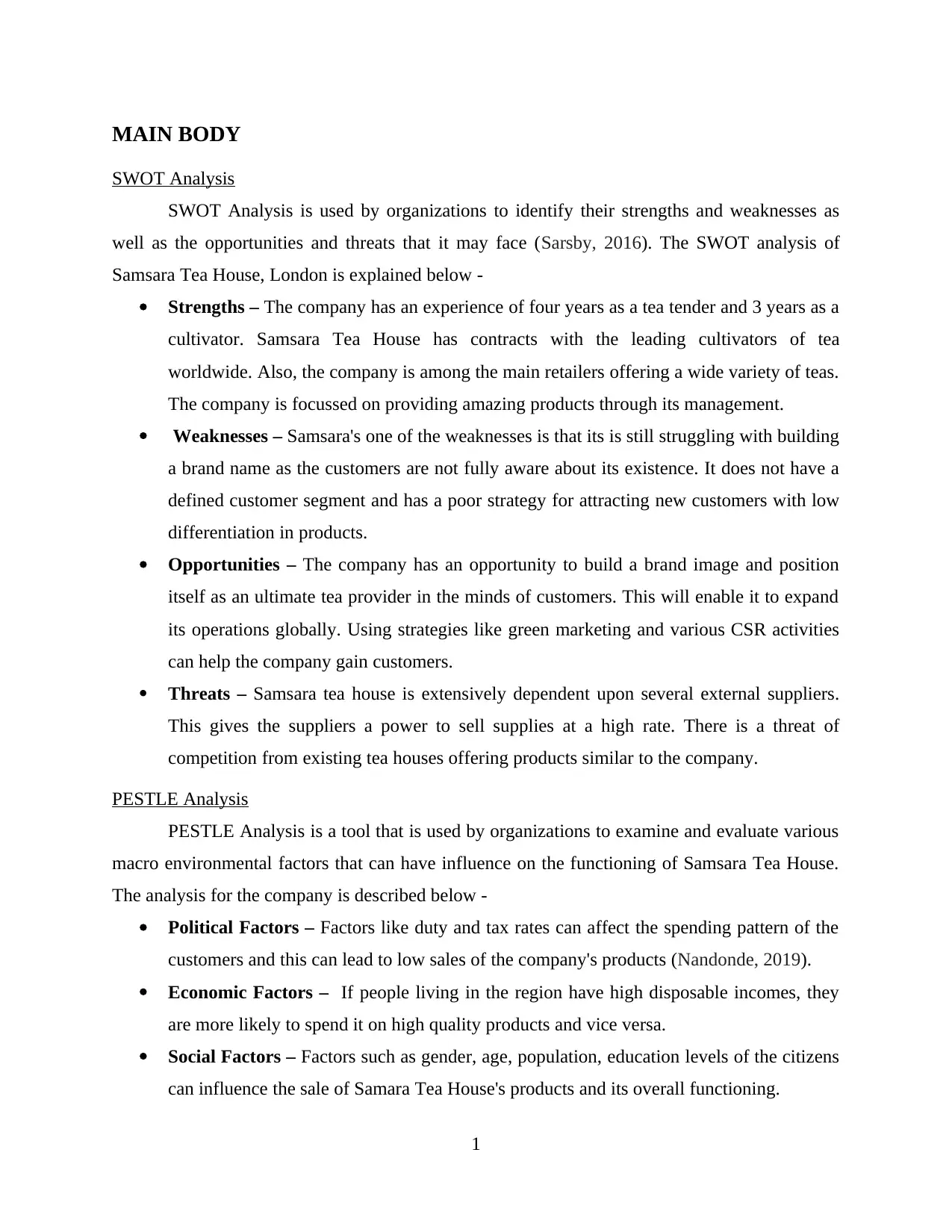
MAIN BODY
SWOT Analysis
SWOT Analysis is used by organizations to identify their strengths and weaknesses as
well as the opportunities and threats that it may face (Sarsby, 2016). The SWOT analysis of
Samsara Tea House, London is explained below -
Strengths – The company has an experience of four years as a tea tender and 3 years as a
cultivator. Samsara Tea House has contracts with the leading cultivators of tea
worldwide. Also, the company is among the main retailers offering a wide variety of teas.
The company is focussed on providing amazing products through its management.
Weaknesses – Samsara's one of the weaknesses is that its is still struggling with building
a brand name as the customers are not fully aware about its existence. It does not have a
defined customer segment and has a poor strategy for attracting new customers with low
differentiation in products.
Opportunities – The company has an opportunity to build a brand image and position
itself as an ultimate tea provider in the minds of customers. This will enable it to expand
its operations globally. Using strategies like green marketing and various CSR activities
can help the company gain customers.
Threats – Samsara tea house is extensively dependent upon several external suppliers.
This gives the suppliers a power to sell supplies at a high rate. There is a threat of
competition from existing tea houses offering products similar to the company.
PESTLE Analysis
PESTLE Analysis is a tool that is used by organizations to examine and evaluate various
macro environmental factors that can have influence on the functioning of Samsara Tea House.
The analysis for the company is described below -
Political Factors – Factors like duty and tax rates can affect the spending pattern of the
customers and this can lead to low sales of the company's products (Nandonde, 2019).
Economic Factors – If people living in the region have high disposable incomes, they
are more likely to spend it on high quality products and vice versa.
Social Factors – Factors such as gender, age, population, education levels of the citizens
can influence the sale of Samara Tea House's products and its overall functioning.
1
SWOT Analysis
SWOT Analysis is used by organizations to identify their strengths and weaknesses as
well as the opportunities and threats that it may face (Sarsby, 2016). The SWOT analysis of
Samsara Tea House, London is explained below -
Strengths – The company has an experience of four years as a tea tender and 3 years as a
cultivator. Samsara Tea House has contracts with the leading cultivators of tea
worldwide. Also, the company is among the main retailers offering a wide variety of teas.
The company is focussed on providing amazing products through its management.
Weaknesses – Samsara's one of the weaknesses is that its is still struggling with building
a brand name as the customers are not fully aware about its existence. It does not have a
defined customer segment and has a poor strategy for attracting new customers with low
differentiation in products.
Opportunities – The company has an opportunity to build a brand image and position
itself as an ultimate tea provider in the minds of customers. This will enable it to expand
its operations globally. Using strategies like green marketing and various CSR activities
can help the company gain customers.
Threats – Samsara tea house is extensively dependent upon several external suppliers.
This gives the suppliers a power to sell supplies at a high rate. There is a threat of
competition from existing tea houses offering products similar to the company.
PESTLE Analysis
PESTLE Analysis is a tool that is used by organizations to examine and evaluate various
macro environmental factors that can have influence on the functioning of Samsara Tea House.
The analysis for the company is described below -
Political Factors – Factors like duty and tax rates can affect the spending pattern of the
customers and this can lead to low sales of the company's products (Nandonde, 2019).
Economic Factors – If people living in the region have high disposable incomes, they
are more likely to spend it on high quality products and vice versa.
Social Factors – Factors such as gender, age, population, education levels of the citizens
can influence the sale of Samara Tea House's products and its overall functioning.
1
⊘ This is a preview!⊘
Do you want full access?
Subscribe today to unlock all pages.

Trusted by 1+ million students worldwide

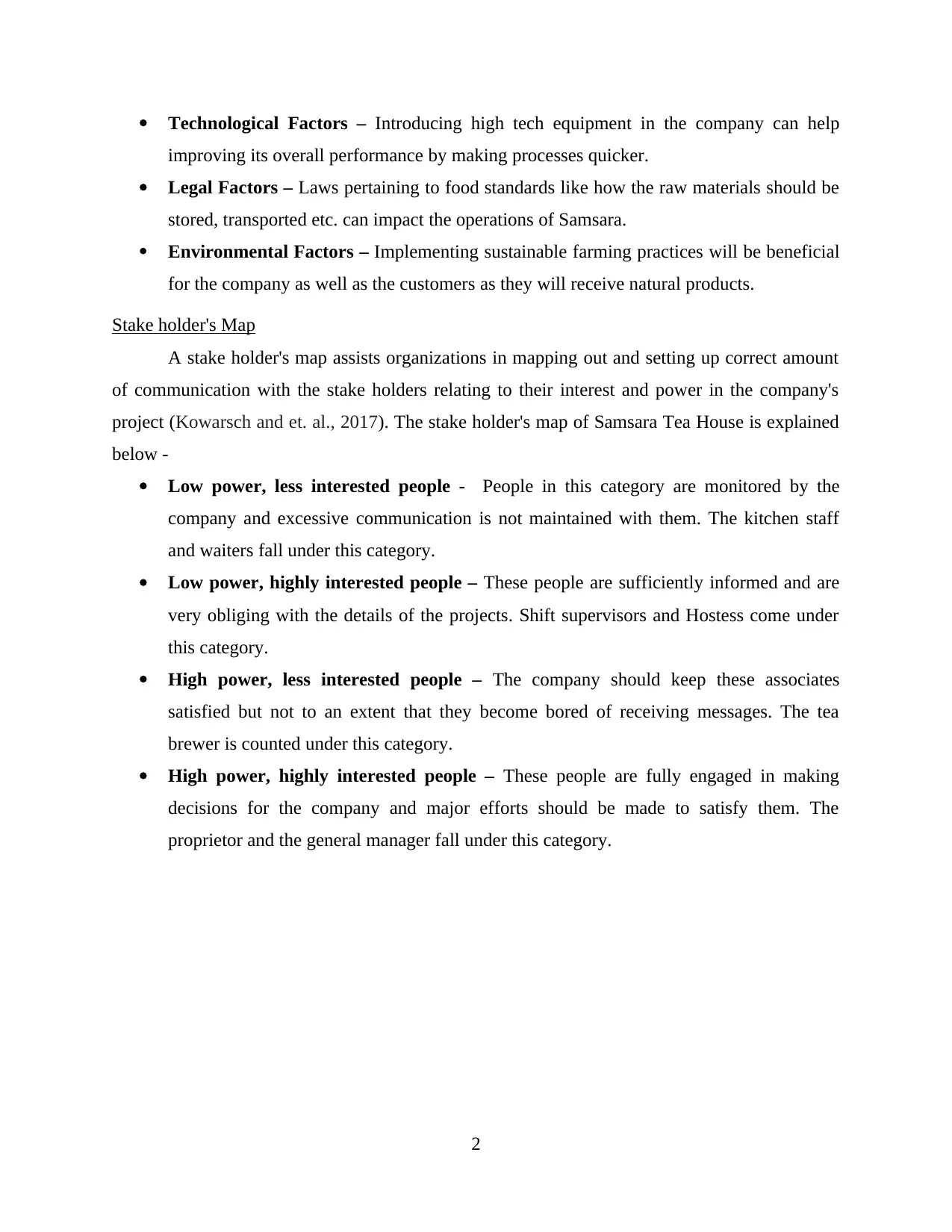
Technological Factors – Introducing high tech equipment in the company can help
improving its overall performance by making processes quicker.
Legal Factors – Laws pertaining to food standards like how the raw materials should be
stored, transported etc. can impact the operations of Samsara.
Environmental Factors – Implementing sustainable farming practices will be beneficial
for the company as well as the customers as they will receive natural products.
Stake holder's Map
A stake holder's map assists organizations in mapping out and setting up correct amount
of communication with the stake holders relating to their interest and power in the company's
project (Kowarsch and et. al., 2017). The stake holder's map of Samsara Tea House is explained
below -
Low power, less interested people - People in this category are monitored by the
company and excessive communication is not maintained with them. The kitchen staff
and waiters fall under this category.
Low power, highly interested people – These people are sufficiently informed and are
very obliging with the details of the projects. Shift supervisors and Hostess come under
this category.
High power, less interested people – The company should keep these associates
satisfied but not to an extent that they become bored of receiving messages. The tea
brewer is counted under this category.
High power, highly interested people – These people are fully engaged in making
decisions for the company and major efforts should be made to satisfy them. The
proprietor and the general manager fall under this category.
2
improving its overall performance by making processes quicker.
Legal Factors – Laws pertaining to food standards like how the raw materials should be
stored, transported etc. can impact the operations of Samsara.
Environmental Factors – Implementing sustainable farming practices will be beneficial
for the company as well as the customers as they will receive natural products.
Stake holder's Map
A stake holder's map assists organizations in mapping out and setting up correct amount
of communication with the stake holders relating to their interest and power in the company's
project (Kowarsch and et. al., 2017). The stake holder's map of Samsara Tea House is explained
below -
Low power, less interested people - People in this category are monitored by the
company and excessive communication is not maintained with them. The kitchen staff
and waiters fall under this category.
Low power, highly interested people – These people are sufficiently informed and are
very obliging with the details of the projects. Shift supervisors and Hostess come under
this category.
High power, less interested people – The company should keep these associates
satisfied but not to an extent that they become bored of receiving messages. The tea
brewer is counted under this category.
High power, highly interested people – These people are fully engaged in making
decisions for the company and major efforts should be made to satisfy them. The
proprietor and the general manager fall under this category.
2
Paraphrase This Document
Need a fresh take? Get an instant paraphrase of this document with our AI Paraphraser

REFERENCES
Books & Journals
Kowarsch, M. and et. al., 2017. A road map for global environmental assessments. Nature
Climate Change. 7(6). p.379.
Nandonde, F. A., 2019. A PESTLE analysis of international retailing in the East African
Community. Global Business and Organizational Excellence. 38(4). pp.54-61.
Sarsby, A., 2016. SWOT analysis. Lulu. Com.
3
Books & Journals
Kowarsch, M. and et. al., 2017. A road map for global environmental assessments. Nature
Climate Change. 7(6). p.379.
Nandonde, F. A., 2019. A PESTLE analysis of international retailing in the East African
Community. Global Business and Organizational Excellence. 38(4). pp.54-61.
Sarsby, A., 2016. SWOT analysis. Lulu. Com.
3
1 out of 5
Related Documents
Your All-in-One AI-Powered Toolkit for Academic Success.
+13062052269
info@desklib.com
Available 24*7 on WhatsApp / Email
Unlock your academic potential
Copyright © 2020–2025 A2Z Services. All Rights Reserved. Developed and managed by ZUCOL.