Smartphone Market: Product Redesigning Impact on Customer Satisfaction
VerifiedAdded on 2023/02/01
|13
|3391
|67
Report
AI Summary
This report delves into the strategic importance of product redesigning in the highly competitive smartphone market, with a specific focus on its impact on customer satisfaction, sales volume, and profit generation. The research uses Samsung Electronics as a key case study, analyzing how the company leverages product redesigning to maintain its market leadership. The report explores the roles of engineering managers, the relationship between product enhancements and customer experience, and the challenges faced by smaller companies in keeping up with the pace of innovation. The methodology involves a qualitative approach, utilizing secondary data sources such as articles, journals, and company websites to establish a comprehensive understanding of the topic. The study aims to answer critical research questions regarding the effectiveness of product redesigning in enhancing profit generation and customer satisfaction within the ICT sector. The report also considers the broader implications of global competition and the strategies employed by major players to stay ahead in the market.
Running head: SMART PHONE MARKET COMPETITION
Product Redesigning and Customer Satisfaction
Name of the Student:
Name of the University:
Author Note:
Product Redesigning and Customer Satisfaction
Name of the Student:
Name of the University:
Author Note:

Paraphrase This Document
Need a fresh take? Get an instant paraphrase of this document with our AI Paraphraser
1
SMART PHONE MARKET COMPETITION
Table of Contents
Chapter 1. Introduction:...................................................................................................................2
1.0. Research background:...........................................................................................................2
1.1. Research rationale:................................................................................................................3
1.2. Research aim:........................................................................................................................3
1.3. Research question:....................................................................................................................3
Chapter 2. Preliminary literature review:........................................................................................4
2.0. Product re-designing:............................................................................................................4
2.1. Roles of engineering managers in redesigning products:.....................................................5
2.3. Profit, sales generation and product redesigning:.................................................................5
2.4. Product redesigning and global competition:.......................................................................6
Chapter 3. Research methods:.........................................................................................................7
3.0. Research philosophy, design and approaches:......................................................................7
3.1. Proposed data collection method:.............................................................................................7
3.2. Data analysis:............................................................................................................................9
3.3. Ethics and Limitation:...............................................................................................................9
4.0. Gantt chart schedule:................................................................................................................9
References:....................................................................................................................................11
SMART PHONE MARKET COMPETITION
Table of Contents
Chapter 1. Introduction:...................................................................................................................2
1.0. Research background:...........................................................................................................2
1.1. Research rationale:................................................................................................................3
1.2. Research aim:........................................................................................................................3
1.3. Research question:....................................................................................................................3
Chapter 2. Preliminary literature review:........................................................................................4
2.0. Product re-designing:............................................................................................................4
2.1. Roles of engineering managers in redesigning products:.....................................................5
2.3. Profit, sales generation and product redesigning:.................................................................5
2.4. Product redesigning and global competition:.......................................................................6
Chapter 3. Research methods:.........................................................................................................7
3.0. Research philosophy, design and approaches:......................................................................7
3.1. Proposed data collection method:.............................................................................................7
3.2. Data analysis:............................................................................................................................9
3.3. Ethics and Limitation:...............................................................................................................9
4.0. Gantt chart schedule:................................................................................................................9
References:....................................................................................................................................11
2
SMART PHONE MARKET COMPETITION
Chapter 1. Introduction:
Redesigning of products has emerged into a competitive strategies multinational
companies use to hold their position in the global market. Redesigning of smart phones and
adding new features enhance their attractiveness and appeal consumers which enable them to
earn higher revenues. The company which would form the crux of the research would the
world’s largest smart phone manufacturer by market penetration, Samsung Electronics Limited.
Samsung Electronics Company Limited is the electronics arm of the business conglomerate
Samsung Group based in South Korea. The company is listed on Korea Exchange (KRX) and
leads the world in terms of smart phones. It is this capacity to redesign smart phones as per the
needs of the customers which has earned the company top position in the global market and
attributes it with high profits. Thus it is evident from the discussion that the global competition is
an issue which Samsung faces in the smart phone market which in turn necessitates it to redesign
its existing smart phone models to retain its top position.
1.0. Research background:
The background of the research would be provided by the pressing need which global
ICT companies to sustain in the market-product redesigning their existing products to make more
high-end smart phones available to customers. The international smart phone manufacturers
usually provide advanced advanced models of smart phones at high prices. These high priced
electronic devices usually stay beyond the reach of the middle and lower class customers
forming the majority of customer base demanding smart phones. This huge gap between demand
and supply of high end smart phones are capitalized by local smart firms which provide smart
phone models having the same features of the high-end smart phone models. However, these low
cost smart phone companies fail to maintain the quality parameters. The international smart
SMART PHONE MARKET COMPETITION
Chapter 1. Introduction:
Redesigning of products has emerged into a competitive strategies multinational
companies use to hold their position in the global market. Redesigning of smart phones and
adding new features enhance their attractiveness and appeal consumers which enable them to
earn higher revenues. The company which would form the crux of the research would the
world’s largest smart phone manufacturer by market penetration, Samsung Electronics Limited.
Samsung Electronics Company Limited is the electronics arm of the business conglomerate
Samsung Group based in South Korea. The company is listed on Korea Exchange (KRX) and
leads the world in terms of smart phones. It is this capacity to redesign smart phones as per the
needs of the customers which has earned the company top position in the global market and
attributes it with high profits. Thus it is evident from the discussion that the global competition is
an issue which Samsung faces in the smart phone market which in turn necessitates it to redesign
its existing smart phone models to retain its top position.
1.0. Research background:
The background of the research would be provided by the pressing need which global
ICT companies to sustain in the market-product redesigning their existing products to make more
high-end smart phones available to customers. The international smart phone manufacturers
usually provide advanced advanced models of smart phones at high prices. These high priced
electronic devices usually stay beyond the reach of the middle and lower class customers
forming the majority of customer base demanding smart phones. This huge gap between demand
and supply of high end smart phones are capitalized by local smart firms which provide smart
phone models having the same features of the high-end smart phone models. However, these low
cost smart phone companies fail to maintain the quality parameters. The international smart
⊘ This is a preview!⊘
Do you want full access?
Subscribe today to unlock all pages.

Trusted by 1+ million students worldwide
3
SMART PHONE MARKET COMPETITION
companies capitalize on this gap of quality to redesign their existing models to provide more
advanced models at no extra price. Product redesigning strategies which global smart phone
companies use today have revolutionized the smart phone market. The base of the research
would be provided by the product redesigning and the impact it has on the sales as well as profit
generation of these companies.
1.1. Research rationale:
The research rationale would be the issues of sales and revenue generation which global
smart phone companies face. The rationale would also show how the strategy of product
redesigning is assisting the smart phone companies to deal with these issues.
1.2. Research aim:
The aim of the topic would be to visit the role of redesigning of products in ensuring high
sales volume and profits.
1.3. Research question:
The main question which the research would aim to answer is:
Does product redesigning enhance profit generation in ICT companies?
The secondary question which the research would aim to answer is:
Does product redesigning enhance customer satisfaction?
SMART PHONE MARKET COMPETITION
companies capitalize on this gap of quality to redesign their existing models to provide more
advanced models at no extra price. Product redesigning strategies which global smart phone
companies use today have revolutionized the smart phone market. The base of the research
would be provided by the product redesigning and the impact it has on the sales as well as profit
generation of these companies.
1.1. Research rationale:
The research rationale would be the issues of sales and revenue generation which global
smart phone companies face. The rationale would also show how the strategy of product
redesigning is assisting the smart phone companies to deal with these issues.
1.2. Research aim:
The aim of the topic would be to visit the role of redesigning of products in ensuring high
sales volume and profits.
1.3. Research question:
The main question which the research would aim to answer is:
Does product redesigning enhance profit generation in ICT companies?
The secondary question which the research would aim to answer is:
Does product redesigning enhance customer satisfaction?
Paraphrase This Document
Need a fresh take? Get an instant paraphrase of this document with our AI Paraphraser
4
SMART PHONE MARKET COMPETITION
Chapter 2. Preliminary literature review:
The literature review would delve into the topic by acquiring and analyzing data obtained
from secondary sources. The secondary sources of data would be articles, journals, newspapers
and relevant websites.
2.0. Product re-designing:
Tran and Park (2016) defines the term product redesigning the the process in which
companies re-design or modify their existing products to suit the needs of the market. Kumar et
al. (2018) define the term product re-designing the entire process which business organisations
carry out to make their existing products meet more needs of the customers by adding new
features to them. Thus, the term product re-designing on analyzing the definitions of the two sets
of authors can be interpreted as the entire process which business organizations take to modify
their existing products to suit the needs of the customers. Andrei et al. (2015) contributes to the
discussion by pointed out that product re-designing enables business organizations to bring about
advancements within their existing both terms of hardware and software. This advancement
enables the products to play more roles and thus enable the customers to satisfy a wider ambit of
needs compared to products which have not undergone re-designing. Lin et al. (2017) strengthen
the discussion by pointing out redesigning of products enhance the experiences which customers
feel by using newer versions of products. This analysis shows that product re-designing enable
companies to enhance their customer experience which encourage customers to remain loyal to
the business organisations owning the concerned products. Samsung Electronics Limited being
the largest manufacturer of smart phones keep on introducing redesigned versions of its existing
smart phone models which are more aligned to the needs of the customers. Thus, it is evident
SMART PHONE MARKET COMPETITION
Chapter 2. Preliminary literature review:
The literature review would delve into the topic by acquiring and analyzing data obtained
from secondary sources. The secondary sources of data would be articles, journals, newspapers
and relevant websites.
2.0. Product re-designing:
Tran and Park (2016) defines the term product redesigning the the process in which
companies re-design or modify their existing products to suit the needs of the market. Kumar et
al. (2018) define the term product re-designing the entire process which business organisations
carry out to make their existing products meet more needs of the customers by adding new
features to them. Thus, the term product re-designing on analyzing the definitions of the two sets
of authors can be interpreted as the entire process which business organizations take to modify
their existing products to suit the needs of the customers. Andrei et al. (2015) contributes to the
discussion by pointed out that product re-designing enables business organizations to bring about
advancements within their existing both terms of hardware and software. This advancement
enables the products to play more roles and thus enable the customers to satisfy a wider ambit of
needs compared to products which have not undergone re-designing. Lin et al. (2017) strengthen
the discussion by pointing out redesigning of products enhance the experiences which customers
feel by using newer versions of products. This analysis shows that product re-designing enable
companies to enhance their customer experience which encourage customers to remain loyal to
the business organisations owning the concerned products. Samsung Electronics Limited being
the largest manufacturer of smart phones keep on introducing redesigned versions of its existing
smart phone models which are more aligned to the needs of the customers. Thus, it is evident
5
SMART PHONE MARKET COMPETITION
from the discussion the product redesigning enables the company in generating more sales and
revenue in the global market. This is evident from the global position of Samsung.
2.1. Roles of engineering managers in redesigning products:
Salazar, Lelah and Brissaud (2015) point out that the skilled engineering managers are
responsible for the high quality product redesigning at Samsung. Schoenwitz, et al. (2017)
mention that the continuous research which the engineering managers conduct are responsible
for introduction of redesigned products which are more aligned with the customers’
requirements. As far as Samsung Electronics Limited is concerned, it can be pointed out that
Korean multinational company has offices in several markets like the US, the UK, China and
India. Moreover, the company partners with research and development laboratories all the world
to conduct open innovation in its smart phone products. Thus, the company is able to bring about
disruptive innovation to introduce new models of smart phones. Thus, it is evident that R&D
plays a very crucial role in redesigning the models of smart phones which ultimately enables the
company generate huge sales and revenue.
2.3. Profit, sales generation and product redesigning:
Customer satisfaction is directly proportional to product redesigning. Shrivastava (2016)
in this respect point out redesigning of products enable the companies to enhance customer
satisfaction. The smart phone companies today use the strategy of redesigning their existing
products to enhance customer satisfaction. Yassine and Naoum-Sawaya (2017) opine that this
integration of consumer satisfaction and product redesigning requires immense investments from
the side of the companies. This is because manufacturing of advanced high-end products like
smart phone require companies to invest immense amount of capital into carrying out continuous
research to develop advanced versions of smart phones. Lindskog et al. (2016) add to the opinion
SMART PHONE MARKET COMPETITION
from the discussion the product redesigning enables the company in generating more sales and
revenue in the global market. This is evident from the global position of Samsung.
2.1. Roles of engineering managers in redesigning products:
Salazar, Lelah and Brissaud (2015) point out that the skilled engineering managers are
responsible for the high quality product redesigning at Samsung. Schoenwitz, et al. (2017)
mention that the continuous research which the engineering managers conduct are responsible
for introduction of redesigned products which are more aligned with the customers’
requirements. As far as Samsung Electronics Limited is concerned, it can be pointed out that
Korean multinational company has offices in several markets like the US, the UK, China and
India. Moreover, the company partners with research and development laboratories all the world
to conduct open innovation in its smart phone products. Thus, the company is able to bring about
disruptive innovation to introduce new models of smart phones. Thus, it is evident that R&D
plays a very crucial role in redesigning the models of smart phones which ultimately enables the
company generate huge sales and revenue.
2.3. Profit, sales generation and product redesigning:
Customer satisfaction is directly proportional to product redesigning. Shrivastava (2016)
in this respect point out redesigning of products enable the companies to enhance customer
satisfaction. The smart phone companies today use the strategy of redesigning their existing
products to enhance customer satisfaction. Yassine and Naoum-Sawaya (2017) opine that this
integration of consumer satisfaction and product redesigning requires immense investments from
the side of the companies. This is because manufacturing of advanced high-end products like
smart phone require companies to invest immense amount of capital into carrying out continuous
research to develop advanced versions of smart phones. Lindskog et al. (2016) add to the opinion
⊘ This is a preview!⊘
Do you want full access?
Subscribe today to unlock all pages.
Trusted by 1+ million students worldwide
6
SMART PHONE MARKET COMPETITION
that product redesigning requires smart phone companies to invest immense amount of capital to
acquire talented and skilled engineers from all round the world. Thus, it can be pointed out that
this investment in R&D and talent acquisition ultimately leads to high sale generation and
resultant revenue generation. Engel, Browning and Reich (2017) though did not contradict the
opinion of the previous authors, point out that smaller smart phone companies with their
respective markets restricted to small regions cannot mobilise the immense amount of capital the
multinational companies can. They in order to boost their sales have to depend on other
strategies like promoting their products more aggressively in the market. Thus, it can be inferred
from the discussion that multinational smart phone giants like Samsung are able to redesign their
smart phone products according to the needs of the consumers. However, smaller smart phone
companies cannot afford to redesign their smart phones on regular basis due to their limited
capital. Yet, the link between product redesigning and generation of sales as well as revenue
cannot be denied.
2.4. Product redesigning and global competition:
Product redesigning plays a very significant role in achieving high global
competitiveness which in turn stands on the two variables sales generation and revenue
generation. According to Fan and Yang (2016) the proliferation of smart phone companies in the
global market has created an immense competition for revenue generation and sales generation.
The local smart phone companies are able to provide more features in their smart phone models
at lower costs which are finding acceptance among the middle and lower class customers, both of
which constitute majority of the smart phone user’s base (Gehani, 2016). However, these smart
phone companies in order to keep their production cost low, often compromise on their quality
parameters. The low quality smart phones have been reported to swell up, get overheated and
SMART PHONE MARKET COMPETITION
that product redesigning requires smart phone companies to invest immense amount of capital to
acquire talented and skilled engineers from all round the world. Thus, it can be pointed out that
this investment in R&D and talent acquisition ultimately leads to high sale generation and
resultant revenue generation. Engel, Browning and Reich (2017) though did not contradict the
opinion of the previous authors, point out that smaller smart phone companies with their
respective markets restricted to small regions cannot mobilise the immense amount of capital the
multinational companies can. They in order to boost their sales have to depend on other
strategies like promoting their products more aggressively in the market. Thus, it can be inferred
from the discussion that multinational smart phone giants like Samsung are able to redesign their
smart phone products according to the needs of the consumers. However, smaller smart phone
companies cannot afford to redesign their smart phones on regular basis due to their limited
capital. Yet, the link between product redesigning and generation of sales as well as revenue
cannot be denied.
2.4. Product redesigning and global competition:
Product redesigning plays a very significant role in achieving high global
competitiveness which in turn stands on the two variables sales generation and revenue
generation. According to Fan and Yang (2016) the proliferation of smart phone companies in the
global market has created an immense competition for revenue generation and sales generation.
The local smart phone companies are able to provide more features in their smart phone models
at lower costs which are finding acceptance among the middle and lower class customers, both of
which constitute majority of the smart phone user’s base (Gehani, 2016). However, these smart
phone companies in order to keep their production cost low, often compromise on their quality
parameters. The low quality smart phones have been reported to swell up, get overheated and
Paraphrase This Document
Need a fresh take? Get an instant paraphrase of this document with our AI Paraphraser
7
SMART PHONE MARKET COMPETITION
even explode, thus attracting operational risks for the users. This is where the multinational
global companies like Samsung Electronics step in. The challenge which the low cost smart
phone companies throw before their MNC counterparts. Samsung utilizes this gap between
quality and cost of smart phones manufactured by smaller smart phone companies to redesign its
existing products to incorporate new features and offer them at no extra costs (Salazar, Lelah &
Brissaud, 2015). Thus, it is evident from this discussion that redesigning enables Samsung to
market advanced smart phone models without raising the price. Thus, Samsung is able to retain
its customer base and in fact attract customers from its local counterparts. This capability of
retaining its present customers and poaching customers from its smaller counterparts is
responsible for the high revenue and sales generation which Samsung boasts. Thus, it is clear
from the discussion that competitive strategy, product redesigning, sales and revenue generation
are directly proportional.
Chapter 3. Research methods:
3.0. Research philosophy, design and approaches:
The aim of the study is to establish the relationship between smart phone redesigning and
sales volume generation. The appropriate research philosophy which would be made use in the
research would be positivity theory. The research plan would involve systematic and orderly
analysis of various secondary sources so that a large volume of data can be accumulated to carry
on the research. The following is the research plan which would be considered to carry on the
research:
3.1. Proposed data collection method:
The research would be based on secondary sources of data which would be collected
from different sources and analyzed. The methodology to be used would be qualitative data. The
SMART PHONE MARKET COMPETITION
even explode, thus attracting operational risks for the users. This is where the multinational
global companies like Samsung Electronics step in. The challenge which the low cost smart
phone companies throw before their MNC counterparts. Samsung utilizes this gap between
quality and cost of smart phones manufactured by smaller smart phone companies to redesign its
existing products to incorporate new features and offer them at no extra costs (Salazar, Lelah &
Brissaud, 2015). Thus, it is evident from this discussion that redesigning enables Samsung to
market advanced smart phone models without raising the price. Thus, Samsung is able to retain
its customer base and in fact attract customers from its local counterparts. This capability of
retaining its present customers and poaching customers from its smaller counterparts is
responsible for the high revenue and sales generation which Samsung boasts. Thus, it is clear
from the discussion that competitive strategy, product redesigning, sales and revenue generation
are directly proportional.
Chapter 3. Research methods:
3.0. Research philosophy, design and approaches:
The aim of the study is to establish the relationship between smart phone redesigning and
sales volume generation. The appropriate research philosophy which would be made use in the
research would be positivity theory. The research plan would involve systematic and orderly
analysis of various secondary sources so that a large volume of data can be accumulated to carry
on the research. The following is the research plan which would be considered to carry on the
research:
3.1. Proposed data collection method:
The research would be based on secondary sources of data which would be collected
from different sources and analyzed. The methodology to be used would be qualitative data. The
8
SMART PHONE MARKET COMPETITION
data would involve data about product redesigning and its impact of sales volume with Samsung
as the example. This approach can be justified on the ground that in order to carry an in depth
research into the topic selected, the researcher would require to collect a vast body of historical
data. The historical data like past redesigning of smart phones undertaken by a company and
impact of the redesigning on the revenue generation (Johnston, 2017). This it is clear that the
research would require study of several pieces of past new on smart redesigning. Similarly,
formation of a profound literature review would require analysis of several journal, articles and
books. This need of immense body of secondary data required to conduct the research
successfully can only be satiated by qualitative analysis (Walliman, 2017). Thus, it is justified
that the most appropriate approach to carry on the research would be qualitative approach.
The secondary sources which would be used to gain information would be articles,
books, magazines and newspapers. The secondary sources of data would also consist of online
sources of information like official website of companies like Samsung. The research would
heavily take information from the official website of the MNC under consideration namely,
Samsung Electronics Company Limited. The variables for the research would be product
redesigning, profit generation and customer satisfaction (Kannothra, Manning & Haigh, 2018).
The research approach which would be used is descriptive research design. The choice of
the research can be justified on the grounds that the topic of product designing requires in depth
secondary analysis which would be served by descriptive research design.
3.2. Data analysis:
The data analysis would involve thorough analysis of the data collected from the
secondary data. The data would be presented in an orderly and coherent manner. This is because
SMART PHONE MARKET COMPETITION
data would involve data about product redesigning and its impact of sales volume with Samsung
as the example. This approach can be justified on the ground that in order to carry an in depth
research into the topic selected, the researcher would require to collect a vast body of historical
data. The historical data like past redesigning of smart phones undertaken by a company and
impact of the redesigning on the revenue generation (Johnston, 2017). This it is clear that the
research would require study of several pieces of past new on smart redesigning. Similarly,
formation of a profound literature review would require analysis of several journal, articles and
books. This need of immense body of secondary data required to conduct the research
successfully can only be satiated by qualitative analysis (Walliman, 2017). Thus, it is justified
that the most appropriate approach to carry on the research would be qualitative approach.
The secondary sources which would be used to gain information would be articles,
books, magazines and newspapers. The secondary sources of data would also consist of online
sources of information like official website of companies like Samsung. The research would
heavily take information from the official website of the MNC under consideration namely,
Samsung Electronics Company Limited. The variables for the research would be product
redesigning, profit generation and customer satisfaction (Kannothra, Manning & Haigh, 2018).
The research approach which would be used is descriptive research design. The choice of
the research can be justified on the grounds that the topic of product designing requires in depth
secondary analysis which would be served by descriptive research design.
3.2. Data analysis:
The data analysis would involve thorough analysis of the data collected from the
secondary data. The data would be presented in an orderly and coherent manner. This is because
⊘ This is a preview!⊘
Do you want full access?
Subscribe today to unlock all pages.
Trusted by 1+ million students worldwide
9
SMART PHONE MARKET COMPETITION
the research would collection an immense mass of data including some pieces of data which
would be inappropriate. This means that the analysis would be require exclusion of a high
amount of inappropriate and unauthentic mass of data. This clearly means that the data analysis
would involve collection and analysis of a large mass of information to incorporate it into the
final research (Arnott, Lizama & Song, 2017).
The information required would be data on redesigning of smart phones which have
taken place in the past. The information would also include drawings from a vast body of
literature relating profit generation and customer satisfaction which companies can achieve by
redesigning of products (Walliman, 2017).
3.3. Ethics and Limitation:
The research would only consider acquiring data from secondary sources which are
reliable and authentic. The researcher would abstain from collecting unreliable data which is
unethical. The limitations faced during conducting the research pertains to limitedness of time.
The research could have been conducted in a better way had more time been available.
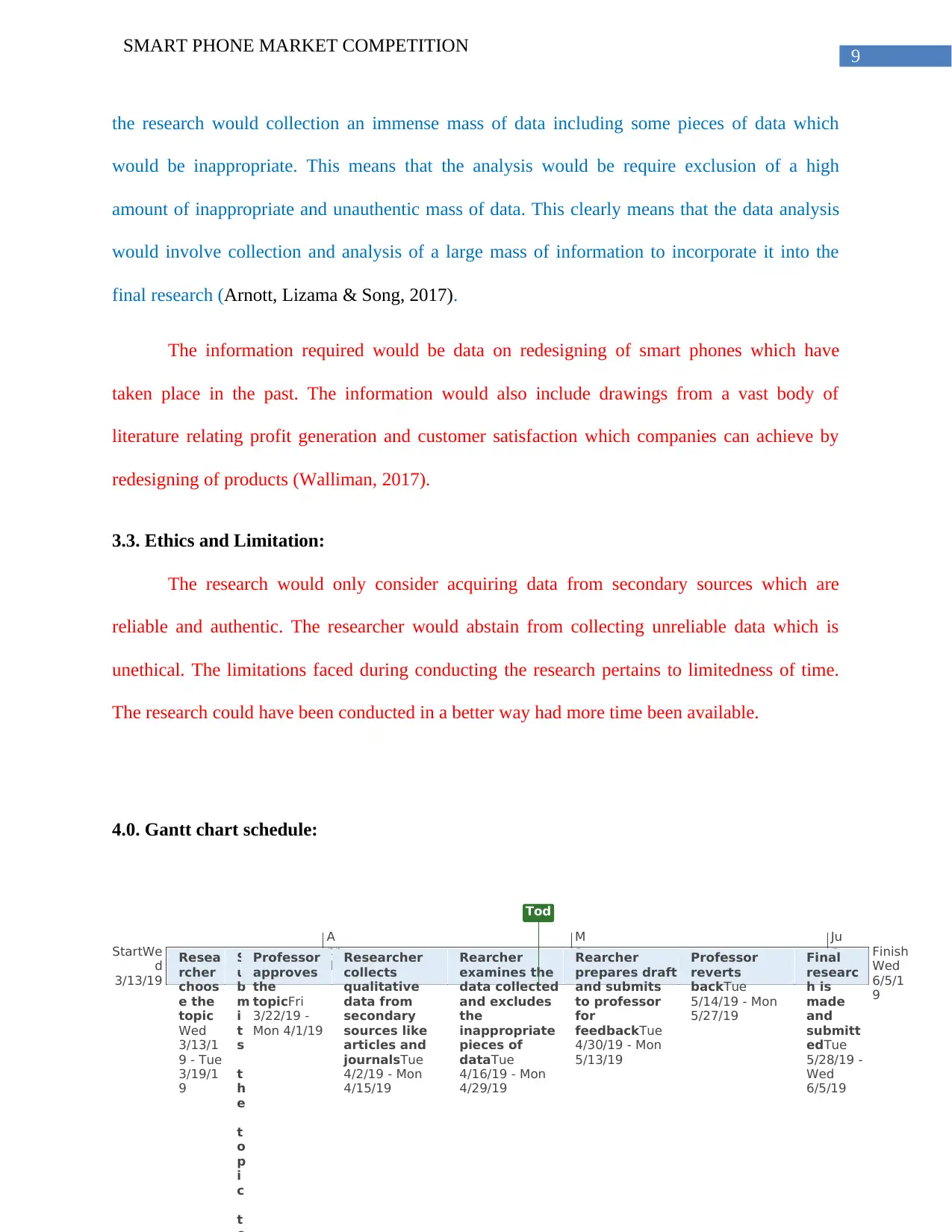
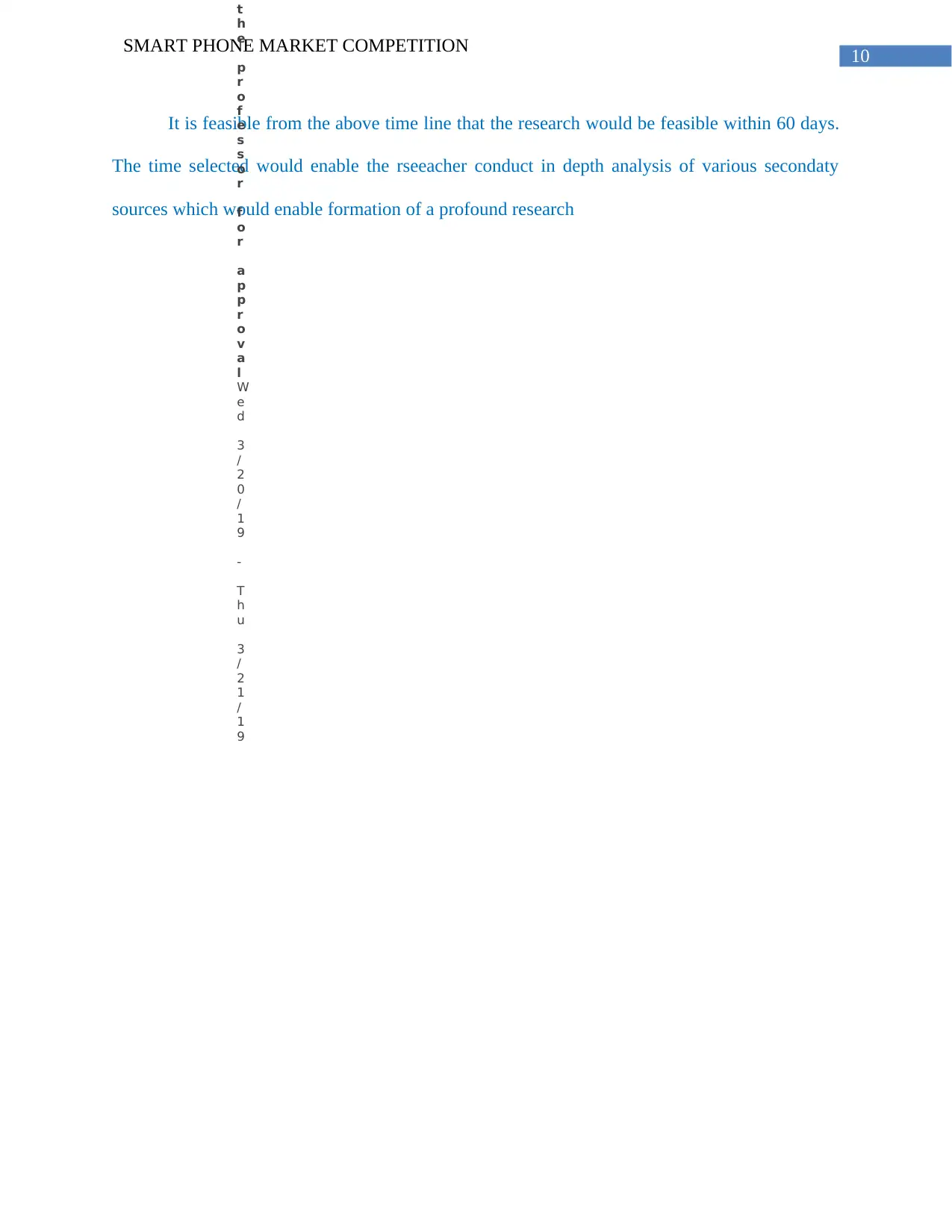
4.0. Gantt chart schedule:
StartWe
d
3/13/19
Finish
Wed
6/5/1
9
A
pr
il
M
a
y
Ju
n
e
Resea
rcher
choos
e the
topic
Wed
3/13/1
9 - Tue
3/19/1
9
S
u
b
m
i
t
s
t
h
e
t
o
p
i
c
t
Professor
approves
the
topicFri
3/22/19 -
Mon 4/1/19
Researcher
collects
qualitative
data from
secondary
sources like
articles and
journalsTue
4/2/19 - Mon
4/15/19
Rearcher
examines the
data collected
and excludes
the
inappropriate
pieces of
dataTue
4/16/19 - Mon
4/29/19
Rearcher
prepares draft
and submits
to professor
for
feedbackTue
4/30/19 - Mon
5/13/19
Professor
reverts
backTue
5/14/19 - Mon
5/27/19
Final
researc
h is
made
and
submitt
edTue
5/28/19 -
Wed
6/5/19
Tod
ay
SMART PHONE MARKET COMPETITION
the research would collection an immense mass of data including some pieces of data which
would be inappropriate. This means that the analysis would be require exclusion of a high
amount of inappropriate and unauthentic mass of data. This clearly means that the data analysis
would involve collection and analysis of a large mass of information to incorporate it into the
final research (Arnott, Lizama & Song, 2017).
The information required would be data on redesigning of smart phones which have
taken place in the past. The information would also include drawings from a vast body of
literature relating profit generation and customer satisfaction which companies can achieve by
redesigning of products (Walliman, 2017).
3.3. Ethics and Limitation:
The research would only consider acquiring data from secondary sources which are
reliable and authentic. The researcher would abstain from collecting unreliable data which is
unethical. The limitations faced during conducting the research pertains to limitedness of time.
The research could have been conducted in a better way had more time been available.
4.0. Gantt chart schedule:
StartWe
d
3/13/19
Finish
Wed
6/5/1
9
A
pr
il
M
a
y
Ju
n
e
Resea
rcher
choos
e the
topic
Wed
3/13/1
9 - Tue
3/19/1
9
S
u
b
m
i
t
s
t
h
e
t
o
p
i
c
t
Professor
approves
the
topicFri
3/22/19 -
Mon 4/1/19
Researcher
collects
qualitative
data from
secondary
sources like
articles and
journalsTue
4/2/19 - Mon
4/15/19
Rearcher
examines the
data collected
and excludes
the
inappropriate
pieces of
dataTue
4/16/19 - Mon
4/29/19
Rearcher
prepares draft
and submits
to professor
for
feedbackTue
4/30/19 - Mon
5/13/19
Professor
reverts
backTue
5/14/19 - Mon
5/27/19
Final
researc
h is
made
and
submitt
edTue
5/28/19 -
Wed
6/5/19
Tod
ay
Paraphrase This Document
Need a fresh take? Get an instant paraphrase of this document with our AI Paraphraser
10
SMART PHONE MARKET COMPETITION
It is feasible from the above time line that the research would be feasible within 60 days.
The time selected would enable the rseeacher conduct in depth analysis of various secondaty
sources which would enable formation of a profound research
t
h
e
p
r
o
f
e
s
s
o
r
f
o
r
a
p
p
r
o
v
a
l
W
e
d
3
/
2
0
/
1
9
-
T
h
u
3
/
2
1
/
1
9
SMART PHONE MARKET COMPETITION
It is feasible from the above time line that the research would be feasible within 60 days.
The time selected would enable the rseeacher conduct in depth analysis of various secondaty
sources which would enable formation of a profound research
t
h
e
p
r
o
f
e
s
s
o
r
f
o
r
a
p
p
r
o
v
a
l
W
e
d
3
/
2
0
/
1
9
-
T
h
u
3
/
2
1
/
1
9
11
SMART PHONE MARKET COMPETITION
References:
Andrei, A., Cristian, C., Alexandru, C., & Adrian, P. (2015). Redesigning a Product Using
Modern CAD-CAM Software. Procedia Technology, 19, 221-227.
Bressanelli, G., Perona, M., & Saccani, N. (2018). Challenges in supply chain redesign for the
Circular Economy: a literature review and a multiple case study. International Journal of
Production Research, 1-28.
Engel, A., Browning, T.R. & Reich, Y., 2017. Designing products for adaptability: insights from
four industrial cases. Decision Sciences, 48(5), pp.875-917.
Fan, Y., & Yang, C. (2016). Competition, product proliferation and welfare: A study of the us
smartphone market. Available at SSRN 2506423.
Gehani, R. R. (2016). Corporate brand value shifting from identity to innovation capability:
From Coca-Cola to Apple. Journal of technology management & innovation, 11(3), 11-
20.
Johnston, M. P. (2017). Secondary data analysis: A method of which the time has
come. Qualitative and quantitative methods in libraries, 3(3), 619-626.
Kannothra, C. G., Manning, S., & Haigh, N. (2018). How hybrids manage growth and social–
business tensions in global supply chains: The case of impact sourcing. Journal of
Business Ethics, 148(2), 271-290.
Kumar, L., Shuaib, M., Tanveer, Q., Kumar, V., Javaid, M., & Haleem, A. (2018). 3 D scanner
integration with product development. Int J Eng Technol, 7(2), 220-225.
SMART PHONE MARKET COMPETITION
References:
Andrei, A., Cristian, C., Alexandru, C., & Adrian, P. (2015). Redesigning a Product Using
Modern CAD-CAM Software. Procedia Technology, 19, 221-227.
Bressanelli, G., Perona, M., & Saccani, N. (2018). Challenges in supply chain redesign for the
Circular Economy: a literature review and a multiple case study. International Journal of
Production Research, 1-28.
Engel, A., Browning, T.R. & Reich, Y., 2017. Designing products for adaptability: insights from
four industrial cases. Decision Sciences, 48(5), pp.875-917.
Fan, Y., & Yang, C. (2016). Competition, product proliferation and welfare: A study of the us
smartphone market. Available at SSRN 2506423.
Gehani, R. R. (2016). Corporate brand value shifting from identity to innovation capability:
From Coca-Cola to Apple. Journal of technology management & innovation, 11(3), 11-
20.
Johnston, M. P. (2017). Secondary data analysis: A method of which the time has
come. Qualitative and quantitative methods in libraries, 3(3), 619-626.
Kannothra, C. G., Manning, S., & Haigh, N. (2018). How hybrids manage growth and social–
business tensions in global supply chains: The case of impact sourcing. Journal of
Business Ethics, 148(2), 271-290.
Kumar, L., Shuaib, M., Tanveer, Q., Kumar, V., Javaid, M., & Haleem, A. (2018). 3 D scanner
integration with product development. Int J Eng Technol, 7(2), 220-225.
⊘ This is a preview!⊘
Do you want full access?
Subscribe today to unlock all pages.
Trusted by 1+ million students worldwide

1 out of 13


Related Documents


Your All-in-One AI-Powered Toolkit for Academic Success.
+13062052269
info@desklib.com
Available 24*7 on WhatsApp / Email
![[object Object]](/_next/static/media/star-bottom.7253800d.svg)
Unlock your academic potential
Copyright © 2020–2026 A2Z Services. All Rights Reserved. Developed and managed by ZUCOL.