HI5015 Case Study: Legal Aspects of Sandline International v PNG

Verified

Added on  2023/06/04

|12
|896
|121
Case Study
AI Summary
This case study examines the legal dispute between Sandline International Inc. and Papua New Guinea (PNG) regarding a contract for military support. The core issue revolves around PNG's refusal to pay the outstanding amount, citing violations of internal laws. The case highlights arguments from both sides, focusing on the enforceability of the contract under international and domestic laws. The arbitral tribunal ruled in favor of Sandline, emphasizing the application of international law in contracts between states and private companies. The case underscores the importance of clearly defined governing laws in international contracts and the limitations of a state's ability to deny contract performance based on changes in domestic laws. The study includes the background of the case, arguments presented by both parties, the final decision, and its overall importance in the context of international trade and enterprise.
Document Page
Legal Aspects of
International
Trade & Enterprise
SANDLINE INTERNATIONAL INC. V PAPUA NEW
GUINEA
tabler-icon-diamond-filled.svg

Paraphrase This Document

Need a fresh take? Get an instant paraphrase of this document with our AI Paraphraser
Document Page
Background of the Case
In Sandline International Inc. v Papua New
Guinea case, the issue regarding payment of an
outstanding amount under a contract was
raised between parties.
The dispute arises between Sandline and PNG
after PNG refused to pay the outstanding sum
of money to Sandline as per the contract
(August, Mayer and Bixby, 2012).
Sandline demanded the money numerous times
after which a suit was brought before an
arbitration tribunal.
Document Page
Background of the Case
PNG argued that the contract is unlawful since
it was formed after violating the internal laws of
the country.
The contract contravened with the Constitution
and domestic laws of the country and the
provisions of international laws did not apply in
this case.
The judgement was given in favour of Sandline
by the arbitral tribunal based on the
international laws.
Document Page
Brief facts of the case
A contract was formed between Sandline and PNG for
giving military support to PNG.
As per the contract, US$18 million was paid at the
time of the contract and the rest US$18 million were
to be paid once the members of Sandline are
deployed.
Due to a mutiny, the government was overthrown
based on the information given by the chief of
Sandline.
The government of PNG denied repaying US$18
million by providing that the contract is unlawful since
it contravened with section 200 of the constitution
and other internal laws (Jell-Bahlsen and Jell, 2012).
tabler-icon-diamond-filled.svg

Paraphrase This Document

Need a fresh take? Get an instant paraphrase of this document with our AI Paraphraser
Document Page
Legal Issues presented
PNG argued that the contract is not enforceable
since it violated the constitution and other
domestic laws of the country.
PNG argued that it is not liable to pay the
outstanding money since the contract was
formed by the party who did not have the
authority to form such contract.
Sandline argued that PNG is liable under
international law; therefore, it is liable to pay
the outstanding money.
Document Page
Arguments of Parties
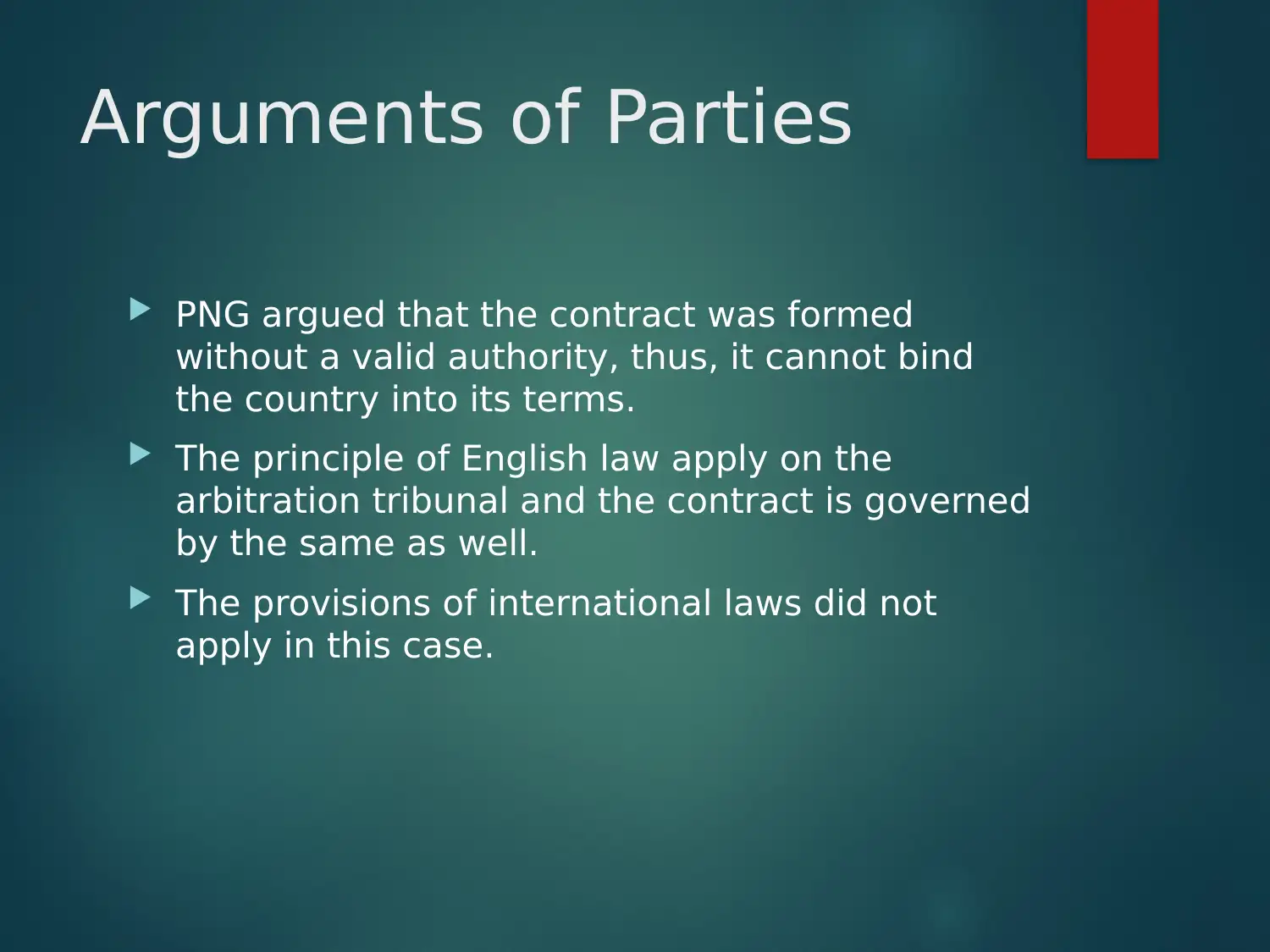
PNG argued that the contract was formed
without a valid authority, thus, it cannot bind
the country into its terms.
The principle of English law apply on the
arbitration tribunal and the contract is governed
by the same as well.
The provisions of international laws did not
apply in this case.
Document Page
Arguments of Parties
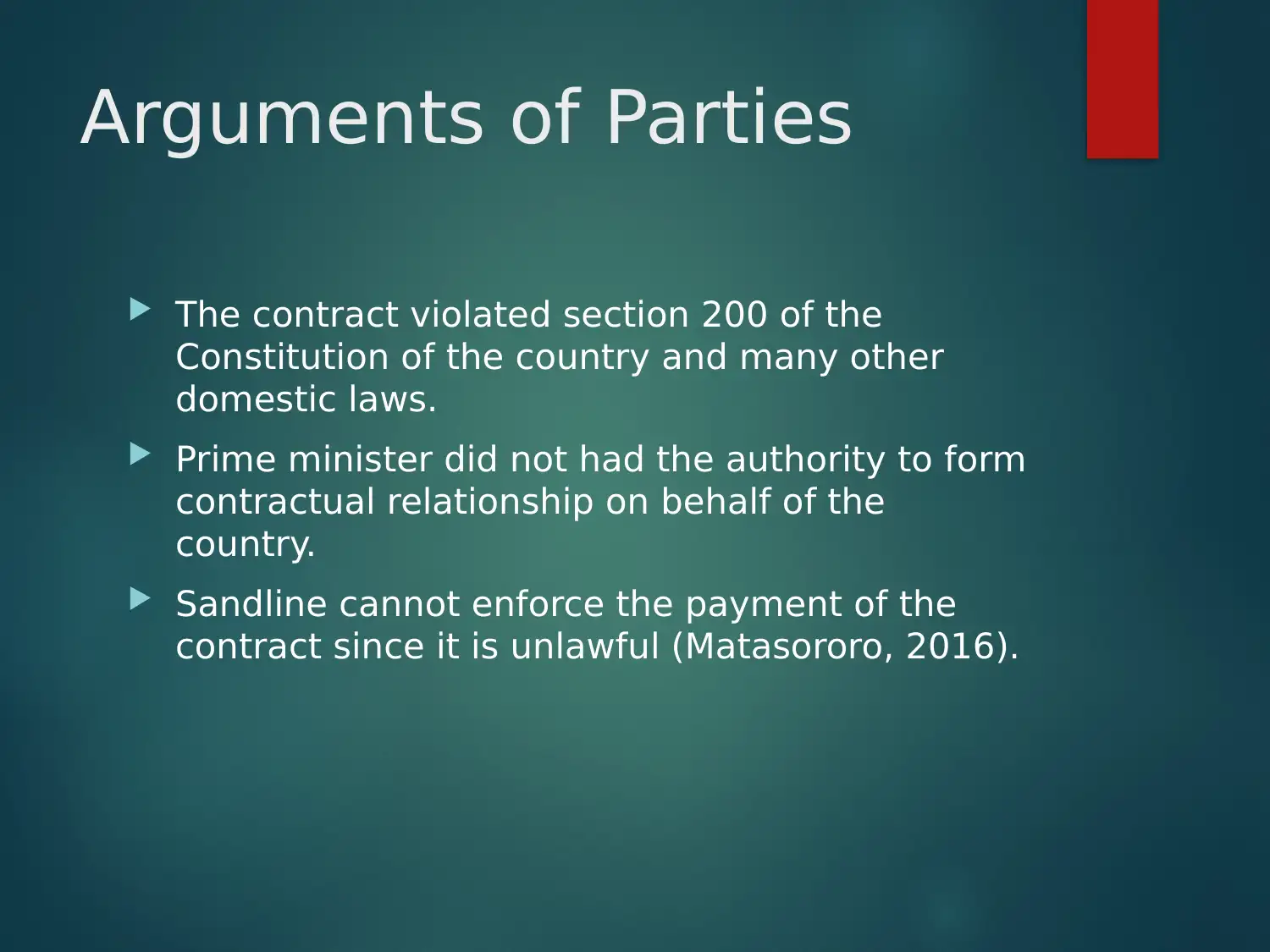
The contract violated section 200 of the
Constitution of the country and many other
domestic laws.
Prime minister did not had the authority to form
contractual relationship on behalf of the
country.
Sandline cannot enforce the payment of the
contract since it is unlawful (Matasororo, 2016).
tabler-icon-diamond-filled.svg

Paraphrase This Document

Need a fresh take? Get an instant paraphrase of this document with our AI Paraphraser
Document Page
Arguments of Parties
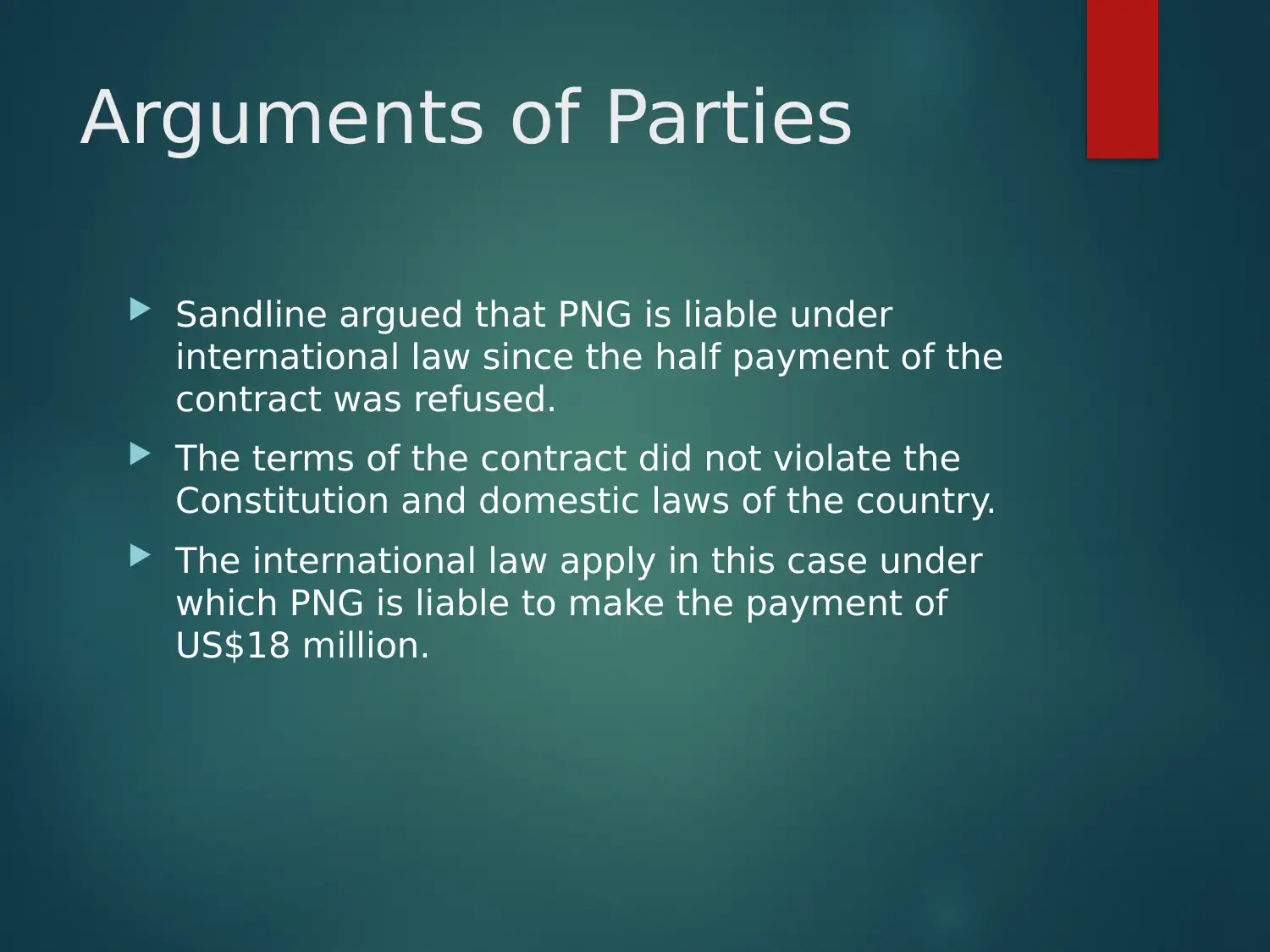
Sandline argued that PNG is liable under
international law since the half payment of the
contract was refused.
The terms of the contract did not violate the
Constitution and domestic laws of the country.
The international law apply in this case under
which PNG is liable to make the payment of
US$18 million.
Document Page
Decision
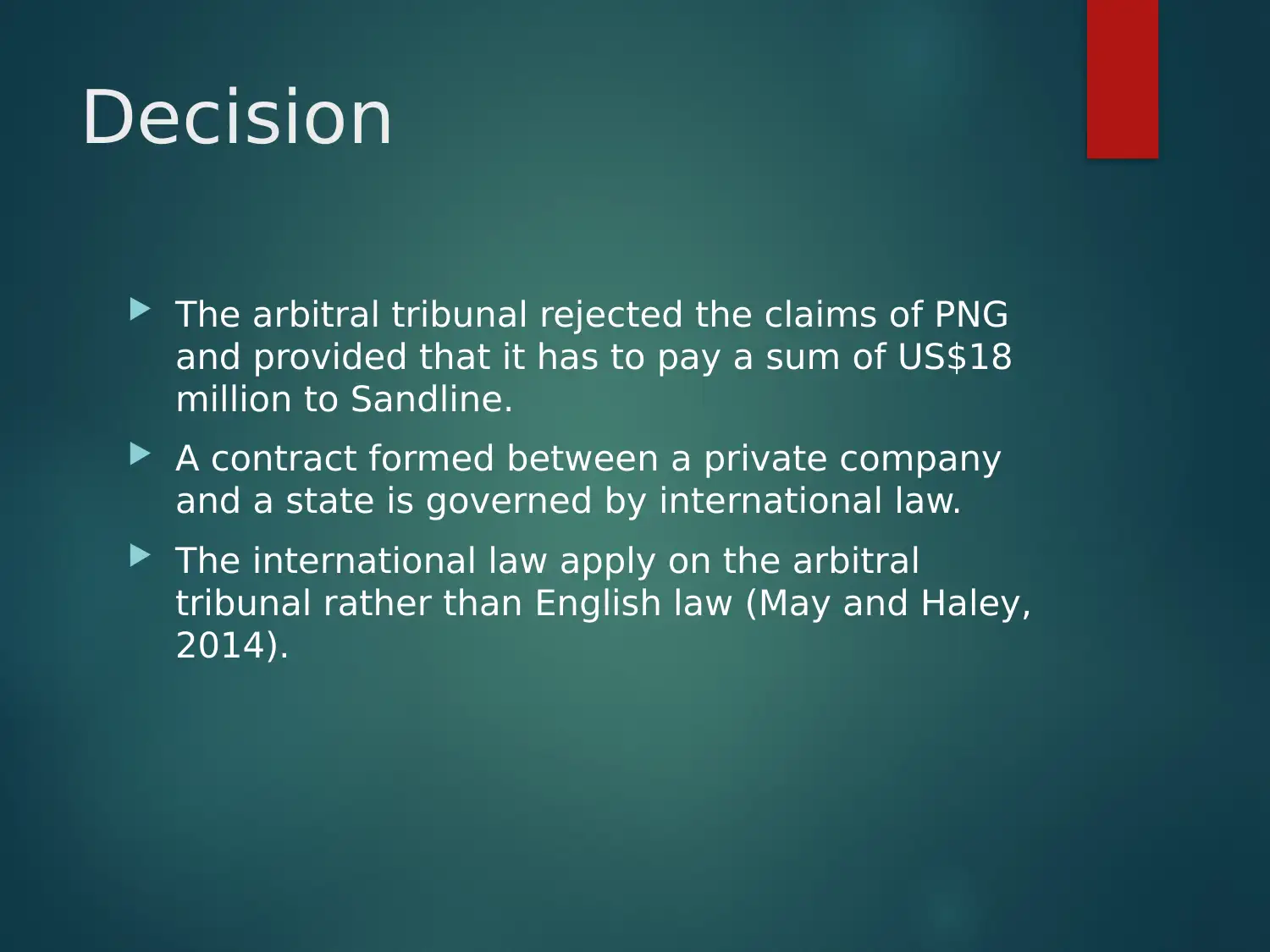
The arbitral tribunal rejected the claims of PNG
and provided that it has to pay a sum of US$18
million to Sandline.
A contract formed between a private company
and a state is governed by international law.
The international law apply on the arbitral
tribunal rather than English law (May and Haley,
2014).
Document Page
Decision
The country can change its internal laws, thus,
the contract formed with a private company are
governed by the international laws.
PNG agreed that it has partially completed the
performance of the contract and partial
performance is denied due to frustration.
Since the presence of a contract is admitted by
PNG, the country cannot refuse its performance,
thus, PNG is liable to pay US$18 million with
interest.
tabler-icon-diamond-filled.svg

Paraphrase This Document

Need a fresh take? Get an instant paraphrase of this document with our AI Paraphraser
Document Page
Importance of the case
This case highlights that a contract is governed
by international laws which is formed between
the state and a private company.
While forming the contract, the parties should
clearly define the law which governs their
agreement.
Since the state can change its internal laws, it
cannot deny the performance of a contract
based on contravention of domestic laws.
Document Page
References
Jell-Bahlsen, S. and Jell, G. (2012) The trans-national
gold curse of Papua New Guinea. Dialectical
Anthropology, 36(3-4), pp.317-341.
Matasororo, E. (2016) Standoff in Papua New
Guinea: Students take issue over corruption. Pacific
Journalism Review: Te Koakoa, 22(2), pp.13-19.
May, R.J. and Haley, N. (2014) The military in Papua
New Guinea: A ‘culture of instability’but no
coup. Security Challenges, 10(2), pp.53-70.
August, R.A., Mayer, D. and Bixby, M. (2012)
International Business Law. 6th ed. London: Pearson.
chevron_up_icon
1 out of 12
circle_padding
hide_on_mobile
zoom_out_icon
[object Object]