BAO6714 Semester T2 2019: Benefits of SAP S/4HANA in Accounting Report
VerifiedAdded on 2022/11/09
|15
|4093
|98
Report
AI Summary
This report provides a comprehensive overview of SAP S/4HANA, a next-generation business suite designed to overcome limitations of past systems. It begins with a historical overview of SAP S/4HANA and discusses the differences between SAP S/4HANA and the current SAP ERP FICO modules, highlighting their respective features and capabilities. The report then addresses the issues related to the use of Fiori (Apps) in contrast to traditional T-codes, including technological challenges and user experience concerns. Furthermore, it outlines the benefits of SAP S/4HANA for businesses, focusing on its finance capabilities, agility, reduced costs, and innovative features. Case studies of companies such as Hexaware and Revlon are used to demonstrate the practical advantages of SAP S/4HANA. The report concludes by summarizing the key findings and emphasizing the significance of SAP S/4HANA in the digital age, providing insights into its role in computerized accounting and reporting.

Running head: ACCOUNTING AND ERP
Accounting and ERP
Page 1
Accounting and ERP
Page 1

Paraphrase This Document
Need a fresh take? Get an instant paraphrase of this document with our AI Paraphraser
ACCOUNTING AND ERP
Table of Contents
1. Introduction........................................................................................................................3
1.1. Historical Overview.....................................................................................................3
2. Discussion..........................................................................................................................5
2.1. Differences amidst SAP S/4HANA and Current SAP ERP FICO.................................5
2.2. Issues Related To Use Of Fiori (Apps) In Contrast To the Traditional T-Codes...........6
2.2.1. Technology Issues of Fiori.......................................................................................6
2.3. Benefits of SAP S/4HANA for Businesses.....................................................................8
2.4. Case Study of Companies...............................................................................................9
2.4.1. Hexaware Company...............................................................................................10
2.4.2. Revlon Company....................................................................................................11
3. Conclusion........................................................................................................................12
References................................................................................................................................14
Page 2
Table of Contents
1. Introduction........................................................................................................................3
1.1. Historical Overview.....................................................................................................3
2. Discussion..........................................................................................................................5
2.1. Differences amidst SAP S/4HANA and Current SAP ERP FICO.................................5
2.2. Issues Related To Use Of Fiori (Apps) In Contrast To the Traditional T-Codes...........6
2.2.1. Technology Issues of Fiori.......................................................................................6
2.3. Benefits of SAP S/4HANA for Businesses.....................................................................8
2.4. Case Study of Companies...............................................................................................9
2.4.1. Hexaware Company...............................................................................................10
2.4.2. Revlon Company....................................................................................................11
3. Conclusion........................................................................................................................12
References................................................................................................................................14
Page 2
ACCOUNTING AND ERP
1. Introduction
1.1. Historical Overview
SAP S/4HANA is signified to be a business suite that has been solely developed for the next-
generation. This has been done with the purpose of shattering the limitations that existed in
the past days. Specifically, SAP had announced the introduction of the latest business suite on
3rd February 2015, i.e., SAP S/4HANA. It is a product that is originated recently and has been
developed “on the most advanced in-memory platform today – SAP HANA – and modern
design principles with the SAP Fiori user experience (UX)” (SAP 2015 p. 4). However, it
needs to be remembered that SAP S/4HANA functions in a way so as to encourage
innovation (such as, Big Data, mobile-first, Internet of Things and business networks) and
massive simplifications including customer adoption, decision-making, business processes,
data model, user experience, and other models so that varied business can operate in a simple
procedure. In other words, SAP S/4HANA is found to provide aid to varied businesses so that
they can prosper and attain success in the digital world with the help of attaining an advanced
accounting and reporting system (SAP 2015).
On this basis, it is important to point out that in case of financial planning and analysis (FP &
A) the opportunities that are availed by businesses with regards to the utilization of SAP
S/4HANA are immense. Precisely, it needs to be mentioned that in the case of implementing
the SAP S/4HANA, there are some benefits, which can be enjoyed by an entity that involves
the reduction of forecasting costs and budgeting. Furthermore, it also ensures that the time
required to generate a report is also reduced to an extent with reasons accounting to the usage
of SAP S/4HANA reporting system. Even the afore-mentioned financial suite aims to use
central master-data in order to ensure proper planning (Deloitte the Netherlands 2018). In this
Page 3
1. Introduction
1.1. Historical Overview
SAP S/4HANA is signified to be a business suite that has been solely developed for the next-
generation. This has been done with the purpose of shattering the limitations that existed in
the past days. Specifically, SAP had announced the introduction of the latest business suite on
3rd February 2015, i.e., SAP S/4HANA. It is a product that is originated recently and has been
developed “on the most advanced in-memory platform today – SAP HANA – and modern
design principles with the SAP Fiori user experience (UX)” (SAP 2015 p. 4). However, it
needs to be remembered that SAP S/4HANA functions in a way so as to encourage
innovation (such as, Big Data, mobile-first, Internet of Things and business networks) and
massive simplifications including customer adoption, decision-making, business processes,
data model, user experience, and other models so that varied business can operate in a simple
procedure. In other words, SAP S/4HANA is found to provide aid to varied businesses so that
they can prosper and attain success in the digital world with the help of attaining an advanced
accounting and reporting system (SAP 2015).
On this basis, it is important to point out that in case of financial planning and analysis (FP &
A) the opportunities that are availed by businesses with regards to the utilization of SAP
S/4HANA are immense. Precisely, it needs to be mentioned that in the case of implementing
the SAP S/4HANA, there are some benefits, which can be enjoyed by an entity that involves
the reduction of forecasting costs and budgeting. Furthermore, it also ensures that the time
required to generate a report is also reduced to an extent with reasons accounting to the usage
of SAP S/4HANA reporting system. Even the afore-mentioned financial suite aims to use
central master-data in order to ensure proper planning (Deloitte the Netherlands 2018). In this
Page 3
⊘ This is a preview!⊘
Do you want full access?
Subscribe today to unlock all pages.

Trusted by 1+ million students worldwide
ACCOUNTING AND ERP
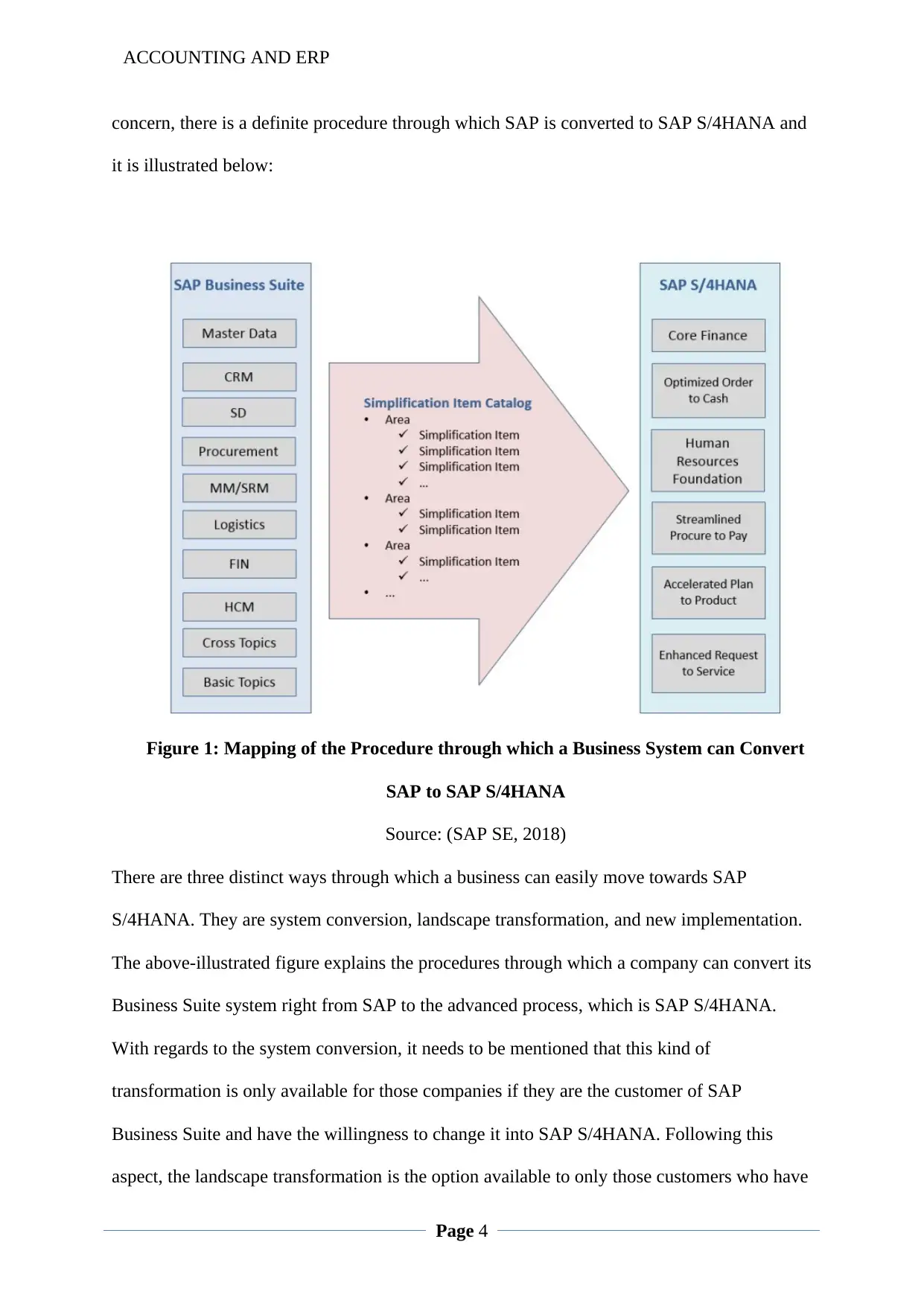
concern, there is a definite procedure through which SAP is converted to SAP S/4HANA and
it is illustrated below:
Figure 1: Mapping of the Procedure through which a Business System can Convert
SAP to SAP S/4HANA
Source: (SAP SE, 2018)
There are three distinct ways through which a business can easily move towards SAP
S/4HANA. They are system conversion, landscape transformation, and new implementation.
The above-illustrated figure explains the procedures through which a company can convert its
Business Suite system right from SAP to the advanced process, which is SAP S/4HANA.
With regards to the system conversion, it needs to be mentioned that this kind of
transformation is only available for those companies if they are the customer of SAP
Business Suite and have the willingness to change it into SAP S/4HANA. Following this
aspect, the landscape transformation is the option available to only those customers who have
Page 4
concern, there is a definite procedure through which SAP is converted to SAP S/4HANA and
it is illustrated below:
Figure 1: Mapping of the Procedure through which a Business System can Convert
SAP to SAP S/4HANA
Source: (SAP SE, 2018)
There are three distinct ways through which a business can easily move towards SAP
S/4HANA. They are system conversion, landscape transformation, and new implementation.
The above-illustrated figure explains the procedures through which a company can convert its
Business Suite system right from SAP to the advanced process, which is SAP S/4HANA.
With regards to the system conversion, it needs to be mentioned that this kind of
transformation is only available for those companies if they are the customer of SAP
Business Suite and have the willingness to change it into SAP S/4HANA. Following this
aspect, the landscape transformation is the option available to only those customers who have
Page 4
Paraphrase This Document
Need a fresh take? Get an instant paraphrase of this document with our AI Paraphraser
ACCOUNTING AND ERP
the desire of consolidating the SAP Business Suite of their present landscape into a system
one that supports SAP S/4HANA. Ultimately, the last alternative of conversion involves new
implementation. Hence, it can be suggested that any customer who has recently adopted SAP
and wants to introduce SAP S/4HANA in their business, then all they are required to do is
install the latter Business Suite in a proper way (SAP SE, 2018).
2. Discussion
2.1. Differences amidst SAP S/4HANA and Current SAP ERP FICO
In a study conducted by Quincy (2019), it has illustrated some of the details about SAP ERP
FICO, stating that the term ‘FICO’ stands for nothing but Financial (FI) and Controlling
(CO). Basically, FICO is two important modules that are present in SAP. FICO is found to be
strongly integrated so as to aid the management in order to generate and maintain financial
reports for sufficing the purpose of strategic planning and decision-making on the basis of the
attained accounting details (Quincy 2019). On the other hand, with regards to SAP
S/4HANA, Singh (2017) have highlighted its salient features by presenting the fact that the
said Business Suite (i.e. SAP S/4HANA) has the capabilities of an application program
thereby enabling authoritative data management. It also involves functions, such as ensuring
support to real-time decisions, predictive analysis, and superior text-mining. Furthermore,
other features state the details that reflect on its skills of positioning on a hybrid model or
cloud. SAP S/4HANA also contains reduced tables, simplified data models, and footprints.
Moreover, it also tends to enhance enterprises’ efficiency after implementation (Singh 2017).
Thus, the illustrated difference certainly suggests that the former is a module but the later one
is a powerful data management system.
Another difference that can be highlighted in this case suggests that SAP S/4HANA is
considerably the latest planning software that looks after an enterprise’s accounting details.
Page 5
the desire of consolidating the SAP Business Suite of their present landscape into a system
one that supports SAP S/4HANA. Ultimately, the last alternative of conversion involves new
implementation. Hence, it can be suggested that any customer who has recently adopted SAP
and wants to introduce SAP S/4HANA in their business, then all they are required to do is
install the latter Business Suite in a proper way (SAP SE, 2018).
2. Discussion
2.1. Differences amidst SAP S/4HANA and Current SAP ERP FICO
In a study conducted by Quincy (2019), it has illustrated some of the details about SAP ERP
FICO, stating that the term ‘FICO’ stands for nothing but Financial (FI) and Controlling
(CO). Basically, FICO is two important modules that are present in SAP. FICO is found to be
strongly integrated so as to aid the management in order to generate and maintain financial
reports for sufficing the purpose of strategic planning and decision-making on the basis of the
attained accounting details (Quincy 2019). On the other hand, with regards to SAP
S/4HANA, Singh (2017) have highlighted its salient features by presenting the fact that the
said Business Suite (i.e. SAP S/4HANA) has the capabilities of an application program
thereby enabling authoritative data management. It also involves functions, such as ensuring
support to real-time decisions, predictive analysis, and superior text-mining. Furthermore,
other features state the details that reflect on its skills of positioning on a hybrid model or
cloud. SAP S/4HANA also contains reduced tables, simplified data models, and footprints.
Moreover, it also tends to enhance enterprises’ efficiency after implementation (Singh 2017).
Thus, the illustrated difference certainly suggests that the former is a module but the later one
is a powerful data management system.
Another difference that can be highlighted in this case suggests that SAP S/4HANA is
considerably the latest planning software that looks after an enterprise’s accounting details.
Page 5
ACCOUNTING AND ERP
Specifically, it is a digital core system that encourages business to transform its traditional
operations and enter into a modern intelligent venture, which is solely driven by attainable
data (Intelligence 2019). On the other, with regards to SAP FICO, Rouse (2019) points out
that it is an essential functional component that enables any business to manage its entire
financial data. It needs to be mentioned on this ground that originally SAP FI and SAP CO
were introduced in the business world separately, but presently they are closely incorporated
in such a manner that many people can consider them to be a single module (Rouse 2019).
2.2. Issues Related To Use Of Fiori (Apps) In Contrast To the Traditional T-Codes
Fiori is seen to be directly related to HANA, not for any provided technical reasons, but just
because SAP wanted to attract the customers so that they buy S/4HANA. On the basis of this
unnecessary connection with HANA, uptake of Fiori has appeared to be constricted than it
would actually have been. This, in turn, had made HANA appear less popular in comparison
to the way it was advertised beforehand. This directly had disrupted the usage of Fiori to a
certain extent. The reason for this kind of disruption deals with the fact that it is the only app,
which does not have the capability of working with AnyDB. This particular issue had
eventually shown up to initiate large connotation for SAP. Thus, it becomes essentially
significant to discuss the technical challenges that are experienced by varied customers while
implementing Fiori.
2.2.1. Technology Issues of Fiori
It needs to be highlighted that SAP has staked much on Fiori, thereby incorporating huge
development resources in it. Moreover, in the previous year, SAP is seen to have increased
the total number of Fiori apps extensively. Several technical problems were also involved,
which entailed factors such as, a technical base that is considered weak, ‘mobile-first’,
number of attempts that are to be made, along with ‘operation and maintenance’ overhead.
Page 6
Specifically, it is a digital core system that encourages business to transform its traditional
operations and enter into a modern intelligent venture, which is solely driven by attainable
data (Intelligence 2019). On the other, with regards to SAP FICO, Rouse (2019) points out
that it is an essential functional component that enables any business to manage its entire
financial data. It needs to be mentioned on this ground that originally SAP FI and SAP CO
were introduced in the business world separately, but presently they are closely incorporated
in such a manner that many people can consider them to be a single module (Rouse 2019).
2.2. Issues Related To Use Of Fiori (Apps) In Contrast To the Traditional T-Codes
Fiori is seen to be directly related to HANA, not for any provided technical reasons, but just
because SAP wanted to attract the customers so that they buy S/4HANA. On the basis of this
unnecessary connection with HANA, uptake of Fiori has appeared to be constricted than it
would actually have been. This, in turn, had made HANA appear less popular in comparison
to the way it was advertised beforehand. This directly had disrupted the usage of Fiori to a
certain extent. The reason for this kind of disruption deals with the fact that it is the only app,
which does not have the capability of working with AnyDB. This particular issue had
eventually shown up to initiate large connotation for SAP. Thus, it becomes essentially
significant to discuss the technical challenges that are experienced by varied customers while
implementing Fiori.
2.2.1. Technology Issues of Fiori
It needs to be highlighted that SAP has staked much on Fiori, thereby incorporating huge
development resources in it. Moreover, in the previous year, SAP is seen to have increased
the total number of Fiori apps extensively. Several technical problems were also involved,
which entailed factors such as, a technical base that is considered weak, ‘mobile-first’,
number of attempts that are to be made, along with ‘operation and maintenance’ overhead.
Page 6
⊘ This is a preview!⊘
Do you want full access?
Subscribe today to unlock all pages.
Trusted by 1+ million students worldwide
ACCOUNTING AND ERP
On this ground, the foremost technical issue that sustains with regards to Fiori suggests the
said app to have a technological underpinning, which is characterised to be an unimpressive
one. Right after that ‘mobile-first’ issue identifies that SAP has time and again misinterpreted
Fiori to be a universal UI, which has the capability of working equally on a tablet, desktop or
phone. Nevertheless, Fiori is a mobile UI. Thus, this is the specific reason as to why it cannot
be translated into the desktop as was claimed by SAP. On the other hand, it is observed that
SAP significantly works on the desktop. All of this suggests that putting everything into stake
just to develop a mobile UI does not make much difference (Snapp 2017).
The third issue that is associated with the Fiori apps explains that there are many attempts
made on the part of the SAP to successfully incorporate it in mobile devices. This can be
rightfully stated as Fiori is the 5th attempt of SAP @ mobil. On this ground, it is important to
highlight that in order to attain effective mobile technologies, SAP before obtaining Sybase,
has actually gone onto implement major resources right into SAP mobility. However, such
initiatives hardly turned into something fruitful. On the other hand, mobility issues cropped
up, which adversely affected the profitability of the business. Ultimately, the last issue that
sustains with regards to the said Fiori application is that it requires an extensive overhead for
the purpose of ensuring its proper management. For example, 80 standard apps are needed for
Fiori ships. However, when advancing further, fundamental package highly requires technical
expertise. The said expertise then needs to prepare the additional apps of Fiori so that they
can be used properly. It has thus been found out that SAP tries to scrutinize its efforts, which
are directed to build up new apps, but not in making those apps user-friendly for customers.
Specifically, it can be easily said that even though apps have been prepared for customers,
but proper supervision is required. However, it has been noted that it is not a matter of
concern for SAP to know that it is usable or not in the part of the customers. On this point, it
Page 7
On this ground, the foremost technical issue that sustains with regards to Fiori suggests the
said app to have a technological underpinning, which is characterised to be an unimpressive
one. Right after that ‘mobile-first’ issue identifies that SAP has time and again misinterpreted
Fiori to be a universal UI, which has the capability of working equally on a tablet, desktop or
phone. Nevertheless, Fiori is a mobile UI. Thus, this is the specific reason as to why it cannot
be translated into the desktop as was claimed by SAP. On the other hand, it is observed that
SAP significantly works on the desktop. All of this suggests that putting everything into stake
just to develop a mobile UI does not make much difference (Snapp 2017).
The third issue that is associated with the Fiori apps explains that there are many attempts
made on the part of the SAP to successfully incorporate it in mobile devices. This can be
rightfully stated as Fiori is the 5th attempt of SAP @ mobil. On this ground, it is important to
highlight that in order to attain effective mobile technologies, SAP before obtaining Sybase,
has actually gone onto implement major resources right into SAP mobility. However, such
initiatives hardly turned into something fruitful. On the other hand, mobility issues cropped
up, which adversely affected the profitability of the business. Ultimately, the last issue that
sustains with regards to the said Fiori application is that it requires an extensive overhead for
the purpose of ensuring its proper management. For example, 80 standard apps are needed for
Fiori ships. However, when advancing further, fundamental package highly requires technical
expertise. The said expertise then needs to prepare the additional apps of Fiori so that they
can be used properly. It has thus been found out that SAP tries to scrutinize its efforts, which
are directed to build up new apps, but not in making those apps user-friendly for customers.
Specifically, it can be easily said that even though apps have been prepared for customers,
but proper supervision is required. However, it has been noted that it is not a matter of
concern for SAP to know that it is usable or not in the part of the customers. On this point, it
Page 7
Paraphrase This Document
Need a fresh take? Get an instant paraphrase of this document with our AI Paraphraser
ACCOUNTING AND ERP
can be easily acknowledged that Fiori represents features of shared development venture for
the customers and not at all a user-friendly finished interface (Snapp 2017).
Fiori, introduced by SAP is an issue right from its establishment. As it has been apparent in
the afore-mentioned section, it appears that SAP is enhancing its developmental processes so
that many Fiori apps can be introduced. This is entirely based on the perception of SAP that
desires to ensure the biggest possible coverage. However, as most of the developed apps are
not at all used so they are mostly checked and then burned. Another aspect that requires to be
brought into notice involves that customization of Fiori is extremely difficult (Snapp 2017).
Thus, it can be well understood that Fiori apps have impactful technological issues.
On the other hand, Naik (2019) have suggested that the traditional t-code has an improper
user experience, which needs to be improved extensively so that any SAP transactions, which
are significantly heavy-duty can easily operate on customer’s mobile devices. The said
transaction functions that have been implemented by the t-code suggest the fact that it
becomes essentially difficult on the part of the customers to use it effectively when a crisis
arises (Naik 2019).
2.3. Benefits of SAP S/4HANA for Businesses
Throughout the world, it is evident that SAP S/4HANA is attaining success and has become
the most crucial part of SAP’s ERP system. S/4HANA is 4th ERP suite that has been
introduced by SAP. It must be significantly brought into notice that for over four long
decades, enterprise resource planning (ERP) has become the prime software of SAP. By far,
S/4HANA is the biggest launch that SAP had taken in previous years or rather it can be said
that concerned business suite (S/4HANA) has created a long-sought history for the company.
Therefore, it becomes obvious to discuss its speciality to understand the development leap
that had been taken by SAP. Specifically, SAP S/4HANA is considered to be a primary
Page 8
can be easily acknowledged that Fiori represents features of shared development venture for
the customers and not at all a user-friendly finished interface (Snapp 2017).
Fiori, introduced by SAP is an issue right from its establishment. As it has been apparent in
the afore-mentioned section, it appears that SAP is enhancing its developmental processes so
that many Fiori apps can be introduced. This is entirely based on the perception of SAP that
desires to ensure the biggest possible coverage. However, as most of the developed apps are
not at all used so they are mostly checked and then burned. Another aspect that requires to be
brought into notice involves that customization of Fiori is extremely difficult (Snapp 2017).
Thus, it can be well understood that Fiori apps have impactful technological issues.
On the other hand, Naik (2019) have suggested that the traditional t-code has an improper
user experience, which needs to be improved extensively so that any SAP transactions, which
are significantly heavy-duty can easily operate on customer’s mobile devices. The said
transaction functions that have been implemented by the t-code suggest the fact that it
becomes essentially difficult on the part of the customers to use it effectively when a crisis
arises (Naik 2019).
2.3. Benefits of SAP S/4HANA for Businesses
Throughout the world, it is evident that SAP S/4HANA is attaining success and has become
the most crucial part of SAP’s ERP system. S/4HANA is 4th ERP suite that has been
introduced by SAP. It must be significantly brought into notice that for over four long
decades, enterprise resource planning (ERP) has become the prime software of SAP. By far,
S/4HANA is the biggest launch that SAP had taken in previous years or rather it can be said
that concerned business suite (S/4HANA) has created a long-sought history for the company.
Therefore, it becomes obvious to discuss its speciality to understand the development leap
that had been taken by SAP. Specifically, SAP S/4HANA is considered to be a primary
Page 8
ACCOUNTING AND ERP
differentiator with reasons accounting to its unique architecture and it directly contradicts the
previous database, which was designed to be a classic rational one. SAP S/4HANA operates
on in-memory, stores data in distinct columns and compute capabilities. The said business
suite is not at all concerned with recording data but it largely focuses on offering end-users to
take proper decisions with regards to the real-time scenario. Furthermore, there are other four
specific benefits of SAP S/4HANA reporting system, which involve agility, minimized total
cost of ownership, simplicity, and innovation that can be beneficial for the users (Eseyin
2016).
With regards to the agility, it is required to point out that SAP S/4HANA is thoroughly driven
by Fiori, which makes it appear as a laudable business benefit. Besides, SAP S/4HANA
illustrates unparalleled simplicity to the administration and management of the entire IT
landscape through which calculating the accounting details of the organization and reporting
them accordingly can be done effectively. It is also coupled together with the potential of
cloud adoption. Thus, SAP S/4HANA highlights centralized network and hardware
resources. Besides, in terms of minimization of the total cost of ownership, it is required to
draw attention to the fact that SAP S/4HANA is a cost-efficient alternative. The reason for
this statement is that it combines all the possible transactional and analytical capabilities of
varied distinct systems into a sole source, which in turn, drives, proactive, and acute business
making. Ultimately, the innovation-related benefit of SAP S/4HANA deals with the fact that
it is one of the reporting systems that remain involved in SAP, which is f supporting the
adoption of cloud by renowned companies (Eseyin 2016).
2.4. Case Study of Companies
There are varied companies who have made their businesses to alter their system and adopt or
rather advance into SAP S/4HANA reporting system. Proper follow-up of their cases would
Page 9
differentiator with reasons accounting to its unique architecture and it directly contradicts the
previous database, which was designed to be a classic rational one. SAP S/4HANA operates
on in-memory, stores data in distinct columns and compute capabilities. The said business
suite is not at all concerned with recording data but it largely focuses on offering end-users to
take proper decisions with regards to the real-time scenario. Furthermore, there are other four
specific benefits of SAP S/4HANA reporting system, which involve agility, minimized total
cost of ownership, simplicity, and innovation that can be beneficial for the users (Eseyin
2016).
With regards to the agility, it is required to point out that SAP S/4HANA is thoroughly driven
by Fiori, which makes it appear as a laudable business benefit. Besides, SAP S/4HANA
illustrates unparalleled simplicity to the administration and management of the entire IT
landscape through which calculating the accounting details of the organization and reporting
them accordingly can be done effectively. It is also coupled together with the potential of
cloud adoption. Thus, SAP S/4HANA highlights centralized network and hardware
resources. Besides, in terms of minimization of the total cost of ownership, it is required to
draw attention to the fact that SAP S/4HANA is a cost-efficient alternative. The reason for
this statement is that it combines all the possible transactional and analytical capabilities of
varied distinct systems into a sole source, which in turn, drives, proactive, and acute business
making. Ultimately, the innovation-related benefit of SAP S/4HANA deals with the fact that
it is one of the reporting systems that remain involved in SAP, which is f supporting the
adoption of cloud by renowned companies (Eseyin 2016).
2.4. Case Study of Companies
There are varied companies who have made their businesses to alter their system and adopt or
rather advance into SAP S/4HANA reporting system. Proper follow-up of their cases would
Page 9
⊘ This is a preview!⊘
Do you want full access?
Subscribe today to unlock all pages.
Trusted by 1+ million students worldwide
ACCOUNTING AND ERP
surely exemplify as to what were the issues, which were faced by the companies in migrating
to the afore-mentioned business suite. Therefore, the description of two distinct companies is
provided below so that the challenges and benefits attained out of SAP S/4HANA can be
highlighted.
2.4.1. Hexaware Company
The case study of Hexaware Company discusses specifically the success story of SAP
S/4HANA reporting system. Hexaware is signified to be the “leading global solar energy
solutions provider” (Hexaware Technologies 2019). Particularly, the case describes details
about the key insights that are related to the solution scope, with regards to the SAP
S/4HANA migration and application system. It also highlights that the said company’s SAP
team has delivered the system successfully. At this point, it is important to state that one of
the prime customer value-adds, extensively involved automation-led perspective, which in
turn, had saved about 30% of the entire efforts, time and costs. Furthermore, the company has
initiated HANA migration within its operations and this had considerably improved the
performance of the clients’ system. It had also simplified the prime business procedures, such
as finance, logistics, and others (Hexaware Technologies 2019).
Hexaware Company is considered to be a large producer of modules that are of rigid thin-
film types. In other words, the company manufactures solar panels. The challenges that were
faced by the company suggested that in future days their insistent growth plans largely
demanded their existing system to turn into something more agile so that it can respond at a
relatively faster rate. The reason for such kind of requirement involves the fact that the
company’s current processes were extensively inadequate to illustrate modern capabilities so
as to offer real-time operational perceptions. The company further understood this
requirement by considering the present condition. Hence, it was high time to convert their
Page
10
surely exemplify as to what were the issues, which were faced by the companies in migrating
to the afore-mentioned business suite. Therefore, the description of two distinct companies is
provided below so that the challenges and benefits attained out of SAP S/4HANA can be
highlighted.
2.4.1. Hexaware Company
The case study of Hexaware Company discusses specifically the success story of SAP
S/4HANA reporting system. Hexaware is signified to be the “leading global solar energy
solutions provider” (Hexaware Technologies 2019). Particularly, the case describes details
about the key insights that are related to the solution scope, with regards to the SAP
S/4HANA migration and application system. It also highlights that the said company’s SAP
team has delivered the system successfully. At this point, it is important to state that one of
the prime customer value-adds, extensively involved automation-led perspective, which in
turn, had saved about 30% of the entire efforts, time and costs. Furthermore, the company has
initiated HANA migration within its operations and this had considerably improved the
performance of the clients’ system. It had also simplified the prime business procedures, such
as finance, logistics, and others (Hexaware Technologies 2019).
Hexaware Company is considered to be a large producer of modules that are of rigid thin-
film types. In other words, the company manufactures solar panels. The challenges that were
faced by the company suggested that in future days their insistent growth plans largely
demanded their existing system to turn into something more agile so that it can respond at a
relatively faster rate. The reason for such kind of requirement involves the fact that the
company’s current processes were extensively inadequate to illustrate modern capabilities so
as to offer real-time operational perceptions. The company further understood this
requirement by considering the present condition. Hence, it was high time to convert their
Page
10
Paraphrase This Document
Need a fresh take? Get an instant paraphrase of this document with our AI Paraphraser
ACCOUNTING AND ERP
legacy model into a framework that dealt with disruptive technology. The latter was the best
alternative at hand, as through transformation revenue recognition will occur at a faster rate
(Hexaware 2018).
Scopes wherein the said company can implement the SAP S/4HANA involve some distinct
services and they are S4 HANA transformation, whereby SAP ERP Central Component
(ECC) was to convert into the latest business suite, i.e., S/4HANA. Following this, the other
services involved herein is remediation of customer code and executing tests so that the
migrated S4 HANA system can be delivered. SAP Fiori enablement and deployment is the
third area where there is scope for changes. Ultimately, filling all the possible gaps by
conducting thorough analysis across the entire businesses, such as O2C, R2R, P2P E2R, and
S2P is the last area where developments could take place. In this regard, it needs to be
mentioned that the solution included seamless migration of S4 HANA, the advancement of
System Capacity and Infrastructure, executing post/pre-conversion verifications, setting up of
Fiori apps, and system conversion right from ECC to S4 HANA. By considering all these
aspects, benefits to the businesses can be attained that involve a significant leap towards
introducing a digital transformation. This can be done by utilizing S4 HANA, noteworthy
development in system performance, Data Exchange all across Satellite System through the
seamless way, simplified processes all across Finance and Logistics and providing a user
experience that mainly consists of next-gen capabilities (Hexaware 2018). Thus, the success
that the business has accomplished after migrating into S/4HANA is highly understood from
the above discussion.
2.4.2. Revlon Company
The S/4HANA case study of Revlon offers significant insight as to what is the process
through which implementation failures are enclosed. The failure that the company had faced
Page
11
legacy model into a framework that dealt with disruptive technology. The latter was the best
alternative at hand, as through transformation revenue recognition will occur at a faster rate
(Hexaware 2018).
Scopes wherein the said company can implement the SAP S/4HANA involve some distinct
services and they are S4 HANA transformation, whereby SAP ERP Central Component
(ECC) was to convert into the latest business suite, i.e., S/4HANA. Following this, the other
services involved herein is remediation of customer code and executing tests so that the
migrated S4 HANA system can be delivered. SAP Fiori enablement and deployment is the
third area where there is scope for changes. Ultimately, filling all the possible gaps by
conducting thorough analysis across the entire businesses, such as O2C, R2R, P2P E2R, and
S2P is the last area where developments could take place. In this regard, it needs to be
mentioned that the solution included seamless migration of S4 HANA, the advancement of
System Capacity and Infrastructure, executing post/pre-conversion verifications, setting up of
Fiori apps, and system conversion right from ECC to S4 HANA. By considering all these
aspects, benefits to the businesses can be attained that involve a significant leap towards
introducing a digital transformation. This can be done by utilizing S4 HANA, noteworthy
development in system performance, Data Exchange all across Satellite System through the
seamless way, simplified processes all across Finance and Logistics and providing a user
experience that mainly consists of next-gen capabilities (Hexaware 2018). Thus, the success
that the business has accomplished after migrating into S/4HANA is highly understood from
the above discussion.
2.4.2. Revlon Company
The S/4HANA case study of Revlon offers significant insight as to what is the process
through which implementation failures are enclosed. The failure that the company had faced
Page
11
ACCOUNTING AND ERP
was hidden entirely by the management. However, when the news of failure cropped up, its
management revealed it in a way so that it appeared to be efficiently controlled by them.
Nevertheless, its failure illustrated an accurate depiction as to how they were fooled by their
consulting power and SAP. The total amount of remediation costs that were provided by the
company along with the statements has identified S/4HANA to be a cutover right into the
production that too in a premature condition. Thus, this case implies that Revlon had long
term issues with the S/4HANA system of simplifying the accounting-related complications.
There were actually two distinct problems associated with S/4HANA and that involves the
extent of an exaggeration, which prevailed around it. Specifically, companies attempted to
purchase S/4HANA on the basis of its promised features but ended up getting something
different. The second issue that sustains with S/4HANA highlights that the consulting
companies of SAP tend to highlight only those facts, which SAP has already stated before.
This signifies that there is as such no independent enterprise, which contradicts the statements
that have already been mentioned by SAP. Thus, all the opinions that are received with
regards to the capabilities of SAP are the same and do not bear any honest remarks about it.
Thus, these two conditions were adequate to deceive Revlon Company, which was the main
reason for failing to transform its existing system to a digitalised one (Snapp 2019).
3. Conclusion
SAP S/4HANA is actually a digitalized business reporting system that drifts apart directly
from the transactional system, which is utilized by most of the companies. It signifies to be a
new generation of SAP Business Suite, which is mainly characterized by its simplification
feature. It was found from the discussion above that its introduction has largely enhanced
efficiency and has developed features, such as, simulation and planning alternatives that were
being performed in varied conventional transactions. It also ensured proper decision-making
Page
12
was hidden entirely by the management. However, when the news of failure cropped up, its
management revealed it in a way so that it appeared to be efficiently controlled by them.
Nevertheless, its failure illustrated an accurate depiction as to how they were fooled by their
consulting power and SAP. The total amount of remediation costs that were provided by the
company along with the statements has identified S/4HANA to be a cutover right into the
production that too in a premature condition. Thus, this case implies that Revlon had long
term issues with the S/4HANA system of simplifying the accounting-related complications.
There were actually two distinct problems associated with S/4HANA and that involves the
extent of an exaggeration, which prevailed around it. Specifically, companies attempted to
purchase S/4HANA on the basis of its promised features but ended up getting something
different. The second issue that sustains with S/4HANA highlights that the consulting
companies of SAP tend to highlight only those facts, which SAP has already stated before.
This signifies that there is as such no independent enterprise, which contradicts the statements
that have already been mentioned by SAP. Thus, all the opinions that are received with
regards to the capabilities of SAP are the same and do not bear any honest remarks about it.
Thus, these two conditions were adequate to deceive Revlon Company, which was the main
reason for failing to transform its existing system to a digitalised one (Snapp 2019).
3. Conclusion
SAP S/4HANA is actually a digitalized business reporting system that drifts apart directly
from the transactional system, which is utilized by most of the companies. It signifies to be a
new generation of SAP Business Suite, which is mainly characterized by its simplification
feature. It was found from the discussion above that its introduction has largely enhanced
efficiency and has developed features, such as, simulation and planning alternatives that were
being performed in varied conventional transactions. It also ensured proper decision-making
Page
12
⊘ This is a preview!⊘
Do you want full access?
Subscribe today to unlock all pages.
Trusted by 1+ million students worldwide

1 out of 15


Related Documents


Your All-in-One AI-Powered Toolkit for Academic Success.
+13062052269
info@desklib.com
Available 24*7 on WhatsApp / Email
![[object Object]](/_next/static/media/star-bottom.7253800d.svg)
Unlock your academic potential
Copyright © 2020–2026 A2Z Services. All Rights Reserved. Developed and managed by ZUCOL.