Total Quality Management Report: SBS – MSc Quality & Risk Management
VerifiedAdded on 2023/04/21
|26
|6688
|76
Report
AI Summary
This report provides a comprehensive overview of Total Quality Management (TQM), exploring its history, dimensions, impact on organizational performance, and implementation barriers. It differentiates between the soft and hard aspects of TQM, highlighting the importance of human resource focus, customer focus, and top management commitment. The report also discusses the aspects of TQM that persist in practice, the barriers to its implementation, and the similarities and differences between TQM and MEM (Management Excellence Model). The analysis draws upon various academic sources to provide a well-rounded understanding of TQM principles and their practical application in corporate settings. Desklib offers a range of study tools and resources for students, including solved assignments and past papers.
Running Head: MANAGEMENT APPROACHES
0
Total Quality Management
Student
0
Total Quality Management
Student

Paraphrase This Document
Need a fresh take? Get an instant paraphrase of this document with our AI Paraphraser
MANAGEMENT APPROACHES
1
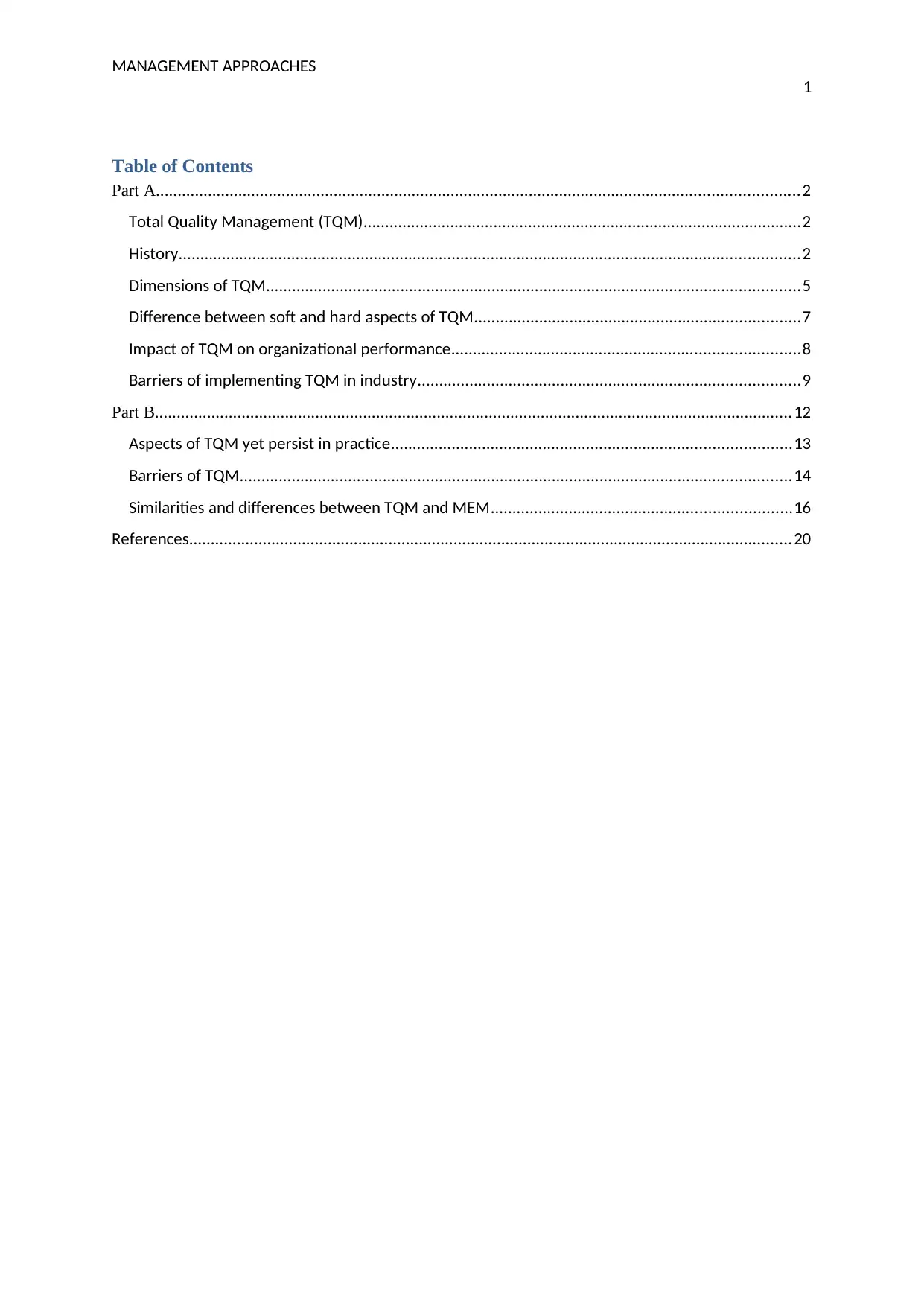
Table of Contents
Part A....................................................................................................................................................2
Total Quality Management (TQM).....................................................................................................2
History...............................................................................................................................................2
Dimensions of TQM...........................................................................................................................5
Difference between soft and hard aspects of TQM...........................................................................7
Impact of TQM on organizational performance................................................................................8
Barriers of implementing TQM in industry........................................................................................9
Part B...................................................................................................................................................12
Aspects of TQM yet persist in practice............................................................................................13
Barriers of TQM...............................................................................................................................14
Similarities and differences between TQM and MEM.....................................................................16
References...........................................................................................................................................20
1
Table of Contents
Part A....................................................................................................................................................2
Total Quality Management (TQM).....................................................................................................2
History...............................................................................................................................................2
Dimensions of TQM...........................................................................................................................5
Difference between soft and hard aspects of TQM...........................................................................7
Impact of TQM on organizational performance................................................................................8
Barriers of implementing TQM in industry........................................................................................9
Part B...................................................................................................................................................12
Aspects of TQM yet persist in practice............................................................................................13
Barriers of TQM...............................................................................................................................14
Similarities and differences between TQM and MEM.....................................................................16
References...........................................................................................................................................20
MANAGEMENT APPROACHES
2
Part A
1. Total Quality Management (TQM)
Total Quality Management or TQM denotes to managing approaches applied to improve
quality and output in corporate establishments (Alghamdi, 2018). TQM is the complete
management strategy that works parallel across the business, including all sections and staffs
and spreading forward and backward to comprise both providers and customers/users. TQM
is the only single of several abbreviations used to tag controlling schemes that concentrate on
quality (Bayazit, and Karpak, 2007). Other different acronyms comprise SQC or statistical
quality control, CQI or continuous quality improvement, QIDW or quality in daily work,
QFD or quality function deployment, TQC or total quality control, etc. Similarly different of
these other schemes, TQM delivers an outline for applying actual quality and output
creativities that can upsurge the cost-effectiveness and competitiveness of companies.
Different advisers and institutes of thought highlight dissimilar aspects of TQM as it has
advanced over time (Prajogo, and Sohal, 2006). These aspects might be technical,
functioning, or social/managerial. The basic components of TQM, as explained by the
American Society for quality regulation, are; policy, planning, and management, product
scheme, and design alteration control, control of bought material, manufacturing quality
control, user interaction and field presentation, corrective act, and employee choice, training,
and inspiration (Alghamdi, 2018).
History
The past of total quality management (TQM) initiated originally as the word invented by the
Naval Air Schemes Facility to define its Japanese-type administration method to quality
development. An umbrella practice for repeatedly refining the superiority of all procedures, it
attractions on information of the values and does of (Alghamdi, 2018):
2
Part A
1. Total Quality Management (TQM)
Total Quality Management or TQM denotes to managing approaches applied to improve
quality and output in corporate establishments (Alghamdi, 2018). TQM is the complete
management strategy that works parallel across the business, including all sections and staffs
and spreading forward and backward to comprise both providers and customers/users. TQM
is the only single of several abbreviations used to tag controlling schemes that concentrate on
quality (Bayazit, and Karpak, 2007). Other different acronyms comprise SQC or statistical
quality control, CQI or continuous quality improvement, QIDW or quality in daily work,
QFD or quality function deployment, TQC or total quality control, etc. Similarly different of
these other schemes, TQM delivers an outline for applying actual quality and output
creativities that can upsurge the cost-effectiveness and competitiveness of companies.
Different advisers and institutes of thought highlight dissimilar aspects of TQM as it has
advanced over time (Prajogo, and Sohal, 2006). These aspects might be technical,
functioning, or social/managerial. The basic components of TQM, as explained by the
American Society for quality regulation, are; policy, planning, and management, product
scheme, and design alteration control, control of bought material, manufacturing quality
control, user interaction and field presentation, corrective act, and employee choice, training,
and inspiration (Alghamdi, 2018).
History
The past of total quality management (TQM) initiated originally as the word invented by the
Naval Air Schemes Facility to define its Japanese-type administration method to quality
development. An umbrella practice for repeatedly refining the superiority of all procedures, it
attractions on information of the values and does of (Alghamdi, 2018):
⊘ This is a preview!⊘
Do you want full access?
Subscribe today to unlock all pages.

Trusted by 1+ million students worldwide
MANAGEMENT APPROACHES
3
The behavioral disciplines
The examination of measurable and no measurable data
Economics philosophies
Procedure examination
Historically, the first phase was observed in the early 1910s in which the Ford Motor-
powered Corporation’s “T” car initiated to employ a set of supervisors to check the creation
in contradiction of the regular, casing the manufacture process and distribution
(Weckenmann, Akkasoglu, and Werner, 2015). The aim was to discrete the lowly product
feature from the satisfactory one and henceforth argued, revised or traded it as low excellence
(Fisher, and Nair, 2009). Another phase was from 1924 to 1931 while arithmetical excellence
control by examination established. The principal one came from unsystematic reasons, and
another came from transferable or distinctive reasons (Shahin, and Dabestani, 2011). It was
projected that a procedure can be prepared to function unsurprisingly by arranging out the
difference due to distinctive causes. Moreover, it was controlled chart coined for detecting
such procedure dissimilarity, therefore defining when to interrelate with the procedure. The
third phase encompasses all the previous periods to deliver satisfactory assurance such that
creation or facility will satisfy clients’ requirements (Martin, Bulkan, and Klempt, 2011).
This phase stressed altering from recognition to stoppage of deprived feature (Androniceanu,
2017). The fourth phase, TQM, comprised the understanding and application of quality
managing's values and ideas in each part of establishments. It stresses that the values of
quality controlling have to be realistic at each level, each stage, and in each department of the
association (Alghamdi, 2018).
In 1920:
Certain of the principal beginnings of quality administration were recognized as the values of
systematic managing cleared through U.S. corporate (Alghamdi, 2018). Industries noticeably
3
The behavioral disciplines
The examination of measurable and no measurable data
Economics philosophies
Procedure examination
Historically, the first phase was observed in the early 1910s in which the Ford Motor-
powered Corporation’s “T” car initiated to employ a set of supervisors to check the creation
in contradiction of the regular, casing the manufacture process and distribution
(Weckenmann, Akkasoglu, and Werner, 2015). The aim was to discrete the lowly product
feature from the satisfactory one and henceforth argued, revised or traded it as low excellence
(Fisher, and Nair, 2009). Another phase was from 1924 to 1931 while arithmetical excellence
control by examination established. The principal one came from unsystematic reasons, and
another came from transferable or distinctive reasons (Shahin, and Dabestani, 2011). It was
projected that a procedure can be prepared to function unsurprisingly by arranging out the
difference due to distinctive causes. Moreover, it was controlled chart coined for detecting
such procedure dissimilarity, therefore defining when to interrelate with the procedure. The
third phase encompasses all the previous periods to deliver satisfactory assurance such that
creation or facility will satisfy clients’ requirements (Martin, Bulkan, and Klempt, 2011).
This phase stressed altering from recognition to stoppage of deprived feature (Androniceanu,
2017). The fourth phase, TQM, comprised the understanding and application of quality
managing's values and ideas in each part of establishments. It stresses that the values of
quality controlling have to be realistic at each level, each stage, and in each department of the
association (Alghamdi, 2018).
In 1920:
Certain of the principal beginnings of quality administration were recognized as the values of
systematic managing cleared through U.S. corporate (Alghamdi, 2018). Industries noticeably
Paraphrase This Document
Need a fresh take? Get an instant paraphrase of this document with our AI Paraphraser
MANAGEMENT APPROACHES
4
unglued the procedures of preparation and following the strategy, and union antagonism
arose as employees were deprived of a speech in the situations and determinations of their
work. The Hawthorne work in the late 1920s presented how worker output could be impacted
by contribution (Alghamdi, 2018).
1930
Walter Stewart advanced the approaches for statistical investigation and regulation of quality
(Alghamdi, 2018).
1950
W. Edwards Deming displayed approaches for statistical investigation and regulation of
quality to the Japanese engineers and officials. This can be measured as the start of TQM.
Joseph M. Juran trained the thoughts of directing quality and directorial breakthrough
(Osayawe Ehigie, and McAndrew, 2005). Total Quality Control book written by Armand V.
Feigenbaum’s, a precursor for the existing information of TQM, was printed. Philip B.
Crosby’s advertising of zero flaws paved the method for quality development in many
corporations (Osayawe Ehigie, and McAndrew, 2005).
1968
The Japanese called their method to entire quality industry-wide quality regulation. It is about
this period that the word quality controlling schemes arising. Kaoru Ishikawa’s development
of the viewpoint donated to Japan’s dominance as the quality frontrunner (Pheng, and Teo,
2004)
4
unglued the procedures of preparation and following the strategy, and union antagonism
arose as employees were deprived of a speech in the situations and determinations of their
work. The Hawthorne work in the late 1920s presented how worker output could be impacted
by contribution (Alghamdi, 2018).
1930
Walter Stewart advanced the approaches for statistical investigation and regulation of quality
(Alghamdi, 2018).
1950
W. Edwards Deming displayed approaches for statistical investigation and regulation of
quality to the Japanese engineers and officials. This can be measured as the start of TQM.
Joseph M. Juran trained the thoughts of directing quality and directorial breakthrough
(Osayawe Ehigie, and McAndrew, 2005). Total Quality Control book written by Armand V.
Feigenbaum’s, a precursor for the existing information of TQM, was printed. Philip B.
Crosby’s advertising of zero flaws paved the method for quality development in many
corporations (Osayawe Ehigie, and McAndrew, 2005).
1968
The Japanese called their method to entire quality industry-wide quality regulation. It is about
this period that the word quality controlling schemes arising. Kaoru Ishikawa’s development
of the viewpoint donated to Japan’s dominance as the quality frontrunner (Pheng, and Teo,
2004)
MANAGEMENT APPROACHES
5
2018
TQM is the title for the idea of a extensive and complete technique for handling managerial
quality. Quality values like the ISO 9000 sequence and excellence reward programs like the
Deming Reward and the Malcolm Baldrige Nationwide Quality Reward specify morals and
procedures that involve TQM (Alghamdi, 2018).
2. Dimensions of TQM
TQM includes three different dimensions; 1) human resource focus, 2) customer focus, and
3) top management commitment (Alghamdi, 2018)
1. Human source controlling:
Human resource focus is the first dimension of total quality managing. This specific section
deals with the the humanoid resource efficiency in the association in terms of staffing,
training and growth, communication, staff security, and happiness (Sabella, Kashou, and
Omran, 2014). The human source has the maximum thoughtful influence on the
organizational performance. A productive collaboration between Human resource
management and TQM can harvest improved organizational outcomes. The arrangement of
HR and quality guidelines, like generating and co-operating the TQM dream, making the
association and workers for TQM application and producing quality consciousness amongst
the staffs across all stages, roles, and subdivisions, must subsidise to the upsurge business
performance. Fascination and holding of the best staffs within the association, growing job
gratification, getting advanced level performance from the workers are the most significant
jobs in HRM (Yang, 2006). Nonetheless to attain all of these goals and to grasp
organizational targets a company must have workers with managerial commitment and job
5
2018
TQM is the title for the idea of a extensive and complete technique for handling managerial
quality. Quality values like the ISO 9000 sequence and excellence reward programs like the
Deming Reward and the Malcolm Baldrige Nationwide Quality Reward specify morals and
procedures that involve TQM (Alghamdi, 2018).
2. Dimensions of TQM
TQM includes three different dimensions; 1) human resource focus, 2) customer focus, and
3) top management commitment (Alghamdi, 2018)
1. Human source controlling:
Human resource focus is the first dimension of total quality managing. This specific section
deals with the the humanoid resource efficiency in the association in terms of staffing,
training and growth, communication, staff security, and happiness (Sabella, Kashou, and
Omran, 2014). The human source has the maximum thoughtful influence on the
organizational performance. A productive collaboration between Human resource
management and TQM can harvest improved organizational outcomes. The arrangement of
HR and quality guidelines, like generating and co-operating the TQM dream, making the
association and workers for TQM application and producing quality consciousness amongst
the staffs across all stages, roles, and subdivisions, must subsidise to the upsurge business
performance. Fascination and holding of the best staffs within the association, growing job
gratification, getting advanced level performance from the workers are the most significant
jobs in HRM (Yang, 2006). Nonetheless to attain all of these goals and to grasp
organizational targets a company must have workers with managerial commitment and job
⊘ This is a preview!⊘
Do you want full access?
Subscribe today to unlock all pages.
Trusted by 1+ million students worldwide
MANAGEMENT APPROACHES
6
association and that is imaginable only when each stakeholder in the established targets for
superiority in each job that they do (Alghamdi, 2018).
2. Customer focus:
Total quality management (TQM) is the firm-wide organization philosophy of unceasingly
refining the excellence of the goods/facilities/procedures by concentrating on the clients’
needs and prospects to enhance purchaser gratification and stable performance (Sila, and
Ebrahimpour, 2003). TQM firms emphasize helping external clients. They first must know
the clients’ prospects and desires and then must offer the goods/facilities, consequently. With
the help of positive client focus determinations, creation can be organized with admiration to
the clients’ desires, beliefs, and objections. This inspires companies to create great quality
and consistent products/facilities on time with augmented efficacy and output. When client
hopes are encountered, their gratification might be augmented, and the company’s trades and
the marketplace share may upsurge. Previous readings have established that client focus
positively affects working performance (Karia, and Hasmi Abu Hassan Asaari, 2006)
inventory administration performance, worker performance, novelty performance, client
satisfaction/outcomes, deals, and collective company performance and it can be said that
consumer concentration is certainly associated to performance (Sadikoglu, and Olcay, 2014)
how observant the business is to client necessities and hopes and how actual the company is
in aspects of handling customer connections. Becoming a client-oriented business has to turn
into one of the main challenges facing establishments tailoring and applying approaches
intended at enlightening client fulfilment must be at the core of any company (Agus,
Krishnan, and Kadir, 2000).
3. Top management commitment
6
association and that is imaginable only when each stakeholder in the established targets for
superiority in each job that they do (Alghamdi, 2018).
2. Customer focus:
Total quality management (TQM) is the firm-wide organization philosophy of unceasingly
refining the excellence of the goods/facilities/procedures by concentrating on the clients’
needs and prospects to enhance purchaser gratification and stable performance (Sila, and
Ebrahimpour, 2003). TQM firms emphasize helping external clients. They first must know
the clients’ prospects and desires and then must offer the goods/facilities, consequently. With
the help of positive client focus determinations, creation can be organized with admiration to
the clients’ desires, beliefs, and objections. This inspires companies to create great quality
and consistent products/facilities on time with augmented efficacy and output. When client
hopes are encountered, their gratification might be augmented, and the company’s trades and
the marketplace share may upsurge. Previous readings have established that client focus
positively affects working performance (Karia, and Hasmi Abu Hassan Asaari, 2006)
inventory administration performance, worker performance, novelty performance, client
satisfaction/outcomes, deals, and collective company performance and it can be said that
consumer concentration is certainly associated to performance (Sadikoglu, and Olcay, 2014)
how observant the business is to client necessities and hopes and how actual the company is
in aspects of handling customer connections. Becoming a client-oriented business has to turn
into one of the main challenges facing establishments tailoring and applying approaches
intended at enlightening client fulfilment must be at the core of any company (Agus,
Krishnan, and Kadir, 2000).
3. Top management commitment
Paraphrase This Document
Need a fresh take? Get an instant paraphrase of this document with our AI Paraphraser
MANAGEMENT APPROACHES
7
The success and the growth ofan industry are heavily be impacted by the combination of
HRM, TQM, executive commitment and work involvement. TQM involves considerable time
investments from directors, it is costly (particularly for training and conferences), it rarely
creates short-term outcomes, it demands strong CEO commitment, and it creates unrealistic
expectations about maximum organizations’ capabilities to alter their cultures (Kannan, and
Tan, 2005). TQM achievement seems to depend disapprovingly on managerial commitment.
Top management promise plays a vigorous role in applying a quality managing system.
Possibly the clearest similarity between the various quality supporters and their programs is
the reliable persistence that administration be vigorously included with and dedicated to
refining quality inside the organization (Talib, Rahman, and Qureshi, 2011). Simply stating
that excellence is significant is not enough. One thing is mutual in all viewpoints that top
managing commitment is obligatory nonetheless there is the fewer focus on the area how one
can receive the top management assurance. One requires having a whole procedure of
getting, performing, calculating, meeting the management commitment (Powell, 1995)
Difference between soft and hard aspects of TQM
Soft features of TQM associated with behavioural characteristics and usually deal with
person’s aspect such as exercise and teaching, loyalty, leadership, collaboration,
empowerment, client focus and gratification, human resource application, associates with
providers and professional connections, addition of the voice of client and provider,
communication, functioning rewards, quality culture and communal duty. Soft features of
TQM are behavioral facets of controlling of the human factor which comprises workforce
assurance, shared vision, and client focus, use of squads, personal exercise, and cooperative
provider relationships (Alghamdi, 2018).
7
The success and the growth ofan industry are heavily be impacted by the combination of
HRM, TQM, executive commitment and work involvement. TQM involves considerable time
investments from directors, it is costly (particularly for training and conferences), it rarely
creates short-term outcomes, it demands strong CEO commitment, and it creates unrealistic
expectations about maximum organizations’ capabilities to alter their cultures (Kannan, and
Tan, 2005). TQM achievement seems to depend disapprovingly on managerial commitment.
Top management promise plays a vigorous role in applying a quality managing system.
Possibly the clearest similarity between the various quality supporters and their programs is
the reliable persistence that administration be vigorously included with and dedicated to
refining quality inside the organization (Talib, Rahman, and Qureshi, 2011). Simply stating
that excellence is significant is not enough. One thing is mutual in all viewpoints that top
managing commitment is obligatory nonetheless there is the fewer focus on the area how one
can receive the top management assurance. One requires having a whole procedure of
getting, performing, calculating, meeting the management commitment (Powell, 1995)
Difference between soft and hard aspects of TQM
Soft features of TQM associated with behavioural characteristics and usually deal with
person’s aspect such as exercise and teaching, loyalty, leadership, collaboration,
empowerment, client focus and gratification, human resource application, associates with
providers and professional connections, addition of the voice of client and provider,
communication, functioning rewards, quality culture and communal duty. Soft features of
TQM are behavioral facets of controlling of the human factor which comprises workforce
assurance, shared vision, and client focus, use of squads, personal exercise, and cooperative
provider relationships (Alghamdi, 2018).
MANAGEMENT APPROACHES
8
Hard features of TQM are system-leaning and are easier to measure. It normally addresses
benchmarking, elasticity, quality schemes, quality reassurance, just-in-time, no defect,
unceasing improvement and novelty, information and performance dimension, process
controlling, strategic scheduling, process mechanism and product/facility strategy (Alghamdi,
2018). Hard TQM feature as quality supervision tools and methods, such as reason and
outcome map, scatter drawing, affinity illustration, associations illustration, force-field
examination, run plan, control plans, quality role placement, and failure manner and effect
evaluation (Daud, and Yusoff, 2011)
3. Influence of TQM on organizational performance
Various authors found that a key important area of making sure that TQM results in sustained
development in the organizational profitability is that straight quantitative MEASURES of
the manufacturing are applied to analyze the efficacy if the manager's performance to
maintain the growth and implementation of TQM programs. TQM has evolved as methods to
create quality goods and reduce costs (Hung, Lien, Yang, Wu, and Kuo, 2011). TQM has
changed as the theoretical method that focus on the requirements to deliver consumers with
extremely valued goods or goods and to do that by development in the efficacy by the way of
eradicating waste, decreasing chief times at every step of the productions process reducing
the costs, and growing people, and enhancing the constantly. Whereas the TQM deliver the
potential for the company to improve their rivalry there are some indications that various
organizations has been dissatisfied in the context to which TQM approach has been related to
the nonstop progresses in the organizational productivity (Alghamdi, 2018). The main thrust
of the TQM theory is that the goods feature and its maintenance have to be developed in form
the starting and that the accomplishments of the quality levels and enhancements is the
accountability of everybody (Fotopoulos, and Psomas, 2009).
8
Hard features of TQM are system-leaning and are easier to measure. It normally addresses
benchmarking, elasticity, quality schemes, quality reassurance, just-in-time, no defect,
unceasing improvement and novelty, information and performance dimension, process
controlling, strategic scheduling, process mechanism and product/facility strategy (Alghamdi,
2018). Hard TQM feature as quality supervision tools and methods, such as reason and
outcome map, scatter drawing, affinity illustration, associations illustration, force-field
examination, run plan, control plans, quality role placement, and failure manner and effect
evaluation (Daud, and Yusoff, 2011)
3. Influence of TQM on organizational performance
Various authors found that a key important area of making sure that TQM results in sustained
development in the organizational profitability is that straight quantitative MEASURES of
the manufacturing are applied to analyze the efficacy if the manager's performance to
maintain the growth and implementation of TQM programs. TQM has evolved as methods to
create quality goods and reduce costs (Hung, Lien, Yang, Wu, and Kuo, 2011). TQM has
changed as the theoretical method that focus on the requirements to deliver consumers with
extremely valued goods or goods and to do that by development in the efficacy by the way of
eradicating waste, decreasing chief times at every step of the productions process reducing
the costs, and growing people, and enhancing the constantly. Whereas the TQM deliver the
potential for the company to improve their rivalry there are some indications that various
organizations has been dissatisfied in the context to which TQM approach has been related to
the nonstop progresses in the organizational productivity (Alghamdi, 2018). The main thrust
of the TQM theory is that the goods feature and its maintenance have to be developed in form
the starting and that the accomplishments of the quality levels and enhancements is the
accountability of everybody (Fotopoulos, and Psomas, 2009).
⊘ This is a preview!⊘
Do you want full access?
Subscribe today to unlock all pages.
Trusted by 1+ million students worldwide
MANAGEMENT APPROACHES
9
There is a considerable optimistic result of the TQM uses together on working and structural
performance of the SMEs. He also found that the main part of the planned aspects in the
successful application of TQM programs within the SMEs. Although some of the researchers
also found that most features commonly linked to the TQM like quality training, procedure
improvements, and benchmarking do not commonly generate any advantages, but other tacit,
behavioral, improperly imitable aspects like exposed culture, worker empowerment, and
managerial assurance can deliver advantages (Kumar, Choisne, de Grosbois, and Kumar,
2009). The strength if the association between TQM practice and administrative performance
has been tested by different experts and stated that there is a substantial difference in the
relations between structural performance and TQM across business sectors and dissimilar
size organizations, especially on the impact of defect rates, warranty rates and innovations of
novel products. The TQM is effective and beneficial in enlightening the performance of the
business but it cannot be said that it is always positive (Alghamdi, 2018).
4. Barriers of implementing TQM in industry
Considering the influences that are probable to obstruct the application of the TQM permits
directors to grow more operative approaches for refining the likelihoods of positively
organize TQM and thus to achieve brilliance in the occupation. However, there are some
barriers the managers may face in implementing the TQM in the industry, Such as
(Alghamdi, 2018);
Strategic barriers: planned matters are important obstacles to the use of TQM and possess
the utmost adverse influence on its achievement ((Alghamdi, 2018). These obstacles are
primarily linked to the administration and headship of the establishment. Some of the
examples of strategic barriers include (Alghamdi, 2018):
9
There is a considerable optimistic result of the TQM uses together on working and structural
performance of the SMEs. He also found that the main part of the planned aspects in the
successful application of TQM programs within the SMEs. Although some of the researchers
also found that most features commonly linked to the TQM like quality training, procedure
improvements, and benchmarking do not commonly generate any advantages, but other tacit,
behavioral, improperly imitable aspects like exposed culture, worker empowerment, and
managerial assurance can deliver advantages (Kumar, Choisne, de Grosbois, and Kumar,
2009). The strength if the association between TQM practice and administrative performance
has been tested by different experts and stated that there is a substantial difference in the
relations between structural performance and TQM across business sectors and dissimilar
size organizations, especially on the impact of defect rates, warranty rates and innovations of
novel products. The TQM is effective and beneficial in enlightening the performance of the
business but it cannot be said that it is always positive (Alghamdi, 2018).
4. Barriers of implementing TQM in industry
Considering the influences that are probable to obstruct the application of the TQM permits
directors to grow more operative approaches for refining the likelihoods of positively
organize TQM and thus to achieve brilliance in the occupation. However, there are some
barriers the managers may face in implementing the TQM in the industry, Such as
(Alghamdi, 2018);
Strategic barriers: planned matters are important obstacles to the use of TQM and possess
the utmost adverse influence on its achievement ((Alghamdi, 2018). These obstacles are
primarily linked to the administration and headship of the establishment. Some of the
examples of strategic barriers include (Alghamdi, 2018):
Paraphrase This Document
Need a fresh take? Get an instant paraphrase of this document with our AI Paraphraser
MANAGEMENT APPROACHES
10
Incorrect TQM program
barriers to the acceptance of TQM
impractical hopes lacking leadership
poor controlling the deficiency of top management help
poor participation of managers
the power of the central management
insufficient planning
the lack of constancy of objectives (Subrahmanya Bhat, and Rajashekhar, 2009)
lack of extended term vision
the deficiency of a dream and a strong directions
conflicting goals and the main concern
the absence of importance of refining the quality (Subrahmanya Bhat, and
Rajashekhar, 2009)
the previous disappointments in terms of initiatives of alteration
the non-existence of Government help
Political improbability (Alghamdi, 2018).
Structural barriers: These types of barriers are linked to the structure, schemes and physical
resources essential to apply the TQM. Certain of the structural obstacles the managers may
face are (Alghamdi, 2018):
Organizational structure unsuitable
Lack of administrative flexibility
Deficiency of bodily resources
An absence of information schemes
10
Incorrect TQM program
barriers to the acceptance of TQM
impractical hopes lacking leadership
poor controlling the deficiency of top management help
poor participation of managers
the power of the central management
insufficient planning
the lack of constancy of objectives (Subrahmanya Bhat, and Rajashekhar, 2009)
lack of extended term vision
the deficiency of a dream and a strong directions
conflicting goals and the main concern
the absence of importance of refining the quality (Subrahmanya Bhat, and
Rajashekhar, 2009)
the previous disappointments in terms of initiatives of alteration
the non-existence of Government help
Political improbability (Alghamdi, 2018).
Structural barriers: These types of barriers are linked to the structure, schemes and physical
resources essential to apply the TQM. Certain of the structural obstacles the managers may
face are (Alghamdi, 2018):
Organizational structure unsuitable
Lack of administrative flexibility
Deficiency of bodily resources
An absence of information schemes
MANAGEMENT APPROACHES
11
Lack of economic support, the price of implementation
Lack of time(Raj, and Attri, 2011)
Human resources barriers: These obstacles are associated with human factors, such as the
absence of employee commitment and confrontation to alteration in TQM. The humanoid
resources obstacles are (Alghamdi, 2018);
The lack of attention of employees
The lack of assurance and participation of employees
Employee confrontation to change
A lacking human resources controlling
Poor allocation at all categorized levels
Few workers work jobs and progressively higher
Lack of exercise and teaching of employees
Lack of inspiration and gratification of employees
The lack of gratitude and recompensing for success (Talib, Rahman, Siddiqui, and
Qureshi, 2011)
Contextual barriers: there are the problems that occur when there are advanced a context
and values suitable to achieve the maximum potential of the organizing of the total quality
management. The contextual obstacles include;
Poor administrative culture
Difficulties in altering the organizational culture
Lack of leadership teams
Poor communication and unproductive
Poor cooperation
11
Lack of economic support, the price of implementation
Lack of time(Raj, and Attri, 2011)
Human resources barriers: These obstacles are associated with human factors, such as the
absence of employee commitment and confrontation to alteration in TQM. The humanoid
resources obstacles are (Alghamdi, 2018);
The lack of attention of employees
The lack of assurance and participation of employees
Employee confrontation to change
A lacking human resources controlling
Poor allocation at all categorized levels
Few workers work jobs and progressively higher
Lack of exercise and teaching of employees
Lack of inspiration and gratification of employees
The lack of gratitude and recompensing for success (Talib, Rahman, Siddiqui, and
Qureshi, 2011)
Contextual barriers: there are the problems that occur when there are advanced a context
and values suitable to achieve the maximum potential of the organizing of the total quality
management. The contextual obstacles include;
Poor administrative culture
Difficulties in altering the organizational culture
Lack of leadership teams
Poor communication and unproductive
Poor cooperation
⊘ This is a preview!⊘
Do you want full access?
Subscribe today to unlock all pages.
Trusted by 1+ million students worldwide

1 out of 26


Related Documents


Your All-in-One AI-Powered Toolkit for Academic Success.
+13062052269
info@desklib.com
Available 24*7 on WhatsApp / Email
![[object Object]](/_next/static/media/star-bottom.7253800d.svg)
Unlock your academic potential
Copyright © 2020–2026 A2Z Services. All Rights Reserved. Developed and managed by ZUCOL.