Traffic Engineering Report: SCATS, AIMSUN, and Incident Management
VerifiedAdded on 2020/05/08
|62
|18391
|86
Report
AI Summary
This report explores traffic engineering and incident management in the context of Australia and New Zealand's growing transport sector. It addresses the limitations of traditional approaches to incident management, such as delays caused by incident detection and response times. The study introduces software packages and Automatic Transport Management Systems (ATMS) to resolve road incidents and manage congestion effectively. The report focuses on mesoscopic and microscopic traffic simulations using the AIMSUN tool, incorporating real-time data from SCATS, an adaptive traffic signal control system. The methodology involves importing SCATS models to analyze the Hoodle Street congestion problem in Melbourne. The report examines various types of incidents contributing to traffic congestion, including accidents, road construction, and roadside building construction. The results and discussion aim to provide insights into improving incident management strategies and demonstrate the effectiveness of technology in congestion control. The report also recommends ways to manage incident-related congestion in the case study area of Hoodle Street and provide information to drivers for diversion.

Traffic Engineering 1
Traffic Engneering
Name
Institution
Traffic Engneering
Name
Institution

Paraphrase This Document
Need a fresh take? Get an instant paraphrase of this document with our AI Paraphraser

Traffic Engineering 2
Abstract
The future of the transport sector in Australia and New Zealand is expected to continue to
grow, due to the higher number of vehicles that are expected to continue utilizing the major road
networks on a daily basis. The rates of accidents have also been projected to increase and this
will contribute to delays on the roads, as well as traffic congestions and other incidents. These
incidents tend to disorganize the entire transport sector. The traditional approaches to these
incidents on the road transport system would not have worked because the time of an incident
would be multiplied and compounded by the time that it would take for an incident that has
occurred to be detected, prompting more delays. Then the time it would take for the response
teams to react and then the time that it would take the involved personnel to arrive at the scene of
the incident. Traditional methods would not be effective in in prudently dealing with the snarl up
caused during incidents, and this would affect the efficiency to keep the road in optimal
operation.
For this reason, a number of software packages have been introduced so as to resolve the
incidents that occur on the road and thereby effectively and successfully managing incidence and
thus the resulting traffic congestion. To achieve this kind technological based management, the
incorporation of Automatic Transport Management System can be utilized so that the impact of
incidents on the road network section and congestion in this area can be established and
managed. This is conducted through the mesoscopic and the microscopic simulation of traffic
across the case study area on Hoodle Street. These simulations are then used to emulate the flow
and movement dynamics of the vehicles moving within the entire transport network based on
specific models of the analytical predictive modeling tool used known as the AIMSUN tool. This
tool is thus able to consider the specifications of the AIMSUN model to emulate factors on the
Abstract
The future of the transport sector in Australia and New Zealand is expected to continue to
grow, due to the higher number of vehicles that are expected to continue utilizing the major road
networks on a daily basis. The rates of accidents have also been projected to increase and this
will contribute to delays on the roads, as well as traffic congestions and other incidents. These
incidents tend to disorganize the entire transport sector. The traditional approaches to these
incidents on the road transport system would not have worked because the time of an incident
would be multiplied and compounded by the time that it would take for an incident that has
occurred to be detected, prompting more delays. Then the time it would take for the response
teams to react and then the time that it would take the involved personnel to arrive at the scene of
the incident. Traditional methods would not be effective in in prudently dealing with the snarl up
caused during incidents, and this would affect the efficiency to keep the road in optimal
operation.
For this reason, a number of software packages have been introduced so as to resolve the
incidents that occur on the road and thereby effectively and successfully managing incidence and
thus the resulting traffic congestion. To achieve this kind technological based management, the
incorporation of Automatic Transport Management System can be utilized so that the impact of
incidents on the road network section and congestion in this area can be established and
managed. This is conducted through the mesoscopic and the microscopic simulation of traffic
across the case study area on Hoodle Street. These simulations are then used to emulate the flow
and movement dynamics of the vehicles moving within the entire transport network based on
specific models of the analytical predictive modeling tool used known as the AIMSUN tool. This
tool is thus able to consider the specifications of the AIMSUN model to emulate factors on the

Traffic Engineering 3
road such as the choice of route from one destination and the car-following and lane changing
movement so as to implement the dynamic flow of traffic on the model. The microscopic regions
are appropriate for the analysis of the operational aspects of that section of the road in the event
of an incident and the models require plenty of synthesized data to run. Mesoscopic areas on the
other hand mainly focus on the flow of traffic on that section of the road which also considers the
obstacles and intersection activity allowing a wider area to be modelled with high traffic
dynamics efficiency. The consistency of the results from the models is extremely important for
the accuracy and precision of the insights given from the model from the mesoscopic and the
microscopic model.
The paper looks into the manner in which SCATS imported models can be used for
incidence management and coincidence control together with AIMSUN as well as how SCATS
has been used in other developed areas as traffic control strategy and as incident management
tool. This is because SCATS is an adaptive traffic signal control system which uses real-time
traffic information to adjust the movement of vehicles in traffic and thus delay incidents and
manage congestion (Sullivan and Flannagan, 2012). In this case study, the real-time information
obtained from scats has been calibrated and validated to fit an AIMSUN model and the model
has been used to design a traffic management tool for Hoodle Street in Melbourne. An effective
incident management system will grant the existing methods of congestion control and incident
management more reliability in terms of the predicted time of travel and delays expected in the
roads, as the AIMSUN model will utilize an analytical predictive modeling tool. All transport
conditions on Hoodle Street on the modelled intervals and days of the week will be modelled and
insights will be generated to improve the incident management strategies used and thus show
how the incorporation of technology would be effective in improving the strategies for
road such as the choice of route from one destination and the car-following and lane changing
movement so as to implement the dynamic flow of traffic on the model. The microscopic regions
are appropriate for the analysis of the operational aspects of that section of the road in the event
of an incident and the models require plenty of synthesized data to run. Mesoscopic areas on the
other hand mainly focus on the flow of traffic on that section of the road which also considers the
obstacles and intersection activity allowing a wider area to be modelled with high traffic
dynamics efficiency. The consistency of the results from the models is extremely important for
the accuracy and precision of the insights given from the model from the mesoscopic and the
microscopic model.
The paper looks into the manner in which SCATS imported models can be used for
incidence management and coincidence control together with AIMSUN as well as how SCATS
has been used in other developed areas as traffic control strategy and as incident management
tool. This is because SCATS is an adaptive traffic signal control system which uses real-time
traffic information to adjust the movement of vehicles in traffic and thus delay incidents and
manage congestion (Sullivan and Flannagan, 2012). In this case study, the real-time information
obtained from scats has been calibrated and validated to fit an AIMSUN model and the model
has been used to design a traffic management tool for Hoodle Street in Melbourne. An effective
incident management system will grant the existing methods of congestion control and incident
management more reliability in terms of the predicted time of travel and delays expected in the
roads, as the AIMSUN model will utilize an analytical predictive modeling tool. All transport
conditions on Hoodle Street on the modelled intervals and days of the week will be modelled and
insights will be generated to improve the incident management strategies used and thus show
how the incorporation of technology would be effective in improving the strategies for
⊘ This is a preview!⊘
Do you want full access?
Subscribe today to unlock all pages.

Trusted by 1+ million students worldwide

Traffic Engineering 4
congestion control and incident management. Thus the tools will also be used to give
recommendations on how incident related congestion can be managed in the case study area of
Hoodle Street. The conveyance of information would also aid drivers to quickly adopt
instructions for diversion thus easing the demand for traffic and thus reducing the rates of
congestion on the roads. This will also improve the traffic safety and improve the compliance of
individuals to traffic rules and regulations.
congestion control and incident management. Thus the tools will also be used to give
recommendations on how incident related congestion can be managed in the case study area of
Hoodle Street. The conveyance of information would also aid drivers to quickly adopt
instructions for diversion thus easing the demand for traffic and thus reducing the rates of
congestion on the roads. This will also improve the traffic safety and improve the compliance of
individuals to traffic rules and regulations.
Paraphrase This Document
Need a fresh take? Get an instant paraphrase of this document with our AI Paraphraser
Traffic Engineering 5
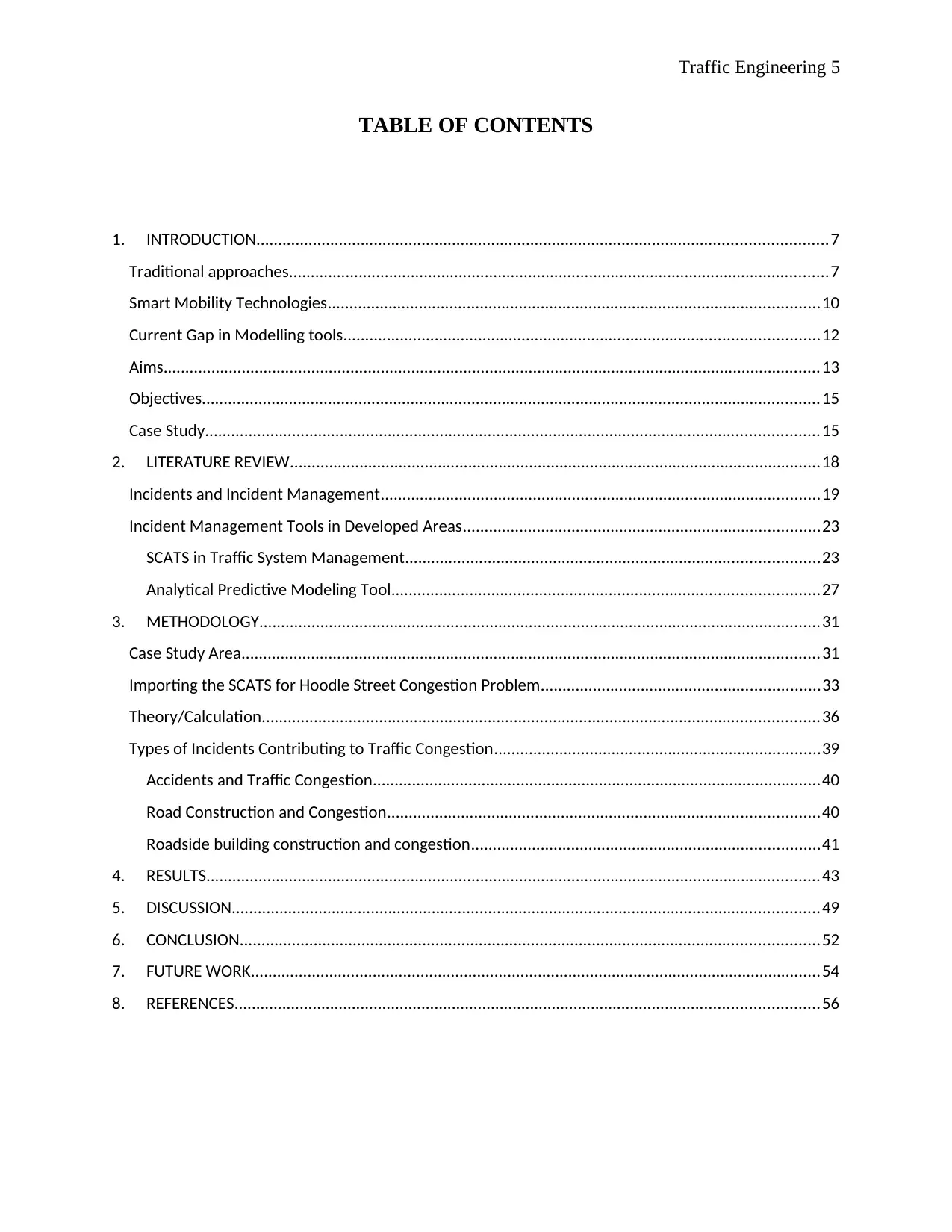
TABLE OF CONTENTS
1. INTRODUCTION...................................................................................................................................7
Traditional approaches............................................................................................................................7
Smart Mobility Technologies.................................................................................................................10
Current Gap in Modelling tools.............................................................................................................12
Aims.......................................................................................................................................................13
Objectives..............................................................................................................................................15
Case Study.............................................................................................................................................15
2. LITERATURE REVIEW..........................................................................................................................18
Incidents and Incident Management.....................................................................................................19
Incident Management Tools in Developed Areas..................................................................................23
SCATS in Traffic System Management...............................................................................................23
Analytical Predictive Modeling Tool..................................................................................................27
3. METHODOLOGY.................................................................................................................................31
Case Study Area.....................................................................................................................................31
Importing the SCATS for Hoodle Street Congestion Problem................................................................33
Theory/Calculation................................................................................................................................36
Types of Incidents Contributing to Traffic Congestion...........................................................................39
Accidents and Traffic Congestion.......................................................................................................40
Road Construction and Congestion...................................................................................................40
Roadside building construction and congestion................................................................................41
4. RESULTS.............................................................................................................................................43
5. DISCUSSION.......................................................................................................................................49
6. CONCLUSION.....................................................................................................................................52
7. FUTURE WORK...................................................................................................................................54
8. REFERENCES......................................................................................................................................56
TABLE OF CONTENTS
1. INTRODUCTION...................................................................................................................................7
Traditional approaches............................................................................................................................7
Smart Mobility Technologies.................................................................................................................10
Current Gap in Modelling tools.............................................................................................................12
Aims.......................................................................................................................................................13
Objectives..............................................................................................................................................15
Case Study.............................................................................................................................................15
2. LITERATURE REVIEW..........................................................................................................................18
Incidents and Incident Management.....................................................................................................19
Incident Management Tools in Developed Areas..................................................................................23
SCATS in Traffic System Management...............................................................................................23
Analytical Predictive Modeling Tool..................................................................................................27
3. METHODOLOGY.................................................................................................................................31
Case Study Area.....................................................................................................................................31
Importing the SCATS for Hoodle Street Congestion Problem................................................................33
Theory/Calculation................................................................................................................................36
Types of Incidents Contributing to Traffic Congestion...........................................................................39
Accidents and Traffic Congestion.......................................................................................................40
Road Construction and Congestion...................................................................................................40
Roadside building construction and congestion................................................................................41
4. RESULTS.............................................................................................................................................43
5. DISCUSSION.......................................................................................................................................49
6. CONCLUSION.....................................................................................................................................52
7. FUTURE WORK...................................................................................................................................54
8. REFERENCES......................................................................................................................................56

Traffic Engineering 6
⊘ This is a preview!⊘
Do you want full access?
Subscribe today to unlock all pages.
Trusted by 1+ million students worldwide
Traffic Engineering 7
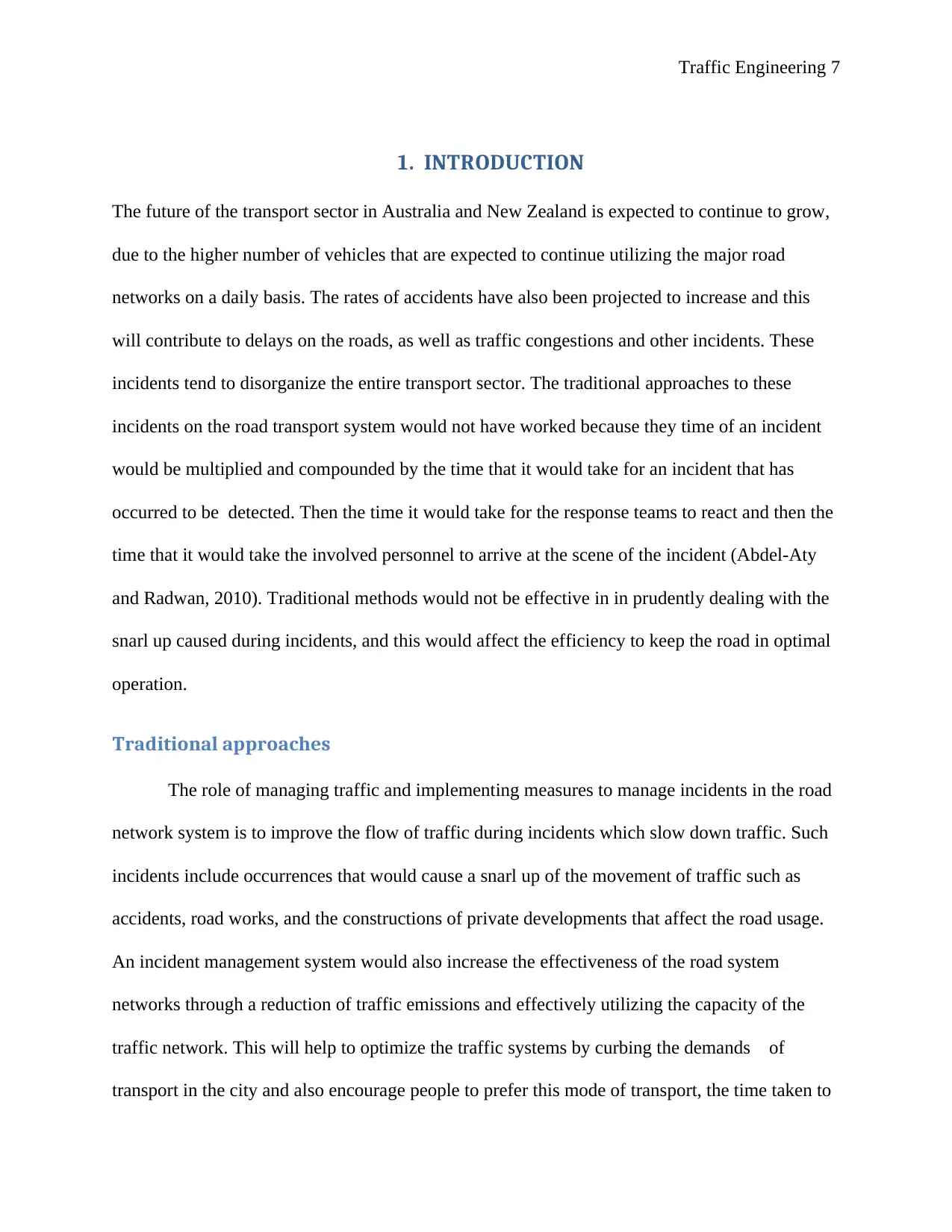
1. INTRODUCTION
The future of the transport sector in Australia and New Zealand is expected to continue to grow,
due to the higher number of vehicles that are expected to continue utilizing the major road
networks on a daily basis. The rates of accidents have also been projected to increase and this
will contribute to delays on the roads, as well as traffic congestions and other incidents. These
incidents tend to disorganize the entire transport sector. The traditional approaches to these
incidents on the road transport system would not have worked because they time of an incident
would be multiplied and compounded by the time that it would take for an incident that has
occurred to be detected. Then the time it would take for the response teams to react and then the
time that it would take the involved personnel to arrive at the scene of the incident (Abdel-Aty
and Radwan, 2010). Traditional methods would not be effective in in prudently dealing with the
snarl up caused during incidents, and this would affect the efficiency to keep the road in optimal
operation.
Traditional approaches
The role of managing traffic and implementing measures to manage incidents in the road
network system is to improve the flow of traffic during incidents which slow down traffic. Such
incidents include occurrences that would cause a snarl up of the movement of traffic such as
accidents, road works, and the constructions of private developments that affect the road usage.
An incident management system would also increase the effectiveness of the road system
networks through a reduction of traffic emissions and effectively utilizing the capacity of the
traffic network. This will help to optimize the traffic systems by curbing the demands of
transport in the city and also encourage people to prefer this mode of transport, the time taken to
1. INTRODUCTION
The future of the transport sector in Australia and New Zealand is expected to continue to grow,
due to the higher number of vehicles that are expected to continue utilizing the major road
networks on a daily basis. The rates of accidents have also been projected to increase and this
will contribute to delays on the roads, as well as traffic congestions and other incidents. These
incidents tend to disorganize the entire transport sector. The traditional approaches to these
incidents on the road transport system would not have worked because they time of an incident
would be multiplied and compounded by the time that it would take for an incident that has
occurred to be detected. Then the time it would take for the response teams to react and then the
time that it would take the involved personnel to arrive at the scene of the incident (Abdel-Aty
and Radwan, 2010). Traditional methods would not be effective in in prudently dealing with the
snarl up caused during incidents, and this would affect the efficiency to keep the road in optimal
operation.
Traditional approaches
The role of managing traffic and implementing measures to manage incidents in the road
network system is to improve the flow of traffic during incidents which slow down traffic. Such
incidents include occurrences that would cause a snarl up of the movement of traffic such as
accidents, road works, and the constructions of private developments that affect the road usage.
An incident management system would also increase the effectiveness of the road system
networks through a reduction of traffic emissions and effectively utilizing the capacity of the
traffic network. This will help to optimize the traffic systems by curbing the demands of
transport in the city and also encourage people to prefer this mode of transport, the time taken to
Paraphrase This Document
Need a fresh take? Get an instant paraphrase of this document with our AI Paraphraser

Traffic Engineering 8
travel and the route taken, due to its improved effectiveness. Thus, for traffic to be managed
effectively, the information regarding traffic and any incidents within the network system has to
be clearly communicated, such as how to control the traffic, the occurrence of incidents and how
they can be managed. This in turn will look into managing the demand for the transport form, as
well as the support as well as the monitoring of the entire transport system.
The information about traffic in this incident management system is a very important feature of
the system, as it provides the system with real-time information for the users and also the
institutions associated with the management of the incidents that occur on the transport system.
This information includes weather news and conditions on the road ahead for the road-users,
schedules for the maintenance of the road or maintenance works areas of the road, occurrences of
any incidents on the road, the traffic information with regards to any incidents on the road and
where the snarl up is, as well as if it is advisable to take any other mode of transport instead. By
providing this kind of information, traffic can easily be controlled in the road transport network
system for every node which are the intersections (Qin, Ivan, and Ravishanker, 2013). This
means that the management system will thus be able to control the entire road network system
per for different sections, through a fixed or a dependent traffic control.
Incident management systems are specifically aimed at detecting any incidences in the transport
network, thus handling any form of traffic incidents and eliminating any possible risks of traffic
snarl ups as a result incidents. It also has to work hand in hand to with different authorities that
would ep to clear up the go slow, regardless of whatever kind of incidence has occurred. It also
involves the management of the demand for the specific transport mode, and thus the
determination of the flow of traffic route, mode, and even time of travel for many road users in
the city. The incidence management system can become successful if the traffic management
travel and the route taken, due to its improved effectiveness. Thus, for traffic to be managed
effectively, the information regarding traffic and any incidents within the network system has to
be clearly communicated, such as how to control the traffic, the occurrence of incidents and how
they can be managed. This in turn will look into managing the demand for the transport form, as
well as the support as well as the monitoring of the entire transport system.
The information about traffic in this incident management system is a very important feature of
the system, as it provides the system with real-time information for the users and also the
institutions associated with the management of the incidents that occur on the transport system.
This information includes weather news and conditions on the road ahead for the road-users,
schedules for the maintenance of the road or maintenance works areas of the road, occurrences of
any incidents on the road, the traffic information with regards to any incidents on the road and
where the snarl up is, as well as if it is advisable to take any other mode of transport instead. By
providing this kind of information, traffic can easily be controlled in the road transport network
system for every node which are the intersections (Qin, Ivan, and Ravishanker, 2013). This
means that the management system will thus be able to control the entire road network system
per for different sections, through a fixed or a dependent traffic control.
Incident management systems are specifically aimed at detecting any incidences in the transport
network, thus handling any form of traffic incidents and eliminating any possible risks of traffic
snarl ups as a result incidents. It also has to work hand in hand to with different authorities that
would ep to clear up the go slow, regardless of whatever kind of incidence has occurred. It also
involves the management of the demand for the specific transport mode, and thus the
determination of the flow of traffic route, mode, and even time of travel for many road users in
the city. The incidence management system can become successful if the traffic management

Traffic Engineering 9
system would be able to regulate access and parking in straight high-speed infrastructure and
organizing facilities for the residents where the road users park and ride. Other incidence
management strategies include carpooling and encouraging the use public transport to cut on the
number of vehicles using the networks, and promoting the cycling and pedestrian traffic (Wood,
2012) In addition, improving the passage of information between the road users and other
stakeholders of the transport sector is also a strategy for the management of incidences through
making use of road charges and tolls.
An effective incidence management system also has a monitoring system, such that ICT
solutions could be incorporated into controls like the automatic speed control and the intersection
control. This part of the incidence management system is utilized for the observation of any
hazardous materials being transported through the road networks. The monitoring systems could
also be used to monitor how the lanes are used automatically (Rock, 2015(. ICT solutions can be
incorporated in driver support systems where the driver is given suggestions by the incidence
management system on that route to give the driver assistance and thereby prevent the
occurrence of collisions, navigation, and helping the drive maintain in their respective lane. It
also includes the control, planning, and monitoring of the transport activity of a given vehicle or
a set of them, especially regarding their operations and movement as well as that of their drivers
(Koorey, McMillan, Nicholson, 2008). The incident management system will therefore only
achieve effectiveness if all the aspects of transport chain and its management operations have
been streamlined to adopt a lean system.
Road network where a strategic incident and traffic management system can be installed
is mainly composed of different components, such as the metropolitan sections, urban areas,
connecting sessions, main roads, basic road networks for rural sections, as well as special sites.
system would be able to regulate access and parking in straight high-speed infrastructure and
organizing facilities for the residents where the road users park and ride. Other incidence
management strategies include carpooling and encouraging the use public transport to cut on the
number of vehicles using the networks, and promoting the cycling and pedestrian traffic (Wood,
2012) In addition, improving the passage of information between the road users and other
stakeholders of the transport sector is also a strategy for the management of incidences through
making use of road charges and tolls.
An effective incidence management system also has a monitoring system, such that ICT
solutions could be incorporated into controls like the automatic speed control and the intersection
control. This part of the incidence management system is utilized for the observation of any
hazardous materials being transported through the road networks. The monitoring systems could
also be used to monitor how the lanes are used automatically (Rock, 2015(. ICT solutions can be
incorporated in driver support systems where the driver is given suggestions by the incidence
management system on that route to give the driver assistance and thereby prevent the
occurrence of collisions, navigation, and helping the drive maintain in their respective lane. It
also includes the control, planning, and monitoring of the transport activity of a given vehicle or
a set of them, especially regarding their operations and movement as well as that of their drivers
(Koorey, McMillan, Nicholson, 2008). The incident management system will therefore only
achieve effectiveness if all the aspects of transport chain and its management operations have
been streamlined to adopt a lean system.
Road network where a strategic incident and traffic management system can be installed
is mainly composed of different components, such as the metropolitan sections, urban areas,
connecting sessions, main roads, basic road networks for rural sections, as well as special sites.
⊘ This is a preview!⊘
Do you want full access?
Subscribe today to unlock all pages.
Trusted by 1+ million students worldwide

Traffic Engineering 10
The effective system can also only function to achieve safety and efficiency of the system
between the different regions that are connected in the network, so as to offer the other users as
well as good transport chain services, foreign exchange in all corners.
Smart Mobility Technologies
Incident management in the streets of Melbourne especially using smart mobility will be an
effective tool in dealing with incidents that would slow down the snarl up of traffic in the city.
This kind of solution will have to make use of the five pillars of incident management, where the
risk of any incidents will be minimized so that the roads can be returned to optimal functioning
road network system. A road management system that utilizes the concepts of smart mobility is
aimed at achieving a road network system that is uniformly functional throughout the entire city.
This is because the smart mobility technologies have created solutions for the most difficult
challenges in today’s modern cities where the road traffic systems have become the backbone of
the city transport system. In situations where the cities have been projected to grow as in the case
of Melbourne, it is expected that continuing to utilize the traditional approaches of road system
networks will elicit great levels of congestion(Abbas, 2013). The high levels of congestion is
also expected to bring in great levels of lawlessness, as it is difficult for any laws to be observed
when the systems being used are unable to follow errors and the roads operation is too
ineffective. The ineffectiveness would also lead to a diminishing of the funds that are set aside to
manage the city, while the conditions would continue to worsen.
Smart mobility methods for running a functional city like Melbourne ought to utilize the five
pillars of incident management using a collection of procedures that aims at enabling effective
operation on road transport networks as well as uses ICT enabled solutions to monitor the
movement of road users to ensure that law is observed. This would greatly reduce the amount of
The effective system can also only function to achieve safety and efficiency of the system
between the different regions that are connected in the network, so as to offer the other users as
well as good transport chain services, foreign exchange in all corners.
Smart Mobility Technologies
Incident management in the streets of Melbourne especially using smart mobility will be an
effective tool in dealing with incidents that would slow down the snarl up of traffic in the city.
This kind of solution will have to make use of the five pillars of incident management, where the
risk of any incidents will be minimized so that the roads can be returned to optimal functioning
road network system. A road management system that utilizes the concepts of smart mobility is
aimed at achieving a road network system that is uniformly functional throughout the entire city.
This is because the smart mobility technologies have created solutions for the most difficult
challenges in today’s modern cities where the road traffic systems have become the backbone of
the city transport system. In situations where the cities have been projected to grow as in the case
of Melbourne, it is expected that continuing to utilize the traditional approaches of road system
networks will elicit great levels of congestion(Abbas, 2013). The high levels of congestion is
also expected to bring in great levels of lawlessness, as it is difficult for any laws to be observed
when the systems being used are unable to follow errors and the roads operation is too
ineffective. The ineffectiveness would also lead to a diminishing of the funds that are set aside to
manage the city, while the conditions would continue to worsen.
Smart mobility methods for running a functional city like Melbourne ought to utilize the five
pillars of incident management using a collection of procedures that aims at enabling effective
operation on road transport networks as well as uses ICT enabled solutions to monitor the
movement of road users to ensure that law is observed. This would greatly reduce the amount of
Paraphrase This Document
Need a fresh take? Get an instant paraphrase of this document with our AI Paraphraser

Traffic Engineering 11
congestion within the city and thus enable the city acquire effective and optimal road transport
network systems. The solution will also have to holistically integrate the aspects of the
traditional approach with smart web technology optimizations to achieve a model that copes with
the pressure in Melbourne, which is expected to continue growing. It also ought to incorporate
the existing patterns of the road users in the city, and plan with the considerations of these
existing patterns and why they exist. In so doing, the incident management system will ensure
that the issue of traffic safety is tackled, while at the same time incorporate the patterns and
dynamics of the behavior of travelers in that city. It also ought to factor in the mobility culture of
the people of Melbourne as well as the environmental and mobility awareness of the people of
that city (Shankar, Mannering, and Barfield, 2015 ). The incorporation of Information
Communication Technologies will aid the smart mobility solution to incorporate many diverse
and more optimal solutions that will aid in managing incidents of whatever kind in the streets of
Melbourne.
The smart mobility solution for the management of incidents in the streets of the city of
Melbourne ICT and traditional approaches can be incorporated to yield an extremely effective
and optimal management system. For instance, making sure that the system introduced for the
city will have a system of programming and preplanning through the utilization of ICT solutions
would ensure that the incident management system is able to detect the occurrences of incidents
soon as they happen, to prevent the build-up of traffic as in the case of traditional approaches.
Traditional approaches usually take time before the occurrence of the incident is detected, and
then before the response systems are informed and they get to the scene with the necessary
equipment. It also requires the role of the traditional approaches to allocate the required
resources for all the systems to run effectively without any shortage. Communication between
congestion within the city and thus enable the city acquire effective and optimal road transport
network systems. The solution will also have to holistically integrate the aspects of the
traditional approach with smart web technology optimizations to achieve a model that copes with
the pressure in Melbourne, which is expected to continue growing. It also ought to incorporate
the existing patterns of the road users in the city, and plan with the considerations of these
existing patterns and why they exist. In so doing, the incident management system will ensure
that the issue of traffic safety is tackled, while at the same time incorporate the patterns and
dynamics of the behavior of travelers in that city. It also ought to factor in the mobility culture of
the people of Melbourne as well as the environmental and mobility awareness of the people of
that city (Shankar, Mannering, and Barfield, 2015 ). The incorporation of Information
Communication Technologies will aid the smart mobility solution to incorporate many diverse
and more optimal solutions that will aid in managing incidents of whatever kind in the streets of
Melbourne.
The smart mobility solution for the management of incidents in the streets of the city of
Melbourne ICT and traditional approaches can be incorporated to yield an extremely effective
and optimal management system. For instance, making sure that the system introduced for the
city will have a system of programming and preplanning through the utilization of ICT solutions
would ensure that the incident management system is able to detect the occurrences of incidents
soon as they happen, to prevent the build-up of traffic as in the case of traditional approaches.
Traditional approaches usually take time before the occurrence of the incident is detected, and
then before the response systems are informed and they get to the scene with the necessary
equipment. It also requires the role of the traditional approaches to allocate the required
resources for all the systems to run effectively without any shortage. Communication between

Traffic Engineering 12
the different sectors of the road network system and the incident management system is
extremely crucial and is the third pillar of an effective incident management plan. This will
require an incorporation of the ICT solutions. The fourth pillars are building skills and capacity
for the people who will work in the different institutions while the fifth pillar is concerned with
managing and reporting of the incident management system.
Current Gap in Modelling tools
The most effective traffic management system will utilize an approach that incorporates ICT
solutions into the traditional approaches of traffic management, so as to yield very promising
results. For instance, to reduce the number of injuries and fatalities as a result of incident
management systems, both automatic monitoring of the road networks and the traditional
approach of the variable traffic control will aid to control the behavior of all motorists on the
road. To improve safety on the road, both ICT and traditional approaches can be incorporated
through the use of notifications of information for the drivers and road users through ICT and
providing information on safety and how it can be achieved in rest stops services. To ensure that
the people comply with all the traffic rule and regulations to prevent the development of any go-
slows, the intervention of ICT systems can be used in automatic monitoring of the roads to
identify traffic rules offenders and using a variable traffic control system for ensuring that every
sections of the road network system is functioning effectively and that there are no offenders in
the roads. Issues like the predictability of incidents can be effectively managed by
communicating to other road users the safety situations on the roads and through the
implementation of incident management strategies that are extremely beneficial and
workable(RTA, 2016). The reliability of the systems can also be guaranteed by encouraging road
users to pay up tolls and road charges which go into managing the system and ensuring it
the different sectors of the road network system and the incident management system is
extremely crucial and is the third pillar of an effective incident management plan. This will
require an incorporation of the ICT solutions. The fourth pillars are building skills and capacity
for the people who will work in the different institutions while the fifth pillar is concerned with
managing and reporting of the incident management system.
Current Gap in Modelling tools
The most effective traffic management system will utilize an approach that incorporates ICT
solutions into the traditional approaches of traffic management, so as to yield very promising
results. For instance, to reduce the number of injuries and fatalities as a result of incident
management systems, both automatic monitoring of the road networks and the traditional
approach of the variable traffic control will aid to control the behavior of all motorists on the
road. To improve safety on the road, both ICT and traditional approaches can be incorporated
through the use of notifications of information for the drivers and road users through ICT and
providing information on safety and how it can be achieved in rest stops services. To ensure that
the people comply with all the traffic rule and regulations to prevent the development of any go-
slows, the intervention of ICT systems can be used in automatic monitoring of the roads to
identify traffic rules offenders and using a variable traffic control system for ensuring that every
sections of the road network system is functioning effectively and that there are no offenders in
the roads. Issues like the predictability of incidents can be effectively managed by
communicating to other road users the safety situations on the roads and through the
implementation of incident management strategies that are extremely beneficial and
workable(RTA, 2016). The reliability of the systems can also be guaranteed by encouraging road
users to pay up tolls and road charges which go into managing the system and ensuring it
⊘ This is a preview!⊘
Do you want full access?
Subscribe today to unlock all pages.
Trusted by 1+ million students worldwide

1 out of 62


Related Documents


Your All-in-One AI-Powered Toolkit for Academic Success.
+13062052269
info@desklib.com
Available 24*7 on WhatsApp / Email
![[object Object]](/_next/static/media/star-bottom.7253800d.svg)
Unlock your academic potential
Copyright © 2020–2026 A2Z Services. All Rights Reserved. Developed and managed by ZUCOL.