Critique of Scenario Planning for Managing Uncertainty
VerifiedAdded on 2021/02/19
|9
|2404
|16
Report
AI Summary
This report critically evaluates the effectiveness of scenario planning as a tool for understanding and managing uncertainty in business contexts. It begins by introducing scenario planning, highlighting its importance in long-term strategic planning and forecasting, and emphasizing its role in identifying variables impacting future plans. The report delves into the core components of scenario planning, including environmental analysis, forecasting, and organizational strategy, and outlines the process involved in creating realistic scenarios. It then discusses the benefits of scenario planning, such as improved decision-making and the identification of uncertainties. The report also examines the concept of uncertainty, detailing its elements and the challenges businesses face in managing it, such as undefined consequences and difficulties in assigning outcomes. The conclusion summarizes the key findings and emphasizes the importance of scenario planning as a strategic tool, while acknowledging the complexities of managing uncertainty in dynamic business environments.
Critique the effectiveness of
scenario planning as a tool
for understanding and
managing uncertainty
scenario planning as a tool
for understanding and
managing uncertainty

Paraphrase This Document
Need a fresh take? Get an instant paraphrase of this document with our AI Paraphraser
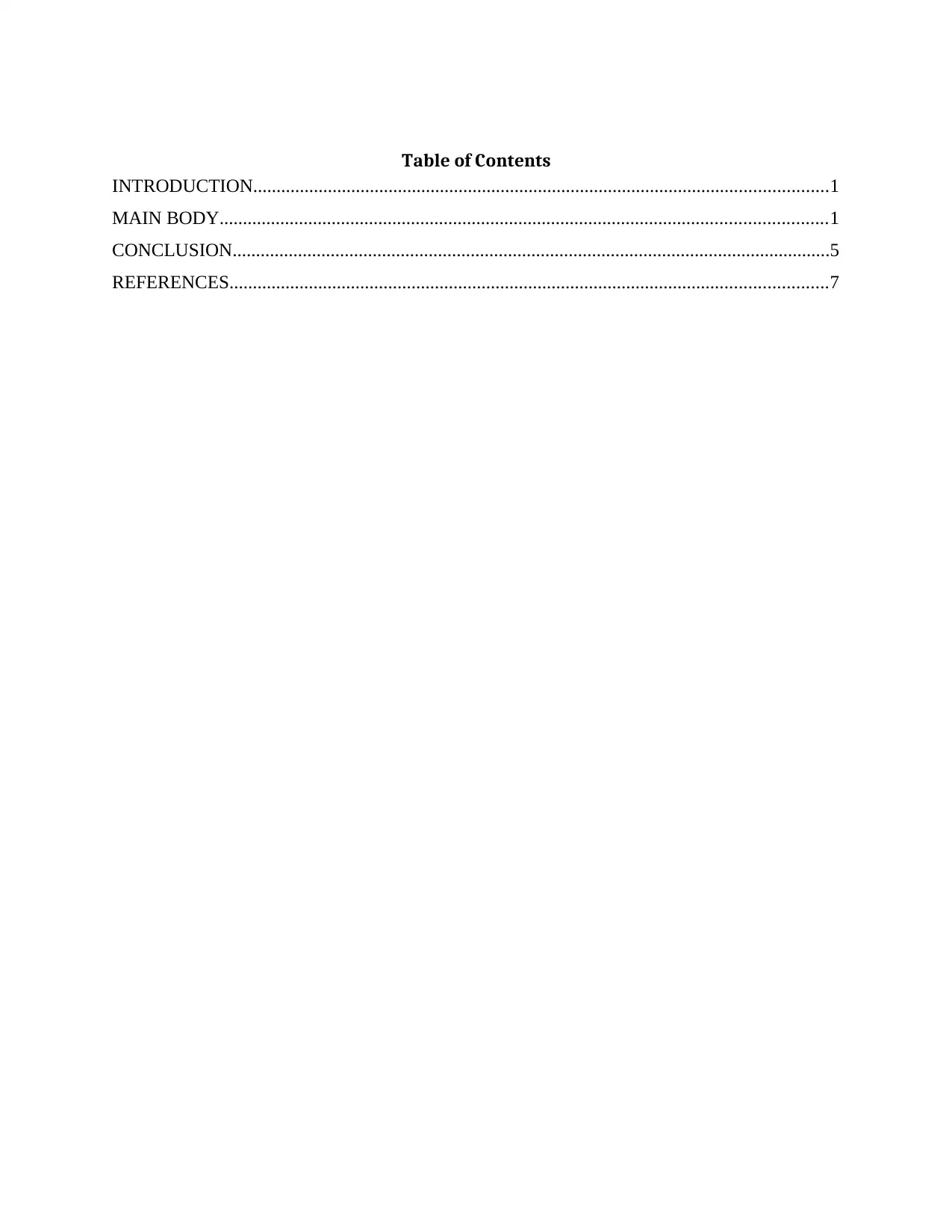
Table of Contents
INTRODUCTION...........................................................................................................................1
MAIN BODY..................................................................................................................................1
CONCLUSION................................................................................................................................5
REFERENCES................................................................................................................................7
INTRODUCTION...........................................................................................................................1
MAIN BODY..................................................................................................................................1
CONCLUSION................................................................................................................................5
REFERENCES................................................................................................................................7
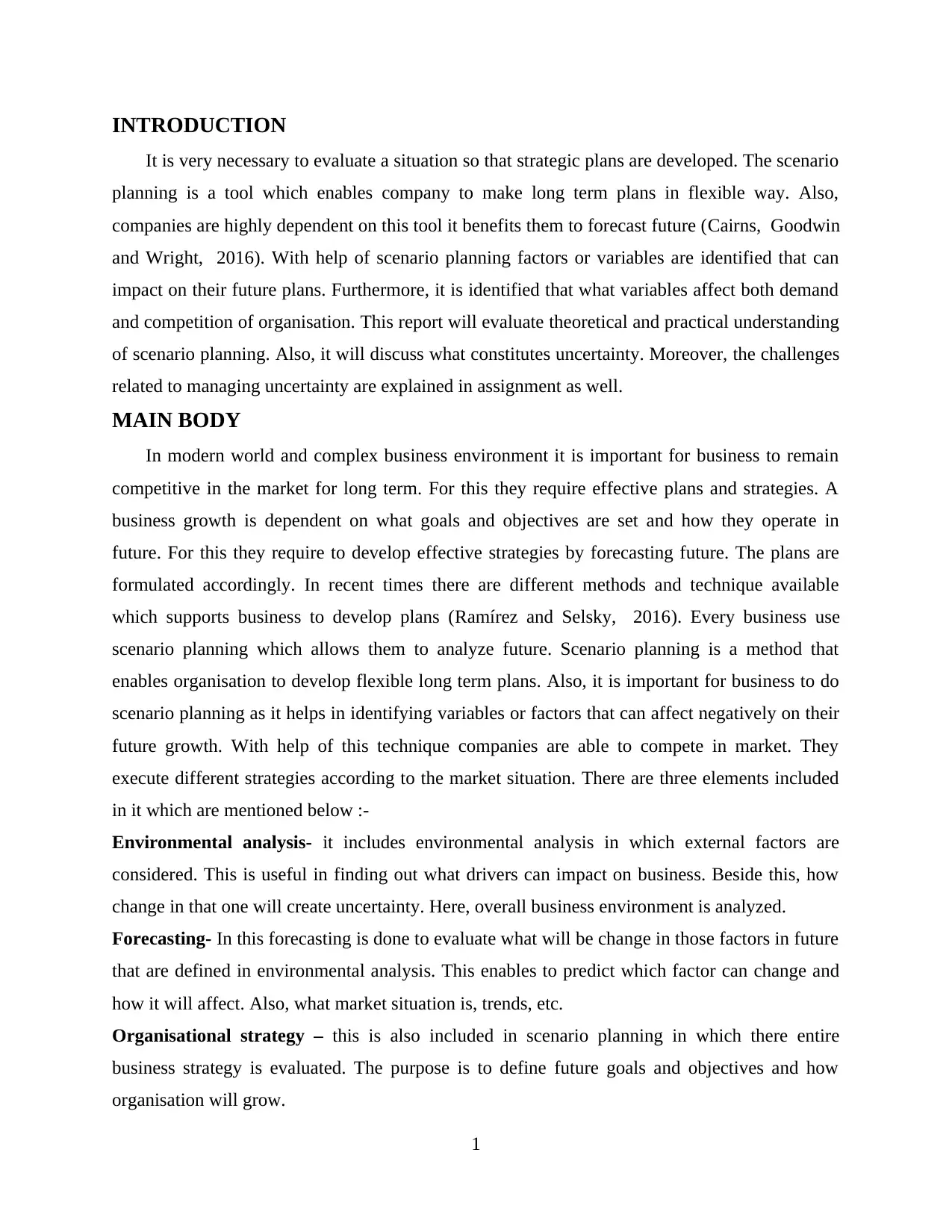
INTRODUCTION
It is very necessary to evaluate a situation so that strategic plans are developed. The scenario
planning is a tool which enables company to make long term plans in flexible way. Also,
companies are highly dependent on this tool it benefits them to forecast future (Cairns, Goodwin
and Wright, 2016). With help of scenario planning factors or variables are identified that can
impact on their future plans. Furthermore, it is identified that what variables affect both demand
and competition of organisation. This report will evaluate theoretical and practical understanding
of scenario planning. Also, it will discuss what constitutes uncertainty. Moreover, the challenges
related to managing uncertainty are explained in assignment as well.
MAIN BODY
In modern world and complex business environment it is important for business to remain
competitive in the market for long term. For this they require effective plans and strategies. A
business growth is dependent on what goals and objectives are set and how they operate in
future. For this they require to develop effective strategies by forecasting future. The plans are
formulated accordingly. In recent times there are different methods and technique available
which supports business to develop plans (Ramírez and Selsky, 2016). Every business use
scenario planning which allows them to analyze future. Scenario planning is a method that
enables organisation to develop flexible long term plans. Also, it is important for business to do
scenario planning as it helps in identifying variables or factors that can affect negatively on their
future growth. With help of this technique companies are able to compete in market. They
execute different strategies according to the market situation. There are three elements included
in it which are mentioned below :-
Environmental analysis- it includes environmental analysis in which external factors are
considered. This is useful in finding out what drivers can impact on business. Beside this, how
change in that one will create uncertainty. Here, overall business environment is analyzed.
Forecasting- In this forecasting is done to evaluate what will be change in those factors in future
that are defined in environmental analysis. This enables to predict which factor can change and
how it will affect. Also, what market situation is, trends, etc.
Organisational strategy – this is also included in scenario planning in which there entire
business strategy is evaluated. The purpose is to define future goals and objectives and how
organisation will grow.
1
It is very necessary to evaluate a situation so that strategic plans are developed. The scenario
planning is a tool which enables company to make long term plans in flexible way. Also,
companies are highly dependent on this tool it benefits them to forecast future (Cairns, Goodwin
and Wright, 2016). With help of scenario planning factors or variables are identified that can
impact on their future plans. Furthermore, it is identified that what variables affect both demand
and competition of organisation. This report will evaluate theoretical and practical understanding
of scenario planning. Also, it will discuss what constitutes uncertainty. Moreover, the challenges
related to managing uncertainty are explained in assignment as well.
MAIN BODY
In modern world and complex business environment it is important for business to remain
competitive in the market for long term. For this they require effective plans and strategies. A
business growth is dependent on what goals and objectives are set and how they operate in
future. For this they require to develop effective strategies by forecasting future. The plans are
formulated accordingly. In recent times there are different methods and technique available
which supports business to develop plans (Ramírez and Selsky, 2016). Every business use
scenario planning which allows them to analyze future. Scenario planning is a method that
enables organisation to develop flexible long term plans. Also, it is important for business to do
scenario planning as it helps in identifying variables or factors that can affect negatively on their
future growth. With help of this technique companies are able to compete in market. They
execute different strategies according to the market situation. There are three elements included
in it which are mentioned below :-
Environmental analysis- it includes environmental analysis in which external factors are
considered. This is useful in finding out what drivers can impact on business. Beside this, how
change in that one will create uncertainty. Here, overall business environment is analyzed.
Forecasting- In this forecasting is done to evaluate what will be change in those factors in future
that are defined in environmental analysis. This enables to predict which factor can change and
how it will affect. Also, what market situation is, trends, etc.
Organisational strategy – this is also included in scenario planning in which there entire
business strategy is evaluated. The purpose is to define future goals and objectives and how
organisation will grow.
1
⊘ This is a preview!⊘
Do you want full access?
Subscribe today to unlock all pages.

Trusted by 1+ million students worldwide
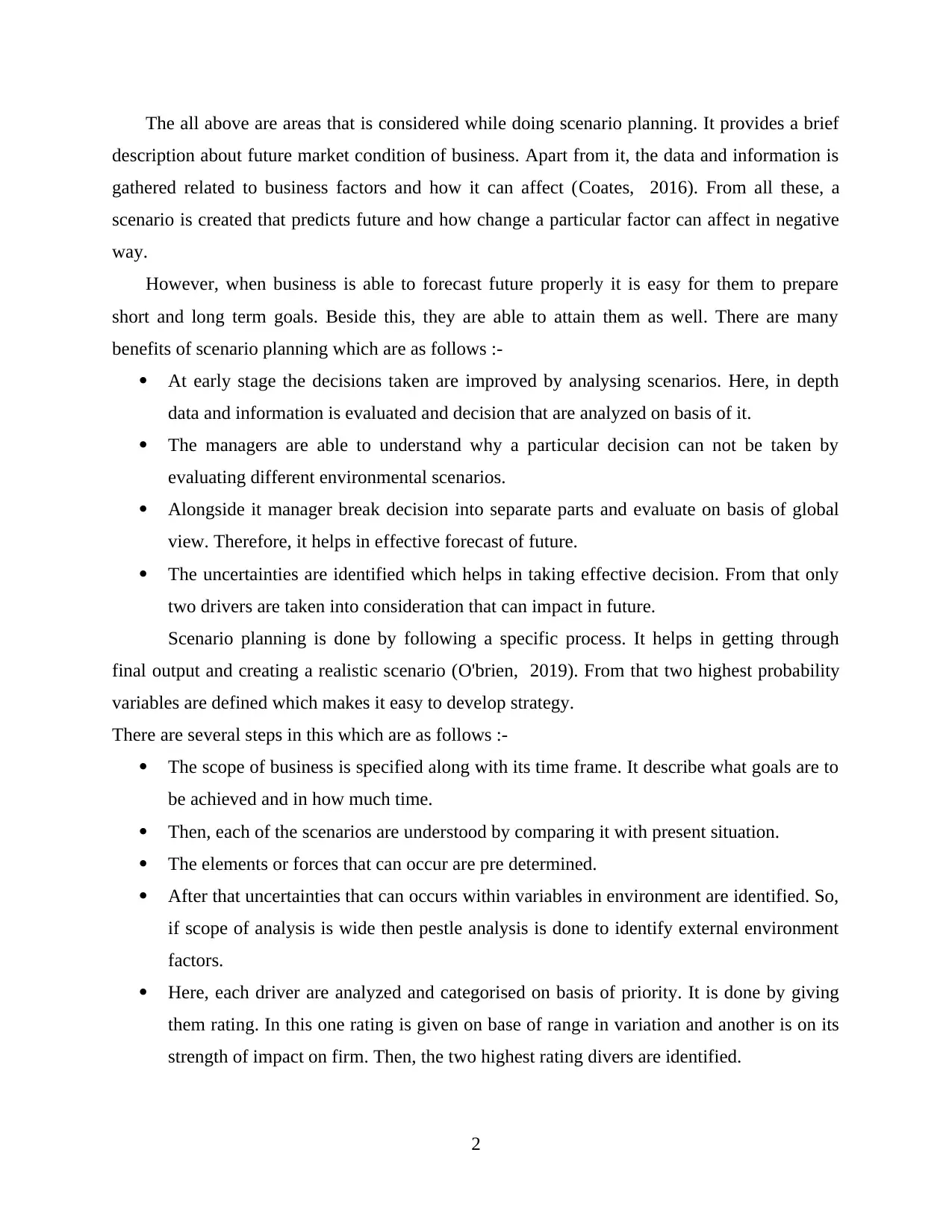
The all above are areas that is considered while doing scenario planning. It provides a brief
description about future market condition of business. Apart from it, the data and information is
gathered related to business factors and how it can affect (Coates, 2016). From all these, a
scenario is created that predicts future and how change a particular factor can affect in negative
way.
However, when business is able to forecast future properly it is easy for them to prepare
short and long term goals. Beside this, they are able to attain them as well. There are many
benefits of scenario planning which are as follows :-
At early stage the decisions taken are improved by analysing scenarios. Here, in depth
data and information is evaluated and decision that are analyzed on basis of it.
The managers are able to understand why a particular decision can not be taken by
evaluating different environmental scenarios.
Alongside it manager break decision into separate parts and evaluate on basis of global
view. Therefore, it helps in effective forecast of future.
The uncertainties are identified which helps in taking effective decision. From that only
two drivers are taken into consideration that can impact in future.
Scenario planning is done by following a specific process. It helps in getting through
final output and creating a realistic scenario (O'brien, 2019). From that two highest probability
variables are defined which makes it easy to develop strategy.
There are several steps in this which are as follows :-
The scope of business is specified along with its time frame. It describe what goals are to
be achieved and in how much time.
Then, each of the scenarios are understood by comparing it with present situation.
The elements or forces that can occur are pre determined.
After that uncertainties that can occurs within variables in environment are identified. So,
if scope of analysis is wide then pestle analysis is done to identify external environment
factors.
Here, each driver are analyzed and categorised on basis of priority. It is done by giving
them rating. In this one rating is given on base of range in variation and another is on its
strength of impact on firm. Then, the two highest rating divers are identified.
2
description about future market condition of business. Apart from it, the data and information is
gathered related to business factors and how it can affect (Coates, 2016). From all these, a
scenario is created that predicts future and how change a particular factor can affect in negative
way.
However, when business is able to forecast future properly it is easy for them to prepare
short and long term goals. Beside this, they are able to attain them as well. There are many
benefits of scenario planning which are as follows :-
At early stage the decisions taken are improved by analysing scenarios. Here, in depth
data and information is evaluated and decision that are analyzed on basis of it.
The managers are able to understand why a particular decision can not be taken by
evaluating different environmental scenarios.
Alongside it manager break decision into separate parts and evaluate on basis of global
view. Therefore, it helps in effective forecast of future.
The uncertainties are identified which helps in taking effective decision. From that only
two drivers are taken into consideration that can impact in future.
Scenario planning is done by following a specific process. It helps in getting through
final output and creating a realistic scenario (O'brien, 2019). From that two highest probability
variables are defined which makes it easy to develop strategy.
There are several steps in this which are as follows :-
The scope of business is specified along with its time frame. It describe what goals are to
be achieved and in how much time.
Then, each of the scenarios are understood by comparing it with present situation.
The elements or forces that can occur are pre determined.
After that uncertainties that can occurs within variables in environment are identified. So,
if scope of analysis is wide then pestle analysis is done to identify external environment
factors.
Here, each driver are analyzed and categorised on basis of priority. It is done by giving
them rating. In this one rating is given on base of range in variation and another is on its
strength of impact on firm. Then, the two highest rating divers are identified.
2
Paraphrase This Document
Need a fresh take? Get an instant paraphrase of this document with our AI Paraphraser
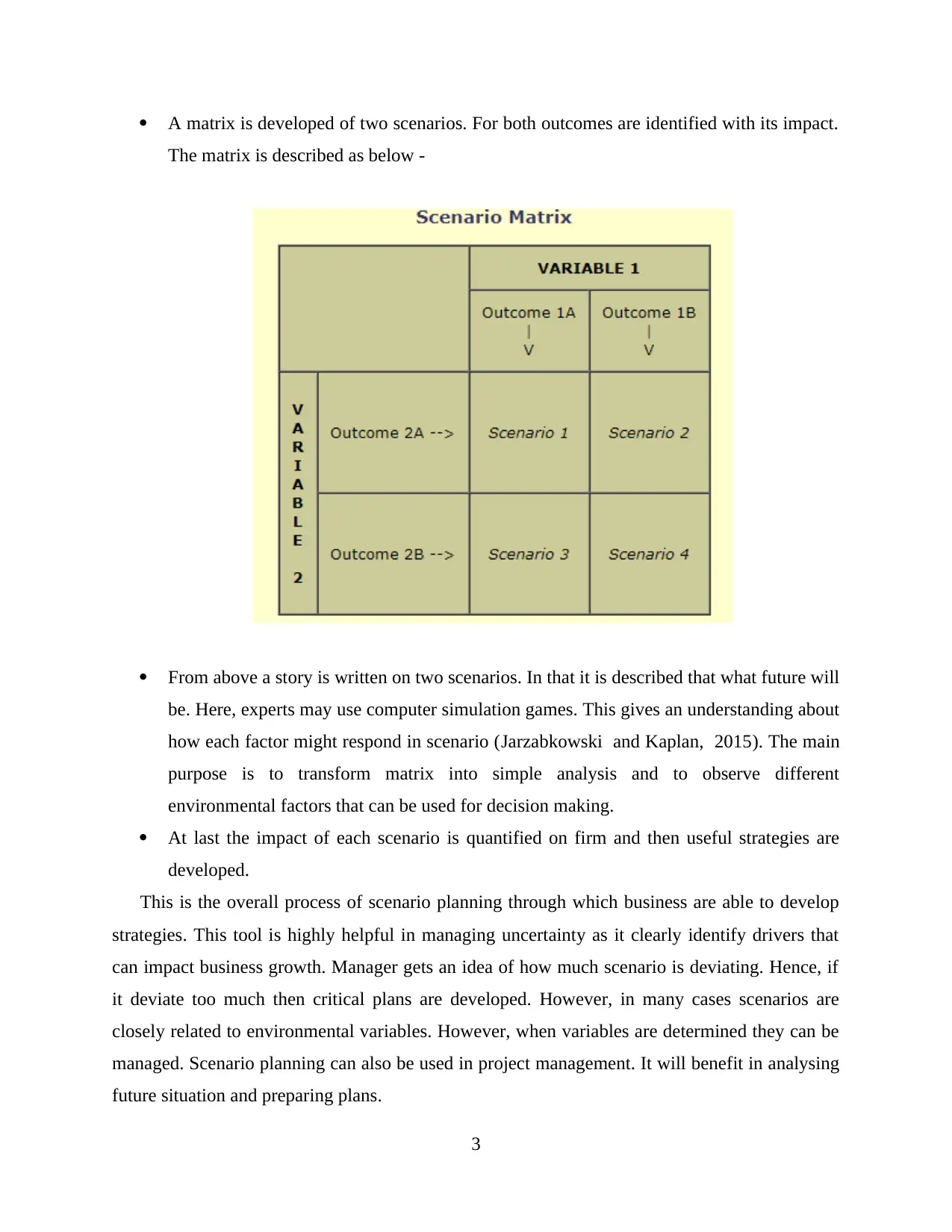
A matrix is developed of two scenarios. For both outcomes are identified with its impact.
The matrix is described as below -
From above a story is written on two scenarios. In that it is described that what future will
be. Here, experts may use computer simulation games. This gives an understanding about
how each factor might respond in scenario (Jarzabkowski and Kaplan, 2015). The main
purpose is to transform matrix into simple analysis and to observe different
environmental factors that can be used for decision making.
At last the impact of each scenario is quantified on firm and then useful strategies are
developed.
This is the overall process of scenario planning through which business are able to develop
strategies. This tool is highly helpful in managing uncertainty as it clearly identify drivers that
can impact business growth. Manager gets an idea of how much scenario is deviating. Hence, if
it deviate too much then critical plans are developed. However, in many cases scenarios are
closely related to environmental variables. However, when variables are determined they can be
managed. Scenario planning can also be used in project management. It will benefit in analysing
future situation and preparing plans.
3
The matrix is described as below -
From above a story is written on two scenarios. In that it is described that what future will
be. Here, experts may use computer simulation games. This gives an understanding about
how each factor might respond in scenario (Jarzabkowski and Kaplan, 2015). The main
purpose is to transform matrix into simple analysis and to observe different
environmental factors that can be used for decision making.
At last the impact of each scenario is quantified on firm and then useful strategies are
developed.
This is the overall process of scenario planning through which business are able to develop
strategies. This tool is highly helpful in managing uncertainty as it clearly identify drivers that
can impact business growth. Manager gets an idea of how much scenario is deviating. Hence, if
it deviate too much then critical plans are developed. However, in many cases scenarios are
closely related to environmental variables. However, when variables are determined they can be
managed. Scenario planning can also be used in project management. It will benefit in analysing
future situation and preparing plans.
3
In business uncertainty can be caused due to change in various conditions. Thus, it is not
predictable that what uncertainty may occur and how it might affect business (Lyons and
Davidson, 2016). For instance, there might be change in economic condition or recession which
can bring drastic consequences on business. So, here the recession is uncertain as it is not
predictable. Another example can be taken is shift in consumer behaviour. A sudden change in
consumer demand will become a variable for business. Uncertainty refers to situation which is
not predictable and can create a negative impact on business. Uncertainty includes many
elements that are comprised below :-
(1) A choice of action or an exposure to loss- This element includes any possibility of loss that
can occur in future. Exposure of loss can be anything like financial loss. It states that the
probability of any loss will impact on finance of business. The loss is related to specific type of
risk.
(2) A negativity of outcome or magnitude of loss- It states the potential impact of loss due to
uncertainty. The loss can be high or low as it depends on situation. Magnitude of loss also
depends in type and nature of driver. It shows how there is need to change
(3) A chance of realisation or chance of loss- It refers to probability or likelihood of occurring of
event. The higher probability reflects that chances of occurring loss is high as well.
Therefore, these all elements constitute uncertainty. It identifies likelihood and impact of
loss on happening of particular event. By this drivers are separated and given rating on basis of
their impact and magnitude. The technique is effective to find out drivers and benefits in
overcoming its negative impact by executing plans and strategies. The overall situation is
analyzed in depth and accordingly measures are taken.
The main challenge business face is they are not able to manage uncertainty. Due to this
scenario planning is not done properly and plans are not executed. It is essential to manage
uncertainty so that strategies can be implemented and goals are attained (Van Staveren, 2018). If
uncertainty is not managed it will impact on business negatively. But there are many challenges
due to which uncertainty is not managed. They are described below :-
Undefined consequences- It is the major challenge which occurs during managing uncertainty.
Here, it is difficult to identify what will be the consequences in future. Even if in scenario
planning the overall situation is explained in detailed but it may not be accurate that particularly
this thing will happen. However, if those plans or strategies are implemented then also results
4
predictable that what uncertainty may occur and how it might affect business (Lyons and
Davidson, 2016). For instance, there might be change in economic condition or recession which
can bring drastic consequences on business. So, here the recession is uncertain as it is not
predictable. Another example can be taken is shift in consumer behaviour. A sudden change in
consumer demand will become a variable for business. Uncertainty refers to situation which is
not predictable and can create a negative impact on business. Uncertainty includes many
elements that are comprised below :-
(1) A choice of action or an exposure to loss- This element includes any possibility of loss that
can occur in future. Exposure of loss can be anything like financial loss. It states that the
probability of any loss will impact on finance of business. The loss is related to specific type of
risk.
(2) A negativity of outcome or magnitude of loss- It states the potential impact of loss due to
uncertainty. The loss can be high or low as it depends on situation. Magnitude of loss also
depends in type and nature of driver. It shows how there is need to change
(3) A chance of realisation or chance of loss- It refers to probability or likelihood of occurring of
event. The higher probability reflects that chances of occurring loss is high as well.
Therefore, these all elements constitute uncertainty. It identifies likelihood and impact of
loss on happening of particular event. By this drivers are separated and given rating on basis of
their impact and magnitude. The technique is effective to find out drivers and benefits in
overcoming its negative impact by executing plans and strategies. The overall situation is
analyzed in depth and accordingly measures are taken.
The main challenge business face is they are not able to manage uncertainty. Due to this
scenario planning is not done properly and plans are not executed. It is essential to manage
uncertainty so that strategies can be implemented and goals are attained (Van Staveren, 2018). If
uncertainty is not managed it will impact on business negatively. But there are many challenges
due to which uncertainty is not managed. They are described below :-
Undefined consequences- It is the major challenge which occurs during managing uncertainty.
Here, it is difficult to identify what will be the consequences in future. Even if in scenario
planning the overall situation is explained in detailed but it may not be accurate that particularly
this thing will happen. However, if those plans or strategies are implemented then also results
4
⊘ This is a preview!⊘
Do you want full access?
Subscribe today to unlock all pages.
Trusted by 1+ million students worldwide
can be worse. Hence, in order to manage uncertainty undefined consequences are challenges. In
this the nature of consequence is not known.
For example- there is an uncertainty that financial loss can occur so effective strategy and plans
are prepared. Furthermore, the probability is identified of magnitude of loss but here the
consequences are undefined. It may not be in favour of scenario that is prepared.
Outcomes can not be assigned – this is another challenge due to which uncertainty can not be
managed. When strategies are developed it is not analyzed that how outcomes is to be assigned.
This means that changes that occur due to situation is not predicted.
For instance – if there is change in tax policy then possibilities are evaluated. But the outcomes
are not evaluated that whether what will happen when tax policy is changed.
Due to these challenge it is difficult to manage uncertainty. It restricts business to
develop plans but there is still negative impact of uncertainty on business. The major concern is
to predict consequence. For every uncertain situation it requires to understand that what will be
its consequence. Thus on basis of this likelihood of outcome is identified (Heckmann, Comes
and Nickel, 2015). Moreover, business should have capacity to identify challenge so that
uncertainty is maintained. There should be proper integration of scenario planning so that
uncertainty is managed. In addition to it, for many times there are some other variables as well
due to which uncertainty is not managed. It may not be managed with change in things.
Alongside it, short term plans are prepared. They are easily been adapted by business in future.
Manager use strategic thinking to analyze scenario.
But on contrary it is stated that many times scenario planning is not useful to understand
uncertainty (Coates, 2016). This is because the external environment factors are fluctuating
which makes difficult to analyze it. However, for small business uncertainty exists and even they
implement strategy outcomes are not attained. It may affect business goals as they are not
achieved. Along with it, in critical situation the plans developed does not work. The impact of
consequence is more than expected. Also, sometime the variables whose likelihood is less can
occur in uncertainty. Thus, scenario planning is not effective in situation where market condition
and external factors highly influence.
CONCLUSION
From above it can be concluded that scenario planning is a technique used by business to
visualise long term growth by developing strategic plans. It helps them to find out variables that
5
this the nature of consequence is not known.
For example- there is an uncertainty that financial loss can occur so effective strategy and plans
are prepared. Furthermore, the probability is identified of magnitude of loss but here the
consequences are undefined. It may not be in favour of scenario that is prepared.
Outcomes can not be assigned – this is another challenge due to which uncertainty can not be
managed. When strategies are developed it is not analyzed that how outcomes is to be assigned.
This means that changes that occur due to situation is not predicted.
For instance – if there is change in tax policy then possibilities are evaluated. But the outcomes
are not evaluated that whether what will happen when tax policy is changed.
Due to these challenge it is difficult to manage uncertainty. It restricts business to
develop plans but there is still negative impact of uncertainty on business. The major concern is
to predict consequence. For every uncertain situation it requires to understand that what will be
its consequence. Thus on basis of this likelihood of outcome is identified (Heckmann, Comes
and Nickel, 2015). Moreover, business should have capacity to identify challenge so that
uncertainty is maintained. There should be proper integration of scenario planning so that
uncertainty is managed. In addition to it, for many times there are some other variables as well
due to which uncertainty is not managed. It may not be managed with change in things.
Alongside it, short term plans are prepared. They are easily been adapted by business in future.
Manager use strategic thinking to analyze scenario.
But on contrary it is stated that many times scenario planning is not useful to understand
uncertainty (Coates, 2016). This is because the external environment factors are fluctuating
which makes difficult to analyze it. However, for small business uncertainty exists and even they
implement strategy outcomes are not attained. It may affect business goals as they are not
achieved. Along with it, in critical situation the plans developed does not work. The impact of
consequence is more than expected. Also, sometime the variables whose likelihood is less can
occur in uncertainty. Thus, scenario planning is not effective in situation where market condition
and external factors highly influence.
CONCLUSION
From above it can be concluded that scenario planning is a technique used by business to
visualise long term growth by developing strategic plans. It helps them to find out variables that
5
Paraphrase This Document
Need a fresh take? Get an instant paraphrase of this document with our AI Paraphraser
impact on their growth. Moreover, uncertainty is constituted of three elements that are exposure
to loss, magnitude of loss and chance of loss. These all describe uncertainty meaning and its
variability. There are several challenges which occurs in managing uncertainty such as undefined
consequence and outcomes can not be assigned. Due to this situation is not evaluated properly
and it plans developed gets failed.
6
to loss, magnitude of loss and chance of loss. These all describe uncertainty meaning and its
variability. There are several challenges which occurs in managing uncertainty such as undefined
consequence and outcomes can not be assigned. Due to this situation is not evaluated properly
and it plans developed gets failed.
6
REFERENCES
Books and Journals
Cairns, G., Goodwin, P. and Wright, G., 2016. A decision-analysis-based framework for
analysing stakeholder behaviour in scenario planning. European Journal of Operational
Research, 249(3), pp.1050-1062.
Coates, J.F., 2016. Scenario planning. Technological forecasting and social change. 113. pp.99-
102.
Heckmann, I., Comes, T. and Nickel, S., 2015. A critical review on supply chain risk–Definition,
measure and modeling. Omega. 52. pp.119-132.
Jarzabkowski, P. and Kaplan, S., 2015. Strategy tools‐in‐use: A framework for understanding
“technologies of rationality” in practice. Strategic management journal 36(4). pp.537-
558.
Lyons, G. and Davidson, C., 2016. Guidance for transport planning and policymaking in the face
of an uncertain future. Transportation Research Part A: Policy and Practice 88. pp.104-
116.
O'brien, J., 2019. Category management in purchasing: a strategic approach to maximize
business profitability. Kogan Page Publishers.
Ramírez, R. and Selsky, J.W., 2016. Strategic planning in turbulent environments: A social
ecology approach to scenarios. Long Range Planning. 49(1). pp.90-102.
Van Staveren, M., 2018. Uncertainty and ground conditions: a risk management approach. CRC
Press.
Online
[online] Available through : <>
7
Books and Journals
Cairns, G., Goodwin, P. and Wright, G., 2016. A decision-analysis-based framework for
analysing stakeholder behaviour in scenario planning. European Journal of Operational
Research, 249(3), pp.1050-1062.
Coates, J.F., 2016. Scenario planning. Technological forecasting and social change. 113. pp.99-
102.
Heckmann, I., Comes, T. and Nickel, S., 2015. A critical review on supply chain risk–Definition,
measure and modeling. Omega. 52. pp.119-132.
Jarzabkowski, P. and Kaplan, S., 2015. Strategy tools‐in‐use: A framework for understanding
“technologies of rationality” in practice. Strategic management journal 36(4). pp.537-
558.
Lyons, G. and Davidson, C., 2016. Guidance for transport planning and policymaking in the face
of an uncertain future. Transportation Research Part A: Policy and Practice 88. pp.104-
116.
O'brien, J., 2019. Category management in purchasing: a strategic approach to maximize
business profitability. Kogan Page Publishers.
Ramírez, R. and Selsky, J.W., 2016. Strategic planning in turbulent environments: A social
ecology approach to scenarios. Long Range Planning. 49(1). pp.90-102.
Van Staveren, M., 2018. Uncertainty and ground conditions: a risk management approach. CRC
Press.
Online
[online] Available through : <>
7
⊘ This is a preview!⊘
Do you want full access?
Subscribe today to unlock all pages.
Trusted by 1+ million students worldwide

1 out of 9


Related Documents


Your All-in-One AI-Powered Toolkit for Academic Success.
+13062052269
info@desklib.com
Available 24*7 on WhatsApp / Email
![[object Object]](/_next/static/media/star-bottom.7253800d.svg)
Unlock your academic potential
Copyright © 2020–2026 A2Z Services. All Rights Reserved. Developed and managed by ZUCOL.