Essay: Schlick and Schopenhauer on the Meaning of Human Existence
VerifiedAdded on 2023/04/21
|8
|2121
|112
Essay
AI Summary
This essay delves into the contrasting philosophical perspectives of Moritz Schlick and Arthur Schopenhauer on the meaning of life. It begins by outlining Schlick's viewpoint, rooted in logical positivism, which emphasizes the importance of play and freedom from external purposes in finding meaning. The essay then explores Schopenhauer's pessimistic view, influenced by Kant, which posits that life is inherently filled with suffering and that the will to live is the primary source of this suffering. The core of the essay then examines how Schlick might respond to Schopenhauer's ideas, highlighting their fundamental disagreements, particularly regarding the role of playful activities versus the acceptance of suffering. The essay concludes by summarizing the divergent attitudes of the two philosophers, emphasizing their differing interpretations of what constitutes a meaningful human existence, and provides a detailed bibliography. The essay adheres to the guidelines set for the PHIL 3030 course at Trent University, including word count and citation requirements.
Running head: SCHLICK'S UNDERSTANDING OF MEANING OF LIFE
SCHLICK'S UNDERSTANDING OF MEANING OF LIFE
Name of the Student
Name of the University
Author Note
SCHLICK'S UNDERSTANDING OF MEANING OF LIFE
Name of the Student
Name of the University
Author Note

Paraphrase This Document
Need a fresh take? Get an instant paraphrase of this document with our AI Paraphraser
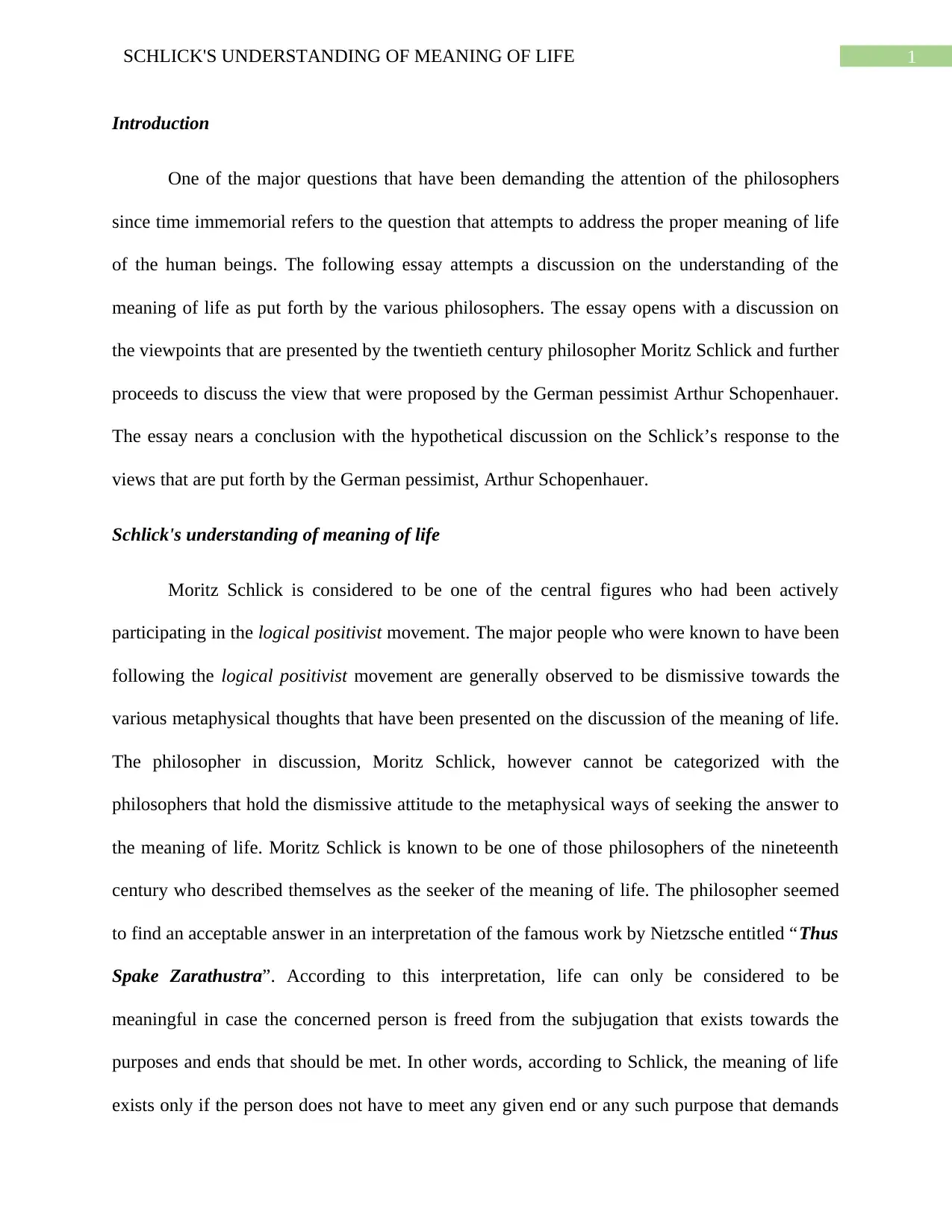
1SCHLICK'S UNDERSTANDING OF MEANING OF LIFE
Introduction
One of the major questions that have been demanding the attention of the philosophers
since time immemorial refers to the question that attempts to address the proper meaning of life
of the human beings. The following essay attempts a discussion on the understanding of the
meaning of life as put forth by the various philosophers. The essay opens with a discussion on
the viewpoints that are presented by the twentieth century philosopher Moritz Schlick and further
proceeds to discuss the view that were proposed by the German pessimist Arthur Schopenhauer.
The essay nears a conclusion with the hypothetical discussion on the Schlick’s response to the
views that are put forth by the German pessimist, Arthur Schopenhauer.
Schlick's understanding of meaning of life
Moritz Schlick is considered to be one of the central figures who had been actively
participating in the logical positivist movement. The major people who were known to have been
following the logical positivist movement are generally observed to be dismissive towards the
various metaphysical thoughts that have been presented on the discussion of the meaning of life.
The philosopher in discussion, Moritz Schlick, however cannot be categorized with the
philosophers that hold the dismissive attitude to the metaphysical ways of seeking the answer to
the meaning of life. Moritz Schlick is known to be one of those philosophers of the nineteenth
century who described themselves as the seeker of the meaning of life. The philosopher seemed
to find an acceptable answer in an interpretation of the famous work by Nietzsche entitled “Thus
Spake Zarathustra”. According to this interpretation, life can only be considered to be
meaningful in case the concerned person is freed from the subjugation that exists towards the
purposes and ends that should be met. In other words, according to Schlick, the meaning of life
exists only if the person does not have to meet any given end or any such purpose that demands
Introduction
One of the major questions that have been demanding the attention of the philosophers
since time immemorial refers to the question that attempts to address the proper meaning of life
of the human beings. The following essay attempts a discussion on the understanding of the
meaning of life as put forth by the various philosophers. The essay opens with a discussion on
the viewpoints that are presented by the twentieth century philosopher Moritz Schlick and further
proceeds to discuss the view that were proposed by the German pessimist Arthur Schopenhauer.
The essay nears a conclusion with the hypothetical discussion on the Schlick’s response to the
views that are put forth by the German pessimist, Arthur Schopenhauer.
Schlick's understanding of meaning of life
Moritz Schlick is considered to be one of the central figures who had been actively
participating in the logical positivist movement. The major people who were known to have been
following the logical positivist movement are generally observed to be dismissive towards the
various metaphysical thoughts that have been presented on the discussion of the meaning of life.
The philosopher in discussion, Moritz Schlick, however cannot be categorized with the
philosophers that hold the dismissive attitude to the metaphysical ways of seeking the answer to
the meaning of life. Moritz Schlick is known to be one of those philosophers of the nineteenth
century who described themselves as the seeker of the meaning of life. The philosopher seemed
to find an acceptable answer in an interpretation of the famous work by Nietzsche entitled “Thus
Spake Zarathustra”. According to this interpretation, life can only be considered to be
meaningful in case the concerned person is freed from the subjugation that exists towards the
purposes and ends that should be met. In other words, according to Schlick, the meaning of life
exists only if the person does not have to meet any given end or any such purpose that demands
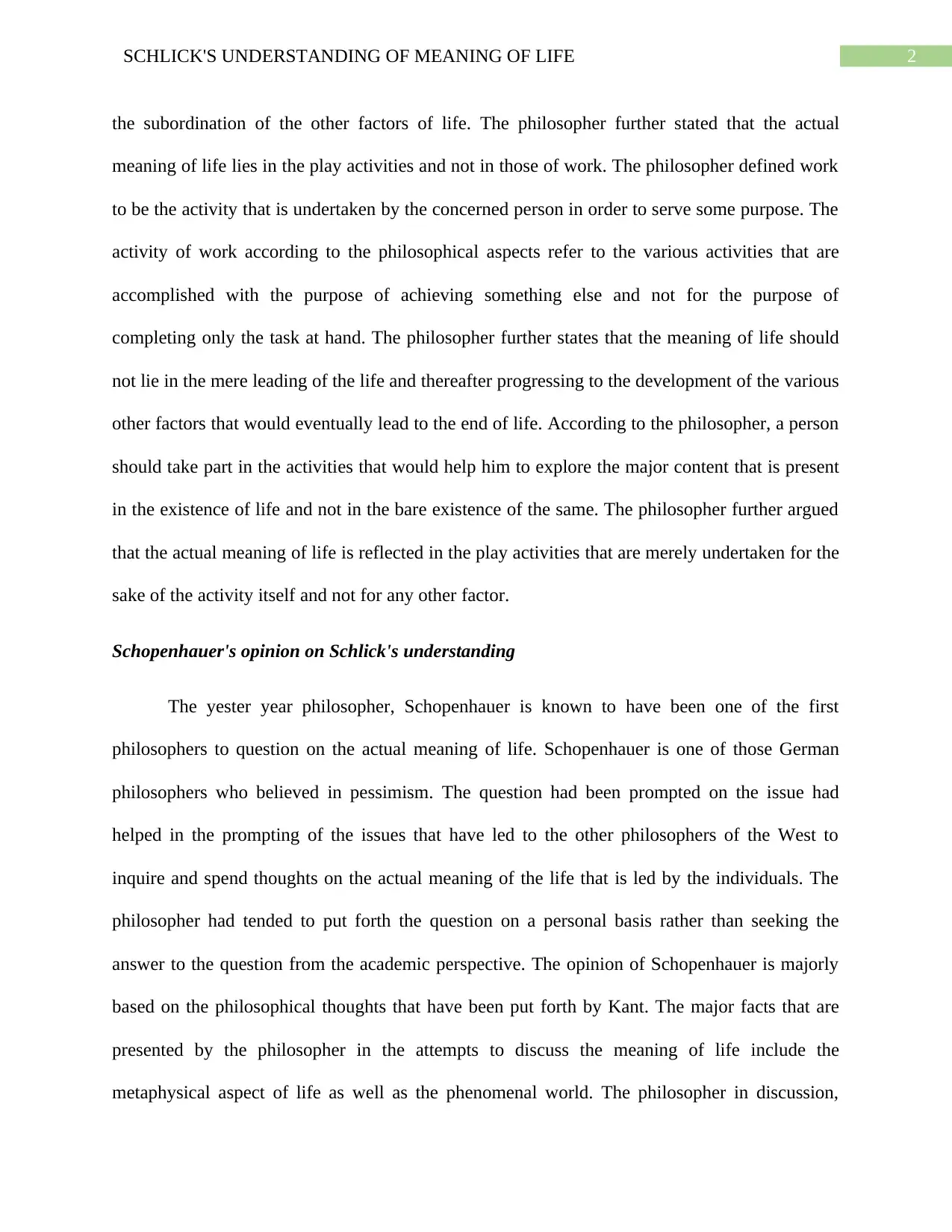
2SCHLICK'S UNDERSTANDING OF MEANING OF LIFE
the subordination of the other factors of life. The philosopher further stated that the actual
meaning of life lies in the play activities and not in those of work. The philosopher defined work
to be the activity that is undertaken by the concerned person in order to serve some purpose. The
activity of work according to the philosophical aspects refer to the various activities that are
accomplished with the purpose of achieving something else and not for the purpose of
completing only the task at hand. The philosopher further states that the meaning of life should
not lie in the mere leading of the life and thereafter progressing to the development of the various
other factors that would eventually lead to the end of life. According to the philosopher, a person
should take part in the activities that would help him to explore the major content that is present
in the existence of life and not in the bare existence of the same. The philosopher further argued
that the actual meaning of life is reflected in the play activities that are merely undertaken for the
sake of the activity itself and not for any other factor.
Schopenhauer's opinion on Schlick's understanding
The yester year philosopher, Schopenhauer is known to have been one of the first
philosophers to question on the actual meaning of life. Schopenhauer is one of those German
philosophers who believed in pessimism. The question had been prompted on the issue had
helped in the prompting of the issues that have led to the other philosophers of the West to
inquire and spend thoughts on the actual meaning of the life that is led by the individuals. The
philosopher had tended to put forth the question on a personal basis rather than seeking the
answer to the question from the academic perspective. The opinion of Schopenhauer is majorly
based on the philosophical thoughts that have been put forth by Kant. The major facts that are
presented by the philosopher in the attempts to discuss the meaning of life include the
metaphysical aspect of life as well as the phenomenal world. The philosopher in discussion,
the subordination of the other factors of life. The philosopher further stated that the actual
meaning of life lies in the play activities and not in those of work. The philosopher defined work
to be the activity that is undertaken by the concerned person in order to serve some purpose. The
activity of work according to the philosophical aspects refer to the various activities that are
accomplished with the purpose of achieving something else and not for the purpose of
completing only the task at hand. The philosopher further states that the meaning of life should
not lie in the mere leading of the life and thereafter progressing to the development of the various
other factors that would eventually lead to the end of life. According to the philosopher, a person
should take part in the activities that would help him to explore the major content that is present
in the existence of life and not in the bare existence of the same. The philosopher further argued
that the actual meaning of life is reflected in the play activities that are merely undertaken for the
sake of the activity itself and not for any other factor.
Schopenhauer's opinion on Schlick's understanding
The yester year philosopher, Schopenhauer is known to have been one of the first
philosophers to question on the actual meaning of life. Schopenhauer is one of those German
philosophers who believed in pessimism. The question had been prompted on the issue had
helped in the prompting of the issues that have led to the other philosophers of the West to
inquire and spend thoughts on the actual meaning of the life that is led by the individuals. The
philosopher had tended to put forth the question on a personal basis rather than seeking the
answer to the question from the academic perspective. The opinion of Schopenhauer is majorly
based on the philosophical thoughts that have been put forth by Kant. The major facts that are
presented by the philosopher in the attempts to discuss the meaning of life include the
metaphysical aspect of life as well as the phenomenal world. The philosopher in discussion,
⊘ This is a preview!⊘
Do you want full access?
Subscribe today to unlock all pages.

Trusted by 1+ million students worldwide
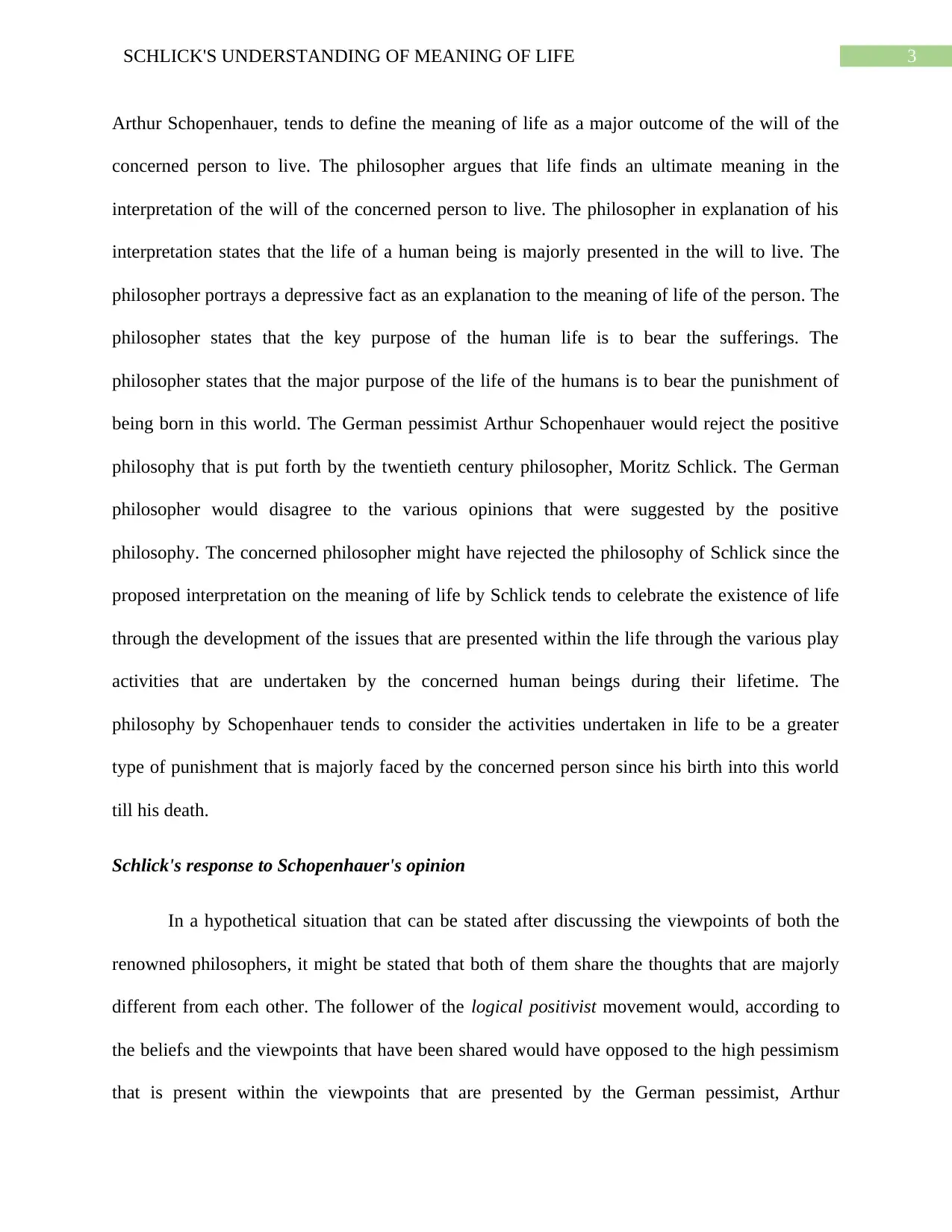
3SCHLICK'S UNDERSTANDING OF MEANING OF LIFE
Arthur Schopenhauer, tends to define the meaning of life as a major outcome of the will of the
concerned person to live. The philosopher argues that life finds an ultimate meaning in the
interpretation of the will of the concerned person to live. The philosopher in explanation of his
interpretation states that the life of a human being is majorly presented in the will to live. The
philosopher portrays a depressive fact as an explanation to the meaning of life of the person. The
philosopher states that the key purpose of the human life is to bear the sufferings. The
philosopher states that the major purpose of the life of the humans is to bear the punishment of
being born in this world. The German pessimist Arthur Schopenhauer would reject the positive
philosophy that is put forth by the twentieth century philosopher, Moritz Schlick. The German
philosopher would disagree to the various opinions that were suggested by the positive
philosophy. The concerned philosopher might have rejected the philosophy of Schlick since the
proposed interpretation on the meaning of life by Schlick tends to celebrate the existence of life
through the development of the issues that are presented within the life through the various play
activities that are undertaken by the concerned human beings during their lifetime. The
philosophy by Schopenhauer tends to consider the activities undertaken in life to be a greater
type of punishment that is majorly faced by the concerned person since his birth into this world
till his death.
Schlick's response to Schopenhauer's opinion
In a hypothetical situation that can be stated after discussing the viewpoints of both the
renowned philosophers, it might be stated that both of them share the thoughts that are majorly
different from each other. The follower of the logical positivist movement would, according to
the beliefs and the viewpoints that have been shared would have opposed to the high pessimism
that is present within the viewpoints that are presented by the German pessimist, Arthur
Arthur Schopenhauer, tends to define the meaning of life as a major outcome of the will of the
concerned person to live. The philosopher argues that life finds an ultimate meaning in the
interpretation of the will of the concerned person to live. The philosopher in explanation of his
interpretation states that the life of a human being is majorly presented in the will to live. The
philosopher portrays a depressive fact as an explanation to the meaning of life of the person. The
philosopher states that the key purpose of the human life is to bear the sufferings. The
philosopher states that the major purpose of the life of the humans is to bear the punishment of
being born in this world. The German pessimist Arthur Schopenhauer would reject the positive
philosophy that is put forth by the twentieth century philosopher, Moritz Schlick. The German
philosopher would disagree to the various opinions that were suggested by the positive
philosophy. The concerned philosopher might have rejected the philosophy of Schlick since the
proposed interpretation on the meaning of life by Schlick tends to celebrate the existence of life
through the development of the issues that are presented within the life through the various play
activities that are undertaken by the concerned human beings during their lifetime. The
philosophy by Schopenhauer tends to consider the activities undertaken in life to be a greater
type of punishment that is majorly faced by the concerned person since his birth into this world
till his death.
Schlick's response to Schopenhauer's opinion
In a hypothetical situation that can be stated after discussing the viewpoints of both the
renowned philosophers, it might be stated that both of them share the thoughts that are majorly
different from each other. The follower of the logical positivist movement would, according to
the beliefs and the viewpoints that have been shared would have opposed to the high pessimism
that is present within the viewpoints that are presented by the German pessimist, Arthur
Paraphrase This Document
Need a fresh take? Get an instant paraphrase of this document with our AI Paraphraser
4SCHLICK'S UNDERSTANDING OF MEANING OF LIFE
Schopenhauer. Schlick would, according to the hypothetical condition emphasized on the free
will of the concerned person to live his life in a playful manner. The philosopher would have
discussed the factors that stated the positivity presented within the life activities of the person.
The philosopher an ardent follower of the follower of the logical positivist movement would
have majorly emphasized on the fact that the life can only be considered to be meaningful in case
the concerned person is freed from the subjugation that exists towards the purposes and ends that
should be met. This would have led to the conditions of a debate wherein the views expressed by
Moeritz Schlick would have argued and emphasized on the importance of the playful activities
that are undertaken by the humans and the positive effect of continuing with these activities in
order to develop a proper meaning of the life that is presented to the concerned human being.
The pessimism that is presented by the German philosopher, Arthur Schopenhauer tends to
discuss the factors that have been representing the factors that portray life to be a very depressive
activity. The German philosopher further argues on the fact that the life might be made worthy
and meaningful through the complete denial of the will of the person. The pessimist further
argues the fact that the concerned person who has been seeking to lead a meaningful life should
attempt a discussion on the development of the denial of the will within the given person. This
might help the person to remain oblivious to the knowledge of the presence of the will as well as
the several horrific phenomena that results from the knowledge of the will within the person. The
German philosopher further states that the actual meaning of life lies in the denial, the quietening
and eventually the abolishment of the thought on the will of the concerned person towards his or
her own life. This will be helpful in the attainment of the proper perspective towards the meaning
of the life of the person.
Conclusion
Schopenhauer. Schlick would, according to the hypothetical condition emphasized on the free
will of the concerned person to live his life in a playful manner. The philosopher would have
discussed the factors that stated the positivity presented within the life activities of the person.
The philosopher an ardent follower of the follower of the logical positivist movement would
have majorly emphasized on the fact that the life can only be considered to be meaningful in case
the concerned person is freed from the subjugation that exists towards the purposes and ends that
should be met. This would have led to the conditions of a debate wherein the views expressed by
Moeritz Schlick would have argued and emphasized on the importance of the playful activities
that are undertaken by the humans and the positive effect of continuing with these activities in
order to develop a proper meaning of the life that is presented to the concerned human being.
The pessimism that is presented by the German philosopher, Arthur Schopenhauer tends to
discuss the factors that have been representing the factors that portray life to be a very depressive
activity. The German philosopher further argues on the fact that the life might be made worthy
and meaningful through the complete denial of the will of the person. The pessimist further
argues the fact that the concerned person who has been seeking to lead a meaningful life should
attempt a discussion on the development of the denial of the will within the given person. This
might help the person to remain oblivious to the knowledge of the presence of the will as well as
the several horrific phenomena that results from the knowledge of the will within the person. The
German philosopher further states that the actual meaning of life lies in the denial, the quietening
and eventually the abolishment of the thought on the will of the concerned person towards his or
her own life. This will be helpful in the attainment of the proper perspective towards the meaning
of the life of the person.
Conclusion
5SCHLICK'S UNDERSTANDING OF MEANING OF LIFE
Moritz Schlick states that the meaning of life exists only if the person does not have to
meet any given end or any such purpose that demands the subordination of the other factors of
life. The philosopher further stated that the actual meaning of life lies in the play activities and
not in those of work. The philosopher defined work to be the activity that is undertaken by the
concerned person in order to serve some purpose. Arthur Schopenhauer, on the other hand,
portrays a depressive fact as an explanation to the meaning of life of the person. The philosopher
states that the key purpose of the human life is to bear the sufferings. The philosopher states that
the major purpose of the life of the humans is to bear the punishment of being born in this world.
Thus, the above discussion helps in the development of two different attitudes towards the life of
the human beings from the philosophical viewpoint.
Moritz Schlick states that the meaning of life exists only if the person does not have to
meet any given end or any such purpose that demands the subordination of the other factors of
life. The philosopher further stated that the actual meaning of life lies in the play activities and
not in those of work. The philosopher defined work to be the activity that is undertaken by the
concerned person in order to serve some purpose. Arthur Schopenhauer, on the other hand,
portrays a depressive fact as an explanation to the meaning of life of the person. The philosopher
states that the key purpose of the human life is to bear the sufferings. The philosopher states that
the major purpose of the life of the humans is to bear the punishment of being born in this world.
Thus, the above discussion helps in the development of two different attitudes towards the life of
the human beings from the philosophical viewpoint.
⊘ This is a preview!⊘
Do you want full access?
Subscribe today to unlock all pages.
Trusted by 1+ million students worldwide
6SCHLICK'S UNDERSTANDING OF MEANING OF LIFE
Bibliography
Bielskis, A. (2017). Existence, Meaning, Excellence: Aristotelian Reflections on the Meaning of
Life. Routledge.
Dönmez, D. (2017). ‘Life as play’from East to West: a comparative analysis of play in
Aurobindo and Schlick. In The Philosophy of Play as Life (pp. 56-67). Routledge.
Gálvez, J. P., & Gaffal, M. (2018). Human Understanding as Problem: An Introduction. Human
Understanding as Problem, 11, 1.
Lanier Anderson, R., & Cristy, R. (2017). What Is ‘The Meaning of Our Cheerfulness’?
Philosophy as a Way of Life in Nietzsche and Montaigne. European Journal of
Philosophy, 25(4), 1514-1549.
LeMahieu, D. L. (2018). Life Writing and Philosophy: Bryan Magee and the Subjectivities of the
Examined Life. Life Writing, 15(3), 399-411.
Mihina, F. (2016). Moritz Schlick–ethics from a meta-theoretical perspective. Ethics &
Bioethics, 6(3-4), 109-118.
Peters, M. A., & Stickney, J. (2018). Picturing Wittgenstein’s Relationships to Education.
In Wittgenstein’s Education:'A Picture Held Us Captive’ (pp. 1-28). Springer, Singapore.
Rowlands, M. (2015). The Immortal, the Intrinsic and the Quasi Meaning of Life. The Journal of
Ethics, 19(3-4), 379-408.
Sciortino, L. (2016). Styles of reasoning, human forms of life, and relativism. International
Studies in the Philosophy of Science, 30(2), 165-184.
Bibliography
Bielskis, A. (2017). Existence, Meaning, Excellence: Aristotelian Reflections on the Meaning of
Life. Routledge.
Dönmez, D. (2017). ‘Life as play’from East to West: a comparative analysis of play in
Aurobindo and Schlick. In The Philosophy of Play as Life (pp. 56-67). Routledge.
Gálvez, J. P., & Gaffal, M. (2018). Human Understanding as Problem: An Introduction. Human
Understanding as Problem, 11, 1.
Lanier Anderson, R., & Cristy, R. (2017). What Is ‘The Meaning of Our Cheerfulness’?
Philosophy as a Way of Life in Nietzsche and Montaigne. European Journal of
Philosophy, 25(4), 1514-1549.
LeMahieu, D. L. (2018). Life Writing and Philosophy: Bryan Magee and the Subjectivities of the
Examined Life. Life Writing, 15(3), 399-411.
Mihina, F. (2016). Moritz Schlick–ethics from a meta-theoretical perspective. Ethics &
Bioethics, 6(3-4), 109-118.
Peters, M. A., & Stickney, J. (2018). Picturing Wittgenstein’s Relationships to Education.
In Wittgenstein’s Education:'A Picture Held Us Captive’ (pp. 1-28). Springer, Singapore.
Rowlands, M. (2015). The Immortal, the Intrinsic and the Quasi Meaning of Life. The Journal of
Ethics, 19(3-4), 379-408.
Sciortino, L. (2016). Styles of reasoning, human forms of life, and relativism. International
Studies in the Philosophy of Science, 30(2), 165-184.
Paraphrase This Document
Need a fresh take? Get an instant paraphrase of this document with our AI Paraphraser
7SCHLICK'S UNDERSTANDING OF MEANING OF LIFE
Theis, S., Bröhl, C., Wille, M., Rasche, P., Mertens, A., Beauxis-Aussalet, E., Hardman, L. &
Schlick, C. M. (2016, July). Ergonomic considerations for the design and the evaluation
of uncertain data visualizations. In International Conference on Human Interface and the
Management of Information (pp. 191-202). Springer, Cham.
Vandenabeele, B. (2016). Schopenhauer and the Objectivity of Art. In A companion to
Schopenhauer (pp. 219-234). Wiley-Blackwell.
Wardle, D. (2016). The meaning (s) of life: a contemporary perspective between Nietzsche
Sartre & Nancy (Doctoral dissertation, University of Pretoria).
Theis, S., Bröhl, C., Wille, M., Rasche, P., Mertens, A., Beauxis-Aussalet, E., Hardman, L. &
Schlick, C. M. (2016, July). Ergonomic considerations for the design and the evaluation
of uncertain data visualizations. In International Conference on Human Interface and the
Management of Information (pp. 191-202). Springer, Cham.
Vandenabeele, B. (2016). Schopenhauer and the Objectivity of Art. In A companion to
Schopenhauer (pp. 219-234). Wiley-Blackwell.
Wardle, D. (2016). The meaning (s) of life: a contemporary perspective between Nietzsche
Sartre & Nancy (Doctoral dissertation, University of Pretoria).

1 out of 8


Your All-in-One AI-Powered Toolkit for Academic Success.
+13062052269
info@desklib.com
Available 24*7 on WhatsApp / Email
![[object Object]](/_next/static/media/star-bottom.7253800d.svg)
Unlock your academic potential
Copyright © 2020–2026 A2Z Services. All Rights Reserved. Developed and managed by ZUCOL.