Schlumberger Advance Taxation Case Study: Regulations and Ethics

Verified

Added on  2023/04/07

|5
|771
|120
Case Study
AI Summary
This assignment presents two case studies related to advance taxation. The first case involves Tom, whose tax information was leaked by his auditor, Kim, via an answering machine message, revealing that he owed the government $5,000 in taxes plus penalties and interest. The issue revolves around the violation of client confidentiality, referencing Section 301 of the AICPA professional standards, which mandates auditors to maintain client information confidentially. Tom has grounds to sue the IRS for the disclosure. The second case features Dr. Nicole Ergo, an accounting professor using two rooms in his house for teaching and research with doctoral students, seeking to deduct home office expenses. Applying Section 280A and the precedent set by Commissioner V. Soliman, it's determined that Dr. Ergo can deduct these expenses as the space is used exclusively and regularly for business purposes, aiding in accumulating business-related expenses. Desklib provides a platform for students to access similar solved assignments and past papers.
Document Page
Schlumberger-Private
Advance taxation
tabler-icon-diamond-filled.svg

Paraphrase This Document

Need a fresh take? Get an instant paraphrase of this document with our AI Paraphraser
Document Page
Schlumberger-Private
Contents
Client Name and Tax Year: Case 1...............................................................................................................3
Client Name and Tax Year: Case 2...............................................................................................................4
Document Page
Schlumberger-Private
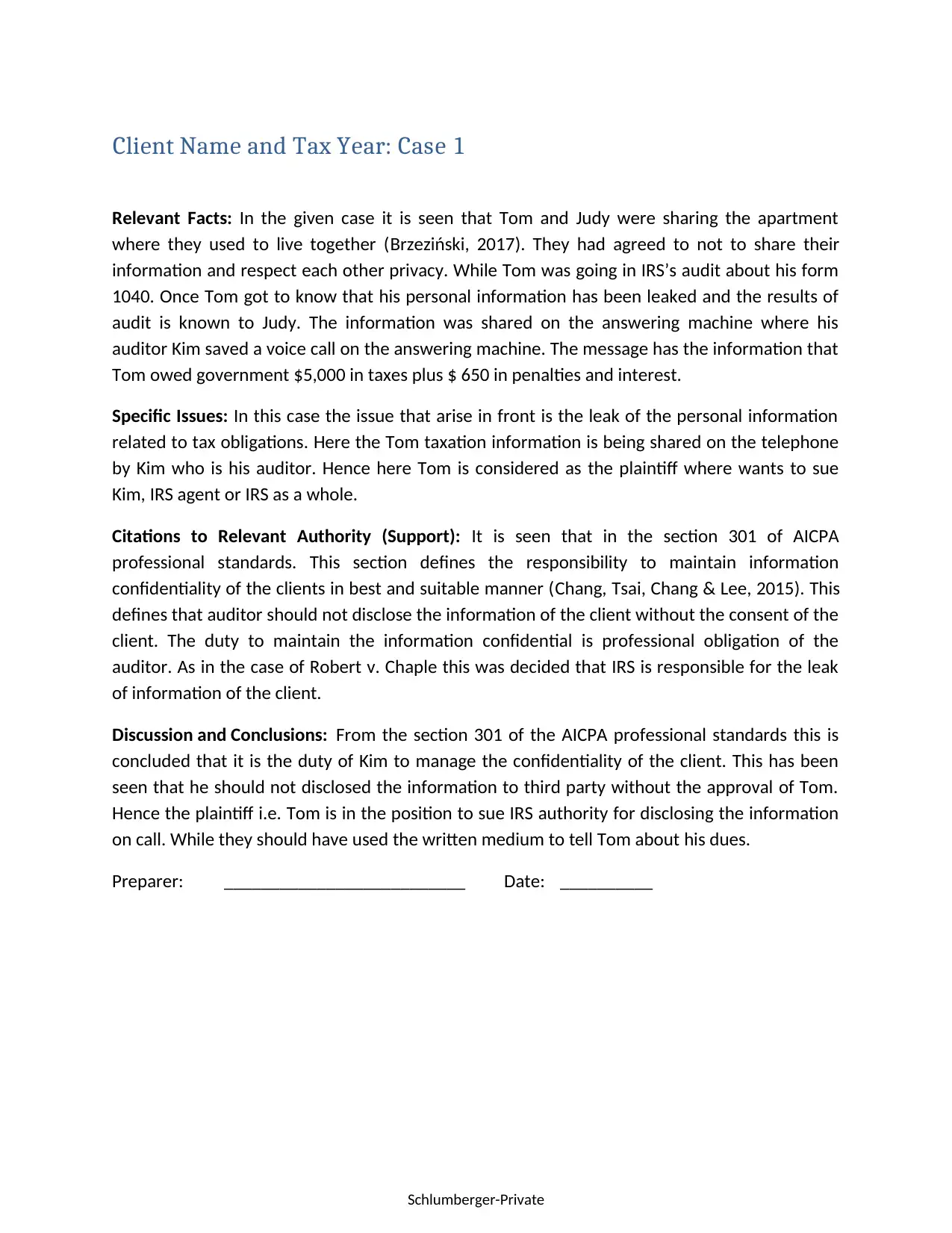
Client Name and Tax Year: Case 1
Relevant Facts: In the given case it is seen that Tom and Judy were sharing the apartment
where they used to live together (Brzeziński, 2017). They had agreed to not to share their
information and respect each other privacy. While Tom was going in IRS’s audit about his form
1040. Once Tom got to know that his personal information has been leaked and the results of
audit is known to Judy. The information was shared on the answering machine where his
auditor Kim saved a voice call on the answering machine. The message has the information that
Tom owed government $5,000 in taxes plus $ 650 in penalties and interest.
Specific Issues: In this case the issue that arise in front is the leak of the personal information
related to tax obligations. Here the Tom taxation information is being shared on the telephone
by Kim who is his auditor. Hence here Tom is considered as the plaintiff where wants to sue
Kim, IRS agent or IRS as a whole.
Citations to Relevant Authority (Support): It is seen that in the section 301 of AICPA
professional standards. This section defines the responsibility to maintain information
confidentiality of the clients in best and suitable manner (Chang, Tsai, Chang & Lee, 2015). This
defines that auditor should not disclose the information of the client without the consent of the
client. The duty to maintain the information confidential is professional obligation of the
auditor. As in the case of Robert v. Chaple this was decided that IRS is responsible for the leak
of information of the client.
Discussion and Conclusions: From the section 301 of the AICPA professional standards this is
concluded that it is the duty of Kim to manage the confidentiality of the client. This has been
seen that he should not disclosed the information to third party without the approval of Tom.
Hence the plaintiff i.e. Tom is in the position to sue IRS authority for disclosing the information
on call. While they should have used the written medium to tell Tom about his dues.
Preparer: __________________________ Date: __________
Document Page
Schlumberger-Private
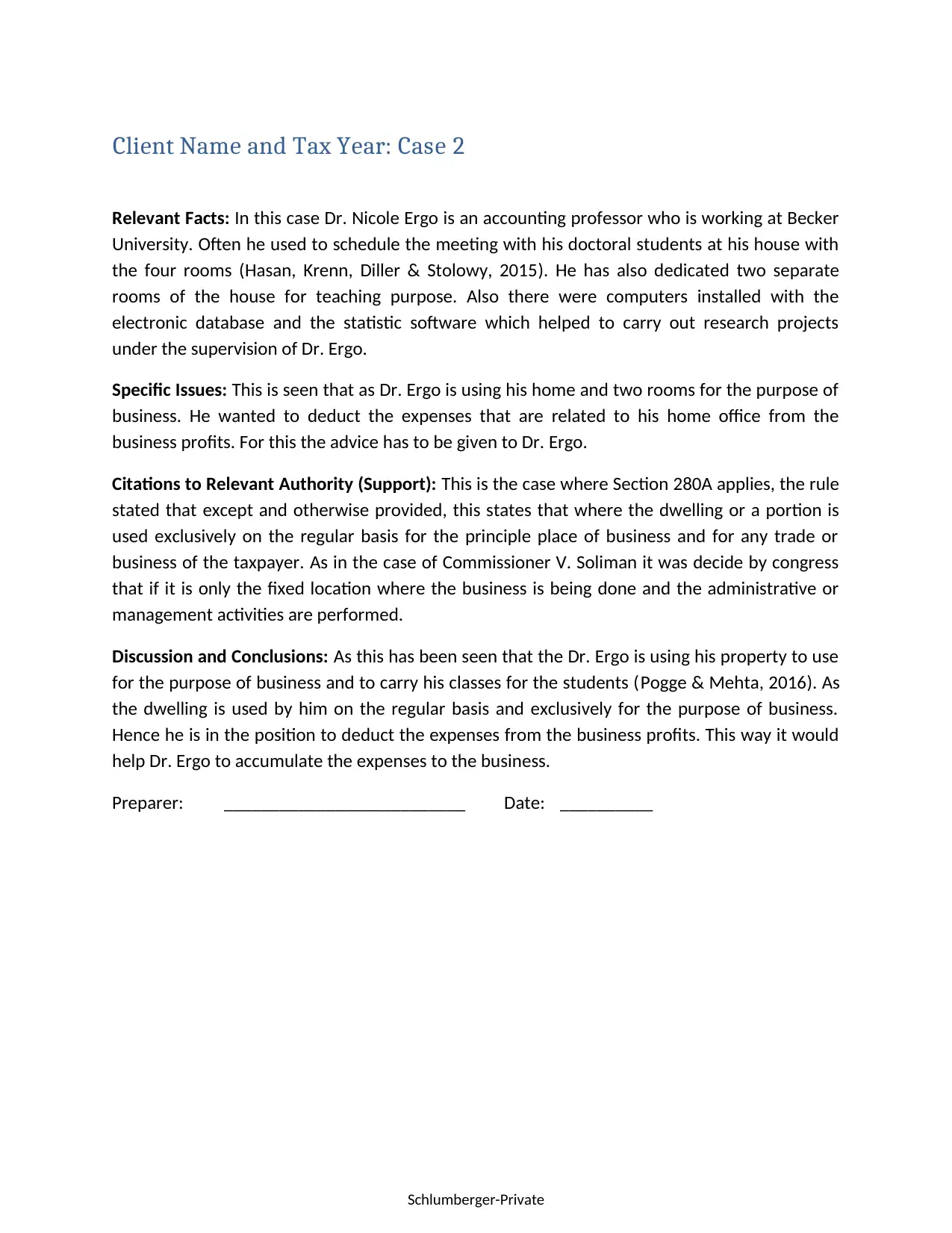
Client Name and Tax Year: Case 2
Relevant Facts: In this case Dr. Nicole Ergo is an accounting professor who is working at Becker
University. Often he used to schedule the meeting with his doctoral students at his house with
the four rooms (Hasan, Krenn, Diller & Stolowy, 2015). He has also dedicated two separate
rooms of the house for teaching purpose. Also there were computers installed with the
electronic database and the statistic software which helped to carry out research projects
under the supervision of Dr. Ergo.
Specific Issues: This is seen that as Dr. Ergo is using his home and two rooms for the purpose of
business. He wanted to deduct the expenses that are related to his home office from the
business profits. For this the advice has to be given to Dr. Ergo.
Citations to Relevant Authority (Support): This is the case where Section 280A applies, the rule
stated that except and otherwise provided, this states that where the dwelling or a portion is
used exclusively on the regular basis for the principle place of business and for any trade or
business of the taxpayer. As in the case of Commissioner V. Soliman it was decide by congress
that if it is only the fixed location where the business is being done and the administrative or
management activities are performed.
Discussion and Conclusions: As this has been seen that the Dr. Ergo is using his property to use
for the purpose of business and to carry his classes for the students (Pogge & Mehta, 2016). As
the dwelling is used by him on the regular basis and exclusively for the purpose of business.
Hence he is in the position to deduct the expenses from the business profits. This way it would
help Dr. Ergo to accumulate the expenses to the business.
Preparer: __________________________ Date: __________
tabler-icon-diamond-filled.svg

Paraphrase This Document

Need a fresh take? Get an instant paraphrase of this document with our AI Paraphraser
Document Page
Schlumberger-Private
References
Books and authors
Brzeziński, B. (2017). Advance Tax Rulings jako instytucja prawa podatkowego. Roczniki Nauk
Prawnych. 8. 13-21.
Chang, W. Y., Tsai, H. F., Chang, J. J., & Lee, K. H. (2015). Consumption tax, seigniorage tax and
tax switch in a cash-in-advance economy of endogenous growth. Journal of
Economics. 114(1). 23-42.
Hasan, M. M., Krenn, P., Diller, M., & Stolowy, H. (2015). Special Issue on Tax
Research. European Accounting Review. 24(3).
Pogge, T., & Mehta, K. (Eds.). (2016). Global tax fairness. Oxford University Press.
chevron_up_icon
1 out of 5
circle_padding
hide_on_mobile
zoom_out_icon
[object Object]