Assessing School Programs: Weight Status and Health Interventions

Verified

Added on  2023/06/10

|5
|1010
|97
Report
AI Summary
This report critically analyzes a study by Evans et al. (2016) that examines the impact of school-based physical activity and vegetable garden interventions on the weight status and related behaviors of low-income, ethnically diverse students. The study, based on data from the "Texas, Grow! Eat!, Go!" (TGEG) cluster-randomized controlled trial, assessed the effects of various treatment options, including the Coordinated Approach to Child Health (CATCH) program, on student weight, consumption of sugar-sweetened beverages and vegetables, sedentary behavior, and physical activity. The analysis includes a critique of the cluster randomized trial methodology, highlighting its advantages in community-based interventions and its limitations regarding precision and cost. The report concludes with a recommendation to consider a randomized trial to address the shortcomings of the chosen methodology. Desklib offers more solved assignments and past papers for students.
Document Page
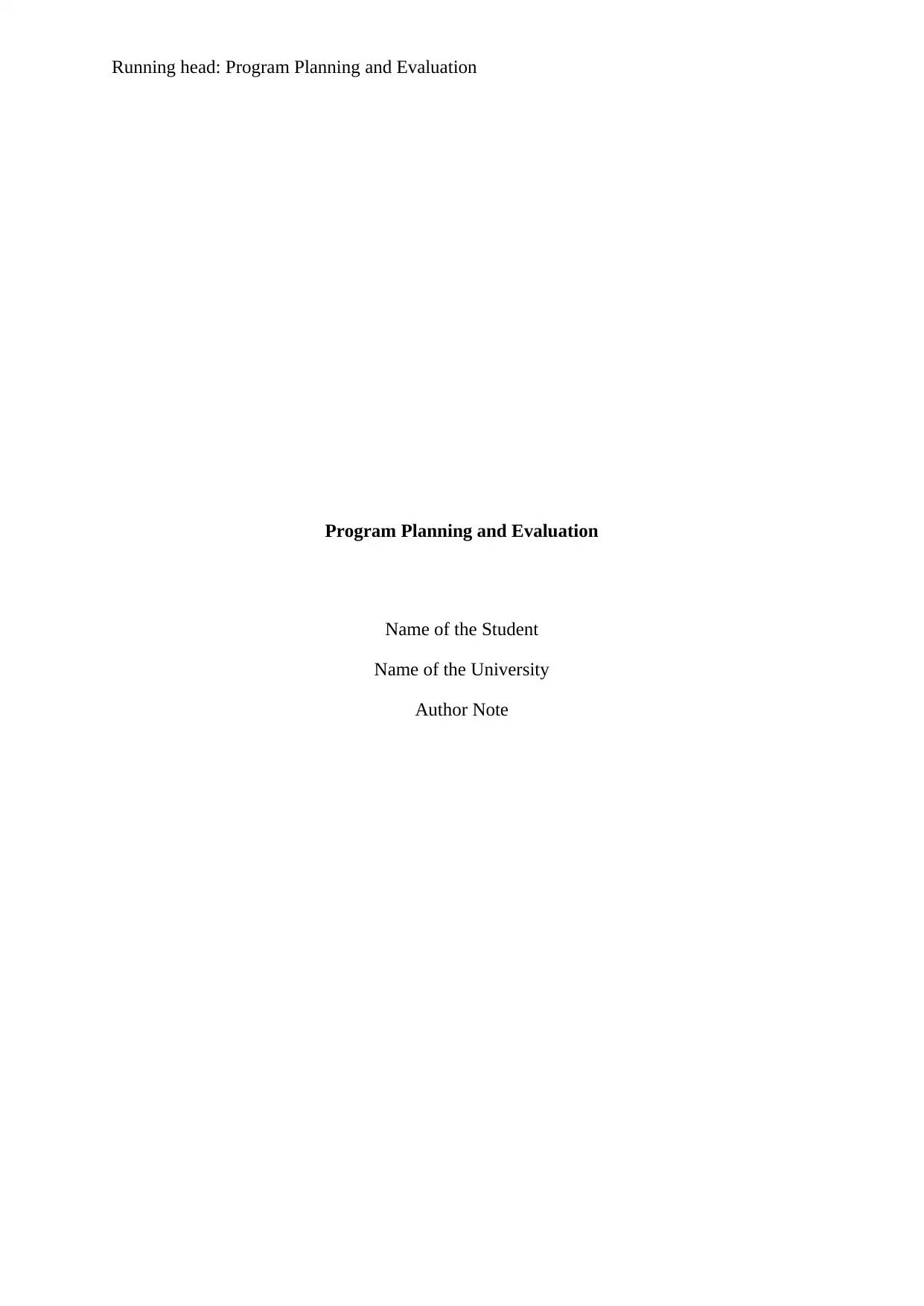
Running head: Program Planning and Evaluation
Program Planning and Evaluation
Name of the Student
Name of the University
Author Note
tabler-icon-diamond-filled.svg

Paraphrase This Document

Need a fresh take? Get an instant paraphrase of this document with our AI Paraphraser
Document Page
1Program Planning and Evaluation
Title:
The objective of this paper is to critically analyze the study by Evans et al., (2016), in
which the effects of physical activity based health interventions and a school based vegetable
garden are analyzed on their ability to improve their body mass and behaviors that influenced
the weights among ethnically heterogeneous and low income groups.
Brief Description (including methodology):
In the study, the author’s attempts to show a relation between coordinated schools
based interventions and improvements in the health behaviors of the students and als their
parents and improvements in their status of weight. The study is developed on baseline data
from the study called “Texas, Grow! Eat!, Go!” (TGEG) cluster-randomized controlled trial
(RCT) (Spears-Lanoix et al., 2015). The design comprised of factorial RCT where 28 schools
were provided one of the 4 treatment options, namely: 1. CATCH with LGEG and WAT , 2.
Coordinated Approach to Child Health (CATCH), 3. CATCH with school garden
intervention- Learn Grow Eat GO (LGEG), 4. CATCH with physical activity intervention-
Walk across Texas (WAT) and (Warren et al., 2012). The study measured variables such as
the weight status of the students, consumption of sugar sweetened beverages and vegetables,
sedentary behavior and physical activity. The study analyzed the data of 1369 students and
1206 parents, and comprised of 52% Hispanics and 18% African Americans and 78% were
from low income groups. At the baseline, no significant differences were observed in the key
variables or demographics within the 4 treatment groups. The authors concludes that the
TGEG study was a success as it was able to target a large number of students as well as their
parents who are at an elevated risks of developing obesity and different co morbidities related
to obesity, and uses a new and collaborated strategy to develop an effective intervention
program (Evans et al., 2016).
Document Page
2Program Planning and Evaluation
Critique of choice of methodology:
The advantages of cluster randomized trial over other randomized design are that it
can be applied for entire communities instead of individuals, such as community based health
interventions. This method can also be logistically convenient, since the entire community is
focused for service delivery. Moreover, this method is also effective to avoid contamination
and allows both the direct as well as the indirect effect of the interventions be considered,
thus helping to understand the overall effect of an intervention in a given population (Hayes
& Moulton, 2017). However the limitations of this design includes a lower precision
compared to individually randomized trial, and a higher cost in the implementation of the
design as it involves working in different sectors. The design can also cause selection bias,
generalization of the outcomes, and an imbalance between the arms of study (Bilimoria et al.,
2016; Hayes & Moulton, 2017). In the study, the authors also selected the data from a study
in a different country, due to which the ethnic groups indigenous to New Zealand were not a
part of and thus failed to show how the identified intervention would affect the indigenous
population of New Zealand.
One line Recommendation:
The methodology utilized a cluster randomized trial due to which the precision of the
study was limited, as well as increased the cost of the study. Using a randomized trial could
have avoided such shortcoming.
Document Page
3Program Planning and Evaluation
References:
Bilimoria, K. Y., Chung, J. W., Hedges, L. V., Dahlke, A. R., Love, R., Cohen, M. E., ... &
Ko, C. Y. (2016). Development of the Flexibility in Duty Hour Requirements for
Surgical Trainees (FIRST) trial protocol: a national cluster-randomized trial of
resident duty hour policies. JAMA surgery, 151(3), 273-281.
Evans, A., Ranjit, N., Hoelscher, D., Jovanovic, C., Lopez, M., McIntosh, A., ... & Smith, C.
(2016). Impact of school-based vegetable garden and physical activity coordinated
health interventions on weight status and weight-related behaviors of ethnically
diverse, low-income students: Study design and baseline data of the Texas, Grow!
Eat! Go!(TGEG) cluster-randomized controlled trial. BMC public health, 16(1), 973.
Hayes, R. J., & Moulton, L. H. (2017). Cluster randomised trials. Chapman and Hall/CRC.
Spears-Lanoix, E. C., McKyer, E. L. J., Evans, A., McIntosh, W. A., Ory, M., Whittlesey,
L., ... & Warren, J. L. (2015). Using family-focused garden, nutrition, and physical
activity programs to reduce childhood obesity: the texas! go! eat! grow! pilot
study. Childhood Obesity, 11(6), 707-714.
Warren, J. L., Evans, A., McIntosh, A., McKyer, L. E., Ory, M., Whittlesey, L., ... &
Robinson, S. (2012). Texas GROW! EAT! GO!(using family-focused gardening,
nutrition, and physical activities to prevent childhood obesity). Journal of Nutrition
Education and Behavior, 44(4), S92.
tabler-icon-diamond-filled.svg

Paraphrase This Document

Need a fresh take? Get an instant paraphrase of this document with our AI Paraphraser
Document Page
4Program Planning and Evaluation
chevron_up_icon
1 out of 5
circle_padding
hide_on_mobile
zoom_out_icon
[object Object]