School Counseling: Consultation Roles, Procedures, and Confidentiality

Verified

Added on  2022/09/11

|4
|700
|15
Homework Assignment
AI Summary
This assignment examines the practice of school counseling consultation, addressing critical questions such as when consultation is most beneficial, who should be considered as a consultant, and the importance of confidentiality in the process. The paper emphasizes the role of consultation in supporting students' social-emotional well-being and academic achievement, highlighting the need for counselors to empower educators and improve students' educational experiences. It also discusses the qualifications of a consultant, stressing the necessity for specialized expertise and professional counseling skills. Furthermore, the assignment outlines the roles and responsibilities of education consultants, including curriculum maintenance, school improvement, teacher performance monitoring, and the organization of school meetings. The process of obtaining a professional consultant is detailed, emphasizing the need for transparency, fairness, and the importance of confidentiality in building trust and facilitating information flow. The paper concludes by referencing key literature on school counseling and consultation practices.
Document Page
Running head: SCHOOL COUNSELING 1
School Counseling
Name
Institution
tabler-icon-diamond-filled.svg

Paraphrase This Document

Need a fresh take? Get an instant paraphrase of this document with our AI Paraphraser
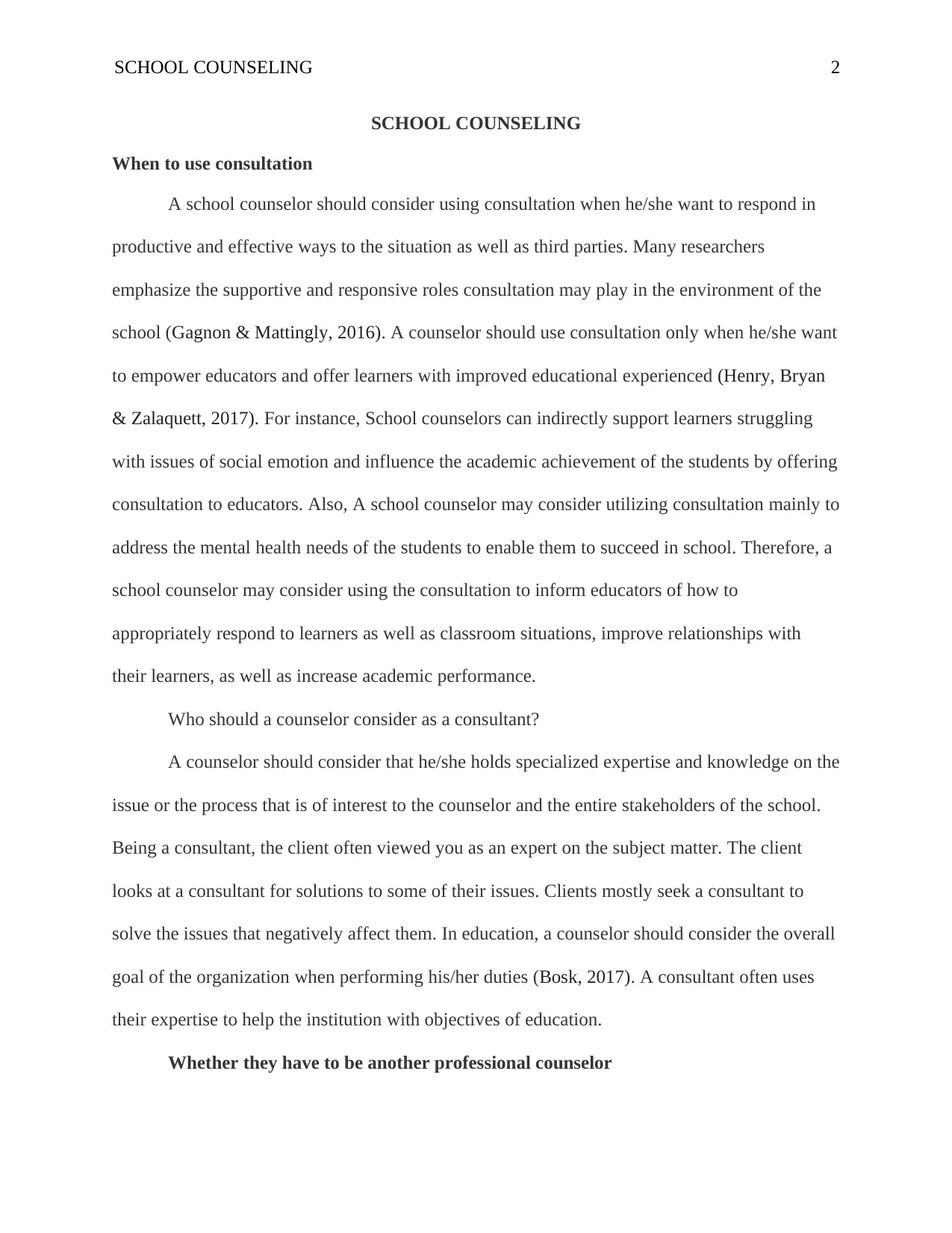
Document Page
SCHOOL COUNSELING 2
SCHOOL COUNSELING
When to use consultation
A school counselor should consider using consultation when he/she want to respond in
productive and effective ways to the situation as well as third parties. Many researchers
emphasize the supportive and responsive roles consultation may play in the environment of the
school (Gagnon & Mattingly, 2016). A counselor should use consultation only when he/she want
to empower educators and offer learners with improved educational experienced (Henry, Bryan
& Zalaquett, 2017). For instance, School counselors can indirectly support learners struggling
with issues of social emotion and influence the academic achievement of the students by offering
consultation to educators. Also, A school counselor may consider utilizing consultation mainly to
address the mental health needs of the students to enable them to succeed in school. Therefore, a
school counselor may consider using the consultation to inform educators of how to
appropriately respond to learners as well as classroom situations, improve relationships with
their learners, as well as increase academic performance.
Who should a counselor consider as a consultant?
A counselor should consider that he/she holds specialized expertise and knowledge on the
issue or the process that is of interest to the counselor and the entire stakeholders of the school.
Being a consultant, the client often viewed you as an expert on the subject matter. The client
looks at a consultant for solutions to some of their issues. Clients mostly seek a consultant to
solve the issues that negatively affect them. In education, a counselor should consider the overall
goal of the organization when performing his/her duties (Bosk, 2017). A consultant often uses
their expertise to help the institution with objectives of education.
Whether they have to be another professional counselor
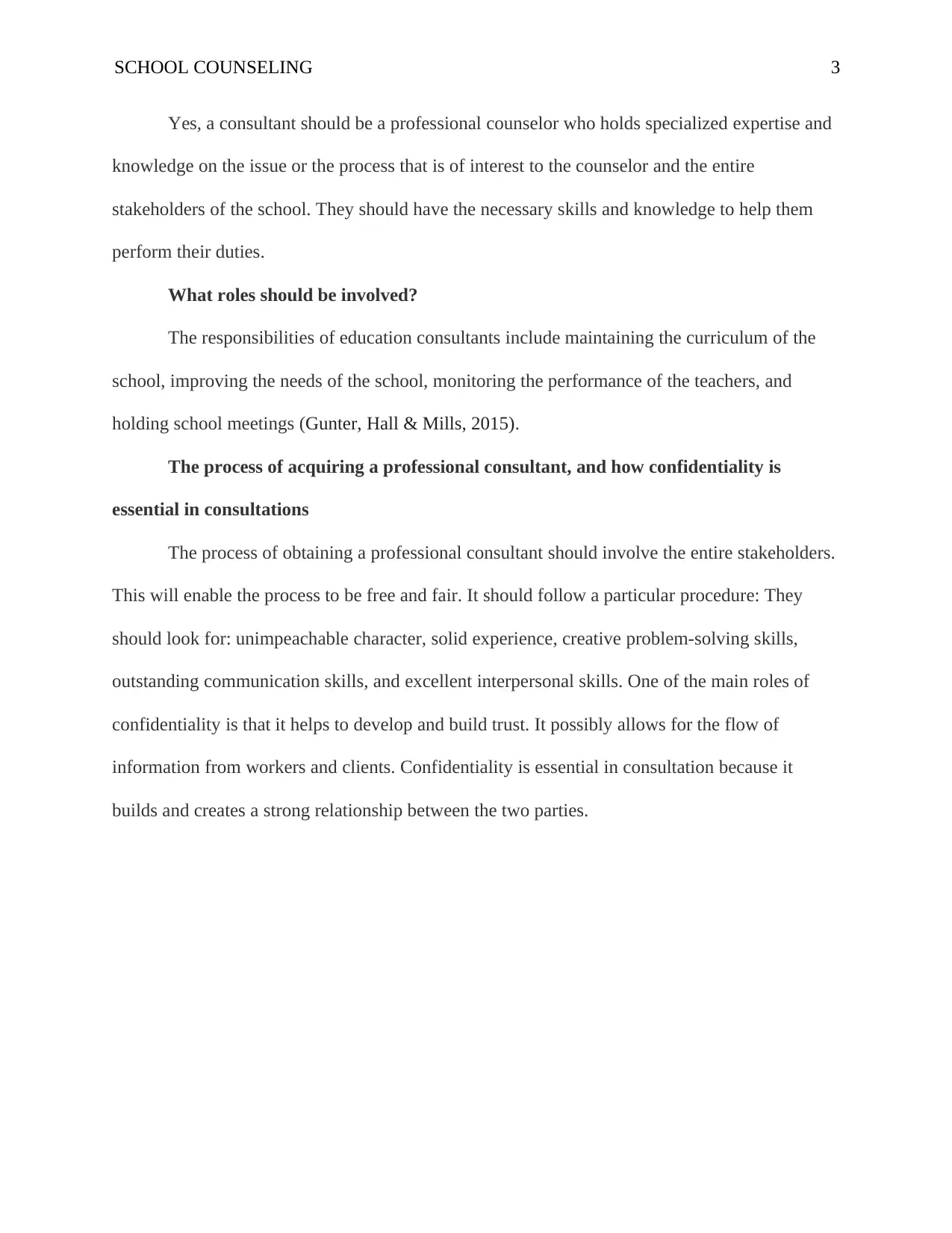
Document Page
SCHOOL COUNSELING 3
Yes, a consultant should be a professional counselor who holds specialized expertise and
knowledge on the issue or the process that is of interest to the counselor and the entire
stakeholders of the school. They should have the necessary skills and knowledge to help them
perform their duties.
What roles should be involved?
The responsibilities of education consultants include maintaining the curriculum of the
school, improving the needs of the school, monitoring the performance of the teachers, and
holding school meetings (Gunter, Hall & Mills, 2015).
The process of acquiring a professional consultant, and how confidentiality is
essential in consultations
The process of obtaining a professional consultant should involve the entire stakeholders.
This will enable the process to be free and fair. It should follow a particular procedure: They
should look for: unimpeachable character, solid experience, creative problem-solving skills,
outstanding communication skills, and excellent interpersonal skills. One of the main roles of
confidentiality is that it helps to develop and build trust. It possibly allows for the flow of
information from workers and clients. Confidentiality is essential in consultation because it
builds and creates a strong relationship between the two parties.
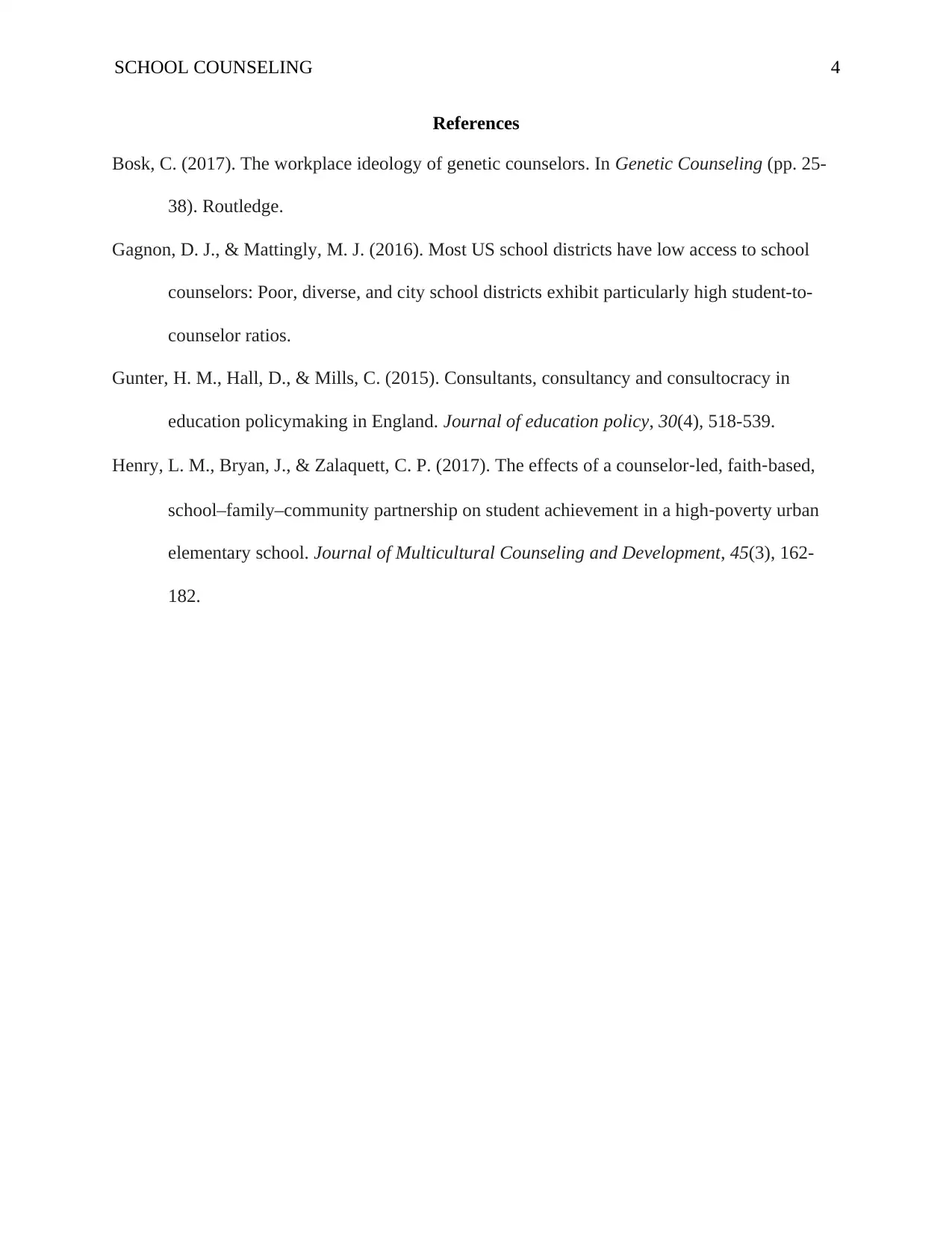
Document Page
SCHOOL COUNSELING 4
References
Bosk, C. (2017). The workplace ideology of genetic counselors. In Genetic Counseling (pp. 25-
38). Routledge.
Gagnon, D. J., & Mattingly, M. J. (2016). Most US school districts have low access to school
counselors: Poor, diverse, and city school districts exhibit particularly high student-to-
counselor ratios.
Gunter, H. M., Hall, D., & Mills, C. (2015). Consultants, consultancy and consultocracy in
education policymaking in England. Journal of education policy, 30(4), 518-539.
Henry, L. M., Bryan, J., & Zalaquett, C. P. (2017). The effects of a counselorled, faithbased,
school–family–community partnership on student achievement in a highpoverty urban
elementary school. Journal of Multicultural Counseling and Development, 45(3), 162-
182.
chevron_up_icon
1 out of 4
circle_padding
hide_on_mobile
zoom_out_icon
[object Object]