Report on Promoting Positive Behavior in Educational Settings
VerifiedAdded on 2023/06/09
|10
|1935
|115
Report
AI Summary
This report examines the importance of school safety policies in fostering a positive learning environment and promoting responsible behavior among students. It begins with an executive summary highlighting the benefits of safety policies, followed by an introduction outlining the ethical framework of educational institutions. The discussion delves into the evaluation of safety policies and procedures, including the development of skills to protect against abuse, encouraging student expression, and thorough background checks for staff. It also addresses the importance of parental and community involvement, as well as the development of emotional and social skills through programs like SEL and PSHE. The report further explores the benefits of these policies in improving young people's behavior, emphasizing reinforcement methods and the development of responsible citizens. The conclusion underscores the value of a planned approach to address challenges and mitigate risks within the school setting. The report references several sources to support its findings.
Running head: PROMOTING POSITIVE BEHAVIOR IN SCHOOL
Promoting Positive Behavior in School
Name of the Student
Name of the University
Author note
Promoting Positive Behavior in School
Name of the Student
Name of the University
Author note
Paraphrase This Document
Need a fresh take? Get an instant paraphrase of this document with our AI Paraphraser

1
PROMOTING POSITIVE BEHAVIOUR IN SCHOOL
Executive Summary
The report aims at elucidating the various benefits of implementing Safety policies in Schools. It
proceeds with the evaluation of factors, within school premises that require the significant
attention of the school authority as well as the parents, guardians and community in which the
student belongs. The report concludes by shedding light on the aspect that implementation of
safety measures and spreading awareness about the same not only helps to prevent major
disorganisation within the premises but also yields in building responsible future citizens out of
the students.
PROMOTING POSITIVE BEHAVIOUR IN SCHOOL
Executive Summary
The report aims at elucidating the various benefits of implementing Safety policies in Schools. It
proceeds with the evaluation of factors, within school premises that require the significant
attention of the school authority as well as the parents, guardians and community in which the
student belongs. The report concludes by shedding light on the aspect that implementation of
safety measures and spreading awareness about the same not only helps to prevent major
disorganisation within the premises but also yields in building responsible future citizens out of
the students.

2
PROMOTING POSITIVE BEHAVIOUR IN SCHOOL
Table of Contents
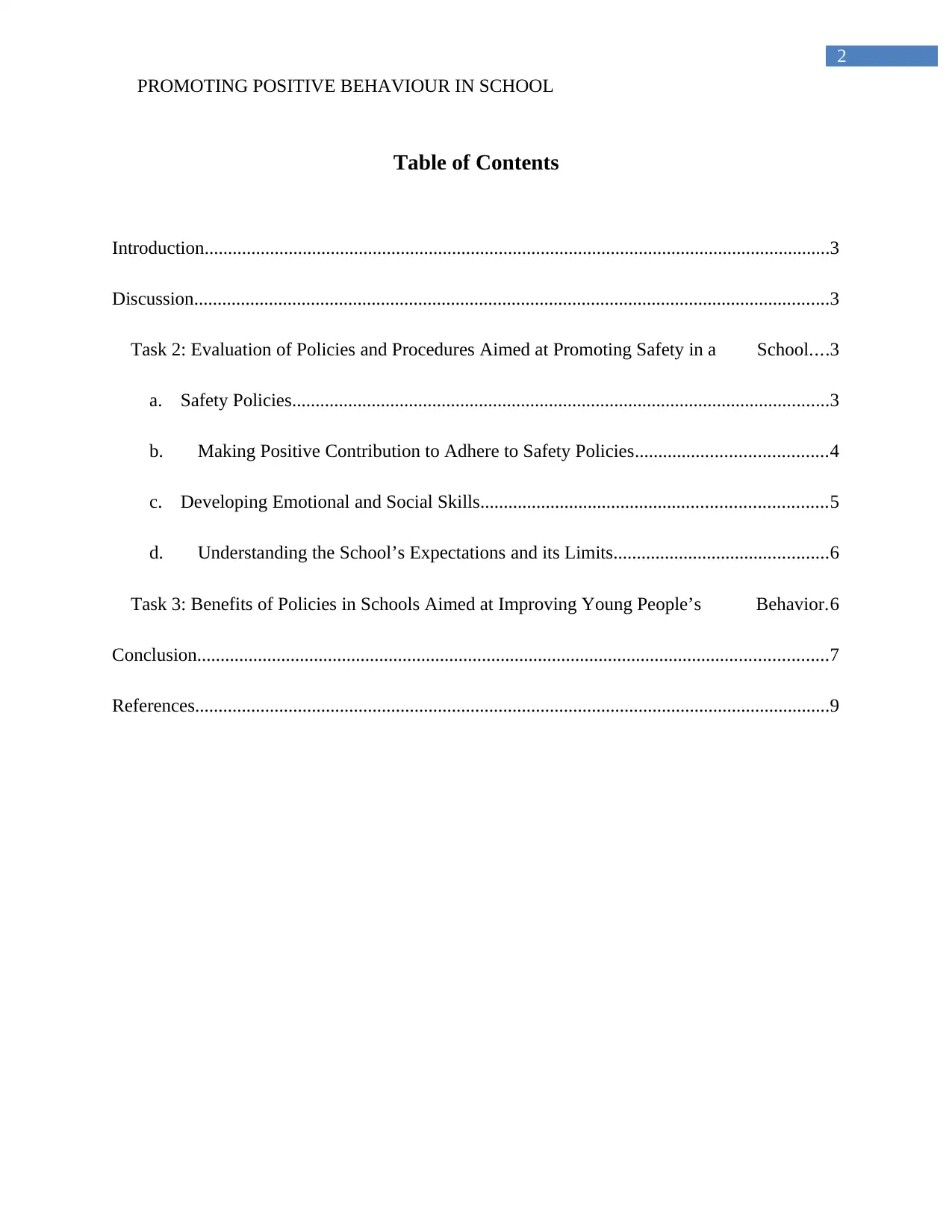
Introduction......................................................................................................................................3
Discussion........................................................................................................................................3
Task 2: Evaluation of Policies and Procedures Aimed at Promoting Safety in a School....3
a. Safety Policies...................................................................................................................3
b. Making Positive Contribution to Adhere to Safety Policies.........................................4
c. Developing Emotional and Social Skills..........................................................................5
d. Understanding the School’s Expectations and its Limits..............................................6
Task 3: Benefits of Policies in Schools Aimed at Improving Young People’s Behavior.6
Conclusion.......................................................................................................................................7
References........................................................................................................................................9
PROMOTING POSITIVE BEHAVIOUR IN SCHOOL
Table of Contents
Introduction......................................................................................................................................3
Discussion........................................................................................................................................3
Task 2: Evaluation of Policies and Procedures Aimed at Promoting Safety in a School....3
a. Safety Policies...................................................................................................................3
b. Making Positive Contribution to Adhere to Safety Policies.........................................4
c. Developing Emotional and Social Skills..........................................................................5
d. Understanding the School’s Expectations and its Limits..............................................6
Task 3: Benefits of Policies in Schools Aimed at Improving Young People’s Behavior.6
Conclusion.......................................................................................................................................7
References........................................................................................................................................9
⊘ This is a preview!⊘
Do you want full access?
Subscribe today to unlock all pages.

Trusted by 1+ million students worldwide

3
PROMOTING POSITIVE BEHAVIOUR IN SCHOOL
Introduction
All educational institutes are structured in an ethical framework that advocates safe
practices within its premises. These practices and suggestions are strategically formulated into
policies and regulations which every student, teacher and staff members have to abide by. These
policies ensure that each member conforms to the legal responsibilities within their prerogative
and contribute effectively to a safe learning environment1. The following report discusses the
various approaches by which safety policies can be successfully exercised within an educational
premise and also focuses on the benefits of complying with these policies.
Discussion
Task 2: Evaluation of Policies and Procedures Aimed at Promoting Safety in a
School
a. Safety Policies
The inclusion of safety policies in a school curriculum has been done with the primary
objective to promote a harmonious learning environment that contributes to ample productivity2.
Along with this, a school, through these policy regulations, aims at endorsing acceptable
1 Galvin, Peter, Jayne Nash, and Andy Miller. Behaviour and Discipline in Schools: Devising and revising a whole-
school policy. Routledge, 2013.
2 Centers for Disease Control. "Make a difference at your school." (2013).
PROMOTING POSITIVE BEHAVIOUR IN SCHOOL
Introduction
All educational institutes are structured in an ethical framework that advocates safe
practices within its premises. These practices and suggestions are strategically formulated into
policies and regulations which every student, teacher and staff members have to abide by. These
policies ensure that each member conforms to the legal responsibilities within their prerogative
and contribute effectively to a safe learning environment1. The following report discusses the
various approaches by which safety policies can be successfully exercised within an educational
premise and also focuses on the benefits of complying with these policies.
Discussion
Task 2: Evaluation of Policies and Procedures Aimed at Promoting Safety in a
School
a. Safety Policies
The inclusion of safety policies in a school curriculum has been done with the primary
objective to promote a harmonious learning environment that contributes to ample productivity2.
Along with this, a school, through these policy regulations, aims at endorsing acceptable
1 Galvin, Peter, Jayne Nash, and Andy Miller. Behaviour and Discipline in Schools: Devising and revising a whole-
school policy. Routledge, 2013.
2 Centers for Disease Control. "Make a difference at your school." (2013).
Paraphrase This Document
Need a fresh take? Get an instant paraphrase of this document with our AI Paraphraser

4
PROMOTING POSITIVE BEHAVIOUR IN SCHOOL
behavior among students. It helps to ensure a smooth running and unifies the school as a singular
entity. A few of these safety policies are:
Developing skills to protect oneself against abuse
Encourage curriculum that equips students to be vocal about their thoughts and
perception concerned with decision making
Recruiting teachers and staff after a thorough background check and briefing them
appropriately about their roles and responsibilities related to safeguarding students.
Keeping parents, guardians and community members informed about prolonged and
unexplained absenteeism of any student. Regular home visits are carried out to validate
that no student is a victim of abuse which is a vulnerable cause of missing schools.
b. Making Positive Contribution to Adhere to Safety Policies
As stated by3, the safety policies in school, aimed at imparting long-term behavioral
goals, are formulated with equal contribution from school staff, the students and their parents.
These policies are meant to enforce positive behavior in each member of the school so that
everyone feels valued, respected and responsible for their actions.
In order to make students aware of the outcomes of their behavior, both positive and
negative, teachers devise certain methods of reinforcements in compliance with the school’s
policy framework. In such reinforcement methods, when a student exhibits positive behavior, he
or she is encouraged through achievement points or behavior point. This not only urges the child
to stick to his or her good behavior but also sets an example for others in the class. In addition to
3 O'Brien, Tim. Promoting positive behaviour. David Fulton Publishers, 2013.
PROMOTING POSITIVE BEHAVIOUR IN SCHOOL
behavior among students. It helps to ensure a smooth running and unifies the school as a singular
entity. A few of these safety policies are:
Developing skills to protect oneself against abuse
Encourage curriculum that equips students to be vocal about their thoughts and
perception concerned with decision making
Recruiting teachers and staff after a thorough background check and briefing them
appropriately about their roles and responsibilities related to safeguarding students.
Keeping parents, guardians and community members informed about prolonged and
unexplained absenteeism of any student. Regular home visits are carried out to validate
that no student is a victim of abuse which is a vulnerable cause of missing schools.
b. Making Positive Contribution to Adhere to Safety Policies
As stated by3, the safety policies in school, aimed at imparting long-term behavioral
goals, are formulated with equal contribution from school staff, the students and their parents.
These policies are meant to enforce positive behavior in each member of the school so that
everyone feels valued, respected and responsible for their actions.
In order to make students aware of the outcomes of their behavior, both positive and
negative, teachers devise certain methods of reinforcements in compliance with the school’s
policy framework. In such reinforcement methods, when a student exhibits positive behavior, he
or she is encouraged through achievement points or behavior point. This not only urges the child
to stick to his or her good behavior but also sets an example for others in the class. In addition to
3 O'Brien, Tim. Promoting positive behaviour. David Fulton Publishers, 2013.

5
PROMOTING POSITIVE BEHAVIOUR IN SCHOOL
this, teachers occasionally conduct assemblies, like once in a month, to take students through
their behaviour regime and provide assessment of how their own behaviour had been till that
time. Certificates are distributed to those students with outstanding behaviour. It is a well-
established strategy to instil appropriation of behaviour for long term that yield positive
outcomes.
c. Developing Emotional and Social Skills
An essential part of any learning environment is to make it emotionally safe. The fact can
be implemented by encouraging the members to inculcate specific values such as empathy, self
and social awareness, resilience, self-sufficiency, relationship skill and self-esteem. SEL or the
Social and Emotional Learning and PSHE or Physical, Social, Health and Economic Education
are integral parts of modern education system4. These two modules can be incorporated by
employing interactive and experimental learning workshops. Thus in a realistic simulated setting,
it can train the young minds various skills and competencies which can be adapted for making
firm decisions and safe choices, handing challenges, adhere to acceptable attitudes and being
respectful towards others. PSHE, in particular advocate on healthy living by spreading
awareness on the harms of smoking, bullying, alcohol and substance abuse; importance of sex
education, managing personal finance and family relationships and how essential it is to focus on
one’s career. The schools attempts to ingrain the positive aspects of these modules by increasing
their visibility in classrooms and corridors through school charters and display boards. Schools
adopting this module make sure that the students undergo PSHE sessions at least twice a week
4 Studer, Jeannine R., and Blair S. Mynatt. "Bullying prevention in middle schools: a collaborative approach:
collaborative, proactive anti-bullying interventions and policies that strive to create and sustain a safe environment
for all adolescents." Middle School Journal 46.3 (2015): 25-32.
PROMOTING POSITIVE BEHAVIOUR IN SCHOOL
this, teachers occasionally conduct assemblies, like once in a month, to take students through
their behaviour regime and provide assessment of how their own behaviour had been till that
time. Certificates are distributed to those students with outstanding behaviour. It is a well-
established strategy to instil appropriation of behaviour for long term that yield positive
outcomes.
c. Developing Emotional and Social Skills
An essential part of any learning environment is to make it emotionally safe. The fact can
be implemented by encouraging the members to inculcate specific values such as empathy, self
and social awareness, resilience, self-sufficiency, relationship skill and self-esteem. SEL or the
Social and Emotional Learning and PSHE or Physical, Social, Health and Economic Education
are integral parts of modern education system4. These two modules can be incorporated by
employing interactive and experimental learning workshops. Thus in a realistic simulated setting,
it can train the young minds various skills and competencies which can be adapted for making
firm decisions and safe choices, handing challenges, adhere to acceptable attitudes and being
respectful towards others. PSHE, in particular advocate on healthy living by spreading
awareness on the harms of smoking, bullying, alcohol and substance abuse; importance of sex
education, managing personal finance and family relationships and how essential it is to focus on
one’s career. The schools attempts to ingrain the positive aspects of these modules by increasing
their visibility in classrooms and corridors through school charters and display boards. Schools
adopting this module make sure that the students undergo PSHE sessions at least twice a week
4 Studer, Jeannine R., and Blair S. Mynatt. "Bullying prevention in middle schools: a collaborative approach:
collaborative, proactive anti-bullying interventions and policies that strive to create and sustain a safe environment
for all adolescents." Middle School Journal 46.3 (2015): 25-32.
⊘ This is a preview!⊘
Do you want full access?
Subscribe today to unlock all pages.

Trusted by 1+ million students worldwide

6
PROMOTING POSITIVE BEHAVIOUR IN SCHOOL
with the form tutors. In addition to this, outside agencies are sometimes hired to delegate
awareness and also to cater to these needs. These agencies constitute Educational Support
Services, Education Welfare Officer, Paediatrician, Play Therapist and Clinical Psychologist.
d. Understanding the School’s Expectations and its Limits
A child’s safety within the school premise is the responsibility of the school authority.
However, all practices come with limitations. It is precisely at this juncture where cooperation of
the child’s parents and guardians is required. The safety policies not only aim at educating the
young members but its purpose is to extend the awareness and accountability to the world at
large. The systems are aimed at making the community know about the harms of domestic
violence, forced marriage, cyber-crime, sexual exploitation of children, violence concerning
genital mutilation and radicalisation5. Most of these malpractices happen outside the school
premises but have a negative impact on students facing these. Safety policies, thus, go beyond its
limits to demonstrate the basic expectations of a healthy society among the social and cultural
communities.
Task 3: Benefits of Policies in Schools Aimed at Improving Young People’s
Behavior
The benefits that an individual or community can reap from the implication of Safety
Policies is a continuous process, given there is an adequate amount of co-operation among the
schools, its students and their guardians. When monitored closely, it not only prevents the
occurrence of unfavorable circumstances but also establishes positive behavior in the students.
5 Losen, Daniel J. "Discipline policies, successful schools, racial justice, and the law." Family Court Review 51.3
(2013): 388-400.
PROMOTING POSITIVE BEHAVIOUR IN SCHOOL
with the form tutors. In addition to this, outside agencies are sometimes hired to delegate
awareness and also to cater to these needs. These agencies constitute Educational Support
Services, Education Welfare Officer, Paediatrician, Play Therapist and Clinical Psychologist.
d. Understanding the School’s Expectations and its Limits
A child’s safety within the school premise is the responsibility of the school authority.
However, all practices come with limitations. It is precisely at this juncture where cooperation of
the child’s parents and guardians is required. The safety policies not only aim at educating the
young members but its purpose is to extend the awareness and accountability to the world at
large. The systems are aimed at making the community know about the harms of domestic
violence, forced marriage, cyber-crime, sexual exploitation of children, violence concerning
genital mutilation and radicalisation5. Most of these malpractices happen outside the school
premises but have a negative impact on students facing these. Safety policies, thus, go beyond its
limits to demonstrate the basic expectations of a healthy society among the social and cultural
communities.
Task 3: Benefits of Policies in Schools Aimed at Improving Young People’s
Behavior
The benefits that an individual or community can reap from the implication of Safety
Policies is a continuous process, given there is an adequate amount of co-operation among the
schools, its students and their guardians. When monitored closely, it not only prevents the
occurrence of unfavorable circumstances but also establishes positive behavior in the students.
5 Losen, Daniel J. "Discipline policies, successful schools, racial justice, and the law." Family Court Review 51.3
(2013): 388-400.
Paraphrase This Document
Need a fresh take? Get an instant paraphrase of this document with our AI Paraphraser

7
PROMOTING POSITIVE BEHAVIOUR IN SCHOOL
Positive behavior is established by first letting the young pupils understand the essence of it
followed by framing rules that monitor their behavior and finally rewarding or penalizing them
in accordance with the behavior they display. For example, by teaching a student to make the
right choices, the teacher educates him or her the basics of problem solving and decision making
skills and when the student demonstrates a behaviour in the needful situation that is in
compliance with what they had been taught, they become a role model for the other students.
When students are rewarded for their good behaviour, they are likely to get positively reinforced
and repeat the acceptable behaviour in the needful settings. If any student behaves in an
inappropriate manner, such as whispering and disrupting a learning session in presence of a
teacher, the teacher quickly intervenes and use methods of negative reinforcement, such as
giving them a ‘sad peg’ if they continue with their improper demeanour, to restrain them from
behaving unacceptably in future. This is how teachers are able to enforce the required discipline
in students and teach them how they should behave with others, especially the adults, even
outside the school premises. The students also learn crucial lessons regarding when to take a risk
and when to avert it and thus learn to become responsible citizens of the society6.
Conclusion
To conclude the above illustration on the various health and safety policies and its
interpretation of behavioral and social benefits, it can be stated that a planned approach to work
out issues always enables an individual to be more resilient in challenging circumstances. Risks
6 Närhi, Vesa, et al. "Reducing disruptive behaviours and improving learning climates with class-wide positive
behaviour support in middle schools." European Journal of Special Needs Education 30.2 (2015): 274-285.
PROMOTING POSITIVE BEHAVIOUR IN SCHOOL
Positive behavior is established by first letting the young pupils understand the essence of it
followed by framing rules that monitor their behavior and finally rewarding or penalizing them
in accordance with the behavior they display. For example, by teaching a student to make the
right choices, the teacher educates him or her the basics of problem solving and decision making
skills and when the student demonstrates a behaviour in the needful situation that is in
compliance with what they had been taught, they become a role model for the other students.
When students are rewarded for their good behaviour, they are likely to get positively reinforced
and repeat the acceptable behaviour in the needful settings. If any student behaves in an
inappropriate manner, such as whispering and disrupting a learning session in presence of a
teacher, the teacher quickly intervenes and use methods of negative reinforcement, such as
giving them a ‘sad peg’ if they continue with their improper demeanour, to restrain them from
behaving unacceptably in future. This is how teachers are able to enforce the required discipline
in students and teach them how they should behave with others, especially the adults, even
outside the school premises. The students also learn crucial lessons regarding when to take a risk
and when to avert it and thus learn to become responsible citizens of the society6.
Conclusion
To conclude the above illustration on the various health and safety policies and its
interpretation of behavioral and social benefits, it can be stated that a planned approach to work
out issues always enables an individual to be more resilient in challenging circumstances. Risks
6 Närhi, Vesa, et al. "Reducing disruptive behaviours and improving learning climates with class-wide positive
behaviour support in middle schools." European Journal of Special Needs Education 30.2 (2015): 274-285.

8
PROMOTING POSITIVE BEHAVIOUR IN SCHOOL
can occur at any point in life, but with preparation and adequate knowledge, it is possible to avert
it without encountering substantial difficulties.
PROMOTING POSITIVE BEHAVIOUR IN SCHOOL
can occur at any point in life, but with preparation and adequate knowledge, it is possible to avert
it without encountering substantial difficulties.
⊘ This is a preview!⊘
Do you want full access?
Subscribe today to unlock all pages.

Trusted by 1+ million students worldwide

9
PROMOTING POSITIVE BEHAVIOUR IN SCHOOL
References
Centres for Disease Control. "Make a difference at your school." (2013).
Galvin, Peter, Jayne Nash, and Andy Miller. Behaviour and Discipline in Schools: Devising and
revising a whole-school policy. Routledge, 2013.
Losen, Daniel J. "Discipline policies, successful schools, racial justice, and the law." Family
Court Review 51.3 (2013): 388-400.
Närhi, Vesa, et al. "Reducing disruptive behaviours and improving learning climates with class-
wide positive behaviour support in middle schools." European Journal of Special Needs
Education 30.2 (2015): 274-285.
O'Brien, Tim. Promoting positive behaviour. David Fulton Publishers, 2013.
Studer, Jeannine R., and Blair S. Mynatt. "Bullying prevention in middle schools: a collaborative
approach: collaborative, proactive anti-bullying interventions and policies that strive to create
and sustain a safe environment for all adolescents." Middle School Journal 46.3 (2015): 25-32.
PROMOTING POSITIVE BEHAVIOUR IN SCHOOL
References
Centres for Disease Control. "Make a difference at your school." (2013).
Galvin, Peter, Jayne Nash, and Andy Miller. Behaviour and Discipline in Schools: Devising and
revising a whole-school policy. Routledge, 2013.
Losen, Daniel J. "Discipline policies, successful schools, racial justice, and the law." Family
Court Review 51.3 (2013): 388-400.
Närhi, Vesa, et al. "Reducing disruptive behaviours and improving learning climates with class-
wide positive behaviour support in middle schools." European Journal of Special Needs
Education 30.2 (2015): 274-285.
O'Brien, Tim. Promoting positive behaviour. David Fulton Publishers, 2013.
Studer, Jeannine R., and Blair S. Mynatt. "Bullying prevention in middle schools: a collaborative
approach: collaborative, proactive anti-bullying interventions and policies that strive to create
and sustain a safe environment for all adolescents." Middle School Journal 46.3 (2015): 25-32.
1 out of 10
Related Documents
Your All-in-One AI-Powered Toolkit for Academic Success.
+13062052269
info@desklib.com
Available 24*7 on WhatsApp / Email
Unlock your academic potential
Copyright © 2020–2025 A2Z Services. All Rights Reserved. Developed and managed by ZUCOL.