Schooling Operation Assignment: Report on Schooling Operations
VerifiedAdded on 2022/11/15
|18
|3575
|55
Report
AI Summary
This report presents a critical analysis of five papers related to schooling operations. The first paper examines teaching methods in middle schools, emphasizing the importance of student participation in negotiation and democratic schooling. The second paper focuses on integrated learning strategies in middle schools, exploring different approaches and their benefits. The third paper investigates senior VET education in schools, analyzing its impact on student career paths and employment. The report also includes an overview of the Australian context, referencing relevant policies and research. Each paper's topic, purpose, overview, discussion, and criticisms are outlined, providing a comprehensive understanding of the challenges and opportunities in secondary education. The analysis highlights key issues such as the need for practical application of theoretical concepts, the importance of data and statistics, and the challenges of implementing integrated learning and VET programs effectively.
Running head: SCHOOLING OPERATION ASSIGNMENT
Schooling Operation Assignment
Name of the Student:
Name of the University:
Author Note:
Schooling Operation Assignment
Name of the Student:
Name of the University:
Author Note:

Paraphrase This Document
Need a fresh take? Get an instant paraphrase of this document with our AI Paraphraser
1SCHOOLING OPERATION ASSIGNMENT
Table of Contents
1 Criticism.............................................................................................................................3
1.1 Paper 1.........................................................................................................................3
1.1.1 Topic....................................................................................................................3
1.1.2 Purpose.................................................................................................................3
1.1.3 Overview..............................................................................................................3
1.1.4 Discussion............................................................................................................6
1.1.5 Criticisms/ problems/ Issues................................................................................6
1.2 Paper 2.........................................................................................................................6
1.2.1 Topic....................................................................................................................6
1.2.2 Purpose.................................................................................................................6
1.2.3 Overview..............................................................................................................7
1.2.4 Discussion............................................................................................................8
1.2.5 Criticisms/ problems/ Issues................................................................................9
1.3 Paper 3.........................................................................................................................9
1.3.1 Topic....................................................................................................................9
1.3.2 Purpose.................................................................................................................9
1.3.3 Overview..............................................................................................................9
1.3.4 Discussion..........................................................................................................12
1.3.5 Criticisms/ problems/ Issues..............................................................................12
1.4 Paper 4.......................................................................................................................13
Table of Contents
1 Criticism.............................................................................................................................3
1.1 Paper 1.........................................................................................................................3
1.1.1 Topic....................................................................................................................3
1.1.2 Purpose.................................................................................................................3
1.1.3 Overview..............................................................................................................3
1.1.4 Discussion............................................................................................................6
1.1.5 Criticisms/ problems/ Issues................................................................................6
1.2 Paper 2.........................................................................................................................6
1.2.1 Topic....................................................................................................................6
1.2.2 Purpose.................................................................................................................6
1.2.3 Overview..............................................................................................................7
1.2.4 Discussion............................................................................................................8
1.2.5 Criticisms/ problems/ Issues................................................................................9
1.3 Paper 3.........................................................................................................................9
1.3.1 Topic....................................................................................................................9
1.3.2 Purpose.................................................................................................................9
1.3.3 Overview..............................................................................................................9
1.3.4 Discussion..........................................................................................................12
1.3.5 Criticisms/ problems/ Issues..............................................................................12
1.4 Paper 4.......................................................................................................................13
2SCHOOLING OPERATION ASSIGNMENT
1.4.1 Topic..................................................................................................................13
1.4.2 Purpose...............................................................................................................13
1.4.3 Overview............................................................................................................13
1.4.4 Discussion..........................................................................................................14
1.4.5 Criticisms/ problems/ Issues..............................................................................14
1.5 Paper 5.......................................................................................................................14
1.5.1 Topic..................................................................................................................14
1.5.2 Purpose...............................................................................................................14
1.5.3 Overview............................................................................................................15
1.5.4 Discussion..........................................................................................................16
1.5.5 Criticisms/ problems/ Issues..............................................................................16
References................................................................................................................................17
1.4.1 Topic..................................................................................................................13
1.4.2 Purpose...............................................................................................................13
1.4.3 Overview............................................................................................................13
1.4.4 Discussion..........................................................................................................14
1.4.5 Criticisms/ problems/ Issues..............................................................................14
1.5 Paper 5.......................................................................................................................14
1.5.1 Topic..................................................................................................................14
1.5.2 Purpose...............................................................................................................14
1.5.3 Overview............................................................................................................15
1.5.4 Discussion..........................................................................................................16
1.5.5 Criticisms/ problems/ Issues..............................................................................16
References................................................................................................................................17
⊘ This is a preview!⊘
Do you want full access?
Subscribe today to unlock all pages.

Trusted by 1+ million students worldwide
3SCHOOLING OPERATION ASSIGNMENT
1 Criticism
1.1 Paper 1
1.1.1 Topic
Review on Teaching Methods in Middle School
1.1.2 Purpose
The study explores the aspects and ideas of democratic schooling and negotiation in
different study genre. The authors evaluate the importance and advantages of
student’s participation in the negotiation process. Students can engage in the
negotiation process at many levels. This argument identifies those levels and spaces
where students can engage in negotiation in an educational environment.
1.1.3 Overview
Middle school learning includes students’ engagement in negotiation in learning
environments. The capacity of negotiation by the students is important to develop
during their early years of schooling. They should have the idea of that time and place
of negotiation as negotiation pertains to the democratic philosophy related to
educational institutions. According to research, the effects of learning in school is
more profound among students if they have a voice. The participation of the students
allows them to engage in the curriculum, discuss topics and have a much greater
insight into the subjects compared to other study methods. Negotiation ensure
democracy in school environment, as aspects that are generally determined by the
authorities are now being questioned and evaluated. This leads to inclusion of topics
and subjects that are students are interested in and are likely to participate in more.
1 Criticism
1.1 Paper 1
1.1.1 Topic
Review on Teaching Methods in Middle School
1.1.2 Purpose
The study explores the aspects and ideas of democratic schooling and negotiation in
different study genre. The authors evaluate the importance and advantages of
student’s participation in the negotiation process. Students can engage in the
negotiation process at many levels. This argument identifies those levels and spaces
where students can engage in negotiation in an educational environment.
1.1.3 Overview
Middle school learning includes students’ engagement in negotiation in learning
environments. The capacity of negotiation by the students is important to develop
during their early years of schooling. They should have the idea of that time and place
of negotiation as negotiation pertains to the democratic philosophy related to
educational institutions. According to research, the effects of learning in school is
more profound among students if they have a voice. The participation of the students
allows them to engage in the curriculum, discuss topics and have a much greater
insight into the subjects compared to other study methods. Negotiation ensure
democracy in school environment, as aspects that are generally determined by the
authorities are now being questioned and evaluated. This leads to inclusion of topics
and subjects that are students are interested in and are likely to participate in more.
Paraphrase This Document
Need a fresh take? Get an instant paraphrase of this document with our AI Paraphraser
4SCHOOLING OPERATION ASSIGNMENT
The reason that students do not partake in negotiation in school environment is that
they think that they will be in trouble for doing so. There are several platforms in
Australia like, Professional Association of Student Representative Council
Teacher/Advisors or PASTA that have been created to promote student participation
and representation in the curriculum. In spite of that, no enthusiastic participation has
not been found in this aspect. However, there are policies and laws that ensure their
right to participate in the decision-making. The study gives idea about a democratic
classroom. The two aspects that creates a democratic classroom are democratic
structure where the involvement of all the stakeholders in the decision making process
is encouraged and a curriculum that is democratic in nature. Teachers prepare this
curriculum where the interests and opinions of the students have been considered
largely.
The study insists on the importance of introducing the importance of research in the
middle school curriculum. The reason behind this argument is that children are most
inquisitive and curious when they are young. This opportunity will help them to
understand the connections between learning and life experiences. The curriculum
should be prepared in such a way that the students can relate them to their own lives.
In order to enhance the position of the students in schools so that their voices can be
heard. The study analyzes the drawbacks of student decision-making scenario as well.
The problem that might arise here are value clash between the students and the
teachers and isolation of different cultures inside the school.
The reason that students do not partake in negotiation in school environment is that
they think that they will be in trouble for doing so. There are several platforms in
Australia like, Professional Association of Student Representative Council
Teacher/Advisors or PASTA that have been created to promote student participation
and representation in the curriculum. In spite of that, no enthusiastic participation has
not been found in this aspect. However, there are policies and laws that ensure their
right to participate in the decision-making. The study gives idea about a democratic
classroom. The two aspects that creates a democratic classroom are democratic
structure where the involvement of all the stakeholders in the decision making process
is encouraged and a curriculum that is democratic in nature. Teachers prepare this
curriculum where the interests and opinions of the students have been considered
largely.
The study insists on the importance of introducing the importance of research in the
middle school curriculum. The reason behind this argument is that children are most
inquisitive and curious when they are young. This opportunity will help them to
understand the connections between learning and life experiences. The curriculum
should be prepared in such a way that the students can relate them to their own lives.
In order to enhance the position of the students in schools so that their voices can be
heard. The study analyzes the drawbacks of student decision-making scenario as well.
The problem that might arise here are value clash between the students and the
teachers and isolation of different cultures inside the school.
5SCHOOLING OPERATION ASSIGNMENT
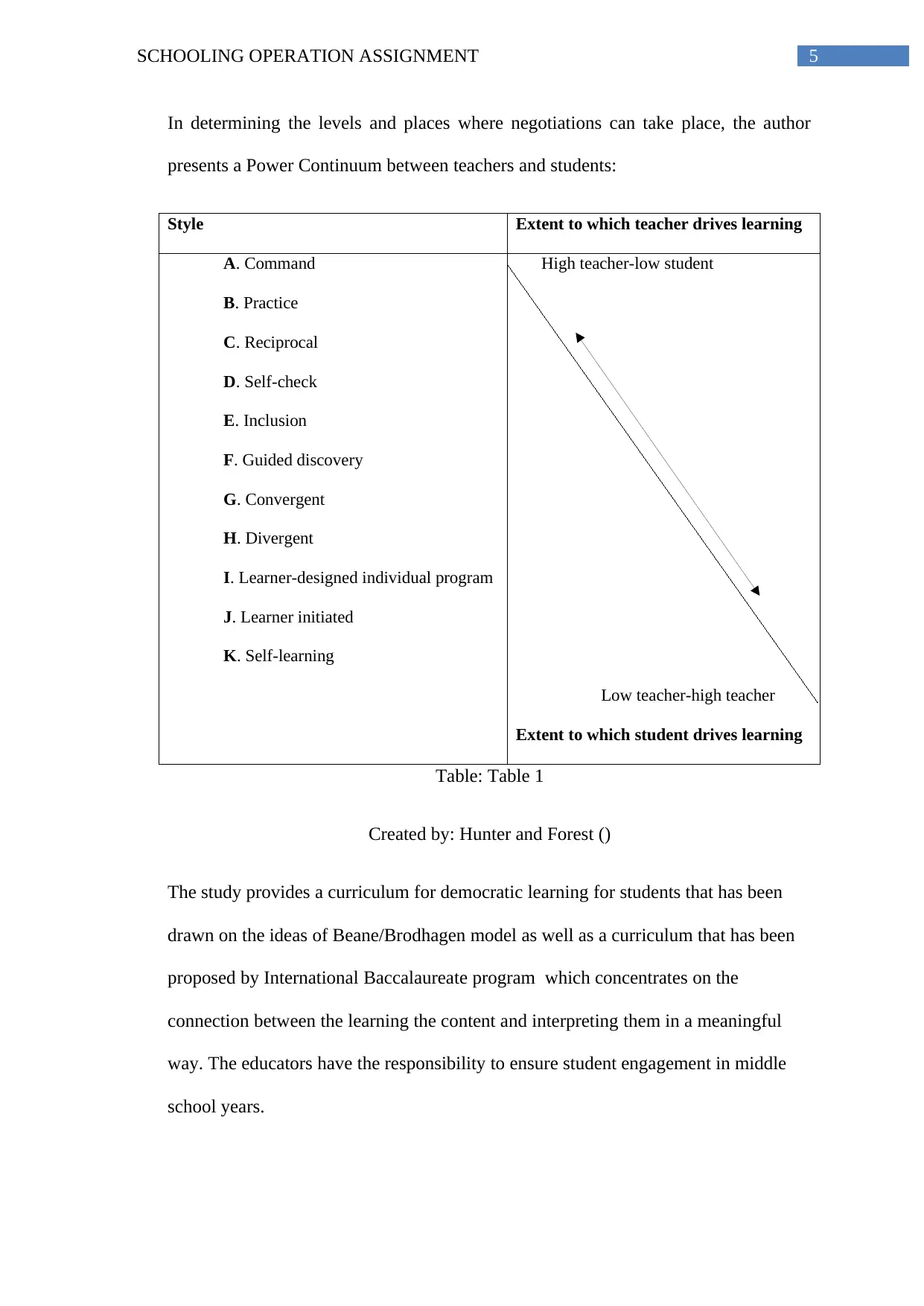
In determining the levels and places where negotiations can take place, the author
presents a Power Continuum between teachers and students:
Style Extent to which teacher drives learning
A. Command
B. Practice
C. Reciprocal
D. Self-check
E. Inclusion
F. Guided discovery
G. Convergent
H. Divergent
I. Learner-designed individual program
J. Learner initiated
K. Self-learning
High teacher-low student
Low teacher-high teacher
Extent to which student drives learning
Table: Table 1
Created by: Hunter and Forest ()
The study provides a curriculum for democratic learning for students that has been
drawn on the ideas of Beane/Brodhagen model as well as a curriculum that has been
proposed by International Baccalaureate program which concentrates on the
connection between the learning the content and interpreting them in a meaningful
way. The educators have the responsibility to ensure student engagement in middle
school years.
In determining the levels and places where negotiations can take place, the author
presents a Power Continuum between teachers and students:
Style Extent to which teacher drives learning
A. Command
B. Practice
C. Reciprocal
D. Self-check
E. Inclusion
F. Guided discovery
G. Convergent
H. Divergent
I. Learner-designed individual program
J. Learner initiated
K. Self-learning
High teacher-low student
Low teacher-high teacher
Extent to which student drives learning
Table: Table 1
Created by: Hunter and Forest ()
The study provides a curriculum for democratic learning for students that has been
drawn on the ideas of Beane/Brodhagen model as well as a curriculum that has been
proposed by International Baccalaureate program which concentrates on the
connection between the learning the content and interpreting them in a meaningful
way. The educators have the responsibility to ensure student engagement in middle
school years.
⊘ This is a preview!⊘
Do you want full access?
Subscribe today to unlock all pages.
Trusted by 1+ million students worldwide
6SCHOOLING OPERATION ASSIGNMENT
1.1.4 Discussion
The above table shows the different aspects and the role and effect that students and
teachers have in ensuring learning. While the table shows that teachers have more
power in command learning while the students are more able in self-learning. The
idea of negotiated learning has many drawbacks. As argued by Wallace, Venville and
Rennie, this required a lot of budget and overstaffing thus was abandoned some years
later. It is recommended that a more practical approach should be generated regarding
this. The idea is extremely appealing but the applicability of the theory is problematic.
1.1.5 Criticisms/ problems/ Issues
The study proposes a strong idea though there are many drawbacks. The main
problem with study is its lack of quantitative data and examples that show how many
schools in Australia or overseas that have actually applied student participation
(Hunter & Forrest, 2010). The effect that they have had following the technique is
unknown. Another issue is that the learning plans that have been provided are not
very practical.
1.2 Paper 2
1.2.1 Topic
Study in junior learning strategy in middle schools.
1.2.2 Purpose
The purpose of this study is to analyze the aspects and advantages of Integrated
learning so that learning strategies can be reformed. The need for integration and its
benefits cannot be denied especially in the middle school. Thus, the study is to
explore different aspects and types of integration and offers a framework to facilitate
integration.
1.1.4 Discussion
The above table shows the different aspects and the role and effect that students and
teachers have in ensuring learning. While the table shows that teachers have more
power in command learning while the students are more able in self-learning. The
idea of negotiated learning has many drawbacks. As argued by Wallace, Venville and
Rennie, this required a lot of budget and overstaffing thus was abandoned some years
later. It is recommended that a more practical approach should be generated regarding
this. The idea is extremely appealing but the applicability of the theory is problematic.
1.1.5 Criticisms/ problems/ Issues
The study proposes a strong idea though there are many drawbacks. The main
problem with study is its lack of quantitative data and examples that show how many
schools in Australia or overseas that have actually applied student participation
(Hunter & Forrest, 2010). The effect that they have had following the technique is
unknown. Another issue is that the learning plans that have been provided are not
very practical.
1.2 Paper 2
1.2.1 Topic
Study in junior learning strategy in middle schools.
1.2.2 Purpose
The purpose of this study is to analyze the aspects and advantages of Integrated
learning so that learning strategies can be reformed. The need for integration and its
benefits cannot be denied especially in the middle school. Thus, the study is to
explore different aspects and types of integration and offers a framework to facilitate
integration.
Paraphrase This Document
Need a fresh take? Get an instant paraphrase of this document with our AI Paraphraser
7SCHOOLING OPERATION ASSIGNMENT
1.2.3 Overview
The study opens with the ideas and concepts regarding Integration. The idea of
integration is largely related to making connections or practical learning. in this
learning method students are able to connect the topics that they read with real life
and global scenarios and thus understand the implications of their learning better. in
spite of these ideas already been present for many years, the teachers and students
both struggle to apply these ideas in real classrooms. The challenges that they face are
devising a lesson plan deriving from the big curriculum instructions, interconnection
teaching where they teach the students how they can relate one aspect to another and
application of classroom learning into the real.
Many researchers have come up with many solutions to ensure integrated learning.
They have suggested making similar topics learning availability in different subjects.
It means that topics related to each other are taught in respective subject classrooms
so that students are able to understand a topic from different perspective. In reality,
the application of this process is quite complicated, as a curriculum does not consider
the complexity of its suggestions rather are more pragmatic in nature.
The authors discuss the different forms that integration can take. The first one is the
Synchronized approach of integration where similar contents are taught across
different subjects so that the students are able to draw correlation among them. In this
method, the teachers already create the correlation as they plan the curriculum that
way. In cross-curricular approach is concerned more with bigger learnings about life.
The learning outcomes are more holistic where students are able to learn aspects of
critical thinking, numeracy and problem solving. A thematic approach is to integrate
the subjects taught into a thread. This method is interactive and need the participation
of both teachers and students to make the connection successful. A Project based
1.2.3 Overview
The study opens with the ideas and concepts regarding Integration. The idea of
integration is largely related to making connections or practical learning. in this
learning method students are able to connect the topics that they read with real life
and global scenarios and thus understand the implications of their learning better. in
spite of these ideas already been present for many years, the teachers and students
both struggle to apply these ideas in real classrooms. The challenges that they face are
devising a lesson plan deriving from the big curriculum instructions, interconnection
teaching where they teach the students how they can relate one aspect to another and
application of classroom learning into the real.
Many researchers have come up with many solutions to ensure integrated learning.
They have suggested making similar topics learning availability in different subjects.
It means that topics related to each other are taught in respective subject classrooms
so that students are able to understand a topic from different perspective. In reality,
the application of this process is quite complicated, as a curriculum does not consider
the complexity of its suggestions rather are more pragmatic in nature.
The authors discuss the different forms that integration can take. The first one is the
Synchronized approach of integration where similar contents are taught across
different subjects so that the students are able to draw correlation among them. In this
method, the teachers already create the correlation as they plan the curriculum that
way. In cross-curricular approach is concerned more with bigger learnings about life.
The learning outcomes are more holistic where students are able to learn aspects of
critical thinking, numeracy and problem solving. A thematic approach is to integrate
the subjects taught into a thread. This method is interactive and need the participation
of both teachers and students to make the connection successful. A Project based
8SCHOOLING OPERATION ASSIGNMENT
approach on the other hand is focused on the projects that students has to do in the
year. The projects are organized in such a way that they provide them with practical
based knowledge about the topics that they are reading. The School-specialized
approach is more permanent in nature as it depends on the infrastructure of the
institution and is a long-term project. Community-focused approach whereas
concentrates on future learning and harmonious living with the community.
The study traces the reasons that integration is much discussed. The first interest of
Integration is Technical. Here the students procure a wholesome knowledge about the
techniques, concepts and ideas that are related to a topic. The students and teachers
must be involved with the learning process to a great degree. In case of Practical
interest, it is the sense drawn by individual student that is important. The sense that
they will draw is largely dependent upon their own experiences, environment and
previous learning. it also helps them to create their own problem solving skills.
Critical interest on the other hand involves challenging the existing practices and
questioning their applicability. It also considers the changes or modifications that can
be made to make the system better. The main idea is challenging the assumption,
analyzing the aspects related to it and coming up with something better that will
change the future of that topic.
1.2.4 Discussion
Many learning institutes are using the model and ideas relayed in the study. The
model that the authors propose have five elements integrated into it. The first is
selecting topics that are related to an idea related to the big curriculum provided. The
second is eliciting the previous knowledge acquired by students. The third to fifth is
to provide technical, practical and critical interest to enable a complete learning.
Lesson plan that they have created is focused on students’ need and applicability of
approach on the other hand is focused on the projects that students has to do in the
year. The projects are organized in such a way that they provide them with practical
based knowledge about the topics that they are reading. The School-specialized
approach is more permanent in nature as it depends on the infrastructure of the
institution and is a long-term project. Community-focused approach whereas
concentrates on future learning and harmonious living with the community.
The study traces the reasons that integration is much discussed. The first interest of
Integration is Technical. Here the students procure a wholesome knowledge about the
techniques, concepts and ideas that are related to a topic. The students and teachers
must be involved with the learning process to a great degree. In case of Practical
interest, it is the sense drawn by individual student that is important. The sense that
they will draw is largely dependent upon their own experiences, environment and
previous learning. it also helps them to create their own problem solving skills.
Critical interest on the other hand involves challenging the existing practices and
questioning their applicability. It also considers the changes or modifications that can
be made to make the system better. The main idea is challenging the assumption,
analyzing the aspects related to it and coming up with something better that will
change the future of that topic.
1.2.4 Discussion
Many learning institutes are using the model and ideas relayed in the study. The
model that the authors propose have five elements integrated into it. The first is
selecting topics that are related to an idea related to the big curriculum provided. The
second is eliciting the previous knowledge acquired by students. The third to fifth is
to provide technical, practical and critical interest to enable a complete learning.
Lesson plan that they have created is focused on students’ need and applicability of
⊘ This is a preview!⊘
Do you want full access?
Subscribe today to unlock all pages.
Trusted by 1+ million students worldwide
9SCHOOLING OPERATION ASSIGNMENT
the delivered knowledge. The study provides many examples of the application of the
different aspects of integrated learning whereas it fails to give one example or any
statistics on the application of the idea as a whole.
1.2.5 Criticisms/ problems/ Issues
The problem that surfaced from this paper is the lack of previous data and statistics.
Though there are many examples that relates how different schools have facilitated
integrated learning, the lack of data regarding the existing methods of teaching and
the success and failure report makes it complicated to understand the need for the new
framework world (Wallace, Venville & Rennie, 2005).
1.3 Paper 3
1.3.1 Topic
Study on senior VET education in school.
1.3.2 Purpose
The aim of the study was to investigate the relation between the participation of the
youths in rural areas in the VET programs that are provided in school and the rate of
recruitment of them in desired careers. The study mainly focuses on the youths that
have lost some essential study years in secondary education. The study also identifies
the features of the VET programs as offered by the schools and post-school programs.
1.3.3 Overview
The study is based on a survey of rural students from six school clusters conducted by
mailed questionnaire. the purpose of school VET is to provide education to the youths
who have not ben able to attend some vital years of their education and assist them in
training themselves to become eligible for employment. The main idea is to inspire in
them the necessity of higher study and train them in necessary skills that would enable
the delivered knowledge. The study provides many examples of the application of the
different aspects of integrated learning whereas it fails to give one example or any
statistics on the application of the idea as a whole.
1.2.5 Criticisms/ problems/ Issues
The problem that surfaced from this paper is the lack of previous data and statistics.
Though there are many examples that relates how different schools have facilitated
integrated learning, the lack of data regarding the existing methods of teaching and
the success and failure report makes it complicated to understand the need for the new
framework world (Wallace, Venville & Rennie, 2005).
1.3 Paper 3
1.3.1 Topic
Study on senior VET education in school.
1.3.2 Purpose
The aim of the study was to investigate the relation between the participation of the
youths in rural areas in the VET programs that are provided in school and the rate of
recruitment of them in desired careers. The study mainly focuses on the youths that
have lost some essential study years in secondary education. The study also identifies
the features of the VET programs as offered by the schools and post-school programs.
1.3.3 Overview
The study is based on a survey of rural students from six school clusters conducted by
mailed questionnaire. the purpose of school VET is to provide education to the youths
who have not ben able to attend some vital years of their education and assist them in
training themselves to become eligible for employment. The main idea is to inspire in
them the necessity of higher study and train them in necessary skills that would enable
Paraphrase This Document
Need a fresh take? Get an instant paraphrase of this document with our AI Paraphraser
10SCHOOLING OPERATION ASSIGNMENT
them to get placements. The author argues that programs related to work placements
are more likely to get appointed in their locality. The distinction between males and
females regarding job choices are also there. Where the males mostly prefer jobs that
are related to trade, technology or industry based, women prefer business, clerical
jobs and work skills.
The statistics that the study produces the idea of outcomes regarding employment
shows that among the employed students who left school early, more than 50% were
school VET students. While the employment demographics show no distinction
among gender, it shows higher rate of employment and retention for the students who
took VET programs. Students that took VET programs were also able to live within
their community than other non-Vet students.
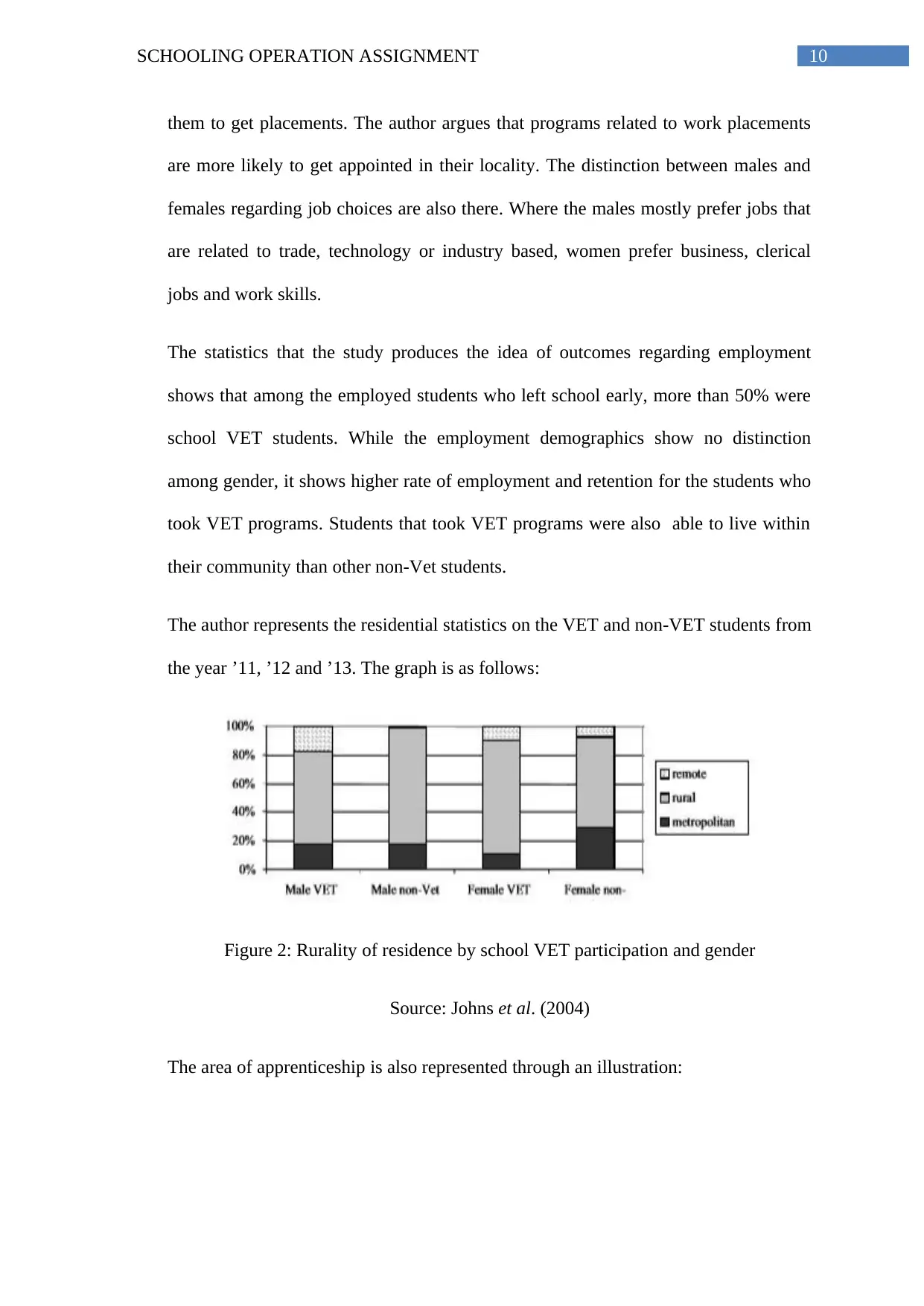
The author represents the residential statistics on the VET and non-VET students from
the year ’11, ’12 and ’13. The graph is as follows:
Figure 2: Rurality of residence by school VET participation and gender
Source: Johns et al. (2004)
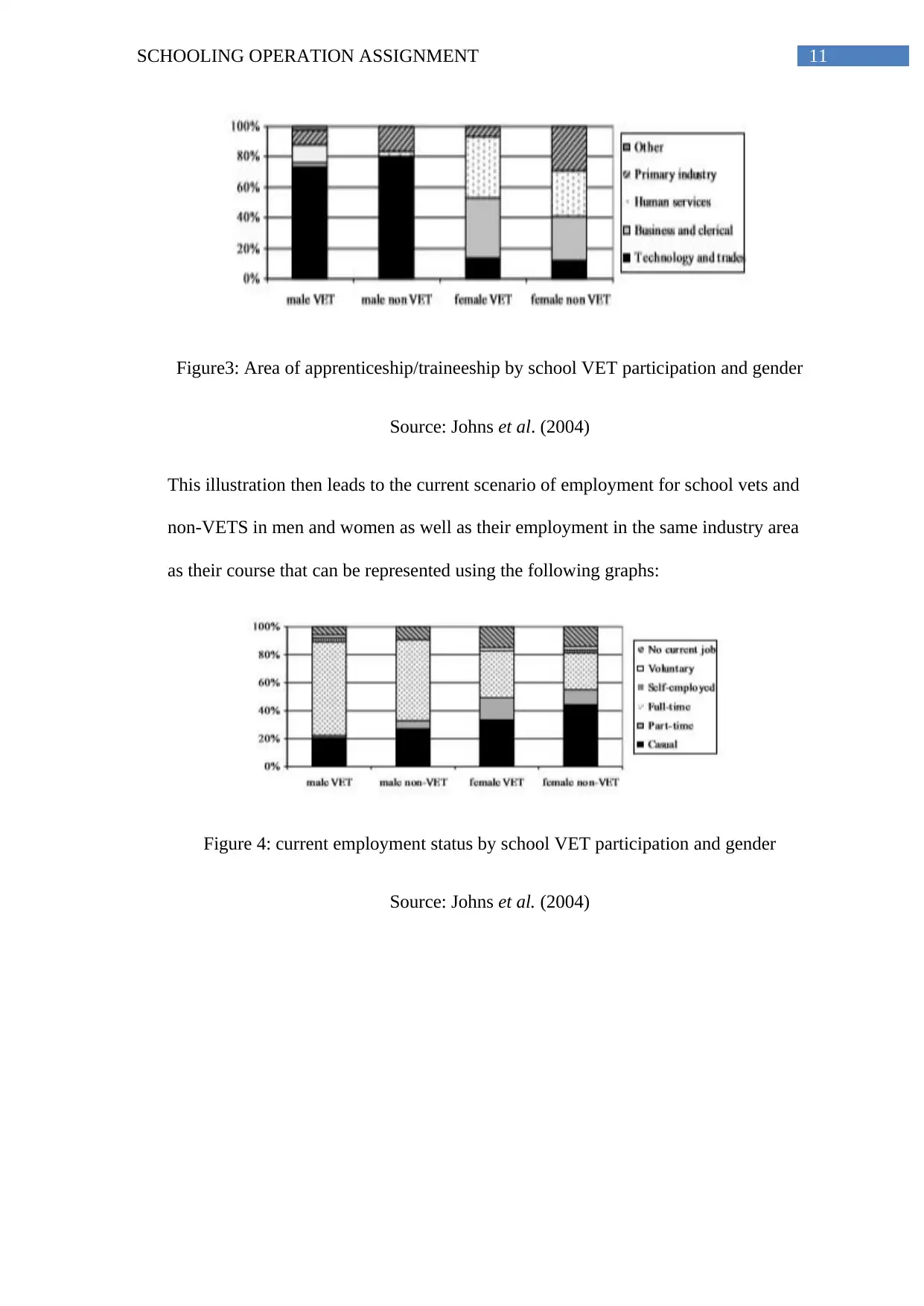
The area of apprenticeship is also represented through an illustration:
them to get placements. The author argues that programs related to work placements
are more likely to get appointed in their locality. The distinction between males and
females regarding job choices are also there. Where the males mostly prefer jobs that
are related to trade, technology or industry based, women prefer business, clerical
jobs and work skills.
The statistics that the study produces the idea of outcomes regarding employment
shows that among the employed students who left school early, more than 50% were
school VET students. While the employment demographics show no distinction
among gender, it shows higher rate of employment and retention for the students who
took VET programs. Students that took VET programs were also able to live within
their community than other non-Vet students.
The author represents the residential statistics on the VET and non-VET students from
the year ’11, ’12 and ’13. The graph is as follows:
Figure 2: Rurality of residence by school VET participation and gender
Source: Johns et al. (2004)
The area of apprenticeship is also represented through an illustration:
11SCHOOLING OPERATION ASSIGNMENT
Figure3: Area of apprenticeship/traineeship by school VET participation and gender
Source: Johns et al. (2004)
This illustration then leads to the current scenario of employment for school vets and
non-VETS in men and women as well as their employment in the same industry area
as their course that can be represented using the following graphs:
Figure 4: current employment status by school VET participation and gender
Source: Johns et al. (2004)
Figure3: Area of apprenticeship/traineeship by school VET participation and gender
Source: Johns et al. (2004)
This illustration then leads to the current scenario of employment for school vets and
non-VETS in men and women as well as their employment in the same industry area
as their course that can be represented using the following graphs:
Figure 4: current employment status by school VET participation and gender
Source: Johns et al. (2004)
⊘ This is a preview!⊘
Do you want full access?
Subscribe today to unlock all pages.
Trusted by 1+ million students worldwide

1 out of 18


Related Documents


Your All-in-One AI-Powered Toolkit for Academic Success.
+13062052269
info@desklib.com
Available 24*7 on WhatsApp / Email
![[object Object]](/_next/static/media/star-bottom.7253800d.svg)
Unlock your academic potential
Copyright © 2020–2026 A2Z Services. All Rights Reserved. Developed and managed by ZUCOL.