STEM: Science and Technology in Early Childhood Education - Discussion

Verified

Added on  2023/01/19

|4
|784
|63
Homework Assignment
AI Summary
This assignment explores the integration of STEM (Science, Technology, Engineering, and Mathematics) principles in early childhood education. It emphasizes the significance of introducing engineering concepts to young children, highlighting how engineering design activities within a STEM framework can foster problem-solving skills, creativity, and critical thinking. The discussion covers various strategies such as introducing the term 'engineering,' explaining the role of engineers, identifying children's interests in engineering, and teaching them to think like engineers. The assignment also highlights the importance of STEM education in turning ideas into reality, making learning fun, and building a foundation for future development. The document references several sources to support the arguments and emphasizes the need for early exposure to engineering concepts to enhance children's capabilities and prepare them for future challenges. This assignment provides a comprehensive overview of STEM's role in shaping young children's understanding and skills.
Document Page
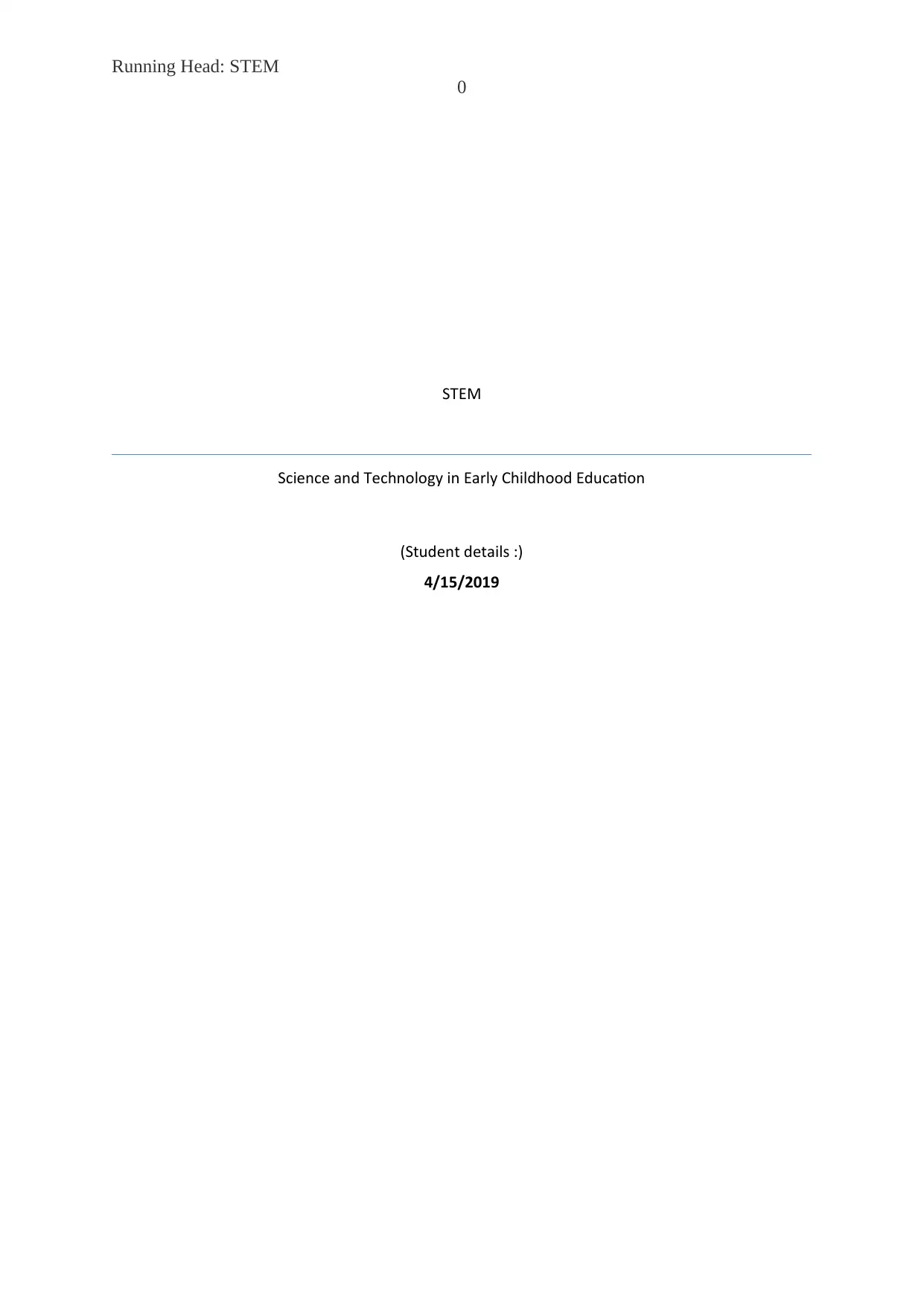
Running Head: STEM
0
STEM
Science and Technology in Early Childhood Education
(Student details :)
4/15/2019
tabler-icon-diamond-filled.svg

Paraphrase This Document

Need a fresh take? Get an instant paraphrase of this document with our AI Paraphraser
Document Page
STEM
1
Science and Technology
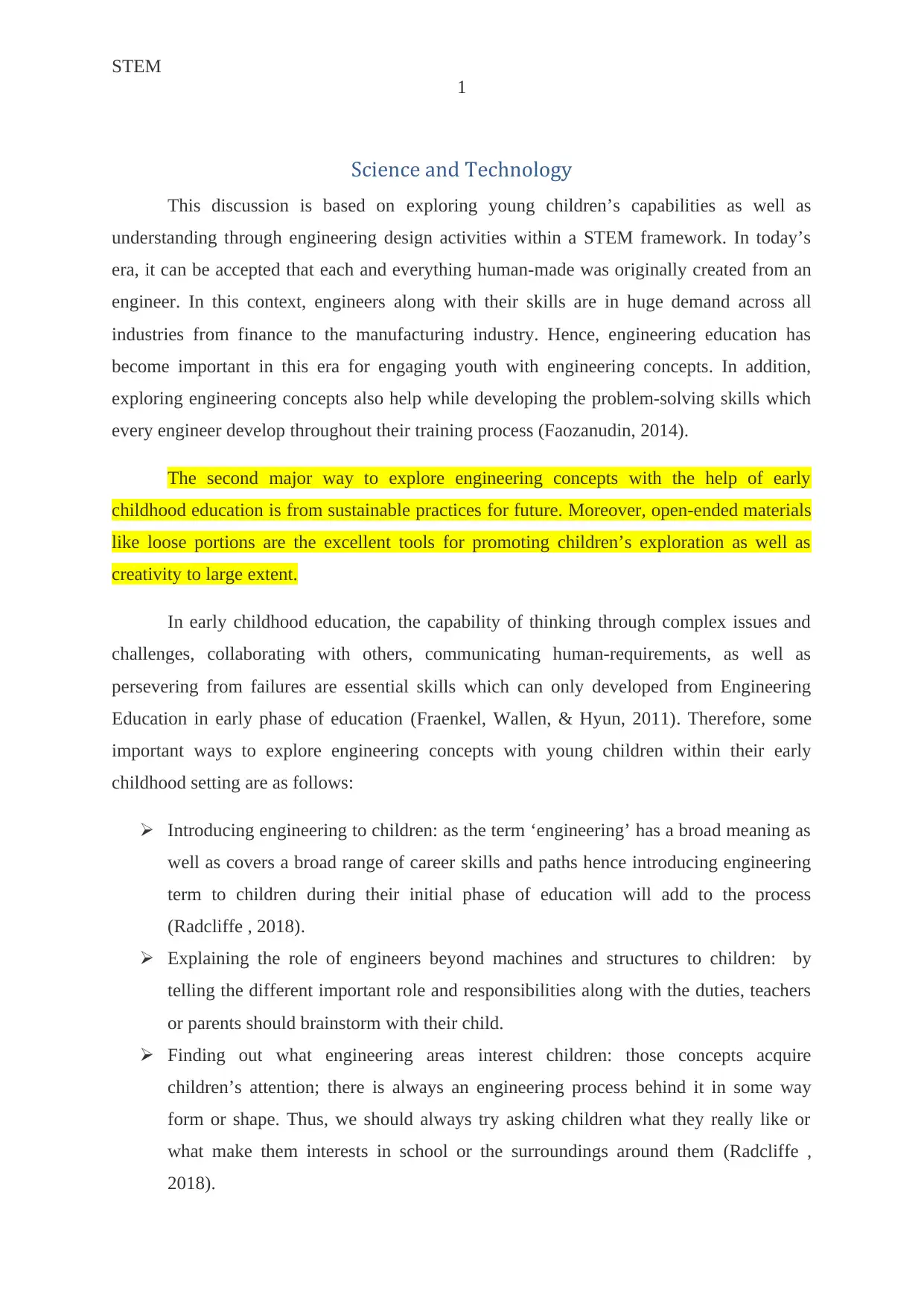
This discussion is based on exploring young children’s capabilities as well as
understanding through engineering design activities within a STEM framework. In today’s
era, it can be accepted that each and everything human-made was originally created from an
engineer. In this context, engineers along with their skills are in huge demand across all
industries from finance to the manufacturing industry. Hence, engineering education has
become important in this era for engaging youth with engineering concepts. In addition,
exploring engineering concepts also help while developing the problem-solving skills which
every engineer develop throughout their training process (Faozanudin, 2014).
The second major way to explore engineering concepts with the help of early
childhood education is from sustainable practices for future. Moreover, open-ended materials
like loose portions are the excellent tools for promoting children’s exploration as well as
creativity to large extent.
In early childhood education, the capability of thinking through complex issues and
challenges, collaborating with others, communicating human-requirements, as well as
persevering from failures are essential skills which can only developed from Engineering
Education in early phase of education (Fraenkel, Wallen, & Hyun, 2011). Therefore, some
important ways to explore engineering concepts with young children within their early
childhood setting are as follows:
Introducing engineering to children: as the term ‘engineering’ has a broad meaning as
well as covers a broad range of career skills and paths hence introducing engineering
term to children during their initial phase of education will add to the process
(Radcliffe , 2018).
Explaining the role of engineers beyond machines and structures to children: by
telling the different important role and responsibilities along with the duties, teachers
or parents should brainstorm with their child.
Finding out what engineering areas interest children: those concepts acquire
children’s attention; there is always an engineering process behind it in some way
form or shape. Thus, we should always try asking children what they really like or
what make them interests in school or the surroundings around them (Radcliffe ,
2018).
Document Page
STEM
2
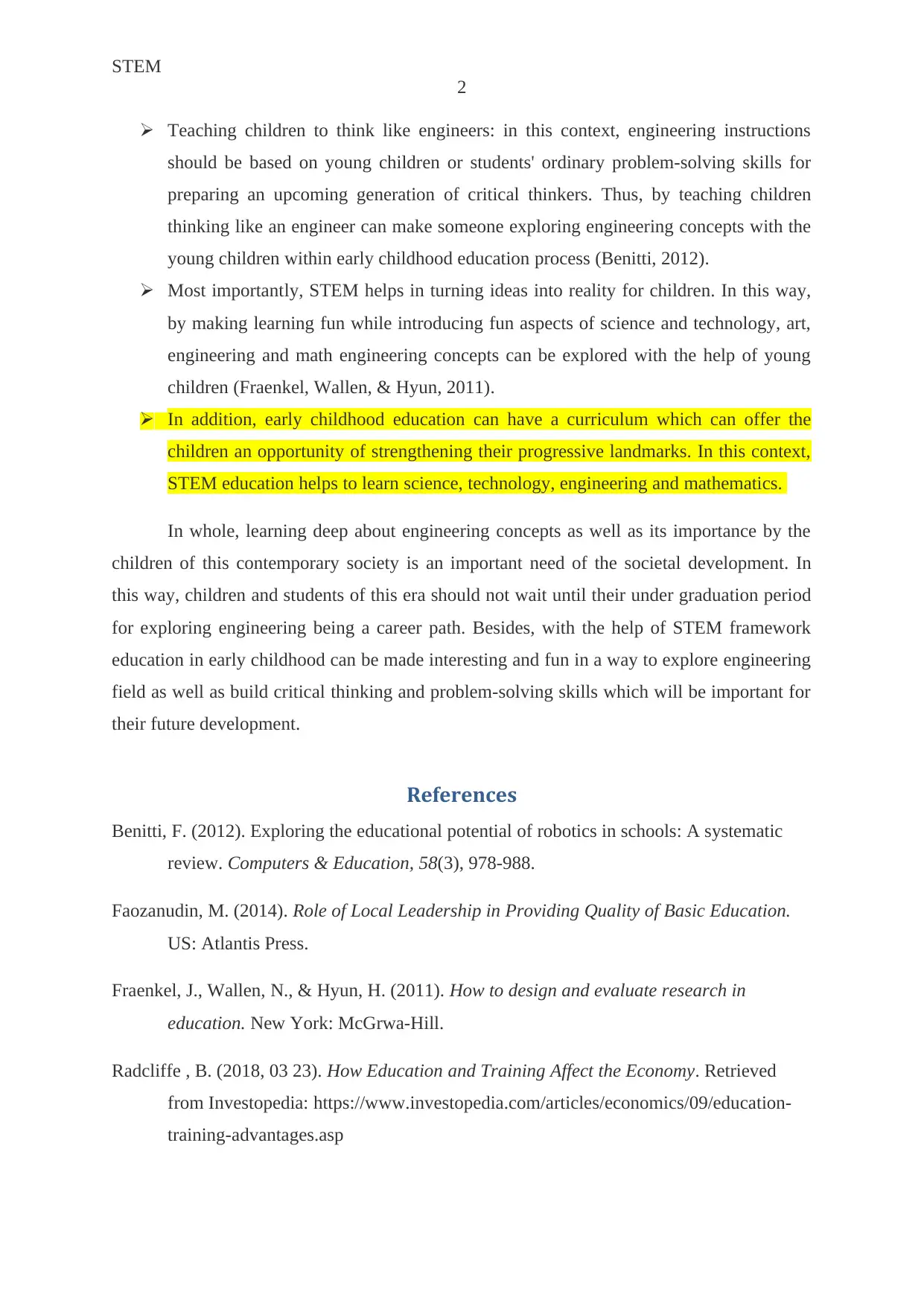
Teaching children to think like engineers: in this context, engineering instructions
should be based on young children or students' ordinary problem-solving skills for
preparing an upcoming generation of critical thinkers. Thus, by teaching children
thinking like an engineer can make someone exploring engineering concepts with the
young children within early childhood education process (Benitti, 2012).
Most importantly, STEM helps in turning ideas into reality for children. In this way,
by making learning fun while introducing fun aspects of science and technology, art,
engineering and math engineering concepts can be explored with the help of young
children (Fraenkel, Wallen, & Hyun, 2011).
In addition, early childhood education can have a curriculum which can offer the
children an opportunity of strengthening their progressive landmarks. In this context,
STEM education helps to learn science, technology, engineering and mathematics.
In whole, learning deep about engineering concepts as well as its importance by the
children of this contemporary society is an important need of the societal development. In
this way, children and students of this era should not wait until their under graduation period
for exploring engineering being a career path. Besides, with the help of STEM framework
education in early childhood can be made interesting and fun in a way to explore engineering
field as well as build critical thinking and problem-solving skills which will be important for
their future development.
References
Benitti, F. (2012). Exploring the educational potential of robotics in schools: A systematic
review. Computers & Education, 58(3), 978-988.
Faozanudin, M. (2014). Role of Local Leadership in Providing Quality of Basic Education.
US: Atlantis Press.
Fraenkel, J., Wallen, N., & Hyun, H. (2011). How to design and evaluate research in
education. New York: McGrwa-Hill.
Radcliffe , B. (2018, 03 23). How Education and Training Affect the Economy. Retrieved
from Investopedia: https://www.investopedia.com/articles/economics/09/education-
training-advantages.asp
Document Page
STEM
3
chevron_up_icon
1 out of 4
circle_padding
hide_on_mobile
zoom_out_icon
[object Object]