SDM404 Report: Analyzing Hotel Meritos' Service for Assunta Hospital

Verified

Added on  2022/09/17

|9
|2005
|34
Report
AI Summary
This report provides a comprehensive analysis of Hotel Meritos' service, specifically tailored for patients and families of Assunta Hospital. It begins by outlining the service concept and its alignment with various departments, including housekeeping, bartending, and restaurants. The report delves into strategies for managing services, emphasizing staff motivation, service failure management, and effective communication. It identifies potential service failures across different departments and proposes solutions, culminating in a handbook design. Furthermore, it examines the importance of managing internal and external customer relationships, highlighting strategies to ensure guaranteed quality service. The report differentiates between personalized services for internal customers and professional services for external customers. Finally, it concludes by reiterating the complexity and dynamism of service in the hotel industry and emphasizes the importance of the strategies discussed for enhancing service quality and customer satisfaction.
Document Page
Introduction
The hotel and hospitality industry is one of the most dynamic industry today. It
essentially is responsible for provision of food and accommodates people in the facility in
destinations like resort, hotel, conference center and amusement park. The aligned industry with
the sector is the catering industry. (Zervas, Proserpio & Byers, 2017) The hotel industry in itself
is a very broad sector from the perspective of the organization. To provide the best services to
the customers it is aligned with housekeeping, bartending, restaurant, and café services. Firstly,
this report will try to analyze and justify the service concept of hotel Meritos’ focusing on the
service of the patients and their family members of Assunta Hospital. Then it discusses the
various strategies for managing services inclusing motivating the staff. It undertakes the various
service failures and how to recover from those problems. The importance of effective
communication is also included in the study. Next potential service failures of the different
departments of the hotel are provided according to which the handbook is designed.
2.2.5. Managing Service Failure and Recovery
Service failures occur when there exists a gap between the service received and the
customer expectation. (Aguilar-Rojas, Fandos-Hererra & Flavian-Blanco. 2015) In this case, the
customer will be dissatisfied if the person receives the wrong service, not receiving the service
within time or inferior quality of service. Then it is the work of the organization to solve the
problem as soon as possible. The result of service failure is giving a negative impression to the
customer. If the problem is not solved at all, it will result in customer rejecting the whole
tabler-icon-diamond-filled.svg

Paraphrase This Document

Need a fresh take? Get an instant paraphrase of this document with our AI Paraphraser
Document Page
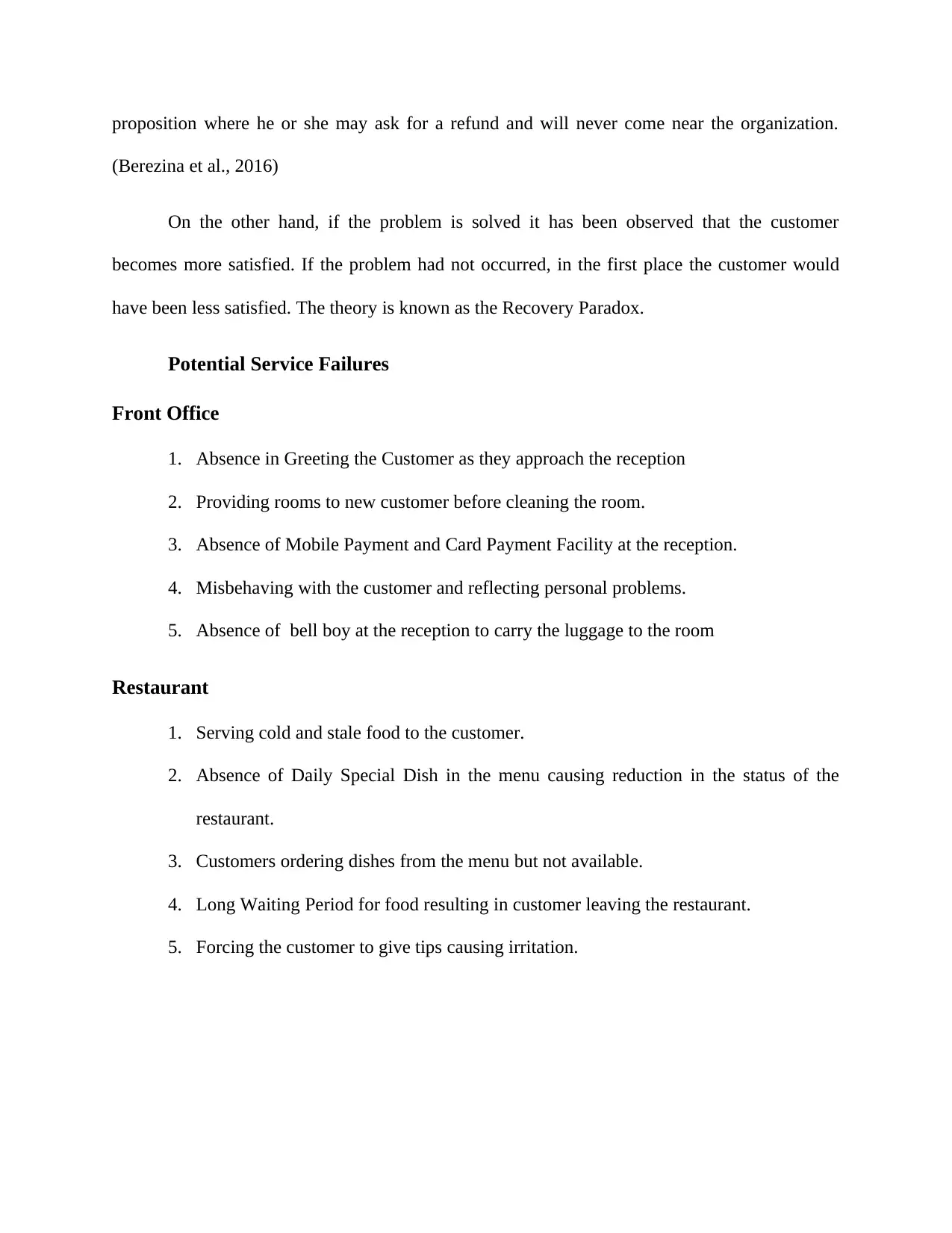
proposition where he or she may ask for a refund and will never come near the organization.
(Berezina et al., 2016)
On the other hand, if the problem is solved it has been observed that the customer
becomes more satisfied. If the problem had not occurred, in the first place the customer would
have been less satisfied. The theory is known as the Recovery Paradox.
Potential Service Failures
Front Office
1. Absence in Greeting the Customer as they approach the reception
2. Providing rooms to new customer before cleaning the room.
3. Absence of Mobile Payment and Card Payment Facility at the reception.
4. Misbehaving with the customer and reflecting personal problems.
5. Absence of bell boy at the reception to carry the luggage to the room
Restaurant
1. Serving cold and stale food to the customer.
2. Absence of Daily Special Dish in the menu causing reduction in the status of the
restaurant.
3. Customers ordering dishes from the menu but not available.
4. Long Waiting Period for food resulting in customer leaving the restaurant.
5. Forcing the customer to give tips causing irritation.
Document Page
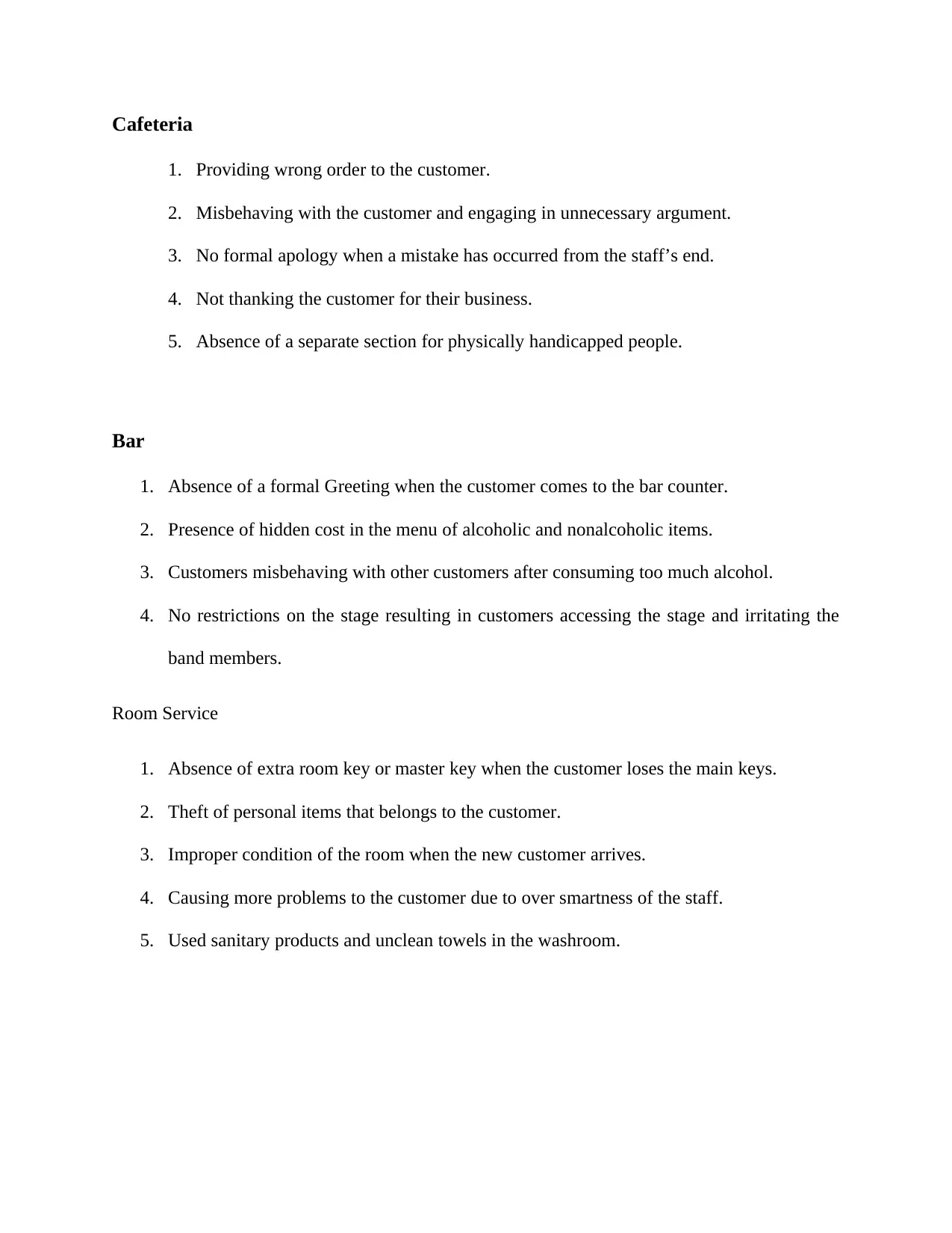
Cafeteria
1. Providing wrong order to the customer.
2. Misbehaving with the customer and engaging in unnecessary argument.
3. No formal apology when a mistake has occurred from the staff’s end.
4. Not thanking the customer for their business.
5. Absence of a separate section for physically handicapped people.
Bar
1. Absence of a formal Greeting when the customer comes to the bar counter.
2. Presence of hidden cost in the menu of alcoholic and nonalcoholic items.
3. Customers misbehaving with other customers after consuming too much alcohol.
4. No restrictions on the stage resulting in customers accessing the stage and irritating the
band members.
Room Service
1. Absence of extra room key or master key when the customer loses the main keys.
2. Theft of personal items that belongs to the customer.
3. Improper condition of the room when the new customer arrives.
4. Causing more problems to the customer due to over smartness of the staff.
5. Used sanitary products and unclean towels in the washroom.
Document Page
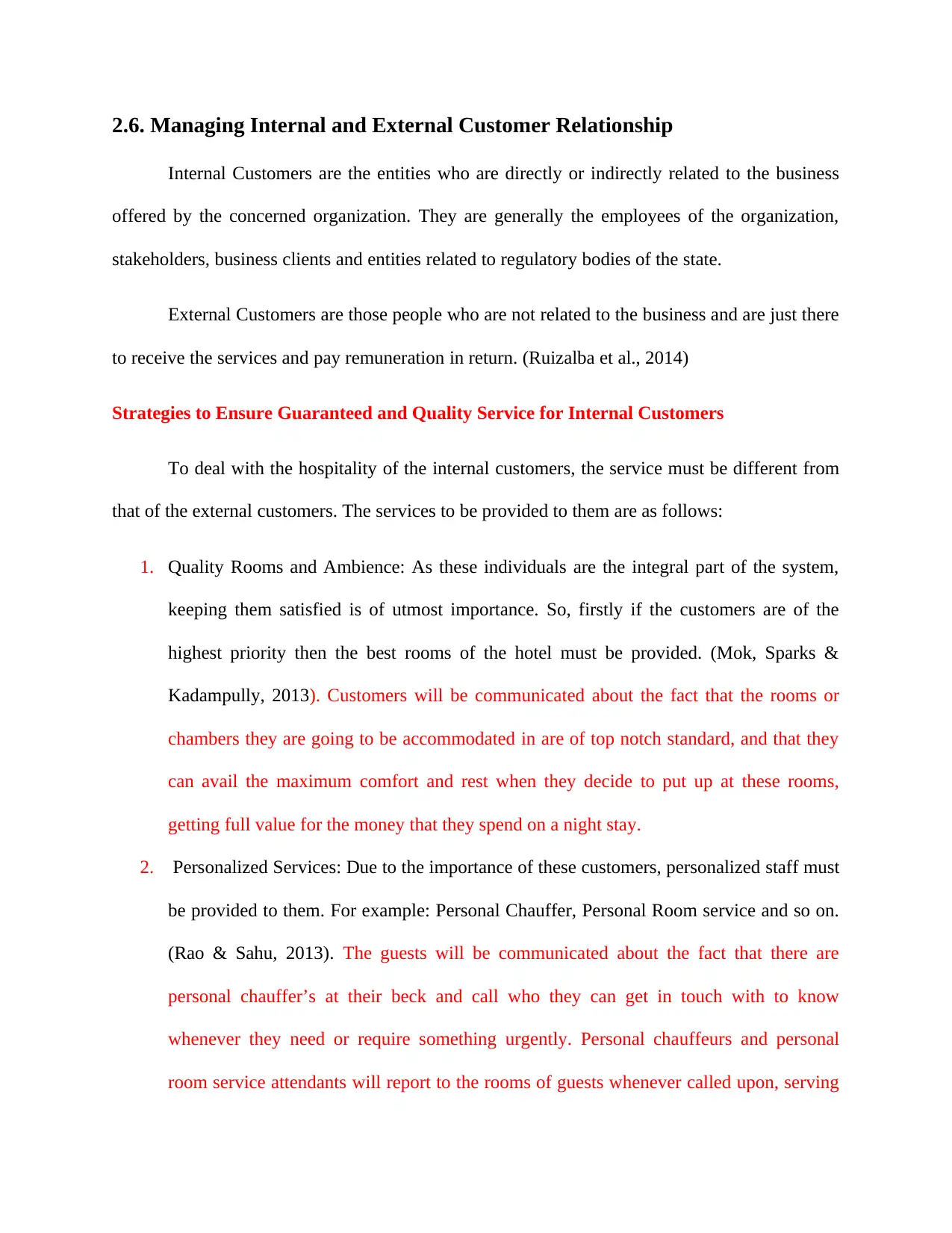
2.6. Managing Internal and External Customer Relationship
Internal Customers are the entities who are directly or indirectly related to the business
offered by the concerned organization. They are generally the employees of the organization,
stakeholders, business clients and entities related to regulatory bodies of the state.
External Customers are those people who are not related to the business and are just there
to receive the services and pay remuneration in return. (Ruizalba et al., 2014)
Strategies to Ensure Guaranteed and Quality Service for Internal Customers
To deal with the hospitality of the internal customers, the service must be different from
that of the external customers. The services to be provided to them are as follows:
1. Quality Rooms and Ambience: As these individuals are the integral part of the system,
keeping them satisfied is of utmost importance. So, firstly if the customers are of the
highest priority then the best rooms of the hotel must be provided. (Mok, Sparks &
Kadampully, 2013). Customers will be communicated about the fact that the rooms or
chambers they are going to be accommodated in are of top notch standard, and that they
can avail the maximum comfort and rest when they decide to put up at these rooms,
getting full value for the money that they spend on a night stay.
2. Personalized Services: Due to the importance of these customers, personalized staff must
be provided to them. For example: Personal Chauffer, Personal Room service and so on.
(Rao & Sahu, 2013). The guests will be communicated about the fact that there are
personal chauffer’s at their beck and call who they can get in touch with to know
whenever they need or require something urgently. Personal chauffeurs and personal
room service attendants will report to the rooms of guests whenever called upon, serving
tabler-icon-diamond-filled.svg

Paraphrase This Document

Need a fresh take? Get an instant paraphrase of this document with our AI Paraphraser
Document Page
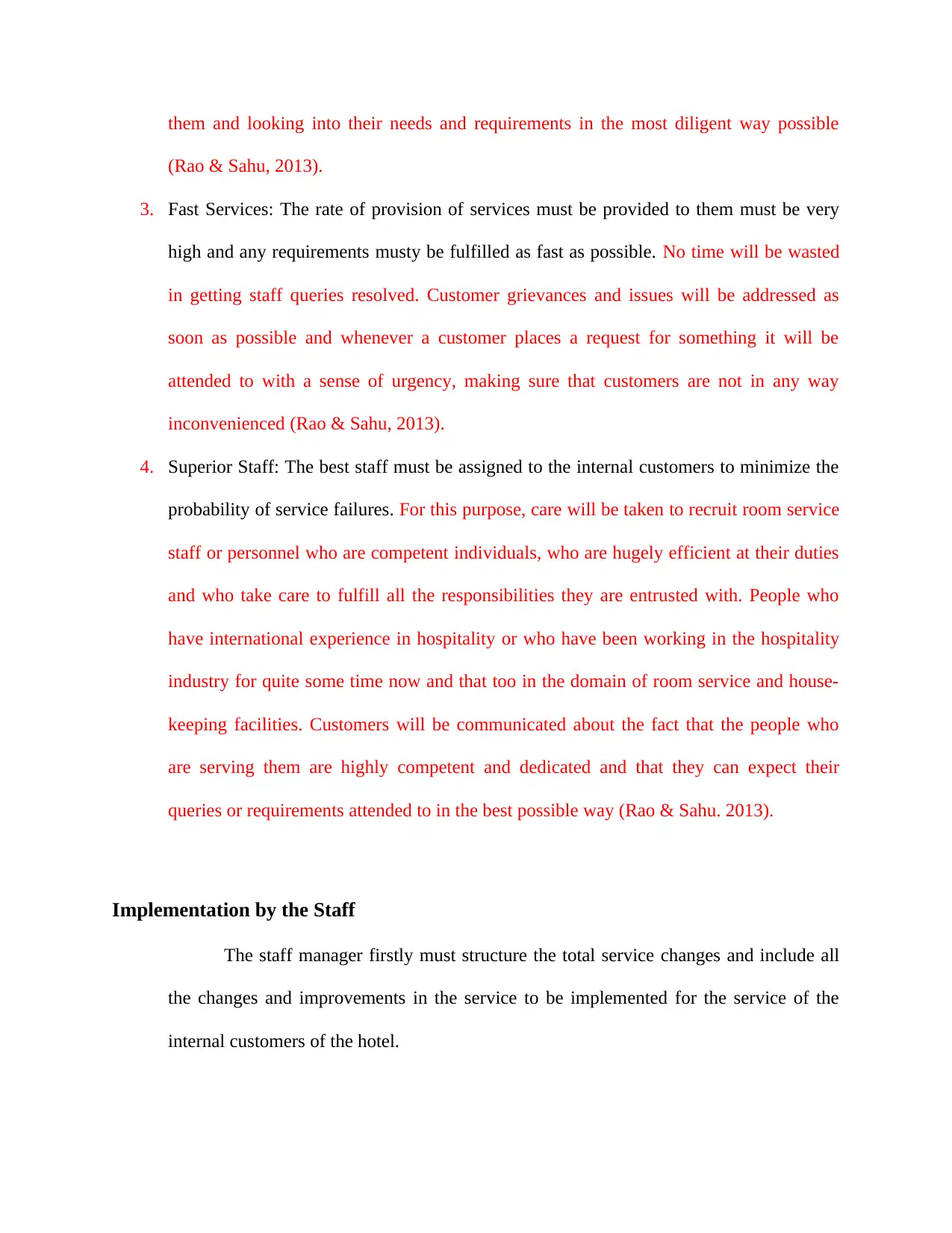
them and looking into their needs and requirements in the most diligent way possible
(Rao & Sahu, 2013).
3. Fast Services: The rate of provision of services must be provided to them must be very
high and any requirements musty be fulfilled as fast as possible. No time will be wasted
in getting staff queries resolved. Customer grievances and issues will be addressed as
soon as possible and whenever a customer places a request for something it will be
attended to with a sense of urgency, making sure that customers are not in any way
inconvenienced (Rao & Sahu, 2013).
4. Superior Staff: The best staff must be assigned to the internal customers to minimize the
probability of service failures. For this purpose, care will be taken to recruit room service
staff or personnel who are competent individuals, who are hugely efficient at their duties
and who take care to fulfill all the responsibilities they are entrusted with. People who
have international experience in hospitality or who have been working in the hospitality
industry for quite some time now and that too in the domain of room service and house-
keeping facilities. Customers will be communicated about the fact that the people who
are serving them are highly competent and dedicated and that they can expect their
queries or requirements attended to in the best possible way (Rao & Sahu. 2013).
Implementation by the Staff
The staff manager firstly must structure the total service changes and include all
the changes and improvements in the service to be implemented for the service of the
internal customers of the hotel.
Document Page
Secondly, a separate team of staff must be formed to make sure that every
requirement is fulfilled at the desired time.
Importance in managing internal and external customer relationships
The importance of managing internal and external customers is very dynamic in
nature. On one hand, the internal customers being a crucial part of the organization so
must be dealt with tactically. On the other hand, the external customers are the main
people who form the financial aspect for the hotel. (Markovic & Jankovic, 2013)
Therefore, the process of dealing with the two types of Customer must be very different.
1. Personalized vs. Professional: The internal customers will be more interested in the
personalized services and efforts being provided to them whereas the external
customers expects a professional behavior and services which allows them to choose
the brand over other brands. External customers must be made to see that the people
who are entrusted with their care and service are highly competent, experienced and
skilled individuals. Their hospitality is something that rests in very good hands and
they must be introduced to their staff and see for themselves how professional and
adept these people are at the services that they carry out for their customers
(Markovic & Jankovic, 2013).
2. Quality vs. Price: The internal customers must be served with the best service quality
whereas the external customers must be served according to the price paid by the
external customers. External customers must be made to see that they are they are
Document Page
being given full value for the price which they pay for their hospitality services. The
care, the attention and professional service which is made available at their disposal
must be provided in accordance with how much it is that they are paying for such
services (Markovic & Jankovic, 2013).
Conclusion
From the above study it can be inferred that the service provided in the hotel industry is
complex and dynamic in nature. Hotel Meritos’ is providing a specialized service to the patient
and the families of the Assunta Hospital. Moreover in this report the service being provided and
the process of proviving the services have been identified. Later, the report focuses on the
service failures of different departments of the hotel. Internal and External Service to the
customers have been examined. The strategies to improve service failures have been identified
and the service gaps have been analysed.
tabler-icon-diamond-filled.svg

Paraphrase This Document

Need a fresh take? Get an instant paraphrase of this document with our AI Paraphraser
Document Page
References
Aguilar-Rojas, O., Fandos-Herrera, C., & Flavián-Blanco, C. (2015). What may lead you to
recommend and revisit a hotel after a service failure instead of complaining?.
International Journal of Contemporary Hospitality Management, 27(2), 214-235.
Marković, S., & Raspor Janković, S. (2013). Exploring the relationship between service quality
and customer satisfaction in Croatian hotel industry. Tourism and Hospitality
Management, 19(2), 149-164.
Mok, C., Sparks, B., & Kadampully, J. (2013). Service quality management in hospitality,
tourism, and leisure. Routledge.
Rao, P. S., & Sahu, P. C. (2013). Impact of service quality on customer satisfaction in hotel
industry. IOSR Journal of Humanities and Social Science, 18(5), 39-44.
Ruizalba, J. L., Bermúdez-González, G., Rodríguez-Molina, M. A., & Blanca, M. J. (2014).
Internal market orientation: An empirical research in hotel sector. International Journal
of Hospitality Management, 38, 11-19.
Zervas, G., Proserpio, D., & Byers, J. W. (2017). The rise of the sharing economy: Estimating
the impact of Airbnb on the hotel industry. Journal of marketing research, 54(5), 687-
705.
Document Page
Rowe, N. E. (2019). The Economic Cost of Attending Educational Conferences. International
Journal on Social and Education Sciences, 1(1), 30-42.
chevron_up_icon
1 out of 9
circle_padding
hide_on_mobile
zoom_out_icon
[object Object]