Project Proposal: Modeling Influenza Spread and Vaccine Effectiveness
VerifiedAdded on Β 2022/08/29
|23
|6466
|32
Project
AI Summary
This project proposal outlines a model for analyzing the spread of influenza, focusing on seasonal flu dynamics, vaccination effectiveness, and potential treatment interventions. The project will utilize SIR models to simulate the infection rate, recovery rate, and the impact of vaccination on the population. The proposal includes an introduction to influenza, its transmission, and the need for new drugs and vaccines. The project will model the flu spread based on world population, sickness duration, infection rates, and virus quantity over time. The student proposes to use existing figures from research papers to provide a better understanding of the virus and guide the modeling process. The analysis will include examining the effectiveness of vaccines, different treatment options, and hospitalization rates. The proposal includes two SIR models, one for regular flu seasons and another for in-between seasons, considering mutation rates. The student will use MATLAB code to simulate the models and analyze the results, discussing the drawbacks of the model, such as the continuous nature of the model and the absence of contact dynamics. The project also includes a comprehensive bibliography and MATLAB code for simulations.
Project Proposal
Scarlett, Qing Sun
#215320302
Introduction
Influenza, also known as flu, is a respiratory infectious disease, as well as a global threat to
humans due to the fact it can be transmitted by having direct contact with infected people and
the contaminated objects, as well as the droplets in the air (i.e peopleβs cough and sneeze).
The Centers for Disease Control and Prevention has pointed out that people infected with
influenza can transmit the pathogen to others up to about 6 feet away2. Nevertheless, after the
virus enters human body, it normally takes 2-4 days for the symptoms to begin1. It also stated
that "you may be able to pass on the flu to someone else before you know you are sick, as
well as while you are sick. Some people may not show any symptoms after being infected by
a flu virus.
During this time, those people may still spread the virus to others."
According to the article βA Roadmap for Influenza Researchβ, published by Viktor MΓΌller,
βthe influenza viruses are characterized by segmented, negative-strand RNA genomes
requiring an RNA-dependent RNA polymerase of viral origin for replication. The particular
structure of the influenza virus genome and function of its viral proteins enable antigenic drift
and antigenic shift.β Very small changes based on the genetic makeup of the influenza strains
have been found to be referred as antigenic drift. However, when a flu strain mutates to a very
high extent, major changes occurs in the antigenic determinants which results in an antigenic
shift.
Moreover, studies and statistics have suggested that flu are constantly changing every
different each year. This is the reason why doctors and experimental scientists need to
develop new drugs, vaccines and adjuvant to help us prevent from getting infected. An article
has suggested that there are between 291,000 and 646,000 people worldwide are being killed
by flu each year.
Modelling:
Scarlett, Qing Sun
#215320302
Introduction
Influenza, also known as flu, is a respiratory infectious disease, as well as a global threat to
humans due to the fact it can be transmitted by having direct contact with infected people and
the contaminated objects, as well as the droplets in the air (i.e peopleβs cough and sneeze).
The Centers for Disease Control and Prevention has pointed out that people infected with
influenza can transmit the pathogen to others up to about 6 feet away2. Nevertheless, after the
virus enters human body, it normally takes 2-4 days for the symptoms to begin1. It also stated
that "you may be able to pass on the flu to someone else before you know you are sick, as
well as while you are sick. Some people may not show any symptoms after being infected by
a flu virus.
During this time, those people may still spread the virus to others."
According to the article βA Roadmap for Influenza Researchβ, published by Viktor MΓΌller,
βthe influenza viruses are characterized by segmented, negative-strand RNA genomes
requiring an RNA-dependent RNA polymerase of viral origin for replication. The particular
structure of the influenza virus genome and function of its viral proteins enable antigenic drift
and antigenic shift.β Very small changes based on the genetic makeup of the influenza strains
have been found to be referred as antigenic drift. However, when a flu strain mutates to a very
high extent, major changes occurs in the antigenic determinants which results in an antigenic
shift.
Moreover, studies and statistics have suggested that flu are constantly changing every
different each year. This is the reason why doctors and experimental scientists need to
develop new drugs, vaccines and adjuvant to help us prevent from getting infected. An article
has suggested that there are between 291,000 and 646,000 people worldwide are being killed
by flu each year.
Modelling:
Paraphrase This Document
Need a fresh take? Get an instant paraphrase of this document with our AI Paraphraser

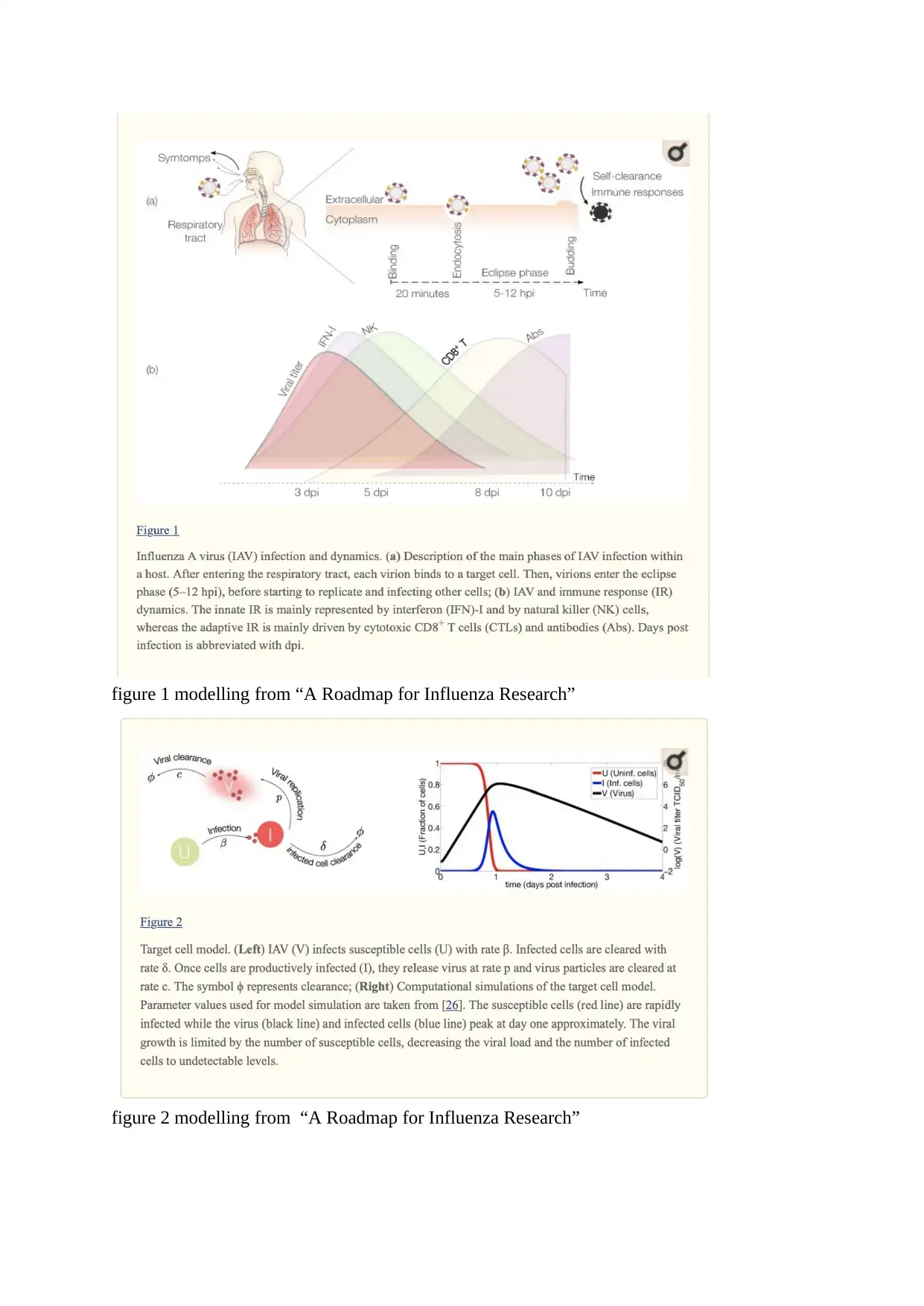
figure 1 modelling from βA Roadmap for Influenza Researchβ
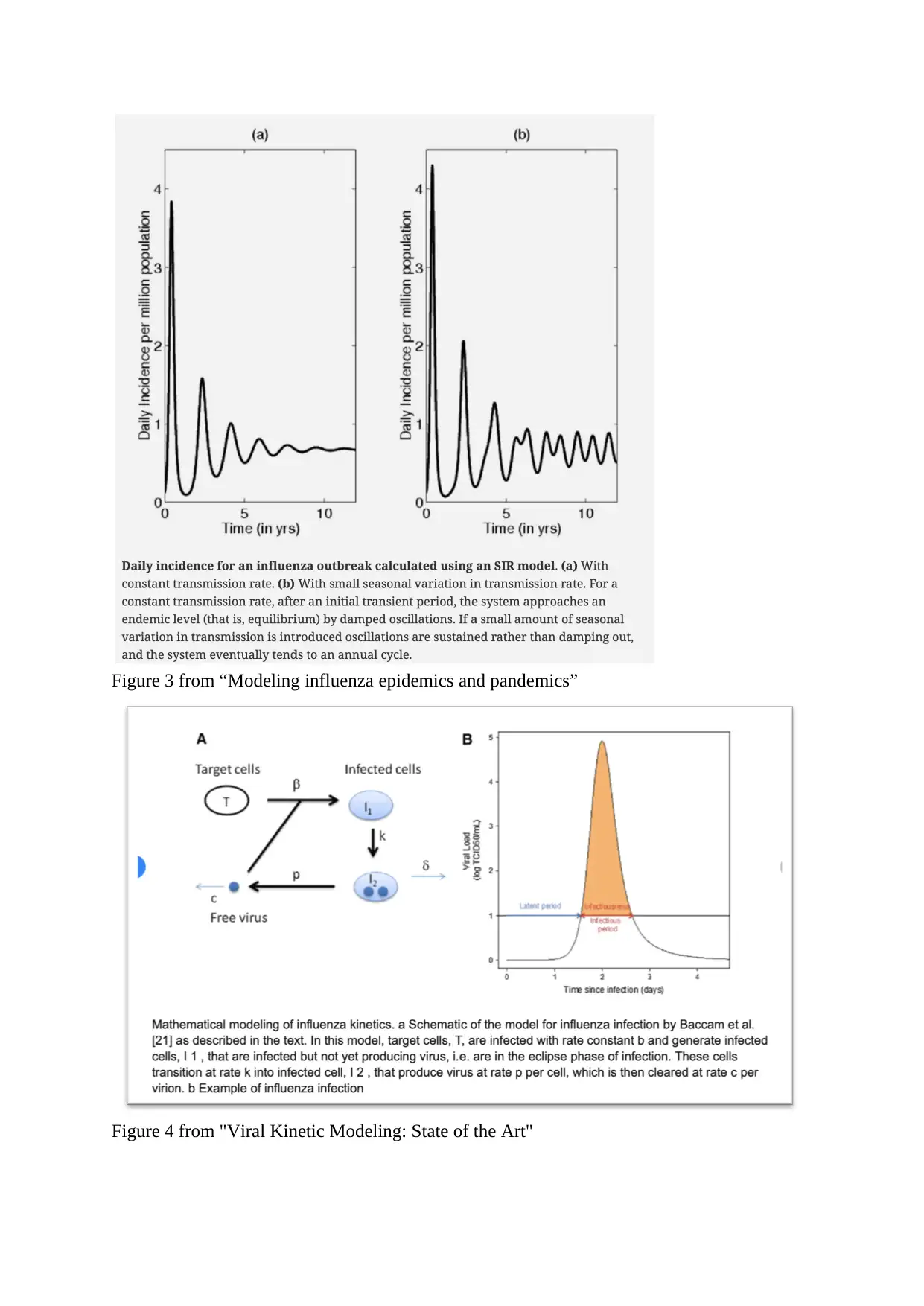
figure 2 modelling from βA Roadmap for Influenza Researchβ

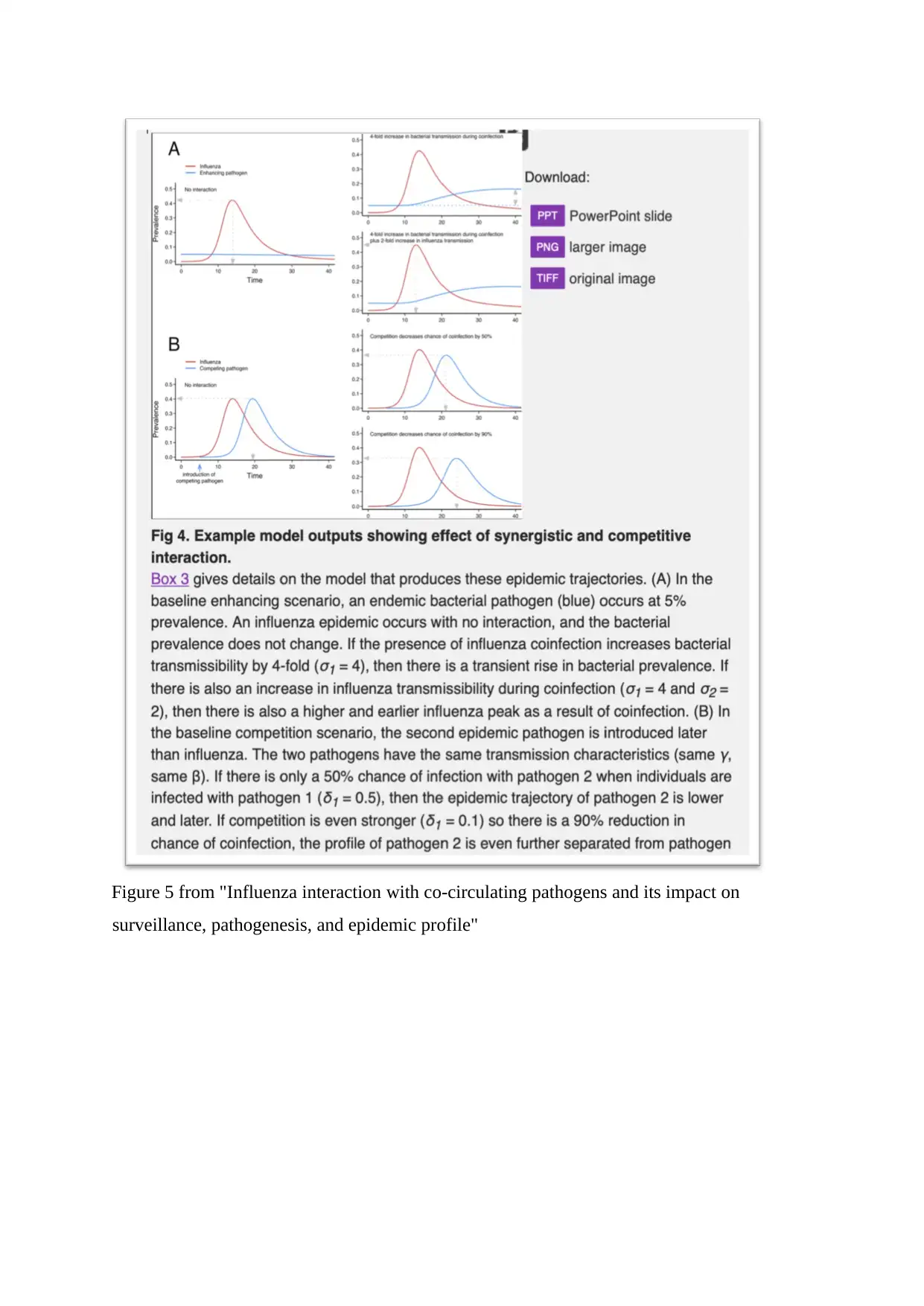
Figure 3 from βModeling influenza epidemics and pandemicsβ
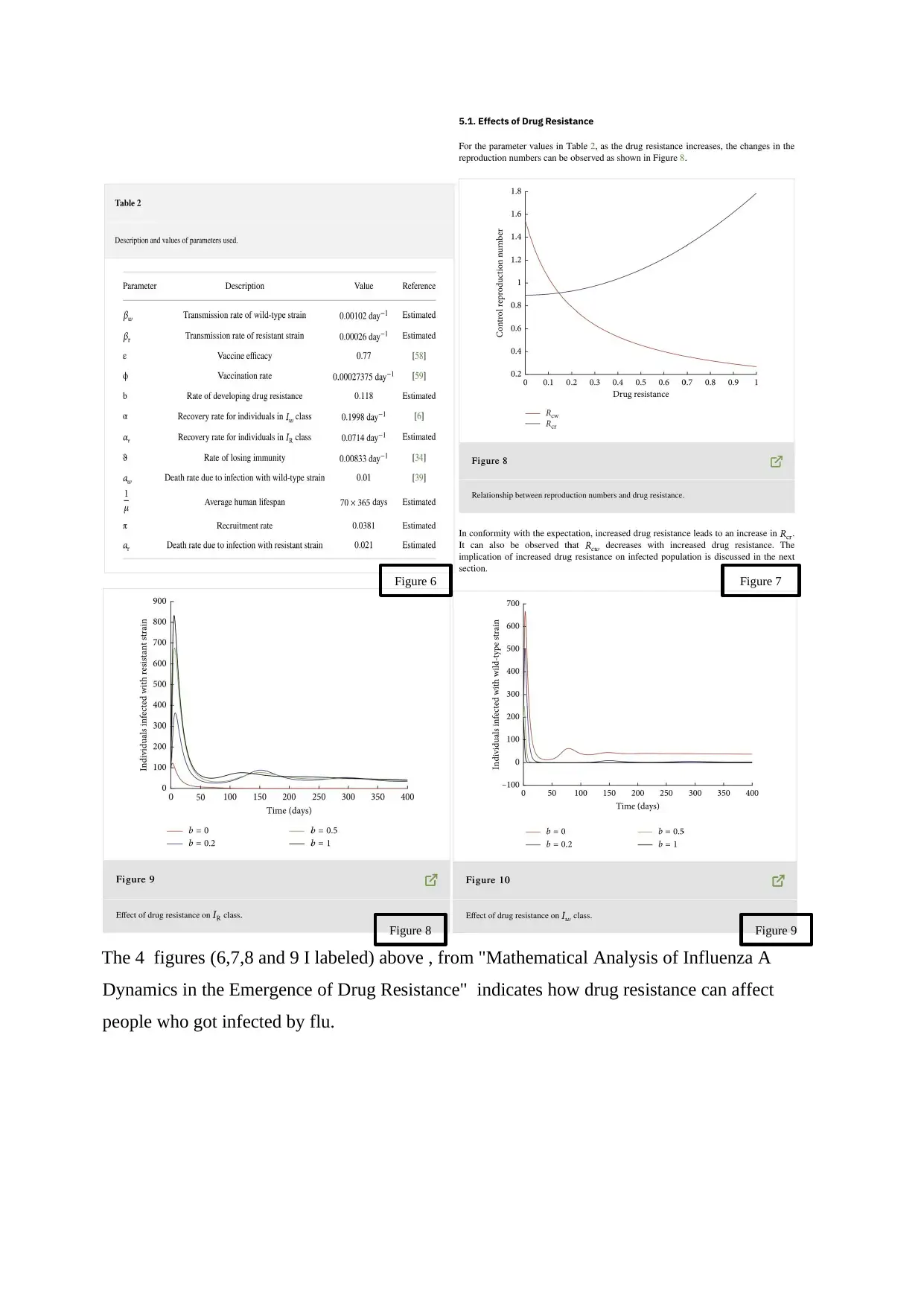
Figure 4 from "Viral Kinetic Modeling: State of the Art"
β This is a preview!β
Do you want full access?
Subscribe today to unlock all pages.

Trusted by 1+ million students worldwide

Figure 5 from "Influenza interaction with co-circulating pathogens and its impact on
surveillance, pathogenesis, and epidemic profile"
Paraphrase This Document
Need a fresh take? Get an instant paraphrase of this document with our AI Paraphraser

The 4 figures (6,7,8 and 9 I labeled) above , from "Mathematical Analysis of Influenza A
Dynamics in the Emergence of Drug Resistance" indicates how drug resistance can affect
people who got infected by flu.
Figure 6 Figure 7
Figure 8 Figure 9
Dynamics in the Emergence of Drug Resistance" indicates how drug resistance can affect
people who got infected by flu.
Figure 6 Figure 7
Figure 8 Figure 9

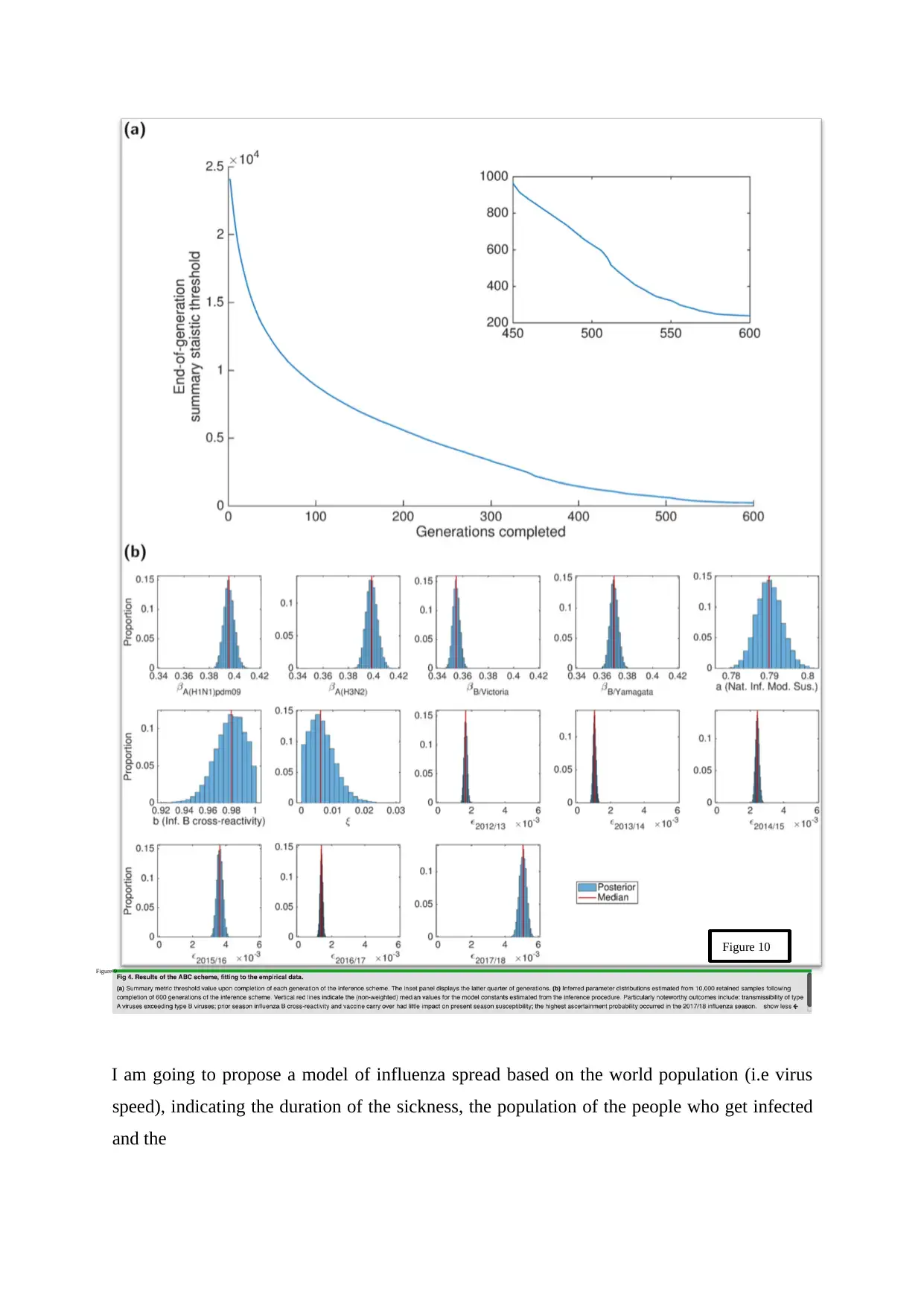
I am going to propose a model of influenza spread based on the world population (i.e virus
speed), indicating the duration of the sickness, the population of the people who get infected
and the
Figure 10
Figure 9
speed), indicating the duration of the sickness, the population of the people who get infected
and the
Figure 10
Figure 9
β This is a preview!β
Do you want full access?
Subscribe today to unlock all pages.

Trusted by 1+ million students worldwide

amount of virus in accordance with time. The figures above will give me a better
understanding towards the virus itself as well as a better idea what I am going to do in this
project.
Quality of vaccines and how it affects the infection rate of the flu:
Every year, people need to get vaccines in order to prevent / reduce the chance of getting a
flu. Flu vaccine is either a four-in-one or a three-in-one shot which protects the human beings
against both influenza A virusesβH3N2 and H1N1βand either both or one of the influenza
B viruses, B/Victoria and B/Yamagata. Reports have shown that most of the flu vaccine is
prepared with killed viruses, and most vaccine used in the United States is quadrivalent or
four in one. The effectiveness of a flu vaccine is based on how much the flu change each
season, the body condition of people who gets vaccination, etc. Moreover, the Centers for
Disease Control and
Prevention [Reference no* 8] suggested that βrecent studies show that flu vaccination reduces the
risk of flu illness by between 40% and 60% among the overall population during seasons
when most circulating flu viruses are well-matched to the flu vaccineβ. It also said that the
current vaccines is more effective on type B influenza and H1N1 (Type A influenza), while
they are less effective on H3N2 influenza.
Interventions
I will do research, considering whether the vaccination is a good match or not; what kind of
treatment should be taken in place as well as hospitalization.
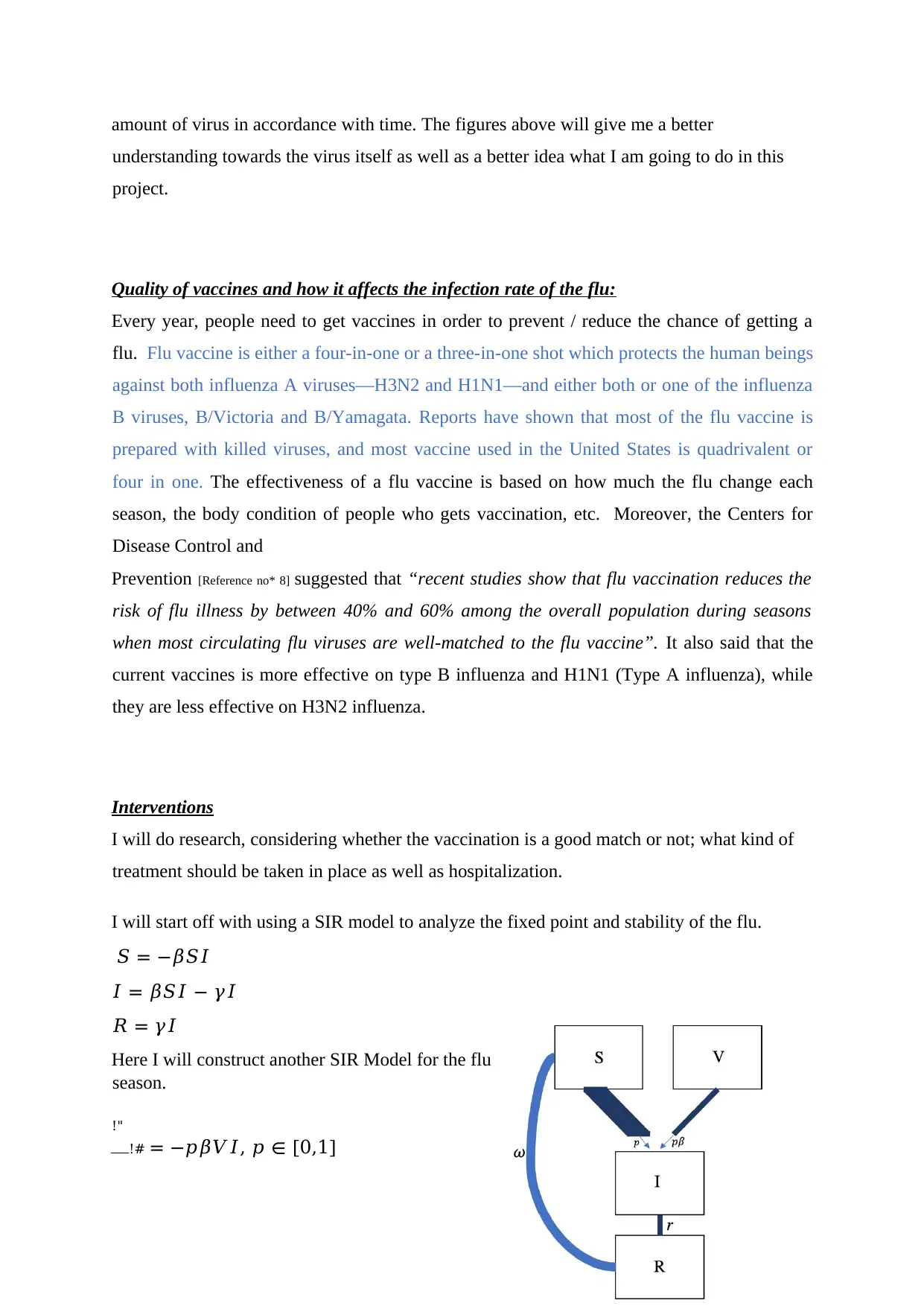
I will start off with using a SIR model to analyze the fixed point and stability of the flu.
π = βπ½ππΌ
πΌ = π½ππΌ β πΎπΌ
π = πΎπΌ
Here I will construct another SIR Model for the flu
season.
!"
!# = βππ½ππΌ, π β [0,1]
understanding towards the virus itself as well as a better idea what I am going to do in this
project.
Quality of vaccines and how it affects the infection rate of the flu:
Every year, people need to get vaccines in order to prevent / reduce the chance of getting a
flu. Flu vaccine is either a four-in-one or a three-in-one shot which protects the human beings
against both influenza A virusesβH3N2 and H1N1βand either both or one of the influenza
B viruses, B/Victoria and B/Yamagata. Reports have shown that most of the flu vaccine is
prepared with killed viruses, and most vaccine used in the United States is quadrivalent or
four in one. The effectiveness of a flu vaccine is based on how much the flu change each
season, the body condition of people who gets vaccination, etc. Moreover, the Centers for
Disease Control and
Prevention [Reference no* 8] suggested that βrecent studies show that flu vaccination reduces the
risk of flu illness by between 40% and 60% among the overall population during seasons
when most circulating flu viruses are well-matched to the flu vaccineβ. It also said that the
current vaccines is more effective on type B influenza and H1N1 (Type A influenza), while
they are less effective on H3N2 influenza.
Interventions
I will do research, considering whether the vaccination is a good match or not; what kind of
treatment should be taken in place as well as hospitalization.
I will start off with using a SIR model to analyze the fixed point and stability of the flu.
π = βπ½ππΌ
πΌ = π½ππΌ β πΎπΌ
π = πΎπΌ
Here I will construct another SIR Model for the flu
season.
!"
!# = βππ½ππΌ, π β [0,1]
Paraphrase This Document
Need a fresh take? Get an instant paraphrase of this document with our AI Paraphraser

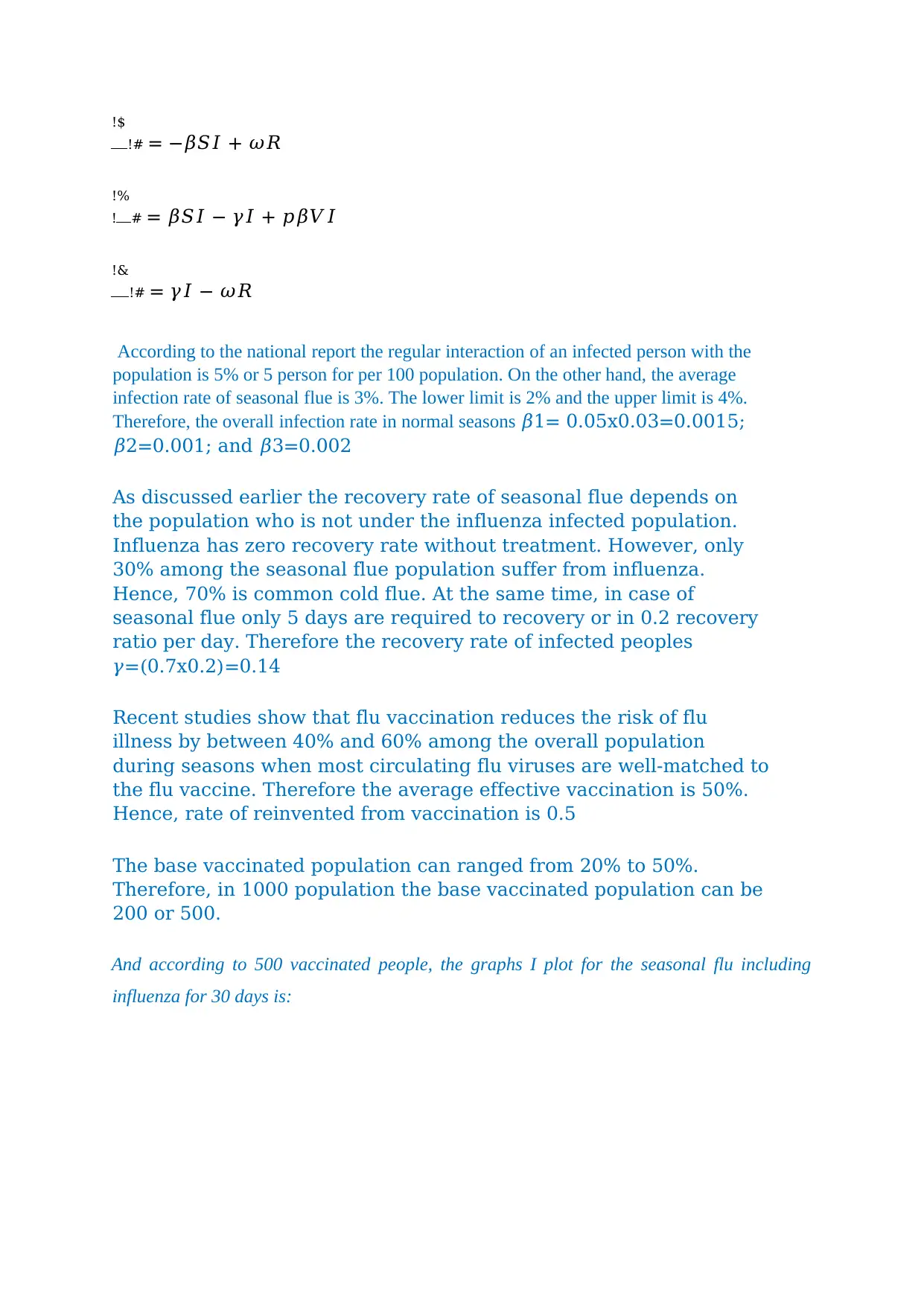
!$
!# = βπ½ππΌ + ππ
!%
! # = π½ππΌ β πΎπΌ + ππ½ππΌ
!&
!# = πΎπΌ β ππ
According to the national report the regular interaction of an infected person with the
population is 5% or 5 person for per 100 population. On the other hand, the average
infection rate of seasonal flue is 3%. The lower limit is 2% and the upper limit is 4%.
Therefore, the overall infection rate in normal seasons π½1= 0.05x0.03=0.0015;
π½2=0.001; and π½3=0.002
As discussed earlier the recovery rate of seasonal flue depends on
the population who is not under the influenza infected population.
Influenza has zero recovery rate without treatment. However, only
30% among the seasonal flue population suffer from influenza.
Hence, 70% is common cold flue. At the same time, in case of
seasonal flue only 5 days are required to recovery or in 0.2 recovery
ratio per day. Therefore the recovery rate of infected peoples
πΎ=(0.7x0.2)=0.14
Recent studies show that flu vaccination reduces the risk of flu
illness by between 40% and 60% among the overall population
during seasons when most circulating flu viruses are well-matched to
the flu vaccine. Therefore the average effective vaccination is 50%.
Hence, rate of reinvented from vaccination is 0.5
The base vaccinated population can ranged from 20% to 50%.
Therefore, in 1000 population the base vaccinated population can be
200 or 500.
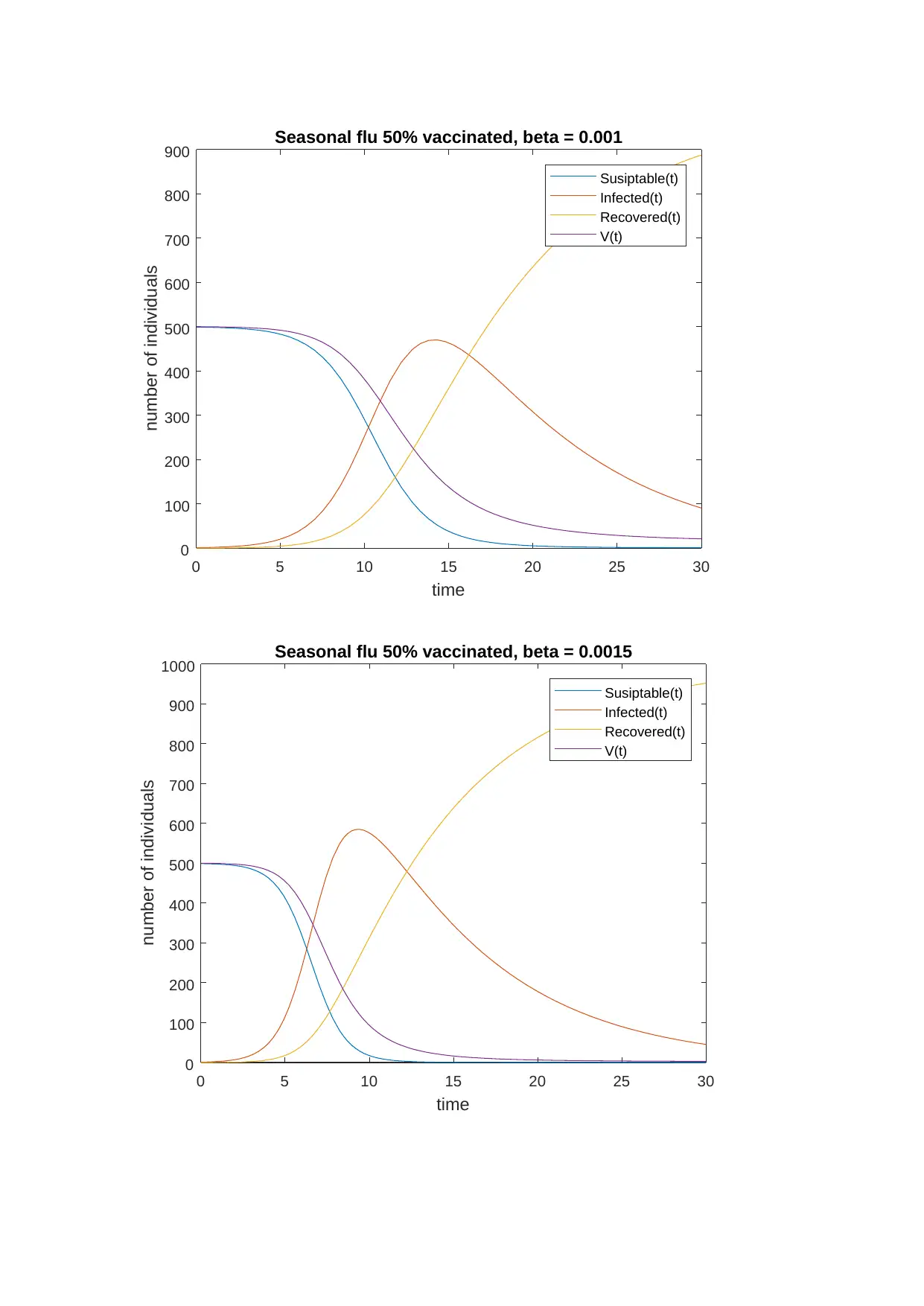
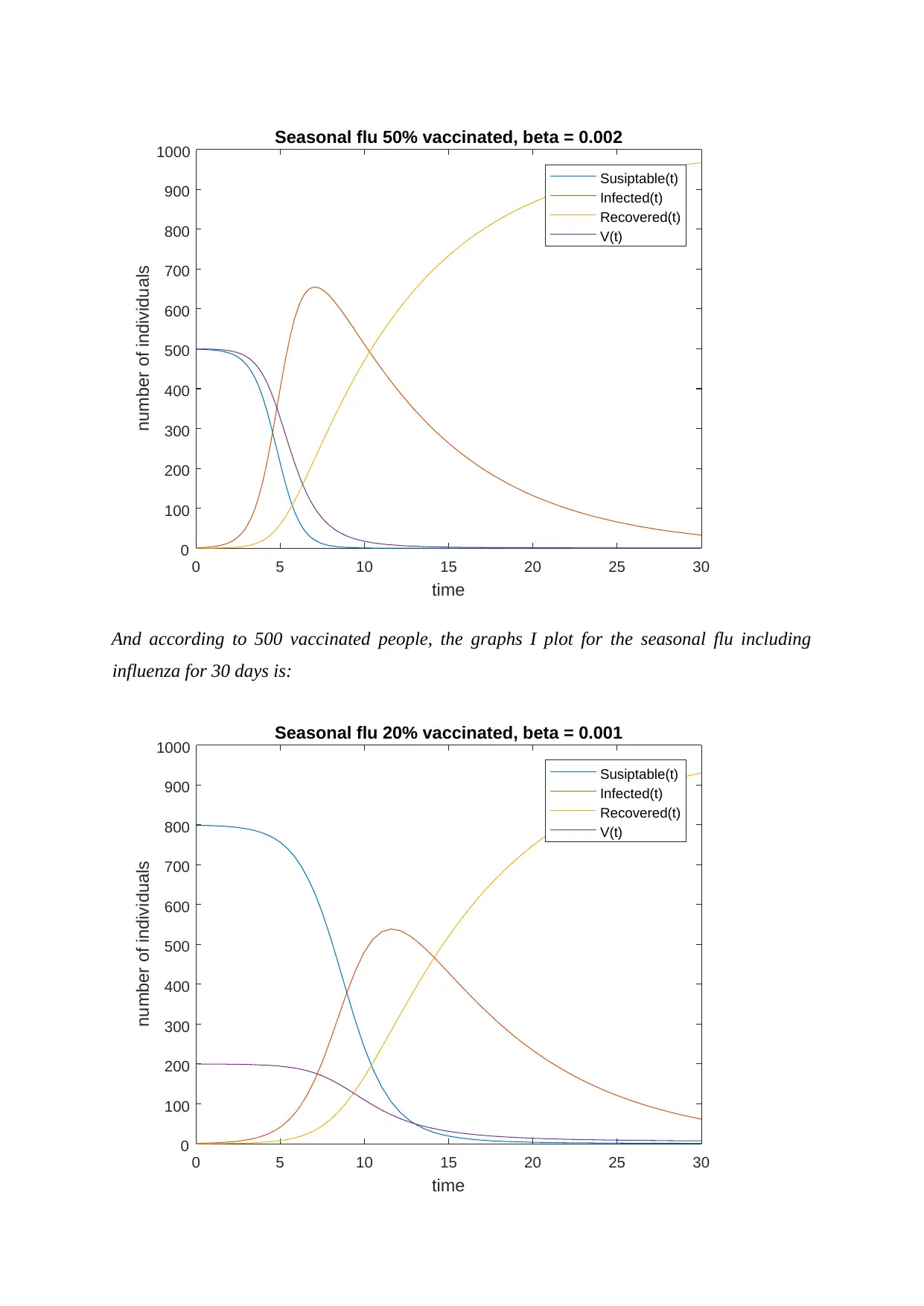
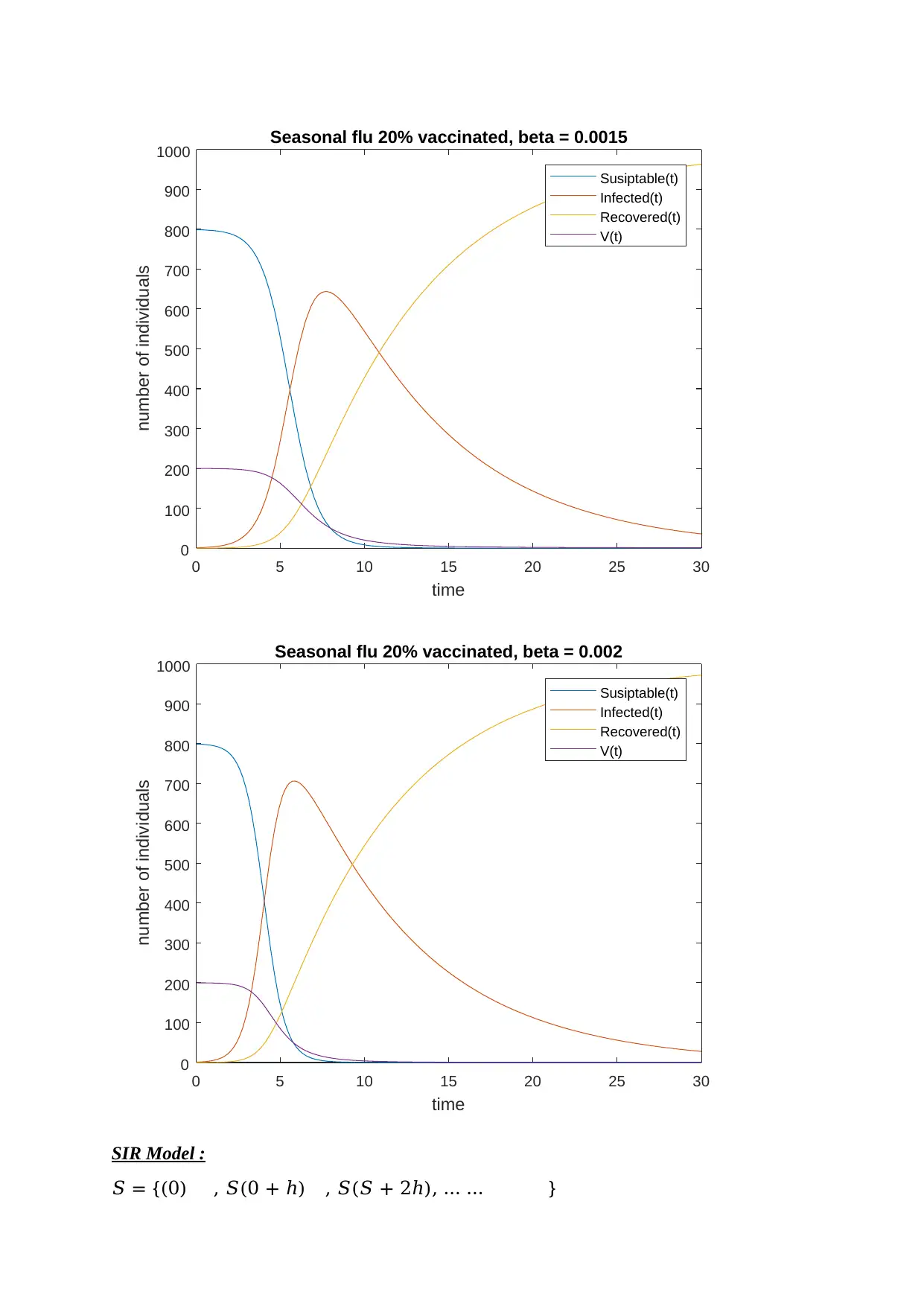
And according to 500 vaccinated people, the graphs I plot for the seasonal flu including
influenza for 30 days is:
!# = βπ½ππΌ + ππ
!%
! # = π½ππΌ β πΎπΌ + ππ½ππΌ
!&
!# = πΎπΌ β ππ
According to the national report the regular interaction of an infected person with the
population is 5% or 5 person for per 100 population. On the other hand, the average
infection rate of seasonal flue is 3%. The lower limit is 2% and the upper limit is 4%.
Therefore, the overall infection rate in normal seasons π½1= 0.05x0.03=0.0015;
π½2=0.001; and π½3=0.002
As discussed earlier the recovery rate of seasonal flue depends on
the population who is not under the influenza infected population.
Influenza has zero recovery rate without treatment. However, only
30% among the seasonal flue population suffer from influenza.
Hence, 70% is common cold flue. At the same time, in case of
seasonal flue only 5 days are required to recovery or in 0.2 recovery
ratio per day. Therefore the recovery rate of infected peoples
πΎ=(0.7x0.2)=0.14
Recent studies show that flu vaccination reduces the risk of flu
illness by between 40% and 60% among the overall population
during seasons when most circulating flu viruses are well-matched to
the flu vaccine. Therefore the average effective vaccination is 50%.
Hence, rate of reinvented from vaccination is 0.5
The base vaccinated population can ranged from 20% to 50%.
Therefore, in 1000 population the base vaccinated population can be
200 or 500.
And according to 500 vaccinated people, the graphs I plot for the seasonal flu including
influenza for 30 days is:

0 5 10 15 20 25 30
time
0
100
200
300
400
500
600
700
800
900
number of individuals
Seasonal flu 50% vaccinated, beta = 0.001
Susiptable(t)
Infected(t)
Recovered(t)
V(t)
0 5 10 15 20 25 30
time
0
100
200
300
400
500
600
700
800
900
1000
number of individuals
Seasonal flu 50% vaccinated, beta = 0.0015
Susiptable(t)
Infected(t)
Recovered(t)
V(t)
time
0
100
200
300
400
500
600
700
800
900
number of individuals
Seasonal flu 50% vaccinated, beta = 0.001
Susiptable(t)
Infected(t)
Recovered(t)
V(t)
0 5 10 15 20 25 30
time
0
100
200
300
400
500
600
700
800
900
1000
number of individuals
Seasonal flu 50% vaccinated, beta = 0.0015
Susiptable(t)
Infected(t)
Recovered(t)
V(t)
β This is a preview!β
Do you want full access?
Subscribe today to unlock all pages.

Trusted by 1+ million students worldwide

0 5 10 15 20 25 30
time
0
100
200
300
400
500
600
700
800
900
1000
number of individuals
Seasonal flu 50% vaccinated, beta = 0.002
Susiptable(t)
Infected(t)
Recovered(t)
V(t)
And according to 500 vaccinated people, the graphs I plot for the seasonal flu including
influenza for 30 days is:
0 5 10 15 20 25 30
time
0
100
200
300
400
500
600
700
800
900
1000
number of individuals
Seasonal flu 20% vaccinated, beta = 0.001
Susiptable(t)
Infected(t)
Recovered(t)
V(t)
time
0
100
200
300
400
500
600
700
800
900
1000
number of individuals
Seasonal flu 50% vaccinated, beta = 0.002
Susiptable(t)
Infected(t)
Recovered(t)
V(t)
And according to 500 vaccinated people, the graphs I plot for the seasonal flu including
influenza for 30 days is:
0 5 10 15 20 25 30
time
0
100
200
300
400
500
600
700
800
900
1000
number of individuals
Seasonal flu 20% vaccinated, beta = 0.001
Susiptable(t)
Infected(t)
Recovered(t)
V(t)
Paraphrase This Document
Need a fresh take? Get an instant paraphrase of this document with our AI Paraphraser

0 5 10 15 20 25 30
time
0
100
200
300
400
500
600
700
800
900
1000
number of individuals
Seasonal flu 20% vaccinated, beta = 0.0015
Susiptable(t)
Infected(t)
Recovered(t)
V(t)
0 5 10 15 20 25 30
time
0
100
200
300
400
500
600
700
800
900
1000
number of individuals
Seasonal flu 20% vaccinated, beta = 0.002
Susiptable(t)
Infected(t)
Recovered(t)
V(t)
SIR Model :
π = {(0) , π(0 + β) , π(π + 2β), β¦ β¦ }
time
0
100
200
300
400
500
600
700
800
900
1000
number of individuals
Seasonal flu 20% vaccinated, beta = 0.0015
Susiptable(t)
Infected(t)
Recovered(t)
V(t)
0 5 10 15 20 25 30
time
0
100
200
300
400
500
600
700
800
900
1000
number of individuals
Seasonal flu 20% vaccinated, beta = 0.002
Susiptable(t)
Infected(t)
Recovered(t)
V(t)
SIR Model :
π = {(0) , π(0 + β) , π(π + 2β), β¦ β¦ }

πΌ = {(0) , πΌ(0 + β) , π(0 + 2β), β¦ β¦ }
π = {(0) , π (0 + β) , β¦ β¦ }
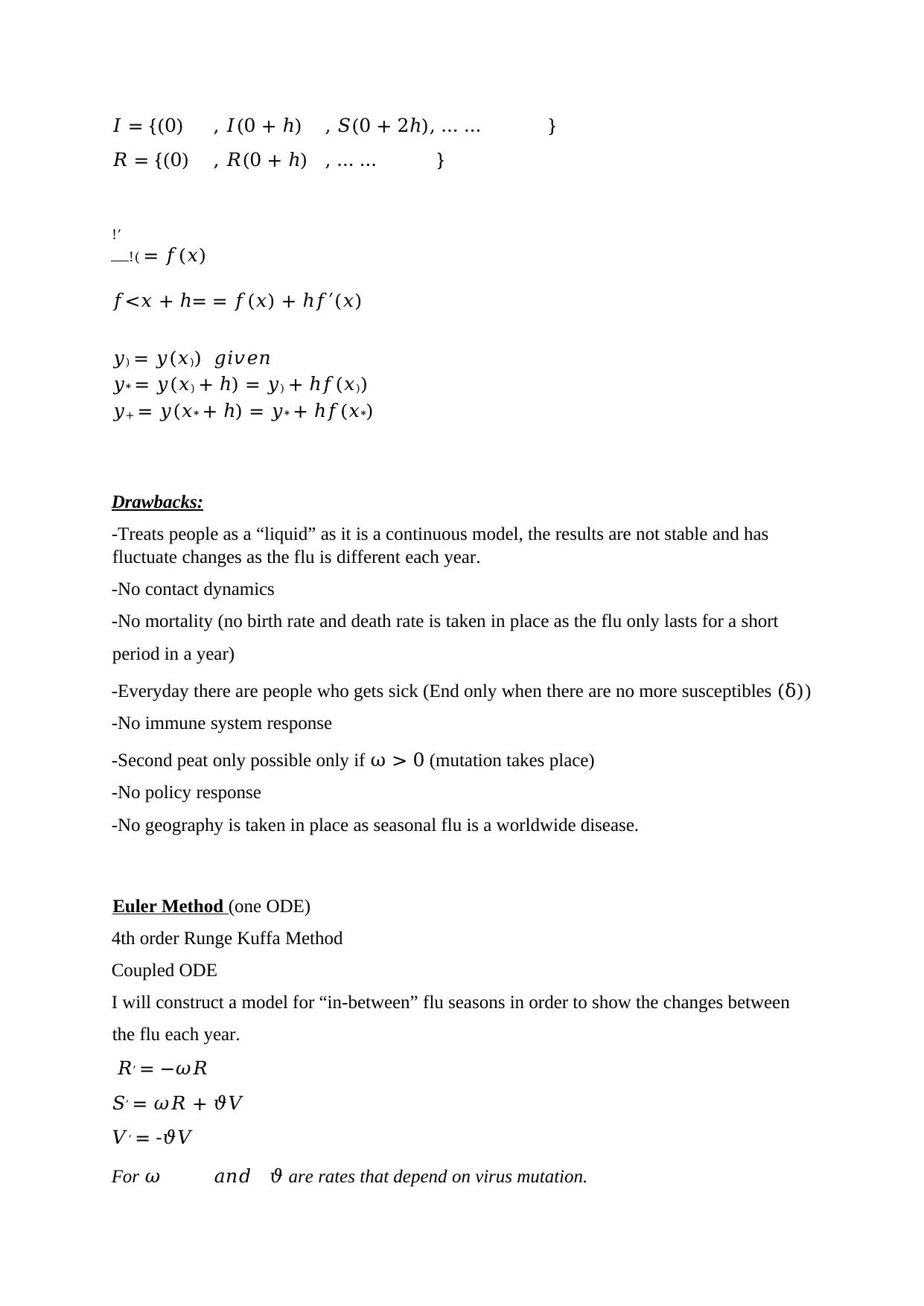
!β
!( = π(π₯)
π<π₯ + β= = π(π₯) + βπβ²(π₯)
π¦) = π¦(π₯)) πππ£ππ
π¦* = π¦(π₯) + β) = π¦) + βπ(π₯))
π¦+ = π¦(π₯* + β) = π¦* + βπ(π₯*)
Drawbacks:
-Treats people as a βliquidβ as it is a continuous model, the results are not stable and has
fluctuate changes as the flu is different each year.
-No contact dynamics
-No mortality (no birth rate and death rate is taken in place as the flu only lasts for a short
period in a year)
-Everyday there are people who gets sick (End only when there are no more susceptibles (Ξ΄))
-No immune system response
-Second peat only possible only if Ο > 0 (mutation takes place)
-No policy response
-No geography is taken in place as seasonal flu is a worldwide disease.
Euler Method (one ODE)
4th order Runge Kuffa Method
Coupled ODE
I will construct a model for βin-betweenβ flu seasons in order to show the changes between
the flu each year.
π , = βππ
π, = ππ + ππ
π, = -ππ
For π πππ π are rates that depend on virus mutation.
π = {(0) , π (0 + β) , β¦ β¦ }
!β
!( = π(π₯)
π<π₯ + β= = π(π₯) + βπβ²(π₯)
π¦) = π¦(π₯)) πππ£ππ
π¦* = π¦(π₯) + β) = π¦) + βπ(π₯))
π¦+ = π¦(π₯* + β) = π¦* + βπ(π₯*)
Drawbacks:
-Treats people as a βliquidβ as it is a continuous model, the results are not stable and has
fluctuate changes as the flu is different each year.
-No contact dynamics
-No mortality (no birth rate and death rate is taken in place as the flu only lasts for a short
period in a year)
-Everyday there are people who gets sick (End only when there are no more susceptibles (Ξ΄))
-No immune system response
-Second peat only possible only if Ο > 0 (mutation takes place)
-No policy response
-No geography is taken in place as seasonal flu is a worldwide disease.
Euler Method (one ODE)
4th order Runge Kuffa Method
Coupled ODE
I will construct a model for βin-betweenβ flu seasons in order to show the changes between
the flu each year.
π , = βππ
π, = ππ + ππ
π, = -ππ
For π πππ π are rates that depend on virus mutation.
β This is a preview!β
Do you want full access?
Subscribe today to unlock all pages.

Trusted by 1+ million students worldwide
1 out of 23
Related Documents
Your All-in-One AI-Powered Toolkit for Academic Success.
Β +13062052269
info@desklib.com
Available 24*7 on WhatsApp / Email
Unlock your academic potential
Copyright Β© 2020β2025 A2Z Services. All Rights Reserved. Developed and managed by ZUCOL.