Analyzing Seasonality and Casual Employment in Tourism Sector

Verified

Added on  2023/06/14

|8
|1710
|440
Essay
AI Summary
This essay examines the significant impact of seasonality on casual employment within the tourism industry. It highlights that tourism, while being one of the fastest-growing global sectors, is heavily influenced by seasonal fluctuations, leading to unstable employment patterns characterized by part-time and casual positions. The paper discusses how these fluctuations affect employment levels in tourist destinations, with businesses hiring more workers during peak seasons and reducing staff during lean periods. The author's personal interest in the tourism sector and research into the industry reveal statistics that challenge common perceptions about job security, noting opportunities for full-time, permanent positions requiring specific skills and experience. The essay concludes by emphasizing the negative impact of casual employment on employee satisfaction and turnover rates, suggesting that addressing this issue is crucial for the long-term stability and success of the tourism and hospitality sectors. Desklib offers a variety of resources, including similar essays and study tools, for students seeking to deepen their understanding of this topic.
Document Page
Running head: SEASONALITY AND CASUAL EMPLOYMENT
Seasonality and Casual Employment
Name of the Student:
Name of the University:
Author note:
tabler-icon-diamond-filled.svg

Paraphrase This Document

Need a fresh take? Get an instant paraphrase of this document with our AI Paraphraser
Document Page
1SEASONALITY AND CASUAL EMPLOYMENT
Tourism is one the largest and speedily growing industries in the world. Seasonality
has always been regarded as one of the most distinguishing aspect of tourism and it has been
gradually become of the most typical feature of the tourism on the international basis after the
temporary movement of people (Radicchi 2013). The seasonality refers to the temporal
imbalance in the tourism that might be expressed in context to the dimensions of elements
like the number of visitors, their expenditure, traffic on the highways, employment etc. It has
commonly regarded as one of the major problems in the tourism industry and has been held
responsible for exacerbating various difficulties that are faced by the industry including that
of the problem of employment. This paper will elaborate on the fact the seasonality and
cyclical nature of tourism has resulted in the high incidence of the seasonal, part-time and
casual employment.
The seasonal change in the supply for and the demand for the destinations and
attractions are endemic within the hospital and tourism industry. Ridderstaat et al. (2014)
have describes seasonality as a cyclic pattern that repeats itself every year. The issue of
seasonality in the tourism industry demand in one of the most continuously vexing policy
issues, especially in the environments of peripheral and cold climate. It indeed causes very
notable challenges for the tourism and hotel industry (Iweze and Nwogu 2014). The product
and services of the tourism industry cannot be stored and therefore, the hotel room which
remains unsold or un-booked is a lost income for the organization. The hospitality industry is
regarded to be non prestigious and temporary employment (De Beer, Rogerson and Rogerson
2014). The image of career in the tourism industry might change because of the emerging
tourism business and the new markets. The impact of seasonality is notable in the alpine
region of the Australia’s New South Wales. Where the issue of seasonality and the challenges
associated with it are inalienable parts of the global tourism, the tourism employment with
proper human resource management could turn into a beneficial career.
Document Page
2SEASONALITY AND CASUAL EMPLOYMENT
The industry of tourism and hospitality create numerous employment opportunities in
several different areas such as transportation, accommodations etc. Therefore, availability of
the trained and skilled manpower is very important element in the overall success of the
tourism program (Agarwal 2013). Hence, employees are considered to be the sine qua non of
this industry. It is to be noted that tourism is mainly about the people. The visitors are the
people who are subject to changes in their demands, decision making and behavior. These
changes are really tough to predict (Aylen, Albertson and Cavan 2014). However, it is also to
be noted that the constraints of the employment issues in the tourism industry is that of the
unstable and fluctuated employment, low pay, and low job status. Employees are the heart of
an excellent service delivery system but a must less attention is paid to the employees of the
tourism and hospitality sectors than the other (Khan 2014).
The levels of employment in the tourist destination follow the seasonality of the
tourism demands for most of the resorts and tourist destinations. During some months of the
years the number of visitation of tourists is very high and therefore, the tourism industry then
hire more number of workers and employees to the business, while when the visitation rate is
low during the lean seasons, the businesses then cut staffs. Most of the resorts, hotels and
tourist destination have high season when there is a high level of visitation of tourists and
employment level. On the other hand, it is said to be as low season when the tourist visitation
and employment level is the lowest (Subramanian and Shin 2013). Hence, this results in an
obvious fluctuation in the employment level. Almost a quarter of all the employees working
in the tourism industry are temporary or casual. Tourism industry is though the fastest
growing industries; it is indeed the fastest growing employers of casual labor in the world.
The tourist visitation in the tourism industry decreases the most at the months of December
and November as compared to the month of January (Poudyal, Paudel and Tarrant 2013) and
Document Page
3SEASONALITY AND CASUAL EMPLOYMENT
hence, during those months the organizations try to cut off their staffs as because to keep the
profit margin of the company balanced.
However, it is also to note that tourism industry is not all about part time and casual
employment. There are also various permanent job opportunities that people all over the
world seek to attain and they are worth the qualification.
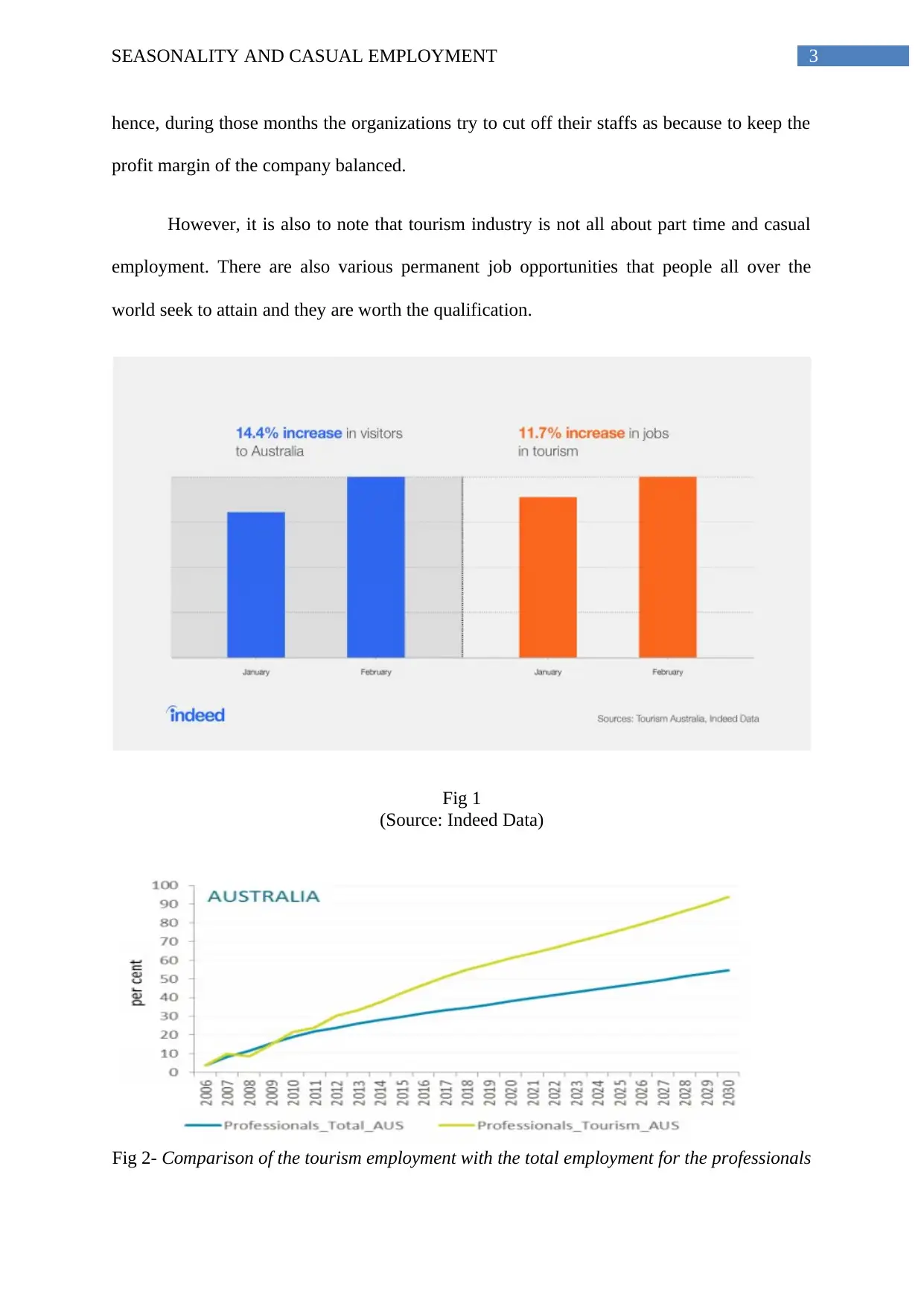
Fig 1
(Source: Indeed Data)
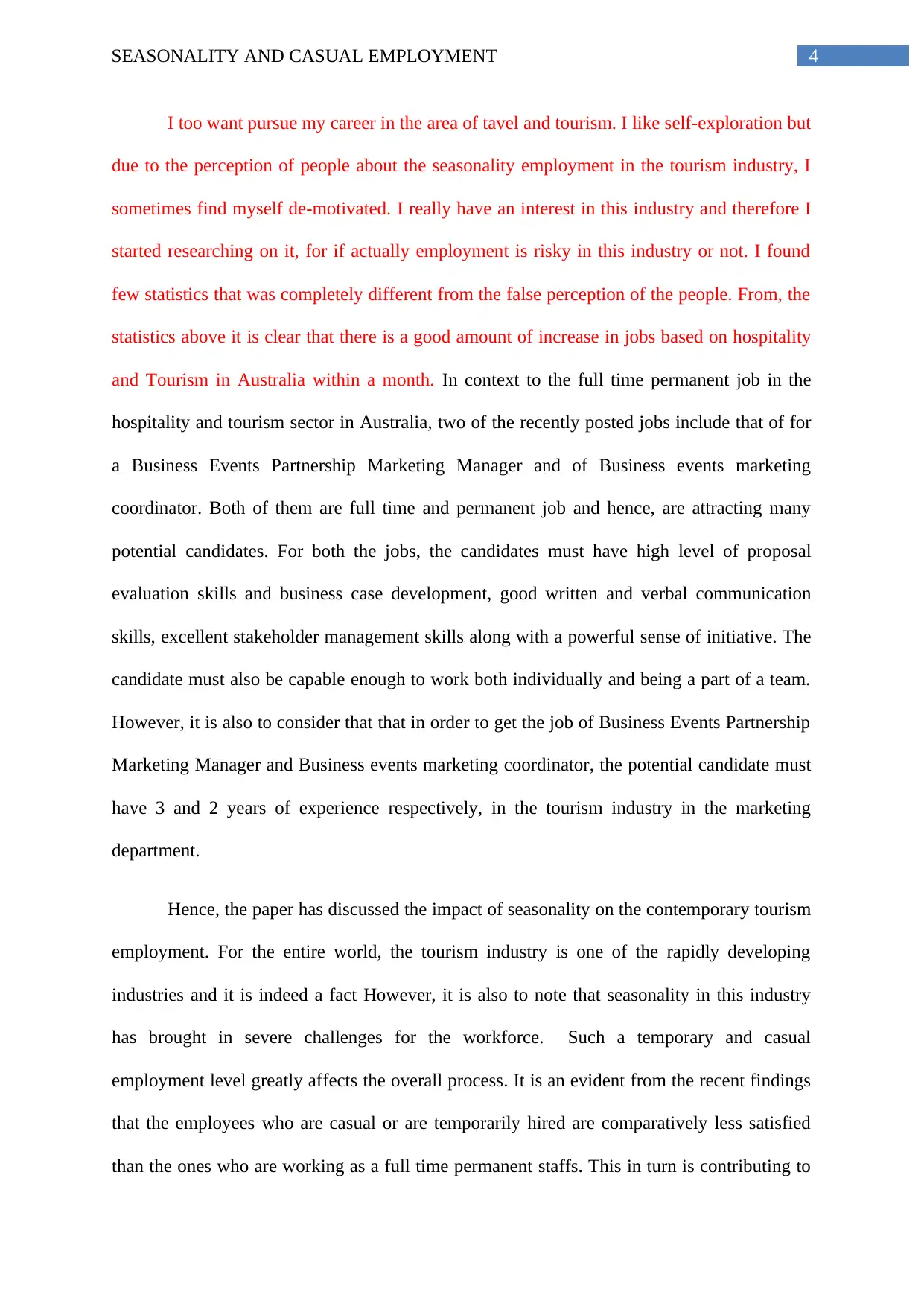
Fig 2- Comparison of the tourism employment with the total employment for the professionals
tabler-icon-diamond-filled.svg

Paraphrase This Document

Need a fresh take? Get an instant paraphrase of this document with our AI Paraphraser
Document Page
4SEASONALITY AND CASUAL EMPLOYMENT
I too want pursue my career in the area of tavel and tourism. I like self-exploration but
due to the perception of people about the seasonality employment in the tourism industry, I
sometimes find myself de-motivated. I really have an interest in this industry and therefore I
started researching on it, for if actually employment is risky in this industry or not. I found
few statistics that was completely different from the false perception of the people. From, the
statistics above it is clear that there is a good amount of increase in jobs based on hospitality
and Tourism in Australia within a month. In context to the full time permanent job in the
hospitality and tourism sector in Australia, two of the recently posted jobs include that of for
a Business Events Partnership Marketing Manager and of Business events marketing
coordinator. Both of them are full time and permanent job and hence, are attracting many
potential candidates. For both the jobs, the candidates must have high level of proposal
evaluation skills and business case development, good written and verbal communication
skills, excellent stakeholder management skills along with a powerful sense of initiative. The
candidate must also be capable enough to work both individually and being a part of a team.
However, it is also to consider that that in order to get the job of Business Events Partnership
Marketing Manager and Business events marketing coordinator, the potential candidate must
have 3 and 2 years of experience respectively, in the tourism industry in the marketing
department.
Hence, the paper has discussed the impact of seasonality on the contemporary tourism
employment. For the entire world, the tourism industry is one of the rapidly developing
industries and it is indeed a fact However, it is also to note that seasonality in this industry
has brought in severe challenges for the workforce. Such a temporary and casual
employment level greatly affects the overall process. It is an evident from the recent findings
that the employees who are casual or are temporarily hired are comparatively less satisfied
than the ones who are working as a full time permanent staffs. This in turn is contributing to
Document Page
5SEASONALITY AND CASUAL EMPLOYMENT
the current problem of high rate of turnover in the tourism and hospitality sectors and the
issues that are linked with the high turnover will sustain if such kind of casual employment
continues to persist in the way it is today.
Document Page
6SEASONALITY AND CASUAL EMPLOYMENT
References:
Agrawal, T., 2013. Vocational education and training programs (VET): An Asian
perspective. Asia-Pacific Journal of Cooperative Education, 14(1), pp.15-26.
Aylen, J., Albertson, K. and Cavan, G., 2014. The impact of weather and climate on tourist
demand: the case of Chester Zoo. Climatic change, 127(2), pp.183-197.
De Beer, A., Rogerson, C.M. and Rogerson, J.M., 2014, March. Decent work in the South
African tourism industry: Evidence from tourist guides. In Urban forum (Vol. 25, No. 1, pp.
89-103). Springer Netherlands.
Iwueze, I.S. and Nwogu, E.C., 2014. Framework for choice of models and detection of
seasonal effect in time series. Far East Journal of Theoretical Statistics, 48(1), p.45.
Khan, M.A., 2014. An Explorative View on Human Resource Management with Focus on
Tourism & Hospitality Industry of India. Advances in Economics and Business Management.
Poudyal, N.C., Paudel, B. and Tarrant, M.A., 2013. A time series analysis of the impact of
recession on national park visitation in the United States. Tourism Management, 35, pp.181-
189.
Radicchi, E., 2013. Tourism and sport: strategic synergies to enhance the sustainable
development of a local context. Physical Culture and Sport. Studies and Research, 57(1),
pp.44-57.
Ridderstaat, J., Oduber, M., Croes, R., Nijkamp, P. and Martens, P., 2014. Impacts of
seasonal patterns of climate on recurrent fluctuations in tourism demand: Evidence from
Aruba. Tourism Management, 41, pp.245-256.
tabler-icon-diamond-filled.svg

Paraphrase This Document

Need a fresh take? Get an instant paraphrase of this document with our AI Paraphraser
Document Page
7SEASONALITY AND CASUAL EMPLOYMENT
Subramanian, I.D. and Shin, Y.N., 2013. Perceived organizational climate and turnover
intention of employees in the hotel industry. World Applied Sciences Journal, 22(12),
pp.1751-1759.
chevron_up_icon
1 out of 8
circle_padding
hide_on_mobile
zoom_out_icon
[object Object]