SEB725 Engineering Entrepreneurship: Eastern Kentucky Adolescents
VerifiedAdded on 2023/06/08
|14
|6622
|407
Report
AI Summary
This research examines the entrepreneurial attitudes of high school seniors in Eastern Kentucky and their preferences to stay or leave the region. Using the GET2Test, the study measures enterprising tendency and its components like need for achievement, creative tendency, and calculated risk-taking. The findings indicate that few students exhibit high levels of enterprising tendency and that those who do are more likely to leave Eastern Kentucky for education and career opportunities. The report discusses the implications of these findings for economic development in the region, highlighting the need for entrepreneurship education to reverse outward migration and improve future prospects. It also contextualizes Eastern Kentucky's socioeconomic challenges, including its history of poverty and dependence on the coal industry, emphasizing the importance of fostering an entrepreneurial ecosystem to promote innovation and economic diversification. This document is available on Desklib, a platform offering a wide range of academic resources and study tools for students.
Small Business Institute® Journal Small Business Institute®
2017, Vol. 13, No. 2, 1-14 ISSN: 1994-1150/69
Full Citation:
Snow, D. and Prater, J. (2017). Entrepreneurship Elsewhere: Examining the Entrepreneurial
Characteristics of Eastern Kentucky Adolescents. Small Business Institute® Journal. Vol. 13, No. 2., pp.
1-14
Entrepreneurship Elsewhere: Examining the Entrepreneurial Characteristics
of Eastern Kentucky Adolescents
David Snow
DavidSnow@upike.edu
University of Pikeville and the Kentucky Innovation Network
Justin Prater
University of Pikeville and the Kentucky Innovation Network
Abstract
Entrepreneurshipis known as a legitimate academic discipline and significant
contributor to economic development. Eastern Kentucky is known for its high levels of
poverty and unemployment. This research examines the entrepreneurial attitudes of hig
school seniors and their preferences to remain in or leave Eastern Kentucky. Findings
indicate few students scored in the high level of enterprisingtendency and the
entrepreneurial characteristics of need for achievement, calculated risk-taking, and
creative tendency. Findings also indicate those with a high level of enterprising tendenc
are more likely to leave Eastern Kentucky for education and career with no intention of
returning.
Keywords: Entrepreneurship; Education; Poverty; Socioeconomic Status
Introduction
“Entrepreneurship Everywhere” is the current slogan for the United States Association
for Small Businessand Entrepreneurship(USASBE). This is one of the premier
organizations for post-secondary teaching, research, and experiential learning in th
entrepreneurship discipline. The reason for this motto is obvious. In many parts of the
U.S. and the world, entrepreneurship is thriving. In 1975, only one hundred form
majors, minors, and certificates existed, but over the last twenty years entrepreneurship
has emerged as a mainstream discipline (Lee et al., 2005; Torrance et al., 2013).
According to Kuratko (2014), over 1,000 schools offer majors in entrepreneurship and
over 2,200 universities teach at least one course in entrepreneurship. Along with this
growth, an increasein business plan competitions,technologycommercialization
programs, product development activities, and startup company internships has occurred
(Duval-Couetil, 2013).
Entrepreneurship education is now also widely offered in secondary schools. With
organizations such as Junior Achievement (JA), the Kauffman Foundation, the Young
Entrepreneurs Academy (YEA), the Network for Teaching Entrepreneurship (NFTE), and
university-based programs, millions of students each year are taught entrepreneurship
(Frazier, 2014; Hamilton, & Hamilton, 2012; Lorz, Mueller, & Volery, 2013).
Entrepreneurship education at the secondary and post-secondary levels has been shown
2017, Vol. 13, No. 2, 1-14 ISSN: 1994-1150/69
Full Citation:
Snow, D. and Prater, J. (2017). Entrepreneurship Elsewhere: Examining the Entrepreneurial
Characteristics of Eastern Kentucky Adolescents. Small Business Institute® Journal. Vol. 13, No. 2., pp.
1-14
Entrepreneurship Elsewhere: Examining the Entrepreneurial Characteristics
of Eastern Kentucky Adolescents
David Snow
DavidSnow@upike.edu
University of Pikeville and the Kentucky Innovation Network
Justin Prater
University of Pikeville and the Kentucky Innovation Network
Abstract
Entrepreneurshipis known as a legitimate academic discipline and significant
contributor to economic development. Eastern Kentucky is known for its high levels of
poverty and unemployment. This research examines the entrepreneurial attitudes of hig
school seniors and their preferences to remain in or leave Eastern Kentucky. Findings
indicate few students scored in the high level of enterprisingtendency and the
entrepreneurial characteristics of need for achievement, calculated risk-taking, and
creative tendency. Findings also indicate those with a high level of enterprising tendenc
are more likely to leave Eastern Kentucky for education and career with no intention of
returning.
Keywords: Entrepreneurship; Education; Poverty; Socioeconomic Status
Introduction
“Entrepreneurship Everywhere” is the current slogan for the United States Association
for Small Businessand Entrepreneurship(USASBE). This is one of the premier
organizations for post-secondary teaching, research, and experiential learning in th
entrepreneurship discipline. The reason for this motto is obvious. In many parts of the
U.S. and the world, entrepreneurship is thriving. In 1975, only one hundred form
majors, minors, and certificates existed, but over the last twenty years entrepreneurship
has emerged as a mainstream discipline (Lee et al., 2005; Torrance et al., 2013).
According to Kuratko (2014), over 1,000 schools offer majors in entrepreneurship and
over 2,200 universities teach at least one course in entrepreneurship. Along with this
growth, an increasein business plan competitions,technologycommercialization
programs, product development activities, and startup company internships has occurred
(Duval-Couetil, 2013).
Entrepreneurship education is now also widely offered in secondary schools. With
organizations such as Junior Achievement (JA), the Kauffman Foundation, the Young
Entrepreneurs Academy (YEA), the Network for Teaching Entrepreneurship (NFTE), and
university-based programs, millions of students each year are taught entrepreneurship
(Frazier, 2014; Hamilton, & Hamilton, 2012; Lorz, Mueller, & Volery, 2013).
Entrepreneurship education at the secondary and post-secondary levels has been shown

Paraphrase This Document
Need a fresh take? Get an instant paraphrase of this document with our AI Paraphraser
Small Business Institute® Journal – Vol. 13, No. 2, 1-14
Snow and Prater Pg. 2
to positively impact students’ self-efficacy, desire to attend college, academic succ
attitude toward entrepreneurship, intention to become entrepreneurs, business skil
and desirability by employers (Abu Talib et al., 2012; Brown, Bowlus, & Seibert 2
Hernandez & Newman, 2009; McNally, Martin, & Kay, 2010; NFTE, 2011; Studda
Dawson, & Jackson, 2013).
It is known entrepreneurship is integral in the efforts of innovation and economic
development (Acs & Audretsch, 2003; Audretsch & Keilbach, 2004; Baumol, 2002;
Hessels & van Stel, 2011; Morris, Neumeyer, & Kuratko, 2015). Research has specifical
examined entrepreneurship as an effective strategy for economic development in rural
areas as well (Jaafar, Dahalan, & Rosdi, 2014; Mojica, Gebremedhim, T., & Schaeffer,
2010; Robinson, Dassie, & Christy, 2004). Entrepreneurial startups are typically born as
small businesses. The majority of small business creations remain classified as sm
businessesthroughouttheir lifespan (Clayton et al., 2013). Even though these
organizations employ less than five hundred employees each, the economic contribution
is significant. In 2011, there were 28.2 million small businesses. Small business
comprise 99.7 percent of U.S. firms, are responsible for 63 percent of net new private-
sector jobs, and employ 49.2% of all private-sector workers (Audretsch & Link, 2012; SB
2014).
Eastern Kentucky
Eastern Kentucky sits in the central region of the Appalachian Mountains. Consisting of
such a vast area, the Appalachian Mountains run from southern New York to northern
Mississippi in eastern North America and include 420 counties in 13 states. Appalachia
is classified into northern, southern, and central regions. Historically, communities in
Appalachia have lagged behind the rest of the country and Central Appalachia is
poorest performing of the three regions (Bauman, 2006; Stephens and Partridge, 2011).
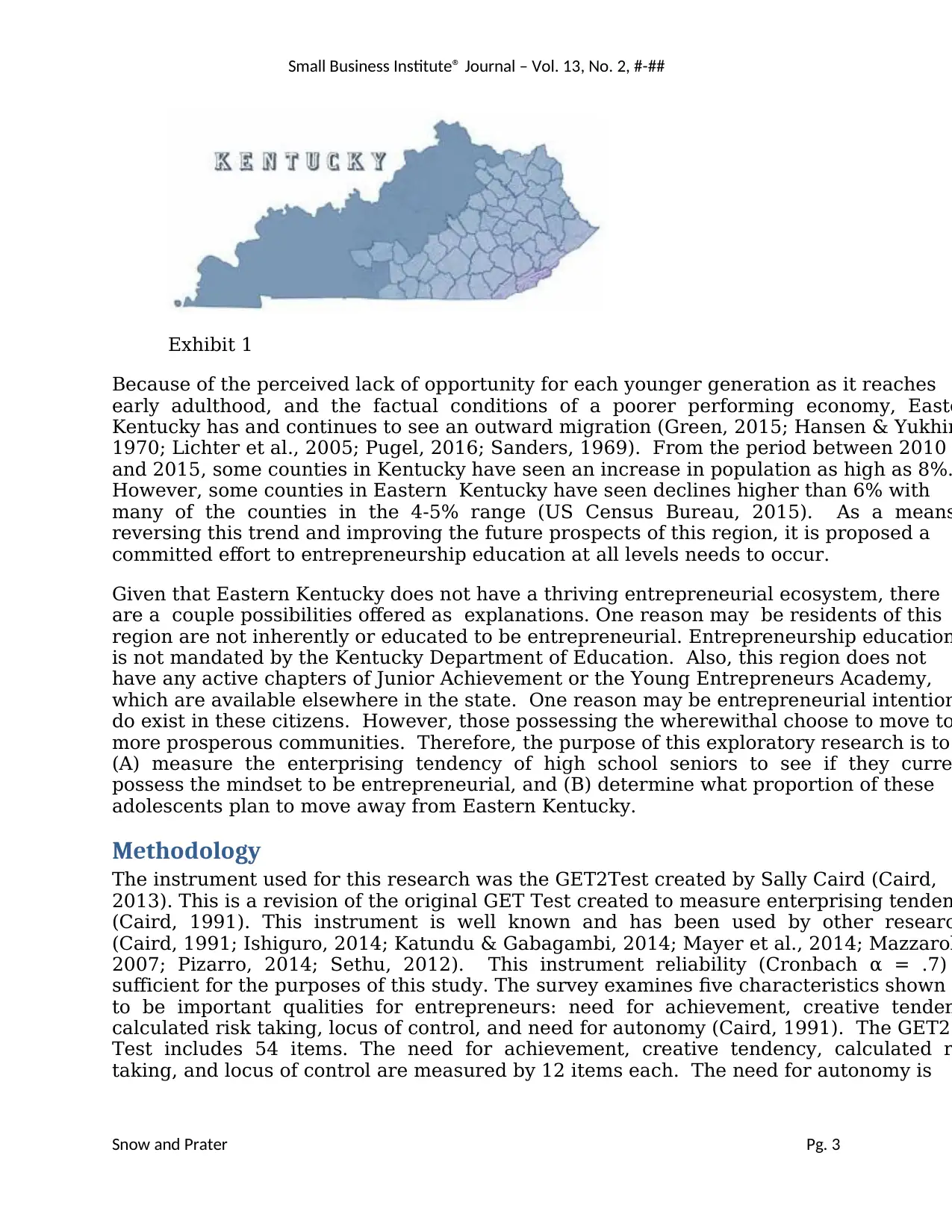
Fifty four counties in Kentucky are classified as Appalachian (see exhibit 1). The
easternmostof these are well known for their high levels of economic distress,
unemployment and poverty (Heflin & Miller, 2012; Tickamyer & Tickamyer, 1988; Ziliak,
2015). Coal has been the major industry in the area for over one hundred years. Howev
the coal industry has experienced many booms and busts over the decades.
The instability of coal demand and the lack of industry diversification have contributed to
the depressed economy of the region (Black, McKinnish, & Sanders, 2005; Epstein et al.,
2011). In 1964, President Lyndon Johnson famously declared his “War on Poverty” from
a home in Eastern Kentucky’sMartin County (Lowrey, 2014; Torstensson,2013).
Although Central Appalachia is one of the poorest regions in the country, it is not from a
lack of monetary infusion from state and federal agencies. In fact, over the past
decades Eastern Kentucky has received over 9 billion dollars in financial aid and remains
behind in economic development, educational attainment, wages, employment level
and standard of living (Baumann, 2006; Gebremariam et al., 2012; Hansen & Yukhin,
1970; Jung, Cho, & Roberts, 2015; Santopietro, 2002).
Snow and Prater Pg. 2
to positively impact students’ self-efficacy, desire to attend college, academic succ
attitude toward entrepreneurship, intention to become entrepreneurs, business skil
and desirability by employers (Abu Talib et al., 2012; Brown, Bowlus, & Seibert 2
Hernandez & Newman, 2009; McNally, Martin, & Kay, 2010; NFTE, 2011; Studda
Dawson, & Jackson, 2013).
It is known entrepreneurship is integral in the efforts of innovation and economic
development (Acs & Audretsch, 2003; Audretsch & Keilbach, 2004; Baumol, 2002;
Hessels & van Stel, 2011; Morris, Neumeyer, & Kuratko, 2015). Research has specifical
examined entrepreneurship as an effective strategy for economic development in rural
areas as well (Jaafar, Dahalan, & Rosdi, 2014; Mojica, Gebremedhim, T., & Schaeffer,
2010; Robinson, Dassie, & Christy, 2004). Entrepreneurial startups are typically born as
small businesses. The majority of small business creations remain classified as sm
businessesthroughouttheir lifespan (Clayton et al., 2013). Even though these
organizations employ less than five hundred employees each, the economic contribution
is significant. In 2011, there were 28.2 million small businesses. Small business
comprise 99.7 percent of U.S. firms, are responsible for 63 percent of net new private-
sector jobs, and employ 49.2% of all private-sector workers (Audretsch & Link, 2012; SB
2014).
Eastern Kentucky
Eastern Kentucky sits in the central region of the Appalachian Mountains. Consisting of
such a vast area, the Appalachian Mountains run from southern New York to northern
Mississippi in eastern North America and include 420 counties in 13 states. Appalachia
is classified into northern, southern, and central regions. Historically, communities in
Appalachia have lagged behind the rest of the country and Central Appalachia is
poorest performing of the three regions (Bauman, 2006; Stephens and Partridge, 2011).
Fifty four counties in Kentucky are classified as Appalachian (see exhibit 1). The
easternmostof these are well known for their high levels of economic distress,
unemployment and poverty (Heflin & Miller, 2012; Tickamyer & Tickamyer, 1988; Ziliak,
2015). Coal has been the major industry in the area for over one hundred years. Howev
the coal industry has experienced many booms and busts over the decades.
The instability of coal demand and the lack of industry diversification have contributed to
the depressed economy of the region (Black, McKinnish, & Sanders, 2005; Epstein et al.,
2011). In 1964, President Lyndon Johnson famously declared his “War on Poverty” from
a home in Eastern Kentucky’sMartin County (Lowrey, 2014; Torstensson,2013).
Although Central Appalachia is one of the poorest regions in the country, it is not from a
lack of monetary infusion from state and federal agencies. In fact, over the past
decades Eastern Kentucky has received over 9 billion dollars in financial aid and remains
behind in economic development, educational attainment, wages, employment level
and standard of living (Baumann, 2006; Gebremariam et al., 2012; Hansen & Yukhin,
1970; Jung, Cho, & Roberts, 2015; Santopietro, 2002).
Small Business Institute® Journal – Vol. 13, No. 2, #-##
Snow and Prater Pg. 3
Exhibit 1
Because of the perceived lack of opportunity for each younger generation as it reaches
early adulthood, and the factual conditions of a poorer performing economy, Easte
Kentucky has and continues to see an outward migration (Green, 2015; Hansen & Yukhin
1970; Lichter et al., 2005; Pugel, 2016; Sanders, 1969). From the period between 2010
and 2015, some counties in Kentucky have seen an increase in population as high as 8%.
However, some counties in Eastern Kentucky have seen declines higher than 6% with
many of the counties in the 4-5% range (US Census Bureau, 2015). As a means
reversing this trend and improving the future prospects of this region, it is proposed a
committed effort to entrepreneurship education at all levels needs to occur.
Given that Eastern Kentucky does not have a thriving entrepreneurial ecosystem, there
are a couple possibilities offered as explanations. One reason may be residents of this
region are not inherently or educated to be entrepreneurial. Entrepreneurship education
is not mandated by the Kentucky Department of Education. Also, this region does not
have any active chapters of Junior Achievement or the Young Entrepreneurs Academy,
which are available elsewhere in the state. One reason may be entrepreneurial intention
do exist in these citizens. However, those possessing the wherewithal choose to move to
more prosperous communities. Therefore, the purpose of this exploratory research is to
(A) measure the enterprising tendency of high school seniors to see if they curre
possess the mindset to be entrepreneurial, and (B) determine what proportion of these
adolescents plan to move away from Eastern Kentucky.
Methodology
The instrument used for this research was the GET2Test created by Sally Caird (Caird,
2013). This is a revision of the original GET Test created to measure enterprising tenden
(Caird, 1991). This instrument is well known and has been used by other researc
(Caird, 1991; Ishiguro, 2014; Katundu & Gabagambi, 2014; Mayer et al., 2014; Mazzarol
2007; Pizarro, 2014; Sethu, 2012). This instrument reliability (Cronbach α = .7)
sufficient for the purposes of this study. The survey examines five characteristics shown
to be important qualities for entrepreneurs: need for achievement, creative tenden
calculated risk taking, locus of control, and need for autonomy (Caird, 1991). The GET2
Test includes 54 items. The need for achievement, creative tendency, calculated r
taking, and locus of control are measured by 12 items each. The need for autonomy is
Snow and Prater Pg. 3
Exhibit 1
Because of the perceived lack of opportunity for each younger generation as it reaches
early adulthood, and the factual conditions of a poorer performing economy, Easte
Kentucky has and continues to see an outward migration (Green, 2015; Hansen & Yukhin
1970; Lichter et al., 2005; Pugel, 2016; Sanders, 1969). From the period between 2010
and 2015, some counties in Kentucky have seen an increase in population as high as 8%.
However, some counties in Eastern Kentucky have seen declines higher than 6% with
many of the counties in the 4-5% range (US Census Bureau, 2015). As a means
reversing this trend and improving the future prospects of this region, it is proposed a
committed effort to entrepreneurship education at all levels needs to occur.
Given that Eastern Kentucky does not have a thriving entrepreneurial ecosystem, there
are a couple possibilities offered as explanations. One reason may be residents of this
region are not inherently or educated to be entrepreneurial. Entrepreneurship education
is not mandated by the Kentucky Department of Education. Also, this region does not
have any active chapters of Junior Achievement or the Young Entrepreneurs Academy,
which are available elsewhere in the state. One reason may be entrepreneurial intention
do exist in these citizens. However, those possessing the wherewithal choose to move to
more prosperous communities. Therefore, the purpose of this exploratory research is to
(A) measure the enterprising tendency of high school seniors to see if they curre
possess the mindset to be entrepreneurial, and (B) determine what proportion of these
adolescents plan to move away from Eastern Kentucky.
Methodology
The instrument used for this research was the GET2Test created by Sally Caird (Caird,
2013). This is a revision of the original GET Test created to measure enterprising tenden
(Caird, 1991). This instrument is well known and has been used by other researc
(Caird, 1991; Ishiguro, 2014; Katundu & Gabagambi, 2014; Mayer et al., 2014; Mazzarol
2007; Pizarro, 2014; Sethu, 2012). This instrument reliability (Cronbach α = .7)
sufficient for the purposes of this study. The survey examines five characteristics shown
to be important qualities for entrepreneurs: need for achievement, creative tenden
calculated risk taking, locus of control, and need for autonomy (Caird, 1991). The GET2
Test includes 54 items. The need for achievement, creative tendency, calculated r
taking, and locus of control are measured by 12 items each. The need for autonomy is
⊘ This is a preview!⊘
Do you want full access?
Subscribe today to unlock all pages.

Trusted by 1+ million students worldwide
Small Business Institute® Journal – Vol. 13, No. 2, 1-14
Snow and Prater Pg. 4
measured by 6 items. Half of these items represent positive entrepreneurial statements,
and the rest of them represent negative entrepreneurial statements (Ishiguro, 2014).
The survey was administered to 287 seniors attending Eastern Kentucky high schools.
The survey was administered in four Eastern Kentucky high schools from four separate
counties. This was done to acquire a sample more representative of the region and not
one specific school in one particular county. The method used may be considere
convenience sampling. At the time this research was conducted an attempt was made to
elicit participation from additional schools to generate a larger sample size. However, th
four high schools were the only ones immediately available to participate.
A generalization may be made that rural high schools are poorer performing than urban
or suburban high schools. However, the four schools in this study rank favorably in the
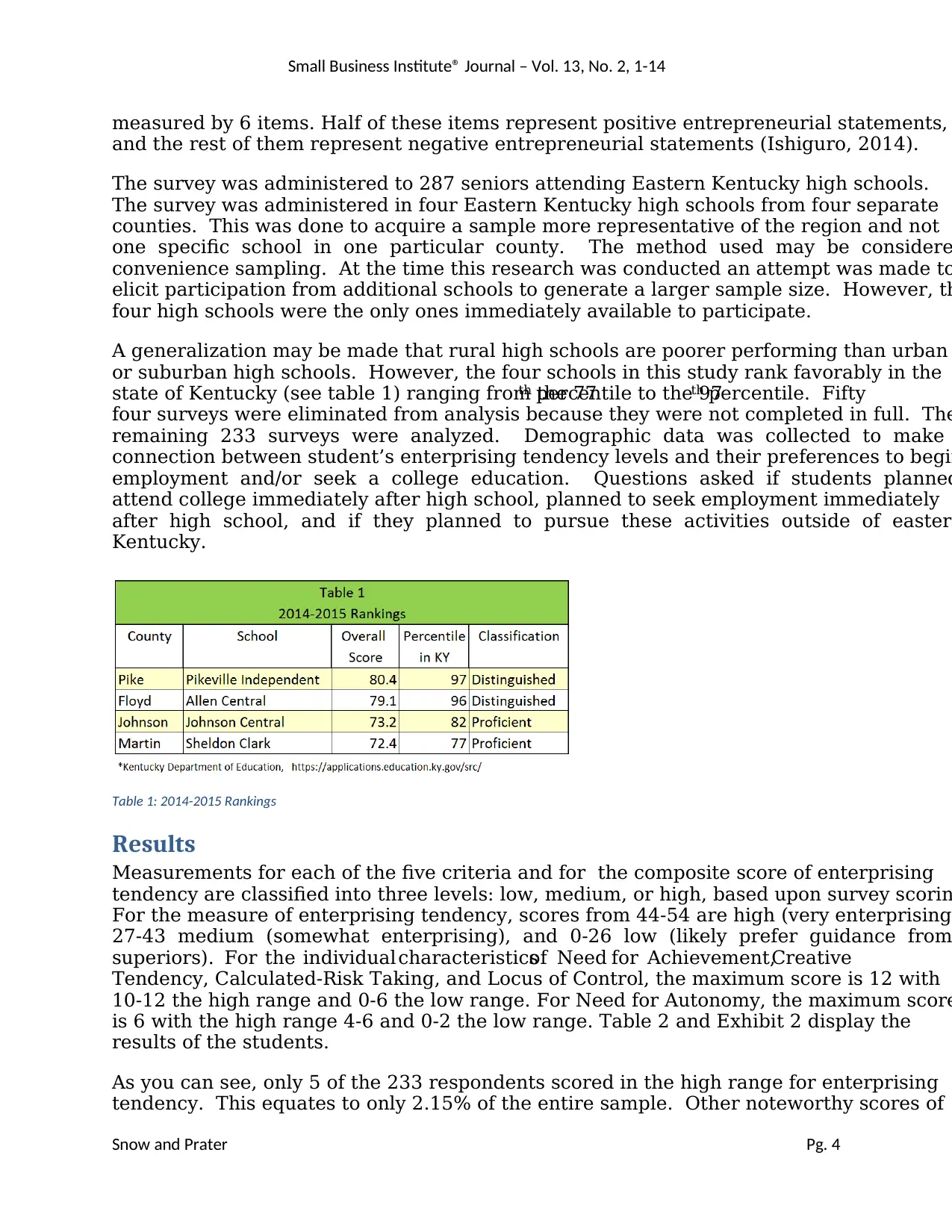
state of Kentucky (see table 1) ranging from the 77th percentile to the 97th percentile. Fifty
four surveys were eliminated from analysis because they were not completed in full. The
remaining 233 surveys were analyzed. Demographic data was collected to make
connection between student’s enterprising tendency levels and their preferences to begin
employment and/or seek a college education. Questions asked if students planned
attend college immediately after high school, planned to seek employment immediately
after high school, and if they planned to pursue these activities outside of eastern
Kentucky.
Table 1: 2014-2015 Rankings
Results
Measurements for each of the five criteria and for the composite score of enterprising
tendency are classified into three levels: low, medium, or high, based upon survey scorin
For the measure of enterprising tendency, scores from 44-54 are high (very enterprising)
27-43 medium (somewhat enterprising), and 0-26 low (likely prefer guidance from
superiors). For the individual characteristicsof Need for Achievement,Creative
Tendency, Calculated-Risk Taking, and Locus of Control, the maximum score is 12 with
10-12 the high range and 0-6 the low range. For Need for Autonomy, the maximum score
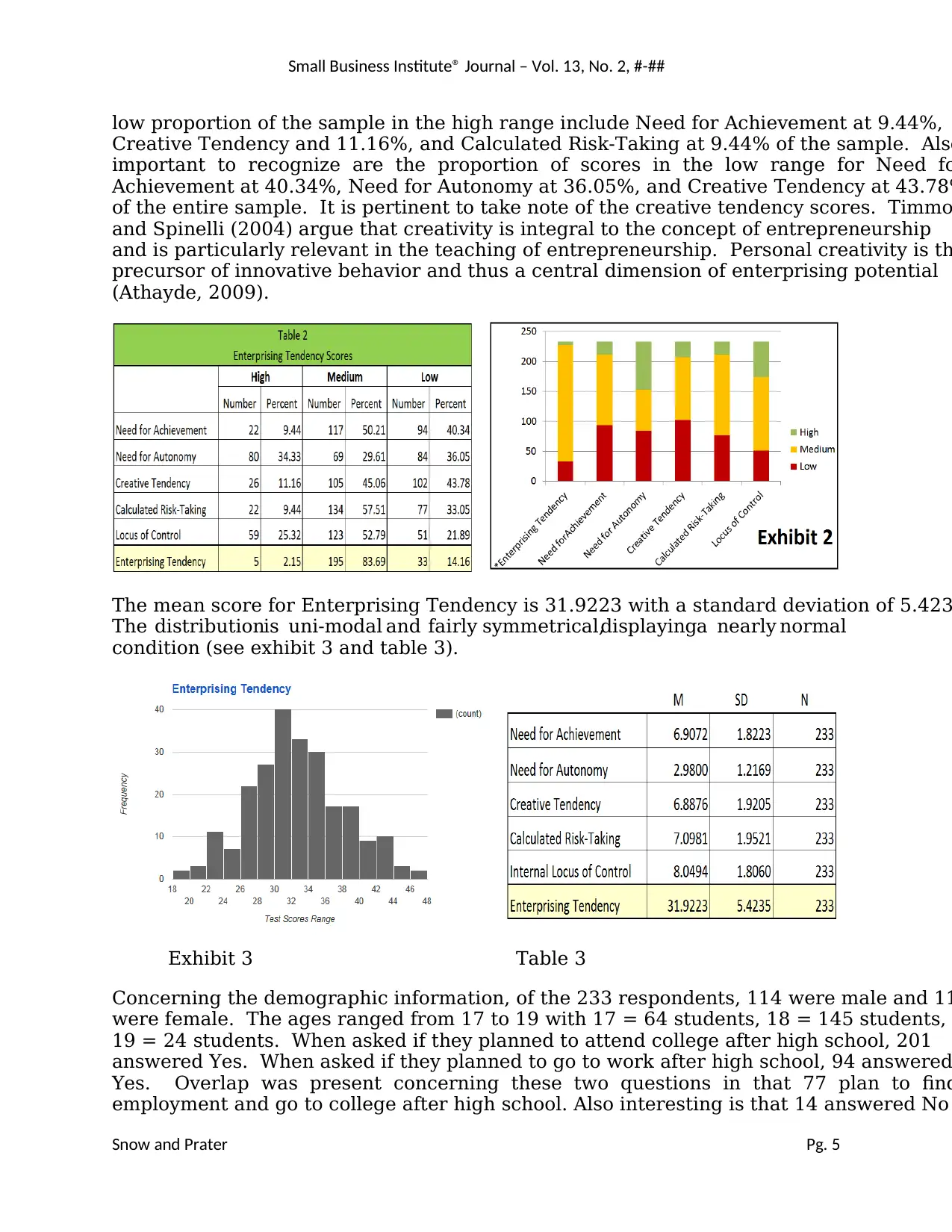
is 6 with the high range 4-6 and 0-2 the low range. Table 2 and Exhibit 2 display the
results of the students.
As you can see, only 5 of the 233 respondents scored in the high range for enterprising
tendency. This equates to only 2.15% of the entire sample. Other noteworthy scores of
Snow and Prater Pg. 4
measured by 6 items. Half of these items represent positive entrepreneurial statements,
and the rest of them represent negative entrepreneurial statements (Ishiguro, 2014).
The survey was administered to 287 seniors attending Eastern Kentucky high schools.
The survey was administered in four Eastern Kentucky high schools from four separate
counties. This was done to acquire a sample more representative of the region and not
one specific school in one particular county. The method used may be considere
convenience sampling. At the time this research was conducted an attempt was made to
elicit participation from additional schools to generate a larger sample size. However, th
four high schools were the only ones immediately available to participate.
A generalization may be made that rural high schools are poorer performing than urban
or suburban high schools. However, the four schools in this study rank favorably in the
state of Kentucky (see table 1) ranging from the 77th percentile to the 97th percentile. Fifty
four surveys were eliminated from analysis because they were not completed in full. The
remaining 233 surveys were analyzed. Demographic data was collected to make
connection between student’s enterprising tendency levels and their preferences to begin
employment and/or seek a college education. Questions asked if students planned
attend college immediately after high school, planned to seek employment immediately
after high school, and if they planned to pursue these activities outside of eastern
Kentucky.
Table 1: 2014-2015 Rankings
Results
Measurements for each of the five criteria and for the composite score of enterprising
tendency are classified into three levels: low, medium, or high, based upon survey scorin
For the measure of enterprising tendency, scores from 44-54 are high (very enterprising)
27-43 medium (somewhat enterprising), and 0-26 low (likely prefer guidance from
superiors). For the individual characteristicsof Need for Achievement,Creative
Tendency, Calculated-Risk Taking, and Locus of Control, the maximum score is 12 with
10-12 the high range and 0-6 the low range. For Need for Autonomy, the maximum score
is 6 with the high range 4-6 and 0-2 the low range. Table 2 and Exhibit 2 display the
results of the students.
As you can see, only 5 of the 233 respondents scored in the high range for enterprising
tendency. This equates to only 2.15% of the entire sample. Other noteworthy scores of
Paraphrase This Document
Need a fresh take? Get an instant paraphrase of this document with our AI Paraphraser
Small Business Institute® Journal – Vol. 13, No. 2, #-##
Snow and Prater Pg. 5
low proportion of the sample in the high range include Need for Achievement at 9.44%,
Creative Tendency and 11.16%, and Calculated Risk-Taking at 9.44% of the sample. Also
important to recognize are the proportion of scores in the low range for Need fo
Achievement at 40.34%, Need for Autonomy at 36.05%, and Creative Tendency at 43.78%
of the entire sample. It is pertinent to take note of the creative tendency scores. Timmo
and Spinelli (2004) argue that creativity is integral to the concept of entrepreneurship
and is particularly relevant in the teaching of entrepreneurship. Personal creativity is th
precursor of innovative behavior and thus a central dimension of enterprising potential
(Athayde, 2009).
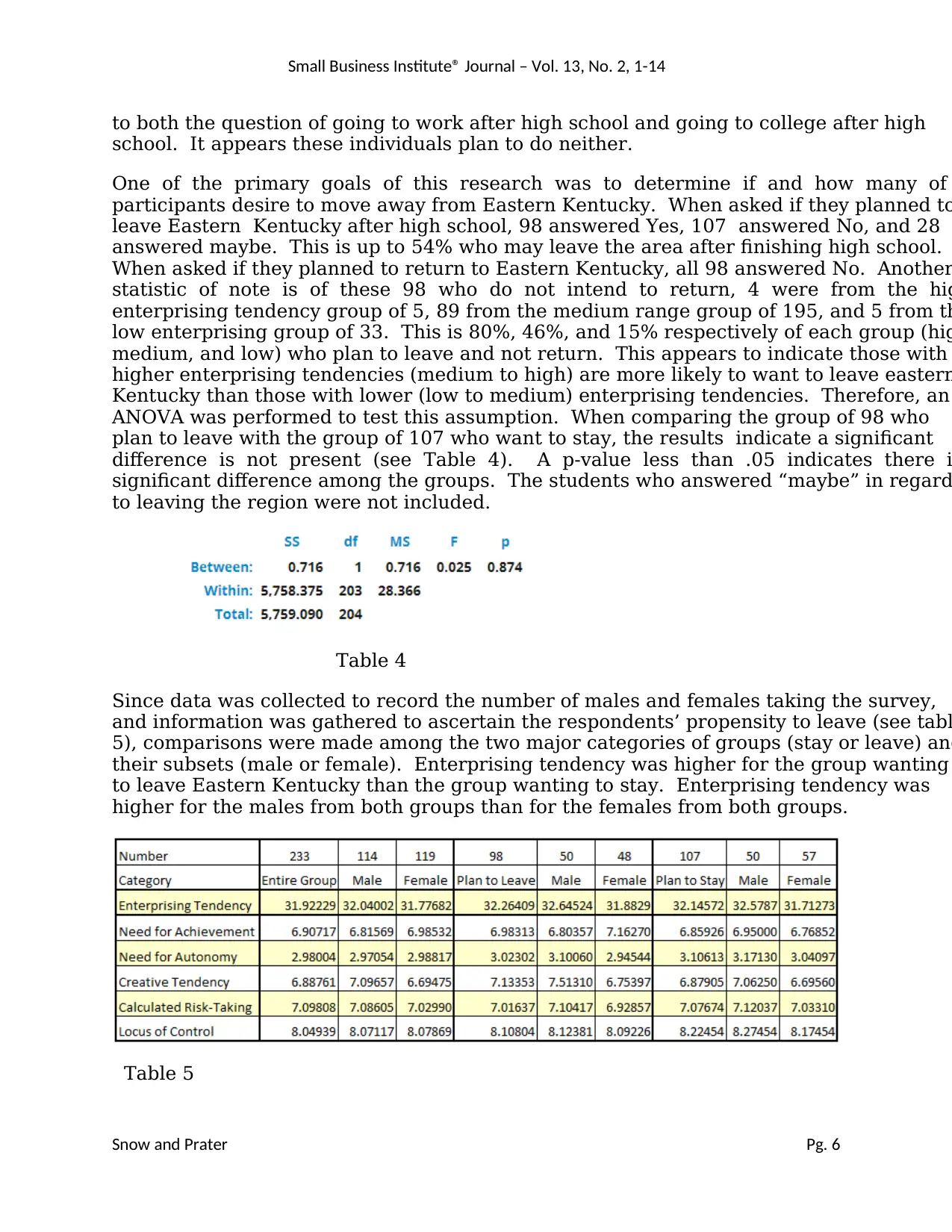
The mean score for Enterprising Tendency is 31.9223 with a standard deviation of 5.423
The distributionis uni-modal and fairly symmetrical,displayinga nearly normal
condition (see exhibit 3 and table 3).
Exhibit 3 Table 3
Concerning the demographic information, of the 233 respondents, 114 were male and 11
were female. The ages ranged from 17 to 19 with 17 = 64 students, 18 = 145 students,
19 = 24 students. When asked if they planned to attend college after high school, 201
answered Yes. When asked if they planned to go to work after high school, 94 answered
Yes. Overlap was present concerning these two questions in that 77 plan to find
employment and go to college after high school. Also interesting is that 14 answered No
Snow and Prater Pg. 5
low proportion of the sample in the high range include Need for Achievement at 9.44%,
Creative Tendency and 11.16%, and Calculated Risk-Taking at 9.44% of the sample. Also
important to recognize are the proportion of scores in the low range for Need fo
Achievement at 40.34%, Need for Autonomy at 36.05%, and Creative Tendency at 43.78%
of the entire sample. It is pertinent to take note of the creative tendency scores. Timmo
and Spinelli (2004) argue that creativity is integral to the concept of entrepreneurship
and is particularly relevant in the teaching of entrepreneurship. Personal creativity is th
precursor of innovative behavior and thus a central dimension of enterprising potential
(Athayde, 2009).
The mean score for Enterprising Tendency is 31.9223 with a standard deviation of 5.423
The distributionis uni-modal and fairly symmetrical,displayinga nearly normal
condition (see exhibit 3 and table 3).
Exhibit 3 Table 3
Concerning the demographic information, of the 233 respondents, 114 were male and 11
were female. The ages ranged from 17 to 19 with 17 = 64 students, 18 = 145 students,
19 = 24 students. When asked if they planned to attend college after high school, 201
answered Yes. When asked if they planned to go to work after high school, 94 answered
Yes. Overlap was present concerning these two questions in that 77 plan to find
employment and go to college after high school. Also interesting is that 14 answered No
Small Business Institute® Journal – Vol. 13, No. 2, 1-14
Snow and Prater Pg. 6
to both the question of going to work after high school and going to college after high
school. It appears these individuals plan to do neither.
One of the primary goals of this research was to determine if and how many of
participants desire to move away from Eastern Kentucky. When asked if they planned to
leave Eastern Kentucky after high school, 98 answered Yes, 107 answered No, and 28
answered maybe. This is up to 54% who may leave the area after finishing high school.
When asked if they planned to return to Eastern Kentucky, all 98 answered No. Another
statistic of note is of these 98 who do not intend to return, 4 were from the hig
enterprising tendency group of 5, 89 from the medium range group of 195, and 5 from th
low enterprising group of 33. This is 80%, 46%, and 15% respectively of each group (hig
medium, and low) who plan to leave and not return. This appears to indicate those with
higher enterprising tendencies (medium to high) are more likely to want to leave eastern
Kentucky than those with lower (low to medium) enterprising tendencies. Therefore, an
ANOVA was performed to test this assumption. When comparing the group of 98 who
plan to leave with the group of 107 who want to stay, the results indicate a significant
difference is not present (see Table 4). A p-value less than .05 indicates there i
significant difference among the groups. The students who answered “maybe” in regard
to leaving the region were not included.
Table 4
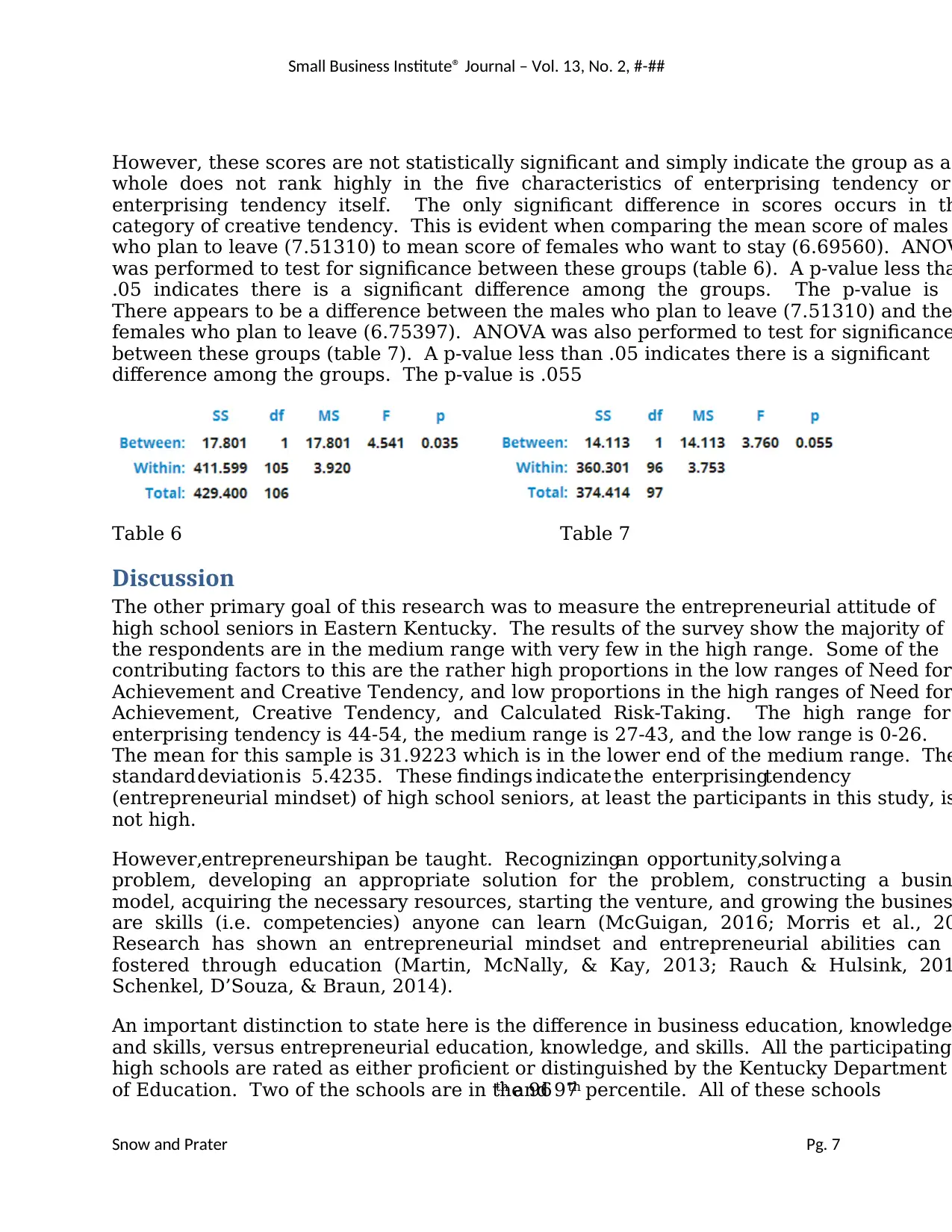
Since data was collected to record the number of males and females taking the survey,
and information was gathered to ascertain the respondents’ propensity to leave (see tabl
5), comparisons were made among the two major categories of groups (stay or leave) and
their subsets (male or female). Enterprising tendency was higher for the group wanting
to leave Eastern Kentucky than the group wanting to stay. Enterprising tendency was
higher for the males from both groups than for the females from both groups.
Table 5
Snow and Prater Pg. 6
to both the question of going to work after high school and going to college after high
school. It appears these individuals plan to do neither.
One of the primary goals of this research was to determine if and how many of
participants desire to move away from Eastern Kentucky. When asked if they planned to
leave Eastern Kentucky after high school, 98 answered Yes, 107 answered No, and 28
answered maybe. This is up to 54% who may leave the area after finishing high school.
When asked if they planned to return to Eastern Kentucky, all 98 answered No. Another
statistic of note is of these 98 who do not intend to return, 4 were from the hig
enterprising tendency group of 5, 89 from the medium range group of 195, and 5 from th
low enterprising group of 33. This is 80%, 46%, and 15% respectively of each group (hig
medium, and low) who plan to leave and not return. This appears to indicate those with
higher enterprising tendencies (medium to high) are more likely to want to leave eastern
Kentucky than those with lower (low to medium) enterprising tendencies. Therefore, an
ANOVA was performed to test this assumption. When comparing the group of 98 who
plan to leave with the group of 107 who want to stay, the results indicate a significant
difference is not present (see Table 4). A p-value less than .05 indicates there i
significant difference among the groups. The students who answered “maybe” in regard
to leaving the region were not included.
Table 4
Since data was collected to record the number of males and females taking the survey,
and information was gathered to ascertain the respondents’ propensity to leave (see tabl
5), comparisons were made among the two major categories of groups (stay or leave) and
their subsets (male or female). Enterprising tendency was higher for the group wanting
to leave Eastern Kentucky than the group wanting to stay. Enterprising tendency was
higher for the males from both groups than for the females from both groups.
Table 5
⊘ This is a preview!⊘
Do you want full access?
Subscribe today to unlock all pages.
Trusted by 1+ million students worldwide
Small Business Institute® Journal – Vol. 13, No. 2, #-##
Snow and Prater Pg. 7
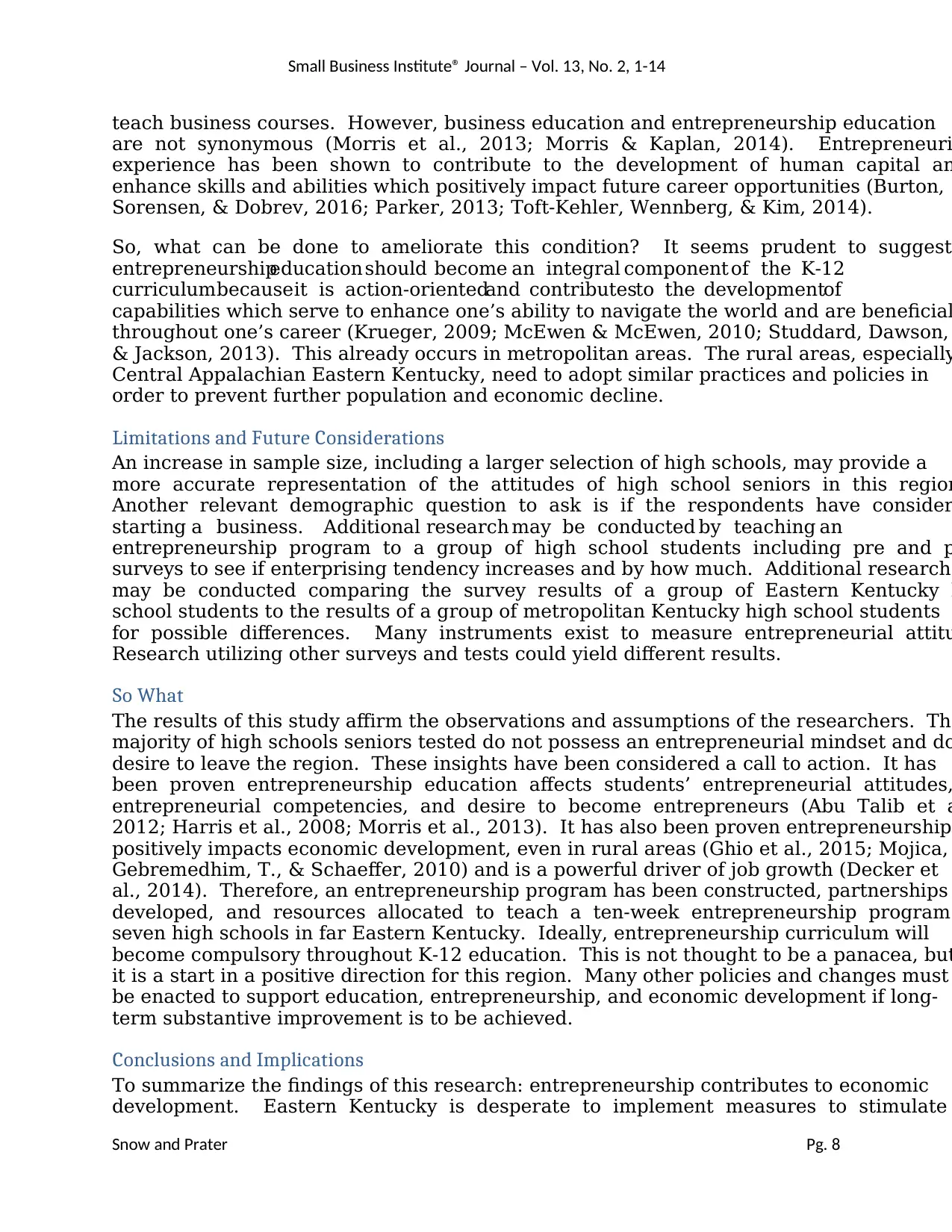
However, these scores are not statistically significant and simply indicate the group as a
whole does not rank highly in the five characteristics of enterprising tendency or
enterprising tendency itself. The only significant difference in scores occurs in th
category of creative tendency. This is evident when comparing the mean score of males
who plan to leave (7.51310) to mean score of females who want to stay (6.69560). ANOV
was performed to test for significance between these groups (table 6). A p-value less tha
.05 indicates there is a significant difference among the groups. The p-value is .
There appears to be a difference between the males who plan to leave (7.51310) and the
females who plan to leave (6.75397). ANOVA was also performed to test for significance
between these groups (table 7). A p-value less than .05 indicates there is a significant
difference among the groups. The p-value is .055
Table 6 Table 7
Discussion
The other primary goal of this research was to measure the entrepreneurial attitude of
high school seniors in Eastern Kentucky. The results of the survey show the majority of
the respondents are in the medium range with very few in the high range. Some of the
contributing factors to this are the rather high proportions in the low ranges of Need for
Achievement and Creative Tendency, and low proportions in the high ranges of Need for
Achievement, Creative Tendency, and Calculated Risk-Taking. The high range for
enterprising tendency is 44-54, the medium range is 27-43, and the low range is 0-26.
The mean for this sample is 31.9223 which is in the lower end of the medium range. The
standard deviation is 5.4235. These findings indicate the enterprisingtendency
(entrepreneurial mindset) of high school seniors, at least the participants in this study, is
not high.
However,entrepreneurshipcan be taught. Recognizingan opportunity,solving a
problem, developing an appropriate solution for the problem, constructing a busin
model, acquiring the necessary resources, starting the venture, and growing the busines
are skills (i.e. competencies) anyone can learn (McGuigan, 2016; Morris et al., 20
Research has shown an entrepreneurial mindset and entrepreneurial abilities can
fostered through education (Martin, McNally, & Kay, 2013; Rauch & Hulsink, 201
Schenkel, D’Souza, & Braun, 2014).
An important distinction to state here is the difference in business education, knowledge
and skills, versus entrepreneurial education, knowledge, and skills. All the participating
high schools are rated as either proficient or distinguished by the Kentucky Department
of Education. Two of the schools are in the 96th and 97th percentile. All of these schools
Snow and Prater Pg. 7
However, these scores are not statistically significant and simply indicate the group as a
whole does not rank highly in the five characteristics of enterprising tendency or
enterprising tendency itself. The only significant difference in scores occurs in th
category of creative tendency. This is evident when comparing the mean score of males
who plan to leave (7.51310) to mean score of females who want to stay (6.69560). ANOV
was performed to test for significance between these groups (table 6). A p-value less tha
.05 indicates there is a significant difference among the groups. The p-value is .
There appears to be a difference between the males who plan to leave (7.51310) and the
females who plan to leave (6.75397). ANOVA was also performed to test for significance
between these groups (table 7). A p-value less than .05 indicates there is a significant
difference among the groups. The p-value is .055
Table 6 Table 7
Discussion
The other primary goal of this research was to measure the entrepreneurial attitude of
high school seniors in Eastern Kentucky. The results of the survey show the majority of
the respondents are in the medium range with very few in the high range. Some of the
contributing factors to this are the rather high proportions in the low ranges of Need for
Achievement and Creative Tendency, and low proportions in the high ranges of Need for
Achievement, Creative Tendency, and Calculated Risk-Taking. The high range for
enterprising tendency is 44-54, the medium range is 27-43, and the low range is 0-26.
The mean for this sample is 31.9223 which is in the lower end of the medium range. The
standard deviation is 5.4235. These findings indicate the enterprisingtendency
(entrepreneurial mindset) of high school seniors, at least the participants in this study, is
not high.
However,entrepreneurshipcan be taught. Recognizingan opportunity,solving a
problem, developing an appropriate solution for the problem, constructing a busin
model, acquiring the necessary resources, starting the venture, and growing the busines
are skills (i.e. competencies) anyone can learn (McGuigan, 2016; Morris et al., 20
Research has shown an entrepreneurial mindset and entrepreneurial abilities can
fostered through education (Martin, McNally, & Kay, 2013; Rauch & Hulsink, 201
Schenkel, D’Souza, & Braun, 2014).
An important distinction to state here is the difference in business education, knowledge
and skills, versus entrepreneurial education, knowledge, and skills. All the participating
high schools are rated as either proficient or distinguished by the Kentucky Department
of Education. Two of the schools are in the 96th and 97th percentile. All of these schools
Paraphrase This Document
Need a fresh take? Get an instant paraphrase of this document with our AI Paraphraser
Small Business Institute® Journal – Vol. 13, No. 2, 1-14
Snow and Prater Pg. 8
teach business courses. However, business education and entrepreneurship education
are not synonymous (Morris et al., 2013; Morris & Kaplan, 2014). Entrepreneuri
experience has been shown to contribute to the development of human capital an
enhance skills and abilities which positively impact future career opportunities (Burton,
Sorensen, & Dobrev, 2016; Parker, 2013; Toft-Kehler, Wennberg, & Kim, 2014).
So, what can be done to ameliorate this condition? It seems prudent to suggest
entrepreneurshipeducation should become an integral component of the K-12
curriculumbecause it is action-orientedand contributesto the developmentof
capabilities which serve to enhance one’s ability to navigate the world and are beneficial
throughout one’s career (Krueger, 2009; McEwen & McEwen, 2010; Studdard, Dawson,
& Jackson, 2013). This already occurs in metropolitan areas. The rural areas, especially
Central Appalachian Eastern Kentucky, need to adopt similar practices and policies in
order to prevent further population and economic decline.
Limitations and Future Considerations
An increase in sample size, including a larger selection of high schools, may provide a
more accurate representation of the attitudes of high school seniors in this region
Another relevant demographic question to ask is if the respondents have consider
starting a business. Additional research may be conducted by teaching an
entrepreneurship program to a group of high school students including pre and p
surveys to see if enterprising tendency increases and by how much. Additional research
may be conducted comparing the survey results of a group of Eastern Kentucky h
school students to the results of a group of metropolitan Kentucky high school students
for possible differences. Many instruments exist to measure entrepreneurial attitu
Research utilizing other surveys and tests could yield different results.
So What
The results of this study affirm the observations and assumptions of the researchers. The
majority of high schools seniors tested do not possess an entrepreneurial mindset and do
desire to leave the region. These insights have been considered a call to action. It has
been proven entrepreneurship education affects students’ entrepreneurial attitudes,
entrepreneurial competencies, and desire to become entrepreneurs (Abu Talib et a
2012; Harris et al., 2008; Morris et al., 2013). It has also been proven entrepreneurship
positively impacts economic development, even in rural areas (Ghio et al., 2015; Mojica,
Gebremedhim, T., & Schaeffer, 2010) and is a powerful driver of job growth (Decker et
al., 2014). Therefore, an entrepreneurship program has been constructed, partnerships
developed, and resources allocated to teach a ten-week entrepreneurship program
seven high schools in far Eastern Kentucky. Ideally, entrepreneurship curriculum will
become compulsory throughout K-12 education. This is not thought to be a panacea, but
it is a start in a positive direction for this region. Many other policies and changes must
be enacted to support education, entrepreneurship, and economic development if long-
term substantive improvement is to be achieved.
Conclusions and Implications
To summarize the findings of this research: entrepreneurship contributes to economic
development. Eastern Kentucky is desperate to implement measures to stimulate
Snow and Prater Pg. 8
teach business courses. However, business education and entrepreneurship education
are not synonymous (Morris et al., 2013; Morris & Kaplan, 2014). Entrepreneuri
experience has been shown to contribute to the development of human capital an
enhance skills and abilities which positively impact future career opportunities (Burton,
Sorensen, & Dobrev, 2016; Parker, 2013; Toft-Kehler, Wennberg, & Kim, 2014).
So, what can be done to ameliorate this condition? It seems prudent to suggest
entrepreneurshipeducation should become an integral component of the K-12
curriculumbecause it is action-orientedand contributesto the developmentof
capabilities which serve to enhance one’s ability to navigate the world and are beneficial
throughout one’s career (Krueger, 2009; McEwen & McEwen, 2010; Studdard, Dawson,
& Jackson, 2013). This already occurs in metropolitan areas. The rural areas, especially
Central Appalachian Eastern Kentucky, need to adopt similar practices and policies in
order to prevent further population and economic decline.
Limitations and Future Considerations
An increase in sample size, including a larger selection of high schools, may provide a
more accurate representation of the attitudes of high school seniors in this region
Another relevant demographic question to ask is if the respondents have consider
starting a business. Additional research may be conducted by teaching an
entrepreneurship program to a group of high school students including pre and p
surveys to see if enterprising tendency increases and by how much. Additional research
may be conducted comparing the survey results of a group of Eastern Kentucky h
school students to the results of a group of metropolitan Kentucky high school students
for possible differences. Many instruments exist to measure entrepreneurial attitu
Research utilizing other surveys and tests could yield different results.
So What
The results of this study affirm the observations and assumptions of the researchers. The
majority of high schools seniors tested do not possess an entrepreneurial mindset and do
desire to leave the region. These insights have been considered a call to action. It has
been proven entrepreneurship education affects students’ entrepreneurial attitudes,
entrepreneurial competencies, and desire to become entrepreneurs (Abu Talib et a
2012; Harris et al., 2008; Morris et al., 2013). It has also been proven entrepreneurship
positively impacts economic development, even in rural areas (Ghio et al., 2015; Mojica,
Gebremedhim, T., & Schaeffer, 2010) and is a powerful driver of job growth (Decker et
al., 2014). Therefore, an entrepreneurship program has been constructed, partnerships
developed, and resources allocated to teach a ten-week entrepreneurship program
seven high schools in far Eastern Kentucky. Ideally, entrepreneurship curriculum will
become compulsory throughout K-12 education. This is not thought to be a panacea, but
it is a start in a positive direction for this region. Many other policies and changes must
be enacted to support education, entrepreneurship, and economic development if long-
term substantive improvement is to be achieved.
Conclusions and Implications
To summarize the findings of this research: entrepreneurship contributes to economic
development. Eastern Kentucky is desperate to implement measures to stimulate
Small Business Institute® Journal – Vol. 13, No. 2, #-##
Snow and Prater Pg. 9
economic development. The region has highly ranked high schools teaching busin
courses, but they do not teach entrepreneurship. The students surveyed do not rate high
for enterprising tendency, need for achievement, creative tendency, calculated risk takin
locus of control, or need for autonomy. Entrepreneurship education is shown to positivel
impact academic success, attitude toward entrepreneurship, intention to become a
entrepreneur, business skills, and desirability by employers. It is logical to teach
entrepreneurship in Eastern Kentucky at the K-12 level as one initiative in an attempt to
improve the mindset of the youth. This will aid in the formation of an entrepreneurial
ecosystemto enhance economicdevelopmentin the region by enlighteningeach
successive generation to the possibilities of creating their own opportunities for career in
their home towns, as opposed to the continued migration of young adults to othe
communities for education, career, and contributions to society.
In conclusion, this research has provided results important to the fields of
entrepreneurship, education, and economic development as they pertain to rural areas
with traditionally non-diverse economies, similar to the conditions of Central
Appalachian Eastern Kentucky.
References
Abu Talib, M. (2012). Innovative Use of IT Applications for Teaching Entrepreneurship
to Youth: UAE Case Study. European, Mediterranean & Middle Eastern
Conference of Information Systems.
Acs, Z., & Audretsch, D. (2003). Innovation and Technological Change. Handbook of
Entrepreneurship Research: An Interdisciplinary Survey and Introduction.
Dordrecht, The Netherlands: Kluwer. 55-80.
Athayde, R. (2009). Measuring Enterprise Potential in Young People. Entrepreneurship
Theory & Practice, 33(2), 481-500.
Audretsch, D., & Link, A. (2012). Valuing an Entrepreneurial Enterprise. Small Business
Economics, 38(2), 139-145.
Audretsch, D., & Keilbach, M. (2004). Entrepreneurship Capital and Economic
Performance. Regional Studies, 38(8), 949–959.
Baumann, R. (2006). Changes in the Appalachian Wage Gap, 1970 to 2000. Growth
and Change, 37(3), 416-443.
Baumol, W. (2002). The Free-Market Innovation Machine: Analyzing the Growth
Miracle of Capitalism. Princeton. NJ: Princeton University Press.
Black, D., McKinnish, T., & Sanders, S. (2005). The Economic Impact of the Coal Boom
and Bust. Economic Journal, 115(503), 449-476.
Snow and Prater Pg. 9
economic development. The region has highly ranked high schools teaching busin
courses, but they do not teach entrepreneurship. The students surveyed do not rate high
for enterprising tendency, need for achievement, creative tendency, calculated risk takin
locus of control, or need for autonomy. Entrepreneurship education is shown to positivel
impact academic success, attitude toward entrepreneurship, intention to become a
entrepreneur, business skills, and desirability by employers. It is logical to teach
entrepreneurship in Eastern Kentucky at the K-12 level as one initiative in an attempt to
improve the mindset of the youth. This will aid in the formation of an entrepreneurial
ecosystemto enhance economicdevelopmentin the region by enlighteningeach
successive generation to the possibilities of creating their own opportunities for career in
their home towns, as opposed to the continued migration of young adults to othe
communities for education, career, and contributions to society.
In conclusion, this research has provided results important to the fields of
entrepreneurship, education, and economic development as they pertain to rural areas
with traditionally non-diverse economies, similar to the conditions of Central
Appalachian Eastern Kentucky.
References
Abu Talib, M. (2012). Innovative Use of IT Applications for Teaching Entrepreneurship
to Youth: UAE Case Study. European, Mediterranean & Middle Eastern
Conference of Information Systems.
Acs, Z., & Audretsch, D. (2003). Innovation and Technological Change. Handbook of
Entrepreneurship Research: An Interdisciplinary Survey and Introduction.
Dordrecht, The Netherlands: Kluwer. 55-80.
Athayde, R. (2009). Measuring Enterprise Potential in Young People. Entrepreneurship
Theory & Practice, 33(2), 481-500.
Audretsch, D., & Link, A. (2012). Valuing an Entrepreneurial Enterprise. Small Business
Economics, 38(2), 139-145.
Audretsch, D., & Keilbach, M. (2004). Entrepreneurship Capital and Economic
Performance. Regional Studies, 38(8), 949–959.
Baumann, R. (2006). Changes in the Appalachian Wage Gap, 1970 to 2000. Growth
and Change, 37(3), 416-443.
Baumol, W. (2002). The Free-Market Innovation Machine: Analyzing the Growth
Miracle of Capitalism. Princeton. NJ: Princeton University Press.
Black, D., McKinnish, T., & Sanders, S. (2005). The Economic Impact of the Coal Boom
and Bust. Economic Journal, 115(503), 449-476.
⊘ This is a preview!⊘
Do you want full access?
Subscribe today to unlock all pages.
Trusted by 1+ million students worldwide
Small Business Institute® Journal – Vol. 13, No. 2, 1-14
Snow and Prater Pg. 10
Brown, K., Bowlus, D., & Seibert, S. (2011). Online Entrepreneurship Curriculum for
High School Students: Impact on Knowledge, Self-Efficacy, and Attitudes.
USASBE Proceedings, 1351-1364.
Burton, D., Sorensen, J., Dobrev, S. (2016). A Careers Perspective on Entrepreneurship.
Entrepreneurship Theory and Practice, 40(2) 237-247.
Caird, S. (2013). General Measure of Enterprising Tendency Test. The Open University’s
Repository of Research Publications and Other Research Outputs. Retrieved from
http://oro.open.ac.uk/5393/2/Get2test_guide.pdf
Caird, S. (1991). Testing Enterprising Tendency in Occupational Groups. British Journal
of Mangement, 2, 177-186.
Clayton, R., Sadeghi, A., Spletzer, J. & Talan, D. (2013). High-Employment-Growth
Firms: Defining and Counting Them. Monthly Labor Review, 136(6), 3-13.
Decker, R., Haltiwanger, J., Jarmin, R. & Miranda, J. (2014). The Role of
Entrepreneurship in US Job Creation and Economic Dynamism. Journal of
Economic Perspectives, 28(3), 3-24.
Duval-Couetil, N. (2013). Assessing the Impact of Entrepreneurship Education
Programs: Challenges and Approaches. Journal of Small Business Management,
51(3), 394-409.
Epstein, P., Buonocore, J., Eckerle, K., Hendryx, M., Iii, B., Heinberg, R., Glustrom, L.
(2011). Full Cost Accounting for the Life Cycle of Coal. Annals of the New York
Academy of Sciences, 73-98.
Frazier, A. (2014). YEA! For Entrepreneurship. Business NH, 31(11) 10-11.
Gebremariam, G., Gebremeskel, H., Gebremedhin, T., Schaeffer, P., Phipps, T. &
Jackson, R. (2012). Employment, Income, Migration and Public Services: A
Simultaneous Spatial Panel Data Model of Regional Growth. Papers in Regional
Science, 91(2), 275-297.
Ghio, N., Guerini, M., Lehmann, E & Rossi-Lamstra, C. (2015). The Emergence of the
Knowledge Spillover Theory of Entrepreneurship. Small Business Economics,
44(1), 1-18.
Green, M. (2015, July8). More Than Half of Kentucky’s Counties Losing Population,
Census Data Shows. http://www.wdrb.com/story/29503122/more-than-half-of-
kentuckys-counties-losing-population-census-data-shows
Hamilton, S., Hamilton, M. (2012). Development in Youth Enterprises. New Directions
for Youth Development, 134, 65-75.
Snow and Prater Pg. 10
Brown, K., Bowlus, D., & Seibert, S. (2011). Online Entrepreneurship Curriculum for
High School Students: Impact on Knowledge, Self-Efficacy, and Attitudes.
USASBE Proceedings, 1351-1364.
Burton, D., Sorensen, J., Dobrev, S. (2016). A Careers Perspective on Entrepreneurship.
Entrepreneurship Theory and Practice, 40(2) 237-247.
Caird, S. (2013). General Measure of Enterprising Tendency Test. The Open University’s
Repository of Research Publications and Other Research Outputs. Retrieved from
http://oro.open.ac.uk/5393/2/Get2test_guide.pdf
Caird, S. (1991). Testing Enterprising Tendency in Occupational Groups. British Journal
of Mangement, 2, 177-186.
Clayton, R., Sadeghi, A., Spletzer, J. & Talan, D. (2013). High-Employment-Growth
Firms: Defining and Counting Them. Monthly Labor Review, 136(6), 3-13.
Decker, R., Haltiwanger, J., Jarmin, R. & Miranda, J. (2014). The Role of
Entrepreneurship in US Job Creation and Economic Dynamism. Journal of
Economic Perspectives, 28(3), 3-24.
Duval-Couetil, N. (2013). Assessing the Impact of Entrepreneurship Education
Programs: Challenges and Approaches. Journal of Small Business Management,
51(3), 394-409.
Epstein, P., Buonocore, J., Eckerle, K., Hendryx, M., Iii, B., Heinberg, R., Glustrom, L.
(2011). Full Cost Accounting for the Life Cycle of Coal. Annals of the New York
Academy of Sciences, 73-98.
Frazier, A. (2014). YEA! For Entrepreneurship. Business NH, 31(11) 10-11.
Gebremariam, G., Gebremeskel, H., Gebremedhin, T., Schaeffer, P., Phipps, T. &
Jackson, R. (2012). Employment, Income, Migration and Public Services: A
Simultaneous Spatial Panel Data Model of Regional Growth. Papers in Regional
Science, 91(2), 275-297.
Ghio, N., Guerini, M., Lehmann, E & Rossi-Lamstra, C. (2015). The Emergence of the
Knowledge Spillover Theory of Entrepreneurship. Small Business Economics,
44(1), 1-18.
Green, M. (2015, July8). More Than Half of Kentucky’s Counties Losing Population,
Census Data Shows. http://www.wdrb.com/story/29503122/more-than-half-of-
kentuckys-counties-losing-population-census-data-shows
Hamilton, S., Hamilton, M. (2012). Development in Youth Enterprises. New Directions
for Youth Development, 134, 65-75.
Paraphrase This Document
Need a fresh take? Get an instant paraphrase of this document with our AI Paraphraser
Small Business Institute® Journal – Vol. 13, No. 2, #-##
Snow and Prater Pg. 11
Hansen, N. & Yukhin, R. (1970). Locational Preferences and Opportunity Costs in a
Lagging Region: A Study of High School Seniors in Eastern Kentucky. Journal of
Human Resources, 5(3), 341-353.
Harris, M., Gibson, S., Taylor, S., & Mick, T. (2008). Examining the Entrepreneurial
Attitudes of Business Students: The Impact of Participation in the Small Business
Institute®. USASBE Proceedings, 1471-1481.
Heflin, C. & Miller, K. (2012). The Geography of Need: Identifying Human Service
Needs in Rural America. Journal of Family Social Work, 15(5), 359-374.
Hernandez, S. & Newman, C. (2009). Positive Long-Term Impact of Minding Our
Business Entrepreneurship Programs for Low-Income Middle School Students.
Hessels, J., & van Stel, A. (2011). Entrepreneurship, export orientation, and economic
growth. Small Business Economics, 37(2), 255-268.
Ishiguro, J. (2014). What Influences Entrepreneurial Career Choice?: An Exploratory
Analysis of the Sally Caird’s GET2 for Japanese High School Students. Allied
Academies International Conference: Proceedings of the Academy of
Entrepreneurship, 20(1), 9-13.
Jaafar, M., Dahalan, N., & Rosdi, S. (2014). Local Community Entrepreneurship: A Case
Study of the Lenggong Valley. Asian Social Science, 10(10), 226-235.
Jung, S., Cho, S., & Roberts, R. (2015). The Impact of Government Funding of Poverty
Reduction Programmes. Papers in Regional Science, 94(3), 653-675.
Katundu, M. & Gabagambi, D. (2014). Entrepreneurial Tendencies of Tanzanian
University Graduates: Evidence from University of Dar-es-Salaam. European
Academic Research, 1(12), 5525-5558.
Krueger, N. (2009). The Microfoundations of Entrepreneurial Learning
and….Education: The Experiential Essence of Entrepreneurial Education. In
Page, G., Gatewood, L. & Shaver, G. University-Wide Entrepreneurship
Education (35-59). Cheltenham, UK: Edward Elgar.
Kuratko, D. (2014). Entrepreneurship: Theory, Process, Practice. 9th ed. Mason, OH:
Cengage/South-Western Publishers.
Lee, S., Chang, D., & Lim, S. (2005). Impact of Entreprenuerial Education: A
Comprative Study of the U.S. and Korea. International Entrepreneurship and
Management Journal, 1(1), 27-43.
Lichter, D., Garrat, J., Marshall, M., & Cardella, M. (2005). Emerging Patterns of
Population Redistribution and Migration in Appalachia. Washington DC:
Appalachian Regional Commission.
Snow and Prater Pg. 11
Hansen, N. & Yukhin, R. (1970). Locational Preferences and Opportunity Costs in a
Lagging Region: A Study of High School Seniors in Eastern Kentucky. Journal of
Human Resources, 5(3), 341-353.
Harris, M., Gibson, S., Taylor, S., & Mick, T. (2008). Examining the Entrepreneurial
Attitudes of Business Students: The Impact of Participation in the Small Business
Institute®. USASBE Proceedings, 1471-1481.
Heflin, C. & Miller, K. (2012). The Geography of Need: Identifying Human Service
Needs in Rural America. Journal of Family Social Work, 15(5), 359-374.
Hernandez, S. & Newman, C. (2009). Positive Long-Term Impact of Minding Our
Business Entrepreneurship Programs for Low-Income Middle School Students.
Hessels, J., & van Stel, A. (2011). Entrepreneurship, export orientation, and economic
growth. Small Business Economics, 37(2), 255-268.
Ishiguro, J. (2014). What Influences Entrepreneurial Career Choice?: An Exploratory
Analysis of the Sally Caird’s GET2 for Japanese High School Students. Allied
Academies International Conference: Proceedings of the Academy of
Entrepreneurship, 20(1), 9-13.
Jaafar, M., Dahalan, N., & Rosdi, S. (2014). Local Community Entrepreneurship: A Case
Study of the Lenggong Valley. Asian Social Science, 10(10), 226-235.
Jung, S., Cho, S., & Roberts, R. (2015). The Impact of Government Funding of Poverty
Reduction Programmes. Papers in Regional Science, 94(3), 653-675.
Katundu, M. & Gabagambi, D. (2014). Entrepreneurial Tendencies of Tanzanian
University Graduates: Evidence from University of Dar-es-Salaam. European
Academic Research, 1(12), 5525-5558.
Krueger, N. (2009). The Microfoundations of Entrepreneurial Learning
and….Education: The Experiential Essence of Entrepreneurial Education. In
Page, G., Gatewood, L. & Shaver, G. University-Wide Entrepreneurship
Education (35-59). Cheltenham, UK: Edward Elgar.
Kuratko, D. (2014). Entrepreneurship: Theory, Process, Practice. 9th ed. Mason, OH:
Cengage/South-Western Publishers.
Lee, S., Chang, D., & Lim, S. (2005). Impact of Entreprenuerial Education: A
Comprative Study of the U.S. and Korea. International Entrepreneurship and
Management Journal, 1(1), 27-43.
Lichter, D., Garrat, J., Marshall, M., & Cardella, M. (2005). Emerging Patterns of
Population Redistribution and Migration in Appalachia. Washington DC:
Appalachian Regional Commission.
Small Business Institute® Journal – Vol. 13, No. 2, 1-14
Snow and Prater Pg. 12
Lorz, M, Mueller, S., & Volery, T. (2013). Entrepreneurship Education: A Systematic
Review of the Methods in Impact Studies. Journal of Enterprising Culture, 21(2),
123-151.
Lowrey, A. (2014, January 5). 50 Years Later, War on Poverty is a Mixed Bag. New York
Times, pp A1-A4.
Martin, B., McNally, J., & Kay, M. (2013). Examining the Formation of Human Capital
in Entrepreneurship: A meta-analysis of Entrepreneurship Education Outcomes.
Journal of Business Venturing, 28(2), 211-224.
Mayer, I., Kortmann, R., Wenzler, I., Wetters, A., & Spaans, J. (2014). Game-Based
Entrepreneurship Education: Identifying Enterprising Personality, Motivation
and Intentions Amongst Engineering Students. Journal of Entrepreneurship
Education, 17(2), 217-244.
Mazzarol, T. (2007). Awakening the Entrepreneur: An Examination of Entrepreneurial
Orientation Among MBA Students. Paper presented at the EFMD 37th
Entrepreneurship, Innovation, & Small Business (EISB) Annual Conference,
September 13-14, 2007.
McEwen, T. & McEwen, B. (2010). Adding Entrepreneurship to the General Education
Curriculum. Allied Academics Conference: Proceedings of the Academy of
Entrepreneurship, 16(2), 37-42.
McGuigan, P. (2016). Practicing What We Preach: Entrepreneurship in
Entrepreneurship Education. Journal of Entrepreneurship Education, 19(1), 38-
50.
McNally, J., Martin, B. & Kay, N. (2010). Examining the Formation of Human Capital
Entrepreneurship: A Meta-analysis of Entrepreneurship Education Outcomes.
Presented at the Annual Meeting of the Academy of Management. Montreal
Canada.
Mojica, M., Gebremedhim, T., & Schaeffer, P. (2010). A County-Level Assessment of
Entrepreneurship Development in Appalachia Using Simultaneous Equations.
Journal of Developing Entrepreneurship, 15(1), 3-18.
Morris, M., Neumeyer, X., Kuratko, D. (2015). A Portfolio Perspective on
Entrepreneurship and Economic Development. Small Business Economics,
45(4), 713-728.
Morris, M., Kaplin, J. (2014). Entrepreneurial (Versus Managerial) Competencies as
Drivers of Entrepreneurship Education. Annals of Entrepreneurship Education
and Pedagogy (134-151). Cheltenham, UK: Edward Elgar.
Snow and Prater Pg. 12
Lorz, M, Mueller, S., & Volery, T. (2013). Entrepreneurship Education: A Systematic
Review of the Methods in Impact Studies. Journal of Enterprising Culture, 21(2),
123-151.
Lowrey, A. (2014, January 5). 50 Years Later, War on Poverty is a Mixed Bag. New York
Times, pp A1-A4.
Martin, B., McNally, J., & Kay, M. (2013). Examining the Formation of Human Capital
in Entrepreneurship: A meta-analysis of Entrepreneurship Education Outcomes.
Journal of Business Venturing, 28(2), 211-224.
Mayer, I., Kortmann, R., Wenzler, I., Wetters, A., & Spaans, J. (2014). Game-Based
Entrepreneurship Education: Identifying Enterprising Personality, Motivation
and Intentions Amongst Engineering Students. Journal of Entrepreneurship
Education, 17(2), 217-244.
Mazzarol, T. (2007). Awakening the Entrepreneur: An Examination of Entrepreneurial
Orientation Among MBA Students. Paper presented at the EFMD 37th
Entrepreneurship, Innovation, & Small Business (EISB) Annual Conference,
September 13-14, 2007.
McEwen, T. & McEwen, B. (2010). Adding Entrepreneurship to the General Education
Curriculum. Allied Academics Conference: Proceedings of the Academy of
Entrepreneurship, 16(2), 37-42.
McGuigan, P. (2016). Practicing What We Preach: Entrepreneurship in
Entrepreneurship Education. Journal of Entrepreneurship Education, 19(1), 38-
50.
McNally, J., Martin, B. & Kay, N. (2010). Examining the Formation of Human Capital
Entrepreneurship: A Meta-analysis of Entrepreneurship Education Outcomes.
Presented at the Annual Meeting of the Academy of Management. Montreal
Canada.
Mojica, M., Gebremedhim, T., & Schaeffer, P. (2010). A County-Level Assessment of
Entrepreneurship Development in Appalachia Using Simultaneous Equations.
Journal of Developing Entrepreneurship, 15(1), 3-18.
Morris, M., Neumeyer, X., Kuratko, D. (2015). A Portfolio Perspective on
Entrepreneurship and Economic Development. Small Business Economics,
45(4), 713-728.
Morris, M., Kaplin, J. (2014). Entrepreneurial (Versus Managerial) Competencies as
Drivers of Entrepreneurship Education. Annals of Entrepreneurship Education
and Pedagogy (134-151). Cheltenham, UK: Edward Elgar.
⊘ This is a preview!⊘
Do you want full access?
Subscribe today to unlock all pages.
Trusted by 1+ million students worldwide

1 out of 14


Your All-in-One AI-Powered Toolkit for Academic Success.
+13062052269
info@desklib.com
Available 24*7 on WhatsApp / Email
![[object Object]](/_next/static/media/star-bottom.7253800d.svg)
Unlock your academic potential
Copyright © 2020–2026 A2Z Services. All Rights Reserved. Developed and managed by ZUCOL.