Implementing Change in Healthcare: The Seclusion Removal Project
VerifiedAdded on 2023/06/07
|8
|2411
|433
Report
AI Summary
This report explores the implementation of change within healthcare, specifically focusing on the removal of seclusion practices in mental health inpatient facilities. It outlines the stages of translating research into practice, including identifying the issue, raising awareness, gaining acceptance, and finally, adoption. The report details the barriers to implementing such a change, such as psychological consequences, conflicting viewpoints, lack of effective substitute treatments, and legal barriers. Furthermore, it highlights the factors that can influence the success of the plan, such as staff support and backing from family and friends. The report concludes that while seclusion is currently used to manage mental health patients, its removal is a complex undertaking with significant ethical considerations and potential challenges. This report is designed to analyze the practice of seclusion and its impact on patients and staff, as well as the factors to be considered when implementing change.
Assessment 2:
Implementing a
Change
Implementing a
Change

Paraphrase This Document
Need a fresh take? Get an instant paraphrase of this document with our AI Paraphraser
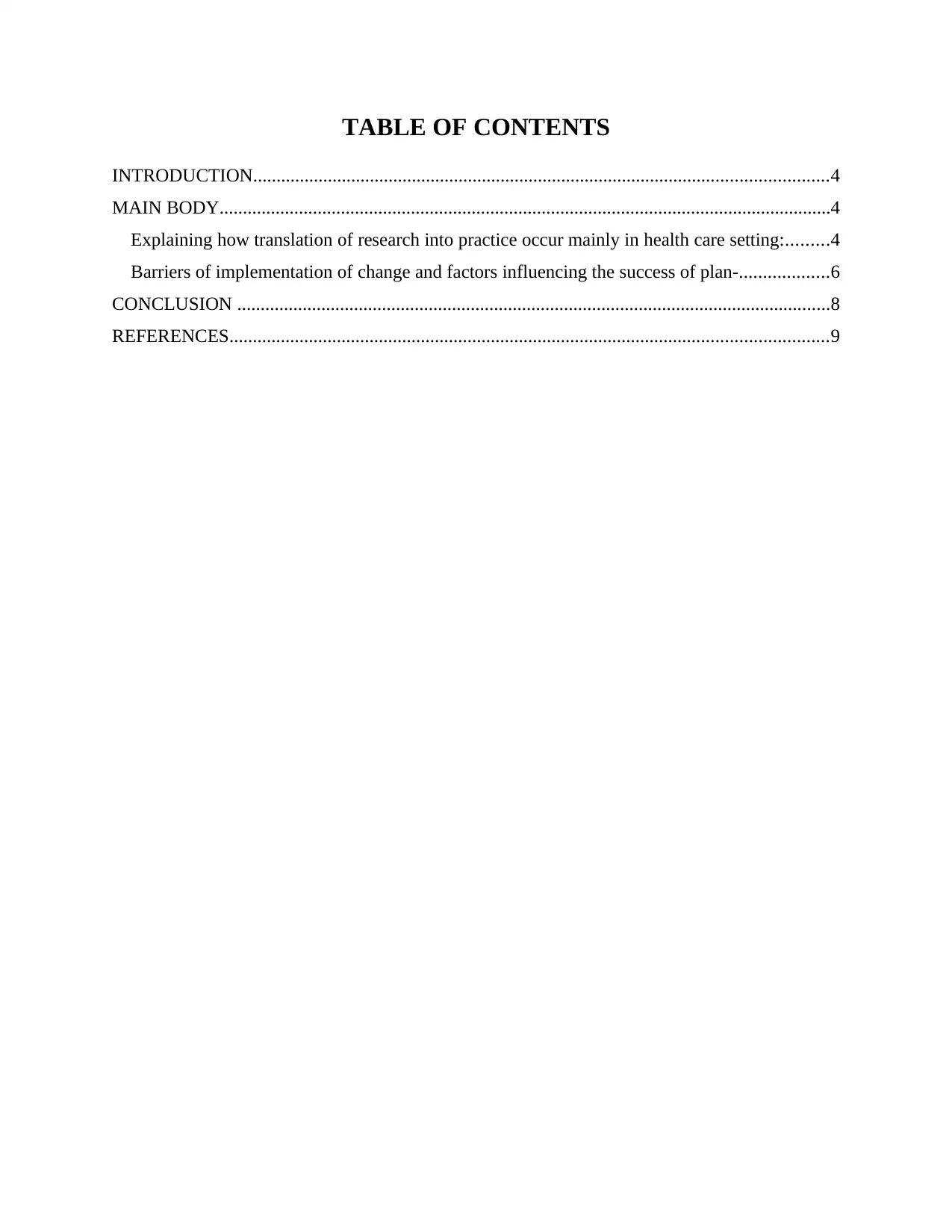
TABLE OF CONTENTS
INTRODUCTION...........................................................................................................................4
MAIN BODY...................................................................................................................................4
Explaining how translation of research into practice occur mainly in health care setting:.........4
Barriers of implementation of change and factors influencing the success of plan-...................6
CONCLUSION ...............................................................................................................................8
REFERENCES................................................................................................................................9
INTRODUCTION...........................................................................................................................4
MAIN BODY...................................................................................................................................4
Explaining how translation of research into practice occur mainly in health care setting:.........4
Barriers of implementation of change and factors influencing the success of plan-...................6
CONCLUSION ...............................................................................................................................8
REFERENCES................................................................................................................................9
INTRODUCTION
Implementing a change in health care area is one of the most challenging task, whole health care
system work on pattern and systems which drive result. Every treatment have better option
which can be selected by the practitioner, however, implementing completely new intervention
demand health care professional to cover important area including effectiveness of new or
change, role of change in betterment of health care system and barrier that will impact the
implementation of change in health care area Bagot & et.al., (2020). This report is based on 'The
removal of the option of the use of seclusion in a local mental health inpatient facility.' this report
will translate research into practice in mental health setting considering a topic. At last certain
barrier will be examined which occur in implementing change, certain factors also will be
discussed to success the plan of implementing change in health care in the process.
MAIN BODY
Explaining how translation of research into practice occur mainly in health care setting:
According to Abu-Odah & et.al., (2020), Seclusion is one of the most common type of
treatment in mental health care in which patient are often kept separated from other individual
because of their behaviour. For example; patient with aggressive behaviour are kept in seclusion
where they are left alone, this is treatment which impact mental stability of patient. Individual
who suffer serious mental issue get this type of treatment, however, keeping patient in a room in
which they can not interact with other is complex treatment. Seclusion is kind of torture if
normal person is kept in a room where he can not interact and connect with anyone else, this
impact their mental position and push them to become depressed because of loneliness. The
removal of seclusion option is mandatory in mental health care because this is a unethical way to
treat a patient, there are many mental health cases which demand this treatment, seclusion is still
in use when condition of patient become critical. There are certain stages which support
translation of research into practice, these are:
Identify the issue: This is first stage and consider as important because before turning research
into practice, it is important to examine issue, this simply means identifying the need of change
in the practice. For example; there is need of change in seclusion practice because this is
problematic in health care and ethical context. It is very clear that seclusion is process in which
mental health patient is kept locked in a room all alone, they can not interact or leave until and
unless the health care professional want which sound unethical. While providing this treatment to
Implementing a change in health care area is one of the most challenging task, whole health care
system work on pattern and systems which drive result. Every treatment have better option
which can be selected by the practitioner, however, implementing completely new intervention
demand health care professional to cover important area including effectiveness of new or
change, role of change in betterment of health care system and barrier that will impact the
implementation of change in health care area Bagot & et.al., (2020). This report is based on 'The
removal of the option of the use of seclusion in a local mental health inpatient facility.' this report
will translate research into practice in mental health setting considering a topic. At last certain
barrier will be examined which occur in implementing change, certain factors also will be
discussed to success the plan of implementing change in health care in the process.
MAIN BODY
Explaining how translation of research into practice occur mainly in health care setting:
According to Abu-Odah & et.al., (2020), Seclusion is one of the most common type of
treatment in mental health care in which patient are often kept separated from other individual
because of their behaviour. For example; patient with aggressive behaviour are kept in seclusion
where they are left alone, this is treatment which impact mental stability of patient. Individual
who suffer serious mental issue get this type of treatment, however, keeping patient in a room in
which they can not interact with other is complex treatment. Seclusion is kind of torture if
normal person is kept in a room where he can not interact and connect with anyone else, this
impact their mental position and push them to become depressed because of loneliness. The
removal of seclusion option is mandatory in mental health care because this is a unethical way to
treat a patient, there are many mental health cases which demand this treatment, seclusion is still
in use when condition of patient become critical. There are certain stages which support
translation of research into practice, these are:
Identify the issue: This is first stage and consider as important because before turning research
into practice, it is important to examine issue, this simply means identifying the need of change
in the practice. For example; there is need of change in seclusion practice because this is
problematic in health care and ethical context. It is very clear that seclusion is process in which
mental health patient is kept locked in a room all alone, they can not interact or leave until and
unless the health care professional want which sound unethical. While providing this treatment to
⊘ This is a preview!⊘
Do you want full access?
Subscribe today to unlock all pages.

Trusted by 1+ million students worldwide
mental health patient, even health care professional face issue of unethical practice because they
believe keeping patient locked is torture and might impact area of their fundamental right. That is
why it is important to first examine the issue and its key importance before converting research
into practice.
According to White, Dudley-Brown and Terhaar, (2019) Awareness: This is second and most
important stage in which awareness is been created, this awareness allows public, individual,
community, health care professional and other workers to understand about the research and its
importance. The implementation of practice is only possible if awareness is created, it is very
clear that every healthcare practice need widespread awareness in which every worker and
patient is aware about the practice. For example; to implement plan of removing seclusion is
only possible when awareness is created in the health care area. Health care authorities have to
aware audience that this treatment is unethical because keeping patient alone in room is kind of
torture which is highly unethical. Awareness is important stage in which every health care
worker and other stakeholder, remain aware about the issue and solution, spreading awareness is
critical in which practice reviewer examine and understand the need of implementing change in
the practice. Even after awareness, it may take up to 17 years to convert research into practice.
According to Rothmore, P. (2018), Acceptance: Every research is health is accepted if this meet
requirement of health care practice, acceptance is third stage in which health care professional,
patient and other stakeholder accept that this research needs to be turned into practice. However,
this stage has more importance than awareness because accepting the practice is critical process,
healthcare professional might deny accepting the research and deny converting it into a practice.
For example; removal of seclusion may sound well but this is treatment used in managing critical
situation of client which means seclusion is important process. There are certain cases in which
health care professional have highlighted the importance of seclusion in managing mental ill
patient. Acceptance stage is critical as viewpoint of different expert, authorities and researcher
might become different and create a conflict. Acceptance may take time, research might consider
as illogical and may fail to meet its outcome, it is very clear that this stage is critical in which
whole research will be considered as ineffective.
Adoption: This is final and critical stage, every practice in health care is adopted when it is
clinically tested and approved by the authority. Adoption is only possible when there is no issue
in the practice which means drafted practice need to be effective enough meet all requirement.
believe keeping patient locked is torture and might impact area of their fundamental right. That is
why it is important to first examine the issue and its key importance before converting research
into practice.
According to White, Dudley-Brown and Terhaar, (2019) Awareness: This is second and most
important stage in which awareness is been created, this awareness allows public, individual,
community, health care professional and other workers to understand about the research and its
importance. The implementation of practice is only possible if awareness is created, it is very
clear that every healthcare practice need widespread awareness in which every worker and
patient is aware about the practice. For example; to implement plan of removing seclusion is
only possible when awareness is created in the health care area. Health care authorities have to
aware audience that this treatment is unethical because keeping patient alone in room is kind of
torture which is highly unethical. Awareness is important stage in which every health care
worker and other stakeholder, remain aware about the issue and solution, spreading awareness is
critical in which practice reviewer examine and understand the need of implementing change in
the practice. Even after awareness, it may take up to 17 years to convert research into practice.
According to Rothmore, P. (2018), Acceptance: Every research is health is accepted if this meet
requirement of health care practice, acceptance is third stage in which health care professional,
patient and other stakeholder accept that this research needs to be turned into practice. However,
this stage has more importance than awareness because accepting the practice is critical process,
healthcare professional might deny accepting the research and deny converting it into a practice.
For example; removal of seclusion may sound well but this is treatment used in managing critical
situation of client which means seclusion is important process. There are certain cases in which
health care professional have highlighted the importance of seclusion in managing mental ill
patient. Acceptance stage is critical as viewpoint of different expert, authorities and researcher
might become different and create a conflict. Acceptance may take time, research might consider
as illogical and may fail to meet its outcome, it is very clear that this stage is critical in which
whole research will be considered as ineffective.
Adoption: This is final and critical stage, every practice in health care is adopted when it is
clinically tested and approved by the authority. Adoption is only possible when there is no issue
in the practice which means drafted practice need to be effective enough meet all requirement.
Paraphrase This Document
Need a fresh take? Get an instant paraphrase of this document with our AI Paraphraser
For example; adaptation of idea that remove seclusion from mental health care treatment is
critical because health care professional might consider seclusion important process. Mental
health care professional will demand more effective treatment than seclusion which means better
practice that allow health care worker to manage critical mental situation of patient. Adoption is
stage in which health care worker, professional, authorities, patient and other stakeholder should
be fully satisfied than research can turn into a practice. Final adaptation of research into practice
is only possible when health care authority approve this research and allow this research to be
health care and clinical practice. However, adaptation may take several times because this may
include certain stages, test and continuous improvement.
Barriers of implementation of change and factors influencing the success of plan-
As per the views of Jury, A., & et.al., (2019)), As the main purpose seclusion is
involuntary confinement of the patient alone in the separate and private room from which the
patient is not able to prevent and leave the place. There are several barriers which the company
can face while removing the seclusion while treating the mental health of the patients. These are
such as-
Psychological consequences: When the patient will not be provided with the better treatment
this will not be good for treating the mental health patients. This will disturb much the health of
the patients as this is one of the most effective practice to treat the mental health of the patient.
Removing the seclusion for treating the mental health people will create much consequences for
the clinic or the healthcare. This will be very difficult to cure the patients who is suffering from
the mental health. The healthcare must understand the need of the seclusion for the treatment of
the mental health patients. As seclusion enables to prevent the patient leaving the place and if
this will be removed no patient will be staying at the clinic.
Conflict of viewpoint: Each and every individual in the hospital is having their own perspective
and views. This will create the barrier for the healthcare to implement the new change within the
clinic. As many of the nurses will have the different views because seclusion is the most
effective treatment for treating the mental health patients so this will create the barrier for the
implementation change. As due to the lack of the knowledge and awareness will create this
difference within the perspectives of the nurses as well as the overall people of the healthcare.
This is one of the most required support while implementing any of the change in the
organisation or the healthcare. This is not in support of the healthcare so this is the considered as
critical because health care professional might consider seclusion important process. Mental
health care professional will demand more effective treatment than seclusion which means better
practice that allow health care worker to manage critical mental situation of patient. Adoption is
stage in which health care worker, professional, authorities, patient and other stakeholder should
be fully satisfied than research can turn into a practice. Final adaptation of research into practice
is only possible when health care authority approve this research and allow this research to be
health care and clinical practice. However, adaptation may take several times because this may
include certain stages, test and continuous improvement.
Barriers of implementation of change and factors influencing the success of plan-
As per the views of Jury, A., & et.al., (2019)), As the main purpose seclusion is
involuntary confinement of the patient alone in the separate and private room from which the
patient is not able to prevent and leave the place. There are several barriers which the company
can face while removing the seclusion while treating the mental health of the patients. These are
such as-
Psychological consequences: When the patient will not be provided with the better treatment
this will not be good for treating the mental health patients. This will disturb much the health of
the patients as this is one of the most effective practice to treat the mental health of the patient.
Removing the seclusion for treating the mental health people will create much consequences for
the clinic or the healthcare. This will be very difficult to cure the patients who is suffering from
the mental health. The healthcare must understand the need of the seclusion for the treatment of
the mental health patients. As seclusion enables to prevent the patient leaving the place and if
this will be removed no patient will be staying at the clinic.
Conflict of viewpoint: Each and every individual in the hospital is having their own perspective
and views. This will create the barrier for the healthcare to implement the new change within the
clinic. As many of the nurses will have the different views because seclusion is the most
effective treatment for treating the mental health patients so this will create the barrier for the
implementation change. As due to the lack of the knowledge and awareness will create this
difference within the perspectives of the nurses as well as the overall people of the healthcare.
This is one of the most required support while implementing any of the change in the
organisation or the healthcare. This is not in support of the healthcare so this is the considered as
one of the barriers for the removing the seclusion within the healthcare for the treatment of the
mental health patients.
No effective substitute treatment: It has been found that there is no better treatment then the
seclusion for the mental health patients. So removing of the seclusion will unable the healthcare
to provide the better treatment to the patents. The patients will not get the quality treatments to
the patients and will not be recovered effectively. This treatment of the mental health is working
from many of the years and removing this will become difficult for the healthcare to implement
another such treatment for the patients. As this will help in better treatment for the mental health
as through this they will be able to recover the patients effectively.
Legal Barrier: The major barrier which will be faced by the healthcare will be the legal barrier.
According to the Muir‐Cochrane, O'Kane & Oster (2018)), Mental Health Act, the seclusion is
the treatment which is provided to the patients for the treatment and so that they cannot move
away by leaving the place. The main aim of this is to protect as well as maintain the safety of the
overall people who are taking the services, staff as well as the visitors of the healthcare.
Implementation of the change of removing the seclusion will be against the laws and this will
create the barrier for the healthcare to make such changes in the business.
Factors influencing success to the new plan-
There are various factors which will influence positively and contribute to the success of
the implementation plan. Removing of the seclusion may happen that unable the company to
have successful results by many of the factors such as-
The staff: As due to the reason that every individual has their own perspective so there are many
of the workers in the healthcare who will be in favour of making such implementation within the
healthcare. They may know the effects of the seclusion within the healthcare as this increases the
level of the psychological impacts on the health of the patients but this treatment is used by the
clinical only to maintain the destructive behaviour of the patients. This support from the staff
will help the healthcare to the success of the implementation plan.
Support from family and friends: As there are number of the families and friends which will
may have the view that their patient must not be provided with such treatment as this has much
pressure on the mental health of the individual. Such support from them will help in successful
implementation of this plan. As in present era, the family does not want that their relative must
mental health patients.
No effective substitute treatment: It has been found that there is no better treatment then the
seclusion for the mental health patients. So removing of the seclusion will unable the healthcare
to provide the better treatment to the patents. The patients will not get the quality treatments to
the patients and will not be recovered effectively. This treatment of the mental health is working
from many of the years and removing this will become difficult for the healthcare to implement
another such treatment for the patients. As this will help in better treatment for the mental health
as through this they will be able to recover the patients effectively.
Legal Barrier: The major barrier which will be faced by the healthcare will be the legal barrier.
According to the Muir‐Cochrane, O'Kane & Oster (2018)), Mental Health Act, the seclusion is
the treatment which is provided to the patients for the treatment and so that they cannot move
away by leaving the place. The main aim of this is to protect as well as maintain the safety of the
overall people who are taking the services, staff as well as the visitors of the healthcare.
Implementation of the change of removing the seclusion will be against the laws and this will
create the barrier for the healthcare to make such changes in the business.
Factors influencing success to the new plan-
There are various factors which will influence positively and contribute to the success of
the implementation plan. Removing of the seclusion may happen that unable the company to
have successful results by many of the factors such as-
The staff: As due to the reason that every individual has their own perspective so there are many
of the workers in the healthcare who will be in favour of making such implementation within the
healthcare. They may know the effects of the seclusion within the healthcare as this increases the
level of the psychological impacts on the health of the patients but this treatment is used by the
clinical only to maintain the destructive behaviour of the patients. This support from the staff
will help the healthcare to the success of the implementation plan.
Support from family and friends: As there are number of the families and friends which will
may have the view that their patient must not be provided with such treatment as this has much
pressure on the mental health of the individual. Such support from them will help in successful
implementation of this plan. As in present era, the family does not want that their relative must
⊘ This is a preview!⊘
Do you want full access?
Subscribe today to unlock all pages.
Trusted by 1+ million students worldwide
be provided with such treatments so this is the most significant factors which will support such
change within the healthcare.
CONCLUSION
From the above report it can be concluded that seclusion is treatment which is provided
to the patients who are suffering from the mental health. It is very significant for the healthcare
to understand the effects as well of providing the treatment to the mental health patients. The
above project is all about removing the seclusion practice which is given for the treatment of the
mental health patients as this is given so that the destructive behaviour of the individual can be
maintained as well as they does not leave the place. This project has discussed the transforming
the research into the practice within the healthcare by considering all the things which are
important to be considered for implementing such practices within the healthcare. Along with
this, the project report has discussed the barriers which will be faced by the healthcare while
implementing the changes as well as the factors which will help in influencing the successful
implementation change of removing seclusion for the treatment of the mental health patients
within the healthcare.
change within the healthcare.
CONCLUSION
From the above report it can be concluded that seclusion is treatment which is provided
to the patients who are suffering from the mental health. It is very significant for the healthcare
to understand the effects as well of providing the treatment to the mental health patients. The
above project is all about removing the seclusion practice which is given for the treatment of the
mental health patients as this is given so that the destructive behaviour of the individual can be
maintained as well as they does not leave the place. This project has discussed the transforming
the research into the practice within the healthcare by considering all the things which are
important to be considered for implementing such practices within the healthcare. Along with
this, the project report has discussed the barriers which will be faced by the healthcare while
implementing the changes as well as the factors which will help in influencing the successful
implementation change of removing seclusion for the treatment of the mental health patients
within the healthcare.
Paraphrase This Document
Need a fresh take? Get an instant paraphrase of this document with our AI Paraphraser
REFERENCES
Books and journals
Abu-Odah & et.al., (2020). Optimizing Translation of Health Research into Practice: A
systematic review of reviews. Authorea Preprints.
Bagot & et.al., (2020). Sustainable implementation of innovative, technology-based health care
practices: a qualitative case study from stroke telemedicine. Journal of Telemedicine
and Telecare, 26(1-2), 79-91.
Jury, A., & et.al., (2019). People who experience seclusion in adult mental health inpatient
services: An examination of health of the nation outcome scales scores. International
Journal of Mental Health Nursing, 28(1), 199-208.
Muir‐Cochrane, E., O'Kane, D., & Oster, C. (2018). Fear and blame in mental health nurses’
accounts of restrictive practices: Implications for the elimination of seclusion and
restraint. International journal of mental health nursing, 27(5), 1511-1521.
Rothmore, P. (2018). How can we improve the translation of research evidence into
practice. Journal of Health, Safety and Environment, 34(1), 3-6.
White, K.M., Dudley-Brown, S. and Terhaar, M.F. eds., 2019. Translation of evidence into
nursing and healthcare. Springer Publishing Company.
1
Books and journals
Abu-Odah & et.al., (2020). Optimizing Translation of Health Research into Practice: A
systematic review of reviews. Authorea Preprints.
Bagot & et.al., (2020). Sustainable implementation of innovative, technology-based health care
practices: a qualitative case study from stroke telemedicine. Journal of Telemedicine
and Telecare, 26(1-2), 79-91.
Jury, A., & et.al., (2019). People who experience seclusion in adult mental health inpatient
services: An examination of health of the nation outcome scales scores. International
Journal of Mental Health Nursing, 28(1), 199-208.
Muir‐Cochrane, E., O'Kane, D., & Oster, C. (2018). Fear and blame in mental health nurses’
accounts of restrictive practices: Implications for the elimination of seclusion and
restraint. International journal of mental health nursing, 27(5), 1511-1521.
Rothmore, P. (2018). How can we improve the translation of research evidence into
practice. Journal of Health, Safety and Environment, 34(1), 3-6.
White, K.M., Dudley-Brown, S. and Terhaar, M.F. eds., 2019. Translation of evidence into
nursing and healthcare. Springer Publishing Company.
1

1 out of 8


Related Documents


Your All-in-One AI-Powered Toolkit for Academic Success.
+13062052269
info@desklib.com
Available 24*7 on WhatsApp / Email
![[object Object]](/_next/static/media/star-bottom.7253800d.svg)
Unlock your academic potential
Copyright © 2020–2025 A2Z Services. All Rights Reserved. Developed and managed by ZUCOL.