The Impact of Seclusion in Mental Health: A Comprehensive Analysis
VerifiedAdded on 2022/09/08
|14
|3384
|29
Report
AI Summary
This report delves into the complex issue of seclusion in mental health management, examining its impacts on both consumers (patients) and healthcare professionals. It highlights the historical context of seclusion, its association with crisis management, and the ongoing debate surrounding its ethical and practical implications. The report critically analyzes the negative consequences of seclusion, including potential abuse of human rights, increased injuries, and the risk of violence. It underscores the need for alternative treatment approaches, such as community-based services and evidence-based interventions, to improve patient care and reduce reliance on seclusion. Furthermore, the report explores the roles of registered nurses and consumers in national initiatives aimed at reducing seclusion, emphasizing the importance of staff training, adherence to guidelines, and the promotion of consumer rights. The report concludes by advocating for a shift in healthcare culture, emphasizing the need for comprehensive assessments, consistent policy reviews, and the implementation of treatment programs that prioritize improved communication and de-escalation techniques, thereby minimizing the use of seclusion and fostering a more supportive and therapeutic environment for mental health patients.
Running head: SECLUSION IN MENTAL HEALTH MANAGEMENT
1
Seclusion in mental health management
Name
Institutional affiliation
1
Seclusion in mental health management
Name
Institutional affiliation

Paraphrase This Document
Need a fresh take? Get an instant paraphrase of this document with our AI Paraphraser
SECLUTION IN MENTAL HEALTH MANAGEMENT
2
Impacts of seclusion to consumers and healthcare professionals
Seclusion technique is firmly connected with the advancement of mental organizations,
particularly the foundation of emergency units and milieu treatment. The clinical idea of
seclusion conclude the maintenance of an inpatient to contain a circumstance that may bring
about a crisis. The exercise of physical self-control as an intercession under the watchful eye of
mental patients goes back to the start of the study of psychiatry. However, it is as yet one of the
difficult inquiries in the mental services and has consistently been considered as a good
argument.
Restrictions and detachment have become a significant point for inpatient mental offices
around the globe. Restrictions and separation are regularly utilized when mental patients present
forceful and undermining practices and that may be harmful to others (Champagne &Stromberg,
2010). Human service authorities from around the globe have endeavored to discover
alternatives for the utilization of limitations and seclusion as they have inferred that such use
gives no helpful incentive to the patient (Mann-poll, Smit, Doeselaar & Hutschemaekers, 2013).
Research has demonstrated that restriction and detachment can introduce a peril to both the
patient and staff, as staff individuals endeavor to put a savage and perilous patient into
restrictions (Hoekstra, Lendemeijer &Jansen, 2014). Commonly, placing a patient into
restrictions or detachment can have a long lasting awful impact on the patient. Similarly, these
occasions can be as horrible for staff as it interferes with the remedial procedure.
The use of restriction and disconnection has been widespread regardless of an absence of
proof of any positive results appended to them. The training is normally associated with a
potential abuse of human rights, expanded injuries, and a danger of brutality (Wale, Belkin &
Moon, 2011). During a great deal of years, a little advancement has been performed concerning
2
Impacts of seclusion to consumers and healthcare professionals
Seclusion technique is firmly connected with the advancement of mental organizations,
particularly the foundation of emergency units and milieu treatment. The clinical idea of
seclusion conclude the maintenance of an inpatient to contain a circumstance that may bring
about a crisis. The exercise of physical self-control as an intercession under the watchful eye of
mental patients goes back to the start of the study of psychiatry. However, it is as yet one of the
difficult inquiries in the mental services and has consistently been considered as a good
argument.
Restrictions and detachment have become a significant point for inpatient mental offices
around the globe. Restrictions and separation are regularly utilized when mental patients present
forceful and undermining practices and that may be harmful to others (Champagne &Stromberg,
2010). Human service authorities from around the globe have endeavored to discover
alternatives for the utilization of limitations and seclusion as they have inferred that such use
gives no helpful incentive to the patient (Mann-poll, Smit, Doeselaar & Hutschemaekers, 2013).
Research has demonstrated that restriction and detachment can introduce a peril to both the
patient and staff, as staff individuals endeavor to put a savage and perilous patient into
restrictions (Hoekstra, Lendemeijer &Jansen, 2014). Commonly, placing a patient into
restrictions or detachment can have a long lasting awful impact on the patient. Similarly, these
occasions can be as horrible for staff as it interferes with the remedial procedure.
The use of restriction and disconnection has been widespread regardless of an absence of
proof of any positive results appended to them. The training is normally associated with a
potential abuse of human rights, expanded injuries, and a danger of brutality (Wale, Belkin &
Moon, 2011). During a great deal of years, a little advancement has been performed concerning
SECLUTION IN MENTAL HEALTH MANAGEMENT
3
taking care of mental patients. Some wellbeing experts imagine that most ideal approach to deal
with them is exercising self-control and being unmindful of their symptoms (Mann-poll, Smit,
Doeselaar & Hutschemaekers, 2013). Seclusion use has put a foreboding shadow over the
treatment strategies used to oversee social issues in the emotional well-being setting without
taking a gander at the long haul impact it has on patients, staff, and the emotional wellness
associations that give treatment to mental patients (Hoekstra, Lendemeijer &Jansen, 2014). The
way of life needs to change in these psychological health facilities by the authority to grow new
information and prepare for staff identifying with treatment techniques other than secluding the
patients. With a change in culture, medical caretakers and human services staff will have the
option to give proof based treatment to psychological well-being.
When exposed to such severe treatment rehearses as disengagement and limitation,
mental patients probably abandon looking for the clinical help from medical clinics once they are
released because of the dread of being pushed (Toombs, 2011). This may additionally present
more dangers to the family members around an individual or the whole society. The alarming
utilization of seclusion adds to the dread of the whole network to look for the clinical
consideration for their family members experiencing mental issues (Champagne &Stromberg,
2014). In spite of a brilliant change in the network standpoint of wellbeing, especially the
psychological one, the board has picked to amplify security in mental units for the staff. This is
showed by the nearness of security monitors watching wards.
The advantageous mental consideration calls for persistence, diligence and an abundant
space to encourage a conveyance of value benefits by the wellbeing experts so as to meet the
unmistakable needs of patients. Unexpectedly, it has not gone to the consideration of health
experts a few threats presented by the present methodology. The methodologies are poor for a
3
taking care of mental patients. Some wellbeing experts imagine that most ideal approach to deal
with them is exercising self-control and being unmindful of their symptoms (Mann-poll, Smit,
Doeselaar & Hutschemaekers, 2013). Seclusion use has put a foreboding shadow over the
treatment strategies used to oversee social issues in the emotional well-being setting without
taking a gander at the long haul impact it has on patients, staff, and the emotional wellness
associations that give treatment to mental patients (Hoekstra, Lendemeijer &Jansen, 2014). The
way of life needs to change in these psychological health facilities by the authority to grow new
information and prepare for staff identifying with treatment techniques other than secluding the
patients. With a change in culture, medical caretakers and human services staff will have the
option to give proof based treatment to psychological well-being.
When exposed to such severe treatment rehearses as disengagement and limitation,
mental patients probably abandon looking for the clinical help from medical clinics once they are
released because of the dread of being pushed (Toombs, 2011). This may additionally present
more dangers to the family members around an individual or the whole society. The alarming
utilization of seclusion adds to the dread of the whole network to look for the clinical
consideration for their family members experiencing mental issues (Champagne &Stromberg,
2014). In spite of a brilliant change in the network standpoint of wellbeing, especially the
psychological one, the board has picked to amplify security in mental units for the staff. This is
showed by the nearness of security monitors watching wards.
The advantageous mental consideration calls for persistence, diligence and an abundant
space to encourage a conveyance of value benefits by the wellbeing experts so as to meet the
unmistakable needs of patients. Unexpectedly, it has not gone to the consideration of health
experts a few threats presented by the present methodology. The methodologies are poor for a
⊘ This is a preview!⊘
Do you want full access?
Subscribe today to unlock all pages.

Trusted by 1+ million students worldwide
SECLUTION IN MENTAL HEALTH MANAGEMENT
4
patient, yet they additionally set a stage for repulsive working spots. According to Happell and
Koehn (2010), it is conceivable that the potential admirers of this calling will be kept off from
seeking if mental specialists keep on being related with harming patients instead of helping them.
Nobody would need to work in such a spot (Muir-Cochrane &Gerece, 2017). The fundamental
issue with the present methodologies is the inability to look for additional options of care,
particularly network based administrations.
The issue of the ward deficiency once in a while powers wellbeing experts to release
patients snappier than anticipated so as to make some space for different unending requests. This
has been an issue since the number of patients has been increasing rapidly (Maguire, Young &
Martin, 2012). Except if the elective methods for offering care and administration are propelled,
this circumstance will undoubtedly proceed, not if all else fails yet as a lone accessible methods
for looking after request. Equivalent to it is the issue with different circles of wellbeing although
well-suited methods have not been actualized to convey or finance them.
Despite the fact that the utilization of substance and physical types of restriction may
have decreased, the passionate limitation is similarly damaging. According to Huckshorn (2014),
at the point when a psychological patient is adapted so that the person loses the certainty to
communicate their perspectives openly to health experts due to the dread of being exploited, the
center is exercising the self-control of practically equivalent impacts like both the physical and
concoction limitations (Kuosmanen, Makkonen, Lehtila &Salminen, 2015). The enthusiastic
restriction is undermining and coercive in nature, similar to when a patient is told except if they
stay delicate and secluded. Regardless of certain cases of prohibition of physical and concoction
limitation, once in a while the two strategies are utilized particularly in the transportation of
patients.
4
patient, yet they additionally set a stage for repulsive working spots. According to Happell and
Koehn (2010), it is conceivable that the potential admirers of this calling will be kept off from
seeking if mental specialists keep on being related with harming patients instead of helping them.
Nobody would need to work in such a spot (Muir-Cochrane &Gerece, 2017). The fundamental
issue with the present methodologies is the inability to look for additional options of care,
particularly network based administrations.
The issue of the ward deficiency once in a while powers wellbeing experts to release
patients snappier than anticipated so as to make some space for different unending requests. This
has been an issue since the number of patients has been increasing rapidly (Maguire, Young &
Martin, 2012). Except if the elective methods for offering care and administration are propelled,
this circumstance will undoubtedly proceed, not if all else fails yet as a lone accessible methods
for looking after request. Equivalent to it is the issue with different circles of wellbeing although
well-suited methods have not been actualized to convey or finance them.
Despite the fact that the utilization of substance and physical types of restriction may
have decreased, the passionate limitation is similarly damaging. According to Huckshorn (2014),
at the point when a psychological patient is adapted so that the person loses the certainty to
communicate their perspectives openly to health experts due to the dread of being exploited, the
center is exercising the self-control of practically equivalent impacts like both the physical and
concoction limitations (Kuosmanen, Makkonen, Lehtila &Salminen, 2015). The enthusiastic
restriction is undermining and coercive in nature, similar to when a patient is told except if they
stay delicate and secluded. Regardless of certain cases of prohibition of physical and concoction
limitation, once in a while the two strategies are utilized particularly in the transportation of
patients.
Paraphrase This Document
Need a fresh take? Get an instant paraphrase of this document with our AI Paraphraser
SECLUTION IN MENTAL HEALTH MANAGEMENT
5
Roles of registered nurses and consumers working towards national initiatives in reducing
seclusion.
Seclusion is presently perceived as a coercive methodology with negative ramifications
for the consumers and staff included. By and by, this intercession keeps on being utilized every
now and again in emotional well-being administrations globally (Kirk, McGlinsey, et al., 2015).
Because of their immediate consideration job, attendants are normally engaged with the
inception or the board of disengagement. Understanding attendants' perspectives to separation is
in this way basic for the accomplishment of any endeavors to diminish seclusion utilization.
There are various techniques that can be grasped to reduce seclusion. To begin with, a
superior responsibility of all partners in the psychological well-being care units may assume an
incredible job in killing the utilization of it (Gerace, Cochrane, et al., 2019). Following a thought
that this technique of dealing with mental patients just motivates mischief to them, endeavors
have been made to dispense with it. Nonetheless, tragically less advancement has been made in
receiving better strategies for taking care of aggressive mental patients (Kirk, McGlinsey, et al.,
2015). The registered nurses (RNs) should work mutually with other Non-Governmental
Organizations to characterize a few estimates that can lessen the exercise of separation and self-
control (Lebej, Duxbury, et al., 2014). The subsequent system is to actualize the proof based
techniques to teach health experts about the impacts of exercising disengagement and self-
control. Through an exploration directed in numerous parts far and wide, there is no proof that
disconnection and seclusion have any restorative worth. Despite what might be expected, they
are related with the hatred experienced by consumers and health experts.
Since isolation is last choice, there stays a need for the registered nurse to utilize some
least prohibitive or elective measures before going for an official choice to separate. These
5
Roles of registered nurses and consumers working towards national initiatives in reducing
seclusion.
Seclusion is presently perceived as a coercive methodology with negative ramifications
for the consumers and staff included. By and by, this intercession keeps on being utilized every
now and again in emotional well-being administrations globally (Kirk, McGlinsey, et al., 2015).
Because of their immediate consideration job, attendants are normally engaged with the
inception or the board of disengagement. Understanding attendants' perspectives to separation is
in this way basic for the accomplishment of any endeavors to diminish seclusion utilization.
There are various techniques that can be grasped to reduce seclusion. To begin with, a
superior responsibility of all partners in the psychological well-being care units may assume an
incredible job in killing the utilization of it (Gerace, Cochrane, et al., 2019). Following a thought
that this technique of dealing with mental patients just motivates mischief to them, endeavors
have been made to dispense with it. Nonetheless, tragically less advancement has been made in
receiving better strategies for taking care of aggressive mental patients (Kirk, McGlinsey, et al.,
2015). The registered nurses (RNs) should work mutually with other Non-Governmental
Organizations to characterize a few estimates that can lessen the exercise of separation and self-
control (Lebej, Duxbury, et al., 2014). The subsequent system is to actualize the proof based
techniques to teach health experts about the impacts of exercising disengagement and self-
control. Through an exploration directed in numerous parts far and wide, there is no proof that
disconnection and seclusion have any restorative worth. Despite what might be expected, they
are related with the hatred experienced by consumers and health experts.
Since isolation is last choice, there stays a need for the registered nurse to utilize some
least prohibitive or elective measures before going for an official choice to separate. These
SECLUTION IN MENTAL HEALTH MANAGEMENT
6
include pharmacological administration, evaluation, de-heightening method, expanded
perception and incorporate ecological control. Controlling condition includes decreasing the
incitement from nature after intensive appraisal of patient's activating variables, tolerant solace
and staff disposition (Ryan & Happell, 2014). De-heightening or talking down includes
psychosocial methods planned for quieting the patient stressing on the appraisal of the quick
circumstance, verbal and non-verbal correspondence and critical thinking procedures (Happell &
Gaskin, 2011). The nurse needs to evaluate and watch patients' upset conduct as often as possible
before they represent any hazard to different patients. In addition, there is a tremendous need to
have a strategy of staff preparing about mental crisis consideration and restorative
correspondence.
The other method is through sticking to guideline. . A consistent exercise of
disconnection and self-control demonstrate the disappointment via parental figures to hold fast to
the gauges preset by their calling codes (Kirk, McGlinsey, et al., 2015). Each psychological
facility ought to guarantee that every one of their clinicians follow these principles and keep up
competency norms all through their course. Another procedure is to help mental guardians
towards a difference in their way of life and that of their facilities (Gerace, Cochrane, et al.,
2019). Since the exercise of seclusion and self-control is exclusively reliant on the way of life of
centers and wellbeing experts, it is critical to instruct and prepare clinicians on such educated
systems as cutting edge correspondence. Buyers ought to likewise be taught on their privileges
with respect to exercising disconnection and self-control (Goulet & Larue, 2016). Facility
reviews ought to be utilized to guarantee that all centers stick to these measures. consumers as
well as their families, companions and supporters should additionally raise worries with what has
been named 'enthusiastic restriction' whereby they feel compelled from communicating their
6
include pharmacological administration, evaluation, de-heightening method, expanded
perception and incorporate ecological control. Controlling condition includes decreasing the
incitement from nature after intensive appraisal of patient's activating variables, tolerant solace
and staff disposition (Ryan & Happell, 2014). De-heightening or talking down includes
psychosocial methods planned for quieting the patient stressing on the appraisal of the quick
circumstance, verbal and non-verbal correspondence and critical thinking procedures (Happell &
Gaskin, 2011). The nurse needs to evaluate and watch patients' upset conduct as often as possible
before they represent any hazard to different patients. In addition, there is a tremendous need to
have a strategy of staff preparing about mental crisis consideration and restorative
correspondence.
The other method is through sticking to guideline. . A consistent exercise of
disconnection and self-control demonstrate the disappointment via parental figures to hold fast to
the gauges preset by their calling codes (Kirk, McGlinsey, et al., 2015). Each psychological
facility ought to guarantee that every one of their clinicians follow these principles and keep up
competency norms all through their course. Another procedure is to help mental guardians
towards a difference in their way of life and that of their facilities (Gerace, Cochrane, et al.,
2019). Since the exercise of seclusion and self-control is exclusively reliant on the way of life of
centers and wellbeing experts, it is critical to instruct and prepare clinicians on such educated
systems as cutting edge correspondence. Buyers ought to likewise be taught on their privileges
with respect to exercising disconnection and self-control (Goulet & Larue, 2016). Facility
reviews ought to be utilized to guarantee that all centers stick to these measures. consumers as
well as their families, companions and supporters should additionally raise worries with what has
been named 'enthusiastic restriction' whereby they feel compelled from communicating their
⊘ This is a preview!⊘
Do you want full access?
Subscribe today to unlock all pages.
Trusted by 1+ million students worldwide
SECLUTION IN MENTAL HEALTH MANAGEMENT
7
perspectives transparently and genuinely to staff because of a paranoid fear of the
outcomes(Brophy, Roper, et al., 2016).
It is a responsibility of all NRs to ensure psychological health administrations are
additionally obliged to guarantee that all purchasers in inpatient facility units have all
encompassing assessments that are sound and in line up with the contemporary practices. These
psychiatry units ought to be associated with the improvement of their individual consideration
procedures that target decreasing the misery and injury (Cochrane, et al., 2018). This should not
necessarily be the duty of a facility alone yet in addition of different partners including patients.
It is also fundamental to ensure that there is a consistent audit of emotional wellness
arrangements (Brophy, Roper, et al., 2016). For any guideline to be followed, people included
must know about the approach and comprehend it to the furthest. As indicated by The Royal
Australian and New Zealand College of Psychiatrists, examining courses of action ought to
likewise be set up to guarantee that harsh measures are taken against those ones that don't hold
fast to them.
Various treatment improvement programs planned for lessening seclusion and restriction
have demonstrated effectiveness without expanded hazard to patients or staff. These methods by
large included improved correspondence. Staff figure out how to turn out to be progressively
delicate to the prompts of raising hostility, taking part in discourse and offering remarks that are
deescalating, than being opposing (Brophy, Roper, et al., 2016). Social mediations, for example,
reliable utilization of remunerations for positive adapting and overlooking negative practices, in
spite of the fact that not an approach in essence, might be useful in diminishing the requirement
for disengagement and limitation just as for helping staff not to heighten emergency
circumstances. Now and then people are compensated through point frameworks or tokens in
7
perspectives transparently and genuinely to staff because of a paranoid fear of the
outcomes(Brophy, Roper, et al., 2016).
It is a responsibility of all NRs to ensure psychological health administrations are
additionally obliged to guarantee that all purchasers in inpatient facility units have all
encompassing assessments that are sound and in line up with the contemporary practices. These
psychiatry units ought to be associated with the improvement of their individual consideration
procedures that target decreasing the misery and injury (Cochrane, et al., 2018). This should not
necessarily be the duty of a facility alone yet in addition of different partners including patients.
It is also fundamental to ensure that there is a consistent audit of emotional wellness
arrangements (Brophy, Roper, et al., 2016). For any guideline to be followed, people included
must know about the approach and comprehend it to the furthest. As indicated by The Royal
Australian and New Zealand College of Psychiatrists, examining courses of action ought to
likewise be set up to guarantee that harsh measures are taken against those ones that don't hold
fast to them.
Various treatment improvement programs planned for lessening seclusion and restriction
have demonstrated effectiveness without expanded hazard to patients or staff. These methods by
large included improved correspondence. Staff figure out how to turn out to be progressively
delicate to the prompts of raising hostility, taking part in discourse and offering remarks that are
deescalating, than being opposing (Brophy, Roper, et al., 2016). Social mediations, for example,
reliable utilization of remunerations for positive adapting and overlooking negative practices, in
spite of the fact that not an approach in essence, might be useful in diminishing the requirement
for disengagement and limitation just as for helping staff not to heighten emergency
circumstances. Now and then people are compensated through point frameworks or tokens in
Paraphrase This Document
Need a fresh take? Get an instant paraphrase of this document with our AI Paraphraser
SECLUTION IN MENTAL HEALTH MANAGEMENT
8
return for benefits. This has the benefit of utilizing learning standards, basically uplifting
feedback, yet additionally encourages staff to be reliable and less passionate in their way to deal
with conceivably irksome practices. What is more, the nurses should figure out how to
compensate the patients for nonaggressive acts. Another procedure is lessening pointless
incitement by permitting the person to withdraw to a calm however non-isolated zone.
The exercise of disconnection and self-control in psychiatry units has been liable for
multitudinous unfriendly impacts to the whole emotional health care calling. Buyers are
influenced by isolation and limitations, which at times bring about the insufferable pain and
dread of looking for the clinical consideration in units. The calling is additionally imperiled on
the grounds that numerous potential mental therapists are probably going to detest the calling
that causes hurt as opposed to being useful. Since there are better options of taking care of
mental patients, the endeavors ought to be made to influence them through helpful systems prior
expressed.
8
return for benefits. This has the benefit of utilizing learning standards, basically uplifting
feedback, yet additionally encourages staff to be reliable and less passionate in their way to deal
with conceivably irksome practices. What is more, the nurses should figure out how to
compensate the patients for nonaggressive acts. Another procedure is lessening pointless
incitement by permitting the person to withdraw to a calm however non-isolated zone.
The exercise of disconnection and self-control in psychiatry units has been liable for
multitudinous unfriendly impacts to the whole emotional health care calling. Buyers are
influenced by isolation and limitations, which at times bring about the insufferable pain and
dread of looking for the clinical consideration in units. The calling is additionally imperiled on
the grounds that numerous potential mental therapists are probably going to detest the calling
that causes hurt as opposed to being useful. Since there are better options of taking care of
mental patients, the endeavors ought to be made to influence them through helpful systems prior
expressed.
SECLUTION IN MENTAL HEALTH MANAGEMENT
9
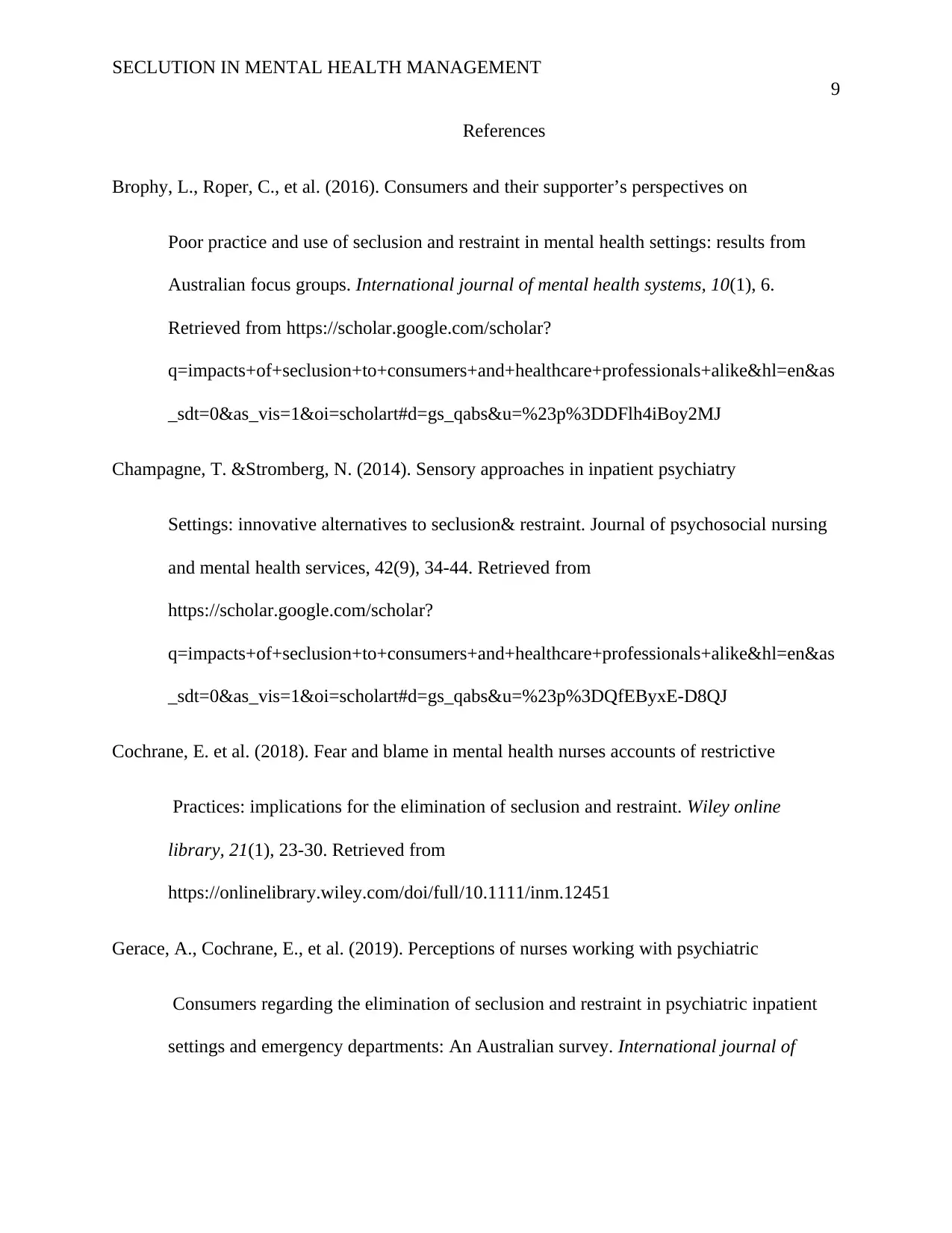
References
Brophy, L., Roper, C., et al. (2016). Consumers and their supporter’s perspectives on
Poor practice and use of seclusion and restraint in mental health settings: results from
Australian focus groups. International journal of mental health systems, 10(1), 6.
Retrieved from https://scholar.google.com/scholar?
q=impacts+of+seclusion+to+consumers+and+healthcare+professionals+alike&hl=en&as
_sdt=0&as_vis=1&oi=scholart#d=gs_qabs&u=%23p%3DDFlh4iBoy2MJ
Champagne, T. &Stromberg, N. (2014). Sensory approaches in inpatient psychiatry
Settings: innovative alternatives to seclusion& restraint. Journal of psychosocial nursing
and mental health services, 42(9), 34-44. Retrieved from
https://scholar.google.com/scholar?
q=impacts+of+seclusion+to+consumers+and+healthcare+professionals+alike&hl=en&as
_sdt=0&as_vis=1&oi=scholart#d=gs_qabs&u=%23p%3DQfEByxE-D8QJ
Cochrane, E. et al. (2018). Fear and blame in mental health nurses accounts of restrictive
Practices: implications for the elimination of seclusion and restraint. Wiley online
library, 21(1), 23-30. Retrieved from
https://onlinelibrary.wiley.com/doi/full/10.1111/inm.12451
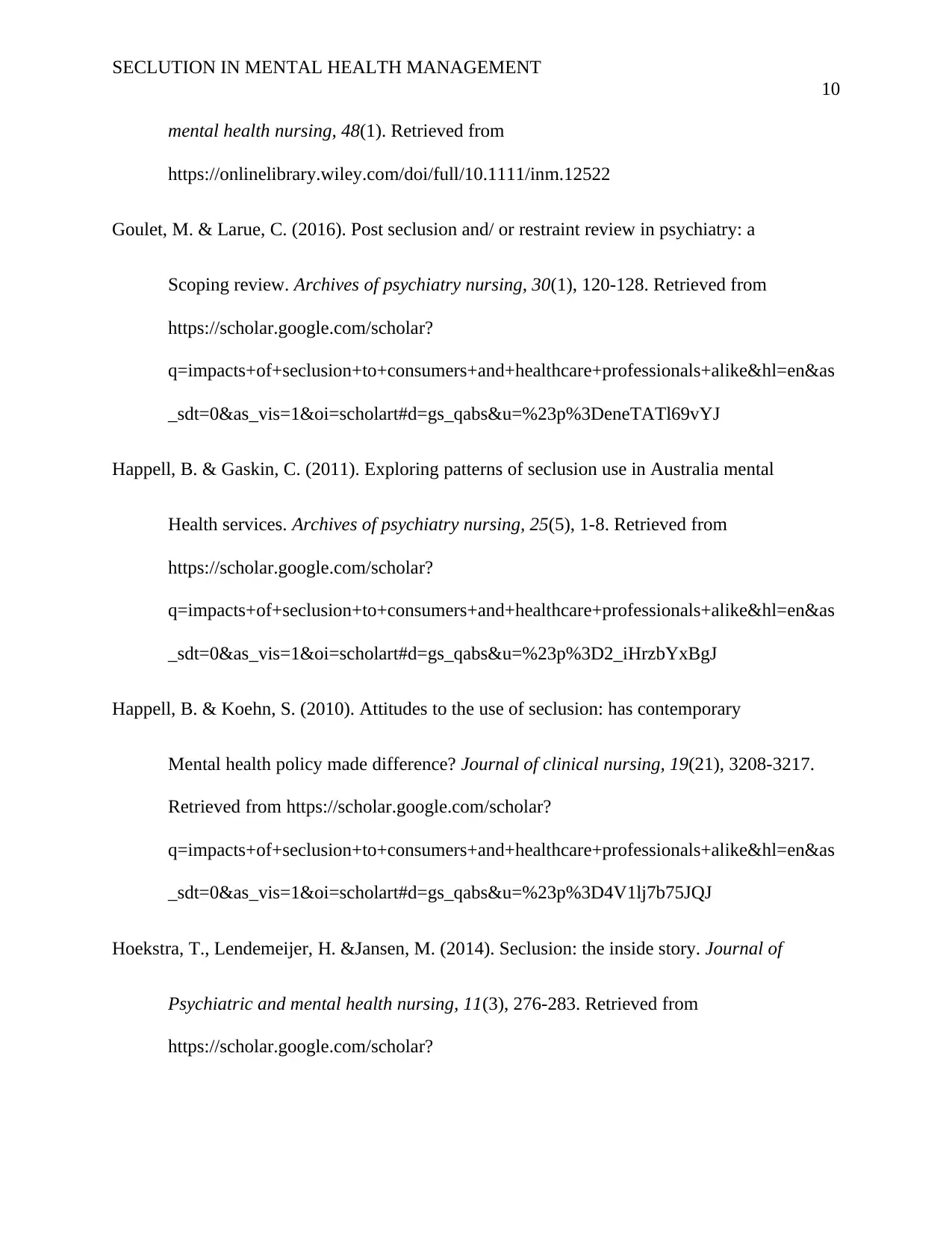
Gerace, A., Cochrane, E., et al. (2019). Perceptions of nurses working with psychiatric
Consumers regarding the elimination of seclusion and restraint in psychiatric inpatient
settings and emergency departments: An Australian survey. International journal of
9
References
Brophy, L., Roper, C., et al. (2016). Consumers and their supporter’s perspectives on
Poor practice and use of seclusion and restraint in mental health settings: results from
Australian focus groups. International journal of mental health systems, 10(1), 6.
Retrieved from https://scholar.google.com/scholar?
q=impacts+of+seclusion+to+consumers+and+healthcare+professionals+alike&hl=en&as
_sdt=0&as_vis=1&oi=scholart#d=gs_qabs&u=%23p%3DDFlh4iBoy2MJ
Champagne, T. &Stromberg, N. (2014). Sensory approaches in inpatient psychiatry
Settings: innovative alternatives to seclusion& restraint. Journal of psychosocial nursing
and mental health services, 42(9), 34-44. Retrieved from
https://scholar.google.com/scholar?
q=impacts+of+seclusion+to+consumers+and+healthcare+professionals+alike&hl=en&as
_sdt=0&as_vis=1&oi=scholart#d=gs_qabs&u=%23p%3DQfEByxE-D8QJ
Cochrane, E. et al. (2018). Fear and blame in mental health nurses accounts of restrictive
Practices: implications for the elimination of seclusion and restraint. Wiley online
library, 21(1), 23-30. Retrieved from
https://onlinelibrary.wiley.com/doi/full/10.1111/inm.12451
Gerace, A., Cochrane, E., et al. (2019). Perceptions of nurses working with psychiatric
Consumers regarding the elimination of seclusion and restraint in psychiatric inpatient
settings and emergency departments: An Australian survey. International journal of
⊘ This is a preview!⊘
Do you want full access?
Subscribe today to unlock all pages.
Trusted by 1+ million students worldwide
SECLUTION IN MENTAL HEALTH MANAGEMENT
10
mental health nursing, 48(1). Retrieved from
https://onlinelibrary.wiley.com/doi/full/10.1111/inm.12522
Goulet, M. & Larue, C. (2016). Post seclusion and/ or restraint review in psychiatry: a
Scoping review. Archives of psychiatry nursing, 30(1), 120-128. Retrieved from
https://scholar.google.com/scholar?
q=impacts+of+seclusion+to+consumers+and+healthcare+professionals+alike&hl=en&as
_sdt=0&as_vis=1&oi=scholart#d=gs_qabs&u=%23p%3DeneTATl69vYJ
Happell, B. & Gaskin, C. (2011). Exploring patterns of seclusion use in Australia mental
Health services. Archives of psychiatry nursing, 25(5), 1-8. Retrieved from
https://scholar.google.com/scholar?
q=impacts+of+seclusion+to+consumers+and+healthcare+professionals+alike&hl=en&as
_sdt=0&as_vis=1&oi=scholart#d=gs_qabs&u=%23p%3D2_iHrzbYxBgJ
Happell, B. & Koehn, S. (2010). Attitudes to the use of seclusion: has contemporary
Mental health policy made difference? Journal of clinical nursing, 19(21), 3208-3217.
Retrieved from https://scholar.google.com/scholar?
q=impacts+of+seclusion+to+consumers+and+healthcare+professionals+alike&hl=en&as
_sdt=0&as_vis=1&oi=scholart#d=gs_qabs&u=%23p%3D4V1lj7b75JQJ
Hoekstra, T., Lendemeijer, H. &Jansen, M. (2014). Seclusion: the inside story. Journal of
Psychiatric and mental health nursing, 11(3), 276-283. Retrieved from
https://scholar.google.com/scholar?
10
mental health nursing, 48(1). Retrieved from
https://onlinelibrary.wiley.com/doi/full/10.1111/inm.12522
Goulet, M. & Larue, C. (2016). Post seclusion and/ or restraint review in psychiatry: a
Scoping review. Archives of psychiatry nursing, 30(1), 120-128. Retrieved from
https://scholar.google.com/scholar?
q=impacts+of+seclusion+to+consumers+and+healthcare+professionals+alike&hl=en&as
_sdt=0&as_vis=1&oi=scholart#d=gs_qabs&u=%23p%3DeneTATl69vYJ
Happell, B. & Gaskin, C. (2011). Exploring patterns of seclusion use in Australia mental
Health services. Archives of psychiatry nursing, 25(5), 1-8. Retrieved from
https://scholar.google.com/scholar?
q=impacts+of+seclusion+to+consumers+and+healthcare+professionals+alike&hl=en&as
_sdt=0&as_vis=1&oi=scholart#d=gs_qabs&u=%23p%3D2_iHrzbYxBgJ
Happell, B. & Koehn, S. (2010). Attitudes to the use of seclusion: has contemporary
Mental health policy made difference? Journal of clinical nursing, 19(21), 3208-3217.
Retrieved from https://scholar.google.com/scholar?
q=impacts+of+seclusion+to+consumers+and+healthcare+professionals+alike&hl=en&as
_sdt=0&as_vis=1&oi=scholart#d=gs_qabs&u=%23p%3D4V1lj7b75JQJ
Hoekstra, T., Lendemeijer, H. &Jansen, M. (2014). Seclusion: the inside story. Journal of
Psychiatric and mental health nursing, 11(3), 276-283. Retrieved from
https://scholar.google.com/scholar?
Paraphrase This Document
Need a fresh take? Get an instant paraphrase of this document with our AI Paraphraser
SECLUTION IN MENTAL HEALTH MANAGEMENT
11
q=impacts+of+seclusion+to+consumers+and+healthcare+professionals+alike&hl=en&as
_sdt=0&as_vis=1&oi=scholart#d=gs_qabs&u=%23p%3D4f4eyo0ZFdEJ
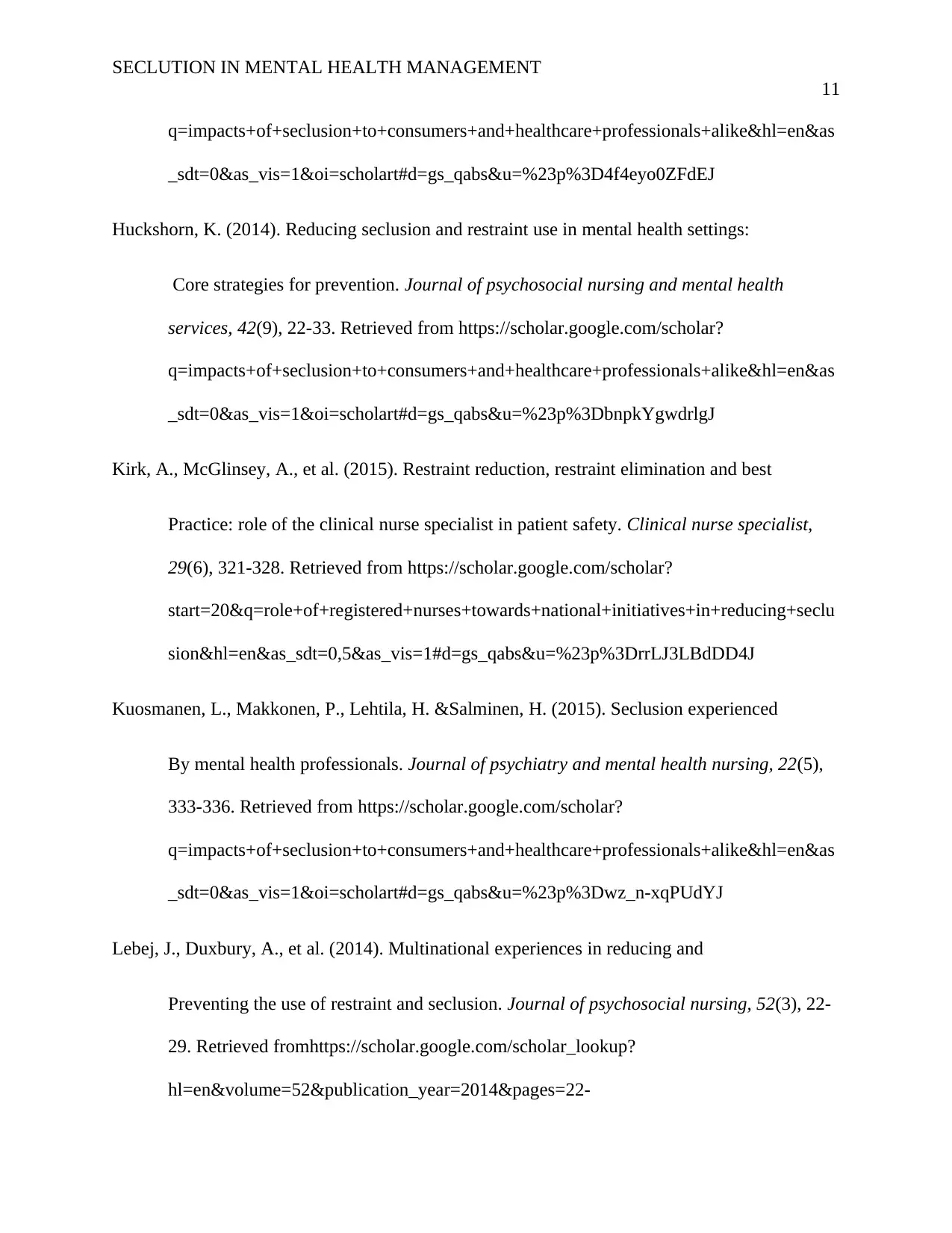
Huckshorn, K. (2014). Reducing seclusion and restraint use in mental health settings:
Core strategies for prevention. Journal of psychosocial nursing and mental health
services, 42(9), 22-33. Retrieved from https://scholar.google.com/scholar?
q=impacts+of+seclusion+to+consumers+and+healthcare+professionals+alike&hl=en&as
_sdt=0&as_vis=1&oi=scholart#d=gs_qabs&u=%23p%3DbnpkYgwdrlgJ
Kirk, A., McGlinsey, A., et al. (2015). Restraint reduction, restraint elimination and best
Practice: role of the clinical nurse specialist in patient safety. Clinical nurse specialist,
29(6), 321-328. Retrieved from https://scholar.google.com/scholar?
start=20&q=role+of+registered+nurses+towards+national+initiatives+in+reducing+seclu
sion&hl=en&as_sdt=0,5&as_vis=1#d=gs_qabs&u=%23p%3DrrLJ3LBdDD4J
Kuosmanen, L., Makkonen, P., Lehtila, H. &Salminen, H. (2015). Seclusion experienced
By mental health professionals. Journal of psychiatry and mental health nursing, 22(5),
333-336. Retrieved from https://scholar.google.com/scholar?
q=impacts+of+seclusion+to+consumers+and+healthcare+professionals+alike&hl=en&as
_sdt=0&as_vis=1&oi=scholart#d=gs_qabs&u=%23p%3Dwz_n-xqPUdYJ
Lebej, J., Duxbury, A., et al. (2014). Multinational experiences in reducing and
Preventing the use of restraint and seclusion. Journal of psychosocial nursing, 52(3), 22-
29. Retrieved fromhttps://scholar.google.com/scholar_lookup?
hl=en&volume=52&publication_year=2014&pages=22-
11
q=impacts+of+seclusion+to+consumers+and+healthcare+professionals+alike&hl=en&as
_sdt=0&as_vis=1&oi=scholart#d=gs_qabs&u=%23p%3D4f4eyo0ZFdEJ
Huckshorn, K. (2014). Reducing seclusion and restraint use in mental health settings:
Core strategies for prevention. Journal of psychosocial nursing and mental health
services, 42(9), 22-33. Retrieved from https://scholar.google.com/scholar?
q=impacts+of+seclusion+to+consumers+and+healthcare+professionals+alike&hl=en&as
_sdt=0&as_vis=1&oi=scholart#d=gs_qabs&u=%23p%3DbnpkYgwdrlgJ
Kirk, A., McGlinsey, A., et al. (2015). Restraint reduction, restraint elimination and best
Practice: role of the clinical nurse specialist in patient safety. Clinical nurse specialist,
29(6), 321-328. Retrieved from https://scholar.google.com/scholar?
start=20&q=role+of+registered+nurses+towards+national+initiatives+in+reducing+seclu
sion&hl=en&as_sdt=0,5&as_vis=1#d=gs_qabs&u=%23p%3DrrLJ3LBdDD4J
Kuosmanen, L., Makkonen, P., Lehtila, H. &Salminen, H. (2015). Seclusion experienced
By mental health professionals. Journal of psychiatry and mental health nursing, 22(5),
333-336. Retrieved from https://scholar.google.com/scholar?
q=impacts+of+seclusion+to+consumers+and+healthcare+professionals+alike&hl=en&as
_sdt=0&as_vis=1&oi=scholart#d=gs_qabs&u=%23p%3Dwz_n-xqPUdYJ
Lebej, J., Duxbury, A., et al. (2014). Multinational experiences in reducing and
Preventing the use of restraint and seclusion. Journal of psychosocial nursing, 52(3), 22-
29. Retrieved fromhttps://scholar.google.com/scholar_lookup?
hl=en&volume=52&publication_year=2014&pages=22-
SECLUTION IN MENTAL HEALTH MANAGEMENT
12
29&journal=Journal+of+Psychosocial+Nursing&author=J.+L.+LeBel&author=J.+A.
+Duxbury&author=A.+Putkonen&author=T.+Sprague&author=C.+Rae&author=J.
+Sharpe&title=Multinational+experiences+in+reducing+and+preventing+the+use+of+re
straint+and+seclusion
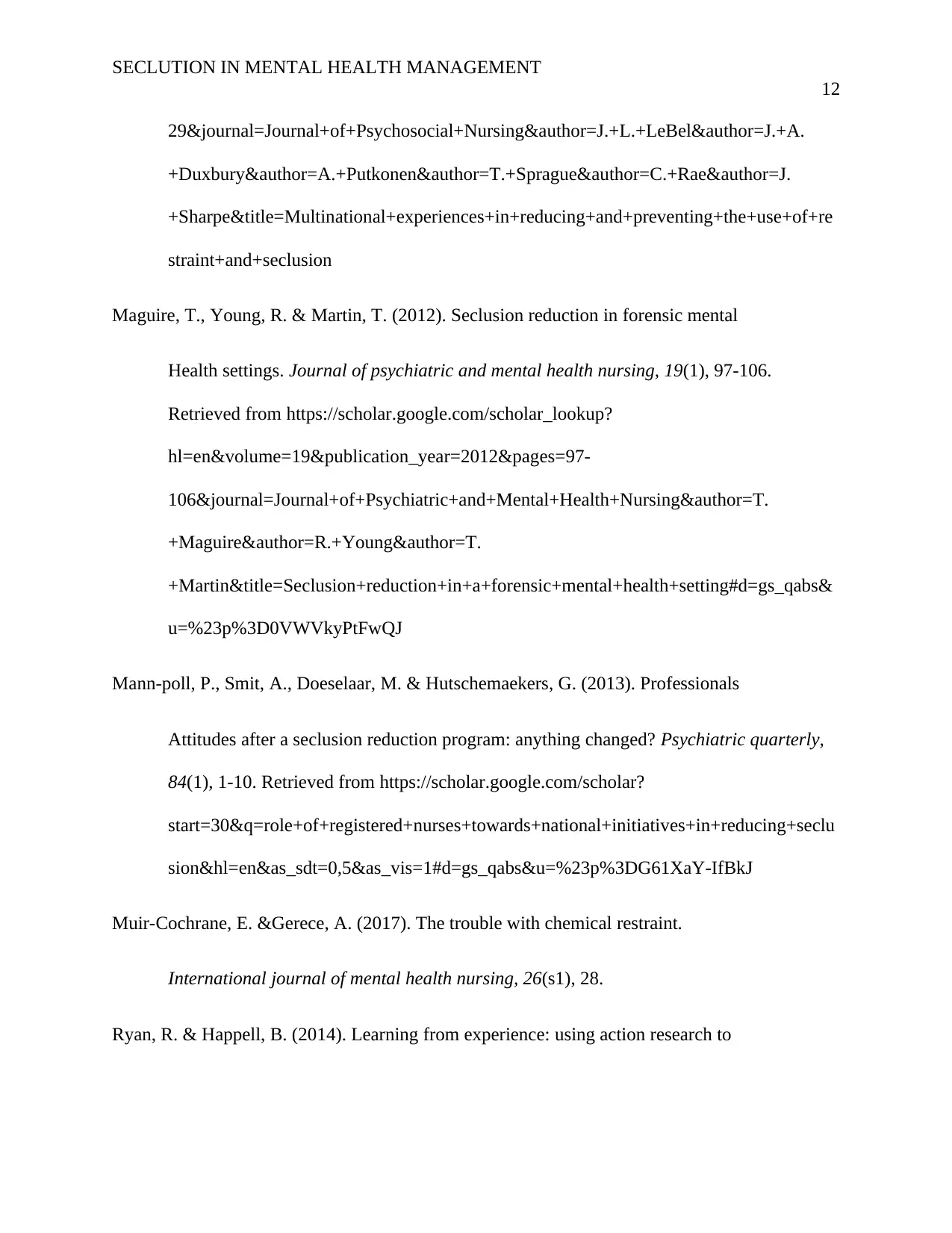
Maguire, T., Young, R. & Martin, T. (2012). Seclusion reduction in forensic mental
Health settings. Journal of psychiatric and mental health nursing, 19(1), 97-106.
Retrieved from https://scholar.google.com/scholar_lookup?
hl=en&volume=19&publication_year=2012&pages=97-
106&journal=Journal+of+Psychiatric+and+Mental+Health+Nursing&author=T.
+Maguire&author=R.+Young&author=T.
+Martin&title=Seclusion+reduction+in+a+forensic+mental+health+setting#d=gs_qabs&
u=%23p%3D0VWVkyPtFwQJ
Mann-poll, P., Smit, A., Doeselaar, M. & Hutschemaekers, G. (2013). Professionals
Attitudes after a seclusion reduction program: anything changed? Psychiatric quarterly,
84(1), 1-10. Retrieved from https://scholar.google.com/scholar?
start=30&q=role+of+registered+nurses+towards+national+initiatives+in+reducing+seclu
sion&hl=en&as_sdt=0,5&as_vis=1#d=gs_qabs&u=%23p%3DG61XaY-IfBkJ
Muir-Cochrane, E. &Gerece, A. (2017). The trouble with chemical restraint.
International journal of mental health nursing, 26(s1), 28.
Ryan, R. & Happell, B. (2014). Learning from experience: using action research to
12
29&journal=Journal+of+Psychosocial+Nursing&author=J.+L.+LeBel&author=J.+A.
+Duxbury&author=A.+Putkonen&author=T.+Sprague&author=C.+Rae&author=J.
+Sharpe&title=Multinational+experiences+in+reducing+and+preventing+the+use+of+re
straint+and+seclusion
Maguire, T., Young, R. & Martin, T. (2012). Seclusion reduction in forensic mental
Health settings. Journal of psychiatric and mental health nursing, 19(1), 97-106.
Retrieved from https://scholar.google.com/scholar_lookup?
hl=en&volume=19&publication_year=2012&pages=97-
106&journal=Journal+of+Psychiatric+and+Mental+Health+Nursing&author=T.
+Maguire&author=R.+Young&author=T.
+Martin&title=Seclusion+reduction+in+a+forensic+mental+health+setting#d=gs_qabs&
u=%23p%3D0VWVkyPtFwQJ
Mann-poll, P., Smit, A., Doeselaar, M. & Hutschemaekers, G. (2013). Professionals
Attitudes after a seclusion reduction program: anything changed? Psychiatric quarterly,
84(1), 1-10. Retrieved from https://scholar.google.com/scholar?
start=30&q=role+of+registered+nurses+towards+national+initiatives+in+reducing+seclu
sion&hl=en&as_sdt=0,5&as_vis=1#d=gs_qabs&u=%23p%3DG61XaY-IfBkJ
Muir-Cochrane, E. &Gerece, A. (2017). The trouble with chemical restraint.
International journal of mental health nursing, 26(s1), 28.
Ryan, R. & Happell, B. (2014). Learning from experience: using action research to
⊘ This is a preview!⊘
Do you want full access?
Subscribe today to unlock all pages.
Trusted by 1+ million students worldwide

1 out of 14


Your All-in-One AI-Powered Toolkit for Academic Success.
+13062052269
info@desklib.com
Available 24*7 on WhatsApp / Email
![[object Object]](/_next/static/media/star-bottom.7253800d.svg)
Unlock your academic potential
Copyright © 2020–2026 A2Z Services. All Rights Reserved. Developed and managed by ZUCOL.