Comprehensive Analysis: Security Industry Pay Structure and Management
VerifiedAdded on 2023/01/18
|12
|1717
|92
Report
AI Summary
This report delves into the critical issues surrounding the pay structure and management within the security industry. It highlights challenges such as low basic wages, excessive overtime, and the impact of headcount-based contracts. The report analyzes the recommendations of the Security Tripartite Cluster, particularly the Progressive Wage Model (PWM), which aims to improve wage structures, promote career advancement, and enhance productivity. It also examines the application of minimum and maximum wage ratios, promotion norms, and the integration of technology and performance-based agreements. The report concludes by emphasizing the benefits of the PWM in fostering higher basic wages, reduced overtime, and improved work-life balance for security officers, ultimately contributing to a more sustainable and motivated workforce. A pay structure for different roles is also created and demonstrated as per the progressive wage model.
Running head: TOTAL REWARD DESIGN AND MANGEMENT
TOTAL REWARD DESIGN AND MANGEMENT
Name of the Student:
Name of the University:
Author note:
TOTAL REWARD DESIGN AND MANGEMENT
Name of the Student:
Name of the University:
Author note:
Paraphrase This Document
Need a fresh take? Get an instant paraphrase of this document with our AI Paraphraser

1
TOTAL REWARD DESIGN AND MANGEMENT
ABSTRACT
The following report focuses on the growing issue on basic pay structure of the Security
Industry. The report has demonstrated a compensation structure for the security department
which involves four job roles that is senior security officer, security supervisor, and senior
security supervisor. The new structure enables the security administration to modify the basic
pay and the overtime which will motivate the employees to work efficiently and thus
increases the productivity of the industry.
TOTAL REWARD DESIGN AND MANGEMENT
ABSTRACT
The following report focuses on the growing issue on basic pay structure of the Security
Industry. The report has demonstrated a compensation structure for the security department
which involves four job roles that is senior security officer, security supervisor, and senior
security supervisor. The new structure enables the security administration to modify the basic
pay and the overtime which will motivate the employees to work efficiently and thus
increases the productivity of the industry.

2
TOTAL REWARD DESIGN AND MANGEMENT
Table of Contents
Introduction................................................................................................................................3
Discussion..................................................................................................................................4
The Challenges faced by the Security Industry......................................................................4
Recommendation of the Security Tripartite Cluster..............................................................5
Conclusion..................................................................................................................................7
Reference and Bibliography.......................................................................................................8
TOTAL REWARD DESIGN AND MANGEMENT
Table of Contents
Introduction................................................................................................................................3
Discussion..................................................................................................................................4
The Challenges faced by the Security Industry......................................................................4
Recommendation of the Security Tripartite Cluster..............................................................5
Conclusion..................................................................................................................................7
Reference and Bibliography.......................................................................................................8
⊘ This is a preview!⊘
Do you want full access?
Subscribe today to unlock all pages.

Trusted by 1+ million students worldwide

3
TOTAL REWARD DESIGN AND MANGEMENT
Introduction
The modern organisation seeks to ensure better facilities and working condition for
the working employees. This enables the organisation to attain employee retention and more
productivity in the organisation. Over the past years, the security industry has met with
several transformation. The Singapore Police has set up the Security Industry Regulatory
Department (SIRD) in 2004. This following report seeks to highlight the issue of over –time
and wage structure of the security department. The report also highlight the Recommendation
of the Security Tripartite Cluster (STC) and the new approach of the Security Tripartite
Cluster that is the “Payment Wage Model” which was introduced in October 2014. Analysing
the issue of the current security department issue the following pay structure has been
designed.
TOTAL REWARD DESIGN AND MANGEMENT
Introduction
The modern organisation seeks to ensure better facilities and working condition for
the working employees. This enables the organisation to attain employee retention and more
productivity in the organisation. Over the past years, the security industry has met with
several transformation. The Singapore Police has set up the Security Industry Regulatory
Department (SIRD) in 2004. This following report seeks to highlight the issue of over –time
and wage structure of the security department. The report also highlight the Recommendation
of the Security Tripartite Cluster (STC) and the new approach of the Security Tripartite
Cluster that is the “Payment Wage Model” which was introduced in October 2014. Analysing
the issue of the current security department issue the following pay structure has been
designed.
Paraphrase This Document
Need a fresh take? Get an instant paraphrase of this document with our AI Paraphraser

4
TOTAL REWARD DESIGN AND MANGEMENT
Discussion
Over the years, the organisation aims to bring dynamics in the workplace to maintain
their productivity and to retain the existing employees and this is mainly constructed by
implementing new policies and practices in the organisation. The management departments
has faced certain challenges in the organisation regarding the payroll and pay scale of the
security department. The challenges that are faced by the security industry is mainly due to
the manpower and operational such as low productivity, low basic wages, high turnover,
unattractive working environment, and excessive overtime hours. These factors lowers the
motivation level of the employees in the security industry.
The problem lies in the current shift pattern which involves the security officer is the
excessive overtime According to the Employment Act the maximum overtime per month
must not exceed 72 hours but in the present the security department is working for 95
overtime hours per month which is probably against the law. Hence analysing the issue and
constructing a reliable and appropriate pay structure would help the security industry to
overcome the difficulties related to employees.
The Challenges faced by the Security Industry
Headcount-Based Contract and Cheap Sourcing- These factor is raised when the service
buyers are given contracts which is based on number of workers and the price that is with less
consideration on quality and performance. This kind of practices by the service buyers are
general common while procuring the security service agreements (Rahim & Yeoh, 2019).
Low-Basic Wage- Over the last few decades, the basic wages in the industry have been
remained low. This has been increased by an increase in some of the variable wage
components such as overtime payment, allowance, reimbursement. Due to this the overall
TOTAL REWARD DESIGN AND MANGEMENT
Discussion
Over the years, the organisation aims to bring dynamics in the workplace to maintain
their productivity and to retain the existing employees and this is mainly constructed by
implementing new policies and practices in the organisation. The management departments
has faced certain challenges in the organisation regarding the payroll and pay scale of the
security department. The challenges that are faced by the security industry is mainly due to
the manpower and operational such as low productivity, low basic wages, high turnover,
unattractive working environment, and excessive overtime hours. These factors lowers the
motivation level of the employees in the security industry.
The problem lies in the current shift pattern which involves the security officer is the
excessive overtime According to the Employment Act the maximum overtime per month
must not exceed 72 hours but in the present the security department is working for 95
overtime hours per month which is probably against the law. Hence analysing the issue and
constructing a reliable and appropriate pay structure would help the security industry to
overcome the difficulties related to employees.
The Challenges faced by the Security Industry
Headcount-Based Contract and Cheap Sourcing- These factor is raised when the service
buyers are given contracts which is based on number of workers and the price that is with less
consideration on quality and performance. This kind of practices by the service buyers are
general common while procuring the security service agreements (Rahim & Yeoh, 2019).
Low-Basic Wage- Over the last few decades, the basic wages in the industry have been
remained low. This has been increased by an increase in some of the variable wage
components such as overtime payment, allowance, reimbursement. Due to this the overall

5
TOTAL REWARD DESIGN AND MANGEMENT
gross wages has been increased. So it is observed that a large amount of wages are today in
the shape of variable.
Overtime Hours- The security industry has average weekly OT hours at the highest level
over the other industries. To achieve the target demand of the market most of the security
officer are working for 12 hours a day for six days a week. On an average they work 95 hours
overtime each month. These 95 hours exceeds 72 hours a month limit which is against the
law.
Excessive Liquidated Damage raise by the Security Administration- The excessive
liquidated damage clauses in thee service contract is a disproportionate to the failure in the
service standards. Such challenge can corrode the constraint and margins the ability of
security administration to improve the wage system.
The Perception of the Industry as a Low skilled Job who have limited Career Progress-
This is a perception of not only the industry but also many people. This perception deters the
new people from entering to the market. Due to this shows the buyers unwillingness to obtain
security service at good price.
Recommendation of the Security Tripartite Cluster
The Progressive Wage Model- The Progressive Wage Model is an approach to wage
structure which is directed by the labour movement of Singapore, which is advocated by the
National Trade Union Congress (NTUC). It was introduced to help the workers of different
sectors to achieve the real wage without statutory deduction. PWM involves four key
components that is salary progression, productivity improvement, career advancement and
skills upgrading. The PWM encourages specific wage stair which is encompassed for each
sector of the industry. The each wage stair is comprised of a series of wage points and is
TOTAL REWARD DESIGN AND MANGEMENT
gross wages has been increased. So it is observed that a large amount of wages are today in
the shape of variable.
Overtime Hours- The security industry has average weekly OT hours at the highest level
over the other industries. To achieve the target demand of the market most of the security
officer are working for 12 hours a day for six days a week. On an average they work 95 hours
overtime each month. These 95 hours exceeds 72 hours a month limit which is against the
law.
Excessive Liquidated Damage raise by the Security Administration- The excessive
liquidated damage clauses in thee service contract is a disproportionate to the failure in the
service standards. Such challenge can corrode the constraint and margins the ability of
security administration to improve the wage system.
The Perception of the Industry as a Low skilled Job who have limited Career Progress-
This is a perception of not only the industry but also many people. This perception deters the
new people from entering to the market. Due to this shows the buyers unwillingness to obtain
security service at good price.
Recommendation of the Security Tripartite Cluster
The Progressive Wage Model- The Progressive Wage Model is an approach to wage
structure which is directed by the labour movement of Singapore, which is advocated by the
National Trade Union Congress (NTUC). It was introduced to help the workers of different
sectors to achieve the real wage without statutory deduction. PWM involves four key
components that is salary progression, productivity improvement, career advancement and
skills upgrading. The PWM encourages specific wage stair which is encompassed for each
sector of the industry. The each wage stair is comprised of a series of wage points and is
⊘ This is a preview!⊘
Do you want full access?
Subscribe today to unlock all pages.

Trusted by 1+ million students worldwide

6
TOTAL REWARD DESIGN AND MANGEMENT
provokes the workers to level up their performance to gain the respective next wage points
(Alsagoff, & Kadir, 2019).
Minimum and Maximum Wage Ratio- The Security Tripartite Cluster encourages the
security administration to adapt a minimum and maximum wage ratio which is not more than
1.5 within each level of the progressive wage model. This thought has been derived in
consultation with industry stakeholder and their union. It enables a seniority wage structure
which takes towards the productivity-based wage structure (Yen & Huang, 2017).
Promotion Norms- The progressive wage model provides a clearer and progression pathway
by setting reliable promotion norms. The industry must promote faster promotion on a case-
by-case basis for good and best performers and the mid-career switchers with relevant and
adequate transferable skills.
Provision for Experienced Security Officers- For the experienced and existing security
officer who are familiar and proficient with the operations, their respective security
administrations may go for assessment and certification adapted by Assessment-Only-
pathway.
Performance-Based Agreements and Usage of Technology- The Security Tripartite
Cluster recommends the service buyers and security administration to work together on their
performance based upon their work design process, contracts, efficient manpower and
investment in technology and enhancement in productivity.
Reimbursement- Security Tripartite Cluster aims the security administration to take the
reimbursements for meals, laundry, and transport into the basic wages.
TOTAL REWARD DESIGN AND MANGEMENT
provokes the workers to level up their performance to gain the respective next wage points
(Alsagoff, & Kadir, 2019).
Minimum and Maximum Wage Ratio- The Security Tripartite Cluster encourages the
security administration to adapt a minimum and maximum wage ratio which is not more than
1.5 within each level of the progressive wage model. This thought has been derived in
consultation with industry stakeholder and their union. It enables a seniority wage structure
which takes towards the productivity-based wage structure (Yen & Huang, 2017).
Promotion Norms- The progressive wage model provides a clearer and progression pathway
by setting reliable promotion norms. The industry must promote faster promotion on a case-
by-case basis for good and best performers and the mid-career switchers with relevant and
adequate transferable skills.
Provision for Experienced Security Officers- For the experienced and existing security
officer who are familiar and proficient with the operations, their respective security
administrations may go for assessment and certification adapted by Assessment-Only-
pathway.
Performance-Based Agreements and Usage of Technology- The Security Tripartite
Cluster recommends the service buyers and security administration to work together on their
performance based upon their work design process, contracts, efficient manpower and
investment in technology and enhancement in productivity.
Reimbursement- Security Tripartite Cluster aims the security administration to take the
reimbursements for meals, laundry, and transport into the basic wages.
Paraphrase This Document
Need a fresh take? Get an instant paraphrase of this document with our AI Paraphraser

7
TOTAL REWARD DESIGN AND MANGEMENT

8
TOTAL REWARD DESIGN AND MANGEMENT
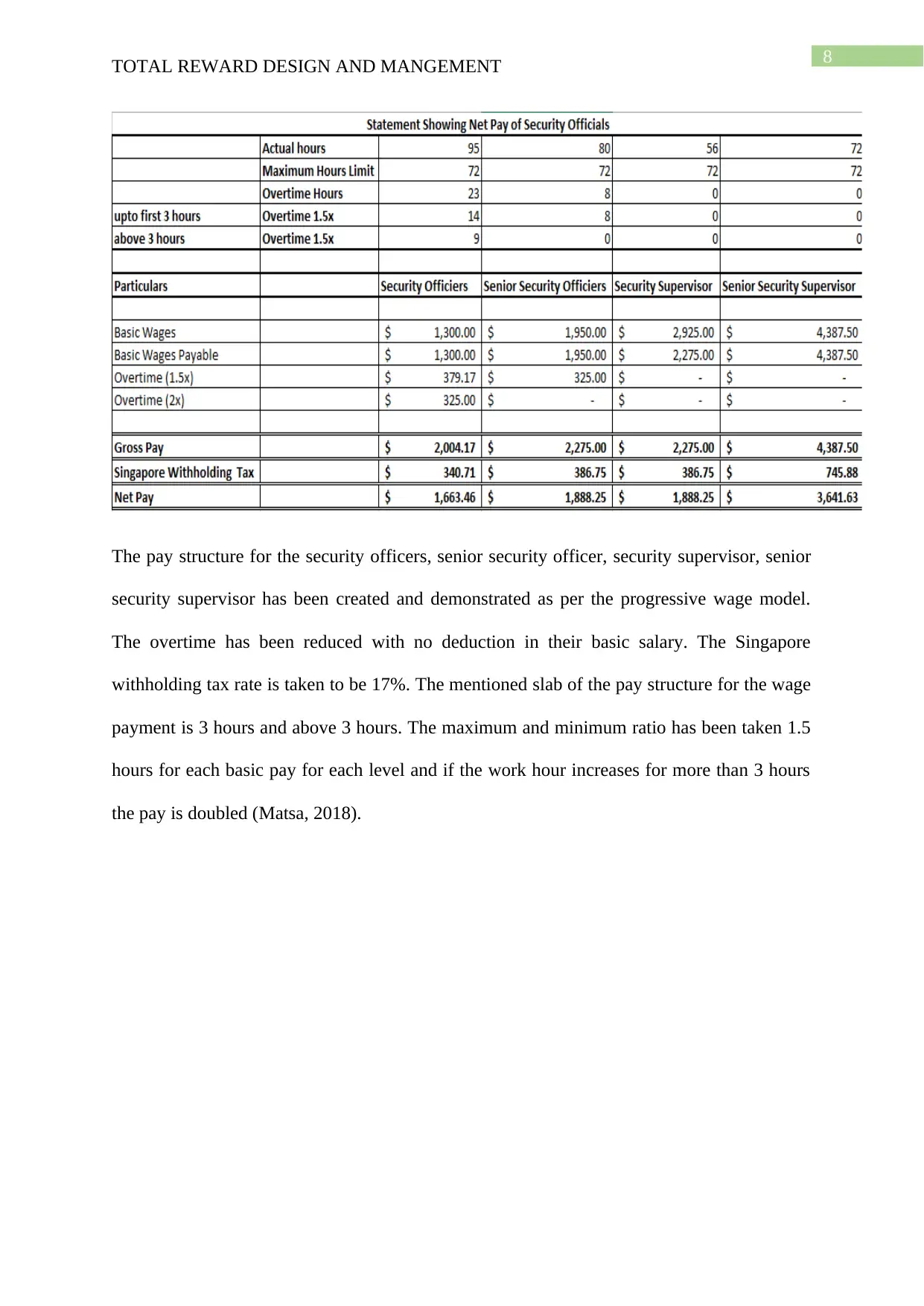
The pay structure for the security officers, senior security officer, security supervisor, senior
security supervisor has been created and demonstrated as per the progressive wage model.
The overtime has been reduced with no deduction in their basic salary. The Singapore
withholding tax rate is taken to be 17%. The mentioned slab of the pay structure for the wage
payment is 3 hours and above 3 hours. The maximum and minimum ratio has been taken 1.5
hours for each basic pay for each level and if the work hour increases for more than 3 hours
the pay is doubled (Matsa, 2018).
TOTAL REWARD DESIGN AND MANGEMENT
The pay structure for the security officers, senior security officer, security supervisor, senior
security supervisor has been created and demonstrated as per the progressive wage model.
The overtime has been reduced with no deduction in their basic salary. The Singapore
withholding tax rate is taken to be 17%. The mentioned slab of the pay structure for the wage
payment is 3 hours and above 3 hours. The maximum and minimum ratio has been taken 1.5
hours for each basic pay for each level and if the work hour increases for more than 3 hours
the pay is doubled (Matsa, 2018).
⊘ This is a preview!⊘
Do you want full access?
Subscribe today to unlock all pages.

Trusted by 1+ million students worldwide

9
TOTAL REWARD DESIGN AND MANGEMENT
Conclusion
It can be inferred from the above discussion that the Progressive Wage Model helps
the security industry in all possible ways. It has taken a step forward to give a hand to the
security administration to receive basic wage that is compensated with the better skill sets,
service standards, training, and higher productivity. The higher basic wages, the security
officer will have the choice of working for fewer overtime hours which will maintain their
work-life balance.
TOTAL REWARD DESIGN AND MANGEMENT
Conclusion
It can be inferred from the above discussion that the Progressive Wage Model helps
the security industry in all possible ways. It has taken a step forward to give a hand to the
security administration to receive basic wage that is compensated with the better skill sets,
service standards, training, and higher productivity. The higher basic wages, the security
officer will have the choice of working for fewer overtime hours which will maintain their
work-life balance.
Paraphrase This Document
Need a fresh take? Get an instant paraphrase of this document with our AI Paraphraser

10
TOTAL REWARD DESIGN AND MANGEMENT
Reference and Bibliography
Alsagoff, S. S. H., & Kadir, M. M. (2019). The Singapore Perspective. A Publication of the
Research and Planning Department, 91.
Gog, S. J., Sung, J., & Ashton, D. N. (2018). Institutional logics and low skills: The case of
the private security sector in Singapore. Work, employment and society, 32(6), 1029-
1043.
Matsa, D. A. (2018). Capital structure and a firm's workforce. Annual Review of Financial
Economics, 10, 387-412.
Ng, I. Y., Ng, Y. Y., & Lee, P. C. (2018). Singapore’s restructuring of low-wage work: Have
cleaning job conditions improved?. The Economic and Labour Relations Review,
29(3), 308-327.
Noe, R. A., Hollenbeck, J. R., Gerhart, B., & Wright, P. M. (2017). Human resource
management: Gaining a competitive advantage. New York, NY: McGraw-Hill
Education.
Rahim, L. Z., & Yeoh, L. K. (2019). Social Policy Reform and Rigidity in Singapore’s
Authoritarian Developmental State. In The Limits of Authoritarian Governance in
Singapore's Developmental State (pp. 95-130). Palgrave Macmillan, Singapore.
Yen, C. D., & Huang, T. C. (2017). The pay structure for task performance in the hospitality
industry: The role of pay satisfaction. GSTF Journal on Business Review (GBR), 2(2).
Zellweger, T. M., Chrisman, J. J., Chua, J. H., & Steier, L. P. (2019). Social structures, social
relationships, and family firms.
TOTAL REWARD DESIGN AND MANGEMENT
Reference and Bibliography
Alsagoff, S. S. H., & Kadir, M. M. (2019). The Singapore Perspective. A Publication of the
Research and Planning Department, 91.
Gog, S. J., Sung, J., & Ashton, D. N. (2018). Institutional logics and low skills: The case of
the private security sector in Singapore. Work, employment and society, 32(6), 1029-
1043.
Matsa, D. A. (2018). Capital structure and a firm's workforce. Annual Review of Financial
Economics, 10, 387-412.
Ng, I. Y., Ng, Y. Y., & Lee, P. C. (2018). Singapore’s restructuring of low-wage work: Have
cleaning job conditions improved?. The Economic and Labour Relations Review,
29(3), 308-327.
Noe, R. A., Hollenbeck, J. R., Gerhart, B., & Wright, P. M. (2017). Human resource
management: Gaining a competitive advantage. New York, NY: McGraw-Hill
Education.
Rahim, L. Z., & Yeoh, L. K. (2019). Social Policy Reform and Rigidity in Singapore’s
Authoritarian Developmental State. In The Limits of Authoritarian Governance in
Singapore's Developmental State (pp. 95-130). Palgrave Macmillan, Singapore.
Yen, C. D., & Huang, T. C. (2017). The pay structure for task performance in the hospitality
industry: The role of pay satisfaction. GSTF Journal on Business Review (GBR), 2(2).
Zellweger, T. M., Chrisman, J. J., Chua, J. H., & Steier, L. P. (2019). Social structures, social
relationships, and family firms.

11
TOTAL REWARD DESIGN AND MANGEMENT
⊘ This is a preview!⊘
Do you want full access?
Subscribe today to unlock all pages.

Trusted by 1+ million students worldwide
1 out of 12
Related Documents
Your All-in-One AI-Powered Toolkit for Academic Success.
+13062052269
info@desklib.com
Available 24*7 on WhatsApp / Email
Unlock your academic potential
Copyright © 2020–2026 A2Z Services. All Rights Reserved. Developed and managed by ZUCOL.