Sedentary Lifestyles: Social Care, Challenges, Sociological Theories

Verified

Added on  2023/06/15

|8
|2200
|425
Essay
AI Summary
This essay examines the social care provisions available to address health concerns associated with sedentary lifestyles in both workplace settings and due to disability, highlighting the challenges in implementing such care. It discusses sociological and psychological theories associated with sedentary behavior, exploring how lifestyle choices contribute to this behavior. The essay also focuses on socio-economic inequalities prevalent in the UK and their influence on sedentary lifestyles. It identifies a range of social care provisions, both formal and informal, and the challenges that face the delivery of these services, including workplace culture, physical environment, and the social treatment of people with disabilities. The essay further explains the nature-nurture debate and factors influencing lifecourse development, concluding that sedentary lifestyle is a driving cause behind obesity, type 2 diabetes, and cardiovascular disease, emphasizing the need for optimal implementation of interventions in both workplace and disability settings. Desklib provides this essay and many other resources for students.
Document Page
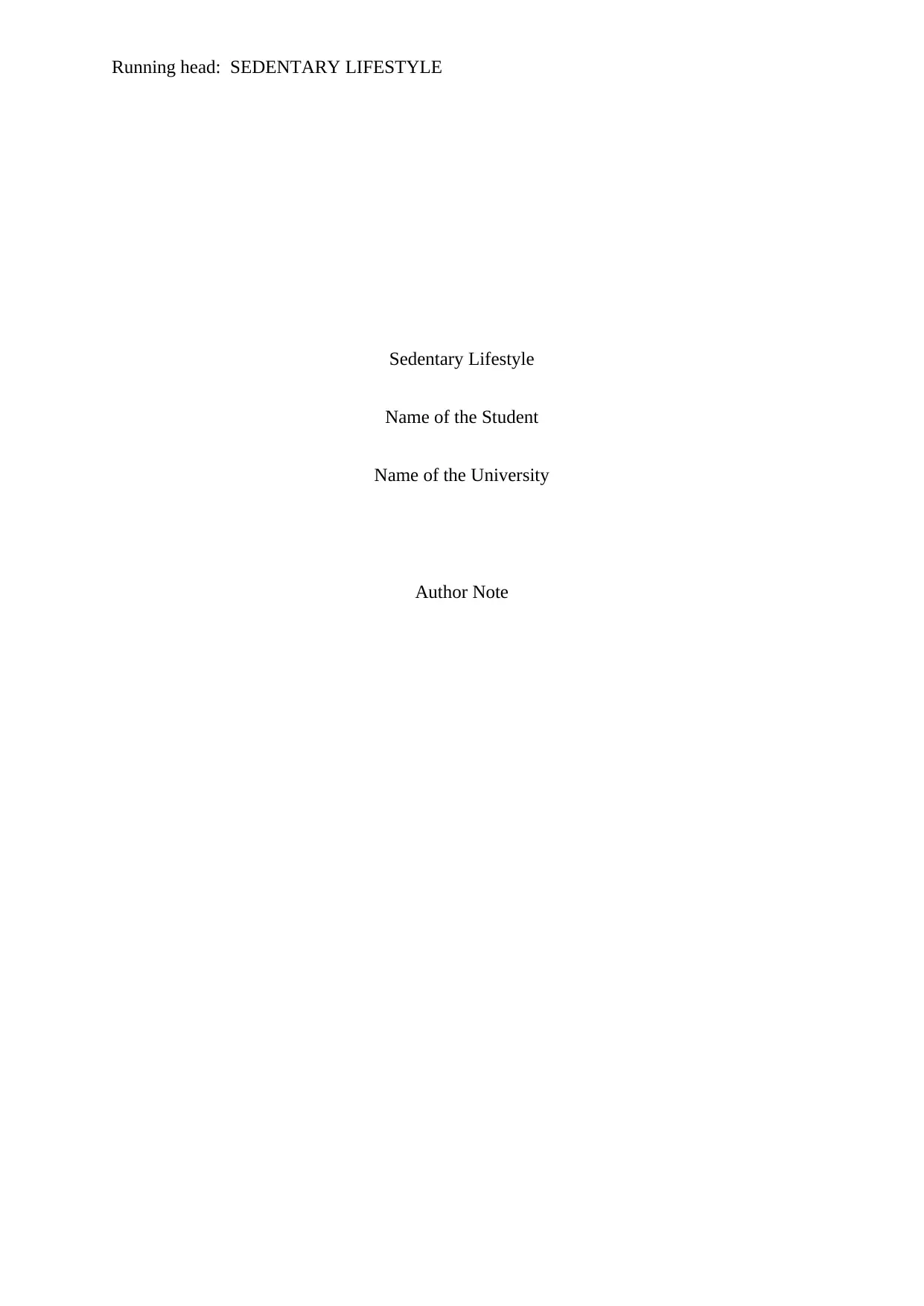
Running head: SEDENTARY LIFESTYLE
Sedentary Lifestyle
Name of the Student
Name of the University
Author Note
tabler-icon-diamond-filled.svg

Paraphrase This Document

Need a fresh take? Get an instant paraphrase of this document with our AI Paraphraser
Document Page
1
SEDENTARY LIFESTYLE
Introduction
Globalization of societies has cause increased reliance of technology especially in
workplace and this comes with a threat of sedentary lifestyle. Huge population of workforce
in office-based settings along with long working hours have made sedentary lifestyle a
critical public health concern (Waters et al. 2016). Sedentary lifestyle the major concern
behind obesity, type 2 diabetes, high cholesterol and cardiovascular disease (Inyang and
Stella 2015). The following essay aims to highlight the social care provisions available to
address the health concerns associated with sedentary lifestyle in both workplace settings and
or due to disability. The essay then throws light over the challenges in implementing such
care. The essay also discusses sociological and psychological theories associated with
sedentary behaviour and how the flow of lifestyle forces a person to develop sedentary
behaviour. Towards the end, the essay focuses on the inequalities in socio-economic stature
prevalent in UK and how it influences sedentary lifestyle.
Identification the range of social care provision, formal and informal, and challenges that
face the delivery of these services
Sedentary behaviour is different from the concept of being physically inactive.
Evidence suggests that prolonged sitting cast detrimental health effects and efforts should be
taken to address this public health concern. Many co-corporate bodies have developed
interventions and subsequently implemented the same in order to reduce the health threats
coming from sedentary behaviour. Some of the interventions include increase in number of
short breaks in-between bouts of sitting (Waters et al. 2016). Waters et al. (2016) further
opined that most effective technique in reducing sedentary behaviour is environmental
modification along with individual education. According to Parry et al. (2013), participatory
workplace interventions can help to reduce the overall sedentary time and thereby increasing
Document Page
2
SEDENTARY LIFESTYLE
the frequency of breaks and improvement towards light activity. However, there are
numerous barriers towards successful reduction of sedentary behaviour among the office
workers with special mention on workplace culture, physical environment and norms (Waters
et al. 2016). The infrastructure of the office building for example availability of lift creates
barrier towards reducing workplace sedentary behaviour. Moreover, majority of office
buildings lack adjustable workstations or standing meetings or common rooms, further
creating barriers towards reducing the tendency of sedentary lifestyle in workplace (Waters et
al. 2016).
In case of people with disability, particular social treatment they receive from their
peers like sympathy for their physical condition generates a feeling of anger or inferiority
complex among them. Apart from anger, they pass through a number of emotional
complications and most significant among this is loss of future expectation or hope in life.
This is due to their hopelessness that they refuse to take self-initiatives to overcome their
disability and thus becomes not only a victim of depression, but also a major ill-health target
of sedentary lifestyle (Harrison et al. 2017). According to the National Health Service UK
(2017), there are number of social services available in UK in order to assist people with
physical disability. This care and support services include equipment and personal help or the
assistance towards mobility, community support, financial support, home adaptations and
residential care. One of the important examples of equipment is hoists that help people with
disability to get on and off chairs while going to toilet, taking bath or going to sleep over bed.
UK National Health Science also have provision for mobility scooters and powered
wheelchairs to assist people with disability and a person need not to have a license to drive
such mobility scooter or powered wheelchair but are required to register it. However,
majority of people who belong to under low socio-economic group are either not aware of
such amenities or lack the financial strength to avail the same.
Document Page
3
SEDENTARY LIFESTYLE
Explore the impact of sociological and psychological theories on behaviour and society
Apart from the long working hours, the sedentary lifestyle under workplace setting is
also dependent on the personal habits, social norms of sitting at desk and availability of
specific set of upholstery (Waters et al. 2016). People, who belong to higher socio-economic
group, tend to execute higher level of sedentary behaviour even after returning from office
and this tendency increases if their parents or siblings also engage in high level of sedentary
behaviour. Moreover, people who fall under high financial bracket have personal
maidservants who satisfy their daily home activities like cooking, cleaning and dusting and
thus preventing them to perform any sort of physical activity even while at home (Inyang and
Stella 2015). The same concept goes within the office premises too. People who work on
higher managerial position have air-conditioned home, comfortable revolving chairs and air
conditioned car with personal driver. All the amenities create a state of supremacy and then
develop a tendency availing the help from the office boys in tasks like fetching coffee,
refilling water in bottle and carrying the corporate bag up to the car. All these further
increases the threats coming from the sedentary lifestyle (Schröer, Haupt and Pieper 2013).
Disabled group of population experience challenging atmosphere that has negligible
access to culturally significant services along with oppressive societal tendencies all these
cumulates to marginal social participation (Cheng 2009). According to the grounded theory
as proposed by Galvin (2005), disabled people receive negative perceptions or behaviours
from other. They are other patronized or pitied and this kind of behaviour singles them out
for unsolicited attention. They are at times treated to be invisible, this sense of neglection
make them believe that they are sexually unattractive or unqualified to enter into a healthy
relationships. Thus they have minimal opportunities for love and this generates a sense of
hopelessness. These essences of despair make them to pass through severe depression and
provoking them to lead a sedentary life altogether (Cheng 2009).
tabler-icon-diamond-filled.svg

Paraphrase This Document

Need a fresh take? Get an instant paraphrase of this document with our AI Paraphraser
Document Page
4
SEDENTARY LIFESTYLE
Explaining the nature-nature debate and suggesting a range of factors that influence life-
course development and life chances from both prospective
Sitting in workplace is mostly dependent on occupation type and kind of tasks
involved. According to Waters et al. (2016), on a typical working day, at least 77% of total
work hours are spent on sedentary activities. So people who lead a sedentary life are required
to abide by certain health behaviours. In general the health behaviour among people is an
amalgamation of their individual characteristics (for example income, salary, age, education
and job type) and environmental factors (like recreational infrastructure, initiatives towards
physical activities, use of land and to participate in sports activity) (Biernat and Piątkowska
2014). However, under extreme work-pressure, surrounding environment does not actively
influence the development of healthy behaviour. People who reside under that particular
environment do not enthusiastically promote physical activity and cite numerous barriers
towards optimal access of sport initiatives. So in such uncooperative environment, motivation
coming from the social groups and governmental plan is the only driving force behind the
engagement of physical activity in between long working hours of after the completion of
working hours. The developing the fate of workplace sedentary life style is not written before
birth, it is the consequences of the surrounding socio-economic platform and personal
requirement. A person in order to earn more for his family is compelled to work-more,
leading to sedentary behaviour (Biernat and Piątkowska 2014).
Explain the concept of inequality in society and how it impacts on social groups
People who belongs to under low socio-economic group, tend to be the major victims
of sedentary lifestyle at workplace as due to their financial crisis, they are compelled to do
desk job with long working hours. However, this social inequality has other aspect over
sedentary lifestyle for example people who belong to higher socio-economic status have more
Document Page
5
SEDENTARY LIFESTYLE
television sets and computers at their home as a result even after returning from office they
remain glued in front of television sets, negating the chance of executing physical activities
(Inyang and Stella 2015).
Gender inequality is another important aspect behind the increase in the rate of
sedentary lifestyle. Increase in self-earning has a positive impact on health but the effect on
increase in spousal money is somewhat complicated. For example, among the heterosexual
married population, an increase in wives’ salary has a positive impact on their health but has
a negative impact on their male counterparts (Ramsay et al. 2008). However, the reverse
concept is not true for the wives as they genuinely become happy with the news of their
husbands’ increase in salary structure. Now a husband whose wife earns more than him, try
to indulge into certain invisible corporate competition with his wife. Here the motive is to
increase the work-flow via performing more and better and getting more financial career
prospects. With a concept of performing more, a person needs to work extra hours leading to
increase in the tenure of sedentary behaviour (Hurst, Gibbon and Nurse 2016).
Conclusion
Thus from the above discussion it can be concluded that sedentary life style is the
driving cause behind high prevalence of obesity, type 2 diabetes and cardiovascular disease.
In the present day scenario, increase in work-pressure along with increase in the total work
hours is the main reason behind the increase in tendency of sedentary lifestyle. Apart from
work place sedentary lifestyle there also lays sedentary behaviour arising out of sudden range
of disability, with a special mention for knee injury or replace or paralysis. Though several
initiatives have been taken both from government and private sector bodies, there still lays
sudden gaps in implementing these targets at optimal level both in workplace and with the
person who is differently able.
Document Page
6
SEDENTARY LIFESTYLE
References
Biernat, E. and Piątkowska, M., 2014. Individual and environmental factors determining
sedentary lifestyle of the Polish population. Iranian journal of public health, 43(8), p.1033.
Cheng, R.P., 2009. Sociological theories of disability, gender, and sexuality: A review of the
literature. Journal of Human Behavior in the Social Environment, 19(1), pp.112-122.
Galvin, R.D., 2005. Researching the disabled identity: Contextualising the identity
transformations which accompany the onset of impairment. Sociology of Health &
Illness, 27(3), pp.393-413.
Harrison, C., Falvo, D., Weiss, V. and Holland, B.E., 2017. Medical and psychosocial
aspects of chronic illness and disability. Jones & Bartlett Learning.
Hurst, C.E., Gibbon, H.M.F. and Nurse, A.M., 2016. Social inequality: Forms, causes, and
consequences. Routledge.
Inyang, M. and Stella, O., 2015. Sedentary lifestyle: health implications. J Nursing Health
Sci, 4, pp.20-5.
National Health Science UK. 2017. Mobility scooters and powered wheelchairs: the rules -
GOV.UK. [online] Available at: https://www.gov.uk/mobility-scooters-and-powered-
wheelchairs-rules [Accessed 6 Feb. 2018].
Parry, S., Straker, L., Gilson, N.D. and Smith, A.J., 2013. Participatory workplace
interventions can reduce sedentary time for office workers—a randomised controlled
trial. PloS one, 8(11), p.e78957.
tabler-icon-diamond-filled.svg

Paraphrase This Document

Need a fresh take? Get an instant paraphrase of this document with our AI Paraphraser
Document Page
7
SEDENTARY LIFESTYLE
Ramsay, S.E., Whincup, P.H., Morris, R.W., Lennon, L.T. and Wannamethee, S.G., 2008.
Extent of social inequalities in disability in the elderly: results from a population-based study
of British men. Annals of epidemiology, 18(12), pp.896-903.
Schröer, S., Haupt, J. and Pieper, C., 2013. Evidence-based lifestyle interventions in the
workplace—an overview. Occupational medicine, 64(1), pp.8-12.
Waters, C.N., Ling, E.P., Chu, A.H., Ng, S.H., Chia, A., Lim, Y.W. and Müller-
Riemenschneider, F., 2016. Assessing and understanding sedentary behaviour in office-based
working adults: a mixed-method approach. BMC public health, 16(1), p.360.
chevron_up_icon
1 out of 8
circle_padding
hide_on_mobile
zoom_out_icon
[object Object]