An Analysis of Segmentation, Targeting, and Positioning in Marketing
VerifiedAdded on 2022/12/18
|17
|4301
|85
Essay
AI Summary
This essay delves into the crucial marketing strategy of Segmentation, Targeting, and Positioning (STP). It begins by defining and evaluating the STP concept, exploring its theoretical underpinnings and practical applications through academic literature. The essay examines how STP is used, its strengths, weaknesses, and benefits for both organizations and customers. It then analyzes the application of STP in the automobile industry, using examples such as Toyota and Nissan, and extends this analysis to product-level applications. The essay also considers the application of STP in the power tool manufacturing industry, specifically examining Hilti & DEWALT. Finally, the essay provides recommendations for businesses and concludes with a synthesis of the key findings, emphasizing the importance of STP in achieving marketing objectives and gaining a competitive edge.
Running head: MARKETING
Segmentation, Targeting, and Positioning
9/17/2019
Segmentation, Targeting, and Positioning
9/17/2019

Paraphrase This Document
Need a fresh take? Get an instant paraphrase of this document with our AI Paraphraser
MARKETING 1
Table of Contents
Introduction................................................................................................................................2
Part 1..........................................................................................................................................2
Segmentation, Targeting, and Positioning.............................................................................2
Part 2..........................................................................................................................................6
STP Application to Automobile Industry..............................................................................6
Application of STP to products..........................................................................................8
STP Application to Power tool Manufacturing......................................................................9
Application of STP on Products.......................................................................................10
Recommendations................................................................................................................12
Conclusion................................................................................................................................12
References................................................................................................................................14
Table of Contents
Introduction................................................................................................................................2
Part 1..........................................................................................................................................2
Segmentation, Targeting, and Positioning.............................................................................2
Part 2..........................................................................................................................................6
STP Application to Automobile Industry..............................................................................6
Application of STP to products..........................................................................................8
STP Application to Power tool Manufacturing......................................................................9
Application of STP on Products.......................................................................................10
Recommendations................................................................................................................12
Conclusion................................................................................................................................12
References................................................................................................................................14
MARKETING 2
Introduction
Marketing strategy is defined as the planning and building a forward looking approach with
the suitable plan for attaining the anticipated objectives and goals of achieving higher sales,
augmented revenue for the company, retaining loyal customer base, enticing new customers,
and attaining competitive advantage in the market in comparison to others. It is essential for
the company’s management to hold a properly defined and ranged marketing strategy in
place along with professionals and talented in-house employees to achieve the objectives and
aims of the business and improve the brand value (Kartawinata and Wardhana, 2013). The
market strategy works as a blueprint for the business to attain the marketing objective. It is
also considered as a building block of the company’s marketing plan. It is created after the
comprehensive marketing research. A marketing strategy supports a business to focus on its
rare resources in the best way in order to increase the sales (Forkan and Ahmed, 2011). The
aim of this report is to discuss about one of the most important marketing strategies that is
used by the businesses to have a clear plan that is STP Analysis. The full form of STP
analysis is segmentation, targeting, and positioning strategies that are used to have a defined
target market and establish a strong position of the business in the industry in comparison to
other players in the market. Besides this, the paper is also discussing about how different
companies are using this strategy such as Toyota, Nissan, Hilti & DEWALT. In the end, the
paper is presenting the recommendation for the businesses for the future development.
Part 1
Segmentation, Targeting, and Positioning
Segmentation, targeting, and positioning are said to be the marketing tools that are utilized to
attain the competitive advantage by the businesses in the market. STP could be considered as
Introduction
Marketing strategy is defined as the planning and building a forward looking approach with
the suitable plan for attaining the anticipated objectives and goals of achieving higher sales,
augmented revenue for the company, retaining loyal customer base, enticing new customers,
and attaining competitive advantage in the market in comparison to others. It is essential for
the company’s management to hold a properly defined and ranged marketing strategy in
place along with professionals and talented in-house employees to achieve the objectives and
aims of the business and improve the brand value (Kartawinata and Wardhana, 2013). The
market strategy works as a blueprint for the business to attain the marketing objective. It is
also considered as a building block of the company’s marketing plan. It is created after the
comprehensive marketing research. A marketing strategy supports a business to focus on its
rare resources in the best way in order to increase the sales (Forkan and Ahmed, 2011). The
aim of this report is to discuss about one of the most important marketing strategies that is
used by the businesses to have a clear plan that is STP Analysis. The full form of STP
analysis is segmentation, targeting, and positioning strategies that are used to have a defined
target market and establish a strong position of the business in the industry in comparison to
other players in the market. Besides this, the paper is also discussing about how different
companies are using this strategy such as Toyota, Nissan, Hilti & DEWALT. In the end, the
paper is presenting the recommendation for the businesses for the future development.
Part 1
Segmentation, Targeting, and Positioning
Segmentation, targeting, and positioning are said to be the marketing tools that are utilized to
attain the competitive advantage by the businesses in the market. STP could be considered as
⊘ This is a preview!⊘
Do you want full access?
Subscribe today to unlock all pages.

Trusted by 1+ million students worldwide
MARKETING 3
the key marketing strategy disciplines, mistakes in this section can lead to failure and incline
to be expensive, and adopting it in right way can help business in attaining success (Xu and
Hong, 2012). Different businesses go through the period where they think of how effectively
they can manage the state of markets becoming reliant and competitive while customers
become fussier. Therefore, segmentation, targeting and positioning is the vital basis for every
strategy of marketing of a product or service. A business organization is capable to create an
operative tactical strategy of marketing with an accurate STP. According to Marquès,
Lamothe and Gourc, (2012), the approach of STP suggests that the mass market is comprised
of few groups that are comparatively homogenous, all with diverse needs and desires. STP
Marketers put efforts to identify those main market segments, direct their marketing activities
at those identified segments about which the marketers are sure that their company can satisfy
better in comparison to their players in the market and can place more effectively their
merchandise to appeal to the segments targeted. Unlike the generic marketing strategies that
are majorly focused on the product, the model of STP is focused towards customer. This
model is used when framing the strategies of marketing communication because it assist
marketers in highlighting propositions, emerging and transporting pertinent and modified
messages to target different audiences. It is focused towards commercial effectiveness,
selecting the suitable market segments for the business thus developing a positioning strategy
of the product and marketing mix for all the areas (Palmatier and Sridhar, 2017).
Market Segmentation – According to Menzly and Ozbas (2010), market segmentation is the
process of dividing the possible market into different customer subsections sharing similar
needs, or characteristics and choosing one or more segment to focus with the exclusive
marketing mix. It is comprised of sub-sections of inclusive market for the product or service
into minor groups or segment, involving consumers who have somewhat similar traits in a
detailed segment and tremendously diverse from consumer in other sections. Market
the key marketing strategy disciplines, mistakes in this section can lead to failure and incline
to be expensive, and adopting it in right way can help business in attaining success (Xu and
Hong, 2012). Different businesses go through the period where they think of how effectively
they can manage the state of markets becoming reliant and competitive while customers
become fussier. Therefore, segmentation, targeting and positioning is the vital basis for every
strategy of marketing of a product or service. A business organization is capable to create an
operative tactical strategy of marketing with an accurate STP. According to Marquès,
Lamothe and Gourc, (2012), the approach of STP suggests that the mass market is comprised
of few groups that are comparatively homogenous, all with diverse needs and desires. STP
Marketers put efforts to identify those main market segments, direct their marketing activities
at those identified segments about which the marketers are sure that their company can satisfy
better in comparison to their players in the market and can place more effectively their
merchandise to appeal to the segments targeted. Unlike the generic marketing strategies that
are majorly focused on the product, the model of STP is focused towards customer. This
model is used when framing the strategies of marketing communication because it assist
marketers in highlighting propositions, emerging and transporting pertinent and modified
messages to target different audiences. It is focused towards commercial effectiveness,
selecting the suitable market segments for the business thus developing a positioning strategy
of the product and marketing mix for all the areas (Palmatier and Sridhar, 2017).
Market Segmentation – According to Menzly and Ozbas (2010), market segmentation is the
process of dividing the possible market into different customer subsections sharing similar
needs, or characteristics and choosing one or more segment to focus with the exclusive
marketing mix. It is comprised of sub-sections of inclusive market for the product or service
into minor groups or segment, involving consumers who have somewhat similar traits in a
detailed segment and tremendously diverse from consumer in other sections. Market
Paraphrase This Document
Need a fresh take? Get an instant paraphrase of this document with our AI Paraphraser
MARKETING 4
segmentation tool can be used by the business by considering different societal factors, such
as beliefs, geography, behaviour, values, lifestyle, psychographics, demographics, life stages,
and benefits. According to Harrison and Kjellberg (2010), a business could distinguish its
consumers on the basis of geographic variables (like state, nation, and region), psychographic
variables (like opinions, attitudes, and values), demographic variables (like gender, age,
income, education), and behavioural variable (like brand loyalty, media habits, purchase
frequency, and channel usage). By bring into line customers together depending on the
similarity of their actions or reactions for the marketing efficiency, customers demand can be
met.
Targeting – Targeting infers the technique of measuring the desirability of each segment and
selecting any of them to take entry. Targeting is also considered as the selection of the
reliable segment. Under this procedure, the business should balance its competences and
resources in contradiction of the attractiveness of varied segments (Kotler, Burton, Deans and
Armstrong, 2015). Targeting is comprised with the strategic focus on the few of the
acknowledged market segments, and creating unique marketing tactics to attract all the
concern segments. After classifying the effective segments and assessing the target profile of
the customer in these areas, it needs to be measured in order to identify whether or not the
segment is enticing for the particular product or service (Klobnak, 2011).
Positioning – Positioning is all about creating the company’s image and putting efforts to
place it in the distinct place of the target market. According to Tudor and Negricea, (2012),
positioning is determined as the strategy to place the product or service for covering a clear,
desired, and distinctive place in relation to the product of the competitor in the eyes of the
customer. This strategy of positioning is considered to be a concept which is preoccupied by
the business with the external environment influence on their competence strategy and
stakeholder anticipations. The central part of the positioning strategy is all about appropriate
segmentation tool can be used by the business by considering different societal factors, such
as beliefs, geography, behaviour, values, lifestyle, psychographics, demographics, life stages,
and benefits. According to Harrison and Kjellberg (2010), a business could distinguish its
consumers on the basis of geographic variables (like state, nation, and region), psychographic
variables (like opinions, attitudes, and values), demographic variables (like gender, age,
income, education), and behavioural variable (like brand loyalty, media habits, purchase
frequency, and channel usage). By bring into line customers together depending on the
similarity of their actions or reactions for the marketing efficiency, customers demand can be
met.
Targeting – Targeting infers the technique of measuring the desirability of each segment and
selecting any of them to take entry. Targeting is also considered as the selection of the
reliable segment. Under this procedure, the business should balance its competences and
resources in contradiction of the attractiveness of varied segments (Kotler, Burton, Deans and
Armstrong, 2015). Targeting is comprised with the strategic focus on the few of the
acknowledged market segments, and creating unique marketing tactics to attract all the
concern segments. After classifying the effective segments and assessing the target profile of
the customer in these areas, it needs to be measured in order to identify whether or not the
segment is enticing for the particular product or service (Klobnak, 2011).
Positioning – Positioning is all about creating the company’s image and putting efforts to
place it in the distinct place of the target market. According to Tudor and Negricea, (2012),
positioning is determined as the strategy to place the product or service for covering a clear,
desired, and distinctive place in relation to the product of the competitor in the eyes of the
customer. This strategy of positioning is considered to be a concept which is preoccupied by
the business with the external environment influence on their competence strategy and
stakeholder anticipations. The central part of the positioning strategy is all about appropriate
MARKETING 5
analysis of the customer, the brand itself, the benefit, and the competitors. It is considered to
be one of the most essential concepts where business can attain competitive advantage by
creating good image in the customer mind of their services and products (Urde and Koch,
2014). A business must measure the impact of its strategy of positioning on other customer
segments. If the negative reaction of any other customer segment takes place, the marketer of
the company must identify those aspects that are likely to entice different segments and
position services and products depending on these aspects (Harrison-Walker, 2011). A
company that places itself in the market the most favourable in relation to the rivals holds
greater changes of gaining higher profits irrespective of gaining average profit in the market.
The STP Tool helps businesses in different aspects such as the main strength of this tool is
that it helps company in gaining a specific and clear segment that is targeted with the use of
marketing efforts by avoiding all types of confusions and positioning the business in the eyes
of the customer (Lupao, 2013). However, this strategy is considered to also having a major
weakness that can impact the business. The major weakness of this tool is that there are
chances that business target wrong segment due to which it can experience huge losses and
gain the failing position in the market.
In addition to this, the STP analysis tool not just provides benefits to the organization but also
to the customer. The business get benefit of this tool by identifying a unique and precise
segment that can be targeted with the market efforts to purchase the services and gain the
distinguish position in the industry against its competitors. On the other side, the benefit that
customers get through this, is gaining the support in identifying the right product that can
meet their desires because nowadays businesses use marketing strategies to target specific
segment (Kahreh, Tive and Hesan, 2014).
analysis of the customer, the brand itself, the benefit, and the competitors. It is considered to
be one of the most essential concepts where business can attain competitive advantage by
creating good image in the customer mind of their services and products (Urde and Koch,
2014). A business must measure the impact of its strategy of positioning on other customer
segments. If the negative reaction of any other customer segment takes place, the marketer of
the company must identify those aspects that are likely to entice different segments and
position services and products depending on these aspects (Harrison-Walker, 2011). A
company that places itself in the market the most favourable in relation to the rivals holds
greater changes of gaining higher profits irrespective of gaining average profit in the market.
The STP Tool helps businesses in different aspects such as the main strength of this tool is
that it helps company in gaining a specific and clear segment that is targeted with the use of
marketing efforts by avoiding all types of confusions and positioning the business in the eyes
of the customer (Lupao, 2013). However, this strategy is considered to also having a major
weakness that can impact the business. The major weakness of this tool is that there are
chances that business target wrong segment due to which it can experience huge losses and
gain the failing position in the market.
In addition to this, the STP analysis tool not just provides benefits to the organization but also
to the customer. The business get benefit of this tool by identifying a unique and precise
segment that can be targeted with the market efforts to purchase the services and gain the
distinguish position in the industry against its competitors. On the other side, the benefit that
customers get through this, is gaining the support in identifying the right product that can
meet their desires because nowadays businesses use marketing strategies to target specific
segment (Kahreh, Tive and Hesan, 2014).
⊘ This is a preview!⊘
Do you want full access?
Subscribe today to unlock all pages.
Trusted by 1+ million students worldwide
MARKETING 6
Part 2
STP Application to Automobile Industry
The automobile industry is comprised of number of main players who are offering their
advanced products across the world. Every business involved in this industry is involved in
using different technology and producing different types of products to meet the demand of
customer. However, it is very tough for the businesses to decide which segment to be targeted
to deliver their services. To solve this issue, the car manufacturers adopt STP marketing tool
that is segmentation, targeting, and positioning strategies in order to have specified market
that will be served by the business to meet their demand (Hassan and Craft, 2012). Under this
the companies of car manufacturing select specific segments depending on their own
resources and capabilities and target depending on the characteristics of the customer. For
example, Toyota divides its market depending on the type of car it manufactures. It is known
that Toyota is involved in manufacturing different types of cars from hybrid vehicles, family
cars, hydrogen fuel-cell vehicles, etc. as per the diverse needs of customers (Cole, 2011).
This reflects that it targets different customer segments by using different marketing
strategies in order to gain the leading position and competitive advantage.
Considering the different types of vehicles Toyota sell, it divide the market based on income,
age, gender, location, behaviour, lifestyle, etc. It manufactures the male, female, low income,
high income, and luxurious cars considering the target market (Chowdhury, 2014). The
company is regularly involved in adopting advanced technologies and incorporated with
skilled and highly qualified workforce that has supported it in leading the industry in
comparison to the rivals.
Considering the above argument, it can be said that different business target different
segments on the basis of their products they manufacture to meet the demand of the specific
segment. Nissan the competitor of Toyota Company is involved in manufacturing similar
Part 2
STP Application to Automobile Industry
The automobile industry is comprised of number of main players who are offering their
advanced products across the world. Every business involved in this industry is involved in
using different technology and producing different types of products to meet the demand of
customer. However, it is very tough for the businesses to decide which segment to be targeted
to deliver their services. To solve this issue, the car manufacturers adopt STP marketing tool
that is segmentation, targeting, and positioning strategies in order to have specified market
that will be served by the business to meet their demand (Hassan and Craft, 2012). Under this
the companies of car manufacturing select specific segments depending on their own
resources and capabilities and target depending on the characteristics of the customer. For
example, Toyota divides its market depending on the type of car it manufactures. It is known
that Toyota is involved in manufacturing different types of cars from hybrid vehicles, family
cars, hydrogen fuel-cell vehicles, etc. as per the diverse needs of customers (Cole, 2011).
This reflects that it targets different customer segments by using different marketing
strategies in order to gain the leading position and competitive advantage.
Considering the different types of vehicles Toyota sell, it divide the market based on income,
age, gender, location, behaviour, lifestyle, etc. It manufactures the male, female, low income,
high income, and luxurious cars considering the target market (Chowdhury, 2014). The
company is regularly involved in adopting advanced technologies and incorporated with
skilled and highly qualified workforce that has supported it in leading the industry in
comparison to the rivals.
Considering the above argument, it can be said that different business target different
segments on the basis of their products they manufacture to meet the demand of the specific
segment. Nissan the competitor of Toyota Company is involved in manufacturing similar
Paraphrase This Document
Need a fresh take? Get an instant paraphrase of this document with our AI Paraphraser
MARKETING 7
type of product but with some different features in order to differentiate itself from other
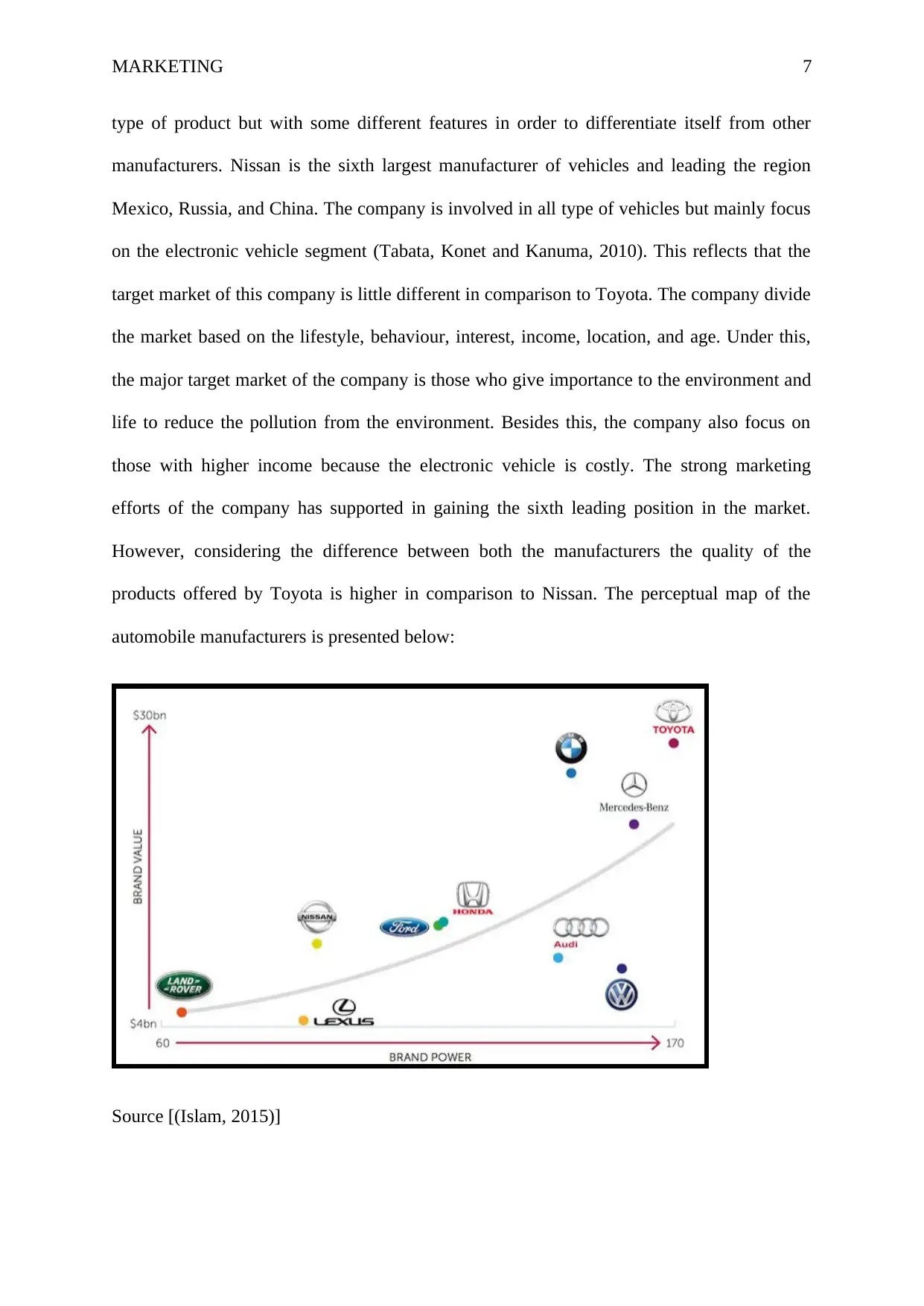
manufacturers. Nissan is the sixth largest manufacturer of vehicles and leading the region
Mexico, Russia, and China. The company is involved in all type of vehicles but mainly focus
on the electronic vehicle segment (Tabata, Konet and Kanuma, 2010). This reflects that the
target market of this company is little different in comparison to Toyota. The company divide
the market based on the lifestyle, behaviour, interest, income, location, and age. Under this,
the major target market of the company is those who give importance to the environment and
life to reduce the pollution from the environment. Besides this, the company also focus on
those with higher income because the electronic vehicle is costly. The strong marketing
efforts of the company has supported in gaining the sixth leading position in the market.
However, considering the difference between both the manufacturers the quality of the
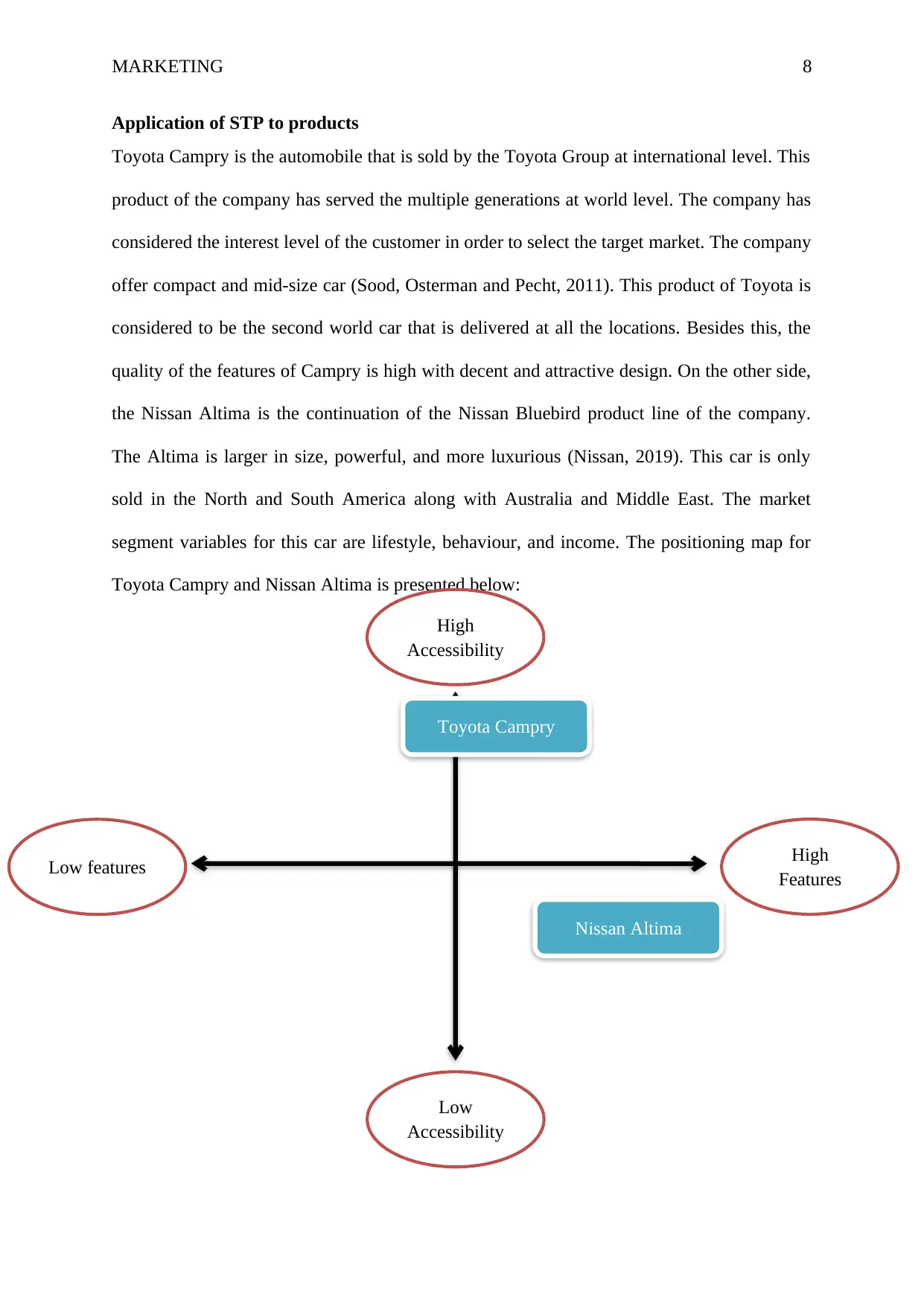
products offered by Toyota is higher in comparison to Nissan. The perceptual map of the
automobile manufacturers is presented below:
Source [(Islam, 2015)]
type of product but with some different features in order to differentiate itself from other
manufacturers. Nissan is the sixth largest manufacturer of vehicles and leading the region
Mexico, Russia, and China. The company is involved in all type of vehicles but mainly focus
on the electronic vehicle segment (Tabata, Konet and Kanuma, 2010). This reflects that the
target market of this company is little different in comparison to Toyota. The company divide
the market based on the lifestyle, behaviour, interest, income, location, and age. Under this,
the major target market of the company is those who give importance to the environment and
life to reduce the pollution from the environment. Besides this, the company also focus on
those with higher income because the electronic vehicle is costly. The strong marketing
efforts of the company has supported in gaining the sixth leading position in the market.
However, considering the difference between both the manufacturers the quality of the
products offered by Toyota is higher in comparison to Nissan. The perceptual map of the
automobile manufacturers is presented below:
Source [(Islam, 2015)]
MARKETING 8
Application of STP to products
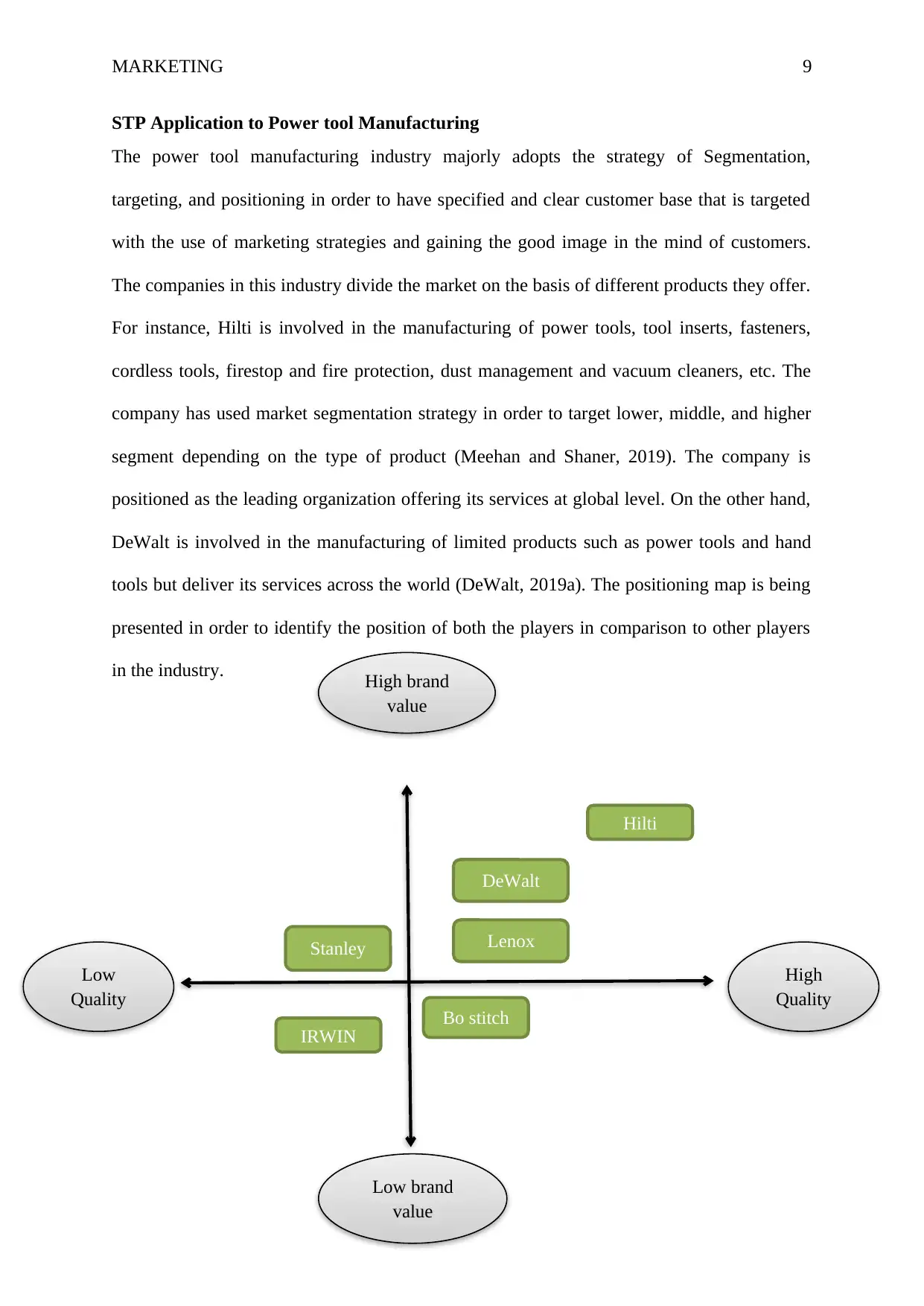
Toyota Campry is the automobile that is sold by the Toyota Group at international level. This
product of the company has served the multiple generations at world level. The company has
considered the interest level of the customer in order to select the target market. The company
offer compact and mid-size car (Sood, Osterman and Pecht, 2011). This product of Toyota is
considered to be the second world car that is delivered at all the locations. Besides this, the
quality of the features of Campry is high with decent and attractive design. On the other side,
the Nissan Altima is the continuation of the Nissan Bluebird product line of the company.
The Altima is larger in size, powerful, and more luxurious (Nissan, 2019). This car is only
sold in the North and South America along with Australia and Middle East. The market
segment variables for this car are lifestyle, behaviour, and income. The positioning map for
Toyota Campry and Nissan Altima is presented below:
High
Accessibility
High
Features
Low
Accessibility
Low features
Toyota Campry
Nissan Altima
Application of STP to products
Toyota Campry is the automobile that is sold by the Toyota Group at international level. This
product of the company has served the multiple generations at world level. The company has
considered the interest level of the customer in order to select the target market. The company
offer compact and mid-size car (Sood, Osterman and Pecht, 2011). This product of Toyota is
considered to be the second world car that is delivered at all the locations. Besides this, the
quality of the features of Campry is high with decent and attractive design. On the other side,
the Nissan Altima is the continuation of the Nissan Bluebird product line of the company.
The Altima is larger in size, powerful, and more luxurious (Nissan, 2019). This car is only
sold in the North and South America along with Australia and Middle East. The market
segment variables for this car are lifestyle, behaviour, and income. The positioning map for
Toyota Campry and Nissan Altima is presented below:
High
Accessibility
High
Features
Low
Accessibility
Low features
Toyota Campry
Nissan Altima
⊘ This is a preview!⊘
Do you want full access?
Subscribe today to unlock all pages.
Trusted by 1+ million students worldwide
MARKETING 9
STP Application to Power tool Manufacturing
The power tool manufacturing industry majorly adopts the strategy of Segmentation,
targeting, and positioning in order to have specified and clear customer base that is targeted
with the use of marketing strategies and gaining the good image in the mind of customers.
The companies in this industry divide the market on the basis of different products they offer.
For instance, Hilti is involved in the manufacturing of power tools, tool inserts, fasteners,
cordless tools, firestop and fire protection, dust management and vacuum cleaners, etc. The
company has used market segmentation strategy in order to target lower, middle, and higher
segment depending on the type of product (Meehan and Shaner, 2019). The company is
positioned as the leading organization offering its services at global level. On the other hand,
DeWalt is involved in the manufacturing of limited products such as power tools and hand
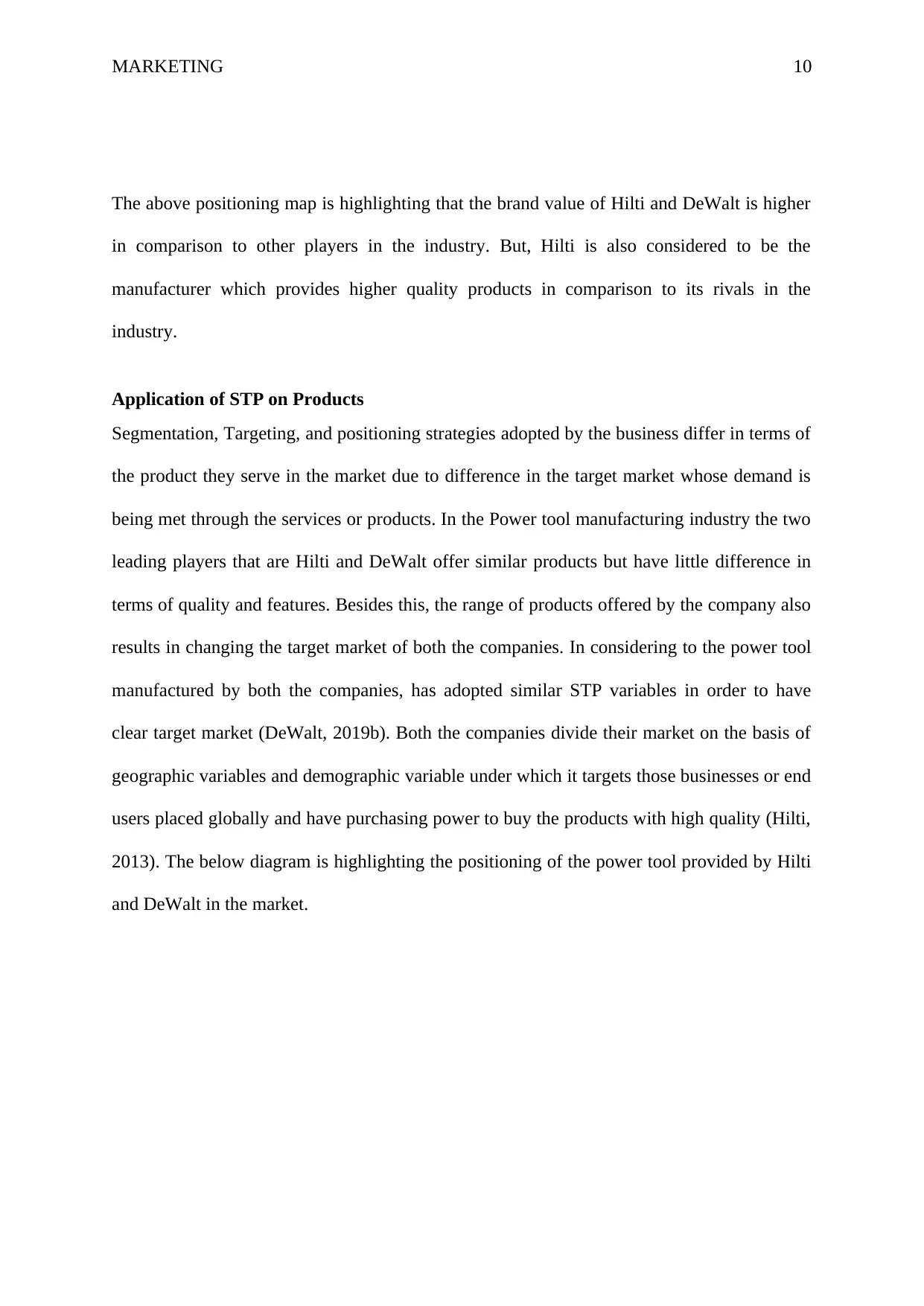
tools but deliver its services across the world (DeWalt, 2019a). The positioning map is being
presented in order to identify the position of both the players in comparison to other players
in the industry. High brand
value
High
Quality
Low
Quality
Low brand
value
DeWalt
Hilti
Bo stitch
Stanley
IRWIN
Lenox
STP Application to Power tool Manufacturing
The power tool manufacturing industry majorly adopts the strategy of Segmentation,
targeting, and positioning in order to have specified and clear customer base that is targeted
with the use of marketing strategies and gaining the good image in the mind of customers.
The companies in this industry divide the market on the basis of different products they offer.
For instance, Hilti is involved in the manufacturing of power tools, tool inserts, fasteners,
cordless tools, firestop and fire protection, dust management and vacuum cleaners, etc. The
company has used market segmentation strategy in order to target lower, middle, and higher
segment depending on the type of product (Meehan and Shaner, 2019). The company is
positioned as the leading organization offering its services at global level. On the other hand,
DeWalt is involved in the manufacturing of limited products such as power tools and hand
tools but deliver its services across the world (DeWalt, 2019a). The positioning map is being
presented in order to identify the position of both the players in comparison to other players
in the industry. High brand
value
High
Quality
Low
Quality
Low brand
value
DeWalt
Hilti
Bo stitch
Stanley
IRWIN
Lenox
Paraphrase This Document
Need a fresh take? Get an instant paraphrase of this document with our AI Paraphraser
MARKETING 10
The above positioning map is highlighting that the brand value of Hilti and DeWalt is higher
in comparison to other players in the industry. But, Hilti is also considered to be the
manufacturer which provides higher quality products in comparison to its rivals in the
industry.
Application of STP on Products
Segmentation, Targeting, and positioning strategies adopted by the business differ in terms of
the product they serve in the market due to difference in the target market whose demand is
being met through the services or products. In the Power tool manufacturing industry the two
leading players that are Hilti and DeWalt offer similar products but have little difference in
terms of quality and features. Besides this, the range of products offered by the company also
results in changing the target market of both the companies. In considering to the power tool
manufactured by both the companies, has adopted similar STP variables in order to have
clear target market (DeWalt, 2019b). Both the companies divide their market on the basis of
geographic variables and demographic variable under which it targets those businesses or end
users placed globally and have purchasing power to buy the products with high quality (Hilti,
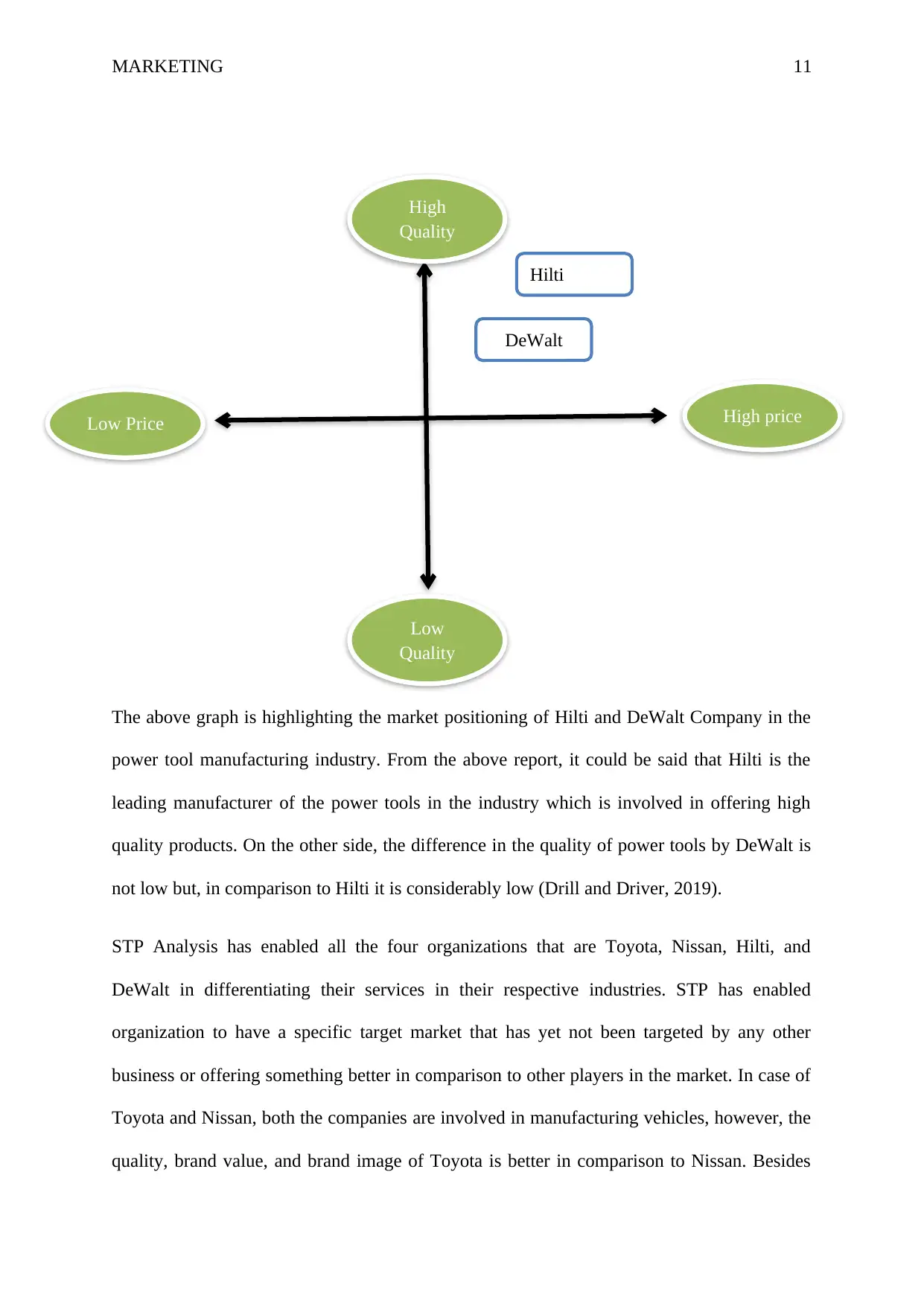
2013). The below diagram is highlighting the positioning of the power tool provided by Hilti
and DeWalt in the market.
The above positioning map is highlighting that the brand value of Hilti and DeWalt is higher
in comparison to other players in the industry. But, Hilti is also considered to be the
manufacturer which provides higher quality products in comparison to its rivals in the
industry.
Application of STP on Products
Segmentation, Targeting, and positioning strategies adopted by the business differ in terms of
the product they serve in the market due to difference in the target market whose demand is
being met through the services or products. In the Power tool manufacturing industry the two
leading players that are Hilti and DeWalt offer similar products but have little difference in
terms of quality and features. Besides this, the range of products offered by the company also
results in changing the target market of both the companies. In considering to the power tool
manufactured by both the companies, has adopted similar STP variables in order to have
clear target market (DeWalt, 2019b). Both the companies divide their market on the basis of
geographic variables and demographic variable under which it targets those businesses or end
users placed globally and have purchasing power to buy the products with high quality (Hilti,
2013). The below diagram is highlighting the positioning of the power tool provided by Hilti
and DeWalt in the market.
MARKETING 11
The above graph is highlighting the market positioning of Hilti and DeWalt Company in the
power tool manufacturing industry. From the above report, it could be said that Hilti is the
leading manufacturer of the power tools in the industry which is involved in offering high
quality products. On the other side, the difference in the quality of power tools by DeWalt is
not low but, in comparison to Hilti it is considerably low (Drill and Driver, 2019).
STP Analysis has enabled all the four organizations that are Toyota, Nissan, Hilti, and
DeWalt in differentiating their services in their respective industries. STP has enabled
organization to have a specific target market that has yet not been targeted by any other
business or offering something better in comparison to other players in the market. In case of
Toyota and Nissan, both the companies are involved in manufacturing vehicles, however, the
quality, brand value, and brand image of Toyota is better in comparison to Nissan. Besides
High
Quality
High price
Low
Quality
Low Price
Hilti
DeWalt
The above graph is highlighting the market positioning of Hilti and DeWalt Company in the
power tool manufacturing industry. From the above report, it could be said that Hilti is the
leading manufacturer of the power tools in the industry which is involved in offering high
quality products. On the other side, the difference in the quality of power tools by DeWalt is
not low but, in comparison to Hilti it is considerably low (Drill and Driver, 2019).
STP Analysis has enabled all the four organizations that are Toyota, Nissan, Hilti, and
DeWalt in differentiating their services in their respective industries. STP has enabled
organization to have a specific target market that has yet not been targeted by any other
business or offering something better in comparison to other players in the market. In case of
Toyota and Nissan, both the companies are involved in manufacturing vehicles, however, the
quality, brand value, and brand image of Toyota is better in comparison to Nissan. Besides
High
Quality
High price
Low
Quality
Low Price
Hilti
DeWalt
⊘ This is a preview!⊘
Do you want full access?
Subscribe today to unlock all pages.
Trusted by 1+ million students worldwide

1 out of 17


Related Documents


Your All-in-One AI-Powered Toolkit for Academic Success.
+13062052269
info@desklib.com
Available 24*7 on WhatsApp / Email
![[object Object]](/_next/static/media/star-bottom.7253800d.svg)
Unlock your academic potential
Copyright © 2020–2025 A2Z Services. All Rights Reserved. Developed and managed by ZUCOL.