Self-Awareness Development: A Reflexive Practitioner Research Report
VerifiedAdded on 2020/10/22
|19
|4303
|113
Report
AI Summary
This report delves into the concept of self-awareness within the framework of a reflexive practitioner. It begins with a literature review, exploring the definition, advantages, and methods for cultivating self-awareness. The research aims to enhance self-awareness, with objectives including evaluating the concept, discovering its advantages, and identifying ways to foster it. The report then examines various research methodologies, including autoethnography, and details the use of personality tests like MBTI and VARK to analyze personal data. It also incorporates the Gibbs Reflective Cycle and a Personal Cultural Text framework to understand self-awareness. The report critically evaluates the research design and concludes by emphasizing the importance of diagnostic approaches in identifying strengths and weaknesses for professional development, particularly in leadership.

Developing the Reflexive
Practitioner Research Project
Practitioner Research Project

Paraphrase This Document
Need a fresh take? Get an instant paraphrase of this document with our AI Paraphraser
Table of Contents
Research aims and Literature review...............................................................................................1
Concept of self-awareness:.....................................................................................................1
Advantages of developing self-awareness:............................................................................2
Ways to create a healthy sense of self-awareness:.................................................................2
Bibliography...........................................................................................................................3
Reflections on Research Methods and Data Analysis.....................................................................4
The Reflexive Practitioner ..............................................................................................................9
Appendix:.......................................................................................................................................13
Research aims and Literature review...............................................................................................1
Concept of self-awareness:.....................................................................................................1
Advantages of developing self-awareness:............................................................................2
Ways to create a healthy sense of self-awareness:.................................................................2
Bibliography...........................................................................................................................3
Reflections on Research Methods and Data Analysis.....................................................................4
The Reflexive Practitioner ..............................................................................................................9
Appendix:.......................................................................................................................................13

⊘ This is a preview!⊘
Do you want full access?
Subscribe today to unlock all pages.

Trusted by 1+ million students worldwide
Research aims and Literature review
Self-awareness refers to realise own personality which includes strengths and
weaknesses, thoughts and beliefs, emotions and motivations etc. By developing this skill, a
person can understand colleagues as well as determine how they perceive in return. Therefore,
being aware means take an opportunity to make changes in own behaviour and attitude. This
would help in giving best performance and attaining a better position at workplace (Dimitriadou–
Panteka, Koukourikos and Pizirtzidou, 2014). In this regard, present research is going to make a
discussion on theoretical approach in terms of self-awareness. This would help in increasing the
abilities of individuals can give better performance. Furthermore, a critical evaluation and
justification for research method and approaches for data analysis are also done. In addition to
this, analysed personal data is created in the form of a storyboard. By developing self-awareness,
I want to grab a position of manager in a big organisation.
Research Aim: “To increase self awareness”.
Research Objectives: The main objectives of this research are given as beneath:
To evaluate the concept of self-awareness.
To discover the advantages of developing self-awareness.
To identify the ways for creating a healthy sense of self-awareness.
To recommend ways by which a person can professionally develop self-image.
Literature Review:
This part reviews scholarly articles, surveys books and other sources which are relevant
to a particular area of research. It provides description, summary as well as critical evaluation to
address research objectives. In this regard, to analyse the concept of increasing self-awareness,
views of various authors and experts are taken. For this purpose, secondary sources are used to
conduct the survey as shown below:-
Concept of self-awareness:
According to views of Miles, Huberman and Saldana (2014), it has ascertained that self-
awareness refers to a key component of emotional intelligence. It can be defined as an ability for
recognising and understanding own character, emotions and mood as well as their effects on
others. The term self-awareness includes a realistic self-assessment which shows capabilities to
do a work (Papamitsiou and Economides, 2014). It helps individuals in identifying areas where
1
Self-awareness refers to realise own personality which includes strengths and
weaknesses, thoughts and beliefs, emotions and motivations etc. By developing this skill, a
person can understand colleagues as well as determine how they perceive in return. Therefore,
being aware means take an opportunity to make changes in own behaviour and attitude. This
would help in giving best performance and attaining a better position at workplace (Dimitriadou–
Panteka, Koukourikos and Pizirtzidou, 2014). In this regard, present research is going to make a
discussion on theoretical approach in terms of self-awareness. This would help in increasing the
abilities of individuals can give better performance. Furthermore, a critical evaluation and
justification for research method and approaches for data analysis are also done. In addition to
this, analysed personal data is created in the form of a storyboard. By developing self-awareness,
I want to grab a position of manager in a big organisation.
Research Aim: “To increase self awareness”.
Research Objectives: The main objectives of this research are given as beneath:
To evaluate the concept of self-awareness.
To discover the advantages of developing self-awareness.
To identify the ways for creating a healthy sense of self-awareness.
To recommend ways by which a person can professionally develop self-image.
Literature Review:
This part reviews scholarly articles, surveys books and other sources which are relevant
to a particular area of research. It provides description, summary as well as critical evaluation to
address research objectives. In this regard, to analyse the concept of increasing self-awareness,
views of various authors and experts are taken. For this purpose, secondary sources are used to
conduct the survey as shown below:-
Concept of self-awareness:
According to views of Miles, Huberman and Saldana (2014), it has ascertained that self-
awareness refers to a key component of emotional intelligence. It can be defined as an ability for
recognising and understanding own character, emotions and mood as well as their effects on
others. The term self-awareness includes a realistic self-assessment which shows capabilities to
do a work (Papamitsiou and Economides, 2014). It helps individuals in identifying areas where
1
Paraphrase This Document
Need a fresh take? Get an instant paraphrase of this document with our AI Paraphraser
they can make improvement and adapt changes as well. Thus, in this regard, by understanding
the concept of self-awareness, I have analysed that in order to gain a position of manager, I have
to work more on my managerial and leadership skills.
Advantages of developing self-awareness:
As per the opinion and thoughts of Davis and Sumara (2014), it has evaluated that
developing self-awareness provides various advantages to individuals. It includes analysing own
abilities and weaknesses so that by taking a professional course, a person can develop skills and
enhance level of knowledge. When an individual develop their self-awareness, their personal
thoughts and interpretation will start to change. It leads to altering emotional state and increases
emotional intelligence as well, which are considered as main important factor for achievement of
overall success. It also helps in controlling own actions and behaviour which increase the
chances to get better outcomes (Caldwell and Hayes, 2016). Listening refers to most important
skill that helps people in improving relationship with others and developing good communication
also. Therefore, through development of self-awareness, I can gain various benefits ans
opportunities such as - becoming more at peace, able to communicate with clarity, enriched life-
experience, improve relationship, making decisions more better etc.
Ways to create a healthy sense of self-awareness:
According to perceptions of Tiidenberg and Gómez Cruz (2015), self-awareness can be
defined a mental state where a person can analyse own abilities and capabilities to do a specific
work. By recognising the difference between own experience and others, a person can analyse
how to develop own capabilities. Since every person has four endowments – self awareness,
conscience, creative imagination and independent. Therefore, it ultimately gives freedom to
people to choose, respond and change own attitude and behaviour (Young and Young, 2014).
Therefore, self-awareness can only develop by accepting the responsibilities of changing
responses and behaviours for external stimuli. The another way for bringing state of awareness is
self-care, developing high emotional intelligence and more. Therefore, by development of
personal attributes, soft skills, effective communication and listening abilities, I can make proper
relationship with customers and other colleagues (Hattie, 2014). It helps in influencing team-
mates towards success of business goals and objectives. Thus, through analysing my own
weaknesses and strengths, I can develop my professional identity and recreate personality as
well.
2
the concept of self-awareness, I have analysed that in order to gain a position of manager, I have
to work more on my managerial and leadership skills.
Advantages of developing self-awareness:
As per the opinion and thoughts of Davis and Sumara (2014), it has evaluated that
developing self-awareness provides various advantages to individuals. It includes analysing own
abilities and weaknesses so that by taking a professional course, a person can develop skills and
enhance level of knowledge. When an individual develop their self-awareness, their personal
thoughts and interpretation will start to change. It leads to altering emotional state and increases
emotional intelligence as well, which are considered as main important factor for achievement of
overall success. It also helps in controlling own actions and behaviour which increase the
chances to get better outcomes (Caldwell and Hayes, 2016). Listening refers to most important
skill that helps people in improving relationship with others and developing good communication
also. Therefore, through development of self-awareness, I can gain various benefits ans
opportunities such as - becoming more at peace, able to communicate with clarity, enriched life-
experience, improve relationship, making decisions more better etc.
Ways to create a healthy sense of self-awareness:
According to perceptions of Tiidenberg and Gómez Cruz (2015), self-awareness can be
defined a mental state where a person can analyse own abilities and capabilities to do a specific
work. By recognising the difference between own experience and others, a person can analyse
how to develop own capabilities. Since every person has four endowments – self awareness,
conscience, creative imagination and independent. Therefore, it ultimately gives freedom to
people to choose, respond and change own attitude and behaviour (Young and Young, 2014).
Therefore, self-awareness can only develop by accepting the responsibilities of changing
responses and behaviours for external stimuli. The another way for bringing state of awareness is
self-care, developing high emotional intelligence and more. Therefore, by development of
personal attributes, soft skills, effective communication and listening abilities, I can make proper
relationship with customers and other colleagues (Hattie, 2014). It helps in influencing team-
mates towards success of business goals and objectives. Thus, through analysing my own
weaknesses and strengths, I can develop my professional identity and recreate personality as
well.
2
Advantage of developing self-awareness:
Being passive aggressive and improve relationship
Being controlling and becoming more at peace with yourself
Being defensive and better able to communicate with clarity
Unconscious behavioural changes and decision making become simplified
Disadvantage of developing self-awareness:
Lack of perceptive to properly understand nature of issues
Lack of knowledge of the way to fix any issue
Lack of motivation i.e. will power to deal with painful situations
Overthinking, misconceptions and incorrect-decisions
Bibliography
Young, C. S. and Young, J. S., 2014. Integrating spirituality and religion into counseling: A
guide to competent practice. John Wiley & Sons.
Caldwell, C. and Hayes, L. A., 2016. Self-efficacy and self-awareness: moral insights to
increased leader effectiveness. Journal of Management Development. 35(9). pp.1163-
1173.
Papamitsiou, Z. and Economides, A.A., 2014. Learning analytics and educational data mining in
practice: A systematic literature review of empirical evidence. Journal of Educational
Technology & Society. 17(4).
Hattie, J., 2014. Self-concept. Psychology Press.
Dimitriadou–Panteka, A., Koukourikos, K. and Pizirtzidou, E., 2014. The concept of self-esteem
in nursing education and its impact on professional behavior. International journal of
caring sciences. 7(1). pp.6-11.
Miles, M. B., Huberman, A. M. and Saldana, J., 2014. Qualitative data analysis. Sage.
Davis, B. and Sumara, D., 2014. Complexity and education: Inquiries into learning, teaching,
and research. Routledge.
Tiidenberg, K. and Gómez Cruz, E., 2015. Selfies, image and the re-making of the body. Body &
Society. 21(4). pp.77-102.
3
Being passive aggressive and improve relationship
Being controlling and becoming more at peace with yourself
Being defensive and better able to communicate with clarity
Unconscious behavioural changes and decision making become simplified
Disadvantage of developing self-awareness:
Lack of perceptive to properly understand nature of issues
Lack of knowledge of the way to fix any issue
Lack of motivation i.e. will power to deal with painful situations
Overthinking, misconceptions and incorrect-decisions
Bibliography
Young, C. S. and Young, J. S., 2014. Integrating spirituality and religion into counseling: A
guide to competent practice. John Wiley & Sons.
Caldwell, C. and Hayes, L. A., 2016. Self-efficacy and self-awareness: moral insights to
increased leader effectiveness. Journal of Management Development. 35(9). pp.1163-
1173.
Papamitsiou, Z. and Economides, A.A., 2014. Learning analytics and educational data mining in
practice: A systematic literature review of empirical evidence. Journal of Educational
Technology & Society. 17(4).
Hattie, J., 2014. Self-concept. Psychology Press.
Dimitriadou–Panteka, A., Koukourikos, K. and Pizirtzidou, E., 2014. The concept of self-esteem
in nursing education and its impact on professional behavior. International journal of
caring sciences. 7(1). pp.6-11.
Miles, M. B., Huberman, A. M. and Saldana, J., 2014. Qualitative data analysis. Sage.
Davis, B. and Sumara, D., 2014. Complexity and education: Inquiries into learning, teaching,
and research. Routledge.
Tiidenberg, K. and Gómez Cruz, E., 2015. Selfies, image and the re-making of the body. Body &
Society. 21(4). pp.77-102.
3
⊘ This is a preview!⊘
Do you want full access?
Subscribe today to unlock all pages.
Trusted by 1+ million students worldwide
Reflections on Research Methods and Data Analysis
Research methodologies are used to investigate a specific topic in deep manner. It
provides various sources through which research questions can be addressed appropriately. It
includes primary and secondary resources, qualitative and quantitative research etc. for
investigation. As per present context for self-awareness, an individual can use various sources of
research methodologies like relfexivity; arts based; auto-ethnographic practices and reflexive
dialogic action research etc. The term Auto-ethnography refers to a form of qualitative research
under which a researcher uses self-reflection to explore personal experience. This concept of
auto-ethnographic is a self-reflective form of writing which includes communication and
performance studies, anthropology, arts education, self-observation and more. While reflexivity
refers to a process of examining own values, interests, beliefs, experiences, political
commitments and more, which have shaped the research. In this regard, there are two different
auto-ethnographic approaches are applied. It includes personal and reflexive ethnography which
refers to systematic introspection, biographical method and narrative inquiry. Here reflexive
ethnography allows researchers to use systematic introspection as well as emotional recall also.
Therefore, I have used this approach in order to start with my personal life and give attention to
own feelings, emotions and thoughts also.
Advantages of Ethnography:
Ethnography aid researchers to know more about values, cultures and traditions.
It also aids to understand more about human behaviour and type of their learning styles. It makes easy to discover new things as well.
Disadvantages of Ethnography:
Point: Short-term studies is considered as a major disadvantage of Ethnography research.
Reason: It takes much time for building trust with informants to facilitate honest
discourse.
Effects: Biasedness of research mostly affect design of study as well as collection and
interpretation of data as well.
In this regard, I have done some personality test as shown below:-
Personal Data Source 1:
4
Research methodologies are used to investigate a specific topic in deep manner. It
provides various sources through which research questions can be addressed appropriately. It
includes primary and secondary resources, qualitative and quantitative research etc. for
investigation. As per present context for self-awareness, an individual can use various sources of
research methodologies like relfexivity; arts based; auto-ethnographic practices and reflexive
dialogic action research etc. The term Auto-ethnography refers to a form of qualitative research
under which a researcher uses self-reflection to explore personal experience. This concept of
auto-ethnographic is a self-reflective form of writing which includes communication and
performance studies, anthropology, arts education, self-observation and more. While reflexivity
refers to a process of examining own values, interests, beliefs, experiences, political
commitments and more, which have shaped the research. In this regard, there are two different
auto-ethnographic approaches are applied. It includes personal and reflexive ethnography which
refers to systematic introspection, biographical method and narrative inquiry. Here reflexive
ethnography allows researchers to use systematic introspection as well as emotional recall also.
Therefore, I have used this approach in order to start with my personal life and give attention to
own feelings, emotions and thoughts also.
Advantages of Ethnography:
Ethnography aid researchers to know more about values, cultures and traditions.
It also aids to understand more about human behaviour and type of their learning styles. It makes easy to discover new things as well.
Disadvantages of Ethnography:
Point: Short-term studies is considered as a major disadvantage of Ethnography research.
Reason: It takes much time for building trust with informants to facilitate honest
discourse.
Effects: Biasedness of research mostly affect design of study as well as collection and
interpretation of data as well.
In this regard, I have done some personality test as shown below:-
Personal Data Source 1:
4
Paraphrase This Document
Need a fresh take? Get an instant paraphrase of this document with our AI Paraphraser
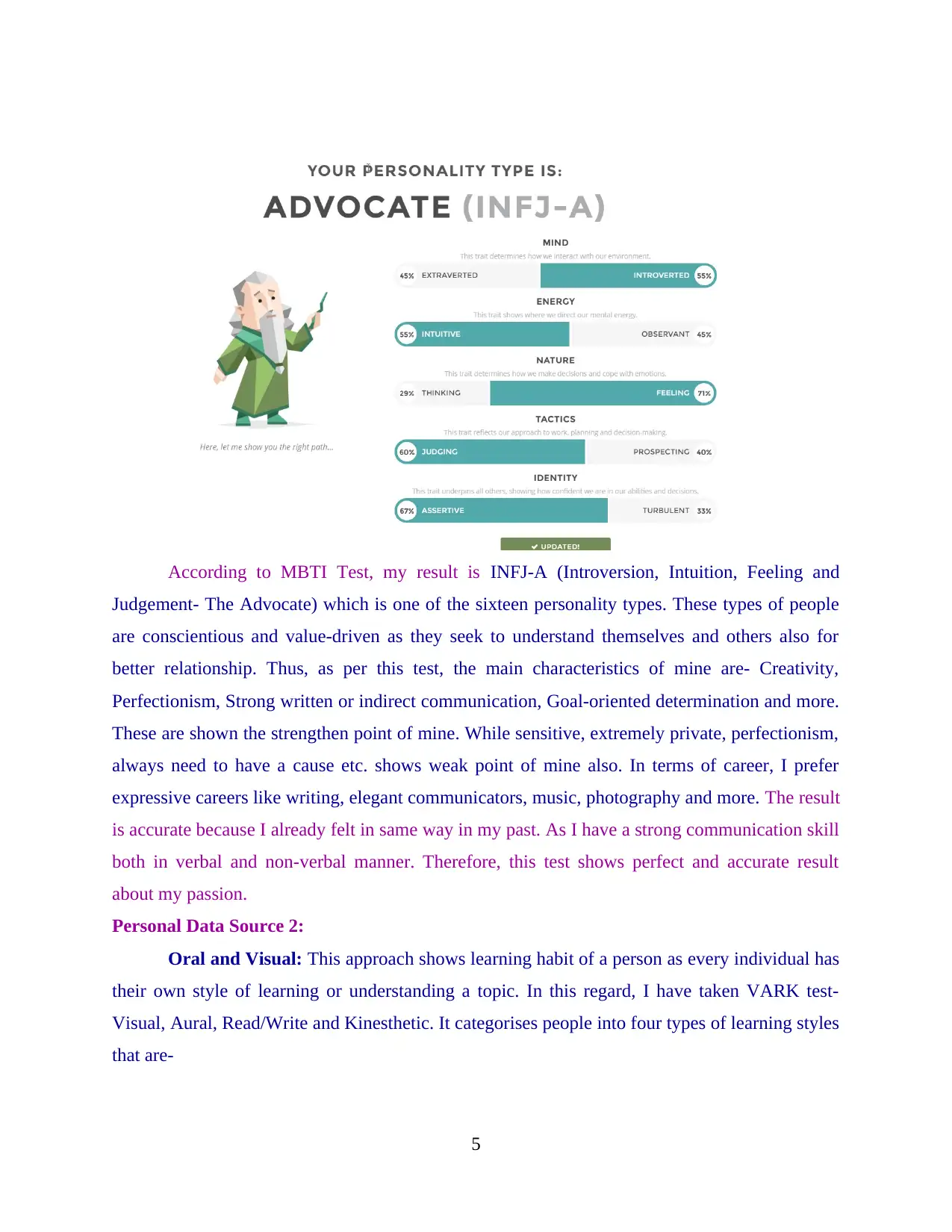
According to MBTI Test, my result is INFJ-A (Introversion, Intuition, Feeling and
Judgement- The Advocate) which is one of the sixteen personality types. These types of people
are conscientious and value-driven as they seek to understand themselves and others also for
better relationship. Thus, as per this test, the main characteristics of mine are- Creativity,
Perfectionism, Strong written or indirect communication, Goal-oriented determination and more.
These are shown the strengthen point of mine. While sensitive, extremely private, perfectionism,
always need to have a cause etc. shows weak point of mine also. In terms of career, I prefer
expressive careers like writing, elegant communicators, music, photography and more. The result
is accurate because I already felt in same way in my past. As I have a strong communication skill
both in verbal and non-verbal manner. Therefore, this test shows perfect and accurate result
about my passion.
Personal Data Source 2:
Oral and Visual: This approach shows learning habit of a person as every individual has
their own style of learning or understanding a topic. In this regard, I have taken VARK test-
Visual, Aural, Read/Write and Kinesthetic. It categorises people into four types of learning styles
that are-
5
Judgement- The Advocate) which is one of the sixteen personality types. These types of people
are conscientious and value-driven as they seek to understand themselves and others also for
better relationship. Thus, as per this test, the main characteristics of mine are- Creativity,
Perfectionism, Strong written or indirect communication, Goal-oriented determination and more.
These are shown the strengthen point of mine. While sensitive, extremely private, perfectionism,
always need to have a cause etc. shows weak point of mine also. In terms of career, I prefer
expressive careers like writing, elegant communicators, music, photography and more. The result
is accurate because I already felt in same way in my past. As I have a strong communication skill
both in verbal and non-verbal manner. Therefore, this test shows perfect and accurate result
about my passion.
Personal Data Source 2:
Oral and Visual: This approach shows learning habit of a person as every individual has
their own style of learning or understanding a topic. In this regard, I have taken VARK test-
Visual, Aural, Read/Write and Kinesthetic. It categorises people into four types of learning styles
that are-
5
Visual learners: These people learn by observing or seeing graphical pictures like charts,
diagrams, illustration and more, to understand a topic. In short, such learners prefers to
learn in visualise manner rather than to listen lectures or written form.
Auditory learners: These learners are learnt by listening lectures. They tend to
remembers things which are told in audio-video manner.
Read/Write learners: They prefer to take information which are displayed as words or
other learning materials like text-based.
Kinaesthetic learners: These learners learn by doing every thing in physical or practical
manner.
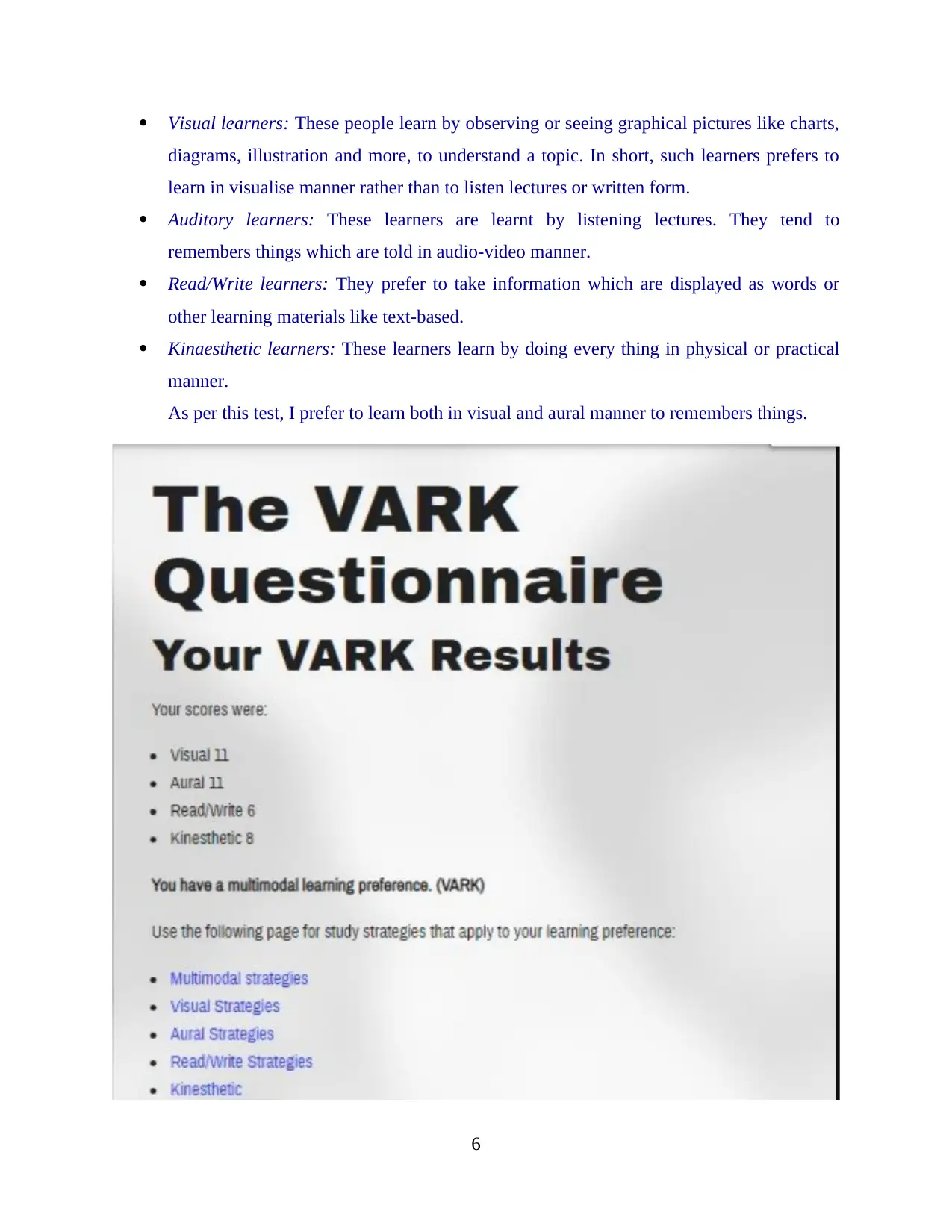
As per this test, I prefer to learn both in visual and aural manner to remembers things.
6
diagrams, illustration and more, to understand a topic. In short, such learners prefers to
learn in visualise manner rather than to listen lectures or written form.
Auditory learners: These learners are learnt by listening lectures. They tend to
remembers things which are told in audio-video manner.
Read/Write learners: They prefer to take information which are displayed as words or
other learning materials like text-based.
Kinaesthetic learners: These learners learn by doing every thing in physical or practical
manner.
As per this test, I prefer to learn both in visual and aural manner to remembers things.
6
⊘ This is a preview!⊘
Do you want full access?
Subscribe today to unlock all pages.
Trusted by 1+ million students worldwide
Diagnostic Approach: From the point of view of research design, diagnostic approach is
used to address two main aspects- what the research is about and why it is being conducted.
Therefore, to increase self-awareness means diagnose in what manner I have seen by others and
how others perceive my way. Through diagnostic approach which includes personality, values,
perceptions and various learning approaches, I can analyse that I have failed to engage in group
activities. But through effective communication, I am able to easily influence my colleagues
towards a common goal and objective.
Gibbs Reflective Cycle: This model refers to situations through which a person gains
own experience. By triggering different-different conditions of workplace, an individual shape
own experience and behaviour. In this regard, I have taken Gibbs Cycle Reflective Model for
deeper understanding the concept of self-awareness. It has helped me in understanding my own
strengths and key areas of development.
Personal Cultural Text:
Learning Diagnostic Self-Awareness Diagnostic Poetics and Creative
Expression
It refers to a tool which helps
in identifying learning
preferences and triggers points
to enhance self-awareness
through personal experiences.
Personal data can be extracted
through Honey and Mumford
theory of learning, Gibbs
model etc.
It concerns with techniques by
which an individual can
identify own strengths and
determine where improvement
is necessary.
Personal data here can be
extracted from personality
test, Emotional intelligence,
testimonies and so on.
It is a form of Aristotle
definition which includes a
metaphor and use a form of
visual metaphor to explore
behaviour, personal attitude
and make sense of emotions for
increasing self-awareness.
Personal data can be obtained
through poetry, lyrics, proverbs
and more.
Critical Evaluation of research design: Here in present research, to analyse the
concept of self-awareness and evaluate my own strengths and weaknesses, I have used various
sources of research methodologies. It includes Diagnostic approach, Gibbs Reflective Cycle and
Personal Cultural Text. In this regard, the most beneficial part of diagnostic research is analysing
whether approaches which I used for developing my managerial abilities are effective or not.
7
used to address two main aspects- what the research is about and why it is being conducted.
Therefore, to increase self-awareness means diagnose in what manner I have seen by others and
how others perceive my way. Through diagnostic approach which includes personality, values,
perceptions and various learning approaches, I can analyse that I have failed to engage in group
activities. But through effective communication, I am able to easily influence my colleagues
towards a common goal and objective.
Gibbs Reflective Cycle: This model refers to situations through which a person gains
own experience. By triggering different-different conditions of workplace, an individual shape
own experience and behaviour. In this regard, I have taken Gibbs Cycle Reflective Model for
deeper understanding the concept of self-awareness. It has helped me in understanding my own
strengths and key areas of development.
Personal Cultural Text:
Learning Diagnostic Self-Awareness Diagnostic Poetics and Creative
Expression
It refers to a tool which helps
in identifying learning
preferences and triggers points
to enhance self-awareness
through personal experiences.
Personal data can be extracted
through Honey and Mumford
theory of learning, Gibbs
model etc.
It concerns with techniques by
which an individual can
identify own strengths and
determine where improvement
is necessary.
Personal data here can be
extracted from personality
test, Emotional intelligence,
testimonies and so on.
It is a form of Aristotle
definition which includes a
metaphor and use a form of
visual metaphor to explore
behaviour, personal attitude
and make sense of emotions for
increasing self-awareness.
Personal data can be obtained
through poetry, lyrics, proverbs
and more.
Critical Evaluation of research design: Here in present research, to analyse the
concept of self-awareness and evaluate my own strengths and weaknesses, I have used various
sources of research methodologies. It includes Diagnostic approach, Gibbs Reflective Cycle and
Personal Cultural Text. In this regard, the most beneficial part of diagnostic research is analysing
whether approaches which I used for developing my managerial abilities are effective or not.
7
Paraphrase This Document
Need a fresh take? Get an instant paraphrase of this document with our AI Paraphraser
Through this process, I can adopt effective methods for improving my weaknesses in particular
area.
Bibliography:
Ellis, C., 2016. Revision: Autoethnographic reflections on life and work. Routledge.
Barge, J. K., 2014. Pivotal leadership and the art of conversation. Leadership. 10(1). pp.56-78.
Willink, K. G. and et. al., 2014. Navigating with the stars: Critical qualitative methodological
constellations for critical intercultural communication research. Journal of International
and Intercultural Communication. 7(4). pp.289-316.
Hellstén, M. and Ucker Perotto, L., 2018. Re-thinking internationalization as social curriculum
for generative supervision: letters from the international community of scholars.
European Journal of Higher Education. 8(1). pp.36-51.
Walz, M., Hoyer, P. and Statler, M., 2016. After Herzog: Blurring fact and fiction in visual
organizational ethnography. Journal of Organizational Ethnography. 5(3). pp.202-218.
Furness, J., Nikora, L.W., Hodgetts, D. and Robertson, N., 2016. Beyond ethics to morality:
Choices and relationships in bicultural research settings. Journal of Community &
Applied Social Psychology. 26(1). pp.75-88.
Online
Gibbs Reflective Cycle. 2015. [Online] Available Through:<https://www.crowe-
associates.co.uk/coaching-and-mentoring-skills/gibbs-reflective-cycle/>.
8
area.
Bibliography:
Ellis, C., 2016. Revision: Autoethnographic reflections on life and work. Routledge.
Barge, J. K., 2014. Pivotal leadership and the art of conversation. Leadership. 10(1). pp.56-78.
Willink, K. G. and et. al., 2014. Navigating with the stars: Critical qualitative methodological
constellations for critical intercultural communication research. Journal of International
and Intercultural Communication. 7(4). pp.289-316.
Hellstén, M. and Ucker Perotto, L., 2018. Re-thinking internationalization as social curriculum
for generative supervision: letters from the international community of scholars.
European Journal of Higher Education. 8(1). pp.36-51.
Walz, M., Hoyer, P. and Statler, M., 2016. After Herzog: Blurring fact and fiction in visual
organizational ethnography. Journal of Organizational Ethnography. 5(3). pp.202-218.
Furness, J., Nikora, L.W., Hodgetts, D. and Robertson, N., 2016. Beyond ethics to morality:
Choices and relationships in bicultural research settings. Journal of Community &
Applied Social Psychology. 26(1). pp.75-88.
Online
Gibbs Reflective Cycle. 2015. [Online] Available Through:<https://www.crowe-
associates.co.uk/coaching-and-mentoring-skills/gibbs-reflective-cycle/>.
8
The Reflexive Practitioner
Reflexive practitioner can be defined as a professional who challenges itself and other
routines of learning skills and abilities. For this purpose, they create space for understanding,
thinking and feeling own voice. By self-assessment, an individual can analyse own strengths and
identifies areas for development as well. A professional in this context can be defined as a life-
long learner who always seeks to continuous developing own practices. Therefore, understanding
the concept of self-awareness helps in developing professional identity. It has evaluated that
developing professional identity by learning practices seems to be hard and complex procedure.
Thus, for this assistance, I have taken the concept of 7 images of self-identity (Ellis, 2016). It
includes Self-doubters, Strugglers, Surfers, Storytellers, Strategists, Stencils and Soldiers. In this
regard, Self-doubters help in finding about myself, Strugglers shows that concept who am I and
Surfers highlights what I want to be. Similarly, Storytellers reflects the past journey or
experience, Strategists in what manner goals can be achieved and Stencils what I have grabbed
thereafter. In last, Soldiers stage reflects that after passing all stages what I have become now.
Thus, through these stages, I have analysed that I have good judgemental and problem
skills. This would reflects that I can become an effective manager in an organisation in
operational field. I can handle all major operations that an operational manager perform
systematically. The reason behind this is my past performance where I have worked on a college
project within a team 5 members. Under this assignment, I have played a team-leader role where
my work is to give instruction how to complete the same. Every team-member was happy by
working under my guidance as I have provided perfect direction and resolve their problems on
time.
By using Gibbs Reflective Model (Gibbs Reflective Cycle, 2016), I have analysed that there
are a number of attributes in me that will help me in becoming an effective manager for business
entity. These behavioural characteristics will assist me in enhancing my personality and
performing in a manner that ensures maximum satisfaction to me as well as the entity. Besides
this, I have evaluated that there are certain shortcomings in me which I need to consider while
taking my professional development to further stages wherein I can hold responsible duties. As
per my evaluation, it can be said that there are various positive as well as adverse aspects of my
personality for the role of manager in an entity. Yet I am not disappointed by my shortcomings
9
Reflexive practitioner can be defined as a professional who challenges itself and other
routines of learning skills and abilities. For this purpose, they create space for understanding,
thinking and feeling own voice. By self-assessment, an individual can analyse own strengths and
identifies areas for development as well. A professional in this context can be defined as a life-
long learner who always seeks to continuous developing own practices. Therefore, understanding
the concept of self-awareness helps in developing professional identity. It has evaluated that
developing professional identity by learning practices seems to be hard and complex procedure.
Thus, for this assistance, I have taken the concept of 7 images of self-identity (Ellis, 2016). It
includes Self-doubters, Strugglers, Surfers, Storytellers, Strategists, Stencils and Soldiers. In this
regard, Self-doubters help in finding about myself, Strugglers shows that concept who am I and
Surfers highlights what I want to be. Similarly, Storytellers reflects the past journey or
experience, Strategists in what manner goals can be achieved and Stencils what I have grabbed
thereafter. In last, Soldiers stage reflects that after passing all stages what I have become now.
Thus, through these stages, I have analysed that I have good judgemental and problem
skills. This would reflects that I can become an effective manager in an organisation in
operational field. I can handle all major operations that an operational manager perform
systematically. The reason behind this is my past performance where I have worked on a college
project within a team 5 members. Under this assignment, I have played a team-leader role where
my work is to give instruction how to complete the same. Every team-member was happy by
working under my guidance as I have provided perfect direction and resolve their problems on
time.
By using Gibbs Reflective Model (Gibbs Reflective Cycle, 2016), I have analysed that there
are a number of attributes in me that will help me in becoming an effective manager for business
entity. These behavioural characteristics will assist me in enhancing my personality and
performing in a manner that ensures maximum satisfaction to me as well as the entity. Besides
this, I have evaluated that there are certain shortcomings in me which I need to consider while
taking my professional development to further stages wherein I can hold responsible duties. As
per my evaluation, it can be said that there are various positive as well as adverse aspects of my
personality for the role of manager in an entity. Yet I am not disappointed by my shortcomings
9
⊘ This is a preview!⊘
Do you want full access?
Subscribe today to unlock all pages.
Trusted by 1+ million students worldwide

1 out of 19


Related Documents


Your All-in-One AI-Powered Toolkit for Academic Success.
+13062052269
info@desklib.com
Available 24*7 on WhatsApp / Email
![[object Object]](/_next/static/media/star-bottom.7253800d.svg)
Unlock your academic potential
Copyright © 2020–2026 A2Z Services. All Rights Reserved. Developed and managed by ZUCOL.