MGN442 Report: Self-Leadership and International Student Success
VerifiedAdded on 2023/01/16
|10
|2698
|64
Report
AI Summary
This report provides a comprehensive literature review on self-leadership theory, specifically exploring its relevance to international students. It delves into the core concepts of self-determination theory, including intrinsic and extrinsic motivation, and analyzes how these factors influence students' adaptation and academic success in a foreign environment. The report examines the interplay of autonomy, competence, and relatedness, highlighting the challenges faced by international students and the importance of fostering self-determination through supportive university programs and social integration. It also discusses the impact of language barriers and cultural differences on motivation and academic outcomes. The report references a variety of academic sources to support its analysis and emphasizes the role of self-leadership in navigating the complexities of studying abroad and achieving educational goals. Finally, the report provides a detailed analysis of how external factors influence the ability of an individual to attain academic success.

Running Head: SELF-LEADERSHIP THEORY 1
SELF-LEADERSHIP
Name
Institution
SELF-LEADERSHIP
Name
Institution

Paraphrase This Document
Need a fresh take? Get an instant paraphrase of this document with our AI Paraphraser
SELF-LEADERSHIP THEORY 2
Introduction
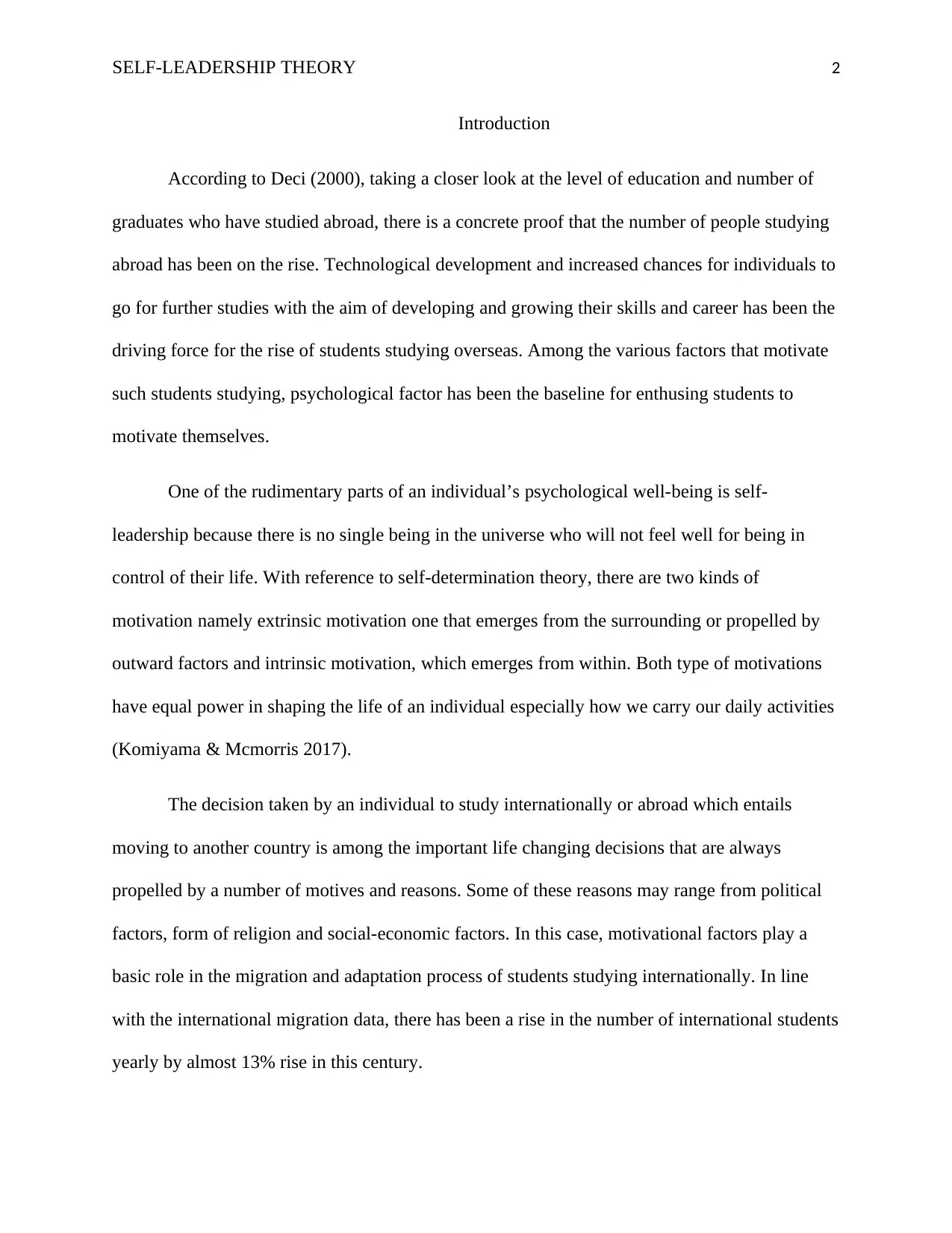
According to Deci (2000), taking a closer look at the level of education and number of
graduates who have studied abroad, there is a concrete proof that the number of people studying
abroad has been on the rise. Technological development and increased chances for individuals to
go for further studies with the aim of developing and growing their skills and career has been the
driving force for the rise of students studying overseas. Among the various factors that motivate
such students studying, psychological factor has been the baseline for enthusing students to
motivate themselves.
One of the rudimentary parts of an individual’s psychological well-being is self-
leadership because there is no single being in the universe who will not feel well for being in
control of their life. With reference to self-determination theory, there are two kinds of
motivation namely extrinsic motivation one that emerges from the surrounding or propelled by
outward factors and intrinsic motivation, which emerges from within. Both type of motivations
have equal power in shaping the life of an individual especially how we carry our daily activities
(Komiyama & Mcmorris 2017).
The decision taken by an individual to study internationally or abroad which entails
moving to another country is among the important life changing decisions that are always
propelled by a number of motives and reasons. Some of these reasons may range from political
factors, form of religion and social-economic factors. In this case, motivational factors play a
basic role in the migration and adaptation process of students studying internationally. In line
with the international migration data, there has been a rise in the number of international students
yearly by almost 13% rise in this century.
Introduction
According to Deci (2000), taking a closer look at the level of education and number of
graduates who have studied abroad, there is a concrete proof that the number of people studying
abroad has been on the rise. Technological development and increased chances for individuals to
go for further studies with the aim of developing and growing their skills and career has been the
driving force for the rise of students studying overseas. Among the various factors that motivate
such students studying, psychological factor has been the baseline for enthusing students to
motivate themselves.
One of the rudimentary parts of an individual’s psychological well-being is self-
leadership because there is no single being in the universe who will not feel well for being in
control of their life. With reference to self-determination theory, there are two kinds of
motivation namely extrinsic motivation one that emerges from the surrounding or propelled by
outward factors and intrinsic motivation, which emerges from within. Both type of motivations
have equal power in shaping the life of an individual especially how we carry our daily activities
(Komiyama & Mcmorris 2017).
The decision taken by an individual to study internationally or abroad which entails
moving to another country is among the important life changing decisions that are always
propelled by a number of motives and reasons. Some of these reasons may range from political
factors, form of religion and social-economic factors. In this case, motivational factors play a
basic role in the migration and adaptation process of students studying internationally. In line
with the international migration data, there has been a rise in the number of international students
yearly by almost 13% rise in this century.
SELF-LEADERSHIP THEORY 3
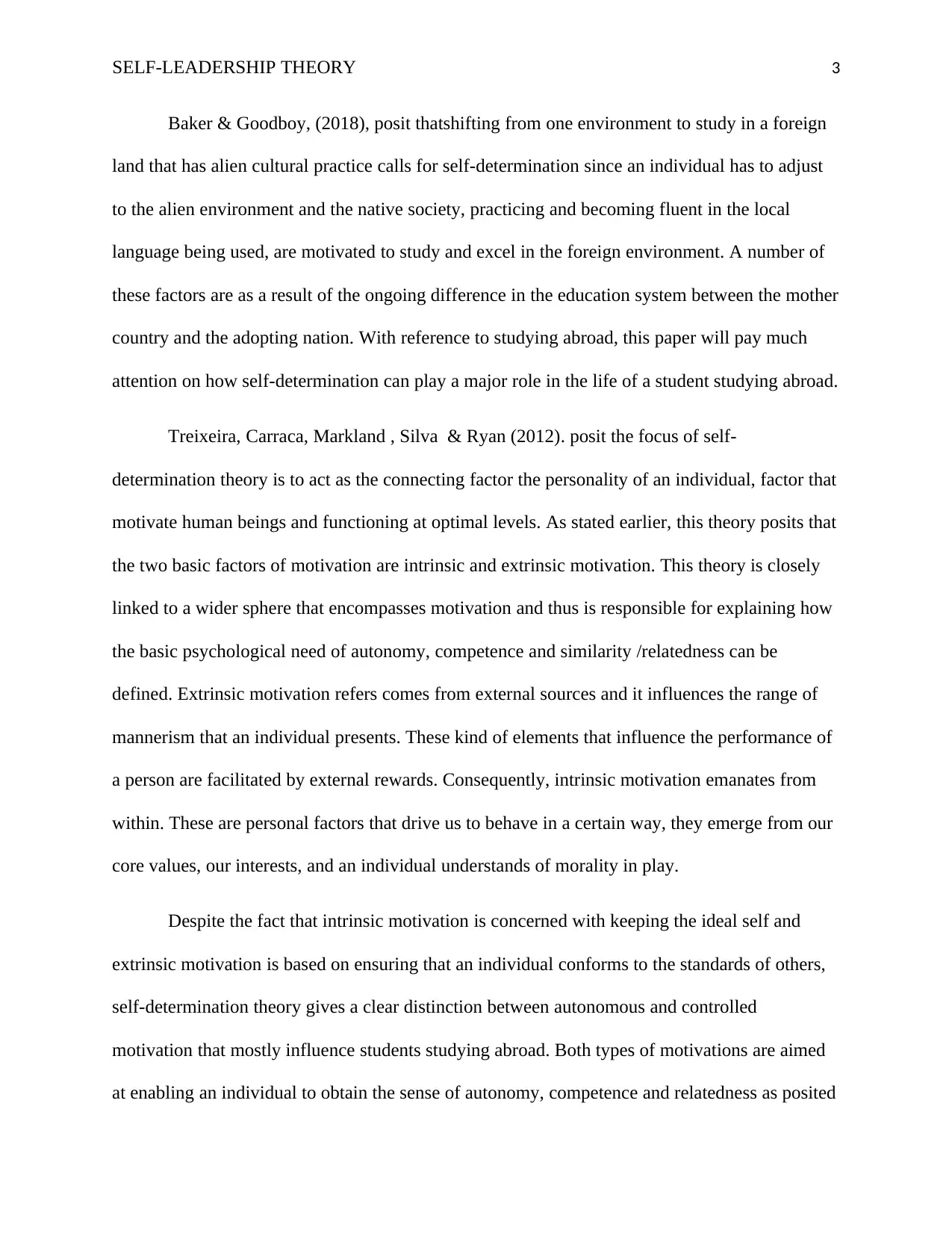
Baker & Goodboy, (2018), posit thatshifting from one environment to study in a foreign
land that has alien cultural practice calls for self-determination since an individual has to adjust
to the alien environment and the native society, practicing and becoming fluent in the local
language being used, are motivated to study and excel in the foreign environment. A number of
these factors are as a result of the ongoing difference in the education system between the mother
country and the adopting nation. With reference to studying abroad, this paper will pay much
attention on how self-determination can play a major role in the life of a student studying abroad.
Treixeira, Carraca, Markland , Silva & Ryan (2012). posit the focus of self-
determination theory is to act as the connecting factor the personality of an individual, factor that
motivate human beings and functioning at optimal levels. As stated earlier, this theory posits that
the two basic factors of motivation are intrinsic and extrinsic motivation. This theory is closely
linked to a wider sphere that encompasses motivation and thus is responsible for explaining how
the basic psychological need of autonomy, competence and similarity /relatedness can be
defined. Extrinsic motivation refers comes from external sources and it influences the range of
mannerism that an individual presents. These kind of elements that influence the performance of
a person are facilitated by external rewards. Consequently, intrinsic motivation emanates from
within. These are personal factors that drive us to behave in a certain way, they emerge from our
core values, our interests, and an individual understands of morality in play.
Despite the fact that intrinsic motivation is concerned with keeping the ideal self and
extrinsic motivation is based on ensuring that an individual conforms to the standards of others,
self-determination theory gives a clear distinction between autonomous and controlled
motivation that mostly influence students studying abroad. Both types of motivations are aimed
at enabling an individual to obtain the sense of autonomy, competence and relatedness as posited
Baker & Goodboy, (2018), posit thatshifting from one environment to study in a foreign
land that has alien cultural practice calls for self-determination since an individual has to adjust
to the alien environment and the native society, practicing and becoming fluent in the local
language being used, are motivated to study and excel in the foreign environment. A number of
these factors are as a result of the ongoing difference in the education system between the mother
country and the adopting nation. With reference to studying abroad, this paper will pay much
attention on how self-determination can play a major role in the life of a student studying abroad.
Treixeira, Carraca, Markland , Silva & Ryan (2012). posit the focus of self-
determination theory is to act as the connecting factor the personality of an individual, factor that
motivate human beings and functioning at optimal levels. As stated earlier, this theory posits that
the two basic factors of motivation are intrinsic and extrinsic motivation. This theory is closely
linked to a wider sphere that encompasses motivation and thus is responsible for explaining how
the basic psychological need of autonomy, competence and similarity /relatedness can be
defined. Extrinsic motivation refers comes from external sources and it influences the range of
mannerism that an individual presents. These kind of elements that influence the performance of
a person are facilitated by external rewards. Consequently, intrinsic motivation emanates from
within. These are personal factors that drive us to behave in a certain way, they emerge from our
core values, our interests, and an individual understands of morality in play.
Despite the fact that intrinsic motivation is concerned with keeping the ideal self and
extrinsic motivation is based on ensuring that an individual conforms to the standards of others,
self-determination theory gives a clear distinction between autonomous and controlled
motivation that mostly influence students studying abroad. Both types of motivations are aimed
at enabling an individual to obtain the sense of autonomy, competence and relatedness as posited
⊘ This is a preview!⊘
Do you want full access?
Subscribe today to unlock all pages.

Trusted by 1+ million students worldwide
SELF-LEADERSHIP THEORY 4
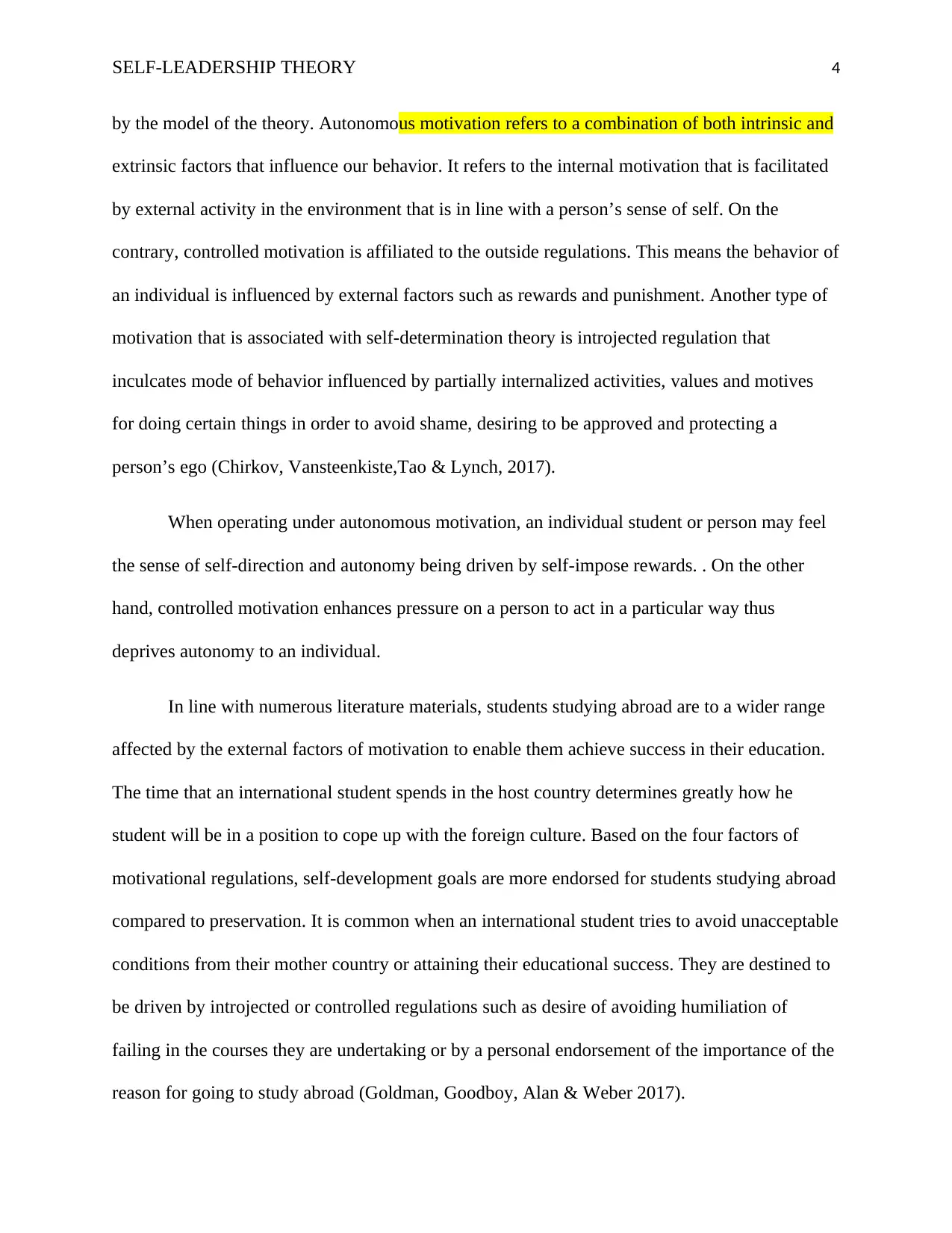
by the model of the theory. Autonomous motivation refers to a combination of both intrinsic and
extrinsic factors that influence our behavior. It refers to the internal motivation that is facilitated
by external activity in the environment that is in line with a person’s sense of self. On the
contrary, controlled motivation is affiliated to the outside regulations. This means the behavior of
an individual is influenced by external factors such as rewards and punishment. Another type of
motivation that is associated with self-determination theory is introjected regulation that
inculcates mode of behavior influenced by partially internalized activities, values and motives
for doing certain things in order to avoid shame, desiring to be approved and protecting a
person’s ego (Chirkov, Vansteenkiste,Tao & Lynch, 2017).
When operating under autonomous motivation, an individual student or person may feel
the sense of self-direction and autonomy being driven by self-impose rewards. . On the other
hand, controlled motivation enhances pressure on a person to act in a particular way thus
deprives autonomy to an individual.
In line with numerous literature materials, students studying abroad are to a wider range
affected by the external factors of motivation to enable them achieve success in their education.
The time that an international student spends in the host country determines greatly how he
student will be in a position to cope up with the foreign culture. Based on the four factors of
motivational regulations, self-development goals are more endorsed for students studying abroad
compared to preservation. It is common when an international student tries to avoid unacceptable
conditions from their mother country or attaining their educational success. They are destined to
be driven by introjected or controlled regulations such as desire of avoiding humiliation of
failing in the courses they are undertaking or by a personal endorsement of the importance of the
reason for going to study abroad (Goldman, Goodboy, Alan & Weber 2017).
by the model of the theory. Autonomous motivation refers to a combination of both intrinsic and
extrinsic factors that influence our behavior. It refers to the internal motivation that is facilitated
by external activity in the environment that is in line with a person’s sense of self. On the
contrary, controlled motivation is affiliated to the outside regulations. This means the behavior of
an individual is influenced by external factors such as rewards and punishment. Another type of
motivation that is associated with self-determination theory is introjected regulation that
inculcates mode of behavior influenced by partially internalized activities, values and motives
for doing certain things in order to avoid shame, desiring to be approved and protecting a
person’s ego (Chirkov, Vansteenkiste,Tao & Lynch, 2017).
When operating under autonomous motivation, an individual student or person may feel
the sense of self-direction and autonomy being driven by self-impose rewards. . On the other
hand, controlled motivation enhances pressure on a person to act in a particular way thus
deprives autonomy to an individual.
In line with numerous literature materials, students studying abroad are to a wider range
affected by the external factors of motivation to enable them achieve success in their education.
The time that an international student spends in the host country determines greatly how he
student will be in a position to cope up with the foreign culture. Based on the four factors of
motivational regulations, self-development goals are more endorsed for students studying abroad
compared to preservation. It is common when an international student tries to avoid unacceptable
conditions from their mother country or attaining their educational success. They are destined to
be driven by introjected or controlled regulations such as desire of avoiding humiliation of
failing in the courses they are undertaking or by a personal endorsement of the importance of the
reason for going to study abroad (Goldman, Goodboy, Alan & Weber 2017).
Paraphrase This Document
Need a fresh take? Get an instant paraphrase of this document with our AI Paraphraser
SELF-LEADERSHIP THEORY 5
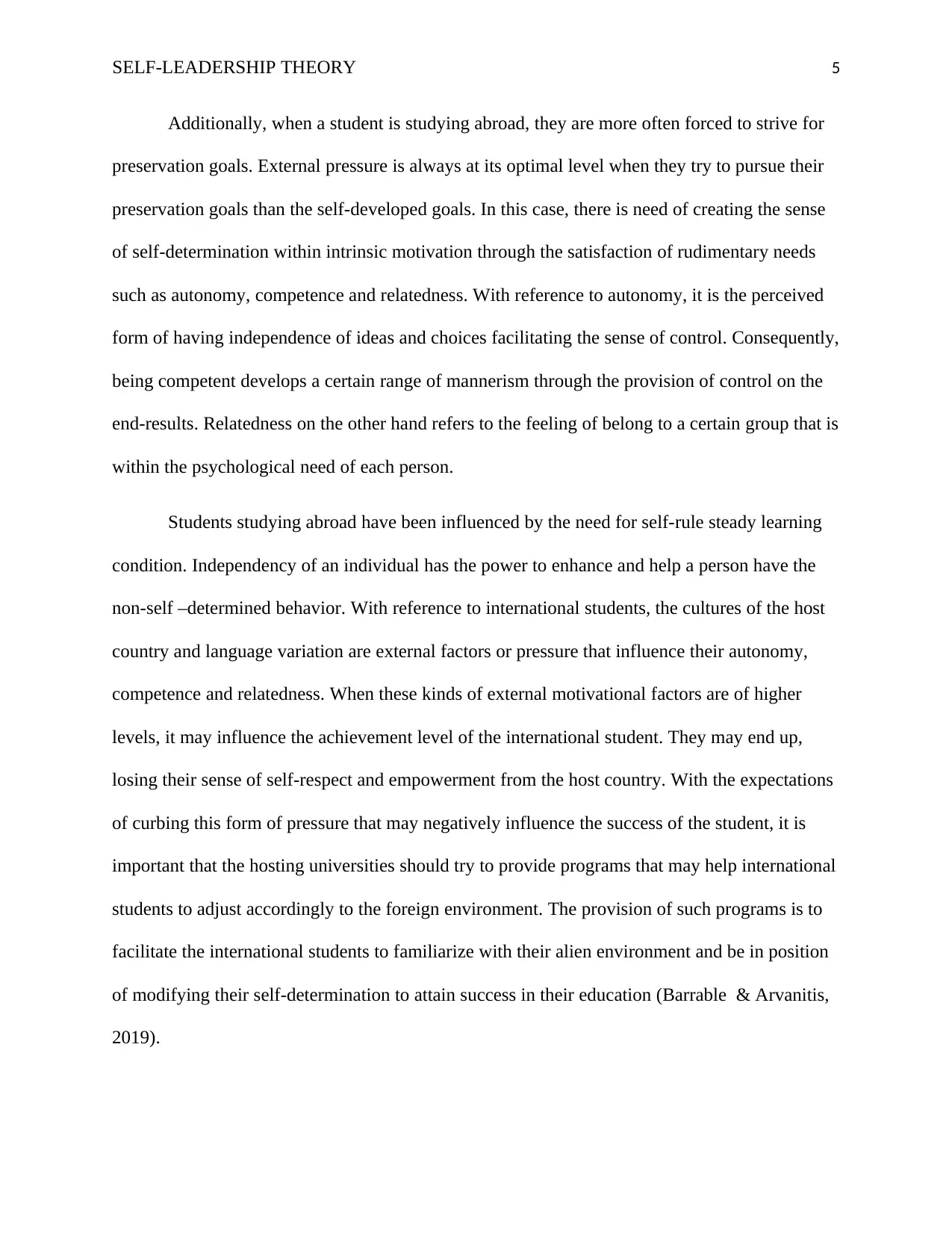
Additionally, when a student is studying abroad, they are more often forced to strive for
preservation goals. External pressure is always at its optimal level when they try to pursue their
preservation goals than the self-developed goals. In this case, there is need of creating the sense
of self-determination within intrinsic motivation through the satisfaction of rudimentary needs
such as autonomy, competence and relatedness. With reference to autonomy, it is the perceived
form of having independence of ideas and choices facilitating the sense of control. Consequently,
being competent develops a certain range of mannerism through the provision of control on the
end-results. Relatedness on the other hand refers to the feeling of belong to a certain group that is
within the psychological need of each person.
Students studying abroad have been influenced by the need for self-rule steady learning
condition. Independency of an individual has the power to enhance and help a person have the
non-self –determined behavior. With reference to international students, the cultures of the host
country and language variation are external factors or pressure that influence their autonomy,
competence and relatedness. When these kinds of external motivational factors are of higher
levels, it may influence the achievement level of the international student. They may end up,
losing their sense of self-respect and empowerment from the host country. With the expectations
of curbing this form of pressure that may negatively influence the success of the student, it is
important that the hosting universities should try to provide programs that may help international
students to adjust accordingly to the foreign environment. The provision of such programs is to
facilitate the international students to familiarize with their alien environment and be in position
of modifying their self-determination to attain success in their education (Barrable & Arvanitis,
2019).
Additionally, when a student is studying abroad, they are more often forced to strive for
preservation goals. External pressure is always at its optimal level when they try to pursue their
preservation goals than the self-developed goals. In this case, there is need of creating the sense
of self-determination within intrinsic motivation through the satisfaction of rudimentary needs
such as autonomy, competence and relatedness. With reference to autonomy, it is the perceived
form of having independence of ideas and choices facilitating the sense of control. Consequently,
being competent develops a certain range of mannerism through the provision of control on the
end-results. Relatedness on the other hand refers to the feeling of belong to a certain group that is
within the psychological need of each person.
Students studying abroad have been influenced by the need for self-rule steady learning
condition. Independency of an individual has the power to enhance and help a person have the
non-self –determined behavior. With reference to international students, the cultures of the host
country and language variation are external factors or pressure that influence their autonomy,
competence and relatedness. When these kinds of external motivational factors are of higher
levels, it may influence the achievement level of the international student. They may end up,
losing their sense of self-respect and empowerment from the host country. With the expectations
of curbing this form of pressure that may negatively influence the success of the student, it is
important that the hosting universities should try to provide programs that may help international
students to adjust accordingly to the foreign environment. The provision of such programs is to
facilitate the international students to familiarize with their alien environment and be in position
of modifying their self-determination to attain success in their education (Barrable & Arvanitis,
2019).
SELF-LEADERSHIP THEORY 6
Many theorists and literature material suggest that international students are mostly
driven by autonomous motivation due to its psychological importance. Autonomy is the product
of individualistic culture that entails the dominance of old traditions and group norms that are
centralized in the thinking of western cultures. Taking an example of international students from
developed countries will not be in the position of enjoying autonomy of the surrounding
environment of third-world countries. Instead of accepting the solution of bringing equity to the
autonomy of self-determination, a number of researchers are busy supporting and promoting the
tilt of autonomy towards responsibility of self and opposed to independence that can be used in
ensuring there is numerous approach to knowledge acquisition (Barrable & Arvanitis, 2019).
The third aspect of self-determination theory is relatedness. This sphere can only be
adhered to if an international student is in position of integrating accepting the norms and
practices which are prevalent in the native society of the host country and are positively
influencing the educational achievement of the student. The basic need according to a number of
researches is to provide a social environment that can lead to development of an individual in al
spheres favorably. This aspect is relevant since it may act as a defense strategy for developing
internal motivation in times of difficult among foreign students. It is essential that the hosting
university of the international students should try to create spheres that may help develop
positive relations among foreign students and their local peers as they are exposed to numerous
cultures that are alien. Provision of supportive environment to new international students during
early stages may facilitate their adaptation thus developing self-determination motives to achieve
academic success.
With reference to Deci and Ryan (2008), the engagement of the society and local peers in
self-determination process for international students is vital. Many internationals students are
Many theorists and literature material suggest that international students are mostly
driven by autonomous motivation due to its psychological importance. Autonomy is the product
of individualistic culture that entails the dominance of old traditions and group norms that are
centralized in the thinking of western cultures. Taking an example of international students from
developed countries will not be in the position of enjoying autonomy of the surrounding
environment of third-world countries. Instead of accepting the solution of bringing equity to the
autonomy of self-determination, a number of researchers are busy supporting and promoting the
tilt of autonomy towards responsibility of self and opposed to independence that can be used in
ensuring there is numerous approach to knowledge acquisition (Barrable & Arvanitis, 2019).
The third aspect of self-determination theory is relatedness. This sphere can only be
adhered to if an international student is in position of integrating accepting the norms and
practices which are prevalent in the native society of the host country and are positively
influencing the educational achievement of the student. The basic need according to a number of
researches is to provide a social environment that can lead to development of an individual in al
spheres favorably. This aspect is relevant since it may act as a defense strategy for developing
internal motivation in times of difficult among foreign students. It is essential that the hosting
university of the international students should try to create spheres that may help develop
positive relations among foreign students and their local peers as they are exposed to numerous
cultures that are alien. Provision of supportive environment to new international students during
early stages may facilitate their adaptation thus developing self-determination motives to achieve
academic success.
With reference to Deci and Ryan (2008), the engagement of the society and local peers in
self-determination process for international students is vital. Many internationals students are
⊘ This is a preview!⊘
Do you want full access?
Subscribe today to unlock all pages.
Trusted by 1+ million students worldwide
SELF-LEADERSHIP THEORY 7
faced with a number of challenges such as language barrier hence distorted communication and
new cultures that greatly influence the related element of a person hence provoking decrease in
internal motivation. As posited by Trice (2004) communication is among the main factors that
may influence the success of international students in their education. For instance, a student
from USA may experience academic deficit due to barriers of communicating in Chinese
language. One needs to be fluent enough to gain the motivation and courage of attaining success.
In this case, language barrier has the ability of deterring the relatedness element of self-
determination and academic success.
In line with Ryan & Ryan (2018), competence as one of the pillars of self-determination
plays a crucial role in determining the success of a student studying abroad academically. To
achieve competence among international students, it is mandatory for their acts, choices and
range of mannerism to be acceptable and acknowledged with members of the hosting country.
An individual may gain the courage and motivation to tackle complex tasks if their decisions are
positively taken by the society. Competence is influenced greatly by the environment of an
individual especially those in foreign nations (Treixeira, Carraca, Markland, Silva & Ryan,
2012). The degree to which an individual is accepted by the society greatly affects their
academic success and competence. The role of the university hosting international students is
thus try and orientate the international students in a manner that can help them make decisions
and choices that can be comprehended buy the society. Most researchers has overlooked this
aspect of competence of international students due to absence of standardized technics of
determining the kind of decisions to be undertaken by an individual.
Carey, Maillet and Grouzet (2018), argue that a supportive environment is the key f
motivating international students to tackle complex topics. Additionally, it may be quite difficult
faced with a number of challenges such as language barrier hence distorted communication and
new cultures that greatly influence the related element of a person hence provoking decrease in
internal motivation. As posited by Trice (2004) communication is among the main factors that
may influence the success of international students in their education. For instance, a student
from USA may experience academic deficit due to barriers of communicating in Chinese
language. One needs to be fluent enough to gain the motivation and courage of attaining success.
In this case, language barrier has the ability of deterring the relatedness element of self-
determination and academic success.
In line with Ryan & Ryan (2018), competence as one of the pillars of self-determination
plays a crucial role in determining the success of a student studying abroad academically. To
achieve competence among international students, it is mandatory for their acts, choices and
range of mannerism to be acceptable and acknowledged with members of the hosting country.
An individual may gain the courage and motivation to tackle complex tasks if their decisions are
positively taken by the society. Competence is influenced greatly by the environment of an
individual especially those in foreign nations (Treixeira, Carraca, Markland, Silva & Ryan,
2012). The degree to which an individual is accepted by the society greatly affects their
academic success and competence. The role of the university hosting international students is
thus try and orientate the international students in a manner that can help them make decisions
and choices that can be comprehended buy the society. Most researchers has overlooked this
aspect of competence of international students due to absence of standardized technics of
determining the kind of decisions to be undertaken by an individual.
Carey, Maillet and Grouzet (2018), argue that a supportive environment is the key f
motivating international students to tackle complex topics. Additionally, it may be quite difficult
Paraphrase This Document
Need a fresh take? Get an instant paraphrase of this document with our AI Paraphraser
SELF-LEADERSHIP THEORY 8
for international student to be competent due to the difference in systems of education and
language when compared to local students. With reference to the discussion pinpointed above, it
is clear that the level of competence of students studying abroad is dependent on the autonomy of
the individual and how acceptable the person is taken by the hosting society. When the activities
of such students are accepted, it plays a crucial role in developing self-determination that can
lead to academic success.
External factors greatly influence the ability of an individual to attain academic success.
Referencing this to international students, they will only engage themselves in activities that
promote their comfort level. If the activities are in favor of the student, it can help build an
individual who is self-determined to achieve or attain his goals.
To sum up, academic success is not an issue that solely dependent on the individuals
intelligent quotient but rather it is affected by a number both intrinsic and extrinsic factors that
interrelate to create motivation to an international student. The mastery of self-determination
depends on the three correlated factors namely; autonomy, competence and relatedness for one to
experience success.
for international student to be competent due to the difference in systems of education and
language when compared to local students. With reference to the discussion pinpointed above, it
is clear that the level of competence of students studying abroad is dependent on the autonomy of
the individual and how acceptable the person is taken by the hosting society. When the activities
of such students are accepted, it plays a crucial role in developing self-determination that can
lead to academic success.
External factors greatly influence the ability of an individual to attain academic success.
Referencing this to international students, they will only engage themselves in activities that
promote their comfort level. If the activities are in favor of the student, it can help build an
individual who is self-determined to achieve or attain his goals.
To sum up, academic success is not an issue that solely dependent on the individuals
intelligent quotient but rather it is affected by a number both intrinsic and extrinsic factors that
interrelate to create motivation to an international student. The mastery of self-determination
depends on the three correlated factors namely; autonomy, competence and relatedness for one to
experience success.
SELF-LEADERSHIP THEORY 9
References
Baker, J. P., & Goodboy, A. K. (2018). Students’ Self-Determination as a Consequence of
Instructor Misbehaviors. Communication Research Reports, 35(1), 68–73.
Barrable A. & Arvanitis, A. (2019). Flourishing in the forest: looking at Forest School through a
self-determination theory lens. Journal of Outdoor & Environmental Education, 22(1),
39–55.
Carey, T. M., Maillet, M. A., & Grouzet, F. M. E. (2018). Self-regulation of student drinking
behavior: Strength-energy and self-determination theory perspectives. Motivation
Science.
Chirkov, V., Vansteenkiste, M., Tao, R., & Lynch, M. (2007). The role of self-determined
motivation and goals for study abroad in the adaptation of international students.
International Journal of Intercultural Relations, 199-222.
Deci, E. L. (2000). Self-determination theory and the facilitation of intrinsic motivation, social
development, and well-being. American Psychologist, 55(1), 68–78.
Deci, L, E., & Ryan. (2008). Self-determination theory: A macrotheory of human motivation,
development, and health. Self-determination theory, 182-185.
Fletcher, J. (2016). Applying Self-Determination Theory to College Students’ Physical-Activity
Behavior: Understanding the Motivators for Physical (In)Activity. Communication
Studies, 67(5), 489–508
References
Baker, J. P., & Goodboy, A. K. (2018). Students’ Self-Determination as a Consequence of
Instructor Misbehaviors. Communication Research Reports, 35(1), 68–73.
Barrable A. & Arvanitis, A. (2019). Flourishing in the forest: looking at Forest School through a
self-determination theory lens. Journal of Outdoor & Environmental Education, 22(1),
39–55.
Carey, T. M., Maillet, M. A., & Grouzet, F. M. E. (2018). Self-regulation of student drinking
behavior: Strength-energy and self-determination theory perspectives. Motivation
Science.
Chirkov, V., Vansteenkiste, M., Tao, R., & Lynch, M. (2007). The role of self-determined
motivation and goals for study abroad in the adaptation of international students.
International Journal of Intercultural Relations, 199-222.
Deci, E. L. (2000). Self-determination theory and the facilitation of intrinsic motivation, social
development, and well-being. American Psychologist, 55(1), 68–78.
Deci, L, E., & Ryan. (2008). Self-determination theory: A macrotheory of human motivation,
development, and health. Self-determination theory, 182-185.
Fletcher, J. (2016). Applying Self-Determination Theory to College Students’ Physical-Activity
Behavior: Understanding the Motivators for Physical (In)Activity. Communication
Studies, 67(5), 489–508
⊘ This is a preview!⊘
Do you want full access?
Subscribe today to unlock all pages.
Trusted by 1+ million students worldwide
SELF-LEADERSHIP THEORY 10
Goldman, Z. W, Goodboy, Alan K., Weber, K.,(2017). College Students’ Psychological Needs
and Intrinsic Motivation to Learn: An Examination of Self-Determination
Theory. Communication Quarterly, 65(2), 167–191.
Komiyama, R. & Mcmorris, A., (2017). Examining International Students’ Motivation to Read
in English From a Self-Determination Theory Perspective. CATESOL Journal, 29(2), 61–
80.
Ryan, W. S., & Ryan, R. M. (2018). Toward a social psychology of authenticity: Exploring
within-person variation in autonomy, congruence, and genuineness using self-
determination theory. Self-Determination Theory. Communication Quarterly, 65(2), 167–
191.
Treixeira, P., Carraca, E., Markland , D., Silva , M., & Ryan, R. (2012). Exercise, physical
activity, and self-determination theory: A systematic review. International Journal of
Behavioral Nutrition and Physical Activity.
Goldman, Z. W, Goodboy, Alan K., Weber, K.,(2017). College Students’ Psychological Needs
and Intrinsic Motivation to Learn: An Examination of Self-Determination
Theory. Communication Quarterly, 65(2), 167–191.
Komiyama, R. & Mcmorris, A., (2017). Examining International Students’ Motivation to Read
in English From a Self-Determination Theory Perspective. CATESOL Journal, 29(2), 61–
80.
Ryan, W. S., & Ryan, R. M. (2018). Toward a social psychology of authenticity: Exploring
within-person variation in autonomy, congruence, and genuineness using self-
determination theory. Self-Determination Theory. Communication Quarterly, 65(2), 167–
191.
Treixeira, P., Carraca, E., Markland , D., Silva , M., & Ryan, R. (2012). Exercise, physical
activity, and self-determination theory: A systematic review. International Journal of
Behavioral Nutrition and Physical Activity.

1 out of 10


Related Documents


Your All-in-One AI-Powered Toolkit for Academic Success.
+13062052269
info@desklib.com
Available 24*7 on WhatsApp / Email
![[object Object]](/_next/static/media/star-bottom.7253800d.svg)
Unlock your academic potential
Copyright © 2020–2026 A2Z Services. All Rights Reserved. Developed and managed by ZUCOL.