Skills Evaluation & Personal Development Plan: A Detailed Report
VerifiedAdded on 2020/05/04
|25
|5150
|123
Report
AI Summary
This report provides a comprehensive analysis of personal and professional development, focusing on self-managed learning approaches, learning styles, and the encouragement of lifelong learning. It evaluates the benefits of self-managed learning for both individuals and organizations. The report identifies a work-based problem related to team management and proposes solutions, discussing learning styles to overcome these challenges and time management strategies for improved efficiency. Furthermore, it includes a skills evaluation against professional standards, the creation of a competency-based CV, and the identification of personal and professional development needs, culminating in a detailed personal development plan with short-term and long-term objectives. The document also reflects on the learning process, documents planned activities, and updates the PDP based on evaluation and feedback. Desklib offers similar solved assignments and resources for students.
RUNNING HEAD: Personal and Professional Development
Personal and Professional Development
Personal and Professional Development

Paraphrase This Document
Need a fresh take? Get an instant paraphrase of this document with our AI Paraphraser
Personal and Professional Development 1
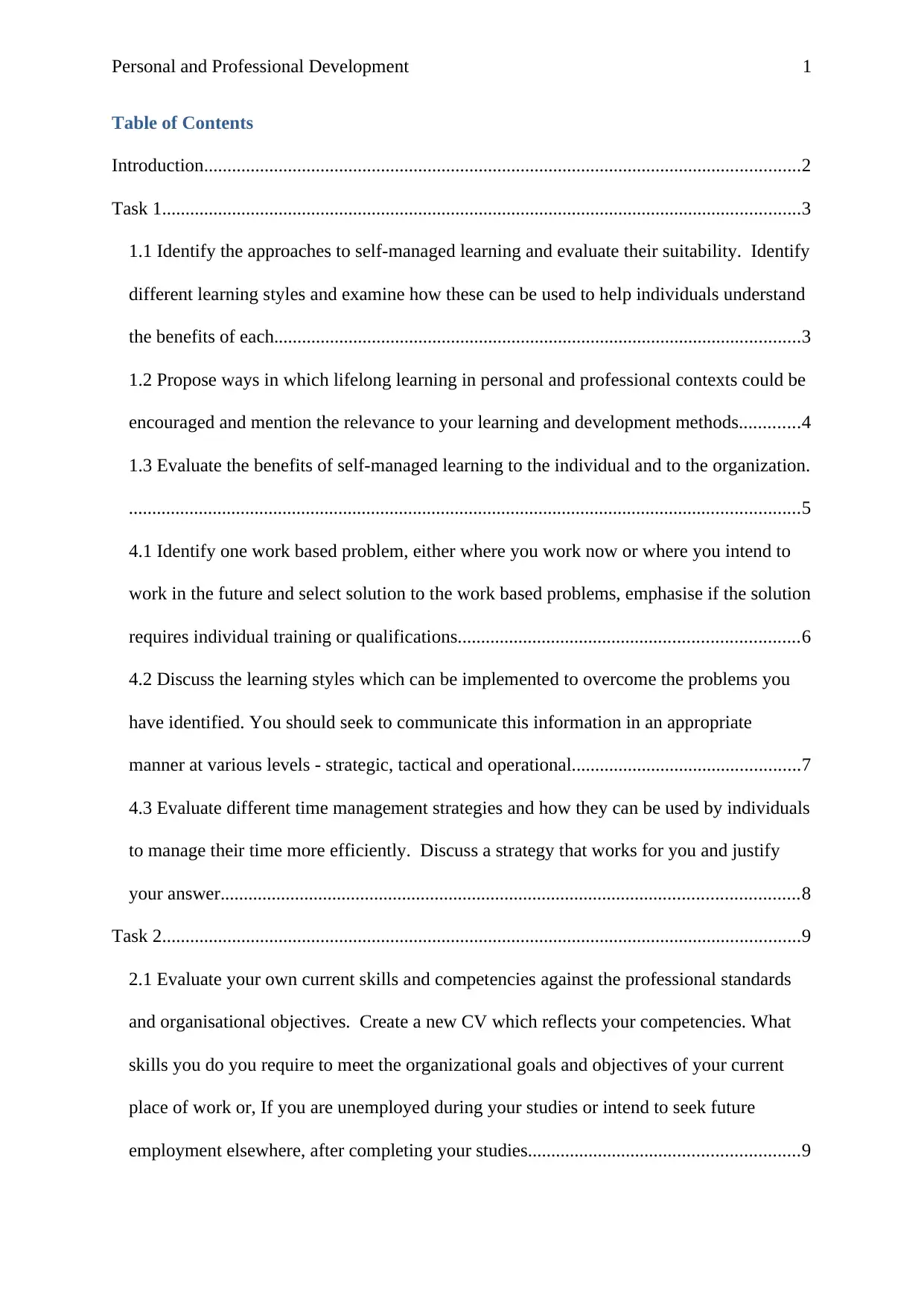
Table of Contents
Introduction................................................................................................................................2
Task 1.........................................................................................................................................3
1.1 Identify the approaches to self-managed learning and evaluate their suitability. Identify
different learning styles and examine how these can be used to help individuals understand
the benefits of each.................................................................................................................3
1.2 Propose ways in which lifelong learning in personal and professional contexts could be
encouraged and mention the relevance to your learning and development methods.............4
1.3 Evaluate the benefits of self-managed learning to the individual and to the organization.
................................................................................................................................................5
4.1 Identify one work based problem, either where you work now or where you intend to
work in the future and select solution to the work based problems, emphasise if the solution
requires individual training or qualifications.........................................................................6
4.2 Discuss the learning styles which can be implemented to overcome the problems you
have identified. You should seek to communicate this information in an appropriate
manner at various levels - strategic, tactical and operational.................................................7
4.3 Evaluate different time management strategies and how they can be used by individuals
to manage their time more efficiently. Discuss a strategy that works for you and justify
your answer............................................................................................................................8
Task 2.........................................................................................................................................9
2.1 Evaluate your own current skills and competencies against the professional standards
and organisational objectives. Create a new CV which reflects your competencies. What
skills you do you require to meet the organizational goals and objectives of your current
place of work or, If you are unemployed during your studies or intend to seek future
employment elsewhere, after completing your studies..........................................................9
Table of Contents
Introduction................................................................................................................................2
Task 1.........................................................................................................................................3
1.1 Identify the approaches to self-managed learning and evaluate their suitability. Identify
different learning styles and examine how these can be used to help individuals understand
the benefits of each.................................................................................................................3
1.2 Propose ways in which lifelong learning in personal and professional contexts could be
encouraged and mention the relevance to your learning and development methods.............4
1.3 Evaluate the benefits of self-managed learning to the individual and to the organization.
................................................................................................................................................5
4.1 Identify one work based problem, either where you work now or where you intend to
work in the future and select solution to the work based problems, emphasise if the solution
requires individual training or qualifications.........................................................................6
4.2 Discuss the learning styles which can be implemented to overcome the problems you
have identified. You should seek to communicate this information in an appropriate
manner at various levels - strategic, tactical and operational.................................................7
4.3 Evaluate different time management strategies and how they can be used by individuals
to manage their time more efficiently. Discuss a strategy that works for you and justify
your answer............................................................................................................................8
Task 2.........................................................................................................................................9
2.1 Evaluate your own current skills and competencies against the professional standards
and organisational objectives. Create a new CV which reflects your competencies. What
skills you do you require to meet the organizational goals and objectives of your current
place of work or, If you are unemployed during your studies or intend to seek future
employment elsewhere, after completing your studies..........................................................9
Personal and Professional Development 2
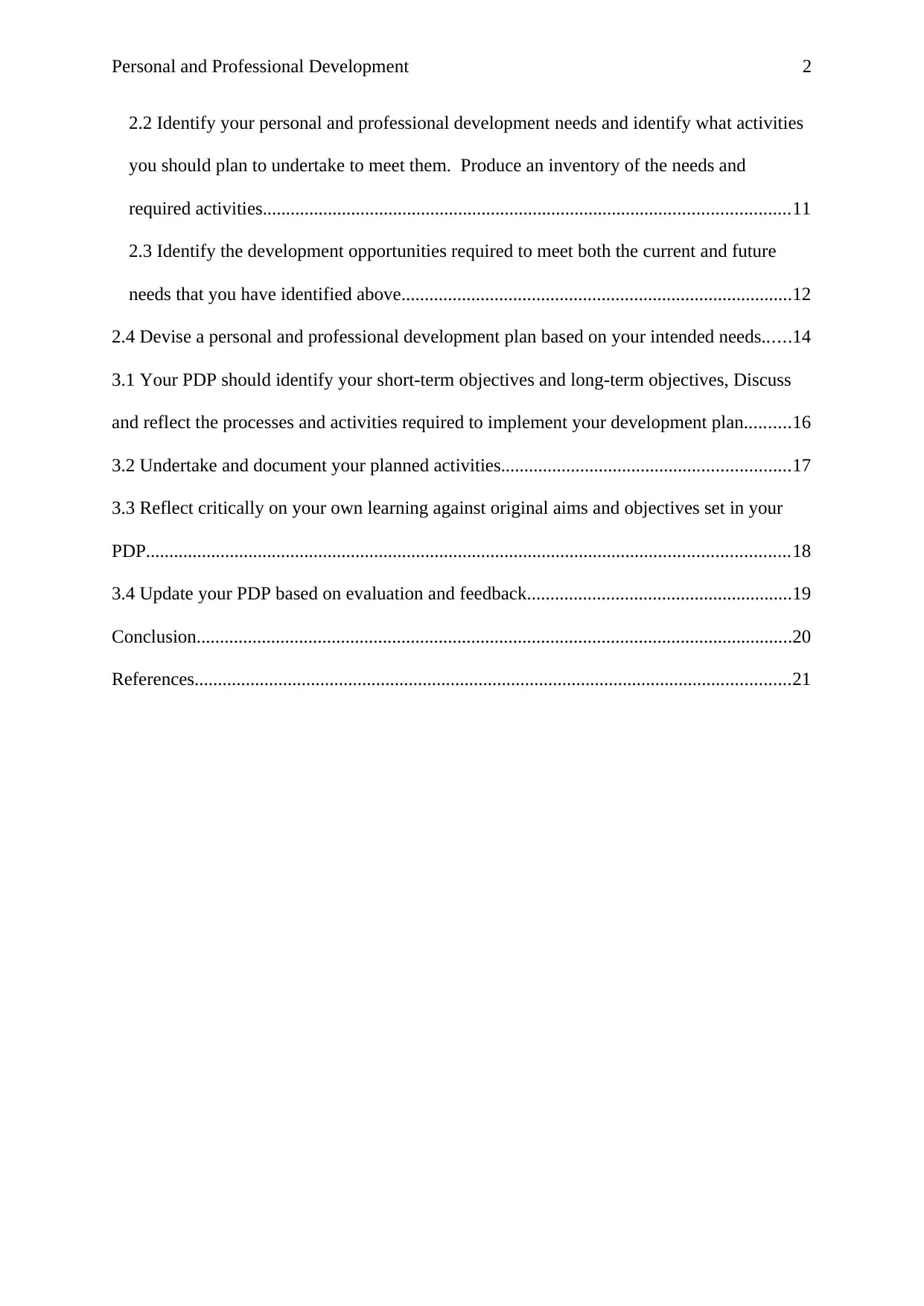
2.2 Identify your personal and professional development needs and identify what activities
you should plan to undertake to meet them. Produce an inventory of the needs and
required activities.................................................................................................................11
2.3 Identify the development opportunities required to meet both the current and future
needs that you have identified above....................................................................................12
2.4 Devise a personal and professional development plan based on your intended needs......14
3.1 Your PDP should identify your short-term objectives and long-term objectives, Discuss
and reflect the processes and activities required to implement your development plan..........16
3.2 Undertake and document your planned activities..............................................................17
3.3 Reflect critically on your own learning against original aims and objectives set in your
PDP..........................................................................................................................................18
3.4 Update your PDP based on evaluation and feedback.........................................................19
Conclusion................................................................................................................................20
References................................................................................................................................21
2.2 Identify your personal and professional development needs and identify what activities
you should plan to undertake to meet them. Produce an inventory of the needs and
required activities.................................................................................................................11
2.3 Identify the development opportunities required to meet both the current and future
needs that you have identified above....................................................................................12
2.4 Devise a personal and professional development plan based on your intended needs......14
3.1 Your PDP should identify your short-term objectives and long-term objectives, Discuss
and reflect the processes and activities required to implement your development plan..........16
3.2 Undertake and document your planned activities..............................................................17
3.3 Reflect critically on your own learning against original aims and objectives set in your
PDP..........................................................................................................................................18
3.4 Update your PDP based on evaluation and feedback.........................................................19
Conclusion................................................................................................................................20
References................................................................................................................................21
⊘ This is a preview!⊘
Do you want full access?
Subscribe today to unlock all pages.

Trusted by 1+ million students worldwide
Personal and Professional Development 3
Introduction
Personal and professional development is an important aspect which focuses on the
enhancement or development of the individual on the personal and professional basis. There
are various aspects related to the concept of personal and professional development which
will be covered in this program. Every individual must develop confidence and positive
attitude so as to enhance the experience gained. Personal development will be discussed in
this program which will outline the learning process of the individual. The self-managed
learning process will be covered in this program which will focus on the development of the
individual for enhancing the experience of the individual.
Introduction
Personal and professional development is an important aspect which focuses on the
enhancement or development of the individual on the personal and professional basis. There
are various aspects related to the concept of personal and professional development which
will be covered in this program. Every individual must develop confidence and positive
attitude so as to enhance the experience gained. Personal development will be discussed in
this program which will outline the learning process of the individual. The self-managed
learning process will be covered in this program which will focus on the development of the
individual for enhancing the experience of the individual.
Paraphrase This Document
Need a fresh take? Get an instant paraphrase of this document with our AI Paraphraser
Personal and Professional Development 4
Task 1
1.1 Identify the approaches to self-managed learning and evaluate their suitability.
Identify different learning styles and examine how these can be used to help individuals
understand the benefits of each.
Different approaches to self-managed learning can be used by the individual for the personal
and professional development. These approaches include mentoring and coaching, social
networks, seminars and conferences, and internet. Seminars and conferences can be used for
sharing information, thoughts or views with different individuals. This will enhance the
knowledge and contribute to the learning process. Use of social networks is increasing with a
motive to enhance the knowledge. An individual can interact with anyone from anywhere
with the use of social networks. The Internet is another common and popular medium from
where an individual can learn about anything at minimal cost. Coaching can be taken from
the knowledgeable person for enhancing the learning and contributing to the experience
(Cunningham, 2010).
Different learning styles can be used for the self-managed learning. These learning styles
include visual learning style, verbal learning style, social learning style and logical learning
style. These different learning styles will create a positive impact on the learning of the
individual by contributing to the effective self-managed learning process. In visual learning
style, pictures, images, and spatial understanding are used. In verbal learning style, words,
speech, and writing are used. In the social learning style, an individual learns by engaging in
a group. In the logical learning style, learning is done on the basis of logic, reasoning, and
systems (Bunderson & Boumgarden, 2010).
Task 1
1.1 Identify the approaches to self-managed learning and evaluate their suitability.
Identify different learning styles and examine how these can be used to help individuals
understand the benefits of each.
Different approaches to self-managed learning can be used by the individual for the personal
and professional development. These approaches include mentoring and coaching, social
networks, seminars and conferences, and internet. Seminars and conferences can be used for
sharing information, thoughts or views with different individuals. This will enhance the
knowledge and contribute to the learning process. Use of social networks is increasing with a
motive to enhance the knowledge. An individual can interact with anyone from anywhere
with the use of social networks. The Internet is another common and popular medium from
where an individual can learn about anything at minimal cost. Coaching can be taken from
the knowledgeable person for enhancing the learning and contributing to the experience
(Cunningham, 2010).
Different learning styles can be used for the self-managed learning. These learning styles
include visual learning style, verbal learning style, social learning style and logical learning
style. These different learning styles will create a positive impact on the learning of the
individual by contributing to the effective self-managed learning process. In visual learning
style, pictures, images, and spatial understanding are used. In verbal learning style, words,
speech, and writing are used. In the social learning style, an individual learns by engaging in
a group. In the logical learning style, learning is done on the basis of logic, reasoning, and
systems (Bunderson & Boumgarden, 2010).
Personal and Professional Development 5
1.2 Propose ways in which lifelong learning in personal and professional contexts could
be encouraged and mention the relevance to your learning and development methods.
Lifelong learning is an important aspect which forms a base for the experience of the
individual. An individual can adopt different ways which encourage lifelong learning for an
individual on the personal and professional basis. These are discussed below:
1. Further education program: an individual can engage in the further education program
for the purpose of enhancing the lifelong learning. An individual can continue the
studies which will help the individual in learning new aspects. An individual can
explore the different aspects related to the industry with the help of this way (Abiy, et.
al., 2014).
2. Self-directed learning: self-directing learning process will help the individual in
setting the objectives or goals which will be attained with efforts of the individual. An
individual directs the efforts towards the right direction.
3. Self-evaluation: an individual can analyze the performance of its own. An individual
can set the standards on the basis of which actual performance of the individual can
be measured. Gaps can be identified and measures can be adopted for filling the gaps.
4. Motivation and communication: motivation will help the individual by enhancing
their morale and encouraging them to perform better. Communication will be used for
interacting with the others effectively (Sugarman, 2011).
1.2 Propose ways in which lifelong learning in personal and professional contexts could
be encouraged and mention the relevance to your learning and development methods.
Lifelong learning is an important aspect which forms a base for the experience of the
individual. An individual can adopt different ways which encourage lifelong learning for an
individual on the personal and professional basis. These are discussed below:
1. Further education program: an individual can engage in the further education program
for the purpose of enhancing the lifelong learning. An individual can continue the
studies which will help the individual in learning new aspects. An individual can
explore the different aspects related to the industry with the help of this way (Abiy, et.
al., 2014).
2. Self-directed learning: self-directing learning process will help the individual in
setting the objectives or goals which will be attained with efforts of the individual. An
individual directs the efforts towards the right direction.
3. Self-evaluation: an individual can analyze the performance of its own. An individual
can set the standards on the basis of which actual performance of the individual can
be measured. Gaps can be identified and measures can be adopted for filling the gaps.
4. Motivation and communication: motivation will help the individual by enhancing
their morale and encouraging them to perform better. Communication will be used for
interacting with the others effectively (Sugarman, 2011).
⊘ This is a preview!⊘
Do you want full access?
Subscribe today to unlock all pages.
Trusted by 1+ million students worldwide
Personal and Professional Development 6
1.3 Evaluate the benefits of self-managed learning to the individual and to the
organization.
Self-managed learning has been considered an important aspect which contributes to the
knowledge, skills, and experience of the individual. The benefits of self-managed learning
can be identified for the individual as well as for the organization. Benefits of self-managed
learning to the individual include enhancement in the communication and interpersonal skills
of the individual, enhancement in the knowledge and skills of the individual, contribute to the
experience of the individual, enhance the confidence level of the individual, prepare the
individual for the better growth opportunities and preparing the individual for challenges
(Barros, 2012).
An organization uses self-managed learning for encouraging the employees to develop
knowledge and skills of the employees. There are various benefits of self-managed learning
to an organization. These benefits enhance the performance of the organization which is
enhancing the quality of the employees, enhances the productivity of the employees and
organization, enhancing the communication process adopted by the organization, promotes
team spirit and execution of the operations of the organization with new and innovative ideas.
All these aspects contribute to the enhanced performance of the organization (Andersson, et.
al., 2013).
1.3 Evaluate the benefits of self-managed learning to the individual and to the
organization.
Self-managed learning has been considered an important aspect which contributes to the
knowledge, skills, and experience of the individual. The benefits of self-managed learning
can be identified for the individual as well as for the organization. Benefits of self-managed
learning to the individual include enhancement in the communication and interpersonal skills
of the individual, enhancement in the knowledge and skills of the individual, contribute to the
experience of the individual, enhance the confidence level of the individual, prepare the
individual for the better growth opportunities and preparing the individual for challenges
(Barros, 2012).
An organization uses self-managed learning for encouraging the employees to develop
knowledge and skills of the employees. There are various benefits of self-managed learning
to an organization. These benefits enhance the performance of the organization which is
enhancing the quality of the employees, enhances the productivity of the employees and
organization, enhancing the communication process adopted by the organization, promotes
team spirit and execution of the operations of the organization with new and innovative ideas.
All these aspects contribute to the enhanced performance of the organization (Andersson, et.
al., 2013).
Paraphrase This Document
Need a fresh take? Get an instant paraphrase of this document with our AI Paraphraser
Personal and Professional Development 7
4.1 Identify one work-based problem, either where you work now or where you intend
to work in the future and select solution to the work based problems, emphasize if the
solution requires individual training or qualifications.
According to Răducan & Răducan (2014), work-based problems can be understood as the
problems which arise in the workplace of the organization. These problems can be related to
different aspects of the organization. One of the most important and common work-based
problem faced by the organization is lack of management of the team in a proper manner.
Different organizations are dealing with this problem. Organisations need to deal with this
work based problem. There are various reasons hidden behind this work based problem.
These reasons include lack of effective management, lack of unity or team spirit and lack of
monitoring on the performance of the teams (Akbarzadeh & Enferadi, 2011).
For coping with this problem, team management strategies can be adopted for the
development of the team spirit among the human resource. This solution will help in coping
with the problem effectively and promoting effective management of the teams of the
organization. Team tasks can be assigned to the teams for developing team spirit and
managing the teams in a proper manner. This solution will ensure the support among the
employees for each other. Team tasks will ensure that the employees are working as a team
by coordinating with other and attaining the targets set for the teams (Gyawali, et. al., 2011).
4.1 Identify one work-based problem, either where you work now or where you intend
to work in the future and select solution to the work based problems, emphasize if the
solution requires individual training or qualifications.
According to Răducan & Răducan (2014), work-based problems can be understood as the
problems which arise in the workplace of the organization. These problems can be related to
different aspects of the organization. One of the most important and common work-based
problem faced by the organization is lack of management of the team in a proper manner.
Different organizations are dealing with this problem. Organisations need to deal with this
work based problem. There are various reasons hidden behind this work based problem.
These reasons include lack of effective management, lack of unity or team spirit and lack of
monitoring on the performance of the teams (Akbarzadeh & Enferadi, 2011).
For coping with this problem, team management strategies can be adopted for the
development of the team spirit among the human resource. This solution will help in coping
with the problem effectively and promoting effective management of the teams of the
organization. Team tasks can be assigned to the teams for developing team spirit and
managing the teams in a proper manner. This solution will ensure the support among the
employees for each other. Team tasks will ensure that the employees are working as a team
by coordinating with other and attaining the targets set for the teams (Gyawali, et. al., 2011).
Personal and Professional Development 8
4.2 Discuss the learning styles which can be implemented to overcome the problems you
have identified. You should seek to communicate this information in an appropriate
manner at various levels - strategic, tactical and operational.
For the purpose of dealing with the problem of lack of proper team management, team
management strategies can be adopted or team tasks can be allocated. These solutions for the
work based problem related to team management need to be communicated at different levels
for the purpose of ensuring that different levels including strategic, tactical and operational
are implementing the solution for dealing with the problem. For communicating these
solutions to the different levels of the organization, formal as well as the informal style of
communication can be adopted by the organization (Yang, et. al., 2015).
Communication can be done by conducting meetings, publishing on the websites of the
organization, sharing with the help of newsletters, social networking platforms or lunchtime
discussions. The formal style of communication will help in the flow of information
effectively among the different levels of the organization. The informal style of
communication will ensure that information is communicated in a fast speed (Kong, et. al.,
2017). The formal style of communication will ensure the communication of the solution
among the different levels of the organization in a formal channel. Solutions to the problem
can be implemented within a short span of time for reducing the impact of the problem on the
performance of the employees and of the organization (Xu, et. al., 2012).
4.2 Discuss the learning styles which can be implemented to overcome the problems you
have identified. You should seek to communicate this information in an appropriate
manner at various levels - strategic, tactical and operational.
For the purpose of dealing with the problem of lack of proper team management, team
management strategies can be adopted or team tasks can be allocated. These solutions for the
work based problem related to team management need to be communicated at different levels
for the purpose of ensuring that different levels including strategic, tactical and operational
are implementing the solution for dealing with the problem. For communicating these
solutions to the different levels of the organization, formal as well as the informal style of
communication can be adopted by the organization (Yang, et. al., 2015).
Communication can be done by conducting meetings, publishing on the websites of the
organization, sharing with the help of newsletters, social networking platforms or lunchtime
discussions. The formal style of communication will help in the flow of information
effectively among the different levels of the organization. The informal style of
communication will ensure that information is communicated in a fast speed (Kong, et. al.,
2017). The formal style of communication will ensure the communication of the solution
among the different levels of the organization in a formal channel. Solutions to the problem
can be implemented within a short span of time for reducing the impact of the problem on the
performance of the employees and of the organization (Xu, et. al., 2012).
⊘ This is a preview!⊘
Do you want full access?
Subscribe today to unlock all pages.
Trusted by 1+ million students worldwide
Personal and Professional Development 9
4.3 Evaluate different time management strategies and how they can be used by
individuals to manage their time more efficiently. Discuss a strategy that works for you
and justify your answer.
There are various time management strategies available which can be adopted by individuals
and implemented for the management of their time efficiently. These time management
strategies include delegation of the activities or tasks, prioritization of the tasks, use of
planning tools for reducing the wastage of efforts and time and motivational techniques. A
delegation of the tasks helps in reducing the efforts of the individual by promoting
effectiveness in the execution of the operations (Furness & Pascal, 2013). This is an effective
approach which focuses on the downward flow of the authority in the organization. Priorities
can be set on the basis of the importance of the activity for the individual. This approach will
enhance the effectiveness of the individual by helping in the management of the tasks or roles
assigned in a better manner (Tractenberg, et. al., 2010).
Planning tools can be used by the individual for framing an action plan or framing schedule.
This will guide the efforts in the right direction and reduce the wastage of efforts. Planning
will encourage the individual to carry out the activities as per the plans prepared. The
organization can engage the employees and assign the small sections or tasks to the
individuals. This will reduce the burden on the individual and helps in the attainment of the
objectives by applying a better approach (Tiew, et. al., 2017).
4.3 Evaluate different time management strategies and how they can be used by
individuals to manage their time more efficiently. Discuss a strategy that works for you
and justify your answer.
There are various time management strategies available which can be adopted by individuals
and implemented for the management of their time efficiently. These time management
strategies include delegation of the activities or tasks, prioritization of the tasks, use of
planning tools for reducing the wastage of efforts and time and motivational techniques. A
delegation of the tasks helps in reducing the efforts of the individual by promoting
effectiveness in the execution of the operations (Furness & Pascal, 2013). This is an effective
approach which focuses on the downward flow of the authority in the organization. Priorities
can be set on the basis of the importance of the activity for the individual. This approach will
enhance the effectiveness of the individual by helping in the management of the tasks or roles
assigned in a better manner (Tractenberg, et. al., 2010).
Planning tools can be used by the individual for framing an action plan or framing schedule.
This will guide the efforts in the right direction and reduce the wastage of efforts. Planning
will encourage the individual to carry out the activities as per the plans prepared. The
organization can engage the employees and assign the small sections or tasks to the
individuals. This will reduce the burden on the individual and helps in the attainment of the
objectives by applying a better approach (Tiew, et. al., 2017).
Paraphrase This Document
Need a fresh take? Get an instant paraphrase of this document with our AI Paraphraser
Personal and Professional Development 10
Task 2
2.1 Evaluate your own current skills and competencies against the professional
standards and organizational objectives. Create a new CV which reflects your
competencies. What skills you do you require to meet the organizational goals and
objectives of your current place of work or, If you are unemployed during your studies
or intend to seek future employment elsewhere, after completing your studies.
CV
Name:
Phone No:
Address:
Email Id:
Personal profile:
I am a hard-working, reliable person with effective communication, interpersonal and
listening skills. I am looking for a position in an organization where I can work as a part of
the great team and deliver quality services to the organization. I can work under pressure in a
challenging environment by staying calm. I have a flexible attitude for adopting the
environment. I am focusing on maintaining a professional behavior by coordinating with
others at the workplace and helping and supporting others in the workplace. I have adopted
strong work ethic which will guide my activities.
Education:
Strengths:
Effective communication, interpersonal and listening skills
Flexible and can easily adapt the different environments
Helping attitude towards others
Task 2
2.1 Evaluate your own current skills and competencies against the professional
standards and organizational objectives. Create a new CV which reflects your
competencies. What skills you do you require to meet the organizational goals and
objectives of your current place of work or, If you are unemployed during your studies
or intend to seek future employment elsewhere, after completing your studies.
CV
Name:
Phone No:
Address:
Email Id:
Personal profile:
I am a hard-working, reliable person with effective communication, interpersonal and
listening skills. I am looking for a position in an organization where I can work as a part of
the great team and deliver quality services to the organization. I can work under pressure in a
challenging environment by staying calm. I have a flexible attitude for adopting the
environment. I am focusing on maintaining a professional behavior by coordinating with
others at the workplace and helping and supporting others in the workplace. I have adopted
strong work ethic which will guide my activities.
Education:
Strengths:
Effective communication, interpersonal and listening skills
Flexible and can easily adapt the different environments
Helping attitude towards others
Personal and Professional Development 11
Friendly and personable nature
Adopting a positive attitude towards the analytical problems for solving them.
Key skills:
Logical and analytical thinking
Good communication and interpersonal skills
Completed training
Good time management skills
Able to perform the deadline tasks effectively within the time limit
Understanding of the technical aspects
Can perform the task as a team and as an individual effectively
Friendly and personable nature
Adopting a positive attitude towards the analytical problems for solving them.
Key skills:
Logical and analytical thinking
Good communication and interpersonal skills
Completed training
Good time management skills
Able to perform the deadline tasks effectively within the time limit
Understanding of the technical aspects
Can perform the task as a team and as an individual effectively
⊘ This is a preview!⊘
Do you want full access?
Subscribe today to unlock all pages.
Trusted by 1+ million students worldwide

1 out of 25


Related Documents


Your All-in-One AI-Powered Toolkit for Academic Success.
+13062052269
info@desklib.com
Available 24*7 on WhatsApp / Email
![[object Object]](/_next/static/media/star-bottom.7253800d.svg)
Unlock your academic potential
Copyright © 2020–2026 A2Z Services. All Rights Reserved. Developed and managed by ZUCOL.