Self-Reflection Essay: SWOT Analysis for Professional Growth
VerifiedAdded on 2022/12/30
|8
|2220
|2
Essay
AI Summary
This essay presents a self-reflective analysis utilizing the SWOT framework to evaluate personal strengths, weaknesses, opportunities, and threats within the context of a healthcare assistant role. The author identifies reading, note-taking, self-motivation, punctuality, concentration, and listening skills as key strengths, while acknowledging weaknesses in time management, patience, and work experience. Opportunities include support from lecturers and colleagues, valuable work experience, and constructive feedback. The primary threats involve challenging work schedules and potential time wastage. The essay concludes by emphasizing the importance of continuous skill development and a positive attitude for achieving personal and career growth, advocating for strategies to leverage strengths, mitigate weaknesses, capitalize on opportunities, and neutralize threats for overall improvement. Desklib offers similar resources for students.
Self-reflection and self-
presentation
presentation

Paraphrase This Document
Need a fresh take? Get an instant paraphrase of this document with our AI Paraphraser
TABLE OF CONTENTS
Self-reflection..................................................................................................................................3
References........................................................................................................................................7
Appendix..........................................................................................................................................8
Self-reflection..................................................................................................................................3
References........................................................................................................................................7
Appendix..........................................................................................................................................8
Self-reflection
I have undertaken this reflective summary to illustrate the benefits of conducting a swot
analysis for myself, and the ways in which it has helped me, such as, identification of the areas
where I lack and the areas where I need further improvement for growth and development. In
context to my profession and career, I am in my first year and have been working as a healthcare
assistant in the operation theatres at the Royal National Orthopaedic Hospital in Stanmore, UK. I
will analyse how determination of certain skills can help in further advancing my career through
utilisation of my academic skills and learnings and increase my efficiency and productivity in the
workplace (Gaus, 2017). I can define a swot analysis as an analytical framework that can help in
self-analysis and introspection of a myself in terms of the skills, attributes, characteristics by
categorising them into the strengths and weaknesses; and determining the present opportunities
in terms of career growth, learning and advancement while identifying the various threats that
might become a hindrance in learning and development or reduce the growth. I have conducted
the swot analysis through effective self-introspection and honest evaluation of the present level
of skills through workplace incidents, experiences and other outcomes that I observed thoroughly
(van Wyk and de Beer, 2017).
In terms of strengths, I have identified various skills that I either excel in or have
moderate to good expertise in the practical applications. The first strength is the habit and ability
of reading, which continuously helps in the working as healthcare assistant as it directly
improves knowledge regarding what practices, policies, rules and details in need to lean and
follow to conduct my practice effectively (Baron, 2017). Reading also helps in improving
empathy and memory, reduces feelings of depression and cuts stress. Another strength is the
habit and ability of note taking as it helps me in retaining certain important information that I
encounter in the profession of healthcare. It also improves my attention to details and focus.
Promotes active learning and teaches me prioritisation, enhances creativity, organising skills and
extends my attention span (Bódi and Gotea, 2016). I also have the strength of remaining self-
motivated most of the time, which drives me to undertake and complete all the daily tasks of
healthcare from sterilising equipment, doing health check-ups, taking blood samples,
communicating with patients to make them comfortable and even to do my daily health
education work. I have also identified myself to be highly punctual which is a necessary habit
and attribute in the healthcare sector. Being punctual helps me in undertaking all the activities
3
I have undertaken this reflective summary to illustrate the benefits of conducting a swot
analysis for myself, and the ways in which it has helped me, such as, identification of the areas
where I lack and the areas where I need further improvement for growth and development. In
context to my profession and career, I am in my first year and have been working as a healthcare
assistant in the operation theatres at the Royal National Orthopaedic Hospital in Stanmore, UK. I
will analyse how determination of certain skills can help in further advancing my career through
utilisation of my academic skills and learnings and increase my efficiency and productivity in the
workplace (Gaus, 2017). I can define a swot analysis as an analytical framework that can help in
self-analysis and introspection of a myself in terms of the skills, attributes, characteristics by
categorising them into the strengths and weaknesses; and determining the present opportunities
in terms of career growth, learning and advancement while identifying the various threats that
might become a hindrance in learning and development or reduce the growth. I have conducted
the swot analysis through effective self-introspection and honest evaluation of the present level
of skills through workplace incidents, experiences and other outcomes that I observed thoroughly
(van Wyk and de Beer, 2017).
In terms of strengths, I have identified various skills that I either excel in or have
moderate to good expertise in the practical applications. The first strength is the habit and ability
of reading, which continuously helps in the working as healthcare assistant as it directly
improves knowledge regarding what practices, policies, rules and details in need to lean and
follow to conduct my practice effectively (Baron, 2017). Reading also helps in improving
empathy and memory, reduces feelings of depression and cuts stress. Another strength is the
habit and ability of note taking as it helps me in retaining certain important information that I
encounter in the profession of healthcare. It also improves my attention to details and focus.
Promotes active learning and teaches me prioritisation, enhances creativity, organising skills and
extends my attention span (Bódi and Gotea, 2016). I also have the strength of remaining self-
motivated most of the time, which drives me to undertake and complete all the daily tasks of
healthcare from sterilising equipment, doing health check-ups, taking blood samples,
communicating with patients to make them comfortable and even to do my daily health
education work. I have also identified myself to be highly punctual which is a necessary habit
and attribute in the healthcare sector. Being punctual helps me in undertaking all the activities
3
⊘ This is a preview!⊘
Do you want full access?
Subscribe today to unlock all pages.

Trusted by 1+ million students worldwide
appropriately which tend to improve the quality f the overall work and reduced the risk for
patients (Pavliuk, 2019). Also, there are certain consequences of being unpunctual behaviour in
terms of patient safety and quality of care. My concentration power is also a major strength as it
enables a faster comprehension or understanding of elements, improving memory helps in
focussing on specific tasks without distractions that are quite common in healthcare functions. It
also helps me in improving the optimality of performance and reduces meaningless and
irrelevant thoughts. I can also attribute to moderate to high listening skills, which help me a lot in
connecting with the patients, broaden my perspective, improve empathy, reduce assumptions that
might hinder the job, showing respect and appreciation and also improving my leadership skills
indirectly (Jovanova-Mitkovska, Popeska and Dimkov, 2018). I have also identified the strengths
of attention to details and having a good memory. Attention to details help me in focusing on the
task at hand and achieve thoroughness and accuracy for completing the task, which is also
assisted the good memory and retention power, helping me in reduction of anxiety, more self
confidence and making learning easier.
The major weaknesses that I evaluated from the swot analysis are weak time
management, lack of patience, inability to deny favours, procrastination and lack of work
experience in the management industry. In terms of time management, my skills are highly poor
and it affects my ability to finish task on deadlines and rises the problem of procrastination. It
makes me do important work at the last moment which has high chances of decreasing the
quality of my work. In order to improve my time management and skills and refrain from
procrastination, I need to learn the ability to create schedules and work as per the calendar and
reminders (Gürel and Tat, 2017). I need to learn the art of delegating the work as I have
supportive colleagues and other first year batch mates. I need to learn regarding the prioritisation
of work, where I need to categorise all the tasks on the basis of importance and level of urgency
in relation to overall affect on productivity. I need to learn on how to set up deadlines, avoid
multitasking, initiating all task and activities on time along with manging work timings and
urgencies in the hospital. Apart from his, I have a major weakness of being impatient and getting
restless, which is not good in the long term of the profession. In order to improve this behaviour,
I need to use my focus and concentration skills to control thing sand not think about things I
can’t control. I need to practice gratitude, find the thing that triggers impatience and change it
with another productive emotion (Vlados, 2019). I also don’t have enough work experience
4
patients (Pavliuk, 2019). Also, there are certain consequences of being unpunctual behaviour in
terms of patient safety and quality of care. My concentration power is also a major strength as it
enables a faster comprehension or understanding of elements, improving memory helps in
focussing on specific tasks without distractions that are quite common in healthcare functions. It
also helps me in improving the optimality of performance and reduces meaningless and
irrelevant thoughts. I can also attribute to moderate to high listening skills, which help me a lot in
connecting with the patients, broaden my perspective, improve empathy, reduce assumptions that
might hinder the job, showing respect and appreciation and also improving my leadership skills
indirectly (Jovanova-Mitkovska, Popeska and Dimkov, 2018). I have also identified the strengths
of attention to details and having a good memory. Attention to details help me in focusing on the
task at hand and achieve thoroughness and accuracy for completing the task, which is also
assisted the good memory and retention power, helping me in reduction of anxiety, more self
confidence and making learning easier.
The major weaknesses that I evaluated from the swot analysis are weak time
management, lack of patience, inability to deny favours, procrastination and lack of work
experience in the management industry. In terms of time management, my skills are highly poor
and it affects my ability to finish task on deadlines and rises the problem of procrastination. It
makes me do important work at the last moment which has high chances of decreasing the
quality of my work. In order to improve my time management and skills and refrain from
procrastination, I need to learn the ability to create schedules and work as per the calendar and
reminders (Gürel and Tat, 2017). I need to learn the art of delegating the work as I have
supportive colleagues and other first year batch mates. I need to learn regarding the prioritisation
of work, where I need to categorise all the tasks on the basis of importance and level of urgency
in relation to overall affect on productivity. I need to learn on how to set up deadlines, avoid
multitasking, initiating all task and activities on time along with manging work timings and
urgencies in the hospital. Apart from his, I have a major weakness of being impatient and getting
restless, which is not good in the long term of the profession. In order to improve this behaviour,
I need to use my focus and concentration skills to control thing sand not think about things I
can’t control. I need to practice gratitude, find the thing that triggers impatience and change it
with another productive emotion (Vlados, 2019). I also don’t have enough work experience
4
Paraphrase This Document
Need a fresh take? Get an instant paraphrase of this document with our AI Paraphraser
which I need to gain through more internships and focussing on the current job, while
broadening my learning dimension. In terms of learning how to say no, I have to improve my
interpersonal skills and keep it simple, firm and direct (Bódi and Gotea, 2016).
The major opportunities that I have are the support that I have from my lecturers which I
can utilise to learn more and help me in manging my time. All the colleagues are quite
professional, working in the organisation from a long period and thus have valuable advise for
me regarding various decisions, management, and growth strategies. I can also improve my team
working abilities and interpersonal skills through effective interaction with the colleagues which
could further improve my quality of work in the hospital. The experience that I am gaining from
the work can help in career development and management where I gain valuable technical and
generic skill, knowledge and professional ethics to make me more liable to work in higher level
positions in future (Bean and et.al., 2018). I can maximise this opportunity through learning all
such elements and building networks in my professional circle to expand the future
opportunities. I also receive appropriate feedback from my lecturers which can be utilised for
monitoring my abilities, knowledge and skills and help in with clarity in identification of weak
spots. The advice that I receive from both the lectures and colleagues can be used together where
I don’t have to waste a lot of time on personal introspection. Searching for more information and
researching more regarding employability skills, growth strategies, career management and
development in context to my job role can further help me in getting over my weaknesses and
neutralising any threats (Sainz, Ferrero and Ugidos, 2019).
In present times, as per the swot analysis in conducted, the major threats I face are in
terms of late working duration and timings that begin early morning at 7 till 8 in the evening.
This becomes a major reason for improper time management, but as this treat is unavoidable, I
have to make sure that whenever I tend to be free during the work hours, I’ll not waste time and
utilise it for development of skills and learning new things, do online courses etc. I need to
maximise the available time as the present time is very limited. I have to set clear goals for every
day, proper schedules, remove non-essential task from my routine and plan to ahead. I also have
a tendency to waste my time on internet and watching television which contributes majorly to
my time utilisation (Konttila and et.al., 2019). Therefore, I have to start by setting up such
software and applications that stop me from utilising phone after certain time period, uninstall
wasteful applications from phone and subscribing to knowledgeable channels on TV.
5
broadening my learning dimension. In terms of learning how to say no, I have to improve my
interpersonal skills and keep it simple, firm and direct (Bódi and Gotea, 2016).
The major opportunities that I have are the support that I have from my lecturers which I
can utilise to learn more and help me in manging my time. All the colleagues are quite
professional, working in the organisation from a long period and thus have valuable advise for
me regarding various decisions, management, and growth strategies. I can also improve my team
working abilities and interpersonal skills through effective interaction with the colleagues which
could further improve my quality of work in the hospital. The experience that I am gaining from
the work can help in career development and management where I gain valuable technical and
generic skill, knowledge and professional ethics to make me more liable to work in higher level
positions in future (Bean and et.al., 2018). I can maximise this opportunity through learning all
such elements and building networks in my professional circle to expand the future
opportunities. I also receive appropriate feedback from my lecturers which can be utilised for
monitoring my abilities, knowledge and skills and help in with clarity in identification of weak
spots. The advice that I receive from both the lectures and colleagues can be used together where
I don’t have to waste a lot of time on personal introspection. Searching for more information and
researching more regarding employability skills, growth strategies, career management and
development in context to my job role can further help me in getting over my weaknesses and
neutralising any threats (Sainz, Ferrero and Ugidos, 2019).
In present times, as per the swot analysis in conducted, the major threats I face are in
terms of late working duration and timings that begin early morning at 7 till 8 in the evening.
This becomes a major reason for improper time management, but as this treat is unavoidable, I
have to make sure that whenever I tend to be free during the work hours, I’ll not waste time and
utilise it for development of skills and learning new things, do online courses etc. I need to
maximise the available time as the present time is very limited. I have to set clear goals for every
day, proper schedules, remove non-essential task from my routine and plan to ahead. I also have
a tendency to waste my time on internet and watching television which contributes majorly to
my time utilisation (Konttila and et.al., 2019). Therefore, I have to start by setting up such
software and applications that stop me from utilising phone after certain time period, uninstall
wasteful applications from phone and subscribing to knowledgeable channels on TV.
5
Apart from these skills, attributes and areas I need to further enhance my skills by
employing some growth strategies to weak aeras identified in the swot analysis. Improving
interpersonal skills and other core skills can definitely help in enhancing my overall ability. I
should also learn on how to move away from my comfort zone, manage responsibilities, increase
experiences, and nurture my existing strengths (Ustyuzhanina and Evsukov, 2018). I need to
establish certain short-term and long-term goals and evaluate the outcomes on a periodical basis.
Overall, I need to develop a more positive attitude, considerate and be open to changes. In
conclusion, the swot analysis has proven to be a very powerful too in the entire process of self-
analysis and will help me in my personal and career development. Based on the analysis, I will
aim at development of all my skills and competencies, improve weak areas, utilise opportunities
and neutralise threats (Hou and et.al., 2017).
6
employing some growth strategies to weak aeras identified in the swot analysis. Improving
interpersonal skills and other core skills can definitely help in enhancing my overall ability. I
should also learn on how to move away from my comfort zone, manage responsibilities, increase
experiences, and nurture my existing strengths (Ustyuzhanina and Evsukov, 2018). I need to
establish certain short-term and long-term goals and evaluate the outcomes on a periodical basis.
Overall, I need to develop a more positive attitude, considerate and be open to changes. In
conclusion, the swot analysis has proven to be a very powerful too in the entire process of self-
analysis and will help me in my personal and career development. Based on the analysis, I will
aim at development of all my skills and competencies, improve weak areas, utilise opportunities
and neutralise threats (Hou and et.al., 2017).
6
⊘ This is a preview!⊘
Do you want full access?
Subscribe today to unlock all pages.
Trusted by 1+ million students worldwide
References
Books and Journals
Baron, S., 2017. The context of healthcare education in 2017: The future nursing professional.
Bean, C., and et.al., 2018. The implicit/explicit continuum of life skills development and
transfer. Quest, 70(4), pp.456-470.
Bódi, D.C. and Gotea, M., 2016. The Evaluation of a Professional Development Program in
Social Work. Using SWOT Analysis as an evaluation method. Bulletin of the
Transilvania University Programs of Educational and Support Supervision. Case Study–
Hospice “House of Hope” Braşov of Braşov, pp.123-128.
Gaus, N., 2017. Selecting research approaches and research designs: A reflective
essay. Qualitative Research Journal.
Gürel, E. and Tat, M., 2017. SWOT analysis: a theoretical review. Journal of International Social
Research, 10(51).
Hou, L., and et.al., 2017. A framework of innovative learning for skill development in complex
operational tasks. Automation in Construction, 83, pp.29-40.
Jovanova-Mitkovska, S., Popeska, B. and Dimkov, T., 2018. SWOT analysis–identification and
application.
Konttila, J., and et.al., 2019. Healthcare professionals’ competence in digitalisation: A systematic
review. Journal of clinical nursing, 28(5-6), pp.745-761.
Pavliuk, L., 2019. SWOT-ANALYSIS OF A COMPETENTLY ORIENTED EDUCATION
PROCESS. Professional Pedagogics, (2 (19)), pp.24-30.
Sainz, M.A., Ferrero, A.M. and Ugidos, A., 2019. Time management: skills to learn and put into
practice. Education+ Training.
Ustyuzhanina, E.V. and Evsukov, S.G., 2018. Digitalization of the educational environment:
opportunities and threats. Vestnik of the Plekhanov Russian University of Economics,
(1), pp.3-12.
van Wyk, H. and de Beer, M., 2017. Inter-professional education: Healthcare students'
experiences. South African Journal of Occupational Therapy, 47(2), pp.35-40.
Vlados, C., 2019. On a correlative and evolutionary SWOT analysis. Journal of Strategy and
Management.
7
Books and Journals
Baron, S., 2017. The context of healthcare education in 2017: The future nursing professional.
Bean, C., and et.al., 2018. The implicit/explicit continuum of life skills development and
transfer. Quest, 70(4), pp.456-470.
Bódi, D.C. and Gotea, M., 2016. The Evaluation of a Professional Development Program in
Social Work. Using SWOT Analysis as an evaluation method. Bulletin of the
Transilvania University Programs of Educational and Support Supervision. Case Study–
Hospice “House of Hope” Braşov of Braşov, pp.123-128.
Gaus, N., 2017. Selecting research approaches and research designs: A reflective
essay. Qualitative Research Journal.
Gürel, E. and Tat, M., 2017. SWOT analysis: a theoretical review. Journal of International Social
Research, 10(51).
Hou, L., and et.al., 2017. A framework of innovative learning for skill development in complex
operational tasks. Automation in Construction, 83, pp.29-40.
Jovanova-Mitkovska, S., Popeska, B. and Dimkov, T., 2018. SWOT analysis–identification and
application.
Konttila, J., and et.al., 2019. Healthcare professionals’ competence in digitalisation: A systematic
review. Journal of clinical nursing, 28(5-6), pp.745-761.
Pavliuk, L., 2019. SWOT-ANALYSIS OF A COMPETENTLY ORIENTED EDUCATION
PROCESS. Professional Pedagogics, (2 (19)), pp.24-30.
Sainz, M.A., Ferrero, A.M. and Ugidos, A., 2019. Time management: skills to learn and put into
practice. Education+ Training.
Ustyuzhanina, E.V. and Evsukov, S.G., 2018. Digitalization of the educational environment:
opportunities and threats. Vestnik of the Plekhanov Russian University of Economics,
(1), pp.3-12.
van Wyk, H. and de Beer, M., 2017. Inter-professional education: Healthcare students'
experiences. South African Journal of Occupational Therapy, 47(2), pp.35-40.
Vlados, C., 2019. On a correlative and evolutionary SWOT analysis. Journal of Strategy and
Management.
7
Paraphrase This Document
Need a fresh take? Get an instant paraphrase of this document with our AI Paraphraser
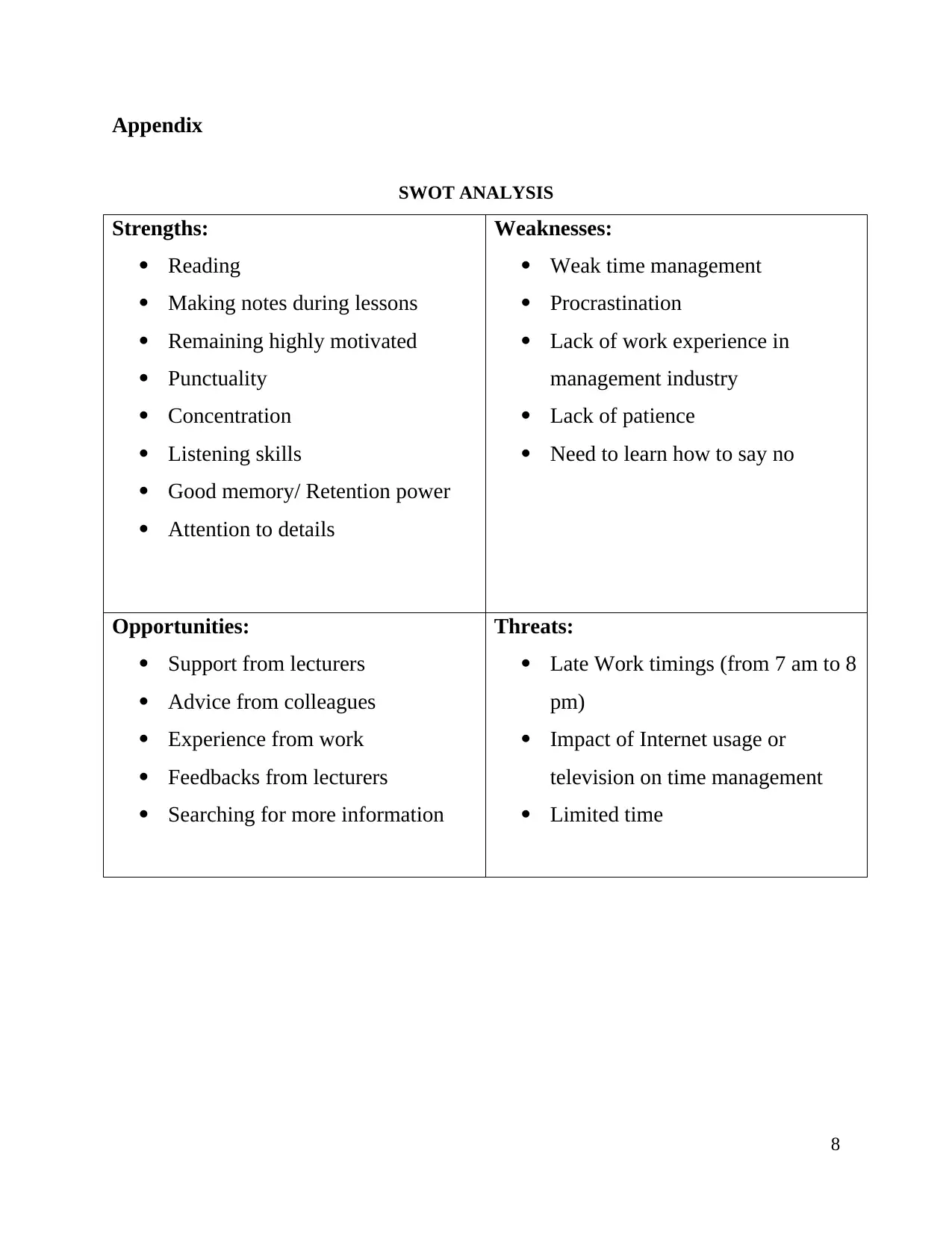
Appendix
SWOT ANALYSIS
Strengths:
Reading
Making notes during lessons
Remaining highly motivated
Punctuality
Concentration
Listening skills
Good memory/ Retention power
Attention to details
Weaknesses:
Weak time management
Procrastination
Lack of work experience in
management industry
Lack of patience
Need to learn how to say no
Opportunities:
Support from lecturers
Advice from colleagues
Experience from work
Feedbacks from lecturers
Searching for more information
Threats:
Late Work timings (from 7 am to 8
pm)
Impact of Internet usage or
television on time management
Limited time
8
SWOT ANALYSIS
Strengths:
Reading
Making notes during lessons
Remaining highly motivated
Punctuality
Concentration
Listening skills
Good memory/ Retention power
Attention to details
Weaknesses:
Weak time management
Procrastination
Lack of work experience in
management industry
Lack of patience
Need to learn how to say no
Opportunities:
Support from lecturers
Advice from colleagues
Experience from work
Feedbacks from lecturers
Searching for more information
Threats:
Late Work timings (from 7 am to 8
pm)
Impact of Internet usage or
television on time management
Limited time
8

1 out of 8


Related Documents


Your All-in-One AI-Powered Toolkit for Academic Success.
+13062052269
info@desklib.com
Available 24*7 on WhatsApp / Email
![[object Object]](/_next/static/media/star-bottom.7253800d.svg)
Unlock your academic potential
Copyright © 2020–2026 A2Z Services. All Rights Reserved. Developed and managed by ZUCOL.