Self-Reflection Report on Team Building and Cultural Awareness
VerifiedAdded on 2020/05/08
|9
|1666
|356
Report
AI Summary
This report is a self-reflection on team building and cultural awareness within a professional environment. It begins with an executive summary and table of contents, then delves into two key reflection topics. The first topic examines team building activities, discussing leadership qualities such as charismatic leadership, individual consideration, intellectual stimulation, courage, dependability, flexibility, integrity, and judgment. The second topic explores cultural awareness in intercultural communication, emphasizing its importance in professional settings. The report highlights the significance of understanding diverse cultural backgrounds for effective communication and collaboration. It concludes by referencing relevant literature to support its claims and underscore the importance of cultural awareness and effective team building in the modern business world.
Running head: SELF REFLECTIONS ON ISSUES OF PROFESSIONAL ENVIRONMENT
SELF REFLECTIONS ON ISSUES OF PROFESSIONAL ENVIRONMENT
Name of the Student
Name of the University
Author note
SELF REFLECTIONS ON ISSUES OF PROFESSIONAL ENVIRONMENT
Name of the Student
Name of the University
Author note
Paraphrase This Document
Need a fresh take? Get an instant paraphrase of this document with our AI Paraphraser

1
SELF REFLECTIONS ON ISSUES OF PRPFESSIONAL ENVIRONMENT
EXCUTIVE SUMMARY
The following report highlights the team building issues in a workplace environment. The report
is in a form of self-reflection and discusses the effects of these issues on an employee in his
professional world. The report encompasses the awareness of cultural and intellectual values in a
perspective of intercultural communication. The report concludes by emphasizing the
implementation of these moral codes in the present business world.
SELF REFLECTIONS ON ISSUES OF PRPFESSIONAL ENVIRONMENT
EXCUTIVE SUMMARY
The following report highlights the team building issues in a workplace environment. The report
is in a form of self-reflection and discusses the effects of these issues on an employee in his
professional world. The report encompasses the awareness of cultural and intellectual values in a
perspective of intercultural communication. The report concludes by emphasizing the
implementation of these moral codes in the present business world.

2
SELF REFLECTIONS ON ISSUES OF PRPFESSIONAL ENVIRONMENT
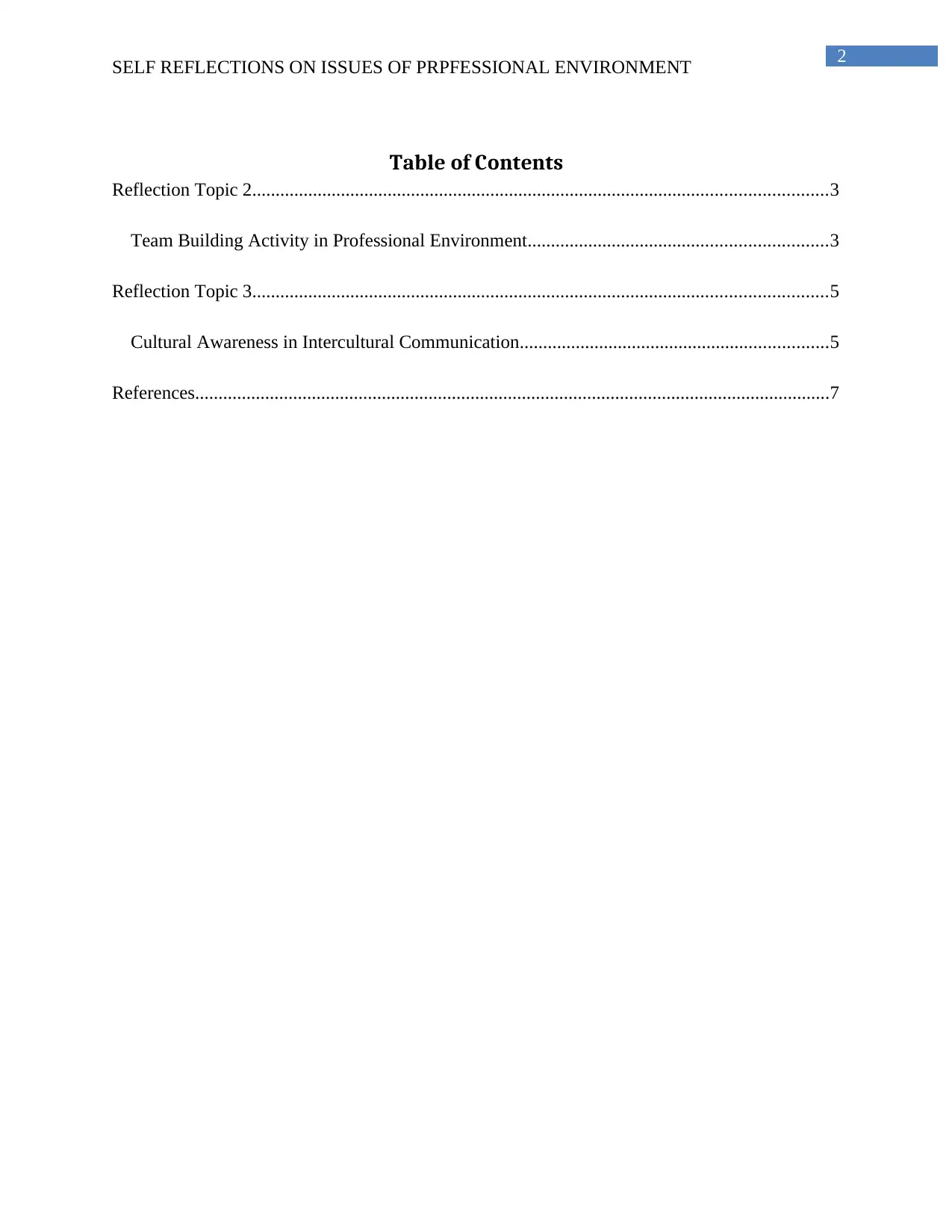
Table of Contents
Reflection Topic 2...........................................................................................................................3
Team Building Activity in Professional Environment................................................................3
Reflection Topic 3...........................................................................................................................5
Cultural Awareness in Intercultural Communication..................................................................5
References........................................................................................................................................7
SELF REFLECTIONS ON ISSUES OF PRPFESSIONAL ENVIRONMENT
Table of Contents
Reflection Topic 2...........................................................................................................................3
Team Building Activity in Professional Environment................................................................3
Reflection Topic 3...........................................................................................................................5
Cultural Awareness in Intercultural Communication..................................................................5
References........................................................................................................................................7
⊘ This is a preview!⊘
Do you want full access?
Subscribe today to unlock all pages.

Trusted by 1+ million students worldwide

3
SELF REFLECTIONS ON ISSUES OF PRPFESSIONAL ENVIRONMENT
Reflection Topic 2
Team Building Activity in Professional Environment
While participating in this professional management project the participants were divided
into 6 teams. Each team had to take part in the event and they were then asked to discuss their
self-reflections. In order to discuss the self-reflective views, each team selected a team leader
who was asked to share the reflective views of his team members. This full process of teamwork
guided me in self-assessing this project.
The management of building a team plays a very significant role in a professional
environment. The building of a team is used frequently for the development of the organization
that aims at cultivating the relationship between the firm and its employees (Mitchell et al 2012).
The process of constructing a team undergoes various steps and situations. There are a variety of
strategies that help an organization to construct a team effectively with respect to its present
situations and challenges (Joham and Clarke 2012).
It is the responsibility of a company to invest in forming a team to increase the efficiency
of the productions of an organization (Khattak, Ku and Goh 2012). According to me, the
construction of building a rig team needs huge surveys and leadership qualities. As the building
of a team more or less refers to an individual’s leadership qualities, it allows the employees to
build trust on their leader. This bond between the employees and the firm is a vital requirement
for the survival of the organization in the long run.
During the construction of a team, the cooperation of each team member is necessary and
this will take out the qualities of leadership within him or her. Another significant role of team
SELF REFLECTIONS ON ISSUES OF PRPFESSIONAL ENVIRONMENT
Reflection Topic 2
Team Building Activity in Professional Environment
While participating in this professional management project the participants were divided
into 6 teams. Each team had to take part in the event and they were then asked to discuss their
self-reflections. In order to discuss the self-reflective views, each team selected a team leader
who was asked to share the reflective views of his team members. This full process of teamwork
guided me in self-assessing this project.
The management of building a team plays a very significant role in a professional
environment. The building of a team is used frequently for the development of the organization
that aims at cultivating the relationship between the firm and its employees (Mitchell et al 2012).
The process of constructing a team undergoes various steps and situations. There are a variety of
strategies that help an organization to construct a team effectively with respect to its present
situations and challenges (Joham and Clarke 2012).
It is the responsibility of a company to invest in forming a team to increase the efficiency
of the productions of an organization (Khattak, Ku and Goh 2012). According to me, the
construction of building a rig team needs huge surveys and leadership qualities. As the building
of a team more or less refers to an individual’s leadership qualities, it allows the employees to
build trust on their leader. This bond between the employees and the firm is a vital requirement
for the survival of the organization in the long run.
During the construction of a team, the cooperation of each team member is necessary and
this will take out the qualities of leadership within him or her. Another significant role of team
Paraphrase This Document
Need a fresh take? Get an instant paraphrase of this document with our AI Paraphraser

4
SELF REFLECTIONS ON ISSUES OF PRPFESSIONAL ENVIRONMENT
building from my perspective is the trial of patience among the members of the team. Since there
are tough competitions with other teams, there is huge opportunity for the team members to give
their best effort for their own team (Erkutlu 2012). My view on building of a team values three
main principles: the first one signifies the sensitivity of belonging to a social group that evokes a
spirit working on behalf of the leader and his expectations. The second significance is the
distribution of the charges and the hidden costs among the leaders and their employees and at
times among various agencies. The third and the most important one is the determination of
differences in the agent’s responsive effort (Goetsch and Davis 2014).
This team building management in a given professional environment has huge benefits
for students like me. This hypothetical process of building a team from my perspective will guide
me for my future employment prospect. The leadership skills that have been attained by me
while doing the practice classes are mentioned below (Batey and Lupi 2012):
Charismatic Leadership: Individuals with charismatic behavior leads to the
development of charismatic leaders. Individuals who have a charming behavior serve as a
successful and accomplished leader (Kohorn 2012). These leaders encourage his team
members to complete their assignments efficiently. A leader with his charismatic
behavior inculcates pride, confidence and assurance and respects his subordinates.
Individual Consideration: Leaders and managers practicing individualized
consideration treat his team members as an individual and guide them in accomplishing
their career targets.
Intellectual Stimulation: In high-profile organizations, a leader’s importance in
technical proficiency and logical power is at times ignored. However, intellectual
SELF REFLECTIONS ON ISSUES OF PRPFESSIONAL ENVIRONMENT
building from my perspective is the trial of patience among the members of the team. Since there
are tough competitions with other teams, there is huge opportunity for the team members to give
their best effort for their own team (Erkutlu 2012). My view on building of a team values three
main principles: the first one signifies the sensitivity of belonging to a social group that evokes a
spirit working on behalf of the leader and his expectations. The second significance is the
distribution of the charges and the hidden costs among the leaders and their employees and at
times among various agencies. The third and the most important one is the determination of
differences in the agent’s responsive effort (Goetsch and Davis 2014).
This team building management in a given professional environment has huge benefits
for students like me. This hypothetical process of building a team from my perspective will guide
me for my future employment prospect. The leadership skills that have been attained by me
while doing the practice classes are mentioned below (Batey and Lupi 2012):
Charismatic Leadership: Individuals with charismatic behavior leads to the
development of charismatic leaders. Individuals who have a charming behavior serve as a
successful and accomplished leader (Kohorn 2012). These leaders encourage his team
members to complete their assignments efficiently. A leader with his charismatic
behavior inculcates pride, confidence and assurance and respects his subordinates.
Individual Consideration: Leaders and managers practicing individualized
consideration treat his team members as an individual and guide them in accomplishing
their career targets.
Intellectual Stimulation: In high-profile organizations, a leader’s importance in
technical proficiency and logical power is at times ignored. However, intellectual

5
SELF REFLECTIONS ON ISSUES OF PRPFESSIONAL ENVIRONMENT
stimulation is a vital aspect of leadership that helps in spreading awareness among his
subordinates in solving critical problems that may arise from different issues.
Courage: An efficient leader always stands up for truth and do not avoid confrontations.
A leader must have confidence in his ability and must work independently.
Dependability: A leader must keep his commitments and take the responsibility of his
actions and at the same time should abide by the laws and terms of his higher authority.
Flexibility: A leader must be able to perform his duties in any given situations and
conditions with stability.
Integrity: An efficient and successful leader must adhere to his strict code of business
ethics and moral values.
Judgment: A leader always uses rational and intellectual judgment to provide a sound
and logical decision for all and sundry.
Therefore, from the above-mentioned points it is evident that building of team
helps in developing a well-organized and successful team leader who can manages his
team members efficiently.
Reflection Topic 3
Cultural Awareness in Intercultural Communication
Inter cultural communication is an approach that is integrated in individuals from diverse
cultures in order to gain proper responses or behaviors from the individuals outside of his own
culture. This includes a major diversity in the individual’s taste and preferences, his linguistic
skills and also in his modesty. In order to strengthen the communicative skills within the
SELF REFLECTIONS ON ISSUES OF PRPFESSIONAL ENVIRONMENT
stimulation is a vital aspect of leadership that helps in spreading awareness among his
subordinates in solving critical problems that may arise from different issues.
Courage: An efficient leader always stands up for truth and do not avoid confrontations.
A leader must have confidence in his ability and must work independently.
Dependability: A leader must keep his commitments and take the responsibility of his
actions and at the same time should abide by the laws and terms of his higher authority.
Flexibility: A leader must be able to perform his duties in any given situations and
conditions with stability.
Integrity: An efficient and successful leader must adhere to his strict code of business
ethics and moral values.
Judgment: A leader always uses rational and intellectual judgment to provide a sound
and logical decision for all and sundry.
Therefore, from the above-mentioned points it is evident that building of team
helps in developing a well-organized and successful team leader who can manages his
team members efficiently.
Reflection Topic 3
Cultural Awareness in Intercultural Communication
Inter cultural communication is an approach that is integrated in individuals from diverse
cultures in order to gain proper responses or behaviors from the individuals outside of his own
culture. This includes a major diversity in the individual’s taste and preferences, his linguistic
skills and also in his modesty. In order to strengthen the communicative skills within the
⊘ This is a preview!⊘
Do you want full access?
Subscribe today to unlock all pages.

Trusted by 1+ million students worldwide

6
SELF REFLECTIONS ON ISSUES OF PRPFESSIONAL ENVIRONMENT
individuals it is important to arouse cultural awareness among different community (Baker
2012).
In classes of intercultural communication, it was instructed by the instructor that each and
every team must include students from diverse cultural backgrounds and it is the responsibility of
the team leader to make all the members aware of every student’s unique cultural milieu.
This practice helped me in obtaining the idea of cultural awareness. Over the last few
decades, cultural awareness has emerged as a significant tool in the concept of teaching
international students. An instance that can be made here is the acceptance of the English
language as a globalized lingua franca (Xiaomei and Yushan 2012). According to me, Cultural
awareness is a conscious understanding of the intercultural communication that leads to an
ability to evaluate significantly based on explicit criteria, perspectives and practices (Thomas and
Peterson 2017).
Cultural awareness plays a crucial role in a professional environment. In an
organization, there are employees from different cultural backgrounds (Pokhilko 2016). In order
to accomplish the job role it is very essential for an employee to communicate with his co-
workers and leaders in conveying his message to others. Here comes the role of cultural
awareness that assists the employee in fulfilling his target (Hammer, Bennett and Wiseman
2012). In order to build a relationship of trust and assurance it is important to develop inter
cultural communication skill (Barrett, Huber and Reynolds 2014). In my opinion, Cultural
awareness also signifies the honor for each community and its cultures. It also symbolizes the
Unity in Diversity and shares the spirit of brotherhood.
SELF REFLECTIONS ON ISSUES OF PRPFESSIONAL ENVIRONMENT
individuals it is important to arouse cultural awareness among different community (Baker
2012).
In classes of intercultural communication, it was instructed by the instructor that each and
every team must include students from diverse cultural backgrounds and it is the responsibility of
the team leader to make all the members aware of every student’s unique cultural milieu.
This practice helped me in obtaining the idea of cultural awareness. Over the last few
decades, cultural awareness has emerged as a significant tool in the concept of teaching
international students. An instance that can be made here is the acceptance of the English
language as a globalized lingua franca (Xiaomei and Yushan 2012). According to me, Cultural
awareness is a conscious understanding of the intercultural communication that leads to an
ability to evaluate significantly based on explicit criteria, perspectives and practices (Thomas and
Peterson 2017).
Cultural awareness plays a crucial role in a professional environment. In an
organization, there are employees from different cultural backgrounds (Pokhilko 2016). In order
to accomplish the job role it is very essential for an employee to communicate with his co-
workers and leaders in conveying his message to others. Here comes the role of cultural
awareness that assists the employee in fulfilling his target (Hammer, Bennett and Wiseman
2012). In order to build a relationship of trust and assurance it is important to develop inter
cultural communication skill (Barrett, Huber and Reynolds 2014). In my opinion, Cultural
awareness also signifies the honor for each community and its cultures. It also symbolizes the
Unity in Diversity and shares the spirit of brotherhood.
Paraphrase This Document
Need a fresh take? Get an instant paraphrase of this document with our AI Paraphraser

7
SELF REFLECTIONS ON ISSUES OF PRPFESSIONAL ENVIRONMENT
References
Baker, W., 2012. From cultural awareness to intercultural awareness: Culture in ELT. ELT
journal, 66(1), pp.62-70.
Barrett, M.D., Huber, J. and Reynolds, C., 2014. Developing intercultural competence through
education. Strasbourg: Council of Europe Publishing.
Batey, J.J. and Lupi, M.H., 2012. Reflections on student interns' cultural awareness developed
through a short-term international internship. Teacher Education Quarterly, 39(3), pp.25-44.
Erkutlu, H., 2012. The impact of organizational culture on the relationship between shared
leadership and team proactivity. Team Performance Management: An International
Journal, 18(1/2), pp.102-119.
Goetsch, D.L. and Davis, S.B., 2014. Quality management for organizational excellence. Upper
Saddle River, NJ: pearson.
Hammer, M.R., Bennett, M. and Wiseman, R., 2012. The intercultural development
inventory. Student learning abroad, pp.115-136.
Joham, C. and Clarke, M., 2012. Teaching critical management skills: the role of problem-based
learning. Teaching in Higher Education, 17(1), pp.75-88.
Khattak, H., Ku, H. and Goh, S., 2012. Courses for teaching leadership capacity in professional
engineering degrees in Australia and Europe. European Journal of Engineering
Education, 37(3), pp.279-296.
SELF REFLECTIONS ON ISSUES OF PRPFESSIONAL ENVIRONMENT
References
Baker, W., 2012. From cultural awareness to intercultural awareness: Culture in ELT. ELT
journal, 66(1), pp.62-70.
Barrett, M.D., Huber, J. and Reynolds, C., 2014. Developing intercultural competence through
education. Strasbourg: Council of Europe Publishing.
Batey, J.J. and Lupi, M.H., 2012. Reflections on student interns' cultural awareness developed
through a short-term international internship. Teacher Education Quarterly, 39(3), pp.25-44.
Erkutlu, H., 2012. The impact of organizational culture on the relationship between shared
leadership and team proactivity. Team Performance Management: An International
Journal, 18(1/2), pp.102-119.
Goetsch, D.L. and Davis, S.B., 2014. Quality management for organizational excellence. Upper
Saddle River, NJ: pearson.
Hammer, M.R., Bennett, M. and Wiseman, R., 2012. The intercultural development
inventory. Student learning abroad, pp.115-136.
Joham, C. and Clarke, M., 2012. Teaching critical management skills: the role of problem-based
learning. Teaching in Higher Education, 17(1), pp.75-88.
Khattak, H., Ku, H. and Goh, S., 2012. Courses for teaching leadership capacity in professional
engineering degrees in Australia and Europe. European Journal of Engineering
Education, 37(3), pp.279-296.

8
SELF REFLECTIONS ON ISSUES OF PRPFESSIONAL ENVIRONMENT
Mitchell, P., Wynia, M., Golden, R., McNellis, B., Okun, S., Webb, C.E., Rohrbach, V. and Von
Kohorn, I., 2012. Core principles & values of effective team-based health care. Washington, DC:
Institute of Medicine.
Pokhilko, O.L., 2016. Cross-Cultural Awareness.
Thomas, D.C. and Peterson, M.F., 2017. Cross-cultural management: Essential concepts. Sage
Publications.
Xiaomei, C. and Yushan, Z., 2012. An action research in college English teaching to raise
students' intercultural awareness [J]. Foreign Language World, 2, p.005.
SELF REFLECTIONS ON ISSUES OF PRPFESSIONAL ENVIRONMENT
Mitchell, P., Wynia, M., Golden, R., McNellis, B., Okun, S., Webb, C.E., Rohrbach, V. and Von
Kohorn, I., 2012. Core principles & values of effective team-based health care. Washington, DC:
Institute of Medicine.
Pokhilko, O.L., 2016. Cross-Cultural Awareness.
Thomas, D.C. and Peterson, M.F., 2017. Cross-cultural management: Essential concepts. Sage
Publications.
Xiaomei, C. and Yushan, Z., 2012. An action research in college English teaching to raise
students' intercultural awareness [J]. Foreign Language World, 2, p.005.
⊘ This is a preview!⊘
Do you want full access?
Subscribe today to unlock all pages.

Trusted by 1+ million students worldwide
1 out of 9
Related Documents
Your All-in-One AI-Powered Toolkit for Academic Success.
+13062052269
info@desklib.com
Available 24*7 on WhatsApp / Email
Unlock your academic potential
Copyright © 2020–2026 A2Z Services. All Rights Reserved. Developed and managed by ZUCOL.