Lab Report: Investigating Semantic Relation Effects on Word Recall
VerifiedAdded on 2023/06/18
|10
|2599
|340
Report
AI Summary
This lab report details an experiment investigating the impact of semantic relations on word recall. The study involved 84 psychology students who participated in an online survey recalling words from two lists: one with semantically related words and another with unrelated words. The results indicated that participants recalled semantically related words more frequently than unrelated words, supporting the alternative hypothesis that a relationship exists between word recall and experimental condition. The report includes a detailed methodology, statistical analysis, and a discussion of the findings, limitations, and future research directions. Desklib offers this and other solved assignments to aid students in their studies.
LAB REPORT

Paraphrase This Document
Need a fresh take? Get an instant paraphrase of this document with our AI Paraphraser
TABLE OF CONTENTS
TITLE..............................................................................................................................................1
PART 1............................................................................................................................................1
PART 2............................................................................................................................................1
Abstract............................................................................................................................................1
Introduction......................................................................................................................................2
Methods...........................................................................................................................................3
Result...............................................................................................................................................4
Discussion........................................................................................................................................6
Conclusion.......................................................................................................................................7
REFERENCES................................................................................................................................8
TITLE..............................................................................................................................................1
PART 1............................................................................................................................................1
PART 2............................................................................................................................................1
Abstract............................................................................................................................................1
Introduction......................................................................................................................................2
Methods...........................................................................................................................................3
Result...............................................................................................................................................4
Discussion........................................................................................................................................6
Conclusion.......................................................................................................................................7
REFERENCES................................................................................................................................8
TITLE
Are semantically related words recalled greater than non- related list of words?
PART 1
Report plan
In this project an experiment will be conducted or evaluating whether an individual can
recall semantically related words more as compared to non- semantically related words or not.
For this first of all brief introduction of the project will be provided in which background
information on experiment will be provided, factors that motivated researcher in conducing
research in this research area and brief description of experiment will be provided (Howard &
Kahana, 2002). Then method that will be used for conduction of experiment will be explained. In
method number of participants participated within study, equipment’s, design of study,
procedure and other general method to be used for experiment will be explained in detailed
manner (Chang & Brainerd, 2021) . Then experiment will be conducted. For experiment first of
all 84 people will be recruited and each of them will be asked to participate within the study. All
the recruited participants will be psychology students. All the participants will be asked to
participate within a survey on computer where they will be participating within survey with the
help of online survey tool. They will be asked to recall words that are in two list, first list is with
14 related words and second list is with 14 unrelated words. Results through survey tool will be
collected and analysed using statistical analysis method. In results second all the results will
analysed and in this mean number of words recalled, graphs, tables etc. will be presented for
gaining better understanding of data. Lastly after result section discussion of results will be done.
In this section interpretation of results will be done for identifying hypothesis which is accepted
and reason because of which that hypothesis was accepted. Lastly this report will further explain
limitation of this experiment and future scope of this experiment for research that will be
conducted in future.
PART 2
Abstract
In this report, it has been summarised about the idea of experiment which is related to
recall words and also aware about the meaning of words. This project had focused upon
conducing an experiment upon evaluating performance of memory that whether semantically
1
Are semantically related words recalled greater than non- related list of words?
PART 1
Report plan
In this project an experiment will be conducted or evaluating whether an individual can
recall semantically related words more as compared to non- semantically related words or not.
For this first of all brief introduction of the project will be provided in which background
information on experiment will be provided, factors that motivated researcher in conducing
research in this research area and brief description of experiment will be provided (Howard &
Kahana, 2002). Then method that will be used for conduction of experiment will be explained. In
method number of participants participated within study, equipment’s, design of study,
procedure and other general method to be used for experiment will be explained in detailed
manner (Chang & Brainerd, 2021) . Then experiment will be conducted. For experiment first of
all 84 people will be recruited and each of them will be asked to participate within the study. All
the recruited participants will be psychology students. All the participants will be asked to
participate within a survey on computer where they will be participating within survey with the
help of online survey tool. They will be asked to recall words that are in two list, first list is with
14 related words and second list is with 14 unrelated words. Results through survey tool will be
collected and analysed using statistical analysis method. In results second all the results will
analysed and in this mean number of words recalled, graphs, tables etc. will be presented for
gaining better understanding of data. Lastly after result section discussion of results will be done.
In this section interpretation of results will be done for identifying hypothesis which is accepted
and reason because of which that hypothesis was accepted. Lastly this report will further explain
limitation of this experiment and future scope of this experiment for research that will be
conducted in future.
PART 2
Abstract
In this report, it has been summarised about the idea of experiment which is related to
recall words and also aware about the meaning of words. This project had focused upon
conducing an experiment upon evaluating performance of memory that whether semantically
1
⊘ This is a preview!⊘
Do you want full access?
Subscribe today to unlock all pages.

Trusted by 1+ million students worldwide
related words are recalled more than non-semantically related words. This topic motivated
researcher to carry research in this field because in this area least number of studies have been
conducted in this area motivated researcher for conducting this experiment because in past
researches only evaluation of conducting this research. Because previous research in this field
have been carried out only for evaluating long term, short term and cache memory of people has
been carried and least number of research in this area have been carried out.
Introduction
Memory is a process though which a person acquires, store, retain and recall information
or data. Memory performance of each and every individual is different and tendency of recalling
information or data of every individual is also different (Cox & et. al., 2018). If memory of every
individual is analysed or evaluate then it can be said that every individual has a tendency to
recall a word with its meaning that further helps them recalling other words (Pollock, 2018). This
completely depend upon performance of memory. This study will focus upon conducing an
experiment in which with the help of recalling of words memory performance will be evaluated.
These are two experiments used in order to determine memory performance of each participant.
The experiment was become as meaningful aspect to examine the importance in the memory
performance.
Research question/ Hypothesis
Dependent variable: Words recalled
Independent variables: Experimental Condition (Semantically related and not related words)
Main hypothesis is to check whether semantically related words and no related words can lead to
different memory performance or not and does this situation affect response of participants or
not.
Null hypothesis: there is no relationship between memory performance and experimental
condition that cannot lead to two different memory performances.
Alternative hypothesis: There is relationship between words recalled and experimental condition
that can lead to two different memory performances.
General information on study
This research project will lay emphasis upon a memory recall experiment conducted in which
examination of effect of semantic relation on word recall was examined. Experimented
conducted was basically based upon evaluation of memory performance. The purpose of this
2
researcher to carry research in this field because in this area least number of studies have been
conducted in this area motivated researcher for conducting this experiment because in past
researches only evaluation of conducting this research. Because previous research in this field
have been carried out only for evaluating long term, short term and cache memory of people has
been carried and least number of research in this area have been carried out.
Introduction
Memory is a process though which a person acquires, store, retain and recall information
or data. Memory performance of each and every individual is different and tendency of recalling
information or data of every individual is also different (Cox & et. al., 2018). If memory of every
individual is analysed or evaluate then it can be said that every individual has a tendency to
recall a word with its meaning that further helps them recalling other words (Pollock, 2018). This
completely depend upon performance of memory. This study will focus upon conducing an
experiment in which with the help of recalling of words memory performance will be evaluated.
These are two experiments used in order to determine memory performance of each participant.
The experiment was become as meaningful aspect to examine the importance in the memory
performance.
Research question/ Hypothesis
Dependent variable: Words recalled
Independent variables: Experimental Condition (Semantically related and not related words)
Main hypothesis is to check whether semantically related words and no related words can lead to
different memory performance or not and does this situation affect response of participants or
not.
Null hypothesis: there is no relationship between memory performance and experimental
condition that cannot lead to two different memory performances.
Alternative hypothesis: There is relationship between words recalled and experimental condition
that can lead to two different memory performances.
General information on study
This research project will lay emphasis upon a memory recall experiment conducted in which
examination of effect of semantic relation on word recall was examined. Experimented
conducted was basically based upon evaluation of memory performance. The purpose of this
2
Paraphrase This Document
Need a fresh take? Get an instant paraphrase of this document with our AI Paraphraser
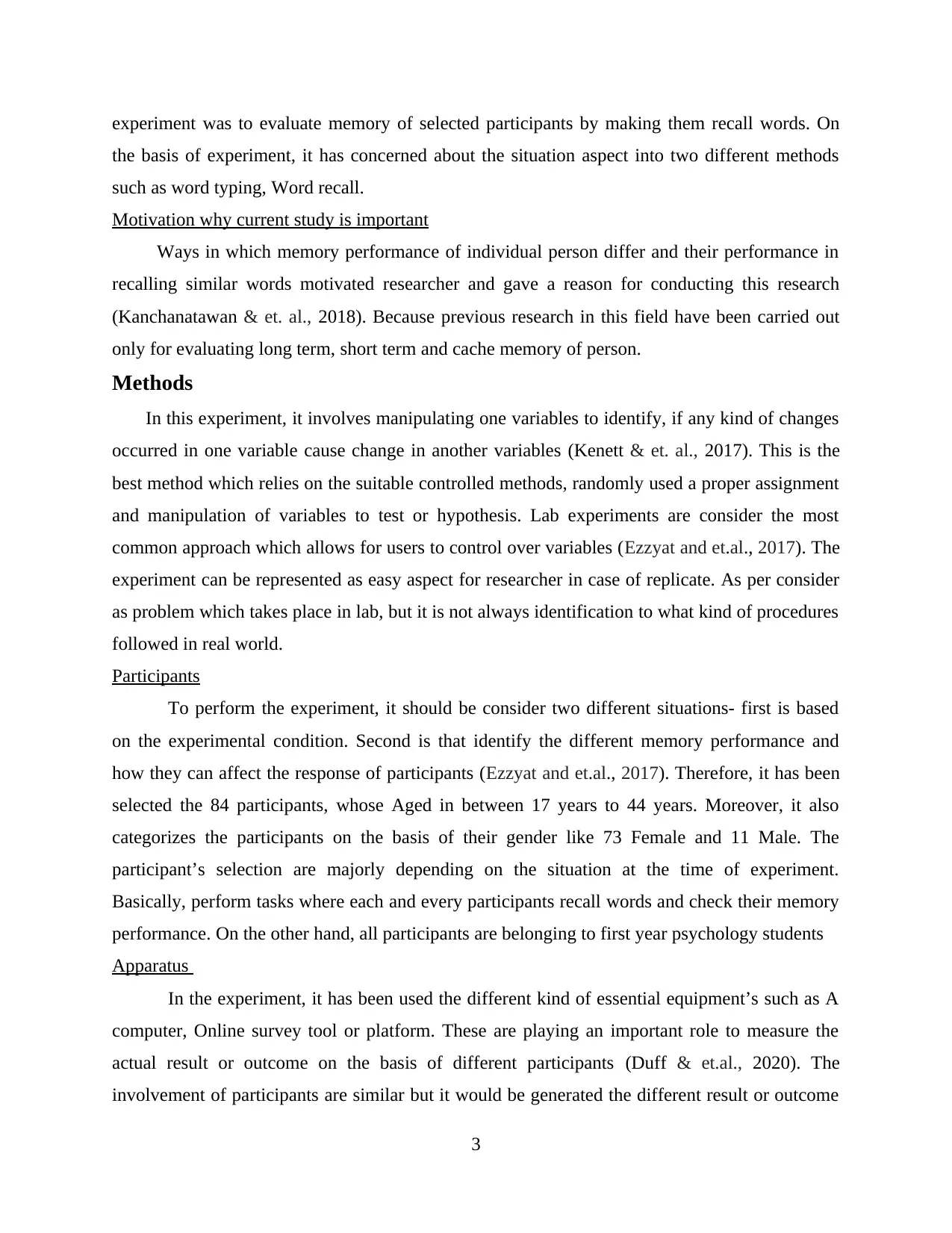
experiment was to evaluate memory of selected participants by making them recall words. On
the basis of experiment, it has concerned about the situation aspect into two different methods
such as word typing, Word recall.
Motivation why current study is important
Ways in which memory performance of individual person differ and their performance in
recalling similar words motivated researcher and gave a reason for conducting this research
(Kanchanatawan & et. al., 2018). Because previous research in this field have been carried out
only for evaluating long term, short term and cache memory of person.
Methods
In this experiment, it involves manipulating one variables to identify, if any kind of changes
occurred in one variable cause change in another variables (Kenett & et. al., 2017). This is the
best method which relies on the suitable controlled methods, randomly used a proper assignment
and manipulation of variables to test or hypothesis. Lab experiments are consider the most
common approach which allows for users to control over variables (Ezzyat and et.al., 2017). The
experiment can be represented as easy aspect for researcher in case of replicate. As per consider
as problem which takes place in lab, but it is not always identification to what kind of procedures
followed in real world.
Participants
To perform the experiment, it should be consider two different situations- first is based
on the experimental condition. Second is that identify the different memory performance and
how they can affect the response of participants (Ezzyat and et.al., 2017). Therefore, it has been
selected the 84 participants, whose Aged in between 17 years to 44 years. Moreover, it also
categorizes the participants on the basis of their gender like 73 Female and 11 Male. The
participant’s selection are majorly depending on the situation at the time of experiment.
Basically, perform tasks where each and every participants recall words and check their memory
performance. On the other hand, all participants are belonging to first year psychology students
Apparatus
In the experiment, it has been used the different kind of essential equipment’s such as A
computer, Online survey tool or platform. These are playing an important role to measure the
actual result or outcome on the basis of different participants (Duff & et.al., 2020). The
involvement of participants are similar but it would be generated the different result or outcome
3
the basis of experiment, it has concerned about the situation aspect into two different methods
such as word typing, Word recall.
Motivation why current study is important
Ways in which memory performance of individual person differ and their performance in
recalling similar words motivated researcher and gave a reason for conducting this research
(Kanchanatawan & et. al., 2018). Because previous research in this field have been carried out
only for evaluating long term, short term and cache memory of person.
Methods
In this experiment, it involves manipulating one variables to identify, if any kind of changes
occurred in one variable cause change in another variables (Kenett & et. al., 2017). This is the
best method which relies on the suitable controlled methods, randomly used a proper assignment
and manipulation of variables to test or hypothesis. Lab experiments are consider the most
common approach which allows for users to control over variables (Ezzyat and et.al., 2017). The
experiment can be represented as easy aspect for researcher in case of replicate. As per consider
as problem which takes place in lab, but it is not always identification to what kind of procedures
followed in real world.
Participants
To perform the experiment, it should be consider two different situations- first is based
on the experimental condition. Second is that identify the different memory performance and
how they can affect the response of participants (Ezzyat and et.al., 2017). Therefore, it has been
selected the 84 participants, whose Aged in between 17 years to 44 years. Moreover, it also
categorizes the participants on the basis of their gender like 73 Female and 11 Male. The
participant’s selection are majorly depending on the situation at the time of experiment.
Basically, perform tasks where each and every participants recall words and check their memory
performance. On the other hand, all participants are belonging to first year psychology students
Apparatus
In the experiment, it has been used the different kind of essential equipment’s such as A
computer, Online survey tool or platform. These are playing an important role to measure the
actual result or outcome on the basis of different participants (Duff & et.al., 2020). The
involvement of participants are similar but it would be generated the different result or outcome
3
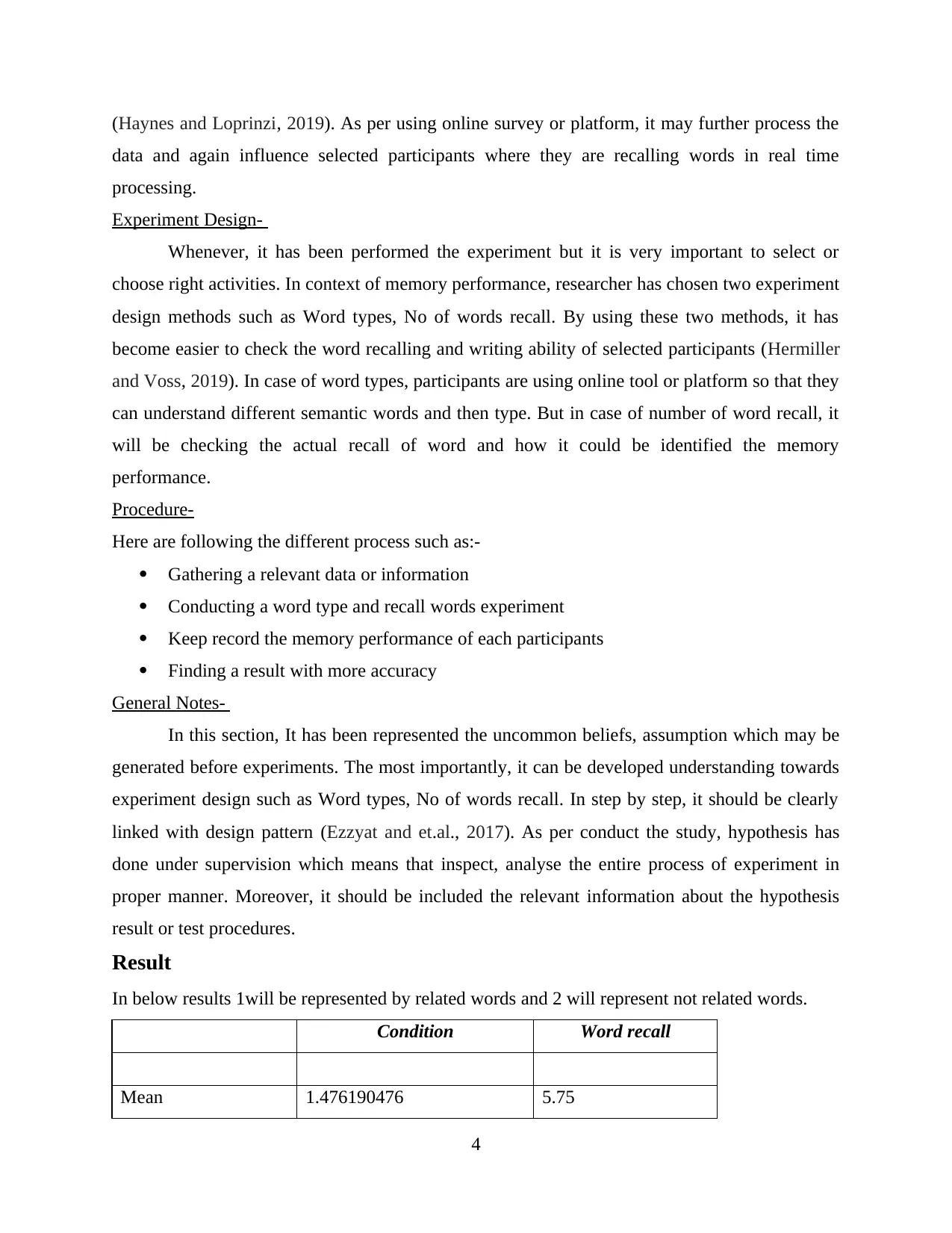
(Haynes and Loprinzi, 2019). As per using online survey or platform, it may further process the
data and again influence selected participants where they are recalling words in real time
processing.
Experiment Design-
Whenever, it has been performed the experiment but it is very important to select or
choose right activities. In context of memory performance, researcher has chosen two experiment
design methods such as Word types, No of words recall. By using these two methods, it has
become easier to check the word recalling and writing ability of selected participants (Hermiller
and Voss, 2019). In case of word types, participants are using online tool or platform so that they
can understand different semantic words and then type. But in case of number of word recall, it
will be checking the actual recall of word and how it could be identified the memory
performance.
Procedure-
Here are following the different process such as:-
Gathering a relevant data or information
Conducting a word type and recall words experiment
Keep record the memory performance of each participants
Finding a result with more accuracy
General Notes-
In this section, It has been represented the uncommon beliefs, assumption which may be
generated before experiments. The most importantly, it can be developed understanding towards
experiment design such as Word types, No of words recall. In step by step, it should be clearly
linked with design pattern (Ezzyat and et.al., 2017). As per conduct the study, hypothesis has
done under supervision which means that inspect, analyse the entire process of experiment in
proper manner. Moreover, it should be included the relevant information about the hypothesis
result or test procedures.
Result
In below results 1will be represented by related words and 2 will represent not related words.
Condition Word recall
Mean 1.476190476 5.75
4
data and again influence selected participants where they are recalling words in real time
processing.
Experiment Design-
Whenever, it has been performed the experiment but it is very important to select or
choose right activities. In context of memory performance, researcher has chosen two experiment
design methods such as Word types, No of words recall. By using these two methods, it has
become easier to check the word recalling and writing ability of selected participants (Hermiller
and Voss, 2019). In case of word types, participants are using online tool or platform so that they
can understand different semantic words and then type. But in case of number of word recall, it
will be checking the actual recall of word and how it could be identified the memory
performance.
Procedure-
Here are following the different process such as:-
Gathering a relevant data or information
Conducting a word type and recall words experiment
Keep record the memory performance of each participants
Finding a result with more accuracy
General Notes-
In this section, It has been represented the uncommon beliefs, assumption which may be
generated before experiments. The most importantly, it can be developed understanding towards
experiment design such as Word types, No of words recall. In step by step, it should be clearly
linked with design pattern (Ezzyat and et.al., 2017). As per conduct the study, hypothesis has
done under supervision which means that inspect, analyse the entire process of experiment in
proper manner. Moreover, it should be included the relevant information about the hypothesis
result or test procedures.
Result
In below results 1will be represented by related words and 2 will represent not related words.
Condition Word recall
Mean 1.476190476 5.75
4
⊘ This is a preview!⊘
Do you want full access?
Subscribe today to unlock all pages.
Trusted by 1+ million students worldwide
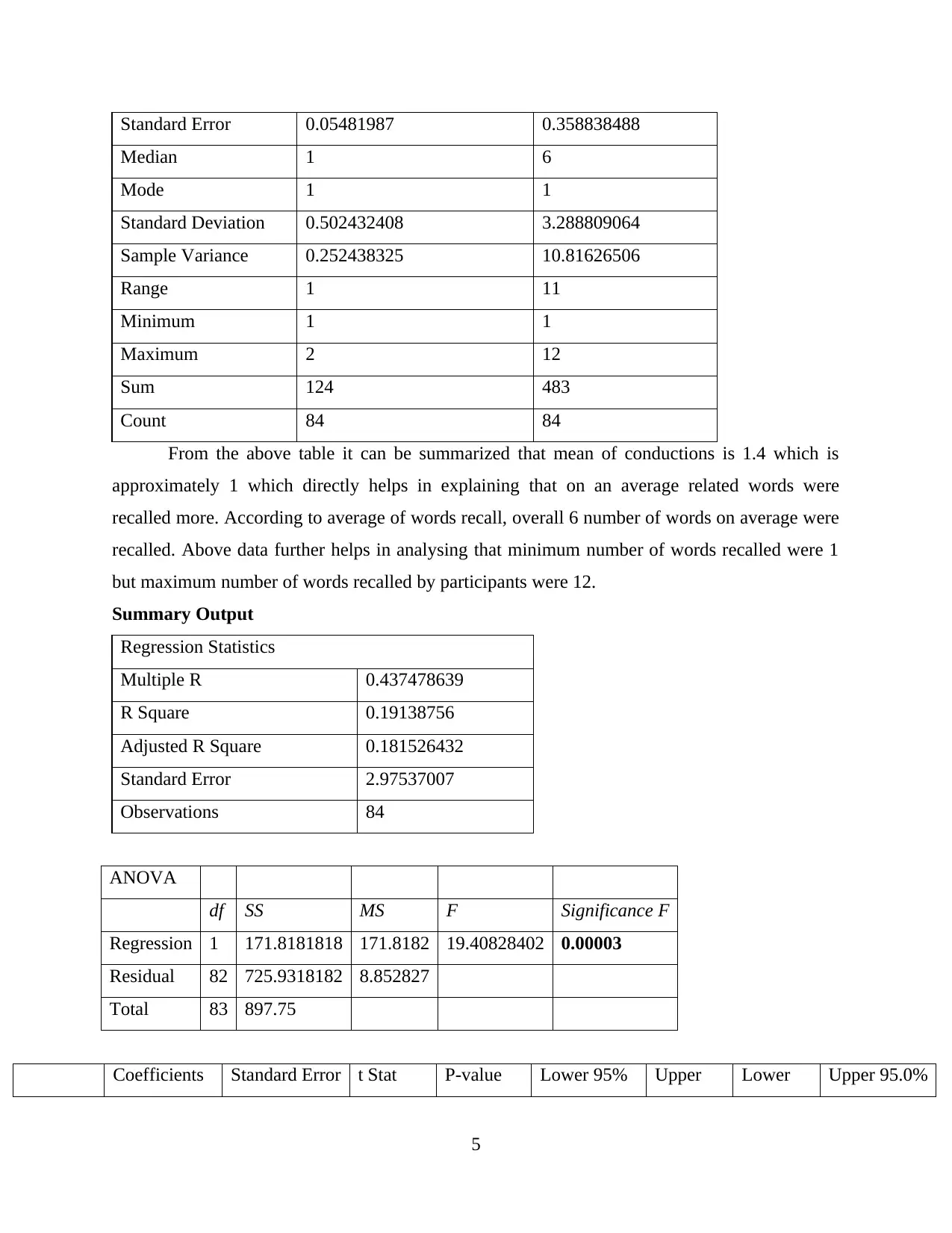
Standard Error 0.05481987 0.358838488
Median 1 6
Mode 1 1
Standard Deviation 0.502432408 3.288809064
Sample Variance 0.252438325 10.81626506
Range 1 11
Minimum 1 1
Maximum 2 12
Sum 124 483
Count 84 84
From the above table it can be summarized that mean of conductions is 1.4 which is
approximately 1 which directly helps in explaining that on an average related words were
recalled more. According to average of words recall, overall 6 number of words on average were
recalled. Above data further helps in analysing that minimum number of words recalled were 1
but maximum number of words recalled by participants were 12.
Summary Output
Regression Statistics
Multiple R 0.437478639
R Square 0.19138756
Adjusted R Square 0.181526432
Standard Error 2.97537007
Observations 84
ANOVA
df SS MS F Significance F
Regression 1 171.8181818 171.8182 19.40828402 0.00003
Residual 82 725.9318182 8.852827
Total 83 897.75
Coefficients Standard Error t Stat P-value Lower 95% Upper Lower Upper 95.0%
5
Median 1 6
Mode 1 1
Standard Deviation 0.502432408 3.288809064
Sample Variance 0.252438325 10.81626506
Range 1 11
Minimum 1 1
Maximum 2 12
Sum 124 483
Count 84 84
From the above table it can be summarized that mean of conductions is 1.4 which is
approximately 1 which directly helps in explaining that on an average related words were
recalled more. According to average of words recall, overall 6 number of words on average were
recalled. Above data further helps in analysing that minimum number of words recalled were 1
but maximum number of words recalled by participants were 12.
Summary Output
Regression Statistics
Multiple R 0.437478639
R Square 0.19138756
Adjusted R Square 0.181526432
Standard Error 2.97537007
Observations 84
ANOVA
df SS MS F Significance F
Regression 1 171.8181818 171.8182 19.40828402 0.00003
Residual 82 725.9318182 8.852827
Total 83 897.75
Coefficients Standard Error t Stat P-value Lower 95% Upper Lower Upper 95.0%
5
Paraphrase This Document
Need a fresh take? Get an instant paraphrase of this document with our AI Paraphraser
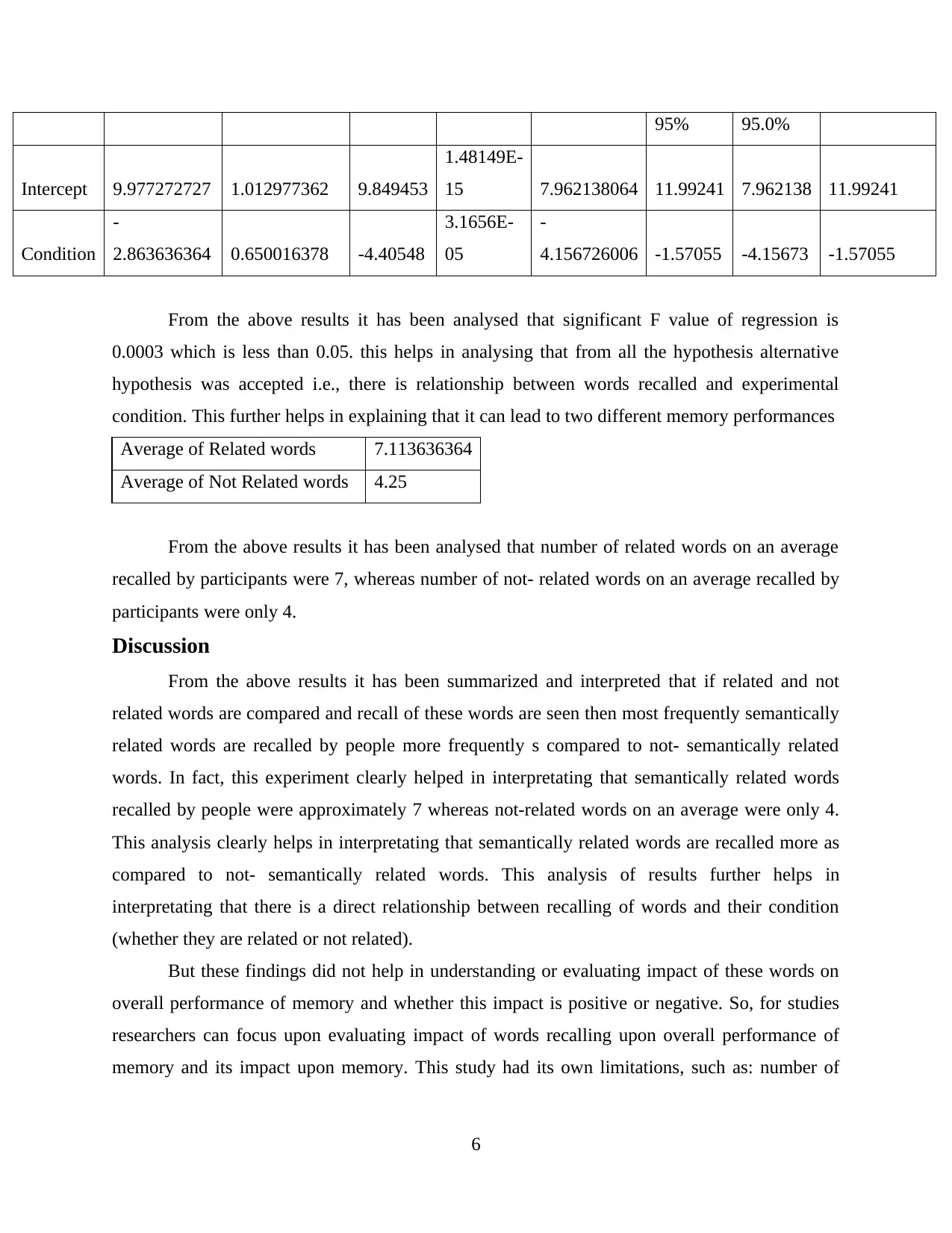
95% 95.0%
Intercept 9.977272727 1.012977362 9.849453
1.48149E-
15 7.962138064 11.99241 7.962138 11.99241
Condition
-
2.863636364 0.650016378 -4.40548
3.1656E-
05
-
4.156726006 -1.57055 -4.15673 -1.57055
From the above results it has been analysed that significant F value of regression is
0.0003 which is less than 0.05. this helps in analysing that from all the hypothesis alternative
hypothesis was accepted i.e., there is relationship between words recalled and experimental
condition. This further helps in explaining that it can lead to two different memory performances
Average of Related words 7.113636364
Average of Not Related words 4.25
From the above results it has been analysed that number of related words on an average
recalled by participants were 7, whereas number of not- related words on an average recalled by
participants were only 4.
Discussion
From the above results it has been summarized and interpreted that if related and not
related words are compared and recall of these words are seen then most frequently semantically
related words are recalled by people more frequently s compared to not- semantically related
words. In fact, this experiment clearly helped in interpretating that semantically related words
recalled by people were approximately 7 whereas not-related words on an average were only 4.
This analysis clearly helps in interpretating that semantically related words are recalled more as
compared to not- semantically related words. This analysis of results further helps in
interpretating that there is a direct relationship between recalling of words and their condition
(whether they are related or not related).
But these findings did not help in understanding or evaluating impact of these words on
overall performance of memory and whether this impact is positive or negative. So, for studies
researchers can focus upon evaluating impact of words recalling upon overall performance of
memory and its impact upon memory. This study had its own limitations, such as: number of
6
Intercept 9.977272727 1.012977362 9.849453
1.48149E-
15 7.962138064 11.99241 7.962138 11.99241
Condition
-
2.863636364 0.650016378 -4.40548
3.1656E-
05
-
4.156726006 -1.57055 -4.15673 -1.57055
From the above results it has been analysed that significant F value of regression is
0.0003 which is less than 0.05. this helps in analysing that from all the hypothesis alternative
hypothesis was accepted i.e., there is relationship between words recalled and experimental
condition. This further helps in explaining that it can lead to two different memory performances
Average of Related words 7.113636364
Average of Not Related words 4.25
From the above results it has been analysed that number of related words on an average
recalled by participants were 7, whereas number of not- related words on an average recalled by
participants were only 4.
Discussion
From the above results it has been summarized and interpreted that if related and not
related words are compared and recall of these words are seen then most frequently semantically
related words are recalled by people more frequently s compared to not- semantically related
words. In fact, this experiment clearly helped in interpretating that semantically related words
recalled by people were approximately 7 whereas not-related words on an average were only 4.
This analysis clearly helps in interpretating that semantically related words are recalled more as
compared to not- semantically related words. This analysis of results further helps in
interpretating that there is a direct relationship between recalling of words and their condition
(whether they are related or not related).
But these findings did not help in understanding or evaluating impact of these words on
overall performance of memory and whether this impact is positive or negative. So, for studies
researchers can focus upon evaluating impact of words recalling upon overall performance of
memory and its impact upon memory. This study had its own limitations, such as: number of
6
participants were psychology students only, none of non- psychology background people were
selected for study. Future studies can keep this in consideration while conducting this study.
Conclusion
From above discussion, it has concluded that understand the concept of experimental
tasks and developed as lab report. On the basis of analysis, it has been discussed about the
hypothesis which has made on the basis of experiment design such as word typing, word recall.
Furthermore, it has followed the procedures of experiment while identifying the uncontrolled
measurement and then generated accurate result or outcome.
7
selected for study. Future studies can keep this in consideration while conducting this study.
Conclusion
From above discussion, it has concluded that understand the concept of experimental
tasks and developed as lab report. On the basis of analysis, it has been discussed about the
hypothesis which has made on the basis of experiment design such as word typing, word recall.
Furthermore, it has followed the procedures of experiment while identifying the uncontrolled
measurement and then generated accurate result or outcome.
7
⊘ This is a preview!⊘
Do you want full access?
Subscribe today to unlock all pages.
Trusted by 1+ million students worldwide
REFERENCES
Book and Journals
Chang, M., & Brainerd, C. J. (2021). Semantic and phonological false memory: A review of
theory and data. Journal of Memory and Language, 119, 104210.
Cox, G. E. & et.al., (2018). Information and processes underlying semantic and episodic memory
across tasks, items, and individuals. Journal of Experimental Psychology:
General, 147(4), 545.
Duff, M. C. & et.al., (2020). Semantic memory and the hippocampus: revisiting, reaffirming, and
extending the reach of their critical relationship. Frontiers in Human
Neuroscience, 13, 471.
Ezzyat, Y. & et.al., (2017). Direct brain stimulation modulates encoding states and memory
performance in humans. Current biology, 27(9), pp.1251-1258.
Haynes IV, J.T. & Loprinzi, P.D., (2019). Experimental effects of acute exercise on episodic
memory function: considerations for the timing of exercise. Psychological
reports, 122(5), pp.1744-1754.
Hermiller, M.S. & Voss, J.L., (2019). Frequency‐specific noninvasive modulation of memory
retrieval and its relationship with hippocampal network
connectivity. Hippocampus, 29(7), pp.595-609.
Howard, M. W., & Kahana, M. J. (2002). When does semantic similarity help episodic
retrieval?. Journal of Memory and Language, 46(1), 85-98.
Kanchanatawan, B. & et.al., (2018). Changes in tryptophan catabolite (TRYCAT) pathway
patterning are associated with mild impairments in declarative memory in
schizophrenia and deficits in semantic and episodic memory coupled with increased
false-memory creation in deficit schizophrenia. Molecular neurobiology, 55(6), 5184-
5201.
Kenett, Y. N. & et.al., (2017). The semantic distance task: Quantifying semantic distance with
semantic network path length. Journal of Experimental Psychology: Learning,
Memory, and Cognition, 43(9), 1470.
Pollock, L. (2018). Statistical and methodological problems with concreteness and other
semantic variables: A list memory experiment case study. Behavior Research
Methods, 50(3), 1198-1216.
8
Book and Journals
Chang, M., & Brainerd, C. J. (2021). Semantic and phonological false memory: A review of
theory and data. Journal of Memory and Language, 119, 104210.
Cox, G. E. & et.al., (2018). Information and processes underlying semantic and episodic memory
across tasks, items, and individuals. Journal of Experimental Psychology:
General, 147(4), 545.
Duff, M. C. & et.al., (2020). Semantic memory and the hippocampus: revisiting, reaffirming, and
extending the reach of their critical relationship. Frontiers in Human
Neuroscience, 13, 471.
Ezzyat, Y. & et.al., (2017). Direct brain stimulation modulates encoding states and memory
performance in humans. Current biology, 27(9), pp.1251-1258.
Haynes IV, J.T. & Loprinzi, P.D., (2019). Experimental effects of acute exercise on episodic
memory function: considerations for the timing of exercise. Psychological
reports, 122(5), pp.1744-1754.
Hermiller, M.S. & Voss, J.L., (2019). Frequency‐specific noninvasive modulation of memory
retrieval and its relationship with hippocampal network
connectivity. Hippocampus, 29(7), pp.595-609.
Howard, M. W., & Kahana, M. J. (2002). When does semantic similarity help episodic
retrieval?. Journal of Memory and Language, 46(1), 85-98.
Kanchanatawan, B. & et.al., (2018). Changes in tryptophan catabolite (TRYCAT) pathway
patterning are associated with mild impairments in declarative memory in
schizophrenia and deficits in semantic and episodic memory coupled with increased
false-memory creation in deficit schizophrenia. Molecular neurobiology, 55(6), 5184-
5201.
Kenett, Y. N. & et.al., (2017). The semantic distance task: Quantifying semantic distance with
semantic network path length. Journal of Experimental Psychology: Learning,
Memory, and Cognition, 43(9), 1470.
Pollock, L. (2018). Statistical and methodological problems with concreteness and other
semantic variables: A list memory experiment case study. Behavior Research
Methods, 50(3), 1198-1216.
8

1 out of 10


Related Documents


Your All-in-One AI-Powered Toolkit for Academic Success.
+13062052269
info@desklib.com
Available 24*7 on WhatsApp / Email
![[object Object]](/_next/static/media/star-bottom.7253800d.svg)
Unlock your academic potential
Copyright © 2020–2026 A2Z Services. All Rights Reserved. Developed and managed by ZUCOL.