Analyzing Sensory Stimulus Effects on Reaction Times at Murdoch

Verified

Added on  2023/06/05

|7
|1380
|91
Report
AI Summary
This report investigates the effects of different sensory stimuli on human reaction times. The study involved 120 first-year science students from Murdoch University, divided into three groups and exposed to visual, auditory, and tactile stimuli. Participants underwent three trial runs, and their reaction times were recorded. Data analysis revealed that auditory stimuli resulted in the longest average reaction time, while visual stimuli produced the shortest. The report includes a bar graph comparing the average reaction times for each stimulus type and a table summarizing the average reaction times and data variation. The findings suggest that the type of sensory stimulus significantly influences reaction time, providing valuable insights into human sensory processing.
Document Page
Running Head: THE EFFECTS OF SENSORY STIMULUS ON REACTION TIMES
The Effects of Sensory Stimulus on Reaction Times
Name of the Student
Name of the University
Student ID
tabler-icon-diamond-filled.svg

Paraphrase This Document

Need a fresh take? Get an instant paraphrase of this document with our AI Paraphraser
Document Page
1THE EFFECTS OF SENSORY STIMULUS ON REACTION TIMES
Abstract
There are a lot of different factors that affect the reaction time of the human beings to any
kind of external stimulus. Thus, there is an importance to the evaluation of the fact that to
which type of stimuli the reaction time is greater. This study has been conducted on the
reaction time of 120 participants of Murdoch University. All the participants are first year
students and have been divided into three groups of 40 members. Each group were exposed to
three different types of stimuli – visual, auditory and tactile. The reaction time of the
participants were recorded. From the analysis, it has been observed that the reaction time of
auditory stimulus is maximum and that of visual stimumus is the minimum.
Document Page
2THE EFFECTS OF SENSORY STIMULUS ON REACTION TIMES
Table of Contents
1.0 Introduction..........................................................................................................................3
2.0 Methods................................................................................................................................4
2.1 Data Collection.....................................................................................................................4
2.2 Data Analysis.......................................................................................................................4
3.0 Results..................................................................................................................................4
References..................................................................................................................................6
Document Page
3THE EFFECTS OF SENSORY STIMULUS ON REACTION TIMES
1.0 Introduction
The response time to any external stimuli by any human being are of two types –
Reaction time and Movement time (1). Reaction time indicates the time taken by a human
being to react to any external stimuli and movement time indicates the total reaction time (2).
A lot of studies has been conducted on the response time of stimuli. The effect of different
factors on the on the response time of human being have been evaluated with the help of a lot
of studies. These studies involve factors such as modality of the stimulus, intensity of the
stimulus, the period before the stimulus, gender of the participants, alternatives of the
response of the stimulus and the location of the stimulus (3). A simple reaction time task
involves only one stimuli whereas, with more than one stimuli, the task is known as the
choice reaction task (4). In case of a simple reaction type task, there is occurrence of only one
stimuli and the required response is also the same all the time (5). This study will be based on
the simple reaction time task only.
Thus, it can be said that a lot of factors are there that can affect the reaction time taken
by a human to respond to any external stimulus. Now these external stimuli can be of various
types. This study is mainly based on the understanding of the type of the external stimuli that
influences the reaction time to a greater degree (6). Three types of stimulus have been
considered in this case – Visual Stimuli, Auditory Stimuli and Tactile stimuli.
Thus, the research question for this study can be expressed as follows:
RQ1: Is there any significant difference in the reaction times of the three types of external
stimuli, namely, Visual Stimuli, Auditory Stimuli and Tactile stimuli.
The research hypothesis that can be framed in order to conduct this study is given as follows:
Null Hypothesis: There are no significant difference in the reaction times to the three types
of external stimuli, namely, Visual Stimuli, Auditory Stimuli and Tactile stimuli.
tabler-icon-diamond-filled.svg

Paraphrase This Document

Need a fresh take? Get an instant paraphrase of this document with our AI Paraphraser
Document Page
4THE EFFECTS OF SENSORY STIMULUS ON REACTION TIMES
Alternate Hypothesis: There are significant differences in the reaction times to the three
types of external stimuli, namely, Visual Stimuli, Auditory Stimuli and Tactile stimuli.
2.0 Methods
2.1 Data Collection
The data has been collected from 120 first year science students from Murdoch
University. The age of the students ranged between 17 to 65 years. 120 students were divided
into three different groups in equal number and were exposed to the three different types of
external stimuli mentioned. Each participant had three trial runs and the reaction time of the
participants to complete the task were recorded. Three different trials were considered so that
there is no effect of practise or forewarning on the results obtained.
2.2 Data Analysis
This analysis is based on the difference in the reaction time taken by the participants
to the different types of stimuli. There are three different types of stimuli involved in this
study namely, visual, auditory and tactile. The average reaction time taken by the participants
exposed to three different types of external stimuli will be shown graphically with the help of
a bar graph to compare the differences in the reaction time. With the help of the bar graph,
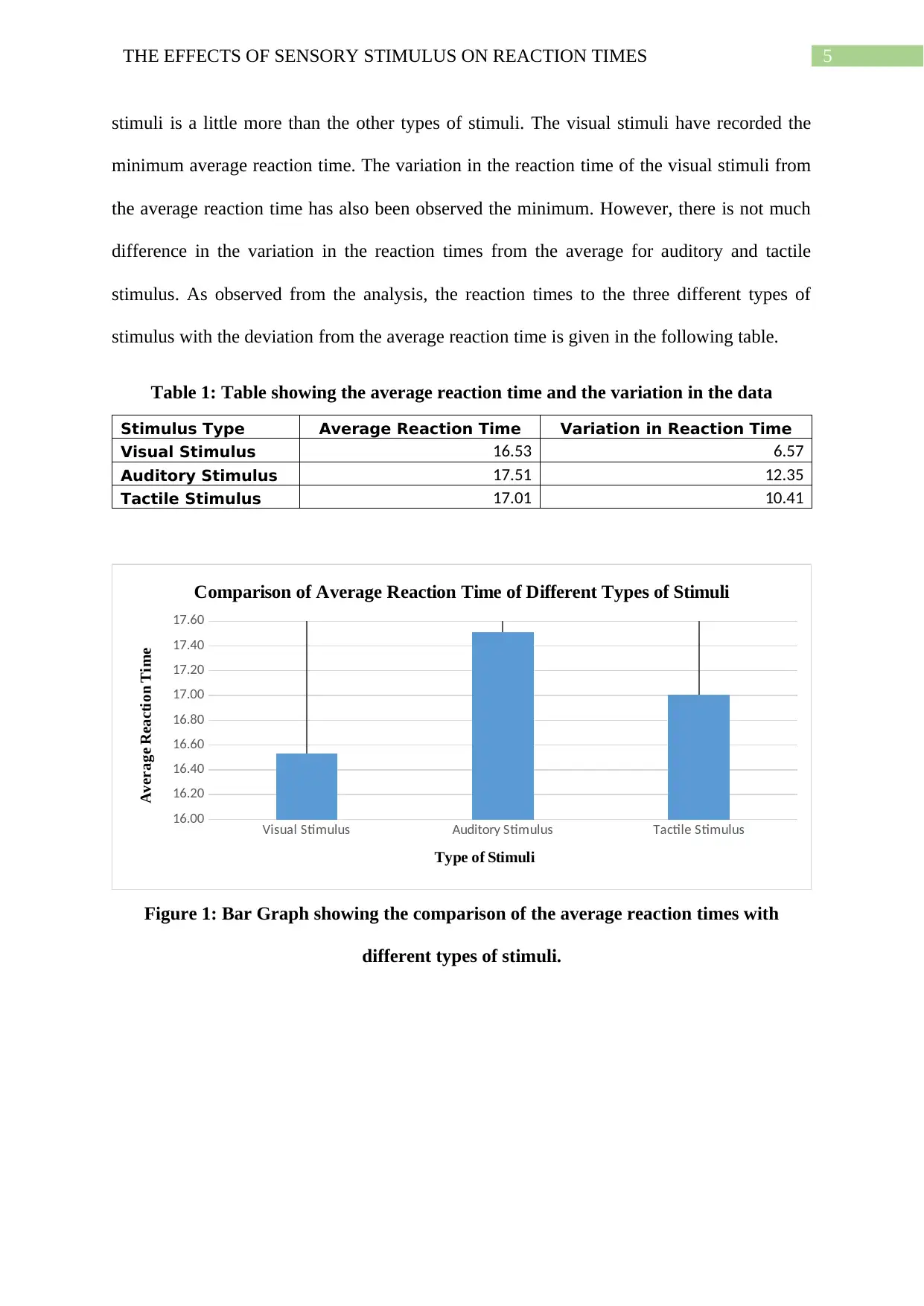
the differences in the reaction time (if any) can be understood clearly. The error bars in the
bar graph will indicate the variation in the data.
3.0 Results
The bar graph given below, in figure 1, shows the average reaction time of the
participants to different types of stimuli such as auditory, visual and tactile. As can be seen
from the graph, the average reaction time to the three types of stimuli are not much different
from each other. However, it can also be seen that the average reaction time to the auditory
Document Page
5THE EFFECTS OF SENSORY STIMULUS ON REACTION TIMES
stimuli is a little more than the other types of stimuli. The visual stimuli have recorded the
minimum average reaction time. The variation in the reaction time of the visual stimuli from
the average reaction time has also been observed the minimum. However, there is not much
difference in the variation in the reaction times from the average for auditory and tactile
stimulus. As observed from the analysis, the reaction times to the three different types of
stimulus with the deviation from the average reaction time is given in the following table.
Table 1: Table showing the average reaction time and the variation in the data
Stimulus Type Average Reaction Time Variation in Reaction Time
Visual Stimulus 16.53 6.57
Auditory Stimulus 17.51 12.35
Tactile Stimulus 17.01 10.41
Visual Stimulus Auditory Stimulus Tactile Stimulus
16.00
16.20
16.40
16.60
16.80
17.00
17.20
17.40
17.60
Comparison of Average Reaction Time of Different Types of Stimuli
Type of Stimuli
Average Reaction Time
Figure 1: Bar Graph showing the comparison of the average reaction times with
different types of stimuli.
Document Page
6THE EFFECTS OF SENSORY STIMULUS ON REACTION TIMES
References
1. Ng AW, Chan AH. Finger response times to visual, auditory and tactile modality
stimuli. InProceedings of the international multiconference of engineers and computer
scientists 2012 Mar (Vol. 2, pp. 1449-1454).
2. Shelton J, Kumar GP. Comparison between auditory and visual simple reaction times.
Neuroscience & Medicine. 2010 Sep 1;1(1):30-2.
3. Polzella DJ, Ramsey EG, Bower SM. The effects of brief variable foreperiods on
simple reaction time. Bulletin of the Psychonomic Society. 1989 May 1;27(5):467-9.
4. Goswami U. Sensory theories of developmental dyslexia: three challenges for
research. Nature Reviews Neuroscience. 2015 Jan;16(1):43.
5. McGinley MJ, David SV, McCormick DA. Cortical membrane potential signature of
optimal states for sensory signal detection. Neuron. 2015 Jul 1;87(1):179-92.
6. Stewart CR, Sanchez SS, Grenesko EL, Brown CM, Chen CP, Keehn B, Velasquez F,
Lincoln AJ, Müller RA. Sensory symptoms and processing of nonverbal auditory and
visual stimuli in children with autism spectrum disorder. Journal of autism and
developmental disorders. 2016 May 1;46(5):1590-601.
chevron_up_icon
1 out of 7
circle_padding
hide_on_mobile
zoom_out_icon
[object Object]