Southern-East Queensland Urban Water Resources: Council Report
VerifiedAdded on 2023/06/03
|8
|2615
|75
Report
AI Summary
This report analyzes urban water resources in Southern-East Queensland, focusing on integrated water cycle management (IWCM) strategies. It reviews council report structures, highlighting the importance of comprehensive planning, risk management, and community engagement in addressing challenges like climate change and population growth. The report emphasizes the need for adaptive management, well-defined governance, and continuous review to ensure water sustainability and resilience in the face of drought conditions. It also covers financial and social considerations, environmental and community consultations, and recommendations for improving IWCM strategies in the region, ultimately aiming for more resilient and livable urban communities. Desklib provides access to this and other student-contributed assignments.
Southern-East Queensland urban water
resources1
SOUTHERN-EAST QUEENSLAND URBAN WATER RESOURCES
Name:
Department:
Course:
Date:
resources1
SOUTHERN-EAST QUEENSLAND URBAN WATER RESOURCES
Name:
Department:
Course:
Date:

Paraphrase This Document
Need a fresh take? Get an instant paraphrase of this document with our AI Paraphraser
Southern-East Queensland urban water resources 2
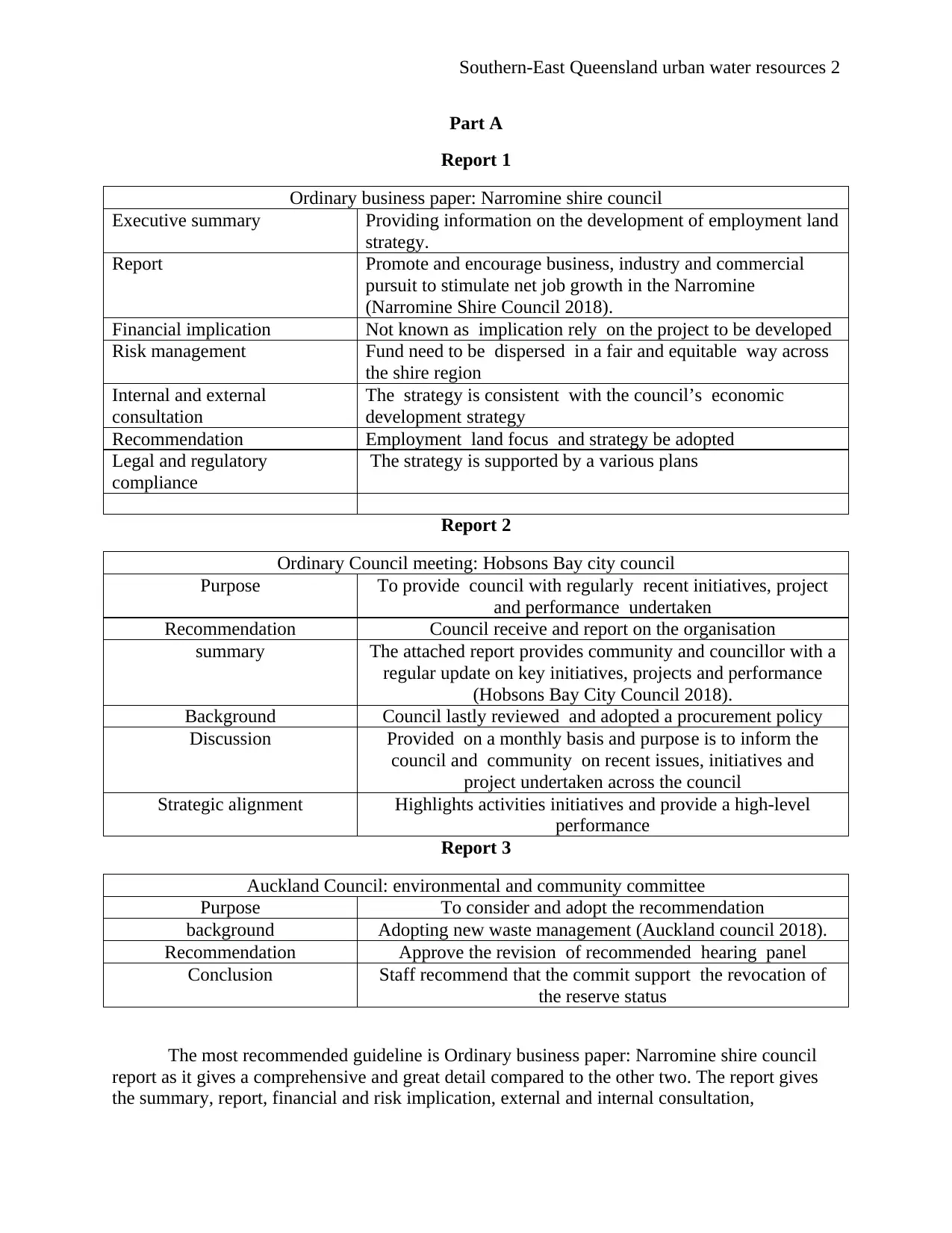
Part A
Report 1
Ordinary business paper: Narromine shire council
Executive summary Providing information on the development of employment land
strategy.
Report Promote and encourage business, industry and commercial
pursuit to stimulate net job growth in the Narromine
(Narromine Shire Council 2018).
Financial implication Not known as implication rely on the project to be developed
Risk management Fund need to be dispersed in a fair and equitable way across
the shire region
Internal and external
consultation
The strategy is consistent with the council’s economic
development strategy
Recommendation Employment land focus and strategy be adopted
Legal and regulatory
compliance
The strategy is supported by a various plans
Report 2
Ordinary Council meeting: Hobsons Bay city council
Purpose To provide council with regularly recent initiatives, project
and performance undertaken
Recommendation Council receive and report on the organisation
summary The attached report provides community and councillor with a
regular update on key initiatives, projects and performance
(Hobsons Bay City Council 2018).
Background Council lastly reviewed and adopted a procurement policy
Discussion Provided on a monthly basis and purpose is to inform the
council and community on recent issues, initiatives and
project undertaken across the council
Strategic alignment Highlights activities initiatives and provide a high-level
performance
Report 3
Auckland Council: environmental and community committee
Purpose To consider and adopt the recommendation
background Adopting new waste management (Auckland council 2018).
Recommendation Approve the revision of recommended hearing panel
Conclusion Staff recommend that the commit support the revocation of
the reserve status
The most recommended guideline is Ordinary business paper: Narromine shire council
report as it gives a comprehensive and great detail compared to the other two. The report gives
the summary, report, financial and risk implication, external and internal consultation,
Part A
Report 1
Ordinary business paper: Narromine shire council
Executive summary Providing information on the development of employment land
strategy.
Report Promote and encourage business, industry and commercial
pursuit to stimulate net job growth in the Narromine
(Narromine Shire Council 2018).
Financial implication Not known as implication rely on the project to be developed
Risk management Fund need to be dispersed in a fair and equitable way across
the shire region
Internal and external
consultation
The strategy is consistent with the council’s economic
development strategy
Recommendation Employment land focus and strategy be adopted
Legal and regulatory
compliance
The strategy is supported by a various plans
Report 2
Ordinary Council meeting: Hobsons Bay city council
Purpose To provide council with regularly recent initiatives, project
and performance undertaken
Recommendation Council receive and report on the organisation
summary The attached report provides community and councillor with a
regular update on key initiatives, projects and performance
(Hobsons Bay City Council 2018).
Background Council lastly reviewed and adopted a procurement policy
Discussion Provided on a monthly basis and purpose is to inform the
council and community on recent issues, initiatives and
project undertaken across the council
Strategic alignment Highlights activities initiatives and provide a high-level
performance
Report 3
Auckland Council: environmental and community committee
Purpose To consider and adopt the recommendation
background Adopting new waste management (Auckland council 2018).
Recommendation Approve the revision of recommended hearing panel
Conclusion Staff recommend that the commit support the revocation of
the reserve status
The most recommended guideline is Ordinary business paper: Narromine shire council
report as it gives a comprehensive and great detail compared to the other two. The report gives
the summary, report, financial and risk implication, external and internal consultation,
Southern-East Queensland urban water resources 3
recommendation, and finally legal and regulatory compliance which are crucial in council and
community involved.
Part B
Southern-East Queensland council
Southern-East Queensland integrated water cycle management
Purpose
To report on all components of water cycle so as to provide population’s wants and
ambitions for water in a manner that optimizes communal, ecological welfares and climate
outlays. Additionally, reports consider whether the council’s strategic planning respond to the
future drought conditions. Finally, the report illustrates the way to secure water for growing,
resilient and greater Southern-East Queensland populace.
Background
A number of motives for TWCM in South-East Queensland comprise the climate change,
population development, technology advances, environmental drop, and varying community
principles (TWCM 2013). The local government in SEQ is currently needed by the
environmental protection water policy of the environmental protection act 1994 to progress and
initiate implementation of water cycle management (Australian Bureau of Statistics 2017). The
guideline offers contextual information, duties of main participants, and statutory framework for
IWCM, and the important connections between another forecasting instrument that is pertinent to
the detail, timing and consistency of IWCM strategies (IWCM n.d). Following the tactics
comprehensive in this policy, it will offer a transparent and robust course to enlighten
management plans, developing instrument, and structure agreement of local government parts
through SEQ. The basic constituents of record tactics are advancing IWCM policy, undertaking
thorough planning where needed, arranging an implementation strategy, obtaining certification
and endorsement through the course, and finally publishing, checking and revising the strategy
(IWCM n.d).
Integrated planning and reporting
The IWCM arrangement identifies local government’s continuing accountability for
scheduling and integrating the viable water supervision. This duty is still needed even after the
past split-up in SEQ of water service delivery from the outdated local government amenities.
IWCM design processes offer local government a chance to cooperate with water service
providers and state government, to better regulate and influence key water cycle services for
their people. To guarantee there is synchronized and aligned control of the water cycles services,
the public aspiration in local governmental community tactics is interpreted into significant
actions and policies (Independent Pricing and Regulatory Tribunal NSW 2016). It will also offer
a chance for the local government to internally synchronize their present water cycle duties for
greater effectiveness and efficiency. IWCM formation offers a procedure to deliberate and
integrate the implication of climate modification into the decision-making process. It is projected
recommendation, and finally legal and regulatory compliance which are crucial in council and
community involved.
Part B
Southern-East Queensland council
Southern-East Queensland integrated water cycle management
Purpose
To report on all components of water cycle so as to provide population’s wants and
ambitions for water in a manner that optimizes communal, ecological welfares and climate
outlays. Additionally, reports consider whether the council’s strategic planning respond to the
future drought conditions. Finally, the report illustrates the way to secure water for growing,
resilient and greater Southern-East Queensland populace.
Background
A number of motives for TWCM in South-East Queensland comprise the climate change,
population development, technology advances, environmental drop, and varying community
principles (TWCM 2013). The local government in SEQ is currently needed by the
environmental protection water policy of the environmental protection act 1994 to progress and
initiate implementation of water cycle management (Australian Bureau of Statistics 2017). The
guideline offers contextual information, duties of main participants, and statutory framework for
IWCM, and the important connections between another forecasting instrument that is pertinent to
the detail, timing and consistency of IWCM strategies (IWCM n.d). Following the tactics
comprehensive in this policy, it will offer a transparent and robust course to enlighten
management plans, developing instrument, and structure agreement of local government parts
through SEQ. The basic constituents of record tactics are advancing IWCM policy, undertaking
thorough planning where needed, arranging an implementation strategy, obtaining certification
and endorsement through the course, and finally publishing, checking and revising the strategy
(IWCM n.d).
Integrated planning and reporting
The IWCM arrangement identifies local government’s continuing accountability for
scheduling and integrating the viable water supervision. This duty is still needed even after the
past split-up in SEQ of water service delivery from the outdated local government amenities.
IWCM design processes offer local government a chance to cooperate with water service
providers and state government, to better regulate and influence key water cycle services for
their people. To guarantee there is synchronized and aligned control of the water cycles services,
the public aspiration in local governmental community tactics is interpreted into significant
actions and policies (Independent Pricing and Regulatory Tribunal NSW 2016). It will also offer
a chance for the local government to internally synchronize their present water cycle duties for
greater effectiveness and efficiency. IWCM formation offers a procedure to deliberate and
integrate the implication of climate modification into the decision-making process. It is projected
⊘ This is a preview!⊘
Do you want full access?
Subscribe today to unlock all pages.

Trusted by 1+ million students worldwide
Southern-East Queensland urban water resources 4
that, over time, climate variation will influence on a number of matters that may be combined
into the IWCM plan such as drought conditions (IWCM n.d). The paper also distinguishes that
adaptive controlling has the possibility to makes approaches of short-term decision that aligns
with long-term supply-demand objectives. For example, a promptness decision that is created as
an adaptive gauge for drought, once instigated, may become the novel long-term resource for
given urban part (Bureau of Meteorology 2015).
Governance matters
The paper recognizes the likely basic to the achievement of adaptive controlling tactics as
being well-defined and conversed governance arrangement and community engagement in the
on-going and planned supervision practices. It denotes that without involved community, climate
variation reaction grounded on adaptive management is expected to flop. An involved
community that comprehends the concerns and the doubts linked with climate alteration could
possibly bear more consistent drought reaction measures, as they will more evidently classify
with the requirement for their reaction and the effect of their act (Victorian Essential Services
Commission 2016).
Risk management
If the goals are not released or unlikely to be met in future, the risk linked with the
letdown to accomplish the objective ought to be evaluated. The guidelines and principles for the
Australia and New Zealand standard 31000:2009 risk management offers a structure for risk
assessment that can be utilised (Melbourne Water 2017). Some of the water cycles may only
have low risk but even comparatively low-risk issues should be recognised and acknowledged to
illustrate transparency and due diligence. Basically, there are three basic outcomes when looking
at the water cycle concerns and linked perils. Low risk comprises issues that are efficiently and
effectively accomplished. In this case, comprehensive planning is not needed and the local
government can avoid the implementation strategy.
Medium risk are present when managing approaches are sufficient for efficiently and proficiently
managing the problems, however, they are not executed. Detailed planning might be required but
not on this phase, and therefore the government can skip the preparation of the execution plan.
High risk: the present managing methods are not proficient of managing the concerns or
management is presently in place. In this case, comprehensive planning is required to pinpoint
and assesses new selections, such as additional or improved expertise.
Financial consideration
The financial, time and human resources are required to make IWCM plan. Typically, it
will differ relying on the scope of complete planning needed, the scale of the part, and the
intricacy of the concerns and solutions advanced. The properties and time frame ought to be
acknowledged early in the procedure. While policy development should classify the need for the
comprehensive planning, present acquaintance and knowledge can be used for an early
approximation of detailed forecasting requirement. The most local government in South-East
Queensland is expected to require undertaking at least some comprehensive planning. As a
possibility, councils may desire to warrant budget scheduling for the 2018/2019 financial year
allots adequate resources to commence comprehensive IWCM planning (Aither 2017).
that, over time, climate variation will influence on a number of matters that may be combined
into the IWCM plan such as drought conditions (IWCM n.d). The paper also distinguishes that
adaptive controlling has the possibility to makes approaches of short-term decision that aligns
with long-term supply-demand objectives. For example, a promptness decision that is created as
an adaptive gauge for drought, once instigated, may become the novel long-term resource for
given urban part (Bureau of Meteorology 2015).
Governance matters
The paper recognizes the likely basic to the achievement of adaptive controlling tactics as
being well-defined and conversed governance arrangement and community engagement in the
on-going and planned supervision practices. It denotes that without involved community, climate
variation reaction grounded on adaptive management is expected to flop. An involved
community that comprehends the concerns and the doubts linked with climate alteration could
possibly bear more consistent drought reaction measures, as they will more evidently classify
with the requirement for their reaction and the effect of their act (Victorian Essential Services
Commission 2016).
Risk management
If the goals are not released or unlikely to be met in future, the risk linked with the
letdown to accomplish the objective ought to be evaluated. The guidelines and principles for the
Australia and New Zealand standard 31000:2009 risk management offers a structure for risk
assessment that can be utilised (Melbourne Water 2017). Some of the water cycles may only
have low risk but even comparatively low-risk issues should be recognised and acknowledged to
illustrate transparency and due diligence. Basically, there are three basic outcomes when looking
at the water cycle concerns and linked perils. Low risk comprises issues that are efficiently and
effectively accomplished. In this case, comprehensive planning is not needed and the local
government can avoid the implementation strategy.
Medium risk are present when managing approaches are sufficient for efficiently and proficiently
managing the problems, however, they are not executed. Detailed planning might be required but
not on this phase, and therefore the government can skip the preparation of the execution plan.
High risk: the present managing methods are not proficient of managing the concerns or
management is presently in place. In this case, comprehensive planning is required to pinpoint
and assesses new selections, such as additional or improved expertise.
Financial consideration
The financial, time and human resources are required to make IWCM plan. Typically, it
will differ relying on the scope of complete planning needed, the scale of the part, and the
intricacy of the concerns and solutions advanced. The properties and time frame ought to be
acknowledged early in the procedure. While policy development should classify the need for the
comprehensive planning, present acquaintance and knowledge can be used for an early
approximation of detailed forecasting requirement. The most local government in South-East
Queensland is expected to require undertaking at least some comprehensive planning. As a
possibility, councils may desire to warrant budget scheduling for the 2018/2019 financial year
allots adequate resources to commence comprehensive IWCM planning (Aither 2017).
Paraphrase This Document
Need a fresh take? Get an instant paraphrase of this document with our AI Paraphraser
Southern-East Queensland urban water resources 5
Social consideration
The review process is backed by a complete engagement and social study programs. The
main objective for public engagement was to comprehend the communal preferences around
particular drought reaction measures, water efficient strategy, alternative portfolio and
environmental flows. Secondly, the aim is to increase the cognizance and ease negotiation
around the plan and review the course. Thirdly, gain an understanding of the difference across
the area in public beliefs connecting to water planning and managing. Fourthly, it aims to grow
clear gears for clarifying multifaceted thoughts to the public. Notably, through a sort of social
investigation and engagement actions, the plan was verbalized in discussion with the community
associates and industry participants. Under the 2018 plan, this can be attained by managing
ecological flows, along with highly established adaptive management and meaningful checking
and clarification (Water Services Association of Australia 2013).
Environmental consultation
Southern-East Queensland is developing innovative tactics to meets the concerns it
encounters including the population growth, climate change such as drought. IWCM will
generate a seamless catchment for all water users, comprising domestic users and business by
removing existing legal, regulatory and replacing them with the new and integrated framework.
The IWCM technique will be in tune with the Australia legislation based on the same philosophy
of sustainability, efficiency and equity. The aim of the legislation is to ensure that water is
sustainable and the ability to avert a future drought condition, which is the vision behind IWCM
(IWCM n.d).
Community consultation
The strategy has been developed with the input from the external agencies, partner
councils and through consultation with the community. Internally, the strategy documents will
continue to be used to engage in a series of conversation with personnel across the organisation
to review the intent and content of specific actions and plans (Frontier Economics & Arup 2017).
To date, internal consultation has been undertaken across the council to identify that
recommendation which is capable to be implemented within present resource 2018-2019.
However, the additional recommendation does not need extra resources.
Internal consultation
An internal steering committee was established, drawing expertise from across council
including the natural resource management, recreation services, planning reforms and building
and environmental, planning and investment.
Recommendations
It is recommended that council endorses approaches such as increasing IWCM strategy,
undertake thorough planning, preparing an execution plan. Also, distributing, observing and
revising, and attaining certification and commendation throughout the course. The method will
Social consideration
The review process is backed by a complete engagement and social study programs. The
main objective for public engagement was to comprehend the communal preferences around
particular drought reaction measures, water efficient strategy, alternative portfolio and
environmental flows. Secondly, the aim is to increase the cognizance and ease negotiation
around the plan and review the course. Thirdly, gain an understanding of the difference across
the area in public beliefs connecting to water planning and managing. Fourthly, it aims to grow
clear gears for clarifying multifaceted thoughts to the public. Notably, through a sort of social
investigation and engagement actions, the plan was verbalized in discussion with the community
associates and industry participants. Under the 2018 plan, this can be attained by managing
ecological flows, along with highly established adaptive management and meaningful checking
and clarification (Water Services Association of Australia 2013).
Environmental consultation
Southern-East Queensland is developing innovative tactics to meets the concerns it
encounters including the population growth, climate change such as drought. IWCM will
generate a seamless catchment for all water users, comprising domestic users and business by
removing existing legal, regulatory and replacing them with the new and integrated framework.
The IWCM technique will be in tune with the Australia legislation based on the same philosophy
of sustainability, efficiency and equity. The aim of the legislation is to ensure that water is
sustainable and the ability to avert a future drought condition, which is the vision behind IWCM
(IWCM n.d).
Community consultation
The strategy has been developed with the input from the external agencies, partner
councils and through consultation with the community. Internally, the strategy documents will
continue to be used to engage in a series of conversation with personnel across the organisation
to review the intent and content of specific actions and plans (Frontier Economics & Arup 2017).
To date, internal consultation has been undertaken across the council to identify that
recommendation which is capable to be implemented within present resource 2018-2019.
However, the additional recommendation does not need extra resources.
Internal consultation
An internal steering committee was established, drawing expertise from across council
including the natural resource management, recreation services, planning reforms and building
and environmental, planning and investment.
Recommendations
It is recommended that council endorses approaches such as increasing IWCM strategy,
undertake thorough planning, preparing an execution plan. Also, distributing, observing and
revising, and attaining certification and commendation throughout the course. The method will
Southern-East Queensland urban water resources 6
be planned to accommodate an array of variance across SEQ including planning intricacy of
water management concerns and local government capability.
Conclusion
The SEQ integrated water cycle management plan encompasses a set of strategies that
generate on work undertaken as part of the earlier plans, novel platforms and initiatives that will
be rolled out over the subsequent years, and activities that will be taken should drought
circumstances return. The report provides the implementation guide that will summarize the
strategies in a plan, associated actions and the relevant timeline for the implementation. The
strategy will be theme to continuous review by the governing concept. Efficient public and
participant engagement will endure a continuing aspect of the plan’s enactment and the growth
of upcoming water strategies. The plan will monitor regularly and it will be subject to a
comprehensive review not later than 2021. Urban communities are more resilient and livable.
Thus, strategies will include the establishment of the Water Smart cities programs, investigating
the obstacles and enables to cost-effective water reprocessing, and forming partnerships and
cooperative measures.
Summary
There is currently considerable goodwill and aid in all level of government, society and
industries for integrated water cycle management. The awareness and support have generated
recent urban development pressure, droughts and environmental awareness. The water sector
practitioners have moved forwards in term of their technical methods to embrace an idea of
integrated water cycle management. To execute these changes, the traditional intergovernmental
blockades need to be split down into holistic integrated institutional methods to departmental
divisions. It is clear that the waterway and water services companies are restricted in their
linkage. A rethink of organisational structures and connections may be important to accomplish
their gain of the IWCM approach (IWCM n.d). The Southern-East Queensland highlight that the
management of drought could be some of most influential factors in shaping the urban centre and
the standard of livability currently and in the future.
be planned to accommodate an array of variance across SEQ including planning intricacy of
water management concerns and local government capability.
Conclusion
The SEQ integrated water cycle management plan encompasses a set of strategies that
generate on work undertaken as part of the earlier plans, novel platforms and initiatives that will
be rolled out over the subsequent years, and activities that will be taken should drought
circumstances return. The report provides the implementation guide that will summarize the
strategies in a plan, associated actions and the relevant timeline for the implementation. The
strategy will be theme to continuous review by the governing concept. Efficient public and
participant engagement will endure a continuing aspect of the plan’s enactment and the growth
of upcoming water strategies. The plan will monitor regularly and it will be subject to a
comprehensive review not later than 2021. Urban communities are more resilient and livable.
Thus, strategies will include the establishment of the Water Smart cities programs, investigating
the obstacles and enables to cost-effective water reprocessing, and forming partnerships and
cooperative measures.
Summary
There is currently considerable goodwill and aid in all level of government, society and
industries for integrated water cycle management. The awareness and support have generated
recent urban development pressure, droughts and environmental awareness. The water sector
practitioners have moved forwards in term of their technical methods to embrace an idea of
integrated water cycle management. To execute these changes, the traditional intergovernmental
blockades need to be split down into holistic integrated institutional methods to departmental
divisions. It is clear that the waterway and water services companies are restricted in their
linkage. A rethink of organisational structures and connections may be important to accomplish
their gain of the IWCM approach (IWCM n.d). The Southern-East Queensland highlight that the
management of drought could be some of most influential factors in shaping the urban centre and
the standard of livability currently and in the future.
⊘ This is a preview!⊘
Do you want full access?
Subscribe today to unlock all pages.
Trusted by 1+ million students worldwide
Southern-East Queensland urban water resources 7
References
Aither. (2017). Urban water sector: Future cost and affordability analysis: The role of water
reform in alleviating national household affordability issues. Available from:
http://infrastructureaustralia.gov.au/policy-publications/publications/reforming-urban-
water.aspx, [accessed on 21 October 2018].
Australian Bureau of Statistics. (2017). Regional population growth, Australia, 2016. Available
from: http://www.abs.gov.au/ausstats/abs@.nsf/mf/3218.0, [accessed on 21 October 2018].
Bureau of Meteorology. (2015). Recent rainfall, drought and southern Australia’s long-term
rainfall decline, available from: http://www.bom.gov.au/climate/updates/articles/a010-southern-
rainfall-decline.shtml, [accessed on 21 October 2018].
Frontier Economics & Arup. (2017). Urban water regulation reform. Available from:
http://infrastructureaustralia.gov.au/policy-publications/publications/reforming-urban-
water.aspx, [accessed on 21 October 2018].
Independent Pricing and Regulatory Tribunal NSW. (2016) Compliance Report – Licence
compliance under the Water industry Competition Act 2006 (NSW) – October 2016. Available
from: https://www.ipart.nsw.gov.au/Home/Industries/Water/Alternate-water-utilities-WICA/
Licence ComplianceReporting/Compliance-Report-Licence-complianceunder-the-Water-
industry-Competition-Act-2006-NSWOctober-2016, [accessed on 21 October 2018].
Melbourne Water. (2017). Natural and urban water cycle. Available
from:https://www.melbournewater.com.au/community-and-education/about-our-water/natural
and urban-water-cycle, [accessed on 21 October 2018].
Victorian Essential Services Commission. (2016). 2018 Water pricing review. Available from:
http://www.esc.vic.gov.au/document/water/36646-2018-water-price-review-guidancepaper-
november-2016/, [accessed on 21 October 2018].
Water Services Association of Australia. (2013). Submission to the National Water Commission
on the future of the urban water industry. Available from:
https://www.wsaa.asn.au/publication/submission-national-water-commission-futureurban-water-
industry, [accessed on 21 October 2018].
IWCM (n.d). Integrated Water Cycle Management. Available from:
https://flowsystems.com.au/water/sustainable-water-communities/integrated-water-cycle-
management/, [accessed on 21 October 2018].
TWCM. (2013) MBRC Total Water Cycle Management implementation plan. Available from:
https://www.moretonbay.qld.gov.au/uploadedFiles/moretonbay/development/planning/TWCM-
Implementation-Plan.pdf, [accessed on 21 October 2018].
Auckland council. (2018). Auckland town hall. Environment and community committee
Available from:
http://infocouncil.aucklandcouncil.govt.nz/Open/2018/06/ENV_20180612_AGN_6840_AT_WE
B.htm, [accessed on 21 October 2018].
References
Aither. (2017). Urban water sector: Future cost and affordability analysis: The role of water
reform in alleviating national household affordability issues. Available from:
http://infrastructureaustralia.gov.au/policy-publications/publications/reforming-urban-
water.aspx, [accessed on 21 October 2018].
Australian Bureau of Statistics. (2017). Regional population growth, Australia, 2016. Available
from: http://www.abs.gov.au/ausstats/abs@.nsf/mf/3218.0, [accessed on 21 October 2018].
Bureau of Meteorology. (2015). Recent rainfall, drought and southern Australia’s long-term
rainfall decline, available from: http://www.bom.gov.au/climate/updates/articles/a010-southern-
rainfall-decline.shtml, [accessed on 21 October 2018].
Frontier Economics & Arup. (2017). Urban water regulation reform. Available from:
http://infrastructureaustralia.gov.au/policy-publications/publications/reforming-urban-
water.aspx, [accessed on 21 October 2018].
Independent Pricing and Regulatory Tribunal NSW. (2016) Compliance Report – Licence
compliance under the Water industry Competition Act 2006 (NSW) – October 2016. Available
from: https://www.ipart.nsw.gov.au/Home/Industries/Water/Alternate-water-utilities-WICA/
Licence ComplianceReporting/Compliance-Report-Licence-complianceunder-the-Water-
industry-Competition-Act-2006-NSWOctober-2016, [accessed on 21 October 2018].
Melbourne Water. (2017). Natural and urban water cycle. Available
from:https://www.melbournewater.com.au/community-and-education/about-our-water/natural
and urban-water-cycle, [accessed on 21 October 2018].
Victorian Essential Services Commission. (2016). 2018 Water pricing review. Available from:
http://www.esc.vic.gov.au/document/water/36646-2018-water-price-review-guidancepaper-
november-2016/, [accessed on 21 October 2018].
Water Services Association of Australia. (2013). Submission to the National Water Commission
on the future of the urban water industry. Available from:
https://www.wsaa.asn.au/publication/submission-national-water-commission-futureurban-water-
industry, [accessed on 21 October 2018].
IWCM (n.d). Integrated Water Cycle Management. Available from:
https://flowsystems.com.au/water/sustainable-water-communities/integrated-water-cycle-
management/, [accessed on 21 October 2018].
TWCM. (2013) MBRC Total Water Cycle Management implementation plan. Available from:
https://www.moretonbay.qld.gov.au/uploadedFiles/moretonbay/development/planning/TWCM-
Implementation-Plan.pdf, [accessed on 21 October 2018].
Auckland council. (2018). Auckland town hall. Environment and community committee
Available from:
http://infocouncil.aucklandcouncil.govt.nz/Open/2018/06/ENV_20180612_AGN_6840_AT_WE
B.htm, [accessed on 21 October 2018].
Paraphrase This Document
Need a fresh take? Get an instant paraphrase of this document with our AI Paraphraser
Southern-East Queensland urban water resources 8
Hobsons Bay City Council. (2018). Ordinary council meeting agenda. Available from:
http://www.hobsonsbay.vic.gov.au/files/content/public/council/council-meetings/ordinary-
council-meeting-14-august-2018/ocm-14-august-2018-confirmed-minutes.pdf?streamFile=true,
[accessed on 21 October 2018].
Narromine Shire Council. (2018). Ordinary meeting business. Report to council- community and
economic development. Available from:
https://www.narromine.nsw.gov.au/_literature_192426/06_-_Reports_to_Council_-
_Community_and_Economic_Development_-_September_2018, [accessed on 21 October 2018].
Hobsons Bay City Council. (2018). Ordinary council meeting agenda. Available from:
http://www.hobsonsbay.vic.gov.au/files/content/public/council/council-meetings/ordinary-
council-meeting-14-august-2018/ocm-14-august-2018-confirmed-minutes.pdf?streamFile=true,
[accessed on 21 October 2018].
Narromine Shire Council. (2018). Ordinary meeting business. Report to council- community and
economic development. Available from:
https://www.narromine.nsw.gov.au/_literature_192426/06_-_Reports_to_Council_-
_Community_and_Economic_Development_-_September_2018, [accessed on 21 October 2018].

1 out of 8


Related Documents


Your All-in-One AI-Powered Toolkit for Academic Success.
+13062052269
info@desklib.com
Available 24*7 on WhatsApp / Email
![[object Object]](/_next/static/media/star-bottom.7253800d.svg)
Unlock your academic potential
Copyright © 2020–2026 A2Z Services. All Rights Reserved. Developed and managed by ZUCOL.