Service Delivery and Technology: A Comprehensive Report
VerifiedAdded on 2021/04/21
|13
|3743
|69
Report
AI Summary
This report provides a comprehensive overview of the relationship between service delivery and technology. It begins by discussing collaborative participation in the sharing economy, emphasizing the shift towards customer-oriented, relational services and the importance of co-creation. The report then explores how technology has revolutionized service offerings, including the emergence of new services and the use of technology in customer interactions. It also delves into the Internet of Things (IoT), highlighting its potential for creating smart, interconnected products and transforming customer relationships, while also addressing the associated challenges such as privacy concerns and standardization issues. Furthermore, the report touches upon the dark side of technology and its potential negative impacts on service delivery and the people involved. Ultimately, the report emphasizes the positive aspects of technology in service delivery, illustrating how technology enhances customer experiences and drives innovation in the modern business landscape. The report also discusses the Servuction and Collaborative Participation models.
Running head: SERVICE DELIVERY AND TECHNOLOGY
Service Delivery and Technology
Name of the student
Name of the University
Author note
Service Delivery and Technology
Name of the student
Name of the University
Author note

Paraphrase This Document
Need a fresh take? Get an instant paraphrase of this document with our AI Paraphraser
1SERVICE DELIVERY AND TECHNOLOGY
Executive Summary
The primary purpose of this report is to discuss the different aspects of providing service with
the help of technology. It discusses how technology can help in the process of collaborative
participation in the age of sharing economy. It discusses how technology has brought in a lot
of innovations in the present market. It talks about the positive and the negative sides of that
of internet-of-things. It also elaborates on the dark sides of that of technology and how it can
prove to be detrimental for the service and the people. The report states that the positive
aspects of providing services out weights that of the negative sides.
Executive Summary
The primary purpose of this report is to discuss the different aspects of providing service with
the help of technology. It discusses how technology can help in the process of collaborative
participation in the age of sharing economy. It discusses how technology has brought in a lot
of innovations in the present market. It talks about the positive and the negative sides of that
of internet-of-things. It also elaborates on the dark sides of that of technology and how it can
prove to be detrimental for the service and the people. The report states that the positive
aspects of providing services out weights that of the negative sides.
2SERVICE DELIVERY AND TECHNOLOGY
Table of Contents
Introduction................................................................................................................................3
Discussion..................................................................................................................................3
Collaborative participation in the era of sharing economy....................................................3
Service and Technology.........................................................................................................4
Internet of Things...................................................................................................................5
Dark Side of technology.........................................................................................................6
Conclusion:................................................................................................................................8
References:...............................................................................................................................10
Table of Contents
Introduction................................................................................................................................3
Discussion..................................................................................................................................3
Collaborative participation in the era of sharing economy....................................................3
Service and Technology.........................................................................................................4
Internet of Things...................................................................................................................5
Dark Side of technology.........................................................................................................6
Conclusion:................................................................................................................................8
References:...............................................................................................................................10
⊘ This is a preview!⊘
Do you want full access?
Subscribe today to unlock all pages.

Trusted by 1+ million students worldwide
3SERVICE DELIVERY AND TECHNOLOGY
Introduction
Organizations and companies provide services to the people for the benefit of the
customers. In the modern era, technology is being used to a great extent in order to provide
services to the people. Technology has influenced the practice in relation to service
marketing. It has created potential in relation to service offerings. Technology is playing a
great role in shaping service and helping both the customers along with the employees to
receive and give customised services (Brohman et al. 2015). This report discusses about the
different aspects of technology pertaining to providing service. It elucidates about the
positive along with the negative sides of technology and its increasing importance in the
modern era.
Discussion
Collaborative participation in the era of sharing economy
Customer participation has become the key in the arena of modern day business. The
customers in the present age are looked upon as operant resources and they act as co-creators
in relation to value. Service delivered in the modern age is customer oriented and it is
relational. According to Wirtz and Lovelock (2016), the modern world is defined by that of
rapid changes and searching for solutions in relation to environmental challenges has become
more complex Co-creation focuses on the aspect of interactive relationships that can help in
improving the customer experience. Active involvement on the part of the customer can help
in creating a rich experience. On the other hand, sharing economy cannot promise the
employees that of steady income and the workers can take on short-term project that may
prove to be lucrative for them on short-term basis. The employers within that of the sharing
economy do not generally offer benefits as the people working from one point of view do not
act as employees (Henze et al. 2016). Workers are bound to pay for their own benefit that
often costs a large amount of their income. Effectiveness in relation to customer service has
an impact on the productivity of the organisation leads to customer satisfaction. The services
emerge from that of “open processes” and in it the customers act as co-producers. They are
hence influenced on account of progress of the different processes. The traditional model of
marketing did not provide marketer with means that can help them in entering the process of
consumption. In the traditional platform, the marketer did not have any idea regarding what
customer did with the goods. According to the service dominant logic, service production can
Introduction
Organizations and companies provide services to the people for the benefit of the
customers. In the modern era, technology is being used to a great extent in order to provide
services to the people. Technology has influenced the practice in relation to service
marketing. It has created potential in relation to service offerings. Technology is playing a
great role in shaping service and helping both the customers along with the employees to
receive and give customised services (Brohman et al. 2015). This report discusses about the
different aspects of technology pertaining to providing service. It elucidates about the
positive along with the negative sides of technology and its increasing importance in the
modern era.
Discussion
Collaborative participation in the era of sharing economy
Customer participation has become the key in the arena of modern day business. The
customers in the present age are looked upon as operant resources and they act as co-creators
in relation to value. Service delivered in the modern age is customer oriented and it is
relational. According to Wirtz and Lovelock (2016), the modern world is defined by that of
rapid changes and searching for solutions in relation to environmental challenges has become
more complex Co-creation focuses on the aspect of interactive relationships that can help in
improving the customer experience. Active involvement on the part of the customer can help
in creating a rich experience. On the other hand, sharing economy cannot promise the
employees that of steady income and the workers can take on short-term project that may
prove to be lucrative for them on short-term basis. The employers within that of the sharing
economy do not generally offer benefits as the people working from one point of view do not
act as employees (Henze et al. 2016). Workers are bound to pay for their own benefit that
often costs a large amount of their income. Effectiveness in relation to customer service has
an impact on the productivity of the organisation leads to customer satisfaction. The services
emerge from that of “open processes” and in it the customers act as co-producers. They are
hence influenced on account of progress of the different processes. The traditional model of
marketing did not provide marketer with means that can help them in entering the process of
consumption. In the traditional platform, the marketer did not have any idea regarding what
customer did with the goods. According to the service dominant logic, service production can
Paraphrase This Document
Need a fresh take? Get an instant paraphrase of this document with our AI Paraphraser
4SERVICE DELIVERY AND TECHNOLOGY
be conceived to be an “open system” for that of the consumer (Foroudi et al. 2018). In the
similar manner, consumption of that of the service can act as open system for that of the
service provider. The Nordic Researchers focussed on the aspect of effect of consumption on
the arena of marketing. Facilitating exchange is viewed as the objective of marketing
principles. It has been stated by Chen, Zhu and Zhou (2015), that the traditional concept of
marketing was related with persuasion of the customers. Modern concept of marketing takes
into view the process that occurs after purchasing of the product.
The Nordic School of Research focussed on facilitating interactions with that of the
consumers during the process of consumption. Foundation in relation to incorporation of
consumption in the arena of services was laid in France. This system model was known as
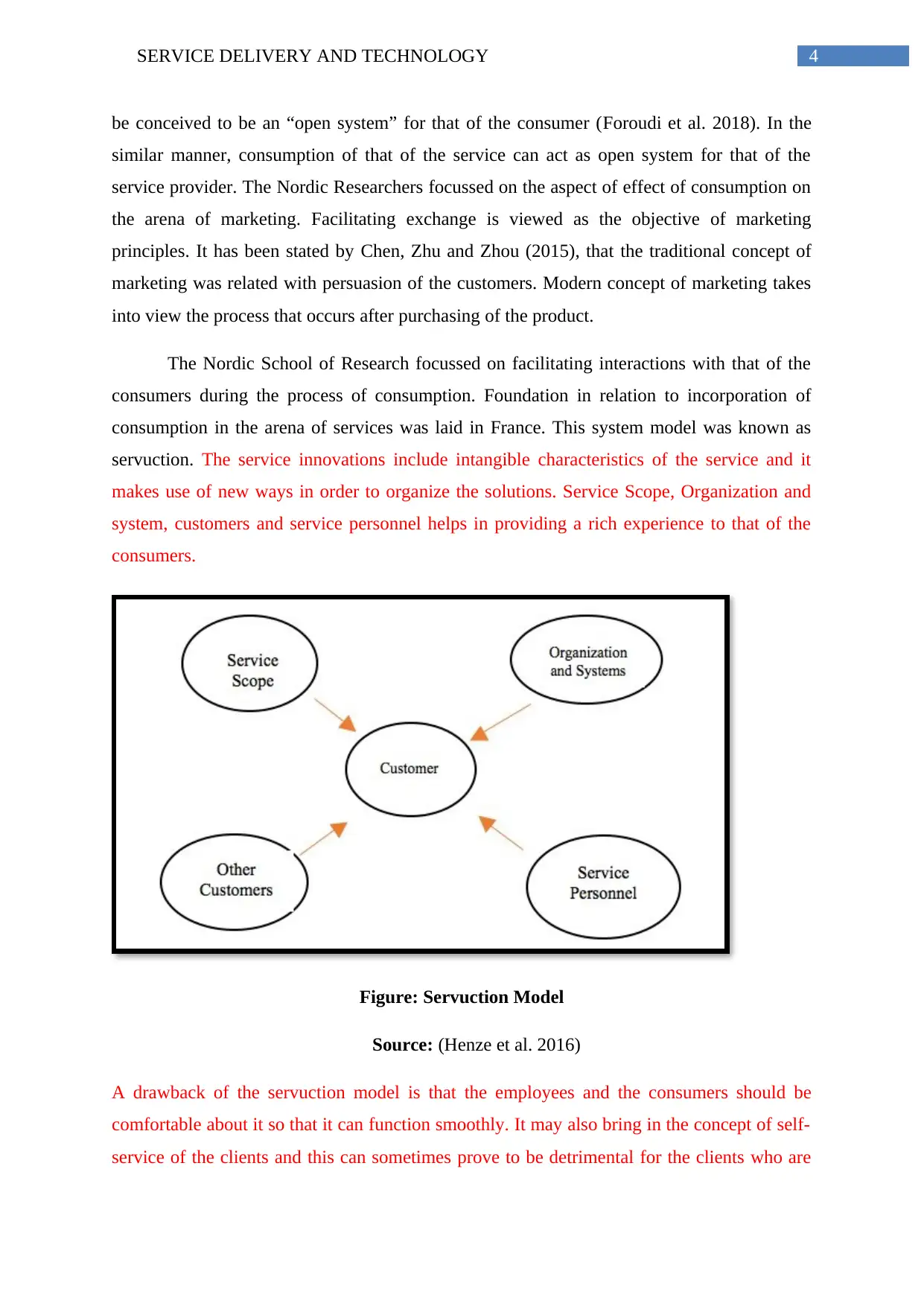
servuction. The service innovations include intangible characteristics of the service and it
makes use of new ways in order to organize the solutions. Service Scope, Organization and
system, customers and service personnel helps in providing a rich experience to that of the
consumers.
Figure: Servuction Model
Source: (Henze et al. 2016)
A drawback of the servuction model is that the employees and the consumers should be
comfortable about it so that it can function smoothly. It may also bring in the concept of self-
service of the clients and this can sometimes prove to be detrimental for the clients who are
be conceived to be an “open system” for that of the consumer (Foroudi et al. 2018). In the
similar manner, consumption of that of the service can act as open system for that of the
service provider. The Nordic Researchers focussed on the aspect of effect of consumption on
the arena of marketing. Facilitating exchange is viewed as the objective of marketing
principles. It has been stated by Chen, Zhu and Zhou (2015), that the traditional concept of
marketing was related with persuasion of the customers. Modern concept of marketing takes
into view the process that occurs after purchasing of the product.
The Nordic School of Research focussed on facilitating interactions with that of the
consumers during the process of consumption. Foundation in relation to incorporation of
consumption in the arena of services was laid in France. This system model was known as
servuction. The service innovations include intangible characteristics of the service and it
makes use of new ways in order to organize the solutions. Service Scope, Organization and
system, customers and service personnel helps in providing a rich experience to that of the
consumers.
Figure: Servuction Model
Source: (Henze et al. 2016)
A drawback of the servuction model is that the employees and the consumers should be
comfortable about it so that it can function smoothly. It may also bring in the concept of self-
service of the clients and this can sometimes prove to be detrimental for the clients who are
5SERVICE DELIVERY AND TECHNOLOGY
not conversant with technology. Within North America, the focus was on selling the jobs to
that of the employees. Service-oriented ingredient was integrated into the marketing mix of
the services. Interaction between that of the service provider and customer was conceived to
be an integrated part in relation to marketing. It was possible to implement successful
marketing with the help of this model. According to Wong et al. (2015), managing the
interaction between firm and customer became the productive focal point in these kinds of
services. Consumption and production of service comes to an end and the successful
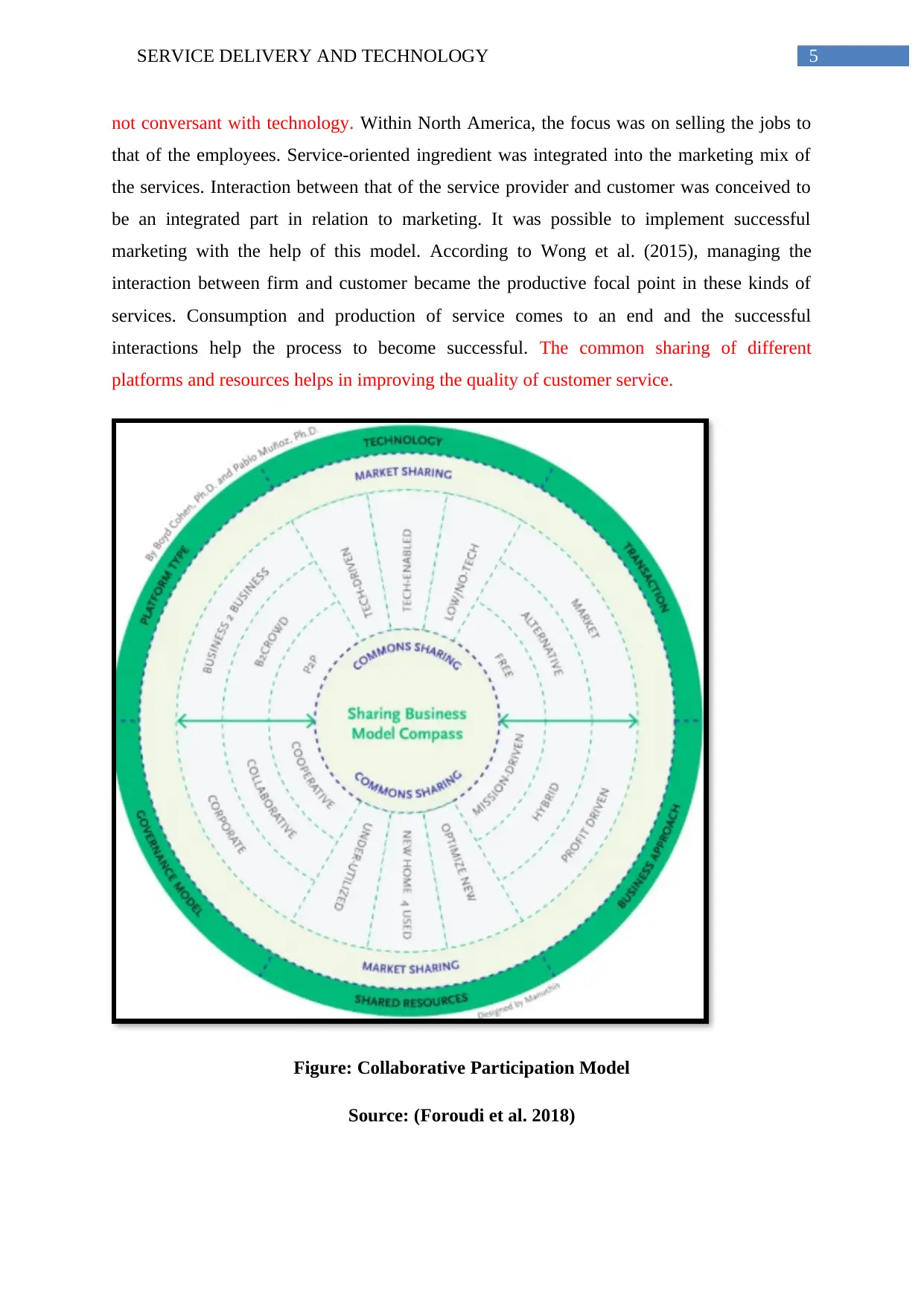
interactions help the process to become successful. The common sharing of different
platforms and resources helps in improving the quality of customer service.
Figure: Collaborative Participation Model
Source: (Foroudi et al. 2018)
not conversant with technology. Within North America, the focus was on selling the jobs to
that of the employees. Service-oriented ingredient was integrated into the marketing mix of
the services. Interaction between that of the service provider and customer was conceived to
be an integrated part in relation to marketing. It was possible to implement successful
marketing with the help of this model. According to Wong et al. (2015), managing the
interaction between firm and customer became the productive focal point in these kinds of
services. Consumption and production of service comes to an end and the successful
interactions help the process to become successful. The common sharing of different
platforms and resources helps in improving the quality of customer service.
Figure: Collaborative Participation Model
Source: (Foroudi et al. 2018)
⊘ This is a preview!⊘
Do you want full access?
Subscribe today to unlock all pages.
Trusted by 1+ million students worldwide
6SERVICE DELIVERY AND TECHNOLOGY
Service and Technology
Continuous exchanges can occur with the help of successful interactions which can be
facilitated by taking recourse to technology. Since the services act as processes as compared
to that of object of transactional exchange it cannot be ascertained at which particular point
the exchange would take place. The service provider gets the money either before service or
after service or on the regular basis over the course of time. It has been argued by Wortmann
and Flüchter (2015) that the interactions that take place over the course of time act as
enactment of that of the exchange process. The exchange process is helped to a great extent
with the help of technology. Exchange is conceived to be higher order concept.
Technology has acted as the basic force for bringing about the innovations in relation
to service. New technology has enabled the different business to make use of services like
Automated voice mail, fax machine, voice response system and automated teller machine.
The explosion of internet has resulted in new services and different companies like Amazon
and E-Bay are offering new service that was previously not heard of. Many new kind of
technology services have arrived on the horizon. Service Delivery Service refers to the link
between that of service provider and client. It has been argued by Mulani and Pingle (2016)
that internal arrangements need to be made so that the service workers can carry out their
duties successfully. The “connected car” helps people to take the advantage of different kind
of services when one is on the road (Wong et al. 2015). There are many cars that have
satellite navigation system that helps in guiding the drivers to that of specific locations.
Going ahead, in-car system can provide recommendations in relation to shopping and inform
the drivers regarding their preferred retailer. In the event of a person being on the road trip
system can help in providing weather forecast along with warnings. The system of the car by
making use of the latest technology can book a room near a hotel and also help in
recommending a restaurant.
Technology also provides the vehicles that can help in the process of delivering
service in a more convenient manner. According to Yang (2014), technology facilitates the
process of basic customer service function and that of transactions. There has been a
movement in the use of technology from that of face-to-face service to that of wireless
service. The servuction model requires the relocation of that of key operations into the areas
that have low labour costs. However, the production in this kind of servuction model is non-
continuous and that of the economy of scale is limited. Technology is facilitating transactions
by offering direct vehicle in order to make the purchases. The technology giant named Del
Service and Technology
Continuous exchanges can occur with the help of successful interactions which can be
facilitated by taking recourse to technology. Since the services act as processes as compared
to that of object of transactional exchange it cannot be ascertained at which particular point
the exchange would take place. The service provider gets the money either before service or
after service or on the regular basis over the course of time. It has been argued by Wortmann
and Flüchter (2015) that the interactions that take place over the course of time act as
enactment of that of the exchange process. The exchange process is helped to a great extent
with the help of technology. Exchange is conceived to be higher order concept.
Technology has acted as the basic force for bringing about the innovations in relation
to service. New technology has enabled the different business to make use of services like
Automated voice mail, fax machine, voice response system and automated teller machine.
The explosion of internet has resulted in new services and different companies like Amazon
and E-Bay are offering new service that was previously not heard of. Many new kind of
technology services have arrived on the horizon. Service Delivery Service refers to the link
between that of service provider and client. It has been argued by Mulani and Pingle (2016)
that internal arrangements need to be made so that the service workers can carry out their
duties successfully. The “connected car” helps people to take the advantage of different kind
of services when one is on the road (Wong et al. 2015). There are many cars that have
satellite navigation system that helps in guiding the drivers to that of specific locations.
Going ahead, in-car system can provide recommendations in relation to shopping and inform
the drivers regarding their preferred retailer. In the event of a person being on the road trip
system can help in providing weather forecast along with warnings. The system of the car by
making use of the latest technology can book a room near a hotel and also help in
recommending a restaurant.
Technology also provides the vehicles that can help in the process of delivering
service in a more convenient manner. According to Yang (2014), technology facilitates the
process of basic customer service function and that of transactions. There has been a
movement in the use of technology from that of face-to-face service to that of wireless
service. The servuction model requires the relocation of that of key operations into the areas
that have low labour costs. However, the production in this kind of servuction model is non-
continuous and that of the economy of scale is limited. Technology is facilitating transactions
by offering direct vehicle in order to make the purchases. The technology giant named Del
Paraphrase This Document
Need a fresh take? Get an instant paraphrase of this document with our AI Paraphraser
7SERVICE DELIVERY AND TECHNOLOGY
offers customer services and order functions to the business customers with the help of
technology. It has been stated by Mulani and Pingle (2016) that online shopping along with
transactions have helped in revolutionizing the business of book along with that of music.
Technology helps the customers in the process of learning and researching. Technology has
made access in relation to information a lot easier. The health related websites are among the
most frequented sites over that of the internet and current estimates have suggested that there
are more than 100,000 sites that provide information related to health. Dangers are also
associated with this because all the sites do not provide the correct information. They provide
false cures that can be detrimental for the health of the patient.
Internet of Things
Internet of Things (IOT) refers to a trend within which a large number of the
embedded devices make use of the communication service. These devices are known as
“smart objects” and they are not directly operated by that of the humans. IOT helps in driving
the emerging technologies and it generates data that can be changed into that of useful
information. According to Cui (2016), it has helped in revolutionising the arena of embedded
computing and it aims at the creation of a ubiquitous computing platform. Internet-of-Things
promises to create smart interconnected product that can help in delivering customer
experience that is better. It has been argued by Chandrakanth et al. (2014) that combination
of the physical products with that of sensors and storage can help in creating more products
as service. It provides many opportunities for transforming the relationship of the brand with
that of the customer. It can also help in creating a more sustainable world. It can help in the
process of reduction of waste and that of natural capital dependencies. It can offer hope for
the future and improve the condition of the environment. According to Weinberg et al.
(2015), it also helps in improving social footprint of the consumers along with that of the
industrial products. It has been argued by Dylko et al. (2017) that there exists no particular
standard for doing the monitoring with that of the sensors. Privacy is a big issue in relation to
IOT. Encryption of data is a necessity so that important data is not leaked to that of the
common people. There are also chances of hacking of the software and personal information
can be misused. Safety risk is a drawback of that of the Internet-of-Things.
The battle with that of standards is a concern for that of Internet of Technology. The
challenge lies in creating effective cross-industry technology architecture that can allow true
interoperability. Smart System is not well-aligned to that of larger IT infrastructure that
creates problems. Google along with Nest have made significant strides in order to establish
offers customer services and order functions to the business customers with the help of
technology. It has been stated by Mulani and Pingle (2016) that online shopping along with
transactions have helped in revolutionizing the business of book along with that of music.
Technology helps the customers in the process of learning and researching. Technology has
made access in relation to information a lot easier. The health related websites are among the
most frequented sites over that of the internet and current estimates have suggested that there
are more than 100,000 sites that provide information related to health. Dangers are also
associated with this because all the sites do not provide the correct information. They provide
false cures that can be detrimental for the health of the patient.
Internet of Things
Internet of Things (IOT) refers to a trend within which a large number of the
embedded devices make use of the communication service. These devices are known as
“smart objects” and they are not directly operated by that of the humans. IOT helps in driving
the emerging technologies and it generates data that can be changed into that of useful
information. According to Cui (2016), it has helped in revolutionising the arena of embedded
computing and it aims at the creation of a ubiquitous computing platform. Internet-of-Things
promises to create smart interconnected product that can help in delivering customer
experience that is better. It has been argued by Chandrakanth et al. (2014) that combination
of the physical products with that of sensors and storage can help in creating more products
as service. It provides many opportunities for transforming the relationship of the brand with
that of the customer. It can also help in creating a more sustainable world. It can help in the
process of reduction of waste and that of natural capital dependencies. It can offer hope for
the future and improve the condition of the environment. According to Weinberg et al.
(2015), it also helps in improving social footprint of the consumers along with that of the
industrial products. It has been argued by Dylko et al. (2017) that there exists no particular
standard for doing the monitoring with that of the sensors. Privacy is a big issue in relation to
IOT. Encryption of data is a necessity so that important data is not leaked to that of the
common people. There are also chances of hacking of the software and personal information
can be misused. Safety risk is a drawback of that of the Internet-of-Things.
The battle with that of standards is a concern for that of Internet of Technology. The
challenge lies in creating effective cross-industry technology architecture that can allow true
interoperability. Smart System is not well-aligned to that of larger IT infrastructure that
creates problems. Google along with Nest have made significant strides in order to establish
8SERVICE DELIVERY AND TECHNOLOGY
Nest Platform. It can act as foundation related to consumer based IOT devices. Major players
like that of Cisco, IBM, and Microsoft have got similar strategies that can help in creation of
standards (Henze et al. 2016). Eclipse IOT Working Group is trying to standardize open
source technology for that of IOT. This group is collaborating in order to build open source
technology that can act as foundation for IOT. Technology comprises of the protocols and
services that can help in building M2M applications. Opinions are divided regarding
standards along with protocols.
The smart products like that of thermostats, phone-controlled lighting and sensor-
based irrigation are conducive to the welfare of the environment but there are certain
questions that should be answered in relation to the ability of a company. A question arises
regarding making of informed judgements relating to the degree to which the new product
will prove to be environmentally positive or negative. Second question arises pertaining to
the designing phase and emphasizes on how much of the functionality of the product resides
within that of the physical product.
Dark Side of technology
Neo-Luddism is a philosophy that opposes the usage of modern technology. It deals
with the impact of technology on that of the individuals along with that of the environment. It
stipulates the usage of precautionary principle in relation to new technologies. It has said that
technologies are safe before that of adoption on account of the un-known effects that can be
brought about by the new technologies. Technology can enhance services but there are also
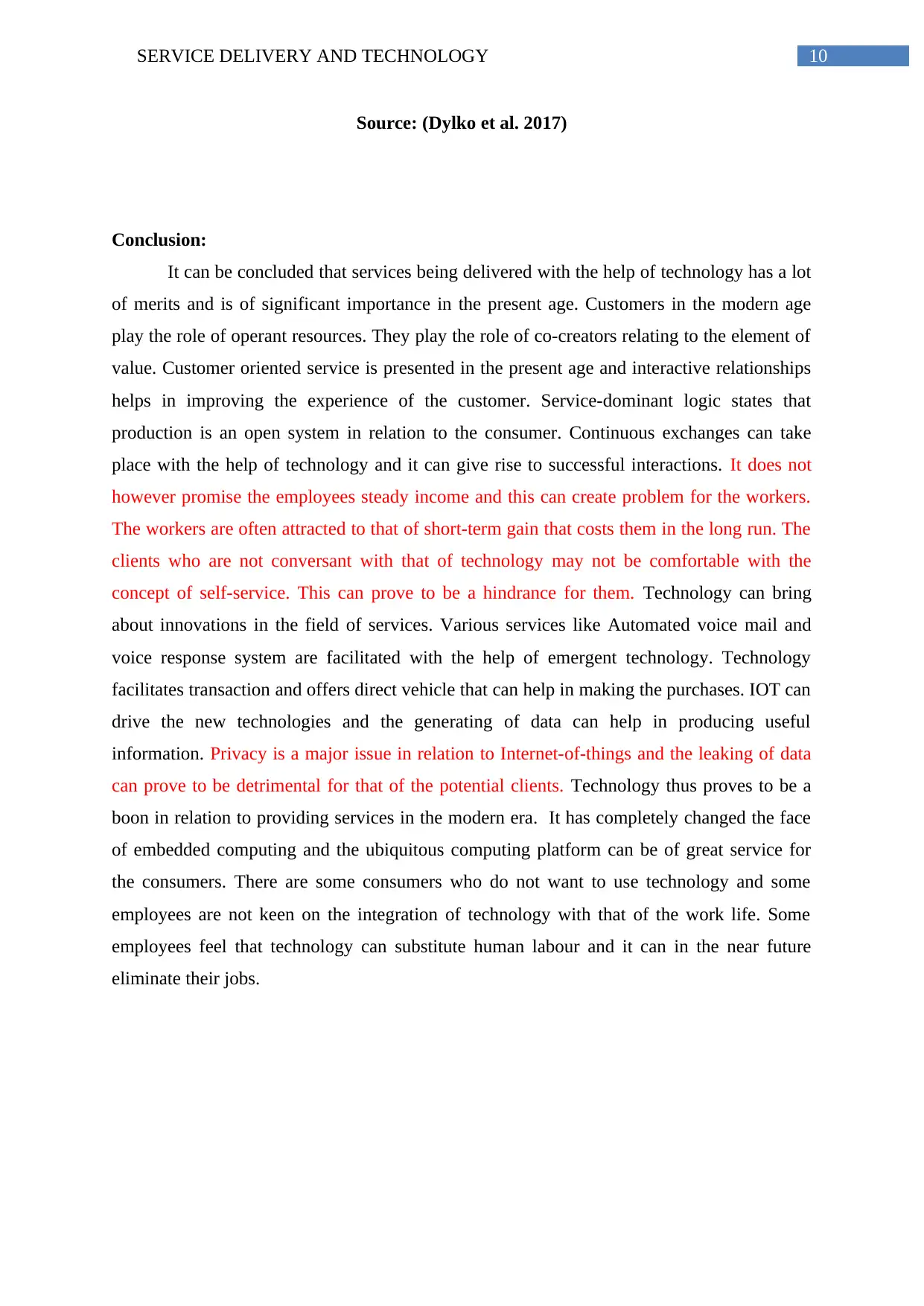
negative outcomes associated with it. The consumer researchers called Mick and Fournier
have highlighted on the paradox in relation to technology products.
Concerns are raised in relation to privacy along with confidentiality that raises issues
for the firms when they want to interact directly with customers by the help of internet. These
concerns are mainly related to efforts for the advancement of technology applications in
relation to health-care industry. All the customers are interested to use technology in order to
interact with the companies. Research has brought out the fact with the help of ‘customer
technology readiness’ that there are some kinds of customers who are not that keen about
using technology (Dylko et al. 2017). There are some employees who do not want to
integrate technology within their work life. This occurs specially when the employees
perceive that technology can substitute that of human labour and eliminate the jobs.
Nest Platform. It can act as foundation related to consumer based IOT devices. Major players
like that of Cisco, IBM, and Microsoft have got similar strategies that can help in creation of
standards (Henze et al. 2016). Eclipse IOT Working Group is trying to standardize open
source technology for that of IOT. This group is collaborating in order to build open source
technology that can act as foundation for IOT. Technology comprises of the protocols and
services that can help in building M2M applications. Opinions are divided regarding
standards along with protocols.
The smart products like that of thermostats, phone-controlled lighting and sensor-
based irrigation are conducive to the welfare of the environment but there are certain
questions that should be answered in relation to the ability of a company. A question arises
regarding making of informed judgements relating to the degree to which the new product
will prove to be environmentally positive or negative. Second question arises pertaining to
the designing phase and emphasizes on how much of the functionality of the product resides
within that of the physical product.
Dark Side of technology
Neo-Luddism is a philosophy that opposes the usage of modern technology. It deals
with the impact of technology on that of the individuals along with that of the environment. It
stipulates the usage of precautionary principle in relation to new technologies. It has said that
technologies are safe before that of adoption on account of the un-known effects that can be
brought about by the new technologies. Technology can enhance services but there are also
negative outcomes associated with it. The consumer researchers called Mick and Fournier
have highlighted on the paradox in relation to technology products.
Concerns are raised in relation to privacy along with confidentiality that raises issues
for the firms when they want to interact directly with customers by the help of internet. These
concerns are mainly related to efforts for the advancement of technology applications in
relation to health-care industry. All the customers are interested to use technology in order to
interact with the companies. Research has brought out the fact with the help of ‘customer
technology readiness’ that there are some kinds of customers who are not that keen about
using technology (Dylko et al. 2017). There are some employees who do not want to
integrate technology within their work life. This occurs specially when the employees
perceive that technology can substitute that of human labour and eliminate the jobs.
⊘ This is a preview!⊘
Do you want full access?
Subscribe today to unlock all pages.
Trusted by 1+ million students worldwide
9SERVICE DELIVERY AND TECHNOLOGY
Technology infusion has created loss of that of human contact and this can be
detrimental from the point of view of quality of life. It can also be harmful from the
perspective of human relationships. Parents often lament regarding how the children spend a
large amount of time in front of that of computer screen. They seek information and use the
services of instant messaging without taking recourse to face-to-face contact with the
humans. It has been stated by Fitzgerald et al. (2016) that the workers within an organization
become more dependent on communicating with the help of technology. Payback in relation
to technology investment is uncertain (Turel, Soror and Steelman 2017). One can take long
amount of time so that the investment can lead to productivity and that of customer
satisfaction gain.
Internet technology has enabled the different organizations for holding meetings and
all the parties need not be present in same place. Holding meeting over that of the internet is
less personal as compared to that of face-to-face meeting. According to Townsend
(2017), internet technology has decreased personal aspect in relation to business relationship.
Lack of the aspect of physical proximity has decreased brainstorming. According to a popular
research, installation of the monitoring software sends message to the employees and it seems
as if the company does not trust the employees. Showing the employees that they should not
be trusted can decrease the morale of the employees.
Figure: Paradox of Technology Products
Technology infusion has created loss of that of human contact and this can be
detrimental from the point of view of quality of life. It can also be harmful from the
perspective of human relationships. Parents often lament regarding how the children spend a
large amount of time in front of that of computer screen. They seek information and use the
services of instant messaging without taking recourse to face-to-face contact with the
humans. It has been stated by Fitzgerald et al. (2016) that the workers within an organization
become more dependent on communicating with the help of technology. Payback in relation
to technology investment is uncertain (Turel, Soror and Steelman 2017). One can take long
amount of time so that the investment can lead to productivity and that of customer
satisfaction gain.
Internet technology has enabled the different organizations for holding meetings and
all the parties need not be present in same place. Holding meeting over that of the internet is
less personal as compared to that of face-to-face meeting. According to Townsend
(2017), internet technology has decreased personal aspect in relation to business relationship.
Lack of the aspect of physical proximity has decreased brainstorming. According to a popular
research, installation of the monitoring software sends message to the employees and it seems
as if the company does not trust the employees. Showing the employees that they should not
be trusted can decrease the morale of the employees.
Figure: Paradox of Technology Products
Paraphrase This Document
Need a fresh take? Get an instant paraphrase of this document with our AI Paraphraser
10SERVICE DELIVERY AND TECHNOLOGY
Source: (Dylko et al. 2017)
Conclusion:
It can be concluded that services being delivered with the help of technology has a lot
of merits and is of significant importance in the present age. Customers in the modern age
play the role of operant resources. They play the role of co-creators relating to the element of
value. Customer oriented service is presented in the present age and interactive relationships
helps in improving the experience of the customer. Service-dominant logic states that
production is an open system in relation to the consumer. Continuous exchanges can take
place with the help of technology and it can give rise to successful interactions. It does not
however promise the employees steady income and this can create problem for the workers.
The workers are often attracted to that of short-term gain that costs them in the long run. The
clients who are not conversant with that of technology may not be comfortable with the
concept of self-service. This can prove to be a hindrance for them. Technology can bring
about innovations in the field of services. Various services like Automated voice mail and
voice response system are facilitated with the help of emergent technology. Technology
facilitates transaction and offers direct vehicle that can help in making the purchases. IOT can
drive the new technologies and the generating of data can help in producing useful
information. Privacy is a major issue in relation to Internet-of-things and the leaking of data
can prove to be detrimental for that of the potential clients. Technology thus proves to be a
boon in relation to providing services in the modern era. It has completely changed the face
of embedded computing and the ubiquitous computing platform can be of great service for
the consumers. There are some consumers who do not want to use technology and some
employees are not keen on the integration of technology with that of the work life. Some
employees feel that technology can substitute human labour and it can in the near future
eliminate their jobs.
Source: (Dylko et al. 2017)
Conclusion:
It can be concluded that services being delivered with the help of technology has a lot
of merits and is of significant importance in the present age. Customers in the modern age
play the role of operant resources. They play the role of co-creators relating to the element of
value. Customer oriented service is presented in the present age and interactive relationships
helps in improving the experience of the customer. Service-dominant logic states that
production is an open system in relation to the consumer. Continuous exchanges can take
place with the help of technology and it can give rise to successful interactions. It does not
however promise the employees steady income and this can create problem for the workers.
The workers are often attracted to that of short-term gain that costs them in the long run. The
clients who are not conversant with that of technology may not be comfortable with the
concept of self-service. This can prove to be a hindrance for them. Technology can bring
about innovations in the field of services. Various services like Automated voice mail and
voice response system are facilitated with the help of emergent technology. Technology
facilitates transaction and offers direct vehicle that can help in making the purchases. IOT can
drive the new technologies and the generating of data can help in producing useful
information. Privacy is a major issue in relation to Internet-of-things and the leaking of data
can prove to be detrimental for that of the potential clients. Technology thus proves to be a
boon in relation to providing services in the modern era. It has completely changed the face
of embedded computing and the ubiquitous computing platform can be of great service for
the consumers. There are some consumers who do not want to use technology and some
employees are not keen on the integration of technology with that of the work life. Some
employees feel that technology can substitute human labour and it can in the near future
eliminate their jobs.
11SERVICE DELIVERY AND TECHNOLOGY
References:
Brohman, K., Parasuraman, A., Watson, R.T. and Piccoli, G., 2015. Internet-Based Customer
Service Systems: What are They and When are They Successful?. In New meanings for
marketing in a new millennium (pp. 150-153). Springer, Cham.
Chandrakanth, S., Venkatesh, K., Uma Mahesh, J. and Naganjaneyulu, K.V., 2014. Internet
of things. International Journal of Innovations & Advancement in Computer Science, 3(8),
pp.16-20.
Chen, Z., Zhu, J. and Zhou, M., 2015. How does a servant leader fuel the service fire? A
multilevel model of servant leadership, individual self identity, group competition climate,
and customer service performance. Journal of Applied Psychology, 100(2), p.511.
Cui, X., 2016. The internet of things. In Ethical Ripples of Creativity and Innovation (pp. 61-
68). Palgrave Macmillan, London.
Dylko, I., Dolgov, I., Hoffman, W., Eckhart, N., Molina, M. and Aaziz, O., 2017. The dark
side of technology: An experimental investigation of the influence of customizability
technology on online political selective exposure. Computers in Human Behavior, 73,
pp.181-190.
Fitzgerald, S., Kachersky, L., Saldanha, N., Chung, E., Farrell, L., Laud, G., Rahman, K.,
Reid, M. and Robinson, L., 2016. The Dark Side of Connected Health Technology: How
Connectivity Creates Exercise Addiction Among Conscientious Users. ACR North American
Advances.
Foroudi, P., Gupta, S., Sivarajah, U. and Broderick, A., 2018. Investigating the effects of
smart technology on customer dynamics and customer experience. Computers in Human
Behavior, 80, pp.271-282.
Henze, M., Hermerschmidt, L., Kerpen, D., Häußling, R., Rumpe, B. and Wehrle, K., 2016.
A comprehensive approach to privacy in the cloud-based Internet of Things. Future
Generation Computer Systems, 56, pp.701-718.
Mulani, T.T. and Pingle, S.V., 2016. Internet of things. International Research Journal of
Multidisciplinary Studies, 2(3).
References:
Brohman, K., Parasuraman, A., Watson, R.T. and Piccoli, G., 2015. Internet-Based Customer
Service Systems: What are They and When are They Successful?. In New meanings for
marketing in a new millennium (pp. 150-153). Springer, Cham.
Chandrakanth, S., Venkatesh, K., Uma Mahesh, J. and Naganjaneyulu, K.V., 2014. Internet
of things. International Journal of Innovations & Advancement in Computer Science, 3(8),
pp.16-20.
Chen, Z., Zhu, J. and Zhou, M., 2015. How does a servant leader fuel the service fire? A
multilevel model of servant leadership, individual self identity, group competition climate,
and customer service performance. Journal of Applied Psychology, 100(2), p.511.
Cui, X., 2016. The internet of things. In Ethical Ripples of Creativity and Innovation (pp. 61-
68). Palgrave Macmillan, London.
Dylko, I., Dolgov, I., Hoffman, W., Eckhart, N., Molina, M. and Aaziz, O., 2017. The dark
side of technology: An experimental investigation of the influence of customizability
technology on online political selective exposure. Computers in Human Behavior, 73,
pp.181-190.
Fitzgerald, S., Kachersky, L., Saldanha, N., Chung, E., Farrell, L., Laud, G., Rahman, K.,
Reid, M. and Robinson, L., 2016. The Dark Side of Connected Health Technology: How
Connectivity Creates Exercise Addiction Among Conscientious Users. ACR North American
Advances.
Foroudi, P., Gupta, S., Sivarajah, U. and Broderick, A., 2018. Investigating the effects of
smart technology on customer dynamics and customer experience. Computers in Human
Behavior, 80, pp.271-282.
Henze, M., Hermerschmidt, L., Kerpen, D., Häußling, R., Rumpe, B. and Wehrle, K., 2016.
A comprehensive approach to privacy in the cloud-based Internet of Things. Future
Generation Computer Systems, 56, pp.701-718.
Mulani, T.T. and Pingle, S.V., 2016. Internet of things. International Research Journal of
Multidisciplinary Studies, 2(3).
⊘ This is a preview!⊘
Do you want full access?
Subscribe today to unlock all pages.
Trusted by 1+ million students worldwide

1 out of 13


Related Documents


Your All-in-One AI-Powered Toolkit for Academic Success.
+13062052269
info@desklib.com
Available 24*7 on WhatsApp / Email
![[object Object]](/_next/static/media/star-bottom.7253800d.svg)
Unlock your academic potential
Copyright © 2020–2026 A2Z Services. All Rights Reserved. Developed and managed by ZUCOL.