Challenges and Solutions for Order Management in Service Industries

Verified

Added on  2023/06/08

|4
|757
|420
Report
AI Summary
This report delves into the critical role of order management within the service industry, highlighting the increasing challenges faced by organizations in this sector. It emphasizes the significance of efficient order management as a key link between organizational processes, crucial for maintaining a competitive edge, generating new business leads, and strengthening client relationships. The report outlines the potential consequences of poor order management, including lack of visibility in planning, increased processing costs, missed opportunities for competitive advantage, and negative impacts on customer experience. The report stresses the importance of batch processing techniques to track order status and reduce processing cycles, which can greatly enhance a service organization's ability to meet market expectations and compete effectively. The report references several academic sources to support its arguments and findings.

Document Page
Supply Chain Management
Name of Student
Name of Institute
tabler-icon-diamond-filled.svg

Paraphrase This Document

Need a fresh take? Get an instant paraphrase of this document with our AI Paraphraser
Document Page
2
Contents
Service industries do face complex and increasing challenges regarding order
management and fulfilment....................................................................................................3
References.................................................................................................................................4
Document Page
3
Service industries do face complex and increasing challenges regarding
order management and fulfilment.
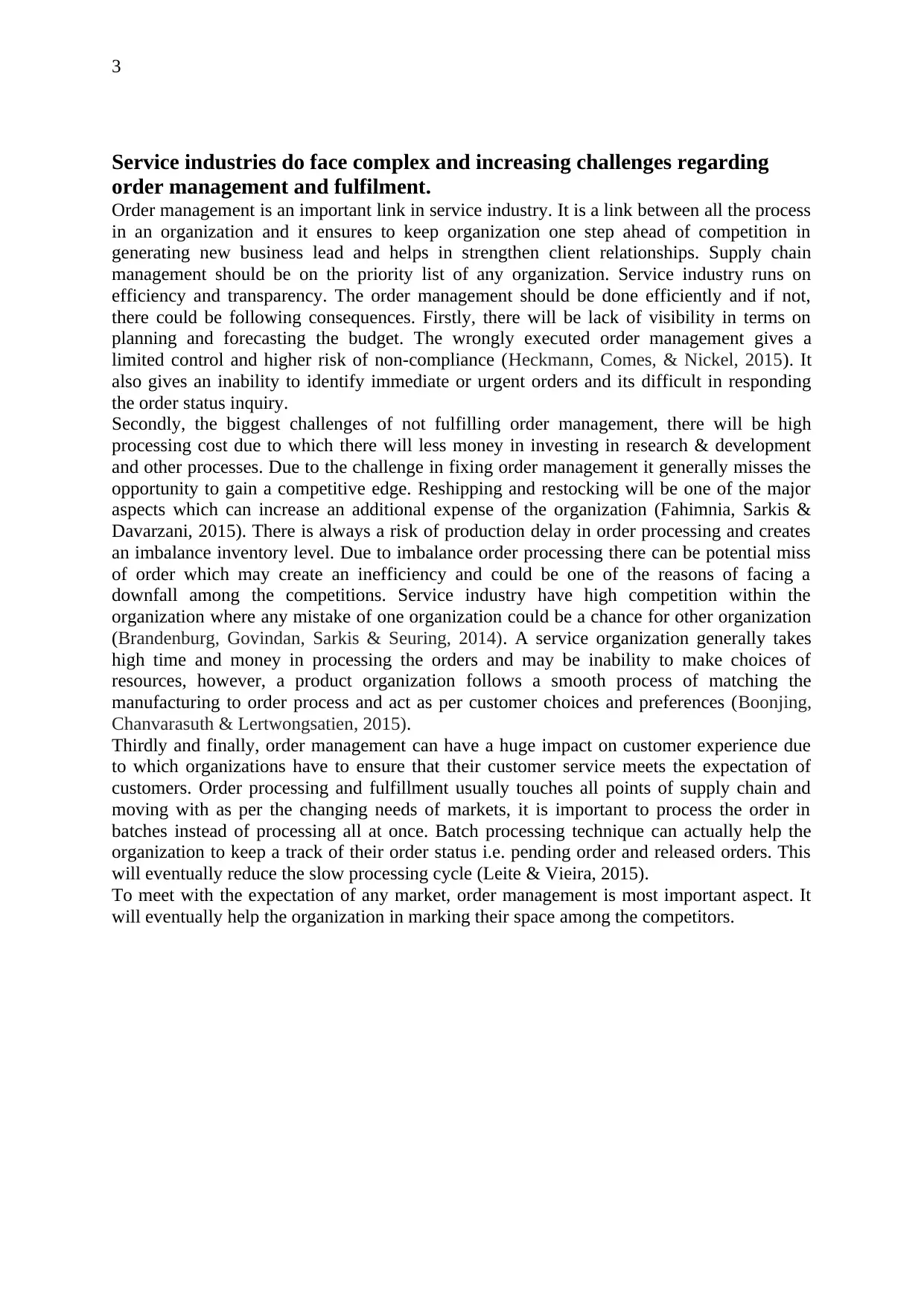
Order management is an important link in service industry. It is a link between all the process
in an organization and it ensures to keep organization one step ahead of competition in
generating new business lead and helps in strengthen client relationships. Supply chain
management should be on the priority list of any organization. Service industry runs on
efficiency and transparency. The order management should be done efficiently and if not,
there could be following consequences. Firstly, there will be lack of visibility in terms on
planning and forecasting the budget. The wrongly executed order management gives a
limited control and higher risk of non-compliance (Heckmann, Comes, & Nickel, 2015). It
also gives an inability to identify immediate or urgent orders and its difficult in responding
the order status inquiry.
Secondly, the biggest challenges of not fulfilling order management, there will be high
processing cost due to which there will less money in investing in research & development
and other processes. Due to the challenge in fixing order management it generally misses the
opportunity to gain a competitive edge. Reshipping and restocking will be one of the major
aspects which can increase an additional expense of the organization (Fahimnia, Sarkis &
Davarzani, 2015). There is always a risk of production delay in order processing and creates
an imbalance inventory level. Due to imbalance order processing there can be potential miss
of order which may create an inefficiency and could be one of the reasons of facing a
downfall among the competitions. Service industry have high competition within the
organization where any mistake of one organization could be a chance for other organization
(Brandenburg, Govindan, Sarkis & Seuring, 2014). A service organization generally takes
high time and money in processing the orders and may be inability to make choices of
resources, however, a product organization follows a smooth process of matching the
manufacturing to order process and act as per customer choices and preferences (Boonjing,
Chanvarasuth & Lertwongsatien, 2015).
Thirdly and finally, order management can have a huge impact on customer experience due
to which organizations have to ensure that their customer service meets the expectation of
customers. Order processing and fulfillment usually touches all points of supply chain and
moving with as per the changing needs of markets, it is important to process the order in
batches instead of processing all at once. Batch processing technique can actually help the
organization to keep a track of their order status i.e. pending order and released orders. This
will eventually reduce the slow processing cycle (Leite & Vieira, 2015).
To meet with the expectation of any market, order management is most important aspect. It
will eventually help the organization in marking their space among the competitors.
Document Page
4
References
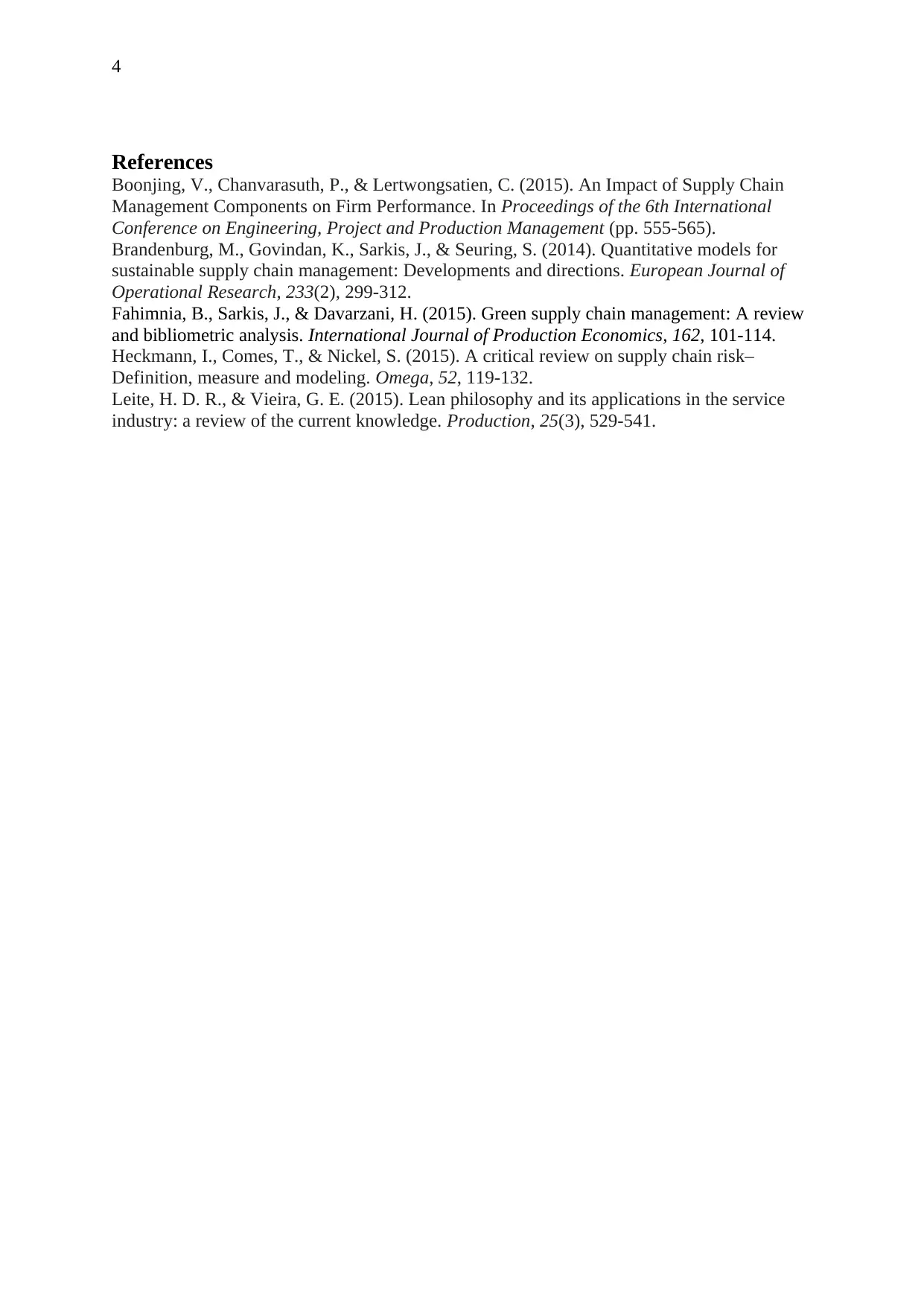
Boonjing, V., Chanvarasuth, P., & Lertwongsatien, C. (2015). An Impact of Supply Chain
Management Components on Firm Performance. In Proceedings of the 6th International
Conference on Engineering, Project and Production Management (pp. 555-565).
Brandenburg, M., Govindan, K., Sarkis, J., & Seuring, S. (2014). Quantitative models for
sustainable supply chain management: Developments and directions. European Journal of
Operational Research, 233(2), 299-312.
Fahimnia, B., Sarkis, J., & Davarzani, H. (2015). Green supply chain management: A review
and bibliometric analysis. International Journal of Production Economics, 162, 101-114.
Heckmann, I., Comes, T., & Nickel, S. (2015). A critical review on supply chain risk–
Definition, measure and modeling. Omega, 52, 119-132.
Leite, H. D. R., & Vieira, G. E. (2015). Lean philosophy and its applications in the service
industry: a review of the current knowledge. Production, 25(3), 529-541.
chevron_up_icon
1 out of 4
circle_padding
hide_on_mobile
zoom_out_icon
[object Object]