Service Learning Essay: Exploring Benefits, Types, and Limitations
VerifiedAdded on  2023/06/11
|7
|1285
|436
Essay
AI Summary
This essay provides a comprehensive overview of service learning as a teaching and learning approach that combines learning objectives with community service to meet social needs and promote civic responsibility. It highlights the benefits of service learning, including the development of in-depth knowledge, teamwork skills, and interpersonal skills for students, as well as enhanced teaching quality and professional experience for teachers. The essay also discusses various types of service learning, such as advocacy service learning, research-based service learning, direct service learning, and indirect service learning, providing examples for each. While acknowledging the advantages, the essay also addresses the limitations of service learning, such as insufficient working space, organizational structure issues, role ambiguity, and time constraints. The essay concludes that the positive outcomes of service learning outweigh the challenges, making it a valuable method for developing relationships with the community and fostering self-confidence and teamwork skills.
Running head: Service Learning Essay 1
Service Learning Essay
Jiabao Wen
Baker College of Owasso
Service Learning Essay
Jiabao Wen
Baker College of Owasso
Paraphrase This Document
Need a fresh take? Get an instant paraphrase of this document with our AI Paraphraser

Service Learning Essay 2
Service Learning Essay
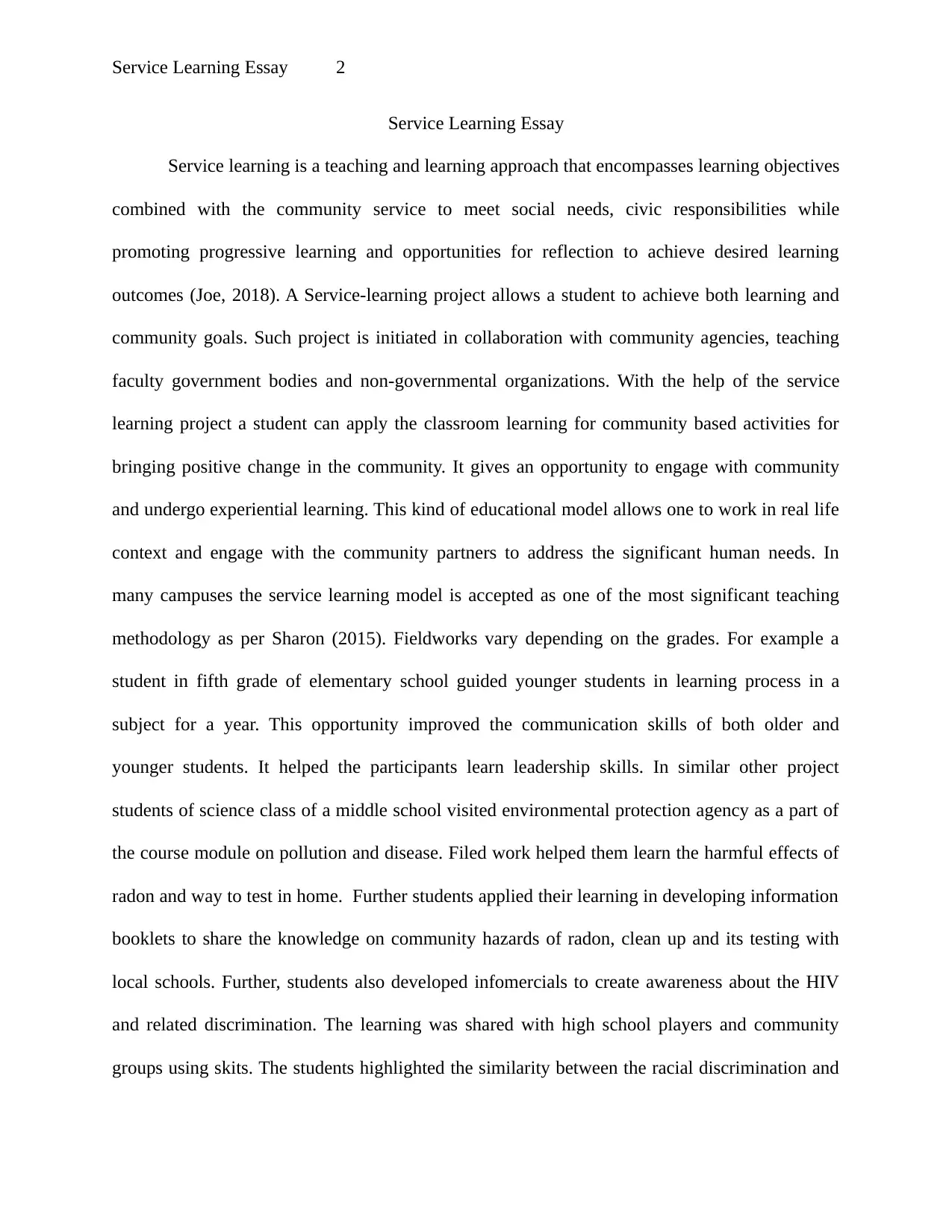
Service learning is a teaching and learning approach that encompasses learning objectives
combined with the community service to meet social needs, civic responsibilities while
promoting progressive learning and opportunities for reflection to achieve desired learning
outcomes (Joe, 2018). A Service-learning project allows a student to achieve both learning and
community goals. Such project is initiated in collaboration with community agencies, teaching
faculty government bodies and non-governmental organizations. With the help of the service
learning project a student can apply the classroom learning for community based activities for
bringing positive change in the community. It gives an opportunity to engage with community
and undergo experiential learning. This kind of educational model allows one to work in real life
context and engage with the community partners to address the significant human needs. In
many campuses the service learning model is accepted as one of the most significant teaching
methodology as per Sharon (2015). Fieldworks vary depending on the grades. For example a
student in fifth grade of elementary school guided younger students in learning process in a
subject for a year. This opportunity improved the communication skills of both older and
younger students. It helped the participants learn leadership skills. In similar other project
students of science class of a middle school visited environmental protection agency as a part of
the course module on pollution and disease. Filed work helped them learn the harmful effects of
radon and way to test in home. Further students applied their learning in developing information
booklets to share the knowledge on community hazards of radon, clean up and its testing with
local schools. Further, students also developed infomercials to create awareness about the HIV
and related discrimination. The learning was shared with high school players and community
groups using skits. The students highlighted the similarity between the racial discrimination and
Service Learning Essay
Service learning is a teaching and learning approach that encompasses learning objectives
combined with the community service to meet social needs, civic responsibilities while
promoting progressive learning and opportunities for reflection to achieve desired learning
outcomes (Joe, 2018). A Service-learning project allows a student to achieve both learning and
community goals. Such project is initiated in collaboration with community agencies, teaching
faculty government bodies and non-governmental organizations. With the help of the service
learning project a student can apply the classroom learning for community based activities for
bringing positive change in the community. It gives an opportunity to engage with community
and undergo experiential learning. This kind of educational model allows one to work in real life
context and engage with the community partners to address the significant human needs. In
many campuses the service learning model is accepted as one of the most significant teaching
methodology as per Sharon (2015). Fieldworks vary depending on the grades. For example a
student in fifth grade of elementary school guided younger students in learning process in a
subject for a year. This opportunity improved the communication skills of both older and
younger students. It helped the participants learn leadership skills. In similar other project
students of science class of a middle school visited environmental protection agency as a part of
the course module on pollution and disease. Filed work helped them learn the harmful effects of
radon and way to test in home. Further students applied their learning in developing information
booklets to share the knowledge on community hazards of radon, clean up and its testing with
local schools. Further, students also developed infomercials to create awareness about the HIV
and related discrimination. The learning was shared with high school players and community
groups using skits. The students highlighted the similarity between the racial discrimination and

Service Learning Essay 3
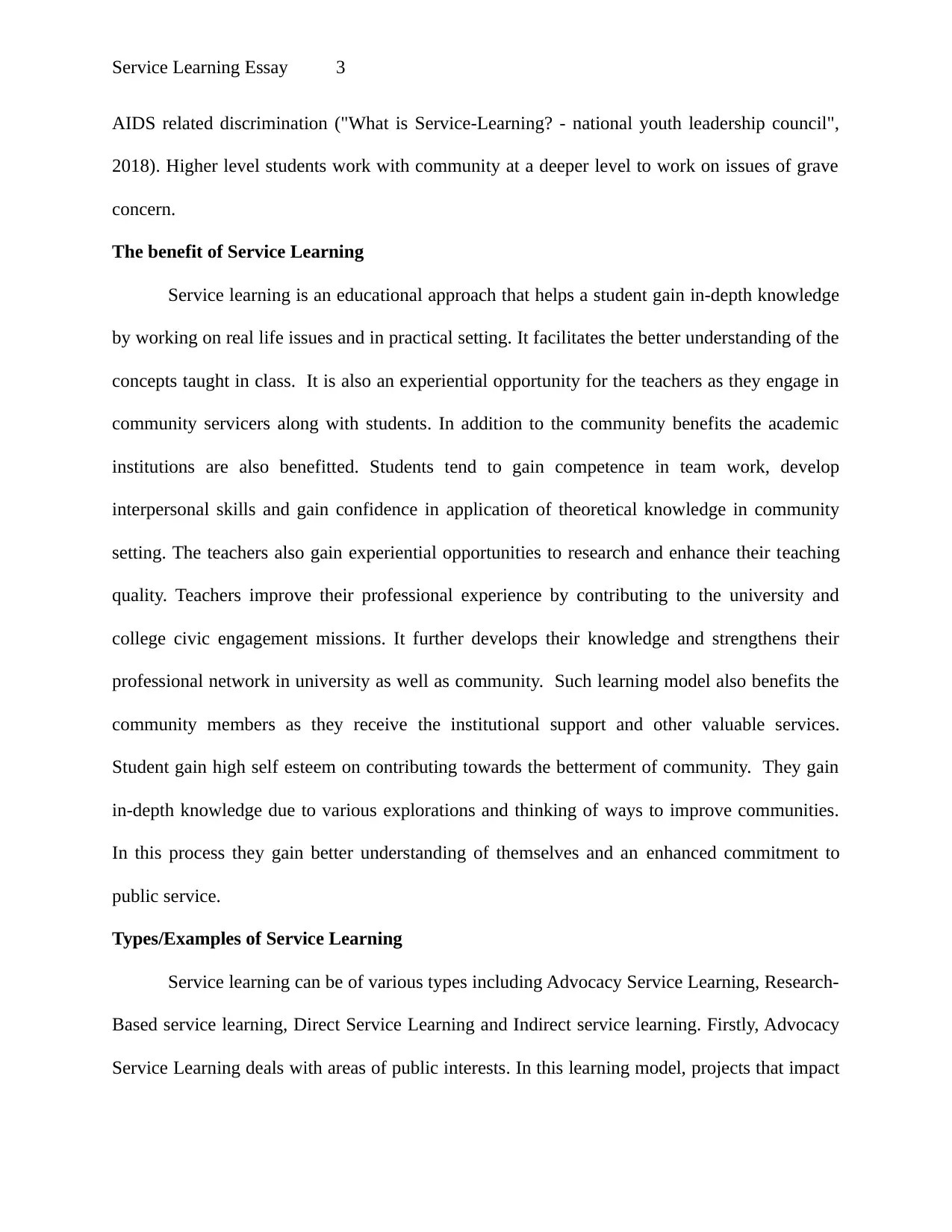
AIDS related discrimination ("What is Service-Learning? - national youth leadership council",
2018). Higher level students work with community at a deeper level to work on issues of grave
concern.
The benefit of Service Learning
Service learning is an educational approach that helps a student gain in-depth knowledge
by working on real life issues and in practical setting. It facilitates the better understanding of the
concepts taught in class. It is also an experiential opportunity for the teachers as they engage in
community servicers along with students. In addition to the community benefits the academic
institutions are also benefitted. Students tend to gain competence in team work, develop
interpersonal skills and gain confidence in application of theoretical knowledge in community
setting. The teachers also gain experiential opportunities to research and enhance their teaching
quality. Teachers improve their professional experience by contributing to the university and
college civic engagement missions. It further develops their knowledge and strengthens their
professional network in university as well as community. Such learning model also benefits the
community members as they receive the institutional support and other valuable services.
Student gain high self esteem on contributing towards the betterment of community. They gain
in-depth knowledge due to various explorations and thinking of ways to improve communities.
In this process they gain better understanding of themselves and an enhanced commitment to
public service.
Types/Examples of Service Learning
Service learning can be of various types including Advocacy Service Learning, Research-
Based service learning, Direct Service Learning and Indirect service learning. Firstly, Advocacy
Service Learning deals with areas of public interests. In this learning model, projects that impact
AIDS related discrimination ("What is Service-Learning? - national youth leadership council",
2018). Higher level students work with community at a deeper level to work on issues of grave
concern.
The benefit of Service Learning
Service learning is an educational approach that helps a student gain in-depth knowledge
by working on real life issues and in practical setting. It facilitates the better understanding of the
concepts taught in class. It is also an experiential opportunity for the teachers as they engage in
community servicers along with students. In addition to the community benefits the academic
institutions are also benefitted. Students tend to gain competence in team work, develop
interpersonal skills and gain confidence in application of theoretical knowledge in community
setting. The teachers also gain experiential opportunities to research and enhance their teaching
quality. Teachers improve their professional experience by contributing to the university and
college civic engagement missions. It further develops their knowledge and strengthens their
professional network in university as well as community. Such learning model also benefits the
community members as they receive the institutional support and other valuable services.
Student gain high self esteem on contributing towards the betterment of community. They gain
in-depth knowledge due to various explorations and thinking of ways to improve communities.
In this process they gain better understanding of themselves and an enhanced commitment to
public service.
Types/Examples of Service Learning
Service learning can be of various types including Advocacy Service Learning, Research-
Based service learning, Direct Service Learning and Indirect service learning. Firstly, Advocacy
Service Learning deals with areas of public interests. In this learning model, projects that impact
⊘ This is a preview!⊘
Do you want full access?
Subscribe today to unlock all pages.

Trusted by 1+ million students worldwide

Service Learning Essay 4
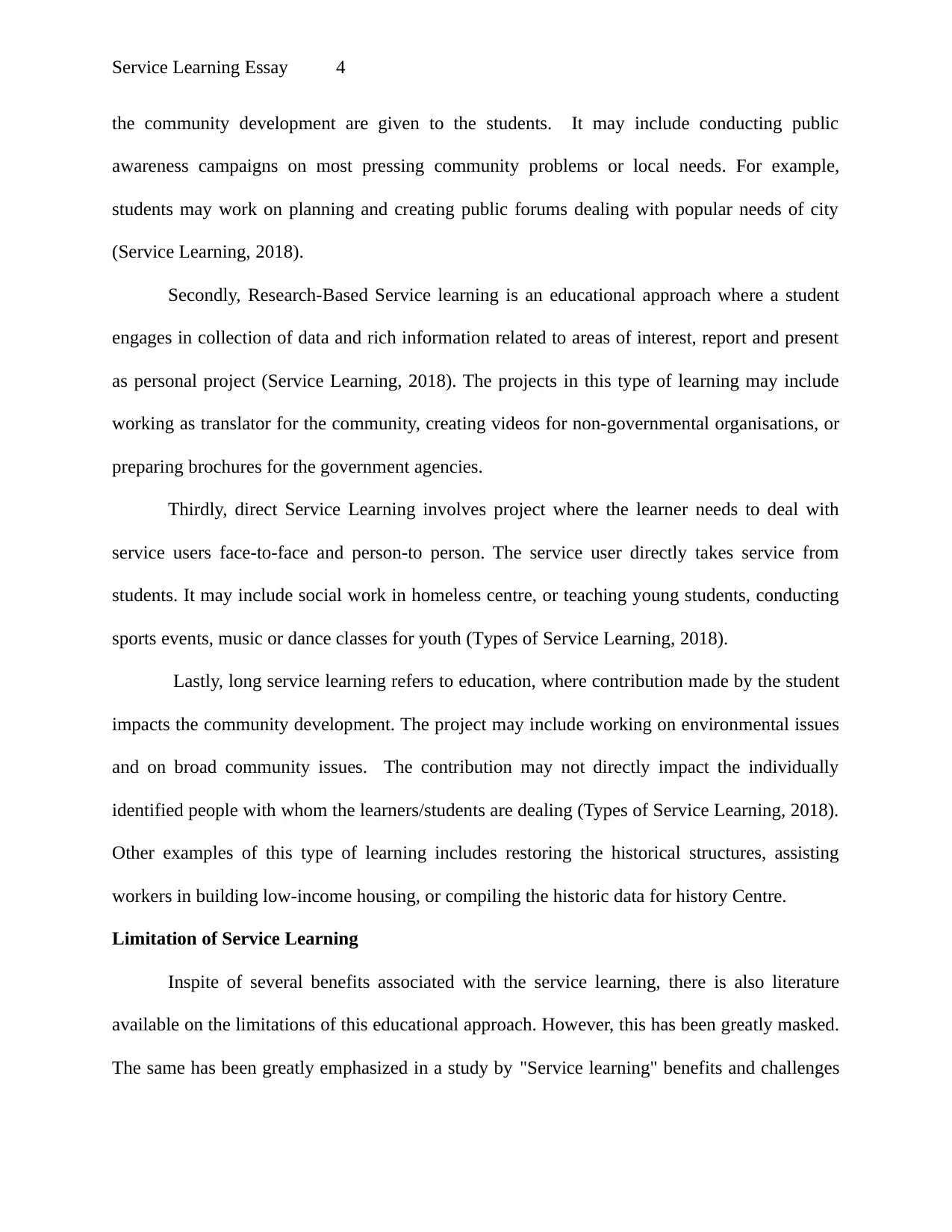
the community development are given to the students. It may include conducting public
awareness campaigns on most pressing community problems or local needs. For example,
students may work on planning and creating public forums dealing with popular needs of city
(Service Learning, 2018).
Secondly, Research-Based Service learning is an educational approach where a student
engages in collection of data and rich information related to areas of interest, report and present
as personal project (Service Learning, 2018). The projects in this type of learning may include
working as translator for the community, creating videos for non-governmental organisations, or
preparing brochures for the government agencies.
Thirdly, direct Service Learning involves project where the learner needs to deal with
service users face-to-face and person-to person. The service user directly takes service from
students. It may include social work in homeless centre, or teaching young students, conducting
sports events, music or dance classes for youth (Types of Service Learning, 2018).
Lastly, long service learning refers to education, where contribution made by the student
impacts the community development. The project may include working on environmental issues
and on broad community issues. The contribution may not directly impact the individually
identified people with whom the learners/students are dealing (Types of Service Learning, 2018).
Other examples of this type of learning includes restoring the historical structures, assisting
workers in building low-income housing, or compiling the historic data for history Centre.
Limitation of Service Learning
Inspite of several benefits associated with the service learning, there is also literature
available on the limitations of this educational approach. However, this has been greatly masked.
The same has been greatly emphasized in a study by "Service learning" benefits and challenges
the community development are given to the students. It may include conducting public
awareness campaigns on most pressing community problems or local needs. For example,
students may work on planning and creating public forums dealing with popular needs of city
(Service Learning, 2018).
Secondly, Research-Based Service learning is an educational approach where a student
engages in collection of data and rich information related to areas of interest, report and present
as personal project (Service Learning, 2018). The projects in this type of learning may include
working as translator for the community, creating videos for non-governmental organisations, or
preparing brochures for the government agencies.
Thirdly, direct Service Learning involves project where the learner needs to deal with
service users face-to-face and person-to person. The service user directly takes service from
students. It may include social work in homeless centre, or teaching young students, conducting
sports events, music or dance classes for youth (Types of Service Learning, 2018).
Lastly, long service learning refers to education, where contribution made by the student
impacts the community development. The project may include working on environmental issues
and on broad community issues. The contribution may not directly impact the individually
identified people with whom the learners/students are dealing (Types of Service Learning, 2018).
Other examples of this type of learning includes restoring the historical structures, assisting
workers in building low-income housing, or compiling the historic data for history Centre.
Limitation of Service Learning
Inspite of several benefits associated with the service learning, there is also literature
available on the limitations of this educational approach. However, this has been greatly masked.
The same has been greatly emphasized in a study by "Service learning" benefits and challenges
Paraphrase This Document
Need a fresh take? Get an instant paraphrase of this document with our AI Paraphraser

Service Learning Essay 5
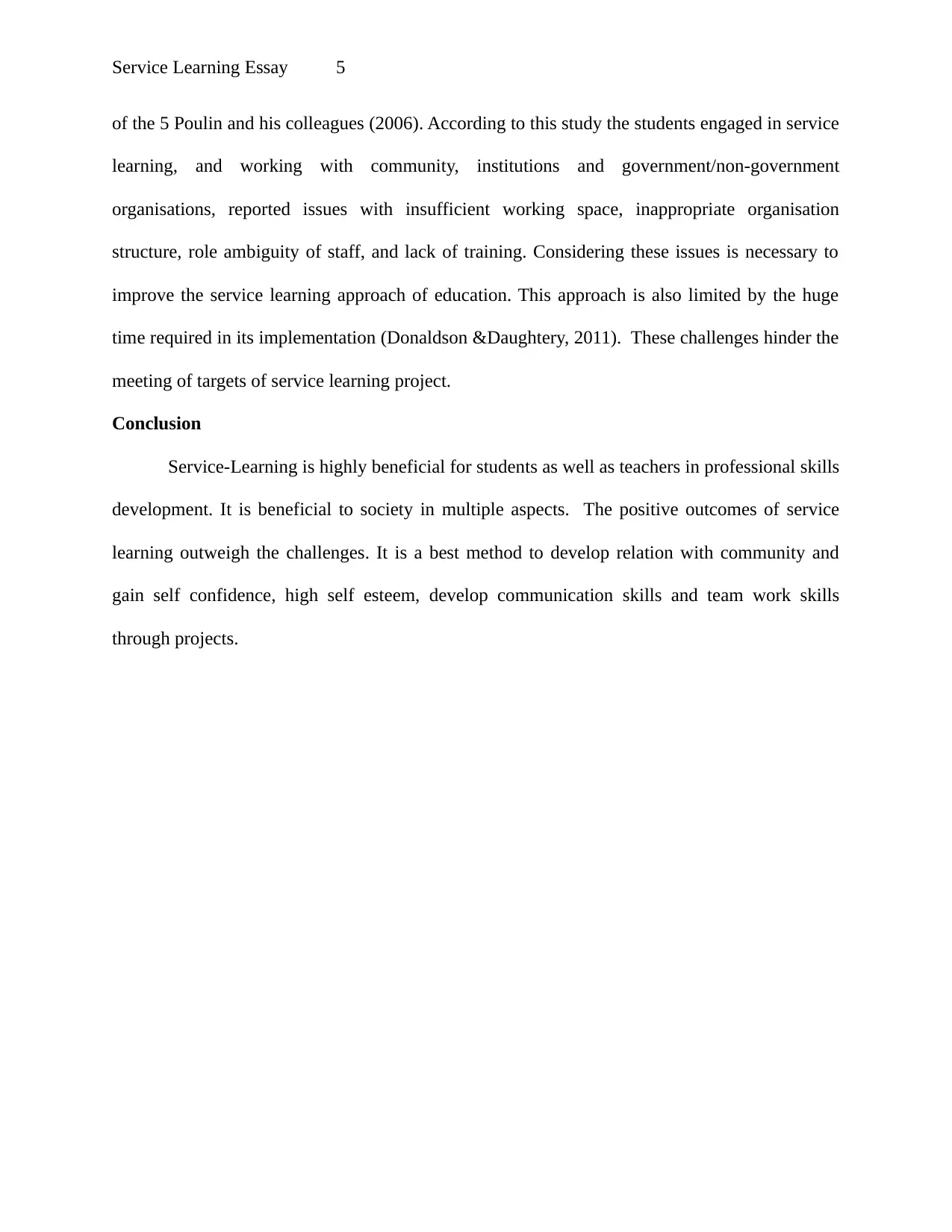
of the 5 Poulin and his colleagues (2006). According to this study the students engaged in service
learning, and working with community, institutions and government/non-government
organisations, reported issues with insufficient working space, inappropriate organisation
structure, role ambiguity of staff, and lack of training. Considering these issues is necessary to
improve the service learning approach of education. This approach is also limited by the huge
time required in its implementation (Donaldson &Daughtery, 2011). These challenges hinder the
meeting of targets of service learning project.
Conclusion
Service-Learning is highly beneficial for students as well as teachers in professional skills
development. It is beneficial to society in multiple aspects. The positive outcomes of service
learning outweigh the challenges. It is a best method to develop relation with community and
gain self confidence, high self esteem, develop communication skills and team work skills
through projects.
of the 5 Poulin and his colleagues (2006). According to this study the students engaged in service
learning, and working with community, institutions and government/non-government
organisations, reported issues with insufficient working space, inappropriate organisation
structure, role ambiguity of staff, and lack of training. Considering these issues is necessary to
improve the service learning approach of education. This approach is also limited by the huge
time required in its implementation (Donaldson &Daughtery, 2011). These challenges hinder the
meeting of targets of service learning project.
Conclusion
Service-Learning is highly beneficial for students as well as teachers in professional skills
development. It is beneficial to society in multiple aspects. The positive outcomes of service
learning outweigh the challenges. It is a best method to develop relation with community and
gain self confidence, high self esteem, develop communication skills and team work skills
through projects.

Service Learning Essay 6
Reference
Belliveau, M. (2011). Interdisciplinary service-learning: Building student competencies through
the cross-cultural parent groups project. Advances in Social Work, 12(1), 79-93.
What is Service-Learning? - national youth leadership council. (2018). Retrieved from
https://nylc.org/service-learning/
What is Service Learning or Community Engagement? (2018). Retrieved from
https://cft.vanderbilt.edu/guides-sub-pages/teaching-through-community-engagement/
Donaldson, L. P., &Daughtery, L. (2011). Introducing asset-based models of social justice into
service-learning: A social work approach. Journal of Community Practice, 19, 80-99.
Becker, S. (2014, October 1). TechKopila - an experiment in social media. International School,
17(1), 35.
Reference
Belliveau, M. (2011). Interdisciplinary service-learning: Building student competencies through
the cross-cultural parent groups project. Advances in Social Work, 12(1), 79-93.
What is Service-Learning? - national youth leadership council. (2018). Retrieved from
https://nylc.org/service-learning/
What is Service Learning or Community Engagement? (2018). Retrieved from
https://cft.vanderbilt.edu/guides-sub-pages/teaching-through-community-engagement/
Donaldson, L. P., &Daughtery, L. (2011). Introducing asset-based models of social justice into
service-learning: A social work approach. Journal of Community Practice, 19, 80-99.
Becker, S. (2014, October 1). TechKopila - an experiment in social media. International School,
17(1), 35.
⊘ This is a preview!⊘
Do you want full access?
Subscribe today to unlock all pages.

Trusted by 1+ million students worldwide

Service Learning Essay 7
1 out of 7
Related Documents
Your All-in-One AI-Powered Toolkit for Academic Success.
 +13062052269
info@desklib.com
Available 24*7 on WhatsApp / Email
Unlock your academic potential
Copyright © 2020–2026 A2Z Services. All Rights Reserved. Developed and managed by ZUCOL.