Impact of Technology on Leadership and Management in Service Sector
VerifiedAdded on 2021/02/19
|8
|2181
|42
Report
AI Summary
This report analyzes leadership and management principles within the service sector, focusing on the impact of technology. It assesses current management and leadership skills, differentiating between hard and soft skills, and discusses future skills like digital marketing and project management. The report examines change management systems, comparing transformational and personnel changes, and how they affect leadership styles. The analysis uses the Wa Pila hotel as a case study, contrasting its leadership approach with Marriott International, highlighting the importance of adapting to technological advancements for effective management in the service industry. The report concludes by emphasizing the importance of leadership and management in making effective business decisions through new technology.
Leadership and
Management for Service
Management for Service

Paraphrase This Document
Need a fresh take? Get an instant paraphrase of this document with our AI Paraphraser
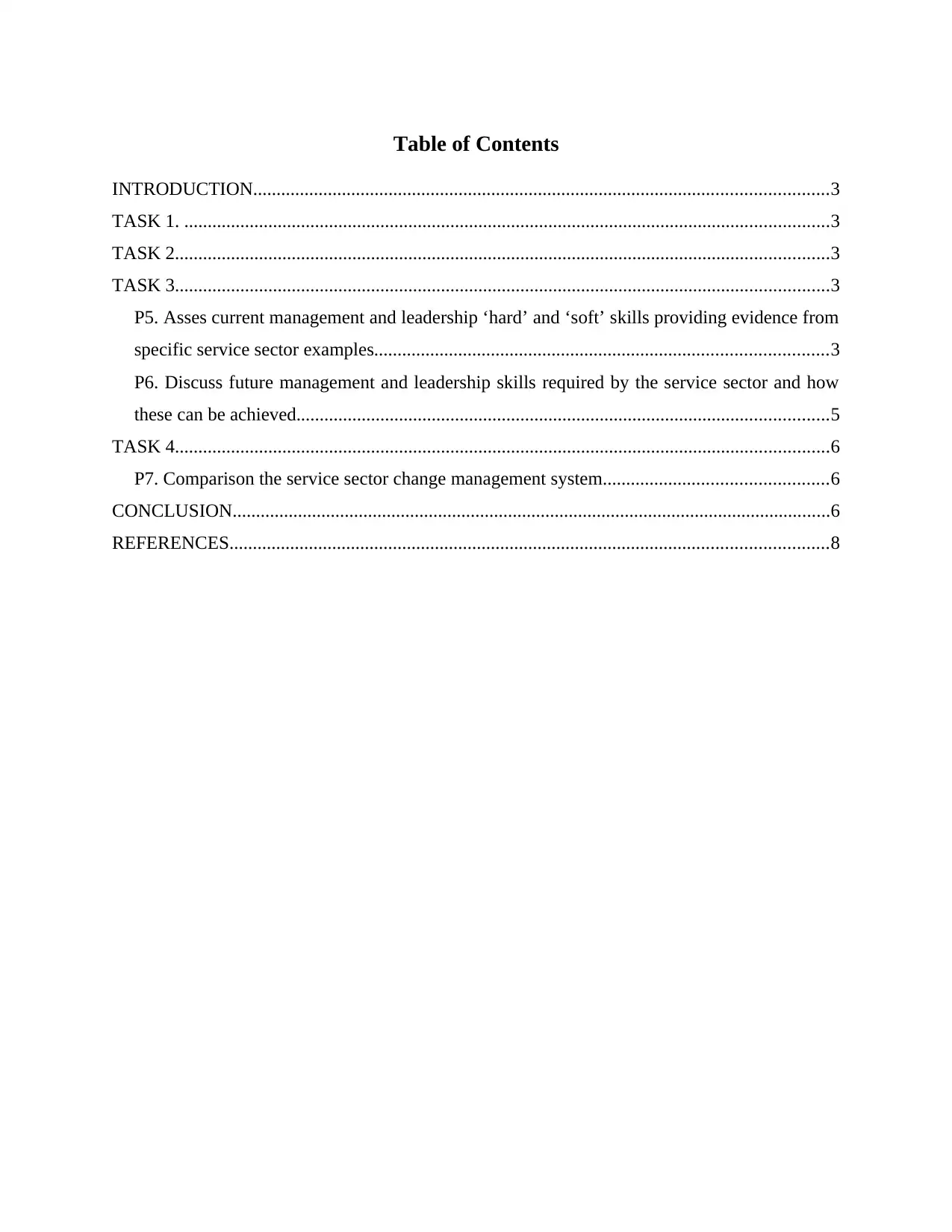
Table of Contents
INTRODUCTION...........................................................................................................................3
TASK 1. ..........................................................................................................................................3
TASK 2............................................................................................................................................3
TASK 3............................................................................................................................................3
P5. Asses current management and leadership ‘hard’ and ‘soft’ skills providing evidence from
specific service sector examples.................................................................................................3
P6. Discuss future management and leadership skills required by the service sector and how
these can be achieved..................................................................................................................5
TASK 4............................................................................................................................................6
P7. Comparison the service sector change management system................................................6
CONCLUSION................................................................................................................................6
REFERENCES................................................................................................................................8
INTRODUCTION...........................................................................................................................3
TASK 1. ..........................................................................................................................................3
TASK 2............................................................................................................................................3
TASK 3............................................................................................................................................3
P5. Asses current management and leadership ‘hard’ and ‘soft’ skills providing evidence from
specific service sector examples.................................................................................................3
P6. Discuss future management and leadership skills required by the service sector and how
these can be achieved..................................................................................................................5
TASK 4............................................................................................................................................6
P7. Comparison the service sector change management system................................................6
CONCLUSION................................................................................................................................6
REFERENCES................................................................................................................................8

INTRODUCTION
The leadership and management are very important for any kind of organisation. This is
why because both have own importance. The leadership is useful in providing direction to the
subordinates so that their activities can be directed towards organisational goals and objectives
(Testa and Sipe, 2012). As well as management is related to setting the plans and policies as per
the objectives. Herein, the aspect of the selected organisation, Wa Pila hotel, they provide wide
range of services so it is necessary for them to adopt proper leadership and management styles.
In the project report, classical theories of the management, types of organisational culture and
different leadership skills are mentioned which helps in smooth running of businesses.
TASK 1.
Covered in PPT
TASK 2.
Covered in Brochure.
TASK 3.
P5. Asses current management and leadership ‘hard’ and ‘soft’ skills providing evidence from
specific service sector examples.
This is necessary for the employees to have the management and leadership skills so that
goals and objectives can be achieved effectively. There are various kind of skills including hard
and soft skills which are mentioned below:
Problem-solving skills- It is the main skill of the leaders which is related to the solving
any crucial situation or issue by own creativity and mindset (Fitzgerald, Ferlie, McGivern and
Buchanan, 2013). In the absence of this skill, it will be difficult to manage the business. Like the
manager of the Wa Pila hotel, has the skill to solve the issues and problem on the basis of own
creativity.
The leadership and management are very important for any kind of organisation. This is
why because both have own importance. The leadership is useful in providing direction to the
subordinates so that their activities can be directed towards organisational goals and objectives
(Testa and Sipe, 2012). As well as management is related to setting the plans and policies as per
the objectives. Herein, the aspect of the selected organisation, Wa Pila hotel, they provide wide
range of services so it is necessary for them to adopt proper leadership and management styles.
In the project report, classical theories of the management, types of organisational culture and
different leadership skills are mentioned which helps in smooth running of businesses.
TASK 1.
Covered in PPT
TASK 2.
Covered in Brochure.
TASK 3.
P5. Asses current management and leadership ‘hard’ and ‘soft’ skills providing evidence from
specific service sector examples.
This is necessary for the employees to have the management and leadership skills so that
goals and objectives can be achieved effectively. There are various kind of skills including hard
and soft skills which are mentioned below:
Problem-solving skills- It is the main skill of the leaders which is related to the solving
any crucial situation or issue by own creativity and mindset (Fitzgerald, Ferlie, McGivern and
Buchanan, 2013). In the absence of this skill, it will be difficult to manage the business. Like the
manager of the Wa Pila hotel, has the skill to solve the issues and problem on the basis of own
creativity.
⊘ This is a preview!⊘
Do you want full access?
Subscribe today to unlock all pages.

Trusted by 1+ million students worldwide
Strategic mindset- It is necessary for a leader to have the strategic mindset so that strong
strategies can be built. Same as in the Wa Pila hotel, their manager has the ability to make strong
strategies as per the need.
Managing discipline- Discipline is the key of success of any kind of organisation. So it
is necessary for the manager of the companies that they should have the skill of the maintaining
proper discipline in organisation. Like in the above mentioned hotel, this is needed for their
manager to maintain a level of discipline.
Planning- It is also an another skill which is required in the managers. In the absence of
proper planning goals can not be achieved. So this is important for the managers of the Wa Pila
hotel that they should be able to make effective planning for different activities.
Communicating- This is a kind of skill which is mandatory for all the managers. It is
related with the sharing of ideas, opinions with others (Johnston and Marshall, 2013). If there is
lack of interaction between employees and managers then it will be difficult to achieve the
common goals and objectives. Basically, there are two ways of communication which are: verbal
and non verbal. The managers of the Wa Pila hotel are required to have good communication
skill with their staff so that possibility of any conflict can be reduce.
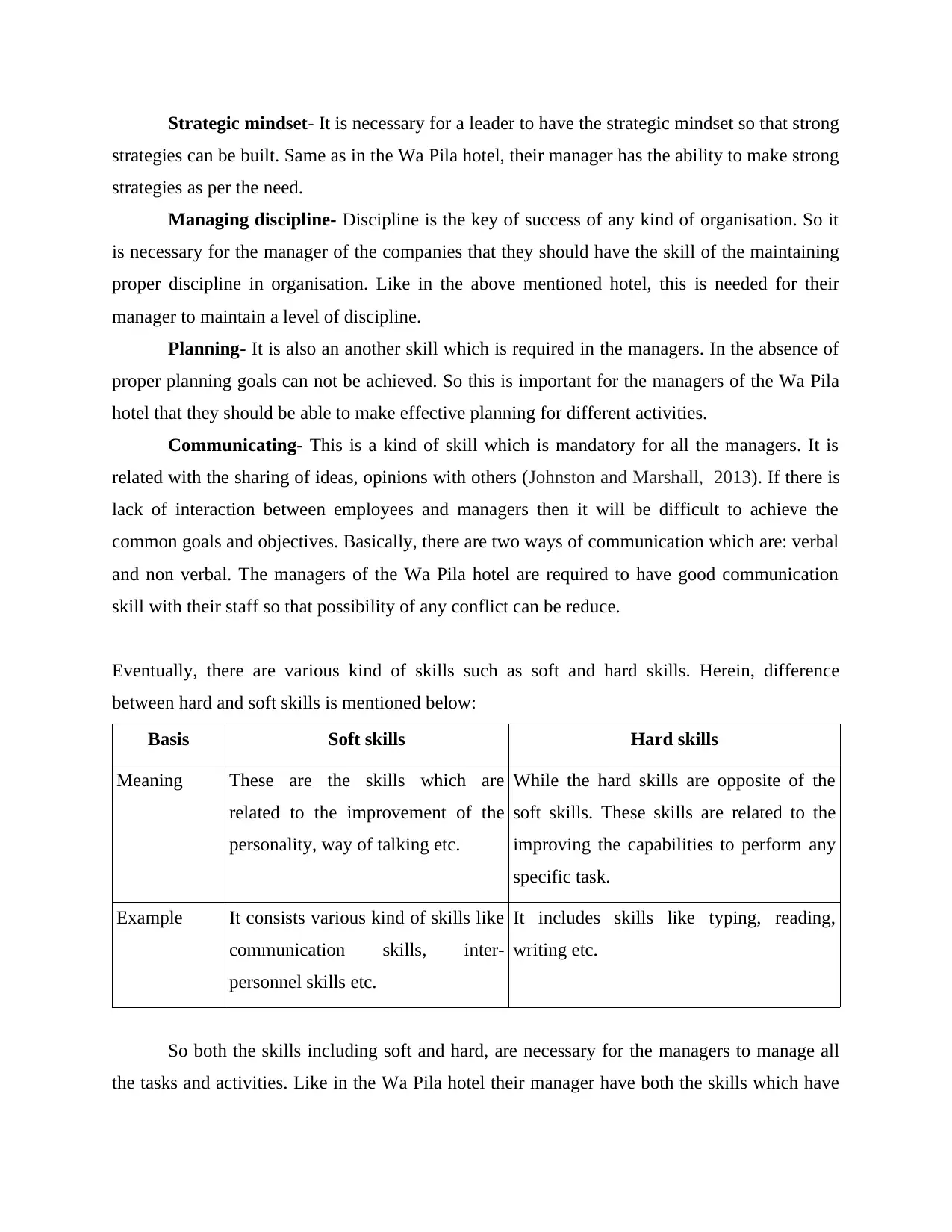
Eventually, there are various kind of skills such as soft and hard skills. Herein, difference
between hard and soft skills is mentioned below:
Basis Soft skills Hard skills
Meaning These are the skills which are
related to the improvement of the
personality, way of talking etc.
While the hard skills are opposite of the
soft skills. These skills are related to the
improving the capabilities to perform any
specific task.
Example It consists various kind of skills like
communication skills, inter-
personnel skills etc.
It includes skills like typing, reading,
writing etc.
So both the skills including soft and hard, are necessary for the managers to manage all
the tasks and activities. Like in the Wa Pila hotel their manager have both the skills which have
strategies can be built. Same as in the Wa Pila hotel, their manager has the ability to make strong
strategies as per the need.
Managing discipline- Discipline is the key of success of any kind of organisation. So it
is necessary for the manager of the companies that they should have the skill of the maintaining
proper discipline in organisation. Like in the above mentioned hotel, this is needed for their
manager to maintain a level of discipline.
Planning- It is also an another skill which is required in the managers. In the absence of
proper planning goals can not be achieved. So this is important for the managers of the Wa Pila
hotel that they should be able to make effective planning for different activities.
Communicating- This is a kind of skill which is mandatory for all the managers. It is
related with the sharing of ideas, opinions with others (Johnston and Marshall, 2013). If there is
lack of interaction between employees and managers then it will be difficult to achieve the
common goals and objectives. Basically, there are two ways of communication which are: verbal
and non verbal. The managers of the Wa Pila hotel are required to have good communication
skill with their staff so that possibility of any conflict can be reduce.
Eventually, there are various kind of skills such as soft and hard skills. Herein, difference
between hard and soft skills is mentioned below:
Basis Soft skills Hard skills
Meaning These are the skills which are
related to the improvement of the
personality, way of talking etc.
While the hard skills are opposite of the
soft skills. These skills are related to the
improving the capabilities to perform any
specific task.
Example It consists various kind of skills like
communication skills, inter-
personnel skills etc.
It includes skills like typing, reading,
writing etc.
So both the skills including soft and hard, are necessary for the managers to manage all
the tasks and activities. Like in the Wa Pila hotel their manager have both the skills which have
Paraphrase This Document
Need a fresh take? Get an instant paraphrase of this document with our AI Paraphraser

multi- pal uses. The hard skills help in accepting the challenges and solving the critical problems.
On the other hand, soft skills are useful in improving the personality and other basic skills.
P6. Discuss future management and leadership skills required by the service sector and how
these can be achieved.
In the context of today's environment it is necessary for the managers to adopt the
technology based skills. This is why because technologies are getting upgrade day to day so it is
necessary for the managers to implement new and advanced skills. Eventually, there are various
kind of skills which are required by the manager of the Wa Pila hotel's manager to cop up with
the certain changes in the technologies. As well if their managers will have these skills then it
will beneficial for both to the organisation and individually for them. There are many skills like
social media and marketing, project management etc. Additionally, the main advantage of these
skills is to make useful decisions to get the competitive advantage over others.
Evaluation of the skills which are crucial for the services:
Social and digital marketing- In recent time period, it is mandatory for the managers to
have the skills by which they can analyse the need and demand of the customers with the
use of social media (Wright, Moynihan and Pandey, 2012). In the aspect of the Wa Pila
hotel, their manager use the digital marketing to promote their services to more
customers. As well as this is an effective way of promoting services so that it is necessary
for the managers to have these skills. If their managers will have the skill of digital
marketing then it will effect to their profits positively.
Project management- It is also an another skill which all the managers are required to
have. This is a kind of skill which is related to the proper management of any kind of
project. Eventually, it is very crucial for the manager to have the skill of the managing the
project. For example in the context of the Wa Pila hotel,their managers are required to
have the skill of managing the project in an effective way. As well as they are involved in
the hospitality sector, so it is necessary skill for them to organize any event successfully.
So these are the skills which are needed to have for the managers of any service industry. In the
absence of these skills it can be difficult for the organisations as well as for the managers to
achieve the goals and objectives. Like in the Wa Pila hotel, this is mandatory for their managers
to have above skills.
On the other hand, soft skills are useful in improving the personality and other basic skills.
P6. Discuss future management and leadership skills required by the service sector and how
these can be achieved.
In the context of today's environment it is necessary for the managers to adopt the
technology based skills. This is why because technologies are getting upgrade day to day so it is
necessary for the managers to implement new and advanced skills. Eventually, there are various
kind of skills which are required by the manager of the Wa Pila hotel's manager to cop up with
the certain changes in the technologies. As well if their managers will have these skills then it
will beneficial for both to the organisation and individually for them. There are many skills like
social media and marketing, project management etc. Additionally, the main advantage of these
skills is to make useful decisions to get the competitive advantage over others.
Evaluation of the skills which are crucial for the services:
Social and digital marketing- In recent time period, it is mandatory for the managers to
have the skills by which they can analyse the need and demand of the customers with the
use of social media (Wright, Moynihan and Pandey, 2012). In the aspect of the Wa Pila
hotel, their manager use the digital marketing to promote their services to more
customers. As well as this is an effective way of promoting services so that it is necessary
for the managers to have these skills. If their managers will have the skill of digital
marketing then it will effect to their profits positively.
Project management- It is also an another skill which all the managers are required to
have. This is a kind of skill which is related to the proper management of any kind of
project. Eventually, it is very crucial for the manager to have the skill of the managing the
project. For example in the context of the Wa Pila hotel,their managers are required to
have the skill of managing the project in an effective way. As well as they are involved in
the hospitality sector, so it is necessary skill for them to organize any event successfully.
So these are the skills which are needed to have for the managers of any service industry. In the
absence of these skills it can be difficult for the organisations as well as for the managers to
achieve the goals and objectives. Like in the Wa Pila hotel, this is mandatory for their managers
to have above skills.
TASK 4.
P7. Comparison the service sector change management system.
Change management system- It is a kind of system which is related with the managing all
the changes so that its impact can reduce on the organisation. There are different kind of change
managements styles which are as follows:
Transformational changes- It is a kind of change which is related to the changing the
existing strategy by implementation of the new strategy (Nixon, Harrington and Parker, 2012).
Eventually, these kind of changes brings benefits for the organisations. This is why because it
helps in the enhancing the productivity and profitability. Like in the Wa Pila hotel, their
managers adopt the transformational change to enhance their different kind of hospitality
operations. As well as due to this, they will be able to satisfy the need and demand of the
customers.
Personnel change- It is a kind of change which is related to the hiring of employees and
lay off by analysing the skills and capabilities. Due to this organisation can get most suitable and
capable employees which result in the success of overall business. Like in the Wa Pila hotel, they
hire those person who have good ability to take important decisions as well as who can make
effective and creative planning.
So these are the changes which are helpful for the organisations. As well it is important to
focus that these changes also effect to the leadership and management styles which is mentioned
below:
How changes affect management and leadership style:
The changes impact to the management and leadership style (Yang, 2012). This is why
because if an organisation will implement any kind of change then it will impact to many
activities and function. It is not necessary that its impact will be only on the leadership and
management styles. For example in the Wa Pila hotel, they implements various kind of changes
and due to this their leadership style effects. They are adopting the leadership style of the Laissez
fair and if they apply any new, advanced technology then its impact will be directly on this style.
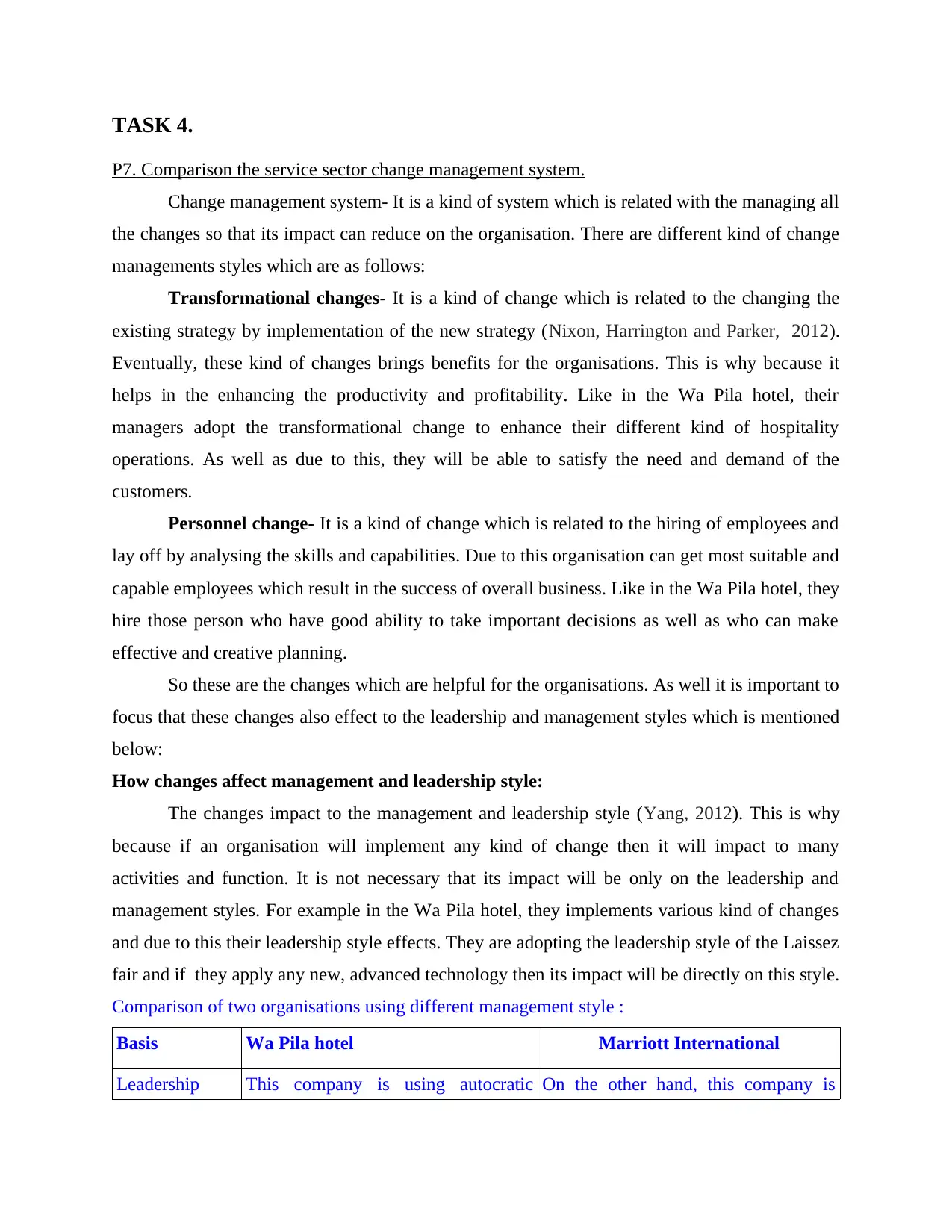
Comparison of two organisations using different management style :
Basis Wa Pila hotel Marriott International
Leadership This company is using autocratic On the other hand, this company is
P7. Comparison the service sector change management system.
Change management system- It is a kind of system which is related with the managing all
the changes so that its impact can reduce on the organisation. There are different kind of change
managements styles which are as follows:
Transformational changes- It is a kind of change which is related to the changing the
existing strategy by implementation of the new strategy (Nixon, Harrington and Parker, 2012).
Eventually, these kind of changes brings benefits for the organisations. This is why because it
helps in the enhancing the productivity and profitability. Like in the Wa Pila hotel, their
managers adopt the transformational change to enhance their different kind of hospitality
operations. As well as due to this, they will be able to satisfy the need and demand of the
customers.
Personnel change- It is a kind of change which is related to the hiring of employees and
lay off by analysing the skills and capabilities. Due to this organisation can get most suitable and
capable employees which result in the success of overall business. Like in the Wa Pila hotel, they
hire those person who have good ability to take important decisions as well as who can make
effective and creative planning.
So these are the changes which are helpful for the organisations. As well it is important to
focus that these changes also effect to the leadership and management styles which is mentioned
below:
How changes affect management and leadership style:
The changes impact to the management and leadership style (Yang, 2012). This is why
because if an organisation will implement any kind of change then it will impact to many
activities and function. It is not necessary that its impact will be only on the leadership and
management styles. For example in the Wa Pila hotel, they implements various kind of changes
and due to this their leadership style effects. They are adopting the leadership style of the Laissez
fair and if they apply any new, advanced technology then its impact will be directly on this style.
Comparison of two organisations using different management style :
Basis Wa Pila hotel Marriott International
Leadership This company is using autocratic On the other hand, this company is
⊘ This is a preview!⊘
Do you want full access?
Subscribe today to unlock all pages.
Trusted by 1+ million students worldwide
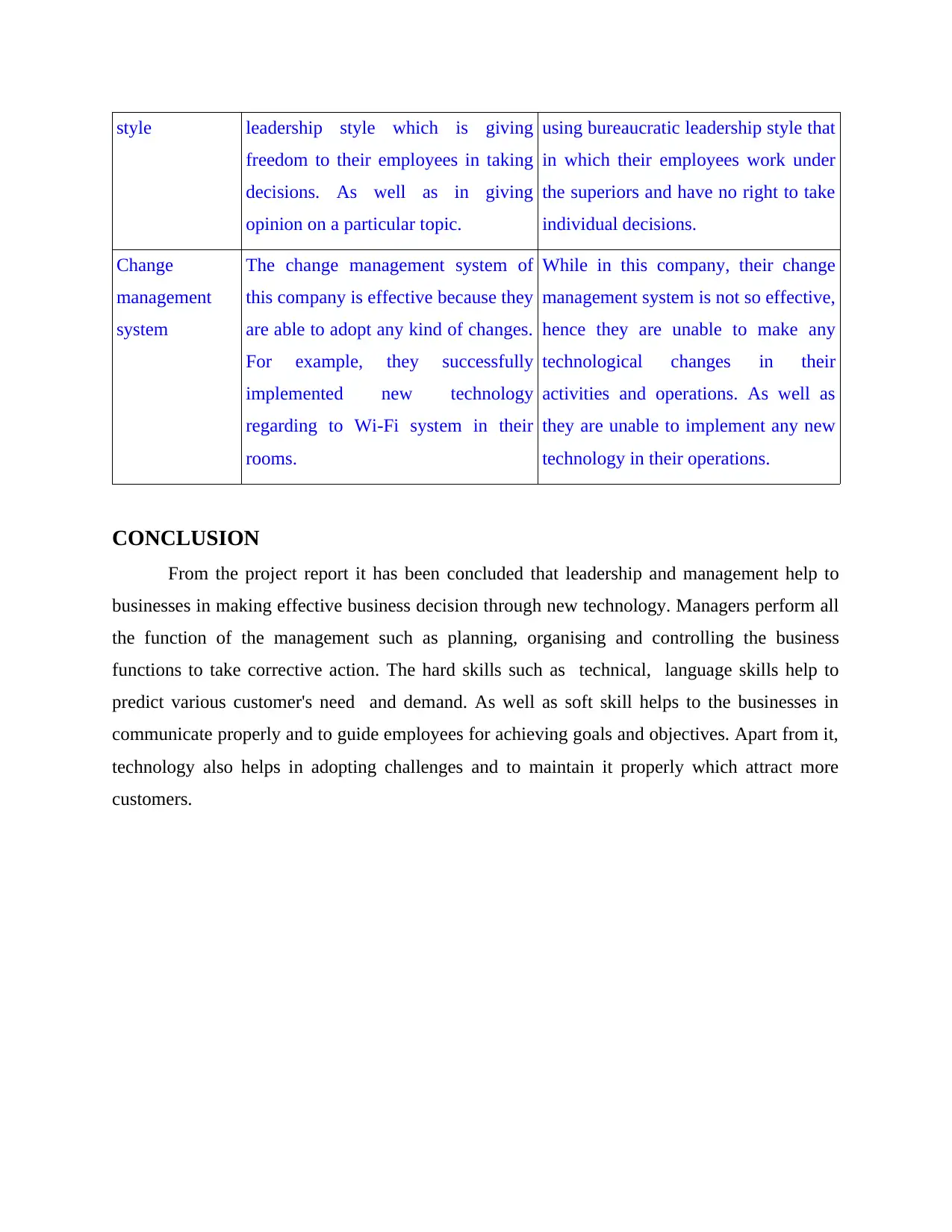
style leadership style which is giving
freedom to their employees in taking
decisions. As well as in giving
opinion on a particular topic.
using bureaucratic leadership style that
in which their employees work under
the superiors and have no right to take
individual decisions.
Change
management
system
The change management system of
this company is effective because they
are able to adopt any kind of changes.
For example, they successfully
implemented new technology
regarding to Wi-Fi system in their
rooms.
While in this company, their change
management system is not so effective,
hence they are unable to make any
technological changes in their
activities and operations. As well as
they are unable to implement any new
technology in their operations.
CONCLUSION
From the project report it has been concluded that leadership and management help to
businesses in making effective business decision through new technology. Managers perform all
the function of the management such as planning, organising and controlling the business
functions to take corrective action. The hard skills such as technical, language skills help to
predict various customer's need and demand. As well as soft skill helps to the businesses in
communicate properly and to guide employees for achieving goals and objectives. Apart from it,
technology also helps in adopting challenges and to maintain it properly which attract more
customers.
freedom to their employees in taking
decisions. As well as in giving
opinion on a particular topic.
using bureaucratic leadership style that
in which their employees work under
the superiors and have no right to take
individual decisions.
Change
management
system
The change management system of
this company is effective because they
are able to adopt any kind of changes.
For example, they successfully
implemented new technology
regarding to Wi-Fi system in their
rooms.
While in this company, their change
management system is not so effective,
hence they are unable to make any
technological changes in their
activities and operations. As well as
they are unable to implement any new
technology in their operations.
CONCLUSION
From the project report it has been concluded that leadership and management help to
businesses in making effective business decision through new technology. Managers perform all
the function of the management such as planning, organising and controlling the business
functions to take corrective action. The hard skills such as technical, language skills help to
predict various customer's need and demand. As well as soft skill helps to the businesses in
communicate properly and to guide employees for achieving goals and objectives. Apart from it,
technology also helps in adopting challenges and to maintain it properly which attract more
customers.
Paraphrase This Document
Need a fresh take? Get an instant paraphrase of this document with our AI Paraphraser
REFERENCES
Books and journals:
Testa, M. R. and Sipe, L., 2012. Service-leadership competencies for hospitality and tourism
management. International journal of hospitality management. 31(3). pp.648-658.
Fitzgerald, L., Ferlie, E., McGivern, G. and Buchanan, D., 2013. Distributed leadership patterns
and service improvement: Evidence and argument from English healthcare. The
Leadership Quarterly. 24(1). pp.227-239.
Johnston, M. W. and Marshall, G .W., 2013. Sales force management: Leadership, innovation,
technology. Routledge.
Wright, B. E., Moynihan, D .P. and Pandey, S. K., 2012. Pulling the levers: Transformational
leadership, public service motivation, and mission valence. Public Administration
Review. 72(2). pp.206-215.
Nixon, P., Harrington, M. and Parker, D., 2012. Leadership performance is significant to project
success or failure: a critical analysis. International Journal of productivity and
performance management. 61(2). pp.204-216.
Yang, Y. F., 2012. Studies of transformational leadership in consumer service: Leadership trust
and the mediating-moderating role of cooperative conflict management. Psychological
Reports. 110(1). pp.315-337.
Books and journals:
Testa, M. R. and Sipe, L., 2012. Service-leadership competencies for hospitality and tourism
management. International journal of hospitality management. 31(3). pp.648-658.
Fitzgerald, L., Ferlie, E., McGivern, G. and Buchanan, D., 2013. Distributed leadership patterns
and service improvement: Evidence and argument from English healthcare. The
Leadership Quarterly. 24(1). pp.227-239.
Johnston, M. W. and Marshall, G .W., 2013. Sales force management: Leadership, innovation,
technology. Routledge.
Wright, B. E., Moynihan, D .P. and Pandey, S. K., 2012. Pulling the levers: Transformational
leadership, public service motivation, and mission valence. Public Administration
Review. 72(2). pp.206-215.
Nixon, P., Harrington, M. and Parker, D., 2012. Leadership performance is significant to project
success or failure: a critical analysis. International Journal of productivity and
performance management. 61(2). pp.204-216.
Yang, Y. F., 2012. Studies of transformational leadership in consumer service: Leadership trust
and the mediating-moderating role of cooperative conflict management. Psychological
Reports. 110(1). pp.315-337.

1 out of 8


Related Documents


Your All-in-One AI-Powered Toolkit for Academic Success.
+13062052269
info@desklib.com
Available 24*7 on WhatsApp / Email
![[object Object]](/_next/static/media/star-bottom.7253800d.svg)
Unlock your academic potential
Copyright © 2020–2026 A2Z Services. All Rights Reserved. Developed and managed by ZUCOL.